Area Architects Lesson Plan Teacher Facilitation Guide
Area Architects: Master Lesson Plan
Deconstructing & Calculating 2D Polygons: Square, Rectangle, Triangle & Trapezoid
Target Grade & Standards Grades 6–7 | CCSS.MATH.6.G.A.1 Duration: 60–75 Minutes
Lesson Focus
Deriving formulas conceptually and applying the 3-step scaffold: Identify, Substitute, Solve .
Materials Needed
Architect Slides, Formula Match Notes, Student Practice Worksheet, rulers, colored highlighters.
Success Criteria
Correctly pair shapes to formulas, isolate perpendicular heights, and calculate accurate square units.
Essential Questions
How does decomposing a shape reveal its area formula?
Why must height in triangles and trapezoids be perpendicular to the base?
How does a 3-step scaffold prevent calculation errors?
Student Objectives
Match geometric shapes to their algebraic area formulas.
Differentiate between side length, slant edge, and perpendicular height.
Compute polygon area using \(A = s^2\), \(A = bh\), \(A = \frac{1}{2}bh\), and \(A = \frac{1}{2}(b_1 + b_2)h\).
Instructional Pacing & Flow
Phase Time Teacher Moves & Guided Actions Student Actions 1. Blueprint Hook 10 min Display Slide 2 floor plan. Ask: "Why can't we use length times width for the skylight triangle or roof trapezoid?" Notice non-rectangular boundaries; brainstorm square grid counts. 2. Formula Deconstruct 15 min Demonstrate geometric folding: rectangle into two triangles (\(\frac{1}{2}bh\)); combining two trapezoids into parallelogram. Complete Guided Practice Part 1 (Formula Matching & Vocabulary). 3. 3-Step Modeling 15 min Model 3-step scaffold: (1) Identify base/height, (2) Substitute into formula, (3) Solve & attach units (\(\text{cm}^2\)). Highlight right angles and bases on Guided Notes examples. 4. Studio Workshop 20 min Circulate with targeted feedback. Pull small group for trapezoid altitude confusion. Facilitate peer checks. Work through tiered problems on Independent Practice Worksheet. 5. Synthesis & Exit 10 min Present Exit Ticket prompt on Slide 8: Error analysis problem (slant height used instead of altitude). Identify error in writing, correct the formula substitution, submit ticket.
Critical Misconceptions & Intervention Moves
Slant Edge vs. Height
Students grab the diagonal outer leg instead of vertical height. Fix: Find and highlight the right-angle square symbol first.
Forgetting the 1/2 Factor
Students multiply \(b \times h\) for triangles and forget to halve. Fix: Prompt: "Does this triangle fill the whole rectangle or half of it?"
Trapezoid Base Confusion
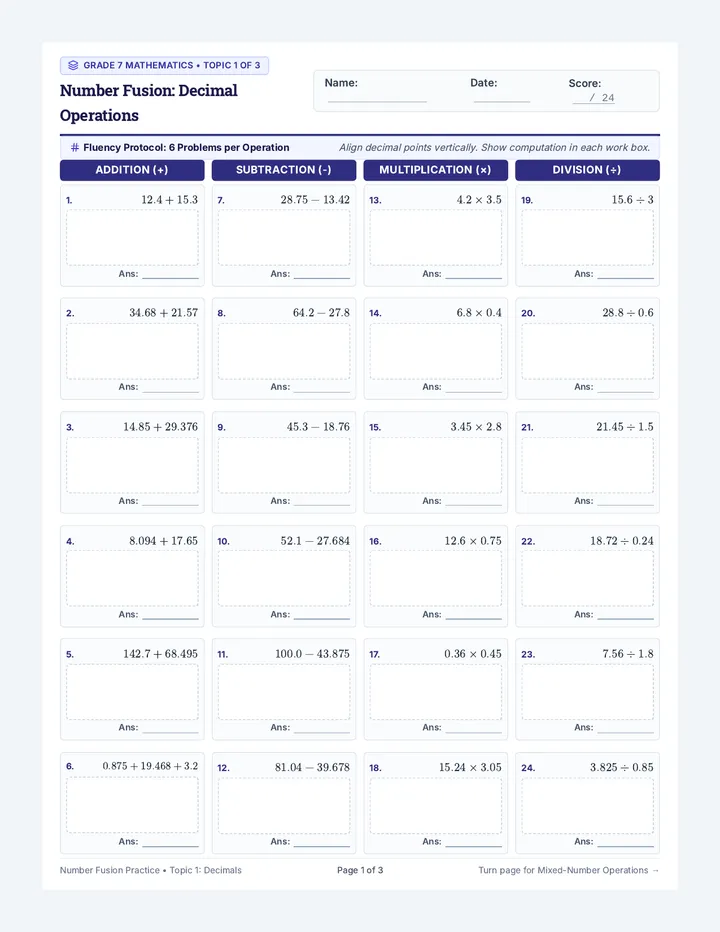
Students multiply bases instead of adding them. Fix: Explain it as finding the average base width: \(\frac{b_1 + b_2}{2}\).
Area Architects • Complete Geometry Bundle Page 1 of 2: Overview & Instructional Strategy
Instructional Delivery & Scaffold Scripts
Phase-by-phase dialog, scaffold prompts, and differentiation matrix
Facilitation Guide
The 3-Step Area Protocol (Teacher Script)
Step 1: IDENTIFY
Prompt: "What shape is this? Which side is the base? Where is the perpendicular height?"
Action: Highlight the right angle box. Cross out extraneous slant labels.
Step 2: SUBSTITUTE
Prompt: "Write the raw formula first. Now replace each variable with its exact numerical value."
Action: Write \(A = \frac{1}{2}(8)(6)\) directly underneath \(A = \frac{1}{2}bh\).
Step 3: SOLVE
Prompt: "Calculate with order of operations. What are the units? Why are they squared?"
Action: Perform math in parentheses first; append units (e.g., \(\text{cm}^2\)).
Visual Derivation Scripts (Slides 3 & 4)
Triangle Demystification: "Take a rectangle with base \(b\) and height \(h\). Draw a diagonal from corner to corner. Notice you have two identical right triangles. Therefore, the area of one triangle must be exactly half the rectangle: \(A = \frac{1}{2}bh\). This holds true even if the triangle is obtuse or acute because you can shear or enclose it in a bounding rectangle."
Trapezoid Demystification: "If you copy any trapezoid, flip it upside down, and lock it against the original, you create a large parallelogram! The base of this big parallelogram is \((b_1 + b_2)\) and its height is \(h\). Since our trapezoid is only one of the two pieces, its area is \(\frac{1}{2}(b_1 + b_2)h\)."
Differentiation Strategy Matrix
Support / Intervention (Tier 2/3)
Color-code bases in blue and heights in red before substituting.
Use grid-backed shapes where students can physically count squares.
Provide formula cheat sheet with variable key right on the desk.
On-Grade Core (Tier 1)
Full 3-step scaffold documentation on every problem.
Include shapes rotated in non-standard orientations.
Mix whole numbers with simple decimal values (e.g., 4.5 cm).
Extension / Accelerated
Reverse solving: given area and one base, solve for the missing height.
Composite floor plans (trapezoid patio + triangular lawn).
Compare cost per square foot for different tiling options.
Exit Ticket Evaluation Criteria
Level 1: Novice
Incorrect formula; relies on slant height.
Level 2: Developing
Correct formula; arithmetic error or missing units.
Level 3: Proficient
Complete 3-step solution; correct substitution & units.
Level 4: Advanced
Proficient + explains why the formula works conceptually.
Area Architects • Complete Geometry Bundle Page 2 of 2: Facilitation Scripts & Differentiation
Area Architects Presentation Slides Architectural Geometry Series
Area Architects
Deconstructing & Calculating Square, Rectangle, Triangle, and Trapezoid Space
Square: \(s^2\) Rectangle: \(bh\) Triangle: \(\frac{1}{2}bh\) Trapezoid: \(\frac{1}{2}(b_1+b_2)h\)
Unit 4: 2D Geometry & Spatial Measurement Standard CCSS.MATH.6.G.A.1
Architectural Design Brief
Why Can't One Formula Rule Them All?
Modern Studio Floor Plan
You are tiling a modern loft with 4 distinct zones:
Living Room: Square Tile
Gallery Hallway: Long Rectangle
Sunroom Corner: Right Triangle
Rooftop Terrace: Trapezoid Deck
The Core Question:
"If every area measures how many 1×1 unit squares fit inside, why do non-rectangles require fractions like \(\frac{1}{2}\)?"
Today's Mission:
Deconstruct each shape, match its master formula, and execute the 3-step solution blueprint!
Remember: Area is always expressed in Square Units (\(\text{ft}^2, \text{cm}^2, \text{m}^2\)).
Formula Matching Studio
Match Every Shape to its Blueprint Formula
\(s\)
Square
All 4 sides equal, all angles \(90^\circ\)
\(A = s^2\)
\(b \times h\)
Rectangle
Opposite sides equal, four right angles
\(A = bh\)
\(b\)
Triangle
3 sides, exactly half of a rectangle
\(A = \frac{1}{2}bh\)
\(b_1\) (top) \(b_2\) (bottom)
Trapezoid
1 pair of parallel bases, perpendicular \(h\)
\(A = \frac{1}{2}(b_1+b_2)h\)
Key Insight: Every non-rectangular formula connects directly back to length \(\times\) width!
Concept Breakdown 1
Squares & Rectangles: The Grid Foundation
Square Formula
\(A = s \times s = s^2\)
Because all sides are congruent (\(s\)), multiplying the base by height is squaring a single side length.
Example Studio Tile:
Side \(s = 7\text{ cm}\)
\(A = 7 \times 7 = 49\text{ cm}^2\)
Exponent \(2\) signifies 2 dimensions: length & width.
Rectangle Formula
\(A = b \times h\)
Count the rows of unit squares. Base (\(b\)) gives units per row, and height (\(h\)) gives the total rows.
Area Architects Guided Practice Guided Notes & Scaffolding
Area Architects: Formula Blueprint
Mastering 2D Area: Squares, Rectangles, Triangles & Trapezoids
Name:
Date: Period:
Part 1: Architectural Formula Matching
Match each shape to its algebraic formula and key rule
Formula A \(A = s^2\)
Formula B \(A = bh\)
Formula C \(A = \frac{1}{2}bh\)
Formula D \(A = \frac{1}{2}(b_1 + b_2)h\)
Polygon Visual Blueprint & Labels Key Identifying Feature Formula Letter Square Equal sides \(s\), right angles
| Base and height are equal; side multiplied by itself. |
|
| Rectangle |
Base \(b\), perpendicular height \(h\)
| Four right angles; opposite sides are congruent. |
|
| Triangle |
Base \(b\), altitude \(h\) at \(90^\circ\)
| Always exactly half of a rectangle with matching base and height. |
|
| Trapezoid |
Parallel bases \(b_1, b_2\), altitude \(h\)
| One pair of parallel lines; take the average of bases times height. |
|
Part 2: The 3-Step Scaffolding Protocol
Step 1: IDENTIFY
Name the shape. Highlight the right angle to locate true height \(h\). Cross out slanted edge distractors!
Step 2: SUBSTITUTE
Write the general formula first. Directly replace variable letters with given numbers.
Step 3: SOLVE & LABEL
Calculate with order of operations (parentheses first). Append correct square units (\(\text{cm}^2, \text{ft}^2\)).
Problem 1 (Guided Model): Rectangle Drafting Table I DO / WE DO
A drafting table is \(14\text{ ft}\) long and \(5.5\text{ ft}\) wide. Calculate its total workspace area.
Step 1: Identify
Base (\(b\)) = 14 ft
Height (\(h\)) = 5.5 ft
Step 2: Substitute
\(A = bh\)
\(A = 14 \times 5.5\)
Step 3: Solve
\(14 \times 5.5 = 77\)
Area = 77 sq ft (\(\text{ft}^2\))
Area Architects • Guided Practice Handout Page 1 of 2: Formula Matching & Core Protocol
Part 3: Guided Step-by-Step Practice (We Do / You Do)
Follow the 3-Step Protocol for each polygon. Be alert for slanted distractor lines!
Area Architects Student Worksheet Independent Practice
Area Architects: Studio Worksheet
Apply formulas with the 3-step scaffold. Beware of slanted distractor lengths!
Name:
Date: Period:
Formula Ref: Square: \(s^2\) Rectangle: \(bh\) Triangle: \(\frac{1}{2}bh\) Trapezoid: \(\frac{1}{2}(b_1+b_2)h\)
1. Square Courtyard Tile
A square patio stone has a side length of \(s = 14\text{ inches}\).
Square
Step 1: Formula
Step 2: Substitution
Step 3: Solution (with units)
2. Rectangular Conference Room Floor
The floor plan indicates a base of \(26\text{ ft}\) and a width/height of \(14.5\text{ ft}\).
Rectangle
Step 1: Formula
Step 2: Substitution
Step 3: Solution (with units)
3. Triangular Glass Gable (Watch for Distractor!)
Measurements: Base = \(16\text{ m}\), Vertical Perpendicular Height = \(9\text{ m}\), Slanted Sides = \(12.5\text{ m}\).
Triangle
Step 1: Identify & Formula
Step 2: Substitution
Step 3: Solution (with units)
4. Trapezoidal Retaining Wall Section
Parallel bases measure \(15\text{ cm}\) and \(25\text{ cm}\). Perpendicular height is \(8\text{ cm}\); diagonal edge is \(10\text{ cm}\).
Trapezoid
Step 1: Identify & Formula
Step 2: Substitution
Step 3: Solution (with units)
Area Architects • Independent Practice Page 1 of 2: Blueprint Foundations
Section B: Architectural Applications & Error Inspection
Solve real-world construction challenges and audit apprentice calculations.
5. Community Park Shade Canopy Triangle Application
An architect designs a large triangular fabric canopy for a park playground. The base along the anchor poles is \(24\text{ meters}\) and the perpendicular altitude reaches \(15.5\text{ meters}\). What is the total square meters of fabric required?
Show Formula & Substitution:
Final Answer with Square Units:
6. Rooftop Terrace Decking & Cost Multi-Step Trapezoid
A penthouse terrace has a trapezoidal shape with parallel edges of \(18\text{ ft}\) and \(32\text{ ft}\). The perpendicular distance between them is \(12\text{ ft}\).
Part A: Calculate Deck Area (\(\text{ft}^2\))
Part B: Cost at $4 per sq ft ($)
7. Comparative Floor Plans: Which Studio is Larger? Comparison
Studio Alpha is a square with side length \(s = 15\text{ ft}\). Studio Beta is a rectangle measuring \(18\text{ ft} \times 12\text{ ft}\). Determine the area of both studios and state which offers more floor space.
Area Architects Answer Key Educator Reference
Area Architects: Master Answer Key
Complete worked solutions, intermediate steps, and distractor alerts
FULL WORKED SOLUTIONS
Guided Practice Handout Solutions
Square Formula A: \(A = s^2\)
Rectangle Formula B: \(A = bh\)
Triangle Formula C: \(A = \frac{1}{2}bh\)
Trapezoid Formula D: \(A = \frac{1}{2}(b_1+b_2)h\)
Guided Prob 2: Skylight
\(s = 8.5\text{ ft}\)
\(A = (8.5)^2 = 8.5 \times 8.5\)
Area = 72.25 sq ft
Guided Prob 3: Truss
\(b = 18, h = 8\) (distractor: 10)
\(A = \frac{1}{2}(18)(8) = 9 \times 8\)
Area = 72 sq m (\(\text{m}^2\))
Guided Prob 4: Patio
\(b_1 = 12, b_2 = 20, h = 7\)
\(A = \frac{1}{2}(32)(7) = 16 \times 7\)
Area = 112 sq ft
Worksheet Section A: Core Blueprint Problems
1. Square Courtyard Tile (\(s = 14\text{ in}\)) Correct: 196 sq in
Step 1: \(A = s^2\)
Step 2: \(A = (14)^2 = 14 \times 14\)
Step 3: \(196\text{ in}^2\) (or sq in)
2. Rectangular Conference Room (\(b = 26\text{ ft}, h = 14.5\text{ ft}\)) Correct: 377 sq ft
Step 1: \(A = bh\)
Step 2: \(A = 26 \times 14.5\)
Step 3: \(377\text{ ft}^2\) (or sq ft)
3. Triangular Glass Gable (\(b = 16\text{ m}, h = 9\text{ m}\), slant = \(12.5\text{ m}\)) Correct: 72 sq m
Step 1: \(b=16, h=9\) (ignore \(12.5\))
Step 2: \(A = \frac{1}{2}(16)(9)\)
Step 3: \(8 \times 9 = 72\text{ m}^2\)
4. Trapezoid Retaining Wall (\(b_1 = 15\text{ cm}, b_2 = 25\text{ cm}, h = 8\text{ cm}\), slant = \(10\text{ cm}\)) Correct: 160 sq cm
Step 1: \(b_1=15, b_2=25, h=8\) (ignore \(10\))
Step 2: \(A = \frac{1}{2}(15+25)(8)\)
Step 3: \(\frac{1}{2}(40)(8) = 160\text{ cm}^2\)
Area Architects • Teacher Answer Key Page 1 of 2: Guided Notes & Section A
Worksheet Section B: Real-World Applications & Audits
Model responses, scoring criteria, and common student errors
5. Community Park Shade Canopy (Triangle) Correct: 186 sq m
Base \(b = 24\text{ m}\), Perpendicular Height \(h = 15.5\text{ m}\).