.
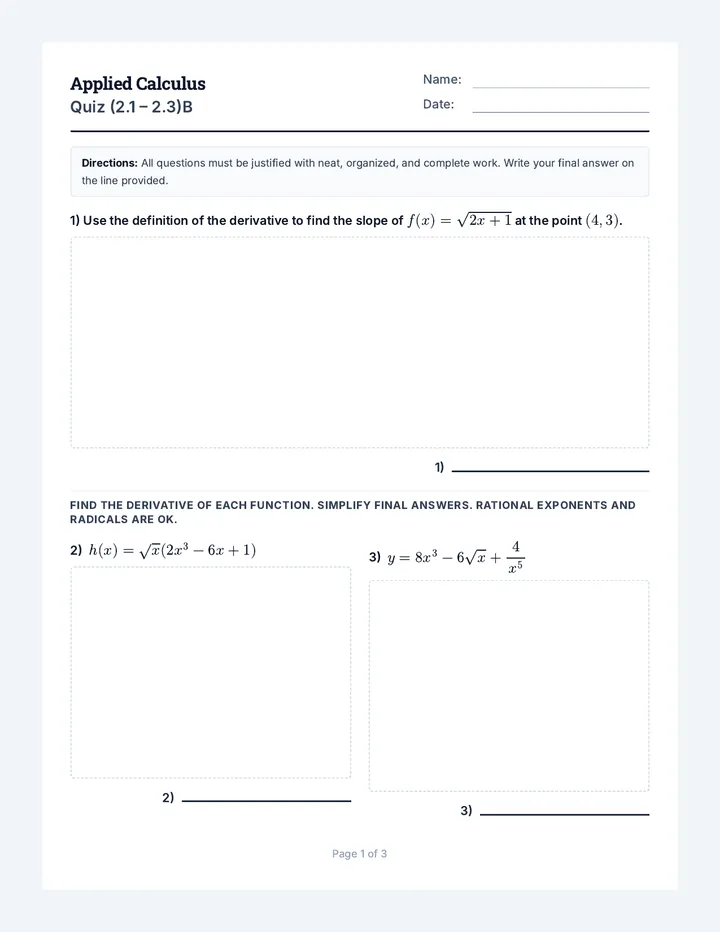
Applied Calculus
Quiz (2.1 – 2.3)B
Name:
Date:
Directions: All questions must be justified with neat, organized, and complete work. Write your final answer on the line provided.
-
Use the definition of the derivative to find the slope of \(f(x) = \sqrt{2x + 1}\) at the point \((4, 3)\).
Find the derivative of each function. Simplify final answers. Rational exponents and radicals are OK.
-
\(h(x) = \sqrt{x}(2x^3 - 6x + 1)\)
-
\(y = 8x^3 - 6\sqrt{x} + \dfrac{4}{x^5}\)
Page 1 of 3
Applied Calculus — Quiz (2.1 – 2.3)B
Name:
-
\(f(x) = 6x^5 - 4\sqrt[4]{x^3} + 7x - 2\)
-
Determine the points on the graph of \(g(x) = 3x^4 - 4x^3 - 12x^2 + 5\) where the tangent line(s) are horizontal.
Find the equation of the tangent line to the curve at the given value.
-
\(f(x) = \dfrac{x^5 - 3x^4 + 2x^3 - 5x}{x} \quad;\quad x = 2\)
Page 2 of 3
Applied Calculus — Quiz (2.1 – 2.3)B
Name:
- A ball is thrown upward from the top of a 274.4-meter tall building so that its height above the ground after \(t\) seconds is:
\(h(t) = -4.9t^2 + 49t + 274.4\)
(a) Find the average velocity over the interval \([1, 4]\).
(a)
(b) Find the instantaneous velocity function and find the instantaneous velocity at \(t = 2, 4,\) and \(7\).
\(v(t) =\)
\(v(2) =\)
\(v(4) =\)
\(v(7) =\)
(c) When does the ball reach its maximum height?
(c)
(d) What is the maximum height of the ball?
(d)
Page 3 of 3
Derivatives Version B Key
Teacher Resource Official Solution Guide
Applied Calculus — Quiz (2.1 – 2.3)B
Answer Key & Scoring Rubric
Total Points: 50 Points
Scope: Limits, Power Rule, Motion
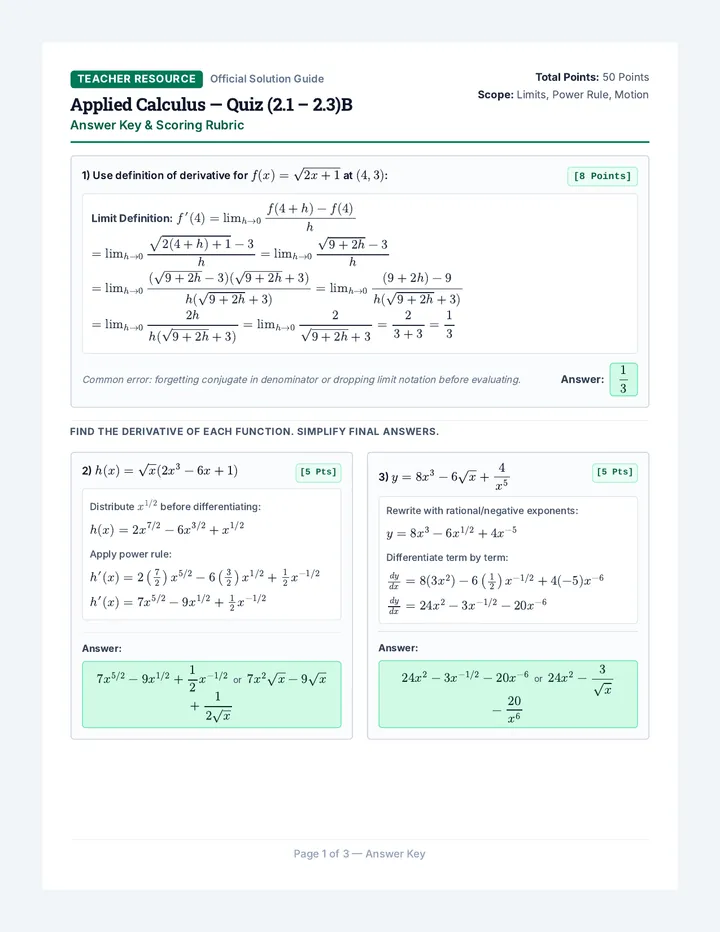
- Use definition of derivative for \(f(x) = \sqrt{2x + 1}\) at \((4, 3)\): [8 Points]
Limit Definition: \(f'(4) = \lim_{h \to 0} \dfrac{f(4+h) - f(4)}{h}\)
\(= \lim_{h \to 0} \dfrac{\sqrt{2(4+h)+1} - 3}{h} = \lim_{h \to 0} \dfrac{\sqrt{9+2h} - 3}{h}\)
\(= \lim_{h \to 0} \dfrac{(\sqrt{9+2h} - 3)(\sqrt{9+2h} + 3)}{h(\sqrt{9+2h} + 3)} = \lim_{h \to 0} \dfrac{(9+2h) - 9}{h(\sqrt{9+2h} + 3)}\)
\(= \lim_{h \to 0} \dfrac{2h}{h(\sqrt{9+2h} + 3)} = \lim_{h \to 0} \dfrac{2}{\sqrt{9+2h} + 3} = \dfrac{2}{3+3} = \dfrac{1}{3}\)
Common error: forgetting conjugate in denominator or dropping limit notation before evaluating.
Answer: \(\dfrac{1}{3}\)
Find the derivative of each function. Simplify final answers.
- \(h(x) = \sqrt{x}(2x^3 - 6x + 1)\) [5 Pts]
Distribute \(x^{1/2}\) before differentiating:
\(h(x) = 2x^{7/2} - 6x^{3/2} + x^{1/2}\)
Apply power rule:
\(h'(x) = 2\left(\frac{7}{2}\right)x^{5/2} - 6\left(\frac{3}{2}\right)x^{1/2} + \frac{1}{2}x^{-1/2}\)
\(h'(x) = 7x^{5/2} - 9x^{1/2} + \frac{1}{2}x^{-1/2}\)
Answer:
\(7x^{5/2} - 9x^{1/2} + \dfrac{1}{2}x^{-1/2}\) or \(7x^2\sqrt{x} - 9\sqrt{x} + \dfrac{1}{2\sqrt{x}}\)
- \(y = 8x^3 - 6\sqrt{x} + \dfrac{4}{x^5}\) [5 Pts]
Rewrite with rational/negative exponents:
\(y = 8x^3 - 6x^{1/2} + 4x^{-5}\)
Differentiate term by term:
\(\frac{dy}{dx} = 8(3x^2) - 6\left(\frac{1}{2}\right)x^{-1/2} + 4(-5)x^{-6}\)
\(\frac{dy}{dx} = 24x^2 - 3x^{-1/2} - 20x^{-6}\)
Answer:
\(24x^2 - 3x^{-1/2} - 20x^{-6}\) or \(24x^2 - \dfrac{3}{\sqrt{x}} - \dfrac{20}{x^6}\)
Page 1 of 3 — Answer Key
Applied Calculus — Quiz (2.1 – 2.3)B Answer Key Horizontal Tangents & Tangent Lines
- Derivative of \(f(x) = 6x^5 - 4\sqrt[4]{x^3} + 7x - 2\): [5 Points]
Rewrite radical as exponent: \(f(x) = 6x^5 - 4x^{3/4} + 7x - 2\)
Power rule: \(f'(x) = 6(5x^4) - 4\left(\frac{3}{4}\right)x^{-1/4} + 7(1) - 0 = 30x^4 - 3x^{-1/4} + 7\)
Answer: \(30x^4 - 3x^{-1/4} + 7\) or \(30x^4 - \dfrac{3}{\sqrt[4]{x}} + 7\)
- Horizontal tangent points for \(g(x) = 3x^4 - 4x^3 - 12x^2 + 5\): [8 Points]
Step 1: Set \(g'(x) = 0\): \(g'(x) = 12x^3 - 12x^2 - 24x = 0\)
Step 2: Factor: \(12x(x^2 - x - 2) = 12x(x - 2)(x + 1) = 0 \implies x = 0,\; x = 2,\; x = -1\)
Step 3: Find y-coordinates on \(g(x)\):
• \(x = 0:\) \(g(0) = 3(0)^4 - 4(0)^3 - 12(0)^2 + 5 = 5 \implies \mathbf{(0, 5)}\)
• \(x = 2:\) \(g(2) = 3(16) - 4(8) - 12(4) + 5 = 48 - 32 - 48 + 5 = -27 \implies \mathbf{(2, -27)}\)
• \(x = -1:\) \(g(-1) = 3(1) - 4(-1) - 12(1) + 5 = 3 + 4 - 12 + 5 = 0 \implies \mathbf{(-1, 0)}\)
Pitfall: students often stop at x-values or plug into \(g'(x)\) instead of \(g(x)\).
Answer: \((0, 5),\; (2, -27),\; (-1, 0)\)
- Tangent line equation to \(f(x) = \dfrac{x^5 - 3x^4 + 2x^3 - 5x}{x}\) at \(x = 2\): [8 Points]
Step 1: Simplify algebraically: \(f(x) = x^4 - 3x^3 + 2x^2 - 5\)
Step 2: Find point \((x_1, y_1)\): \(f(2) = 2^4 - 3(2)^3 + 2(2)^2 - 5 = 16 - 24 + 8 - 5 = -5 \implies (2, -5)\)
Step 3: Find slope \(m = f'(2)\): \(f'(x) = 4x^3 - 9x^2 + 4x\)
\(m = f'(2) = 4(8) - 9(4) + 4(2) = 32 - 36 + 8 = 4\)
Step 4: Equation: \(y - y_1 = m(x - x_1) \implies y - (-5) = 4(x - 2) \implies y + 5 = 4x - 8 \implies y = 4x - 13\)
Answer: \(y = 4x - 13\) or \(y + 5 = 4(x - 2)\)
Page 2 of 3 — Answer Key
Applied Calculus — Quiz (2.1 – 2.3)B Answer Key Projectile Motion Application
- Position function: \(h(t) = -4.9t^2 + 49t + 274.4\) (initial height \(h(0) = 274.4\text{ m}\), \(v_0 = 49\text{ m/s}\))
Scoring: 16 points total (4 points per subpart). Require proper units for full credit.
(a) Average velocity over \([1, 4]\): [4 Points]
\(v_{\text{avg}} = \dfrac{h(4) - h(1)}{4 - 1}\)
\(h(1) = -4.9(1)^2 + 49(1) + 274.4 = 44.1 + 274.4 = 318.5\text{ m}\)
\(h(4) = -4.9(16) + 49(4) + 274.4 = -78.4 + 196 + 274.4 = 392\text{ m}\)
\(v_{\text{avg}} = \dfrac{392 - 318.5}{3} = \dfrac{73.5}{3} = 24.5\text{ m/s}\)
Answer: \(24.5\text{ m/s}\)
(b) Instantaneous velocity function and values at \(t = 2, 4, 7\): [4 Points]
Velocity function: \(v(t) = h'(t) = -9.8t + 49\)
\(v(2):\) \(-9.8(2) + 49 = \mathbf{29.4\text{ m/s}}\)
\(v(4):\) \(-9.8(4) + 49 = \mathbf{9.8\text{ m/s}}\)
\(v(7):\) \(-9.8(7) + 49 = \mathbf{-19.6\text{ m/s}}\)
Answers: \(v(t) = -9.8t + 49\); \(v(2) = 29.4\text{ m/s}\); \(v(4) = 9.8\text{ m/s}\); \(v(7) = -19.6\text{ m/s}\)
(c) Time of maximum height: [4 Points]
Set instantaneous velocity equal to zero: \(v(t) = 0 \implies -9.8t + 49 = 0\)
\(9.8t = 49 \implies t = \dfrac{49}{9.8} = 5\text{ seconds}\)
Answer: \(t = 5\text{ seconds}\)
(d) Maximum height of the ball: [4 Points]
Evaluate position at vertex time \(t = 5\):
\(h(5) = -4.9(5)^2 + 49(5) + 274.4 = -4.9(25) + 245 + 274.4\)
\(= -122.5 + 245 + 274.4 = 122.5 + 274.4 = 396.9\text{ meters}\)
Answer: \(396.9\text{ meters}\)
Page 3 of 3 — Answer Key