Lenny.com
Explore
Create
ActivitiesNewMathEnglish Language ArtsScience & EngineeringSocial StudiesGlobal LanguagesHealth & Physical EducationSpecial EducationCounseling & Life SkillsArts & CreativityESL
Lenny.com
Lenny.com
Explore
Create
ActivitiesNewMathEnglish Language ArtsScience & EngineeringSocial StudiesGlobal LanguagesHealth & Physical EducationSpecial EducationCounseling & Life SkillsArts & CreativityESL
Lenny.com
MathNumbers & CountingCounting ObjectsNumber NamesComparing NumbersNumber OperationsCounting SequenceNumbers 0-10Place Value Understanding and SystemAdd and Subtract Within 20Addition and Subtraction ConceptsAddition and Subtraction EquationsAddition and Subtraction ProblemsFoundations for MultiplicationMultiplication and Division PropertiesMultiply and Divide Within 100Multiplication and Division ProblemsFactors and MultiplesProperties of OperationsPatterns and RelationshipsGenerate and Analyze PatternsMulti-Digit ArithmeticPlace Value OperationsMulti-Digit and Decimal OperationsNumerical ExpressionsFour Operations and PatternsFour Operations Problem SolvingMeasurement & DataMeasurable AttributesMeasuring LengthsMeasure and Estimate Lengths in Standard UnitsRelate Addition and Subtraction to LengthClassifying and Counting ObjectsTime and MoneyArea Concepts and MeasurementPerimeter and Area MeasuresAngle Concepts and MeasurementTime, Volume, and MassMeasurement Unit ConversionsGeometryIdentifying ShapesShapes and AttributesShape Attributes and ReasoningShapes and CompositionClassifying 2D FiguresGeometric Figures and RelationshipsLines, Angles, and ShapesAngle, Area, and VolumeGeometric MeasurementVolume of 3D ShapesCoordinate Plane ApplicationsTransformations in the PlaneCongruence and SimilarityUnderstand congruence in terms of rigid motionsSimilarity and TransformationsProve Theorems Involving SimilarityPythagorean TheoremTrigonometry for General TrianglesMake Geometric ConstructionsProve Geometric TheoremsTheorems About CirclesFind Arc Lengths And Areas of Sectors of CirclesVolume FormulasRelationships Between Two-Dimensional and Three-Dimensional ObjectsProve Simple Geometric Theorems AlgebraicallyTranslate Between Geometric Description and Equation for Conic SectionApply Geometric Concepts in Modeling SituationsFractions & DecimalsFractions as NumbersBuilding FractionsFraction Equivalence and OrderingAdding and Subtracting FractionsMultiplying and Dividing FractionsDividing FractionsDecimal FractionsMulti-Digit Computation and FactorsAdd, Subtract, Multiply, and Divide Rational NumbersRational Number SystemIrrational Numbers and ApproximationsRatiosRatios and ProportionsProportional RelationshipsUnit RateAlgebraAlgebraic ExpressionsGenerate Equivalent ExpressionsQuantitative RelationshipsProportional Relationships and Linear EquationsEquations and InequalitiesEquation Solving and ReasoningLinear Equations and SystemsGraph Equations and InequalitiesSystems of EquationsReal-World Algebraic ProblemsQuantitative Reasoning with UnitsExpression StructureEquivalent Expression FormsRadicals and Integer ExponentsRational ExponentsRational and Irrational NumbersPolynomial OperationsPolynomial IdentitiesPolynomial Zeros and FactorsRational ExpressionsComplex Number OperationsComplex Numbers in PolynomialsComplex Numbers on PlaneStatistics & ProbabilityRepresent and Interpret DataData DistributionsStatistical VariabilityProbability ModelsCompound Event ProbabilitiesStatistical SamplingInterpret Categorical and Quantitative DataBivariate Data PatternsInterpret Linear ModelsComparing Two PopulationsRandom Processes in StatisticsIndependence and Conditional ProbabilityExpected ValuesProbability-Based Decision MakingStatistical Inference and ConclusionsFunctionsFunction Concepts and NotationDefine and Compare FunctionsInterpret Functions in ContextAnalyze Function RepresentationsModel Relationships with FunctionsIdentify Linear vs Exponential GrowthDistinguish Between Function TypesCompare Growth RatesInterpret Function ExpressionsBuild Functions from RelationshipsConstruct and Model FunctionsTransform and Combine FunctionsModel Comparison and SelectionSolve Exponential EquationsTrigonometryTrigonometric Ratios Involving Right TrianglesTrigonometric Functions and Unit CircleModel with Trigonometric FunctionsTrigonometric IdentitiesVectors & MatricesIntroduction to Vectors and MatricesVector QuantitiesVector OperationsMatrix OperationsCalculusLimits and ContinuityDerivative Concepts and NotationDerivative Rules and TechniquesApplications of DerivativesOptimization ProblemsRelated RatesCurve Sketching and AnalysisIntegration Concepts and NotationAntiderivatives and Indefinite IntegralsDefinite Integrals and AreaFundamental Theorem of CalculusIntegration TechniquesApplications of IntegrationDifferential EquationsSequences and SeriesParametric and Polar FunctionsVector-Valued Functions

Ratios and Proportions

Proportional relationships, unit rates, and constant of proportionality. Develops strategies for solving multi-step problems involving scale, percentages, and equivalent ratios.

Lenny.com

Solutions

Lenny for EducatorsLenny for SchoolsLenny for Districts

Product

ExploreSign inCreateSupportAbout

Resources

Getting startedMTSS Acceleration Program

© 2026 Lenny Learning Inc.

TermsPrivacyAccessibility
LinkedInInstagramX
Lenny

Videos

Identifying Independent and Dependent Variables When Graphing

Identifying Independent and Dependent Variables When Graphing

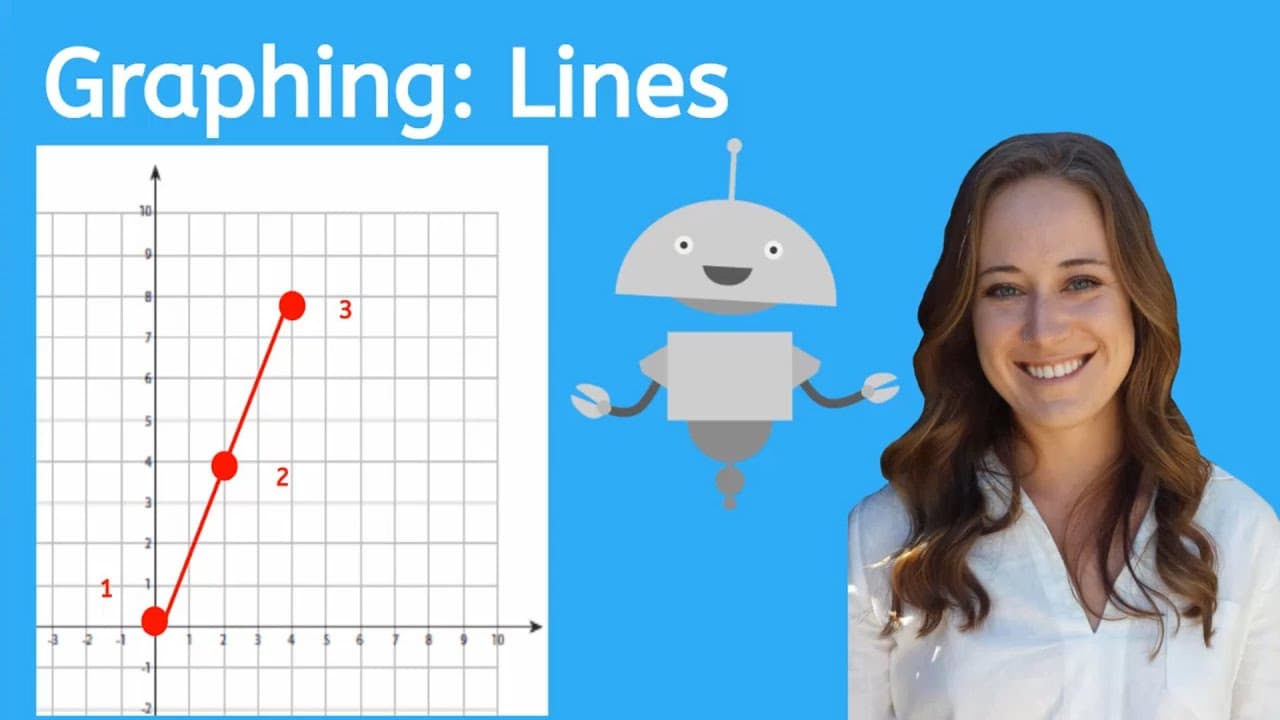
This educational video provides a clear, step-by-step guide to understanding linear graphs, slope, and the critical distinction between dependent and independent variables. Narrated by Kaylee, the lesson begins by reviewing how to calculate slope using "rise over run" on a coordinate grid, demonstrating how a constant slope allows points to form a straight line. It then transitions into real-world applications, using examples like running speed and dog walking wages to show how linear relationships appear in everyday life.

Miacademy & MiaPrep Learning ChannelMiacademy & MiaPrep Learning Channel

13mins 41s

Calculating Travel Time Using Speed and Distance

Calculating Travel Time Using Speed and Distance

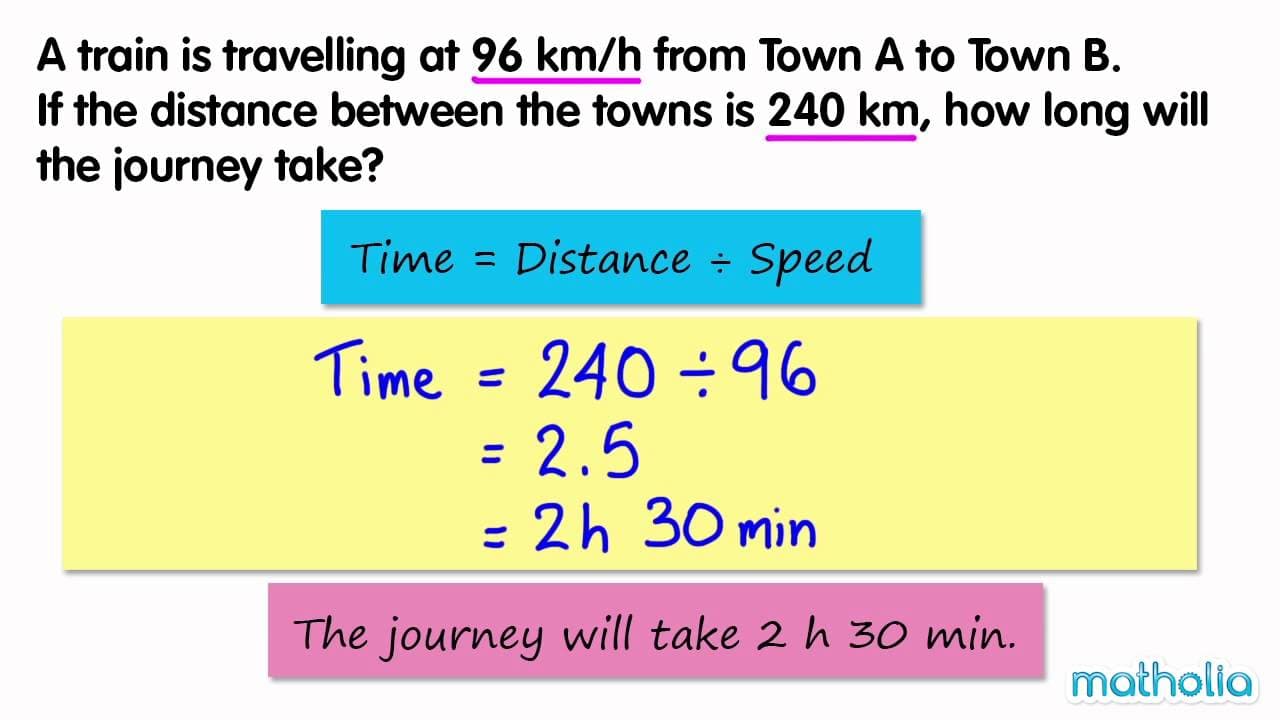
A clear, step-by-step instructional video demonstrating how to calculate time when given speed and distance values. Through three distinct word problems featuring a train, a skier, and a ladybug, the video applies the formula Time = Distance ÷ Speed to solve real-world travel scenarios. The tutorial progresses in difficulty, starting with straightforward calculations and advancing to problems requiring unit conversions before solving. The video explores key mathematical themes including rate, ratios, and measurement. It places significant emphasis on the critical step of verifying unit consistency (e.g., ensuring distance is measured in the same unit for both speed and total distance) before performing division. It also demonstrates how to interpret decimal results in the context of time, such as converting 2.5 hours into 2 hours and 30 minutes. For educators, this resource serves as an excellent model for teaching multi-step word problems involving rates. It helps students move beyond rote calculation by modeling the metacognitive strategy of "checking units first." The visual breakdown of the division process and the explicit conversion of units make it a valuable tool for reinforcing pre-algebra skills and measurement concepts in upper elementary and middle school classrooms.

MatholiaChannelMatholiaChannel

2mins 37s

ACT Math Practice Test: Review of Algebra, Geometry, and Trig Concepts

ACT Math Practice Test: Review of Algebra, Geometry, and Trig Concepts

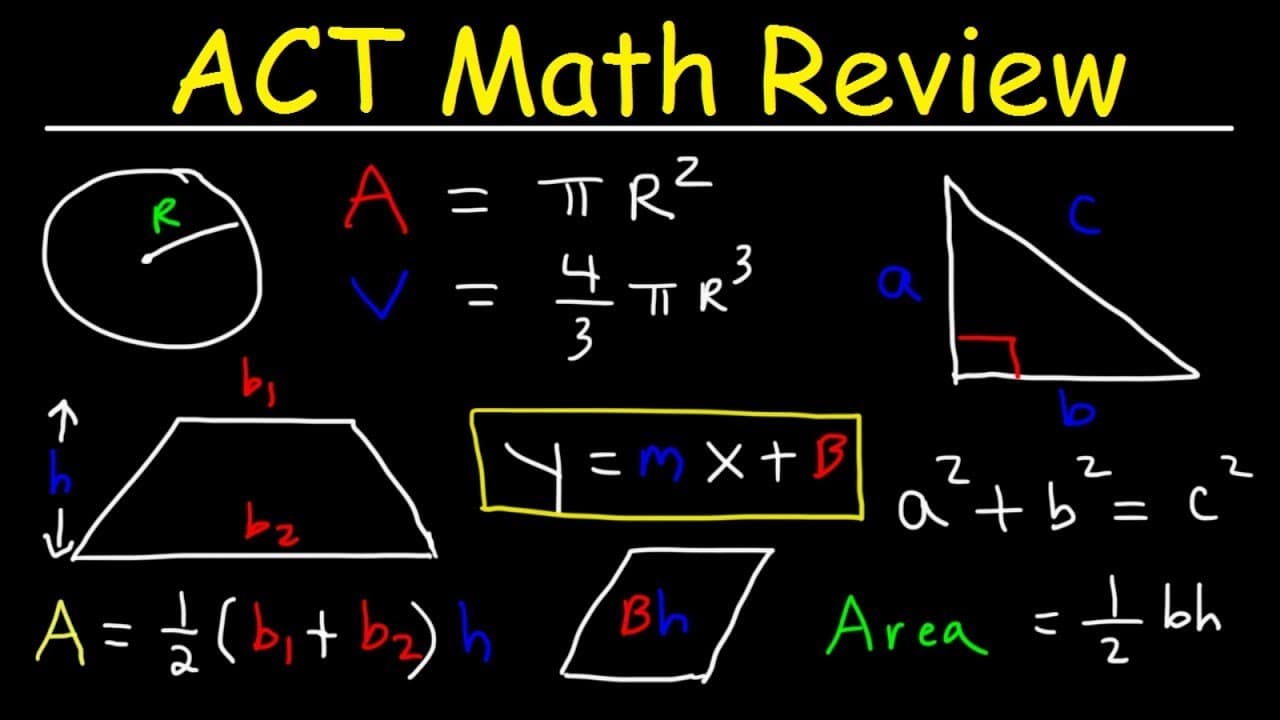
This comprehensive video tutorial serves as an intensive review for the ACT Math section, covering a wide array of topics crucial for high school students preparing for college entrance exams. The content is structured as a series of 31 practice problems that mimic the style and difficulty of actual ACT questions. It progresses through various mathematical domains including pre-algebra, elementary algebra, intermediate algebra, coordinate geometry, plane geometry, and trigonometry. The video adopts a pause-and-practice format, encouraging active participation where viewers attempt each problem before watching the detailed step-by-step solution. Key themes explored in this review include solving linear and quadratic equations, working with functions, understanding geometric properties of polygons and circles, applying trigonometric ratios (SOH CAH TOA) and identities, and analyzing statistical data. The video also places a strong emphasis on real-world application problems involving percentages, sales tax, discounts, and unit conversions. Particular attention is given to algebraic manipulation strategies, such as solving systems of equations and simplifying complex expressions, as well as test-taking tactics like identifying key information in word problems. For educators and students, this video is a valuable resource for standardized test preparation. It allows teachers to identify specific areas of weakness in student understanding by isolating problem types (e.g., if a student struggles with problem 10, they need more support with circle geometry). The step-by-step explanations model clear mathematical reasoning, demonstrating not just *how* to get the right answer, but *why* specific methods work. This makes it an excellent tool for flipped classrooms, homework support, or intensive boot-camp style review sessions prior to test dates.
The Organic Chemistry TutorThe Organic Chemistry Tutor

20mins 33s

Mastering Similar Triangles: Postulates and Proofs

Mastering Similar Triangles: Postulates and Proofs

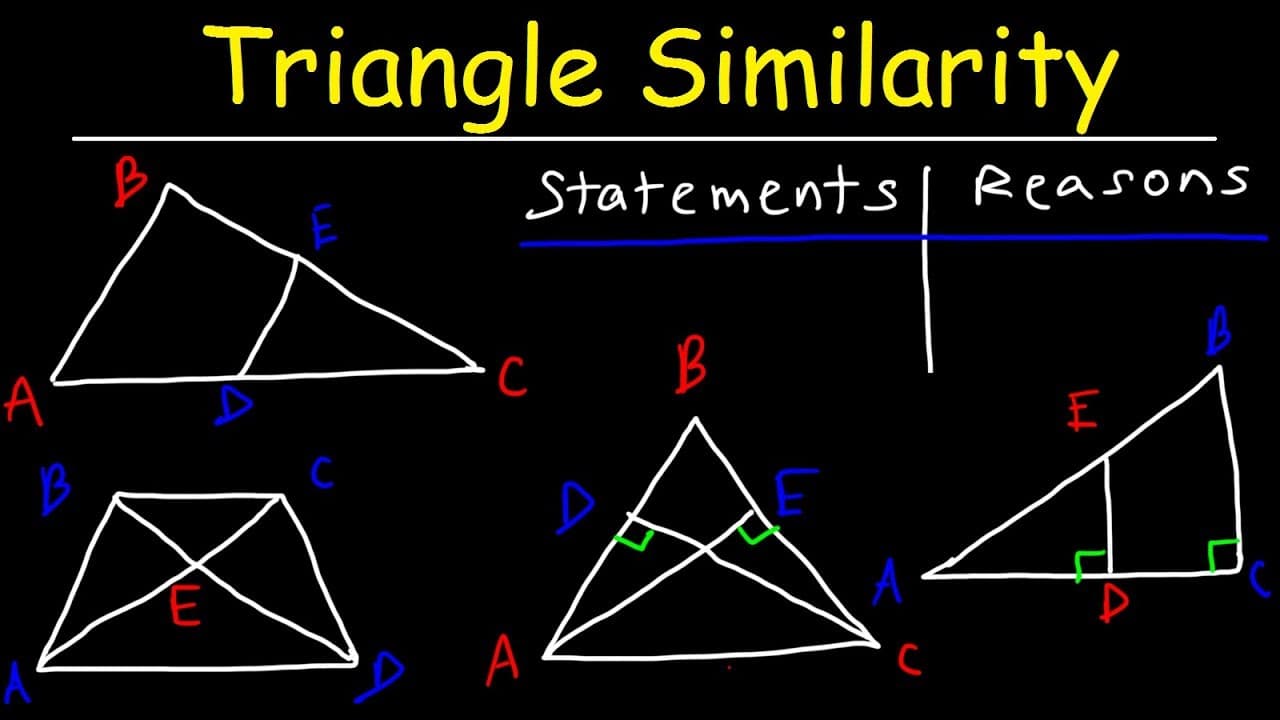
This comprehensive geometry tutorial provides a deep dive into proving triangle similarity, a fundamental concept in high school mathematics. The video begins by systematically explaining the four main methods for proving similarity: Angle-Angle-Angle (AAA), Angle-Angle (AA), Side-Side-Side (SSS), and Side-Angle-Side (SAS). It clearly distinguishes between these postulates and demonstrates how to identify them visually, explaining that while AAA exists, AA is the more commonly used and efficient method. The content transitions from theoretical definitions to practical application through numerical examples. Students are guided through problems where they must calculate ratios of corresponding sides to determine if triangles are similar using SSS and SAS. The video then advances to rigorous two-column geometric proofs. It walks viewers through complex scenarios involving isosceles trapezoids, parallel lines, alternate interior angles, and the reflexive property, modeling the logical step-by-step thinking required for formal geometric proofs. This resource is highly valuable for the classroom as it bridges the gap between basic computation and formal logic. It specifically addresses the challenging "Means-Extremes Product Theorem" (cross-multiplication in proofs), showing students how to work backwards from a product of segments to a similarity statement. The clear, slow-paced narration and visual markup of diagrams make it an excellent tool for introducing proofs or for remediation with struggling students.

The Organic Chemistry TutorThe Organic Chemistry Tutor

29mins 23s

How to Convert Units Using Dimensional Analysis

How to Convert Units Using Dimensional Analysis

This educational video provides a clear and practical introduction to dimensional analysis, a mathematical method used to convert units of measurement. The narrator, Justin, breaks down the process of using known conversion rates to manipulate units, ensuring that unwanted units cancel out to reveal the desired result. Through step-by-step examples, viewers learn how to set up conversion chains for rates, such as changing miles per hour into feet per second. The video explores key themes of unit conversion, ratios, and algebraic thinking. It specifically covers two distinct types of problems: a standard rate conversion involving distance and time, and a more complex multi-variable problem involving currency exchange and mass. The visual presentation emphasizes the importance of placing units correctly in the numerator or denominator to achieve cancellation, a foundational skill for advanced math and science courses. For educators, this video serves as an excellent resource for bridging the gap between basic math skills and applied sciences like chemistry and physics. It demonstrates the "train track" or "fence post" method often used in stoichiometry. Teachers can use this video to introduce the concept of dimensional analysis, reinforce the importance of tracking units during calculation, or as a remediation tool for students struggling with multi-step word problems involving rates.

Miacademy & MiaPrep Learning ChannelMiacademy & MiaPrep Learning Channel

4mins 25s

Understanding Proportions and How to Solve Them

Understanding Proportions and How to Solve Them

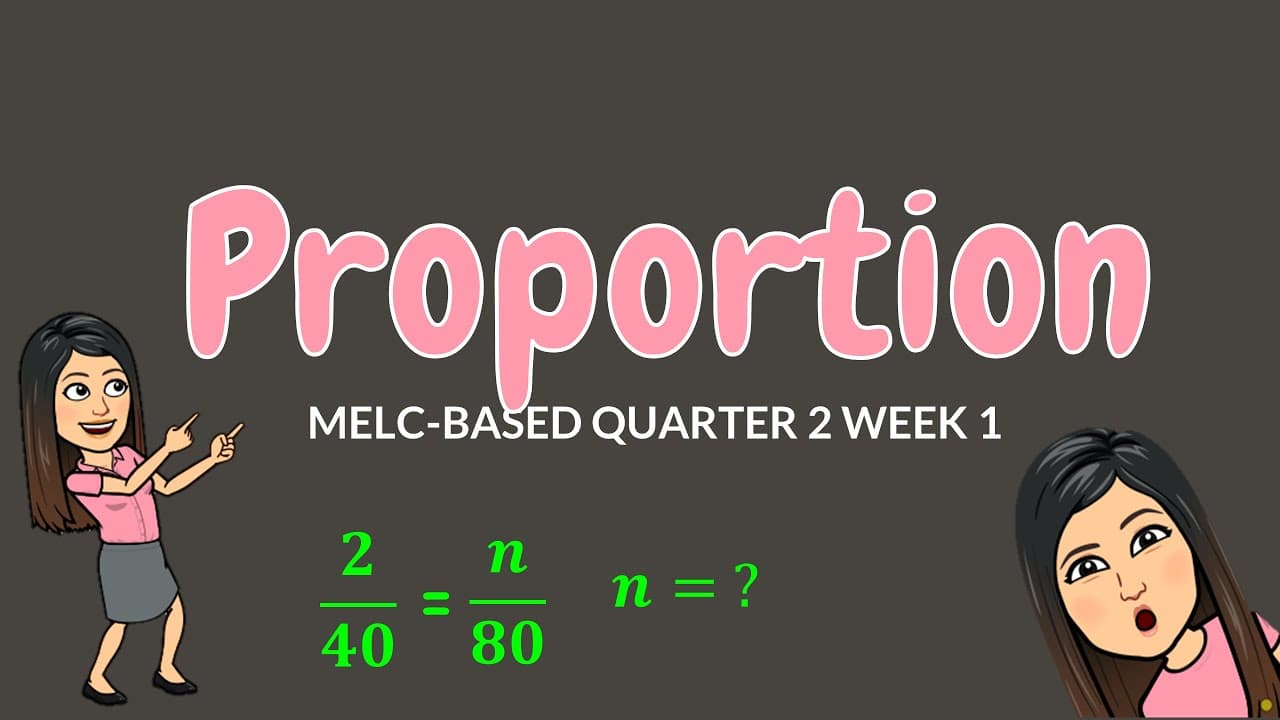
This comprehensive mathematics tutorial introduces students to the fundamental concepts of proportions, building upon prior knowledge of ratios and equivalent ratios. The video utilizes clear animations and real-world analogies, such as snacks and baking ingredients, to demystify abstract algebraic concepts. It systematically guides viewers through defining a proportion, identifying its components (means and extremes), and verifying whether two ratios form a true proportion.

Sheena DoriaSheena Doria

9mins 30s

Materials

Ratio Builders Worksheet

Ratio Builders Worksheet

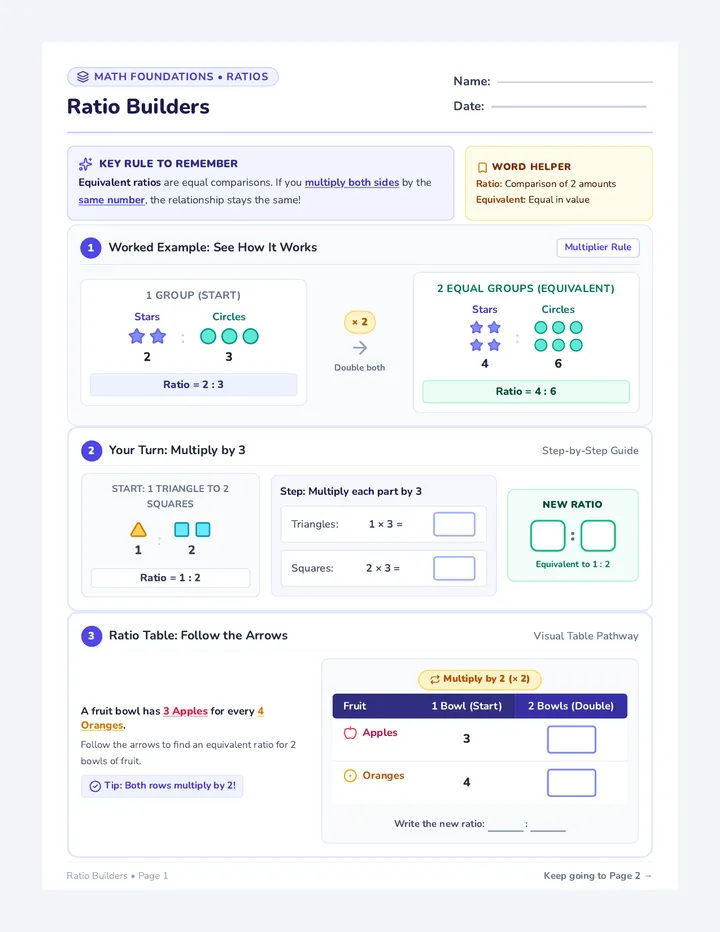
A 2-page scaffolded equivalent ratios worksheet tailored for IEP students, featuring concrete visual models, step-by-step scaffolds, ratio tables with explicit multiplier pathways, and an optional challenge problem.

CS

Courtney Scherer

Scale Factor Anchor Chart

Scale Factor Anchor Chart

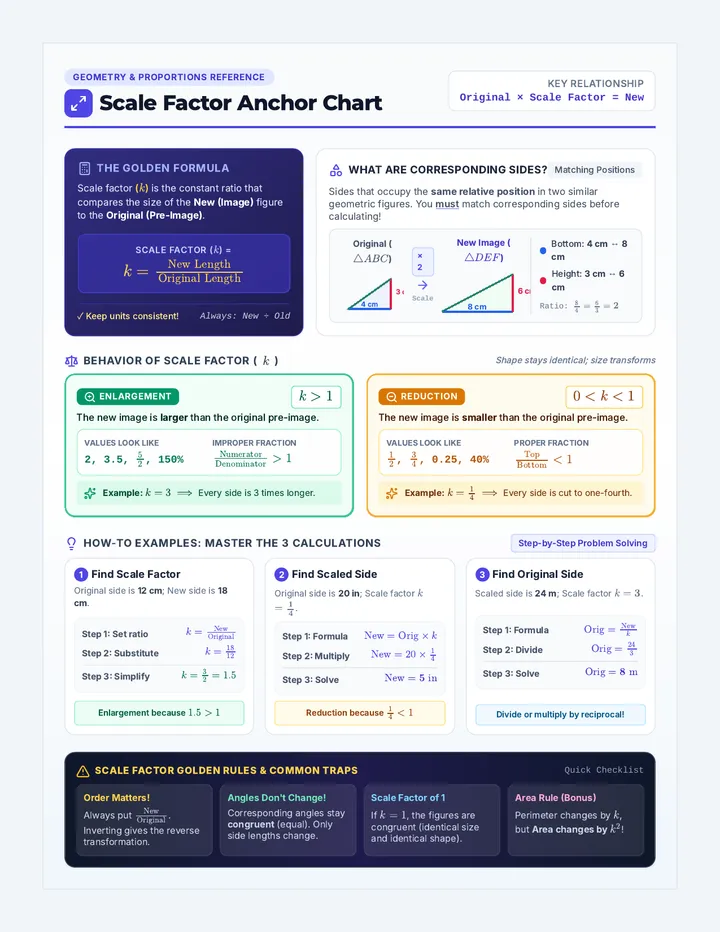
A comprehensive math anchor chart explaining scale factor, corresponding sides, enlargements versus reductions, and step-by-step examples for finding scale factors and missing original or scaled dimensions.

R

rgood

Proportional Relationships Practice Worksheet

Proportional Relationships Practice Worksheet

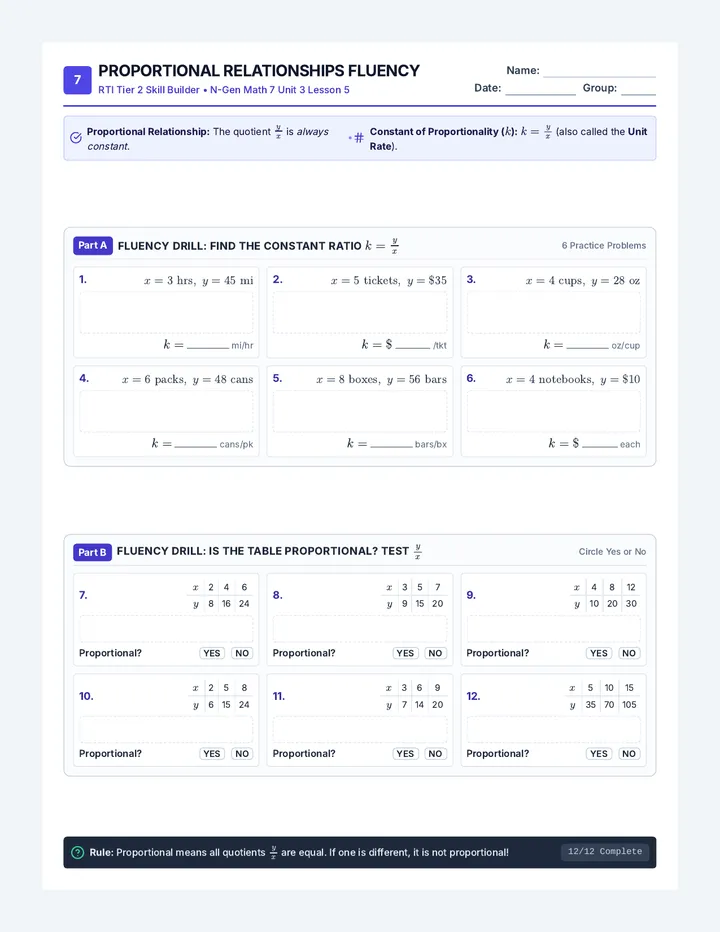
A fluency-focused 2-page RTI math worksheet with 20 bite-sized problems on proportional relationships, calculating unit rates, testing tables, writing equations, and scaffolded mirrors of Lesson 3-5 exercises.

JH

John Holt

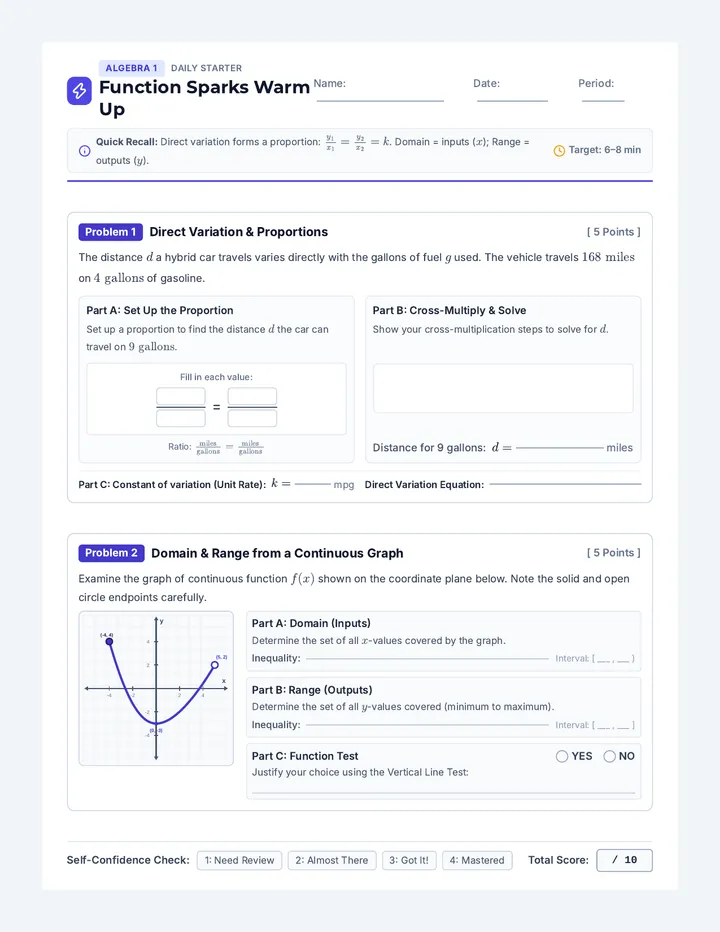
Function Sparks Warm Up

Function Sparks Warm Up

A printable Algebra 1 warm-up featuring a direct variation proportion problem with scaffolded ratio templates, a continuous graphical domain and range analysis, and a student confidence tracker.

KV

Karen Valenciana

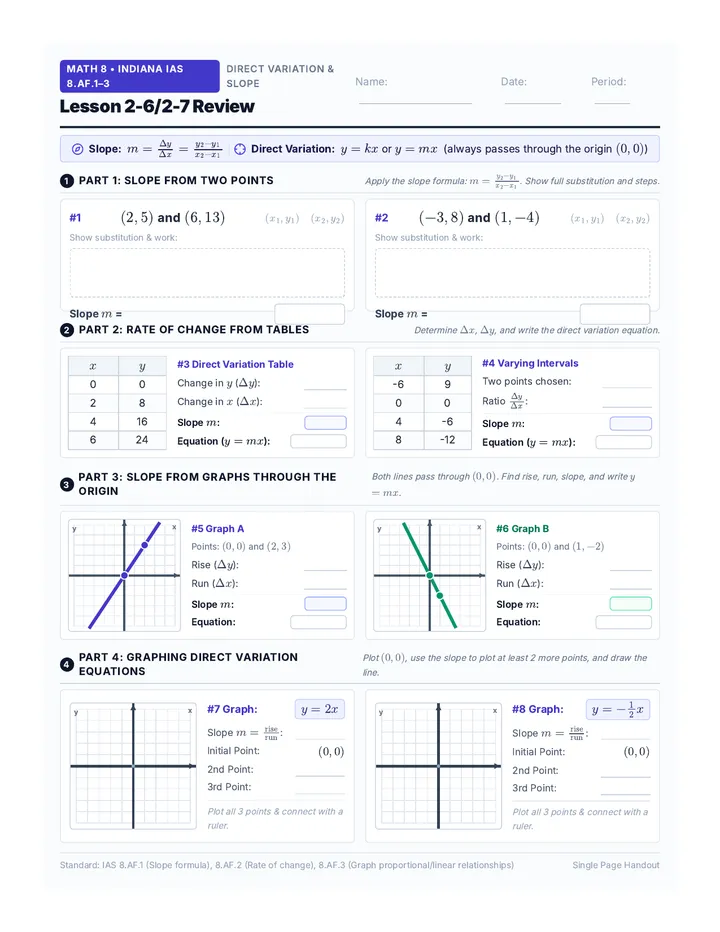
Line Craft Worksheet

Line Craft Worksheet

A Grade 8 review worksheet (Lessons 2-6/2-7) covering slope from ordered pairs with expanded work areas, rate of change from tables, slope from graphs through the origin, and graphing direct variation equations.

K

Kyle.Nicholson

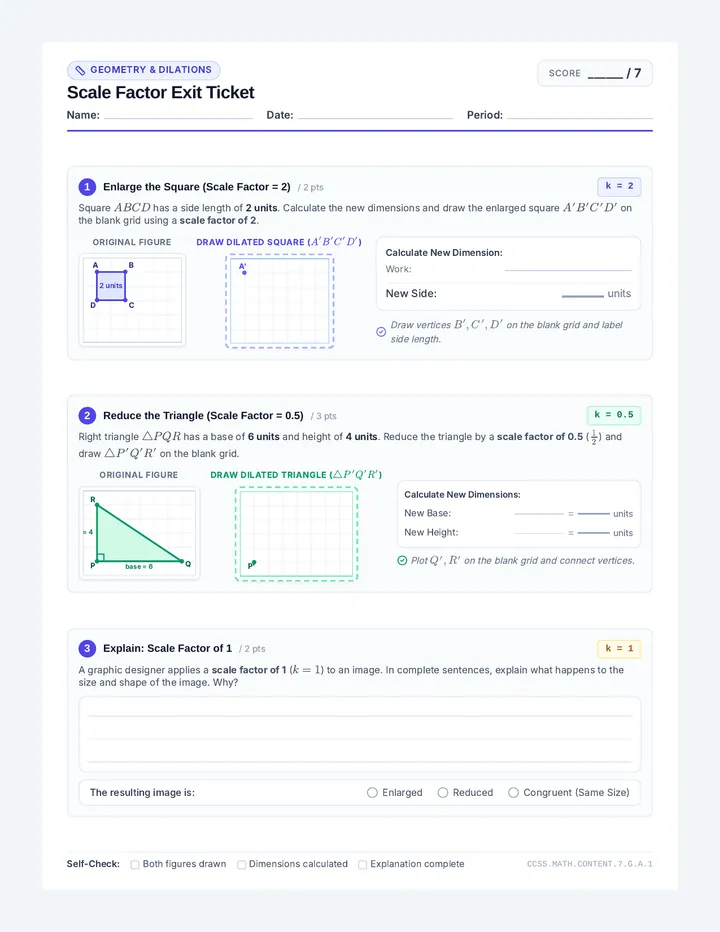
Scale Factor Exit Ticket

Scale Factor Exit Ticket

A one-page exit ticket on scale factor scored out of 7, featuring side-by-side original and blank grids for enlarging a square and reducing a triangle with open calculation spaces, along with an explanation prompt for a unit scale factor.

R

rgood

Sequences

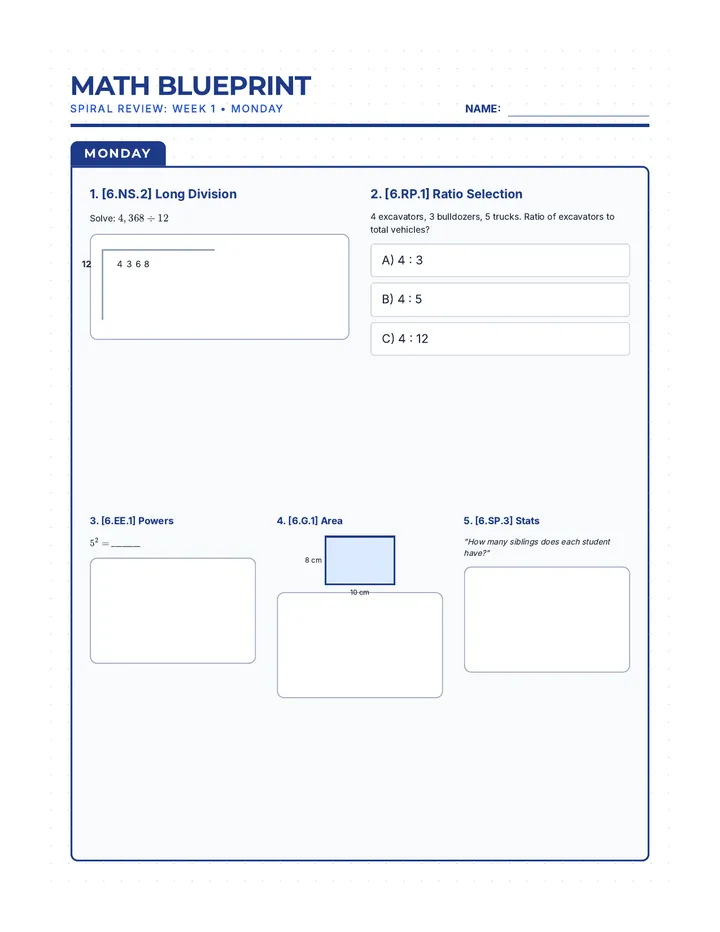
Math Blueprint Week 1 Booklet (Definitive)

Math Blueprint Spiral

A 7-week comprehensive math review sequence designed to prepare 6th-grade students for North Carolina state testing, covering Number Systems, Ratios, Expressions, Geometry, and Statistics.

MK

Michell Kisler

27
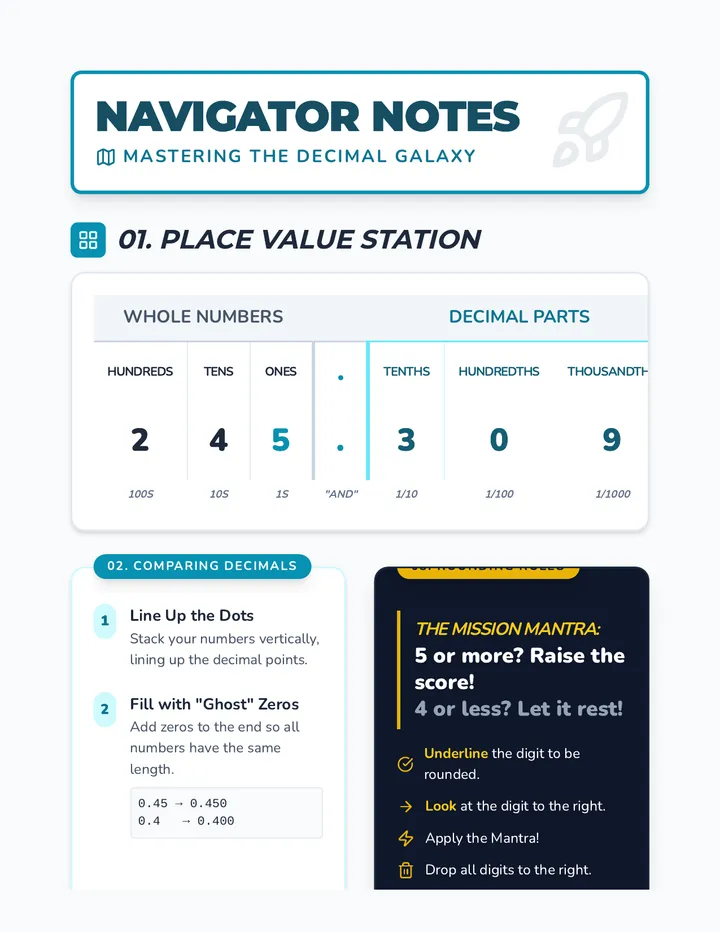
Navigator Notes Anchor Chart

Galactic Navigators

A space-themed math journey where students use decimal operations and proportional relationships to chart courses, calculate planetary scales, and manage spaceship systems.

H

Hardy

10
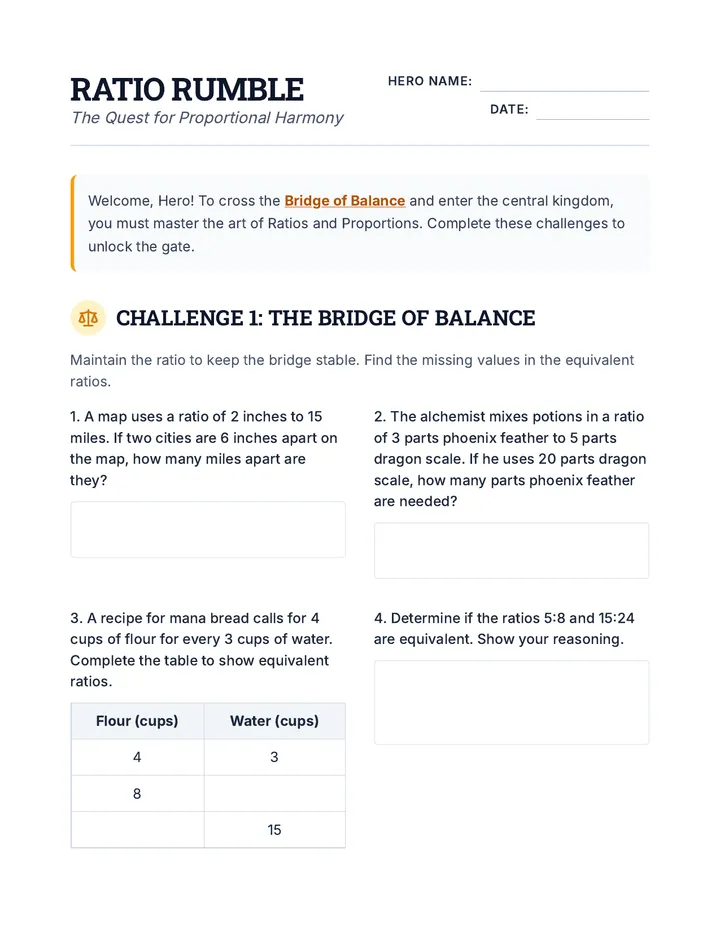
Ratio Rumble Worksheet

Math Quest Review

A week-long adventure-themed 6th-grade math review covering major clusters: Ratios & Proportions, Number System, Expressions & Equations, and Geometry. The sequence culminates in a mixed-review 'Quest Finale' to assess student mastery and readiness.

C

carlsond

15
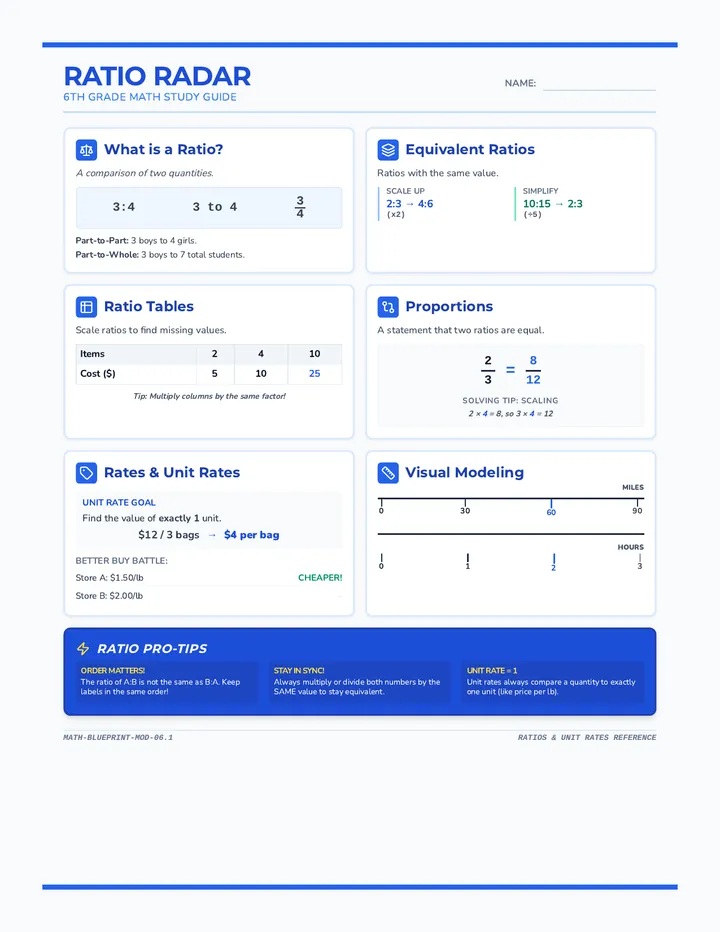
Ratio Radar Cheat Sheet

Math Mastery Guide

A collection of high-quality study tools and practice resources for 6th-grade math, focusing on Ratios, Proportions, Expressions, and Equations.

FB

Faith Bain-Lucey

24
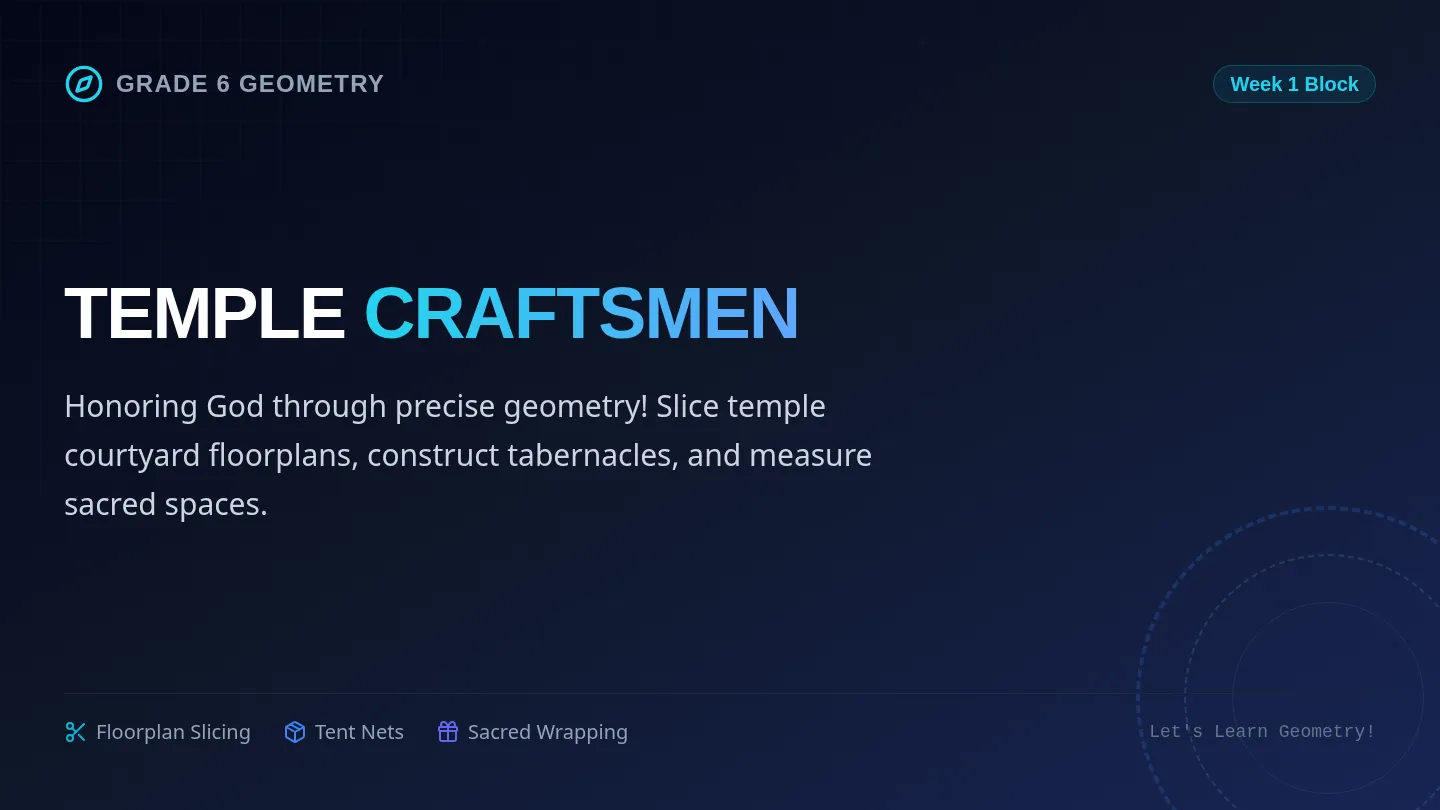
Temple Craftsmen Slides

Middle School Math Block

A multi-subject middle school mathematics block for Week 1, covering 6th Grade Geometry (Temple Craftsmen: polygon decomposition, nets, surface area) and 7th/8th Grade Math (Faithful Stewards: proportional relationships, linear equations, inequalities, transversals) from a Christian perspective.

JR

Jamens Ray II

59
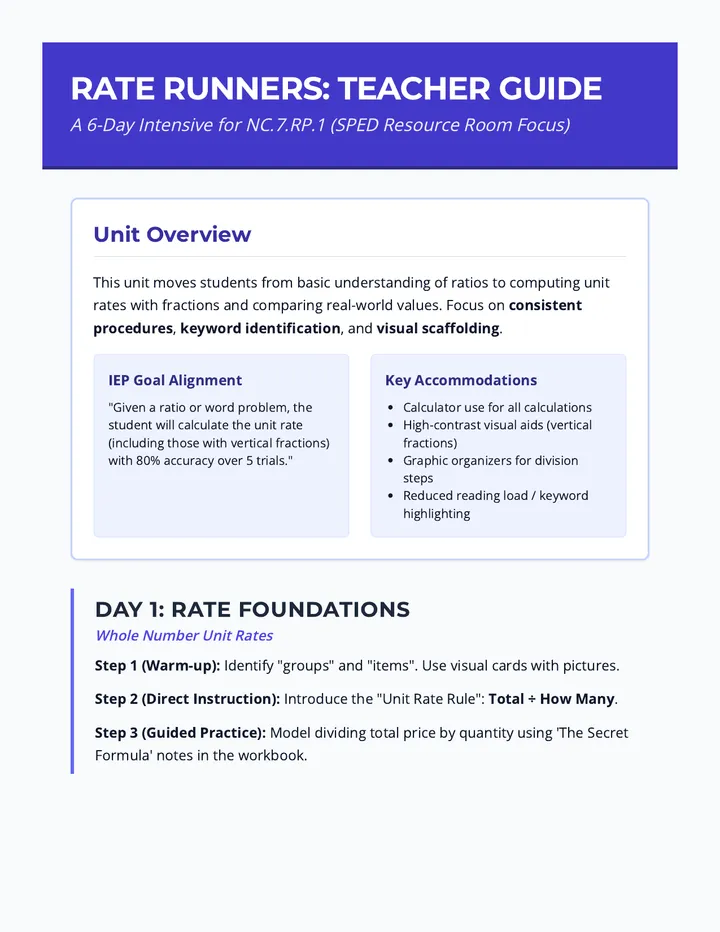
Rate Runners Teacher Guide

Rate Runners

A 6-day intensive test prep unit for NC.7.RP.1 focused on unit rates. Designed specifically for special education resource rooms with heavy scaffolding, visual aids, and real-world shopping and measurement applications. Includes 4 days of instruction, a collaborative review relay, and a final assessment.

BR

Brandon Ruffin

12

Lessons

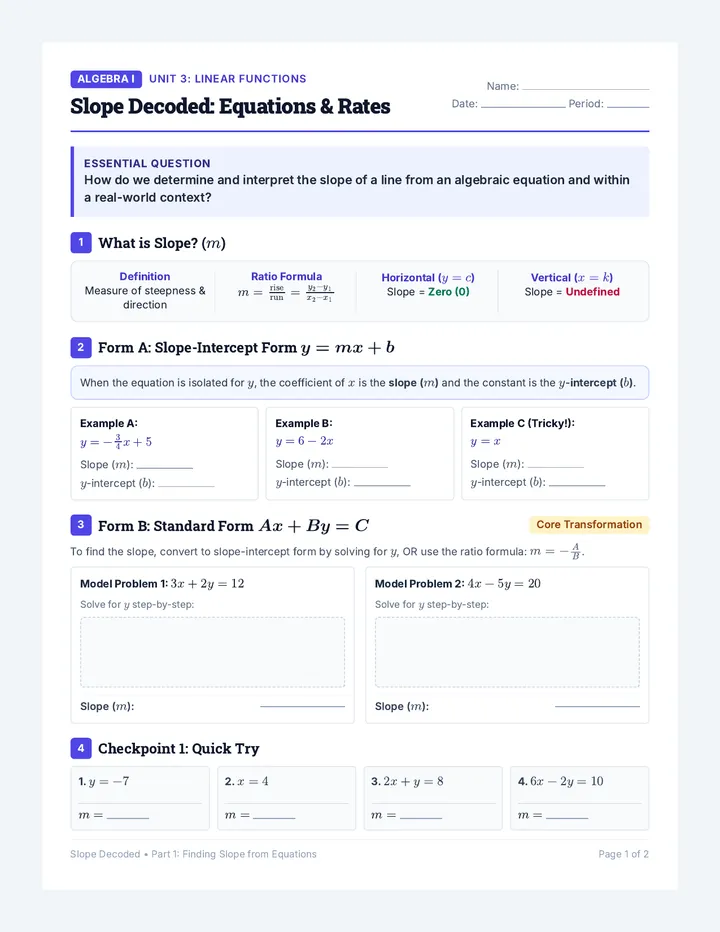
Slope Decoded Guided Notes

Slope Decoded

A comprehensive 100-minute high school algebra lesson exploring slope both algebraically from various equation forms and contextually as a real-world rate of change. Students transition from identifying and calculating slope in equations to interpreting unit rates, initial values, and contextual graphs.

LT

Lane Thompson

6
Size Me Up Lesson Plan

Size Me Up

A 9th-grade geometry lesson where students master similar figures and proportions to solve real-world height problems through shadow reckoning and indirect measurement.

KC

Kris Coyne

6
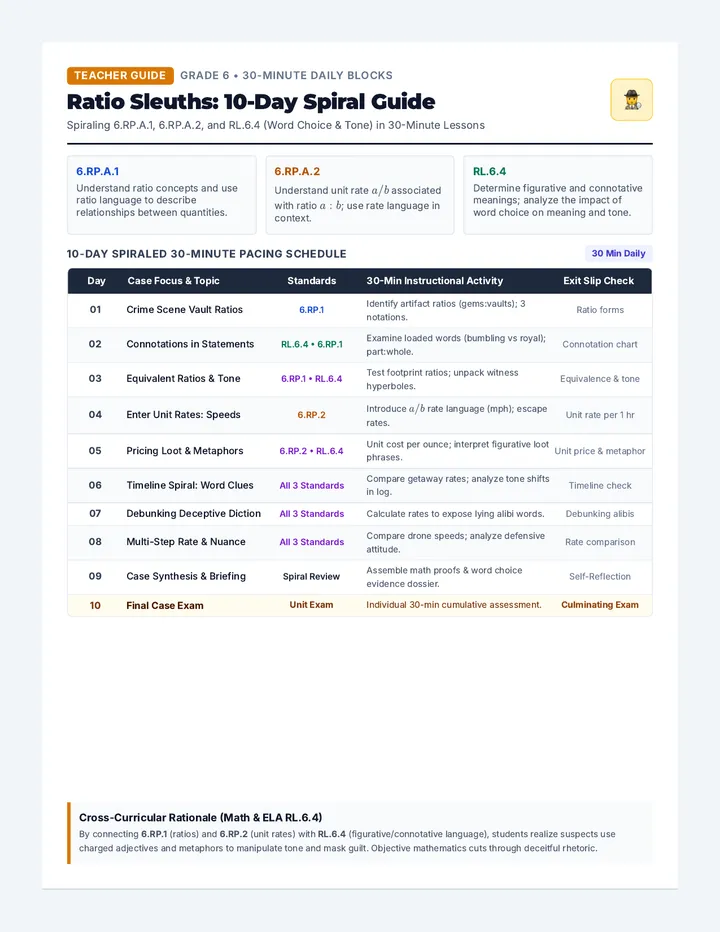
Ratio Sleuths Teacher Guide

Ratio Sleuths Mystery

A 10-day interdisciplinary mystery unit with 30-minute daily lessons spiraling 6th grade ratio concepts (6.RP.1), unit rates (6.RP.2), and figurative language/connotation analysis (RL.6.4). Students act as forensic detectives cracking the Midnight Museum Heist through mathematical reasoning and literary word choice analysis.

SZ

Sandra Zoerhoff

9
Math Screener Student Booklet

8th Grade Math Diagnostic Screener

A comprehensive 8th-grade math screener diagnostic tool designed to identify students for Tier 2 and Tier 3 interventions. Includes a 4-page student booklet, a matching step-by-step answer key, and an instructional rubric, placement guide, and class data tracker spanning 6th, 7th, and 8th-grade standards.

B

Bennington

3
Percent Puzzle Lesson Plan

The Percent Puzzle Solving Percent Equations

A comprehensive 65-minute lesson for 9th-grade students on solving percent equations and proportions, using a "Percent Puzzle" theme to engage students in finding missing parts, wholes, and percentages.

KC

Kris Coyne

6
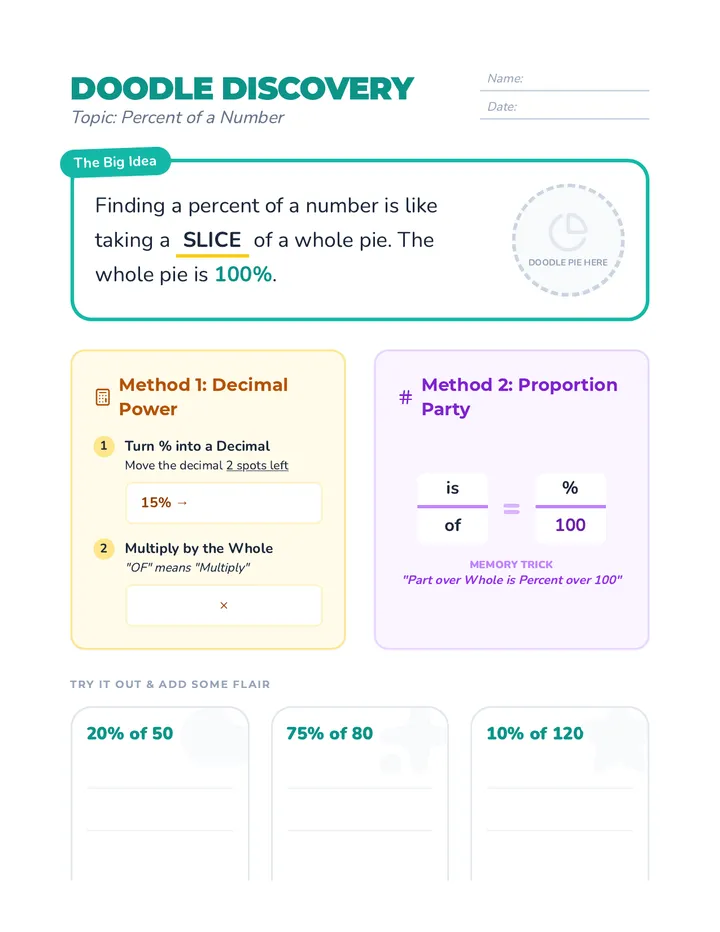
Percent Power Doodle Notes

Percent Power

A comprehensive set of visual, interactive doodle notes and practice activities designed to help students with ADHD master the concept of finding a percent of a number through single-concept focus and hands-on elements.

J

jedriend

5