Lenny.com
Explore
Create
ActivitiesNewMathEnglish Language ArtsScience & EngineeringSocial StudiesGlobal LanguagesHealth & Physical EducationSpecial EducationCounseling & Life SkillsArts & CreativityESL
Lenny.com
Lenny.com
Explore
Create
ActivitiesNewMathEnglish Language ArtsScience & EngineeringSocial StudiesGlobal LanguagesHealth & Physical EducationSpecial EducationCounseling & Life SkillsArts & CreativityESL
Lenny.com
Lenny.com

Solutions

Lenny for EducatorsLenny for SchoolsLenny for Districts

Product

ExploreSign inCreateSupportAbout

Resources

Getting startedMTSS Acceleration Program

© 2026 Lenny Learning Inc.

TermsPrivacyAccessibility
LinkedInInstagramX
Lenny

Time and Money

Analog and digital clock reading, elapsed time calculations, and calendar skills. Strengthens currency identification, coin counting, and basic financial transactions.

MathNumbers & CountingCounting ObjectsNumber NamesComparing NumbersNumber OperationsCounting SequenceNumbers 0-10Place Value Understanding and SystemAdd and Subtract Within 20Addition and Subtraction ConceptsAddition and Subtraction EquationsAddition and Subtraction ProblemsFoundations for MultiplicationMultiplication and Division PropertiesMultiply and Divide Within 100Multiplication and Division ProblemsFactors and MultiplesProperties of OperationsPatterns and RelationshipsGenerate and Analyze PatternsMulti-Digit ArithmeticPlace Value OperationsMulti-Digit and Decimal OperationsNumerical ExpressionsFour Operations and PatternsFour Operations Problem SolvingMeasurement & DataMeasurable AttributesMeasuring LengthsMeasure and Estimate Lengths in Standard UnitsRelate Addition and Subtraction to LengthClassifying and Counting ObjectsTime and MoneyArea Concepts and MeasurementPerimeter and Area MeasuresAngle Concepts and MeasurementTime, Volume, and MassMeasurement Unit ConversionsGeometryIdentifying ShapesShapes and AttributesShape Attributes and ReasoningShapes and CompositionClassifying 2D FiguresGeometric Figures and RelationshipsLines, Angles, and ShapesAngle, Area, and VolumeGeometric MeasurementVolume of 3D ShapesCoordinate Plane ApplicationsTransformations in the PlaneCongruence and SimilarityUnderstand congruence in terms of rigid motionsSimilarity and TransformationsProve Theorems Involving SimilarityPythagorean TheoremTrigonometry for General TrianglesMake Geometric ConstructionsProve Geometric TheoremsTheorems About CirclesFind Arc Lengths And Areas of Sectors of CirclesVolume FormulasRelationships Between Two-Dimensional and Three-Dimensional ObjectsProve Simple Geometric Theorems AlgebraicallyTranslate Between Geometric Description and Equation for Conic SectionApply Geometric Concepts in Modeling SituationsFractions & DecimalsFractions as NumbersBuilding FractionsFraction Equivalence and OrderingAdding and Subtracting FractionsMultiplying and Dividing FractionsDividing FractionsDecimal FractionsMulti-Digit Computation and FactorsAdd, Subtract, Multiply, and Divide Rational NumbersRational Number SystemIrrational Numbers and ApproximationsRatiosRatios and ProportionsProportional RelationshipsUnit RateAlgebraAlgebraic ExpressionsGenerate Equivalent ExpressionsQuantitative RelationshipsProportional Relationships and Linear EquationsEquations and InequalitiesEquation Solving and ReasoningLinear Equations and SystemsGraph Equations and InequalitiesSystems of EquationsReal-World Algebraic ProblemsQuantitative Reasoning with UnitsExpression StructureEquivalent Expression FormsRadicals and Integer ExponentsRational ExponentsRational and Irrational NumbersPolynomial OperationsPolynomial IdentitiesPolynomial Zeros and FactorsRational ExpressionsComplex Number OperationsComplex Numbers in PolynomialsComplex Numbers on PlaneStatistics & ProbabilityRepresent and Interpret DataData DistributionsStatistical VariabilityProbability ModelsCompound Event ProbabilitiesStatistical SamplingInterpret Categorical and Quantitative DataBivariate Data PatternsInterpret Linear ModelsComparing Two PopulationsRandom Processes in StatisticsIndependence and Conditional ProbabilityExpected ValuesProbability-Based Decision MakingStatistical Inference and ConclusionsFunctionsFunction Concepts and NotationDefine and Compare FunctionsInterpret Functions in ContextAnalyze Function RepresentationsModel Relationships with FunctionsIdentify Linear vs Exponential GrowthDistinguish Between Function TypesCompare Growth RatesInterpret Function ExpressionsBuild Functions from RelationshipsConstruct and Model FunctionsTransform and Combine FunctionsModel Comparison and SelectionSolve Exponential EquationsTrigonometryTrigonometric Ratios Involving Right TrianglesTrigonometric Functions and Unit CircleModel with Trigonometric FunctionsTrigonometric IdentitiesVectors & MatricesIntroduction to Vectors and MatricesVector QuantitiesVector OperationsMatrix OperationsCalculusLimits and ContinuityDerivative Concepts and NotationDerivative Rules and TechniquesApplications of DerivativesOptimization ProblemsRelated RatesCurve Sketching and AnalysisIntegration Concepts and NotationAntiderivatives and Indefinite IntegralsDefinite Integrals and AreaFundamental Theorem of CalculusIntegration TechniquesApplications of IntegrationDifferential EquationsSequences and SeriesParametric and Polar FunctionsVector-Valued Functions

Videos

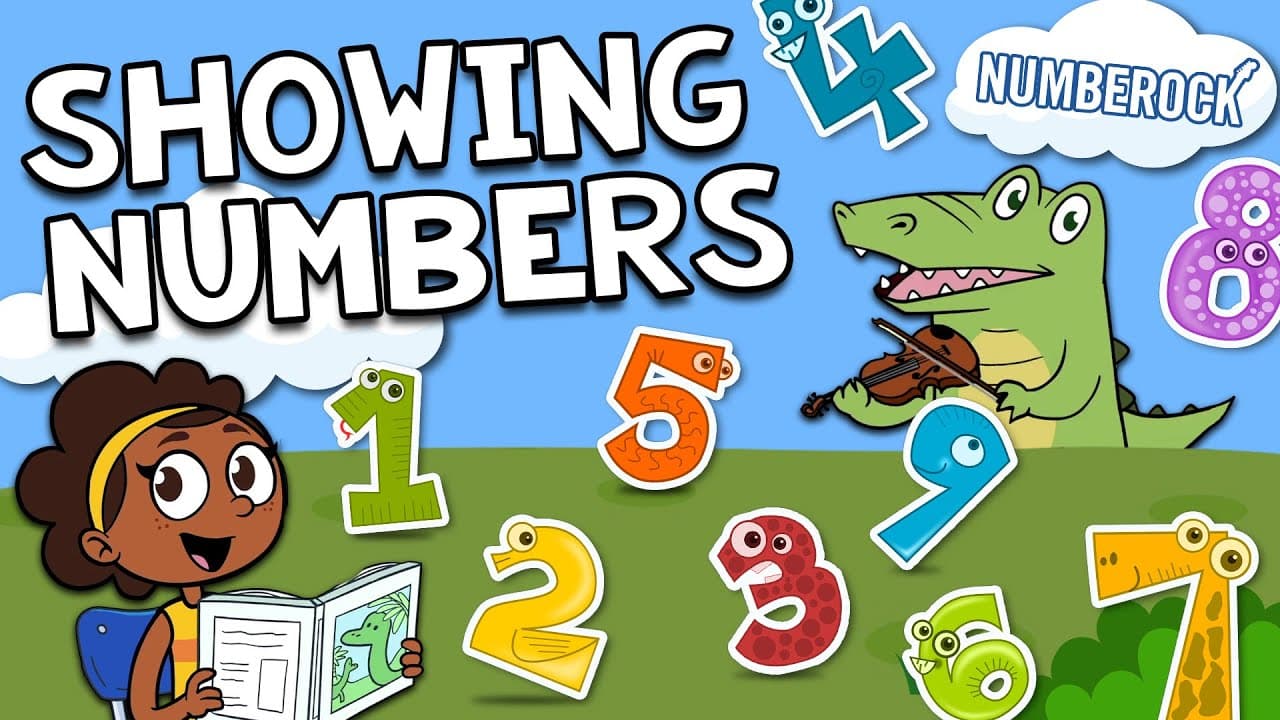
Ways We Use and Represent Numbers

Ways We Use and Represent Numbers

This engaging animated music video introduces early elementary students to the many ways numbers can be represented and used in daily life. Through a catchy folk-style song, the video follows a character named Suzy and a banjo-playing beaver as they demonstrate number concepts ranging from basic counting numerals to more complex representations like ten-frames, number lines, and base-10 blocks. The visual narrative moves from a classroom setting to various real-world scenarios, helping students visualize abstract mathematical concepts. The video systematically explores distinct methods of representing quantity, including written numerals, number words, fingers, tally marks, dice dots, and dominoes. It places special emphasis on grouping strategies, such as bundling tally marks by five and using ten-frames to organize visual counts. Beyond simple enumeration, the content bridges the gap to application by showing how numbers function in measuring distance on road signs, tracking time on clocks and calendars, and calculating money for purchases. For educators, this resource serves as an excellent anchor for a unit on number sense and representation. It supports visual learners by providing concrete imagery for abstract numbers and helps answer the common student question "When will I use this?" by connecting math to shopping, travel, and nature. The song's repetitive chorus and clear visual examples make it a versatile tool for introducing new topics, reviewing concepts, or facilitating choral counting activities in the classroom.

Math Songs by NUMBEROCKMath Songs by NUMBEROCK

3mins 22s

A Guide to Identifying and Counting U.S. Coins

A Guide to Identifying and Counting U.S. Coins

This engaging animated video provides a comprehensive introduction to the six major types of United States coins: the penny, nickel, dime, quarter, half-dollar, and dollar coins. Through clear narration and distinct visual aids, the video guides viewers through the physical characteristics, monetary values, and historical figures associated with each coin. It specifically highlights how to identify coins based on color (copper, silver, gold), size, and the imagery on both the heads and tails sides, including updates to coin designs like the Union Shield penny and the Presidential dollars. The video explores key themes of financial literacy, basic arithmetic, and American history. It covers the concept of value equivalency (e.g., five pennies equal one nickel), introduces significant historical figures like Abraham Lincoln, Thomas Jefferson, and Sacagawea, and touches on civic symbols like the Statue of Liberty and the Presidential Seal. Additionally, it introduces economic concepts simply, such as the cost of manufacturing a penny versus its face value. For educators, this resource is an excellent tool for math and social studies curriculums. It supports learning objectives related to identifying currency, counting money, and understanding place value. The video's segmented structure allows teachers to pause and focus on specific coins, making it ideal for interactive lessons involving coin sorting, counting practice, or historical inquiries about the figures represented on U.S. currency.
Homeschool PopHomeschool Pop

13mins 26s

Practicing Money Math: Counting Notes and Coins

Practicing Money Math: Counting Notes and Coins

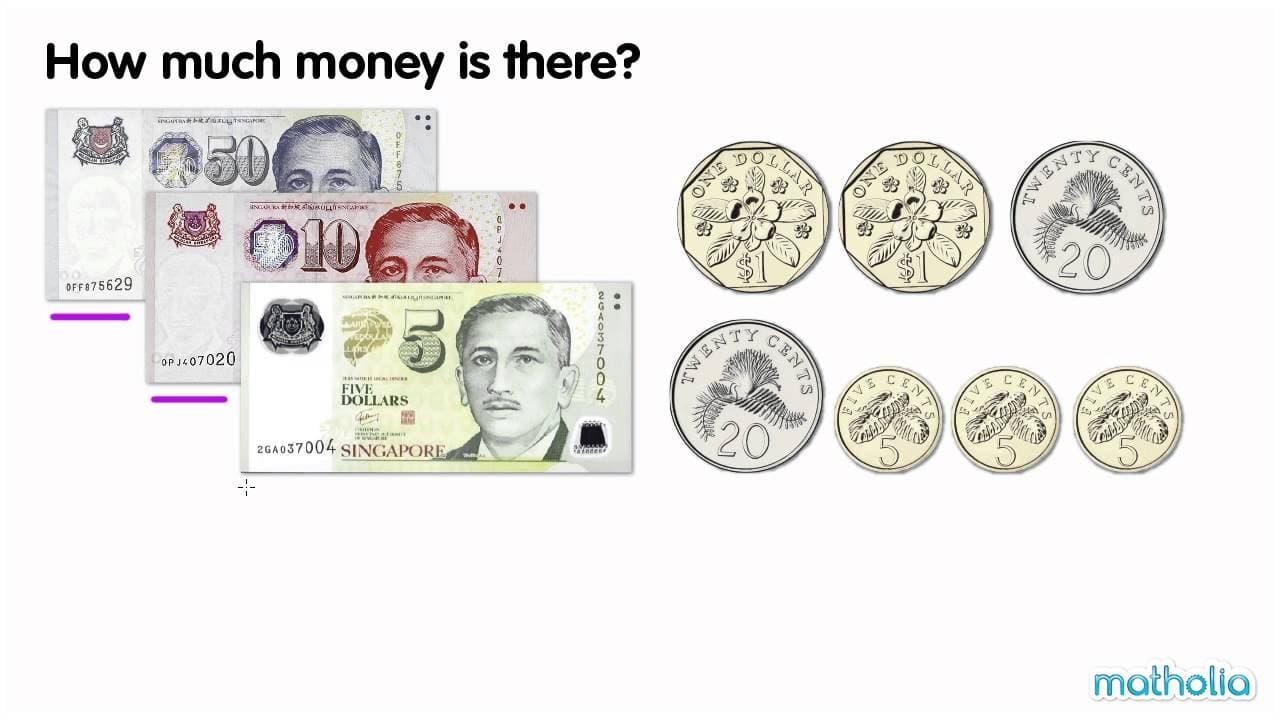
This educational video provides a clear, step-by-step demonstration of how to count mixed collections of currency, specifically using Singapore dollars and cents. Through three distinct examples of increasing complexity, the video models the strategy of counting notes first (largest to smallest value) followed by coins to arrive at a total sum. The visual format highlights each denomination as it is counted, reinforcing the connection between the physical currency and its numerical value. The video explores key themes of addition, place value, and the decimal nature of money. It particularly emphasizes the skill of "bridging" or converting cents into whole dollars when the coin count exceeds 100 cents. By moving from whole dollar amounts to partial cents and back to whole dollars (as seen when 95 cents becomes a dollar with the addition of a 5-cent coin), students see the fluid relationship between fractional and whole currency units. For educators, this resource is an excellent tool for modeling mental math strategies and skip counting with money. It effectively scaffolds learning by starting with simpler combinations and progressing to examples that require regrouping cents into dollars. Teachers can use this video to introduce money concepts, practice choral counting, or as a visual anchor for lessons on decimals and financial literacy. The clear visual cues make it accessible for visual learners and those needing reinforcement in sequential addition.

MatholiaChannelMatholiaChannel

2mins 54s

Identifying the Coins of Singapore

Identifying the Coins of Singapore

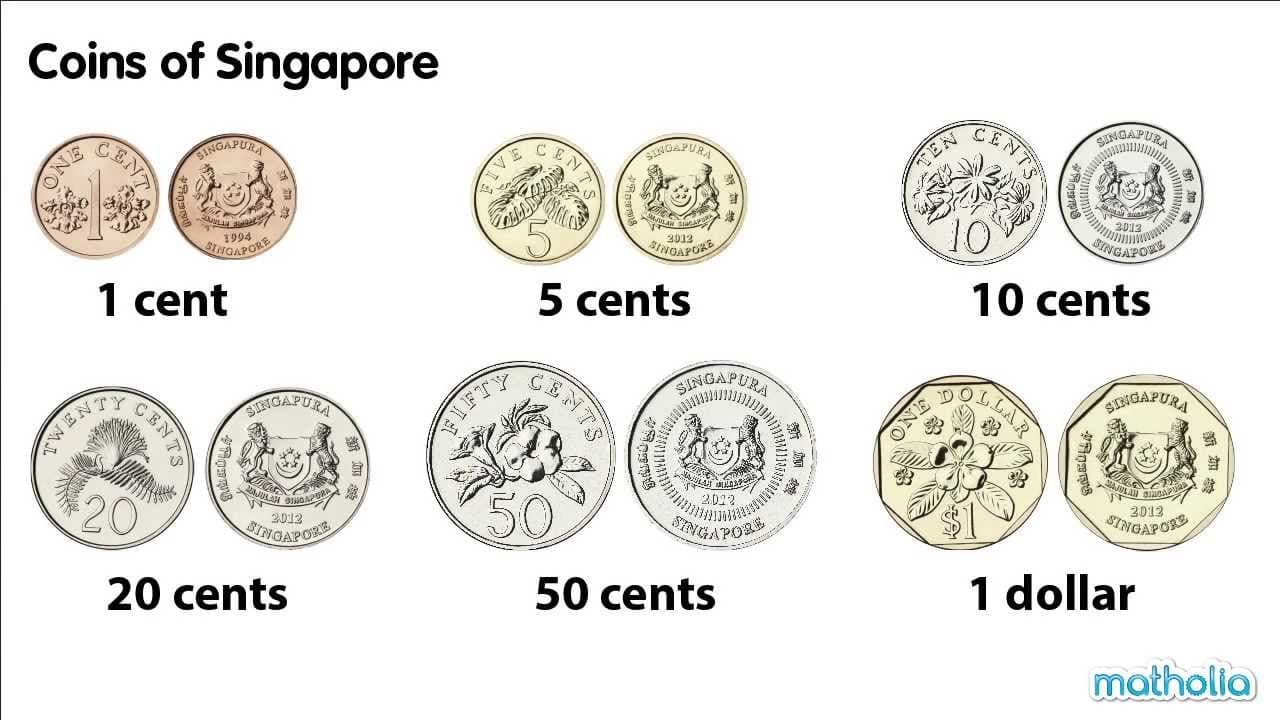
This educational video provides a clear and structured introduction to the currency of Singapore, specifically focusing on coin denominations. Through a simple visual presentation, the video introduces the one-cent, five-cent, ten-cent, twenty-cent, fifty-cent, and one-dollar coins. Each coin is displayed showing both the obverse (front) and reverse (back) sides, allowing students to see the distinct visual features, size differences, and colors associated with each value. The video utilizes a clean, distraction-free format where coins appear one by one against a white background. As each coin is introduced, the narrator clearly articulates its value, and the numerical value is written on screen in both word format (e.g., "1 cent") and symbol format (e.g., "1¢"). The video concludes with a summary screen displaying all the coins side-by-side in ascending order of value, providing a comparative view that reinforces the relative sizes and colors of the currency. For educators, this resource is an excellent tool for early numeracy and financial literacy lessons. It serves as a foundational text for teaching money recognition, sorting, and counting. The clear audio and slow pacing make it particularly suitable for young learners or students learning English as a second language. Teachers can use this video to introduce a unit on money, specifically for students in or learning about Singapore, to help them identify coins before moving on to practical activities like counting change or role-playing shopping scenarios.

MatholiaChannelMatholiaChannel

1min 58s

Learning to Tell Time by 5-Minute Intervals

Learning to Tell Time by 5-Minute Intervals

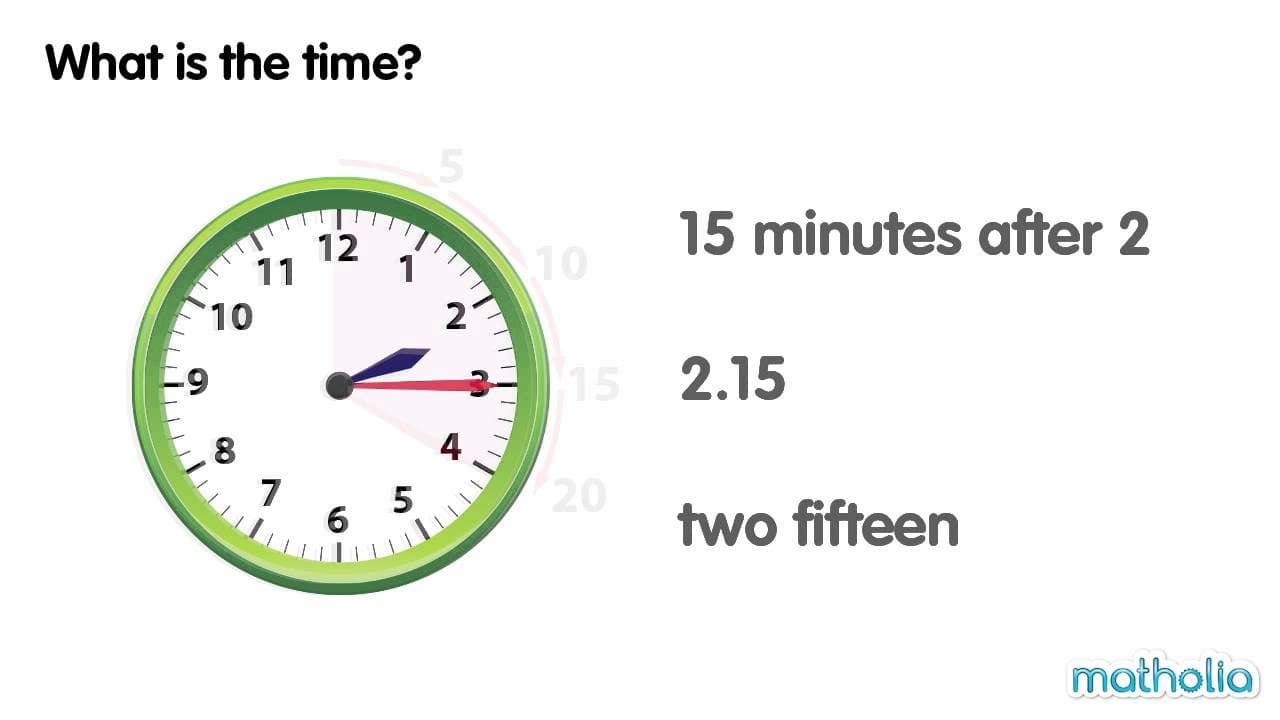
This educational video provides a clear, step-by-step demonstration of telling time in 5-minute intervals using an analog clock. Starting at 2:00, the video incrementally advances the minute hand by five minutes at a time, completing a full hour rotation until the clock reaches 3:00. A narrator systematically guides viewers through each change, reinforcing both the visual position of the hands and the corresponding digital time notation. Themes of measurement, skip counting, and timekeeping are central to this resource. The video explicitly connects the movement of the minute hand to counting by fives, using a visual highlight—a pink shaded sector—to represent the elapsed time. This visual aid helps bridge the gap between abstract numbers and the physical space time occupies on a clock face. It also introduces alternative phrasing for specific times, such as "half past two" for 2:30. For educators, this video serves as an excellent tool for introducing or reviewing clock reading skills in early elementary classrooms. The predictable pattern allows for choral response and active participation, where students can predict the next time before it is revealed. The dual presentation of analog hands and digital numbers supports learners in connecting these two common time formats, while the visualization of elapsed time lays early groundwork for understanding duration and fractions.

MatholiaChannelMatholiaChannel

3mins 10s

How to Add and Subtract Time in Hours and Minutes

How to Add and Subtract Time in Hours and Minutes

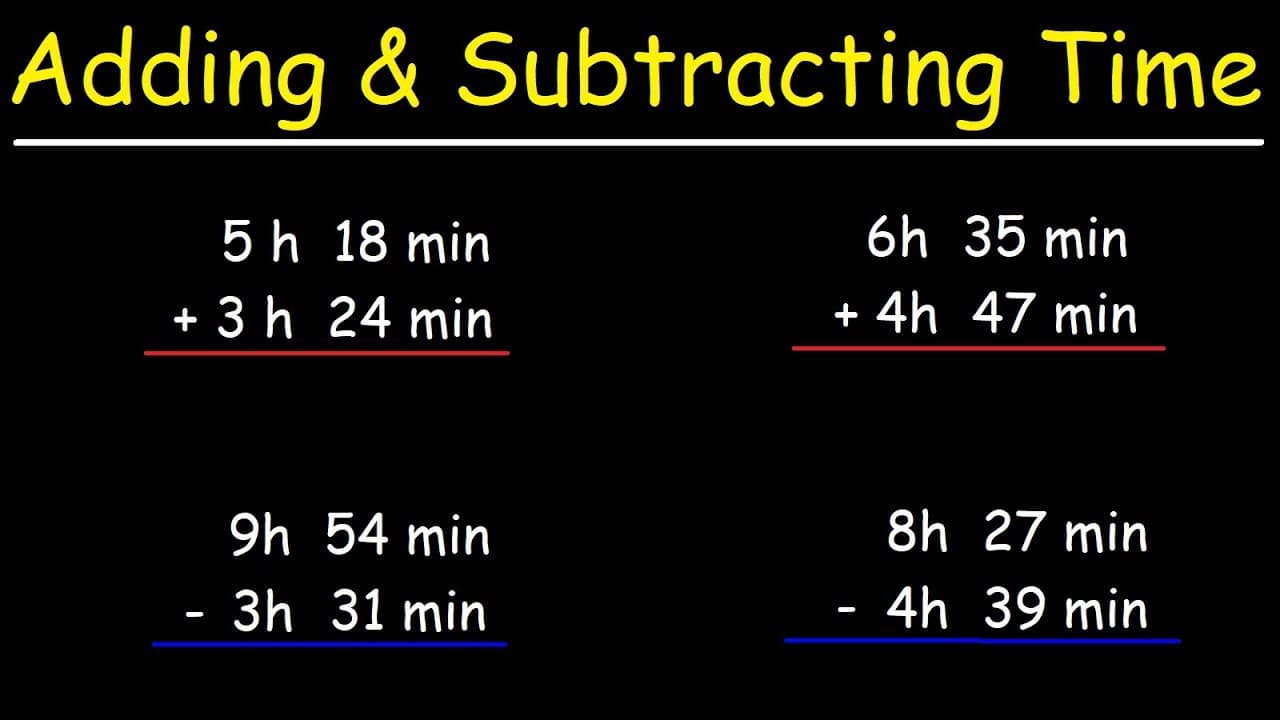
This instructional video provides a clear, step-by-step tutorial on how to perform arithmetic operations with time measurements, specifically focusing on adding and subtracting units of hours and minutes. The narrator utilizes a digital whiteboard to demonstrate the procedural algorithms required to calculate time, moving from simple problems to more complex scenarios that require regrouping (converting minutes to hours) and borrowing (converting hours to minutes).

The Organic Chemistry TutorThe Organic Chemistry Tutor

5mins 31s

Materials

Book Jacket Studio Worksheet

Book Jacket Studio Worksheet

A comprehensive 2-page book jacket and front-matter design worksheet where students craft their own book cover illustration, back cover blurb, endorsements, dedication, table of contents, chapter names, preface, and interior illustration.

MG

MICHELLE GRIMALDI

Budget Detective Practice Worksheet

Budget Detective Practice Worksheet

A four-page printable math worksheet packet featuring 12 structured multi-step money word problems. Students calculate starting funds from currency denominations, deduct initial purchases, and determine if remaining balances suffice for subsequent purchases with dedicated step-by-step work areas.

AP

Allyson Parker

Coin Quest Task Cards

Coin Quest Task Cards

A 4-page math center task card activity featuring 12 mixed coin counting challenges, real-world shopping word problems, a structured student recording sheet, and a complete teacher answer key.

CC

Chloe Crozier

Coin Combo Quest Slides

Coin Combo Quest Slides

An interactive 10-slide instructional deck for 2nd grade students introducing coin values and mastering equivalent coin combinations like making 10¢, 25¢, 50¢, and $1.00 in multiple ways.

S

SUSAN.ROSS

Time Teller Flashcards

Time Teller Flashcards

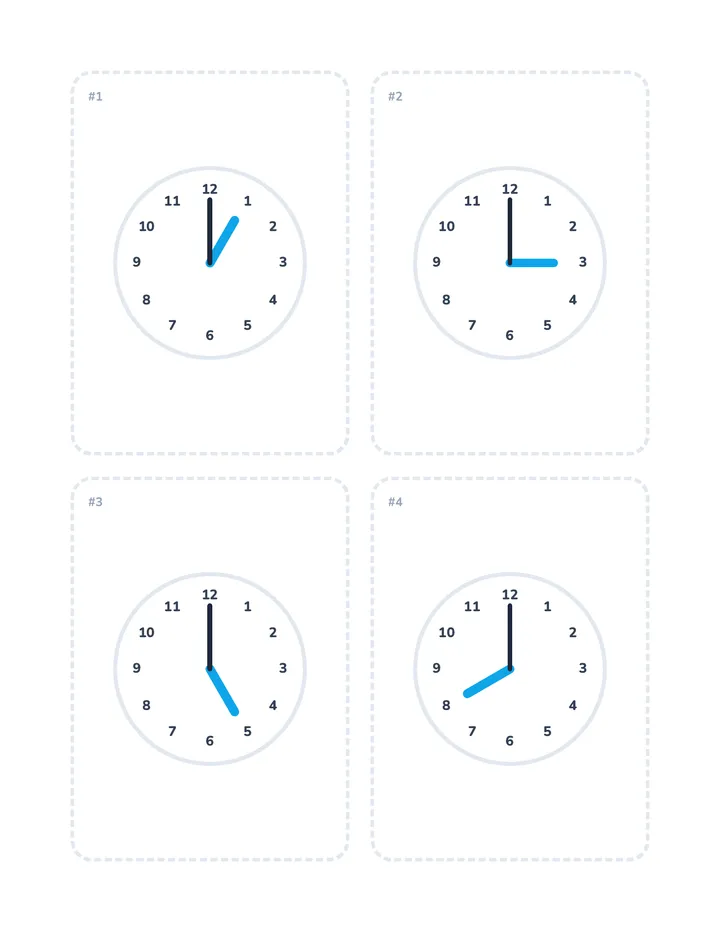
A set of 20 printable flashcards for teaching time to the nearest hour and half-hour, featuring analog clocks on the front and digital/word answers on the back. Designed in a 2x2 grid layout for double-sided printing.

KS

Kirston Sadler

Flower Time Worksheet

Flower Time Worksheet

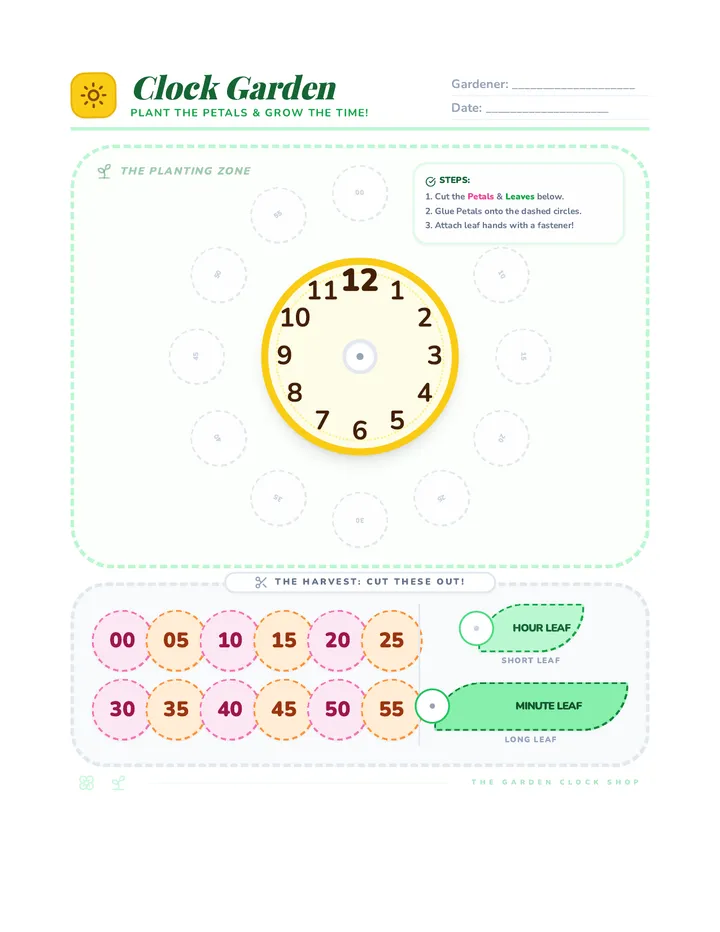
A single-page "Clock Garden" construction activity. Students cut out 12 perfectly rounded circular petals (00-55) and two leaf-shaped hands (Hour and Minute) to glue onto a large central analog clock face. Features a clear "Planting Zone" for assembly and a "Harvest Zone" for cutting.

JK

Juli Kibbe

Sequences

Camp Multi-Math Worksheet

Math Review Adventures

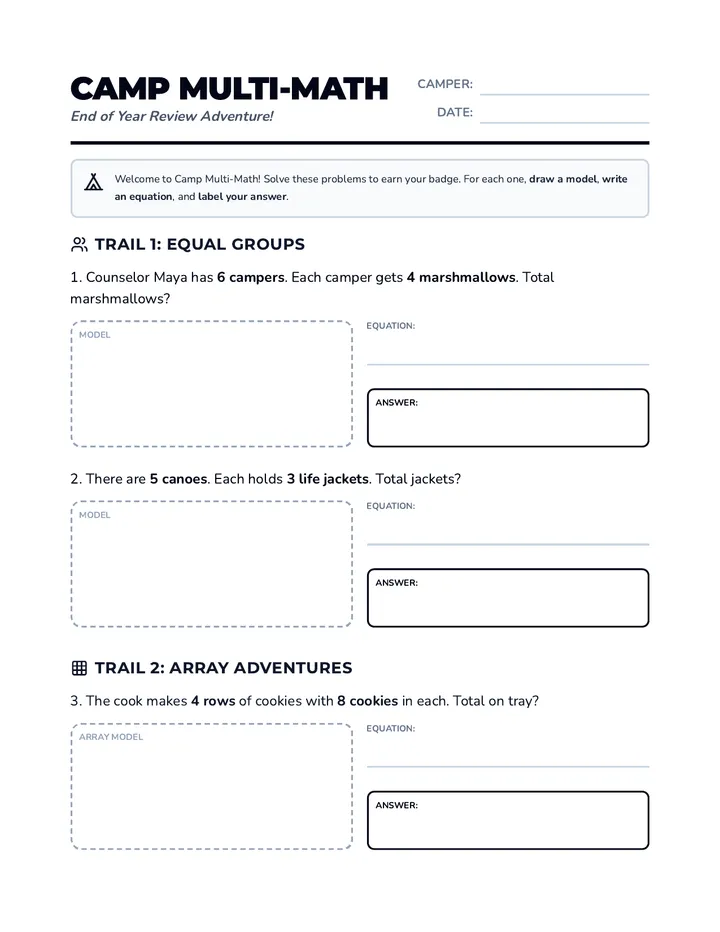
A collection of themed end-of-year math review adventures for different grade levels, focusing on spiraling key standards and problem-solving.

DB

Deborah Burton

21
Number Quest Workbook

Math Quest Tutoring

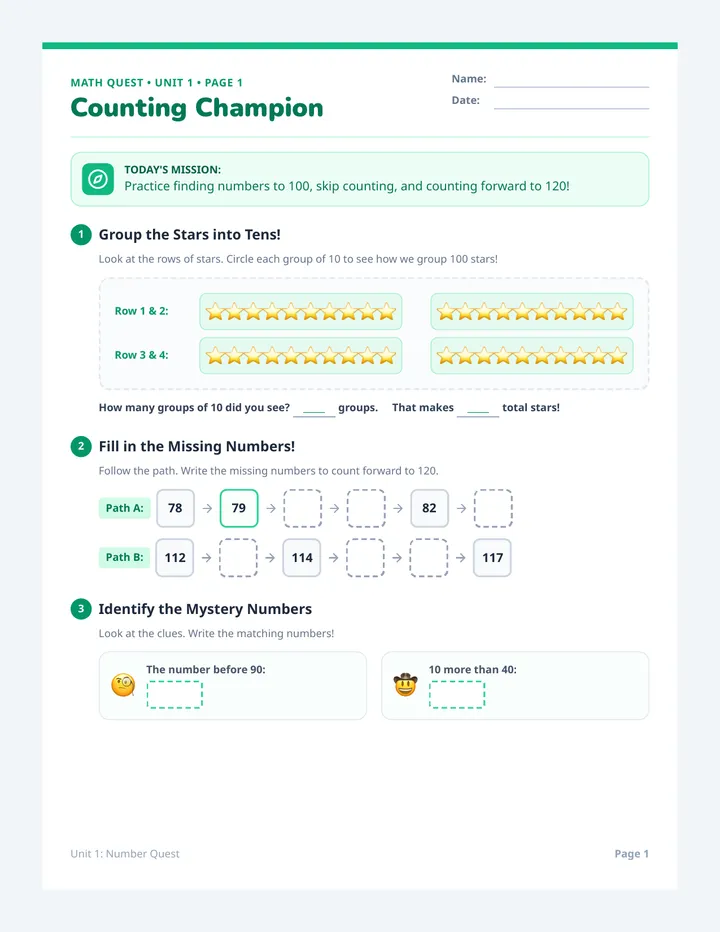
A comprehensive 1st and 2nd-grade math tutoring sequence featuring heavily scaffolded worksheets and visual progress monitoring kits. Covers number sense, algebraic operations, geometry, and measurement.

JC

Jennifer Campbell

16
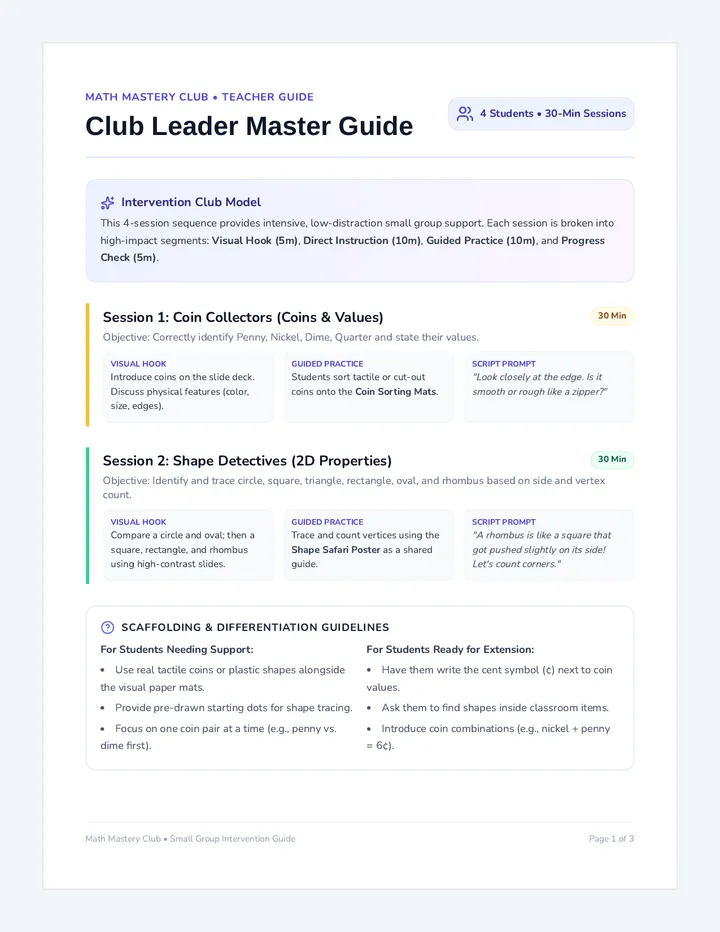
Club Leader Master Guide

Math Mastery Club

An expanded 14-session, cohesive small-group math intervention sequence for four 1st-grade students. Covers coin values (penny, nickel, dime, quarter) over 3 sessions; 2D shapes (circle, square, triangle, rectangle, oval, rhombus) over 3 sessions; and step-by-step number decomposition to make a ten for addition (3 sessions) and subtraction (3 sessions) to ensure deep student mastery.

K

kurtzm

37
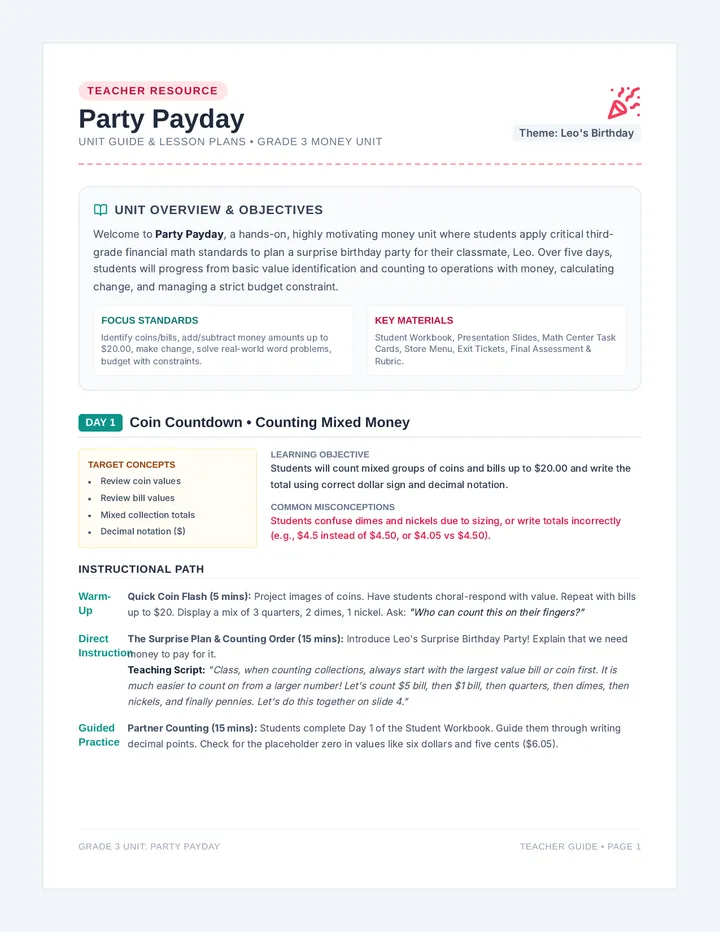
Party Payday Teacher Guide

Party Payday

A 5-day Grade 3 math unit focused on money operations, making change, and budgeting, themed around planning a classmate's birthday party. Students apply math to real-world celebration planning.

JA

Jackie Armata

10
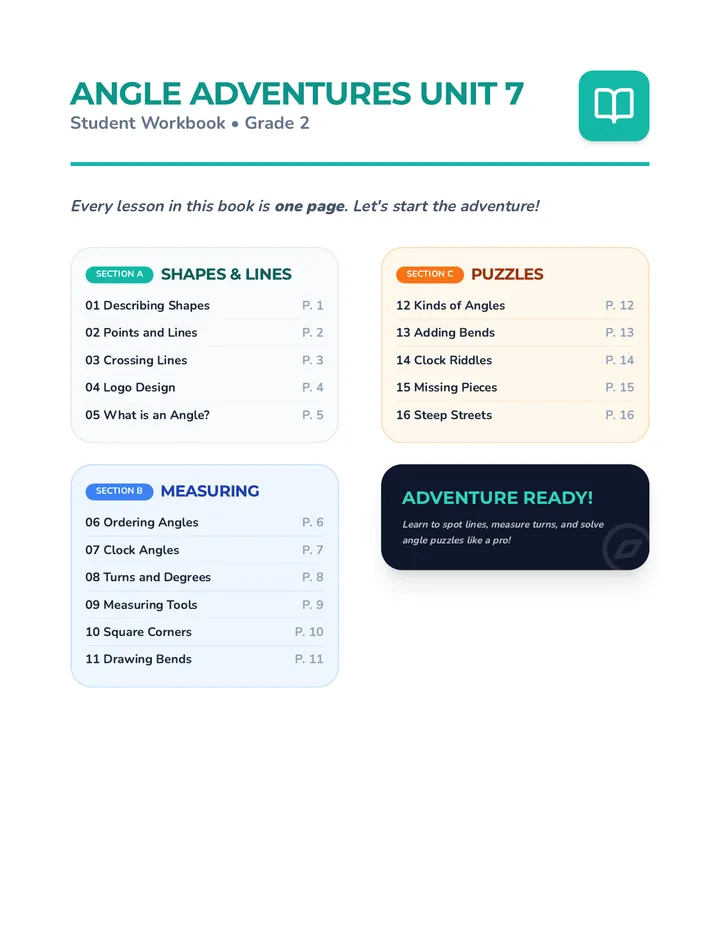
Angle Adventures Table of Contents

Angle Adventures Unit 7

A comprehensive 16-lesson unit on geometry and angle measurement adapted for 2nd-grade students, focusing on simplified language while maintaining the standard of measuring in degrees.

N

nmack

35
Blueprint Basics Anchor Chart

Multi Step Mastery

A comprehensive unit focusing on mastering multi-step word problems using a structured problem-solving routine. Students learn to break down complex problems involving whole numbers, fractions, and decimals using 'blueprint' thinking.

J

jnparrella

9

Lessons

Cash Calculators Slides

Cash Calculators

A comprehensive lesson on mastering currency, from basic coin identification and skip counting to calculating mixed bills and making change in real-world market scenarios. Includes visual slides, scaffolded worksheets, and an interactive matching game.

DP

Deana Padgett

4
Robo Sync Answer Key

Digital Clock Sync

A lesson on reading digital clocks to the hour and half-hour through interactive matching activities.

TL

Tanya Larson

6
Daily Review Practice Worksheet

Checkpoint One Review Lesson

A 10-day ILEARN grade 3 daily math review unit covering place value, rounding, multi-digit operations, algebraic word problems, and money calculations.

KY

Kylie Young

2
Time Tracker Sheet

Tick Tock Time

A foundational lesson on reading analog clocks to the hour and half-hour, featuring hands-on task cards and recording tools.

TL

Tanya Larson

3
Clock Watcher Worksheet

Tick Tock Time

A comprehensive lesson on reading analog clocks to the nearest five minutes, featuring guided practice and independent work.

EC

Emily Condon

6
Money Counting Guide

Money Counting Adventure

An interactive introduction to currency for 5 and 6-year-olds, focusing on identifying coins and bills and performing basic counting through games and activities.

JH

Jade Hodge

4