Lenny.com
Explore
Create
ActivitiesNewMathEnglish Language ArtsScience & EngineeringSocial StudiesGlobal LanguagesHealth & Physical EducationSpecial EducationCounseling & Life SkillsArts & CreativityESL
Lenny.com
Lenny.com
Explore
Create
ActivitiesNewMathEnglish Language ArtsScience & EngineeringSocial StudiesGlobal LanguagesHealth & Physical EducationSpecial EducationCounseling & Life SkillsArts & CreativityESL
Lenny.com
MathNumbers & CountingCounting ObjectsNumber NamesComparing NumbersNumber OperationsCounting SequenceNumbers 0-10Place Value Understanding and SystemAdd and Subtract Within 20Addition and Subtraction ConceptsAddition and Subtraction EquationsAddition and Subtraction ProblemsFoundations for MultiplicationMultiplication and Division PropertiesMultiply and Divide Within 100Multiplication and Division ProblemsFactors and MultiplesProperties of OperationsPatterns and RelationshipsGenerate and Analyze PatternsMulti-Digit ArithmeticPlace Value OperationsMulti-Digit and Decimal OperationsNumerical ExpressionsFour Operations and PatternsFour Operations Problem SolvingMeasurement & DataMeasurable AttributesMeasuring LengthsMeasure and Estimate Lengths in Standard UnitsRelate Addition and Subtraction to LengthClassifying and Counting ObjectsTime and MoneyArea Concepts and MeasurementPerimeter and Area MeasuresAngle Concepts and MeasurementTime, Volume, and MassMeasurement Unit ConversionsGeometryIdentifying ShapesShapes and AttributesShape Attributes and ReasoningShapes and CompositionClassifying 2D FiguresGeometric Figures and RelationshipsLines, Angles, and ShapesAngle, Area, and VolumeGeometric MeasurementVolume of 3D ShapesCoordinate Plane ApplicationsTransformations in the PlaneCongruence and SimilarityUnderstand congruence in terms of rigid motionsSimilarity and TransformationsProve Theorems Involving SimilarityPythagorean TheoremTrigonometry for General TrianglesMake Geometric ConstructionsProve Geometric TheoremsTheorems About CirclesFind Arc Lengths And Areas of Sectors of CirclesVolume FormulasRelationships Between Two-Dimensional and Three-Dimensional ObjectsProve Simple Geometric Theorems AlgebraicallyTranslate Between Geometric Description and Equation for Conic SectionApply Geometric Concepts in Modeling SituationsFractions & DecimalsFractions as NumbersBuilding FractionsFraction Equivalence and OrderingAdding and Subtracting FractionsMultiplying and Dividing FractionsDividing FractionsDecimal FractionsMulti-Digit Computation and FactorsAdd, Subtract, Multiply, and Divide Rational NumbersRational Number SystemIrrational Numbers and ApproximationsRatiosRatios and ProportionsProportional RelationshipsUnit RateAlgebraAlgebraic ExpressionsGenerate Equivalent ExpressionsQuantitative RelationshipsProportional Relationships and Linear EquationsEquations and InequalitiesEquation Solving and ReasoningLinear Equations and SystemsGraph Equations and InequalitiesSystems of EquationsReal-World Algebraic ProblemsQuantitative Reasoning with UnitsExpression StructureEquivalent Expression FormsRadicals and Integer ExponentsRational ExponentsRational and Irrational NumbersPolynomial OperationsPolynomial IdentitiesPolynomial Zeros and FactorsRational ExpressionsComplex Number OperationsComplex Numbers in PolynomialsComplex Numbers on PlaneStatistics & ProbabilityRepresent and Interpret DataData DistributionsStatistical VariabilityProbability ModelsCompound Event ProbabilitiesStatistical SamplingInterpret Categorical and Quantitative DataBivariate Data PatternsInterpret Linear ModelsComparing Two PopulationsRandom Processes in StatisticsIndependence and Conditional ProbabilityExpected ValuesProbability-Based Decision MakingStatistical Inference and ConclusionsFunctionsFunction Concepts and NotationDefine and Compare FunctionsInterpret Functions in ContextAnalyze Function RepresentationsModel Relationships with FunctionsIdentify Linear vs Exponential GrowthDistinguish Between Function TypesCompare Growth RatesInterpret Function ExpressionsBuild Functions from RelationshipsConstruct and Model FunctionsTransform and Combine FunctionsModel Comparison and SelectionSolve Exponential EquationsTrigonometryTrigonometric Ratios Involving Right TrianglesTrigonometric Functions and Unit CircleModel with Trigonometric FunctionsTrigonometric IdentitiesVectors & MatricesIntroduction to Vectors and MatricesVector QuantitiesVector OperationsMatrix OperationsCalculusLimits and ContinuityDerivative Concepts and NotationDerivative Rules and TechniquesApplications of DerivativesOptimization ProblemsRelated RatesCurve Sketching and AnalysisIntegration Concepts and NotationAntiderivatives and Indefinite IntegralsDefinite Integrals and AreaFundamental Theorem of CalculusIntegration TechniquesApplications of IntegrationDifferential EquationsSequences and SeriesParametric and Polar FunctionsVector-Valued Functions

Angle Concepts and Measurement

Identification and measurement of acute, obtuse, right, and straight angles using a protractor. Builds proficiency in geometric relationships, including complementary and supplementary angles.

Lenny.com

Solutions

Lenny for EducatorsLenny for SchoolsLenny for Districts

Product

ExploreSign inCreateSupportAbout

Resources

Getting startedMTSS Acceleration Program

© 2026 Lenny Learning Inc.

TermsPrivacyAccessibility
LinkedInInstagramX
Lenny

Videos

Finding Missing Angles Using the 180-Degree Triangle Rule

Finding Missing Angles Using the 180-Degree Triangle Rule

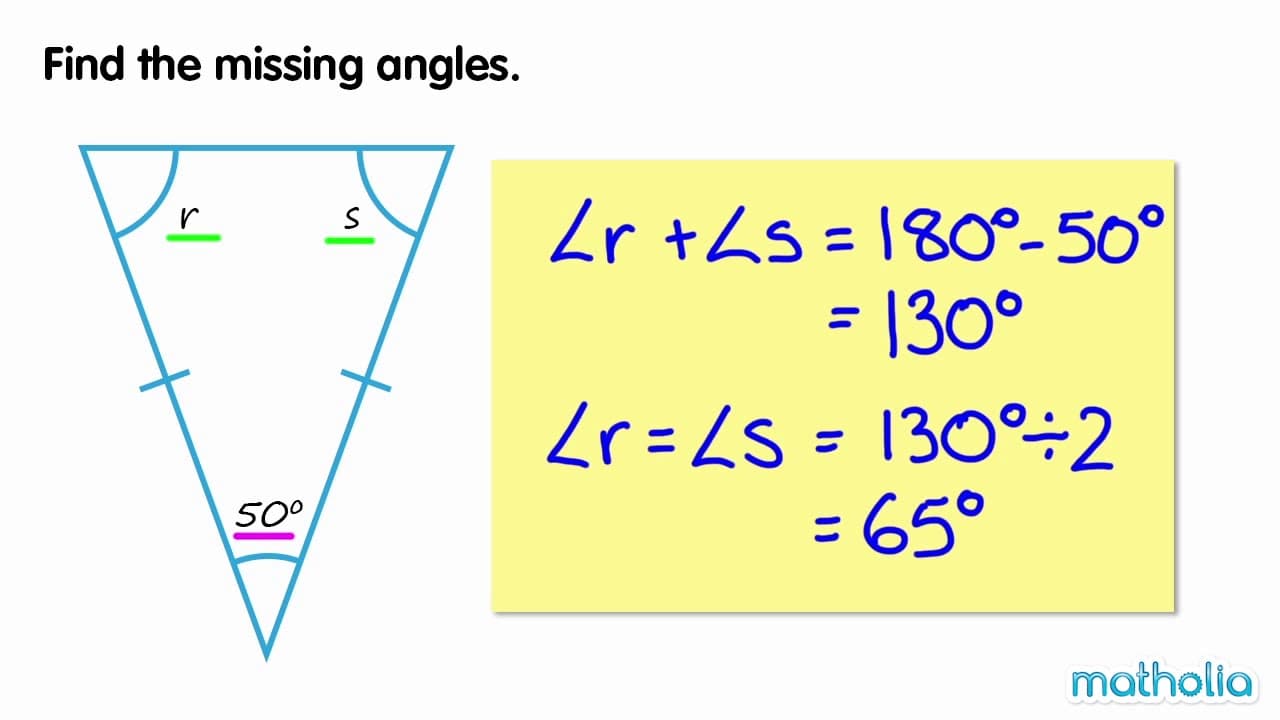
This educational mathematics video provides a clear, step-by-step guide to understanding and calculating the interior angles of triangles. It begins with a conceptual demonstration using a visual 'cutting and rearranging' animation to prove that the sum of angles in any triangle always equals 180 degrees. This foundational concept serves as the anchor for the subsequent problem-solving examples. The video explores two specific scenarios common in geometry curricula: finding a missing angle in a right-angled triangle and finding two missing angles in an isosceles triangle. Key themes include the properties of different triangle types, the significance of geometric notation (such as the square symbol for right angles and tick marks for equal sides), and the application of subtraction to solve for unknowns. For educators, this resource is highly valuable as it moves beyond rote memorization of the "180-degree rule" by first establishing *why* the rule works visually. It then transitions into practical application, modeling how to set up simple subtraction equations to solve geometry problems. The clear visuals and pacing make it excellent for introducing the concept or for student review stations.

MatholiaChannelMatholiaChannel

2mins 3s

Classifying Triangles and Finding Missing Angles

Classifying Triangles and Finding Missing Angles

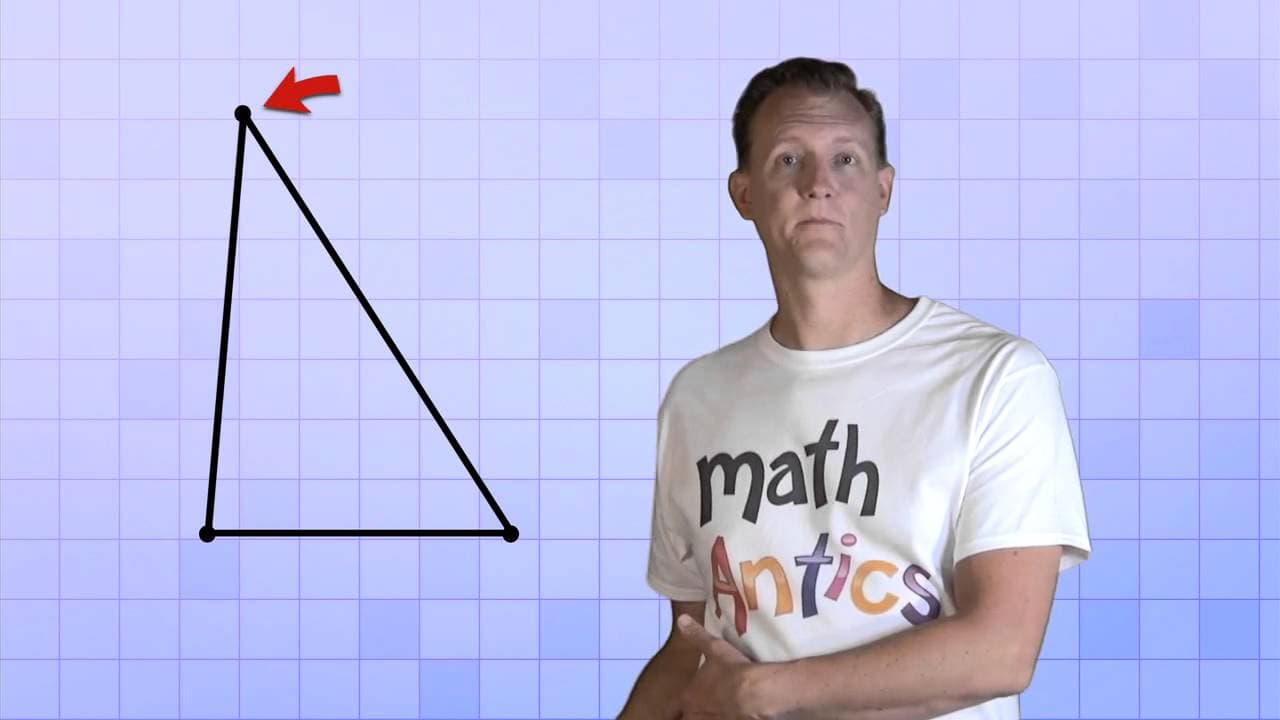
This engaging video provides a comprehensive introduction to triangles, serving as a foundational geometry lesson for elementary and middle school students. The host, Rob from Math Antics, breaks down the definition of a triangle as a three-sided polygon and systematically explains the two primary methods of classification: by side length and by interior angle measurement. The video uses clear, dynamic animations to demonstrate how manipulating vertices changes the triangle's properties, making abstract geometric concepts concrete and visual. The content covers key vocabulary including equilateral, isosceles, and scalene for side-based classification, and right, acute, and obtuse for angle-based classification. A significant portion of the video is dedicated to a matrix that explores how these two classification systems overlap, importantly highlighting which combinations are geometrically impossible (such as a right equilateral triangle). This section promotes critical thinking rather than just rote memorization of definitions. Finally, the video introduces the Angle Sum Theorem, visually proving that the three interior angles of any triangle always add up to 180 degrees. This concept is then applied practically, showing students how to calculate a missing angle when two are known. With its blend of humor, clear visuals, and logical progression, this video is an excellent resource for introducing geometry units, reinforcing vocabulary, or supporting students who struggle to visualize geometric relationships.
mathanticsmathantics

7mins 40s

Understanding Angles, Degrees, and How to Measure Them

Understanding Angles, Degrees, and How to Measure Them

This engaging educational video introduces students to the fundamental concepts of measuring angles using degrees. It clarifies the distinction between measuring length with rulers and measuring rotation with degrees, using clear visual animations to demonstrate how an angle is formed by rotating a ray around an axis. The video takes viewers on a journey from 0 to 360 degrees, stopping to identify and define critical angle types including acute, right, obtuse, and straight angles. The content covers essential geometric vocabulary and measurement techniques. It explains the degree symbol, demonstrates how a protractor is used to measure unknown angles, and visually defines the four quadrants of rotation. Special emphasis is placed on memorizing key benchmarks like 90 degrees (right angle) and 180 degrees (straight angle). The video concludes with practical application problems, showing students how to calculate unknown angle measurements using the properties of complementary and supplementary angles. For educators, this video serves as an excellent primary resource for introducing geometry units or reinforcing measurement skills. The clear, step-by-step animations make abstract concepts concrete, while the inclusion of humor (comparing temperature degrees to geometric degrees) helps maintain student engagement. The final segment connecting angle properties to basic algebraic thinking provides a natural bridge for middle school math curriculums.

mathanticsmathantics

9mins 17s

Understanding Circles: Area, Circumference, Arcs, and Angles

Understanding Circles: Area, Circumference, Arcs, and Angles

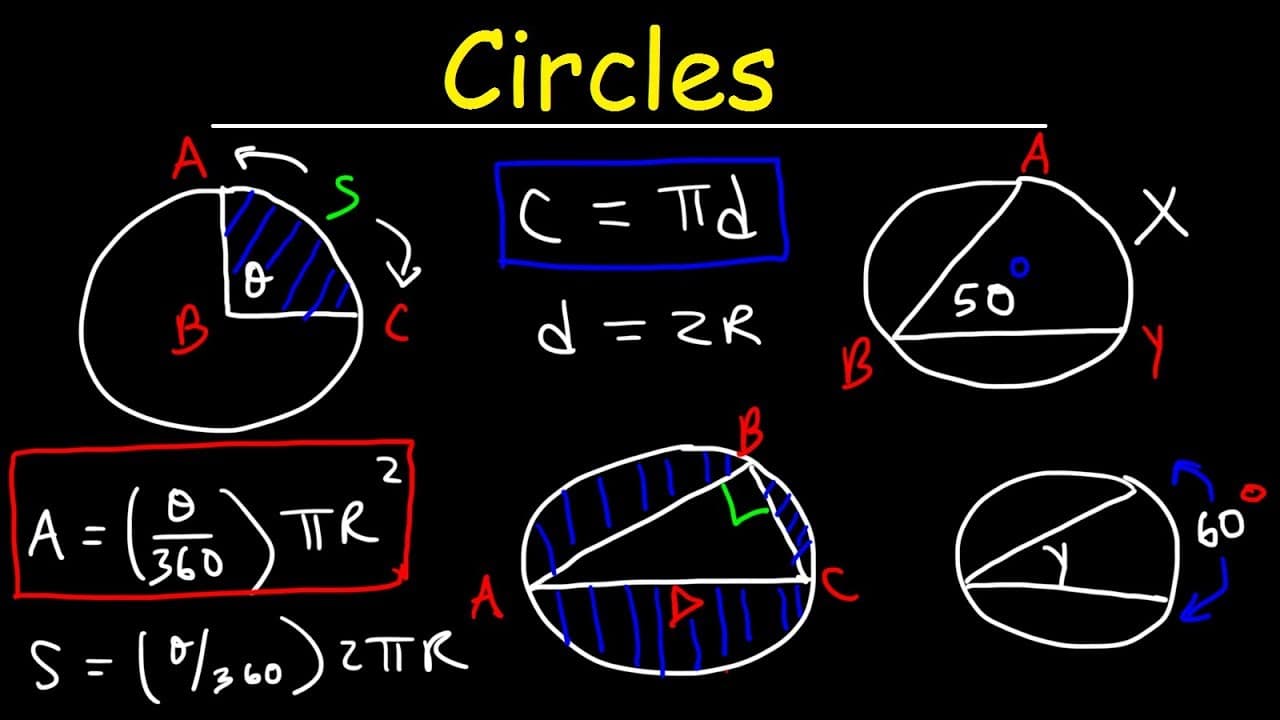
This comprehensive math tutorial provides an in-depth exploration of circle geometry, moving from basic definitions to complex problem-solving. The video begins by defining fundamental components such as the radius, diameter, circumference, and area, clearly establishing the relationship between these elements. It progresses to more advanced concepts including sectors, arc lengths, chords, and the theorems governing central and inscribed angles. The narration uses a blackboard style to visually demonstrate how formulas are derived and applied. Key themes include the distinction between central and inscribed angles, calculating the area of sectors and segments, and using the Pythagorean theorem within circle contexts. The video explicitly covers the Inscribed Angle Theorem—demonstrating that an inscribed angle is half the measure of its intercepted arc—and explores how to calculate arc lengths and sector areas using degrees. It concludes with multi-step word problems that require synthesizing multiple concepts, such as finding the area of a shaded region by subtracting a triangle's area from a circle's area. For educators, this video serves as an excellent instructional tool for high school geometry units. It can be used to introduce new vocabulary, demonstrate the application of formulas, or review for standardized tests. The step-by-step problem-solving sections allow teachers to pause and let students attempt calculations before seeing the solution, making it ideal for interactive classroom learning or independent study for students needing remediation on geometric concepts.

The Organic Chemistry TutorThe Organic Chemistry Tutor

18mins 7s

Finding Missing Angles on a Straight Line

Finding Missing Angles on a Straight Line

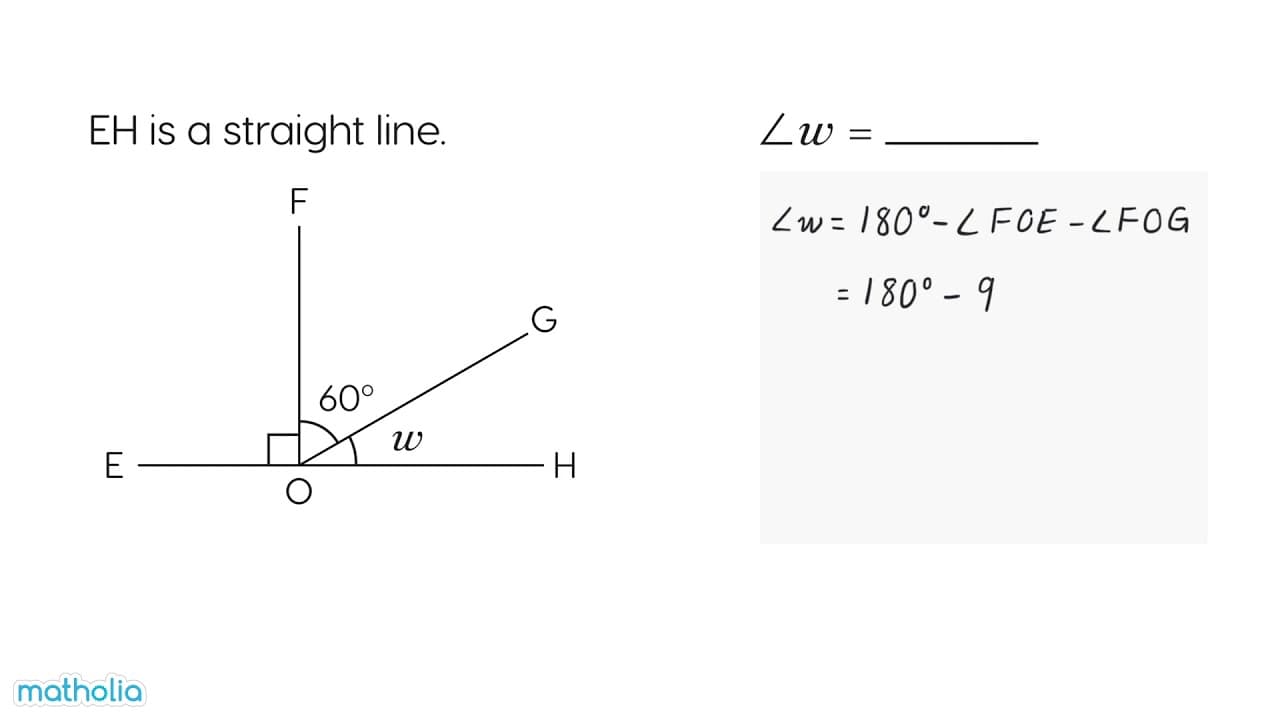
This educational math video provides a clear, step-by-step tutorial on calculating unknown angles situated on a straight line. Using clear diagrams and on-screen text, the video demonstrates the fundamental geometric property that angles on a straight line add up to 180 degrees. It guides viewers through three distinct examples of increasing complexity, starting with a basic three-angle split and progressing to problems involving right angle symbols and multiple rays. The content focuses on key geometry themes such as angle properties, deductive reasoning, and algebraic substitution. It reinforces the concept of a "straight angle" and introduces standard geometric notation, including the square symbol for right angles (90 degrees). The video also explicitly models the problem-solving process: stating the knowns, setting up the subtraction equation based on the 180-degree rule, and performing the calculation to find the variable. For educators, this video is an excellent resource for visual learners in upper elementary or middle school geometry. It can be used to introduce the concept of supplementary angles or as a refresher on angle summation. The clear visual layout, where algebraic steps appear alongside the geometric diagram, helps students bridge the gap between spatial reasoning and arithmetic calculation. It is particularly useful for modeling how to set up equations for missing angles before asking students to solve similar problems independently.

MatholiaChannelMatholiaChannel

2mins 20s

How to Draw a 60-Degree Angle Using a Protractor

How to Draw a 60-Degree Angle Using a Protractor

This concise instructional video demonstrates the step-by-step process of constructing a specific acute angle (60 degrees) using standard geometric tools. The narration guides viewers through placing a ruler to draw a base ray, marking a vertex, correctly aligning a protractor, identifying the correct degree measurement on the scale, and connecting points to finalize the angle. The video emphasizes precision and proper tool handling, specifically highlighting how to align the protractor's center point and base line relative to the drawn line. The central themes are geometric construction, measurement precision, and the practical application of mathematical tools. It specifically focuses on the procedural knowledge required to create angles less than 90 degrees, serving as a foundational skill for more complex geometry tasks like constructing triangles or polygons. The visual simplicity allows learners to focus entirely on the technique without distraction. For educators, this video serves as an excellent model for explicit instruction. It effectively breaks down a physical task that is often difficult to demonstrate to a large group. Teachers can use this video to introduce the concept of using a protractor, as a refresher for students struggling with alignment, or as a self-paced guide during independent practice stations where students construct their own angles alongside the tutorial.

MatholiaChannelMatholiaChannel

1min 16s

Materials

Grade 4 Math Priority Pacing Guide

Grade 4 Math Priority Pacing Guide

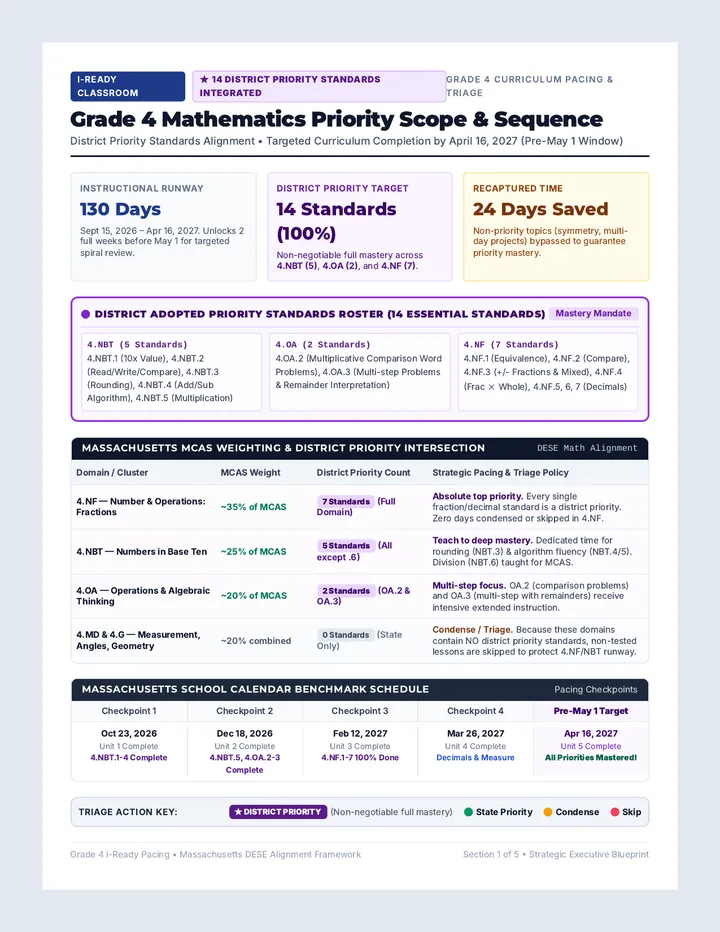
A comprehensive 5-page standards-aligned Grade 4 Mathematics curriculum pacing guide for i-Ready Classroom Mathematics, specifically incorporating the 14 designated District Priority Standards across 4.OA, 4.NBT, and 4.NF. Calibrated to the Massachusetts Curriculum Frameworks to guarantee 100% completion of all district priority standards before May 1, featuring explicit district priority badging, unit-by-unit pacing dates, strategic triage rationales for non-priority topics, and a Tier 2 prerequisite intervention bridge.

AS

Ashley Santiago

Circle Secrets Cheat Sheet

Circle Secrets Cheat Sheet

An expanded single-page reference sheet for circle geometry. Now includes boundary formulas (circumference, area, arc length) and a comprehensive section on angle relationships (central, inscribed, interior, and exterior angles) with visual aids. All fractional formulas have been updated to use division by 2 and the diagrams have been refined for clarity.

C

Courtney.Smiley

Geometry Blueprint Reference

Geometry Blueprint Reference

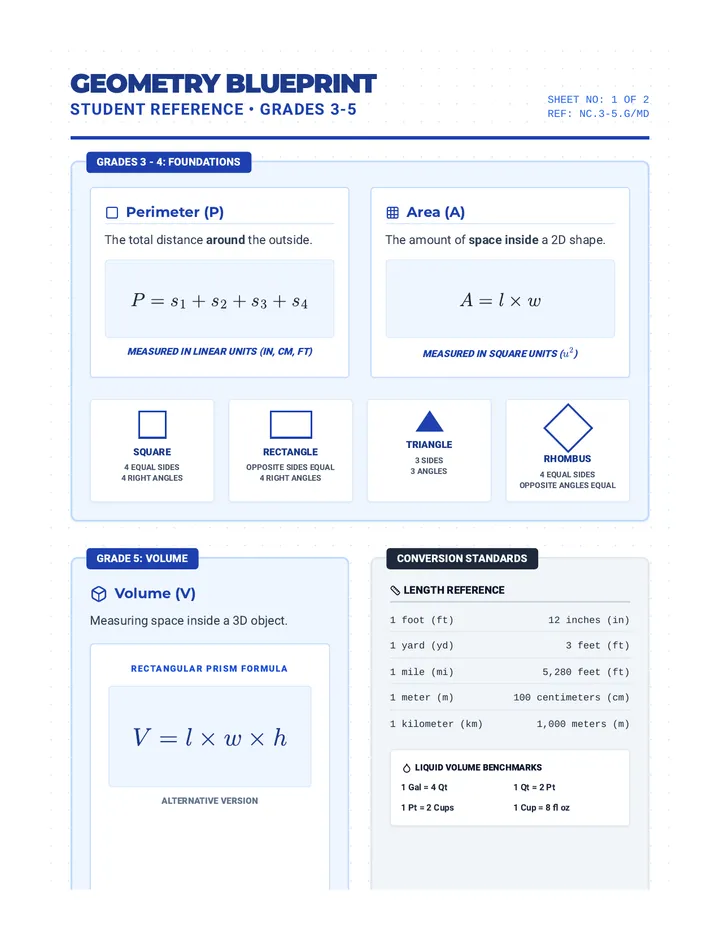
A comprehensive two-page printable geometry anchor chart for grades 3-8, themed as a technical blueprint. Features grade-banded formulas for perimeter, area, volume, surface area, and circles, including the Pythagorean theorem and common measurement conversions. Organized with MathJax for professional notation.

KB

Karen Brown

MCAS Grade Four Math Reference Chart

MCAS Grade Four Math Reference Chart

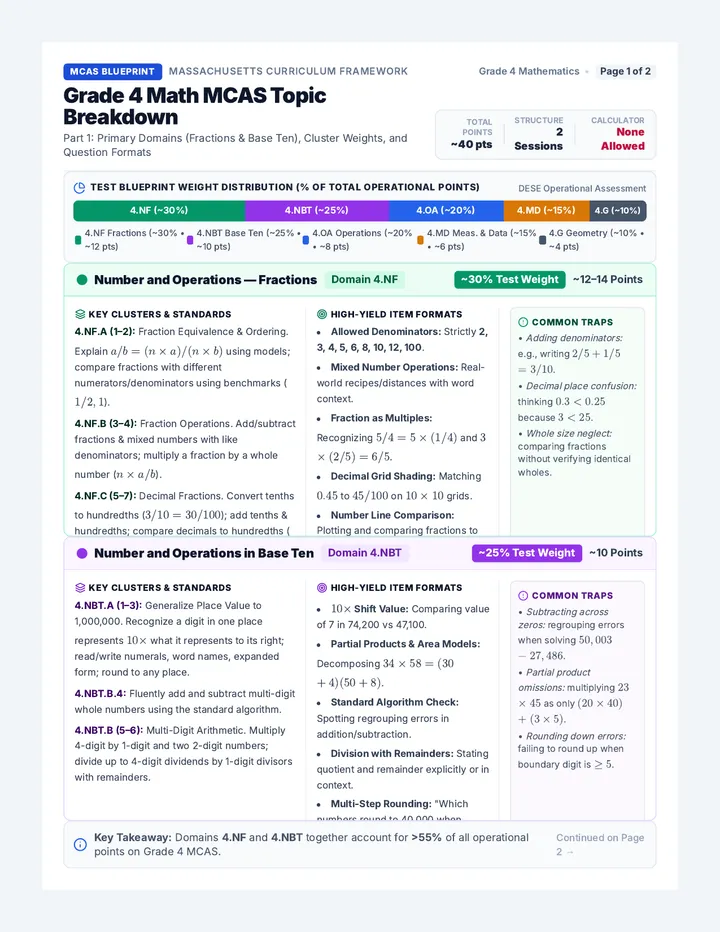
A comprehensive two-page reference chart detailing the Massachusetts MCAS Grade 4 Mathematics test blueprint, including domain weights, priority clusters, released item archetypes, common misconceptions, and constructed-response rubrics.

MS

Meaghan Smith

Circle Secrets Reference Sheet

Circle Secrets Reference Sheet

A circle geometry reference sheet with updated formula rendering and cleaner diagrams that remove redundant borders for a professional look. Diagrams are now clipped and footer text is expanded for clarity.

C

Courtney.Smiley

Clock and Count Practice Worksheet

Clock and Count Practice Worksheet

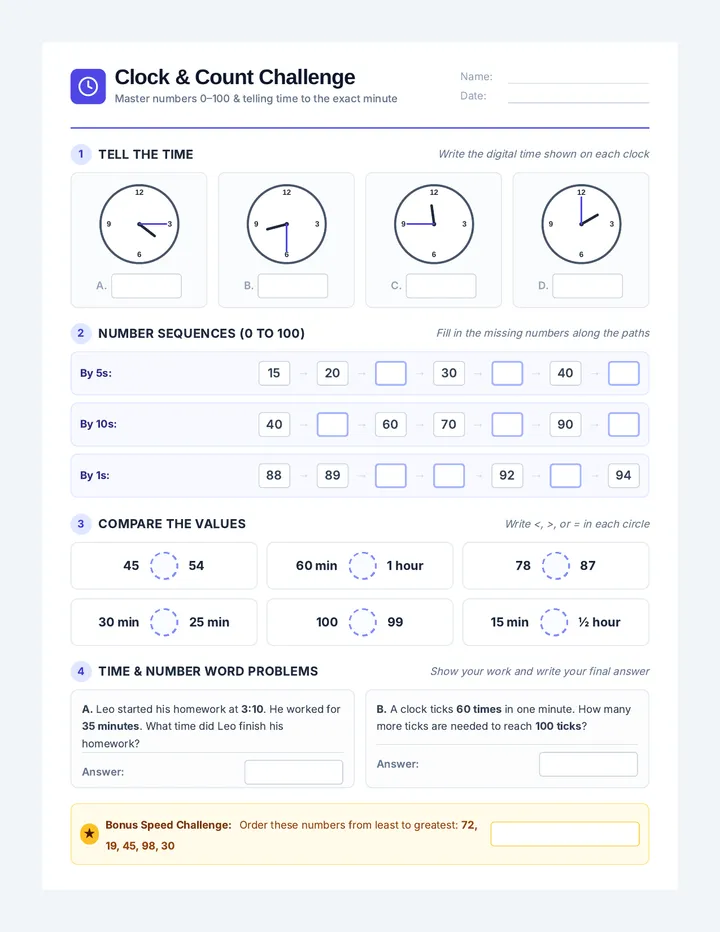
A one-page printable worksheet combining time-telling on analog clocks with numbers 0 to 100, including sequence completion, comparison, and time-based word problems.

CS

Carlos Santos

Sequences

Equation Balancing Student Packet

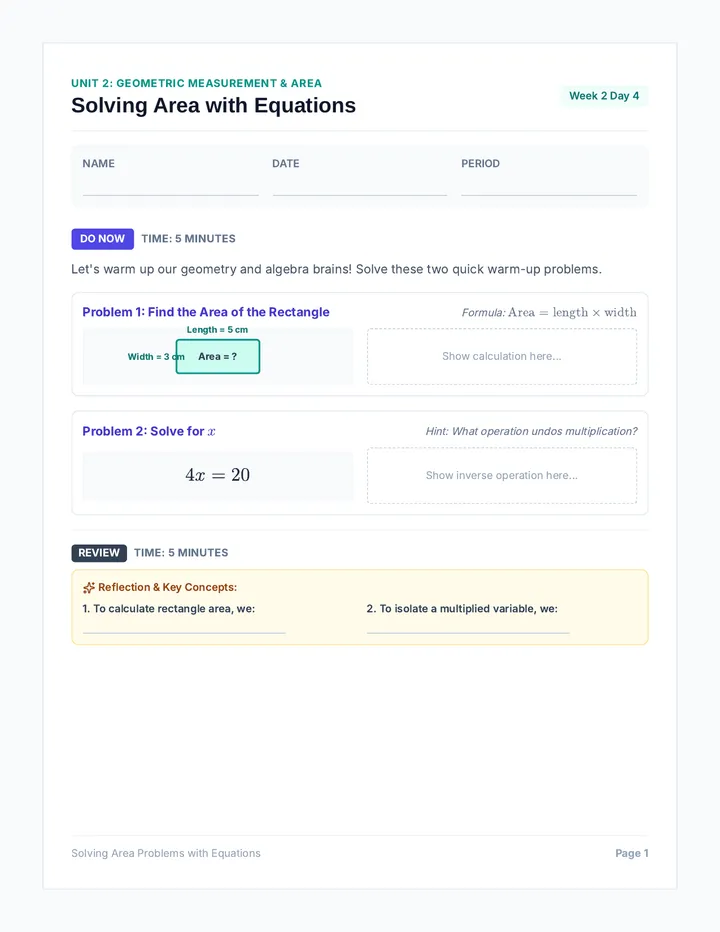
Distance Detectives

A highly visual geometry unit focused on applying algebraic formulas to coordinate planes. Students use coordinate grids, step-by-step graphic organizers, and tactile representations to solve real-world distance and segment length problems.

D

deeohnny.jackson

64
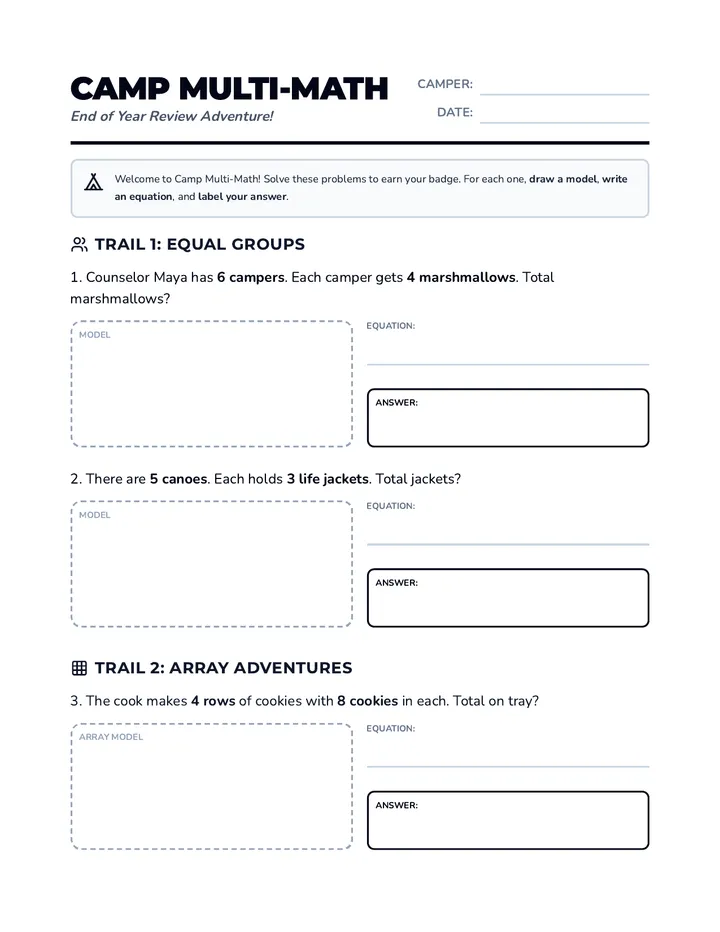
Camp Multi-Math Worksheet

Math Review Adventures

A collection of themed end-of-year math review adventures for different grade levels, focusing on spiraling key standards and problem-solving.

DB

Deborah Burton

21
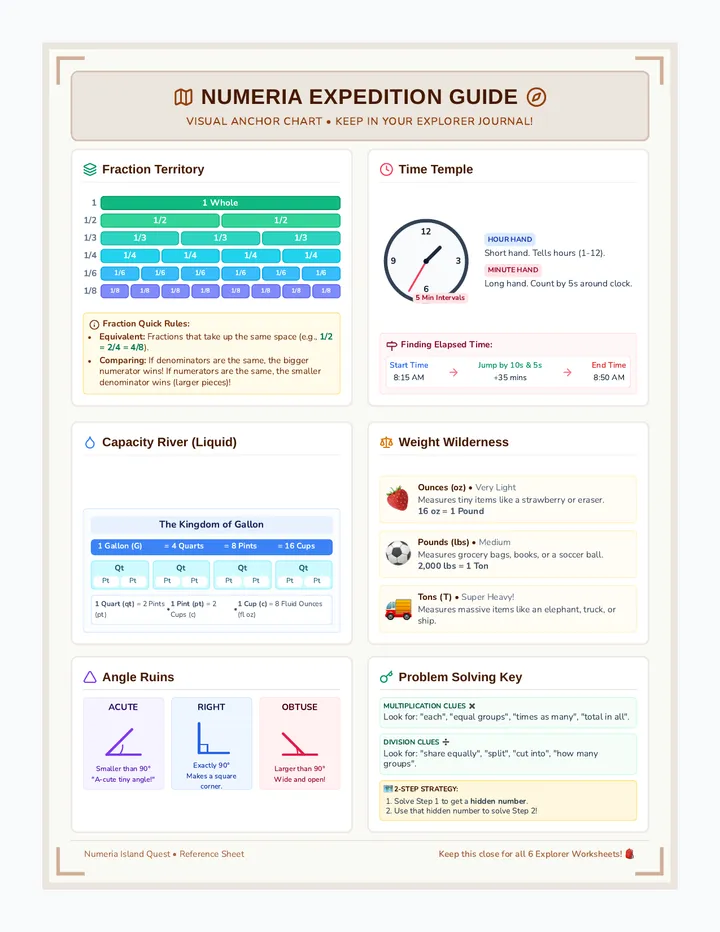
Numeria Expedition Guide Anchor Chart

Explorer Math Adventures

A series of themed explorer math quests designed to reinforce key elementary math concepts for multiple grade levels (rising 3rd and 4th graders) through storytelling, beautiful visuals, and complete self-checking resources.

JC

Jennifer Campbell

15
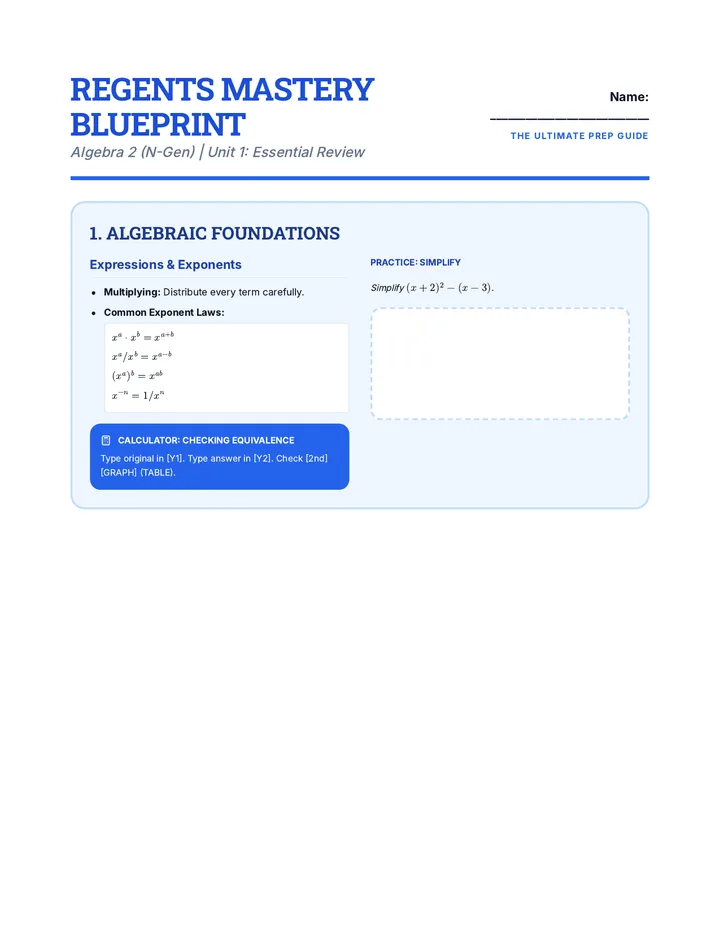
Regents Mastery Blueprint Study Guide

Regents Mastery Suite

A comprehensive review suite for the New York State Mathematics Regents exams, including Algebra 1, Geometry, and Algebra 2, featuring mastery blueprints, calculator strategies, and exam-taking tips.

KB

Kayla Borozny

15
Equation Architect Slides

Geometric Foundations

A comprehensive unit covering 7th-grade geometry standards, focusing on scale drawings, geometric constructions, 3D cross-sections, angle relationships, and solving real-world area, volume, and surface area problems.

D

dbonicoro

25
Temple Craftsmen Slides

Middle School Math Block

A multi-subject middle school mathematics block for Week 1, covering 6th Grade Geometry (Temple Craftsmen: polygon decomposition, nets, surface area) and 7th/8th Grade Math (Faithful Stewards: proportional relationships, linear equations, inequalities, transversals) from a Christian perspective.

JR

Jamens Ray II

59

Lessons

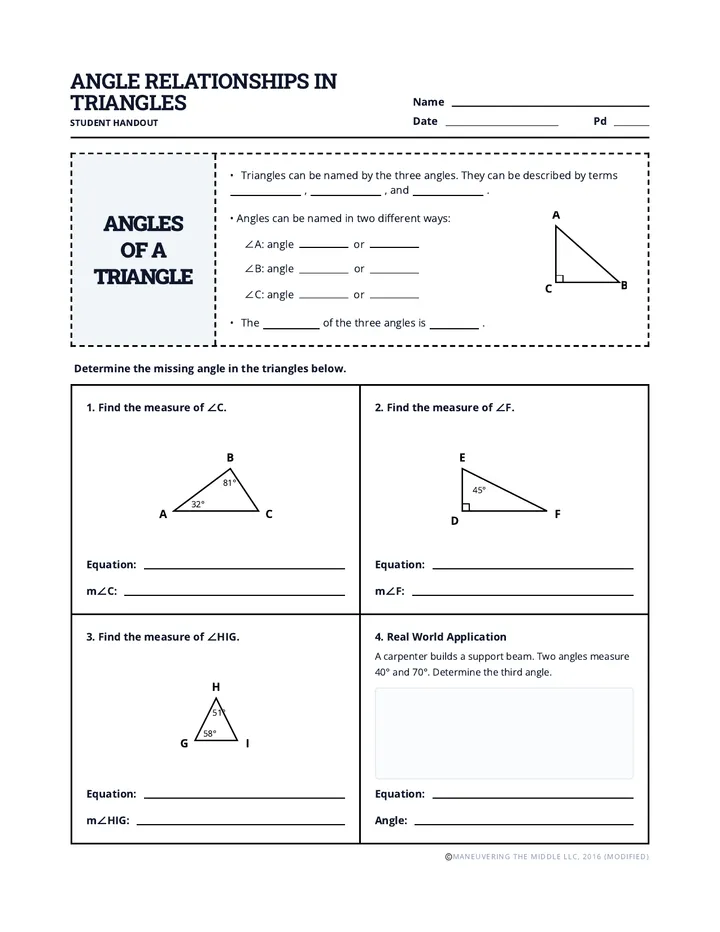
Triangle Sum Secrets Handout

Triangle Sum Secrets

A simplified lesson on the Triangle Sum Rule, focusing on 3-letter angle naming and solving for missing angles using one-step equations with whole numbers.

HF

Hannah Fernandes

6
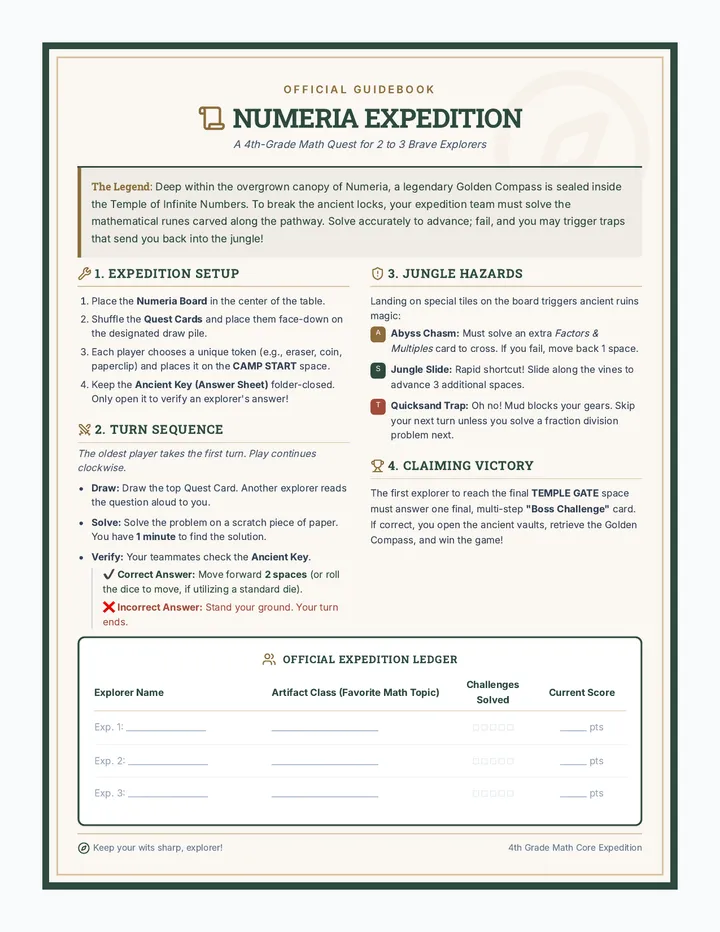
Numeria Expedition Rulebook

Numeria Expedition

A comprehensive, adventure-style 4th-grade math review board game where students solve challenges across 8 core curriculum units to escape the ruins of Numeria. Designed for 2-3 players, it features a printable game board, challenge cards, a player rulebook, and a quick-reference answer key.

N

nmack

4
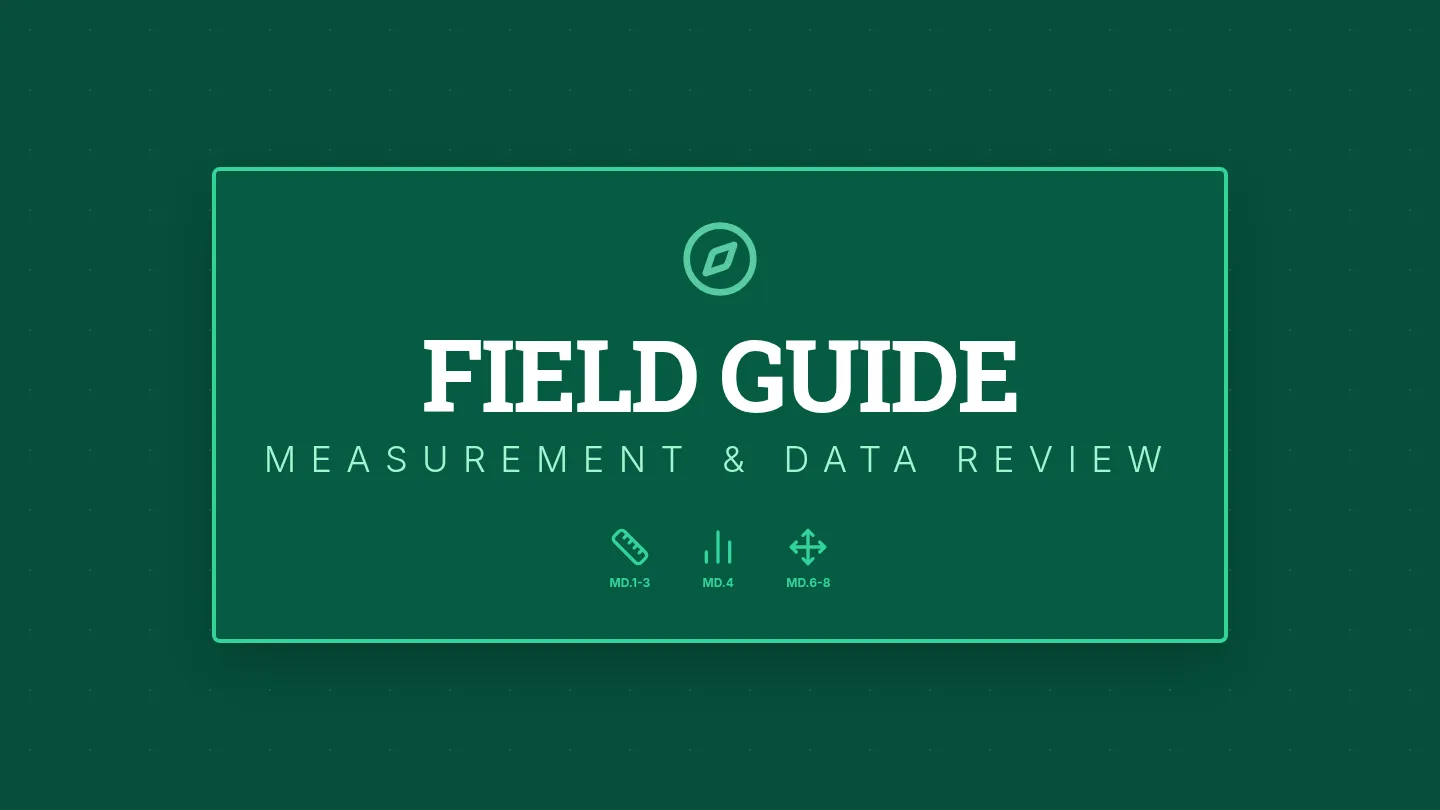
Measurement Field Guide Slides

Drafting Board Measurement & Data Review

A precision-focused drafting-themed review of 4th grade Measurement and Data (MD) standards. Covers units and conversions (MD.1), measurement word problems (MD.2), area and perimeter (MD.3), line plots (MD.4), and angle measurement and addition (MD.6-7). Division has been removed from the curriculum.

DG

Debra Golden

18
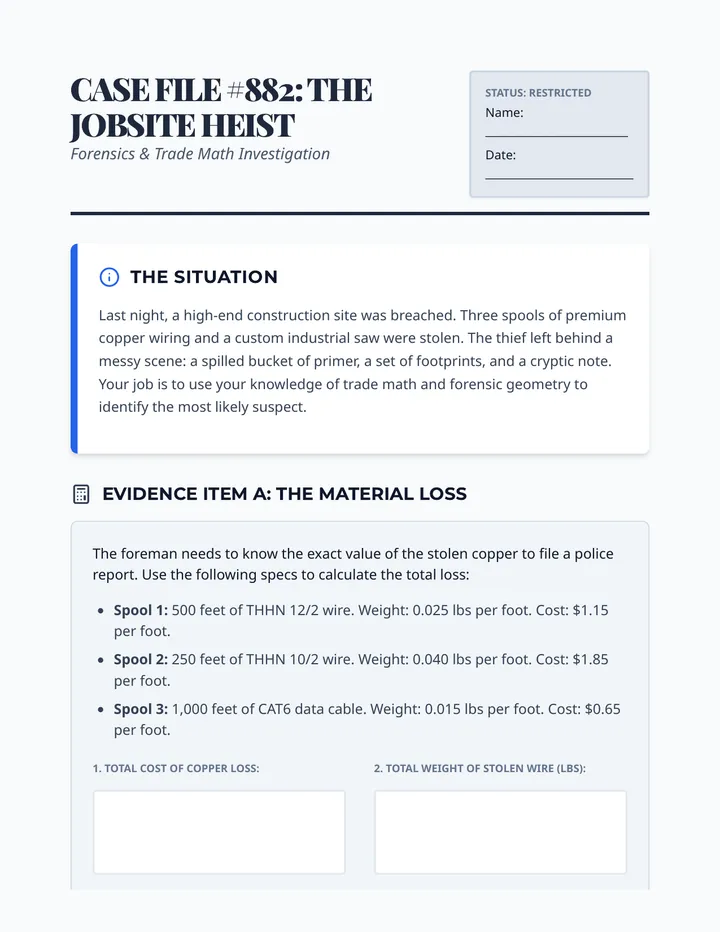
Crime Scene Blueprint Worksheet

Logic Lockdown

A collection of high-interest, multi-disciplinary logic and math challenges themed around forensic investigation, trade skills, and historical mysteries. Designed for high-school level adult learners to practice critical thinking and practical math application.

VL

V Lundgren

10
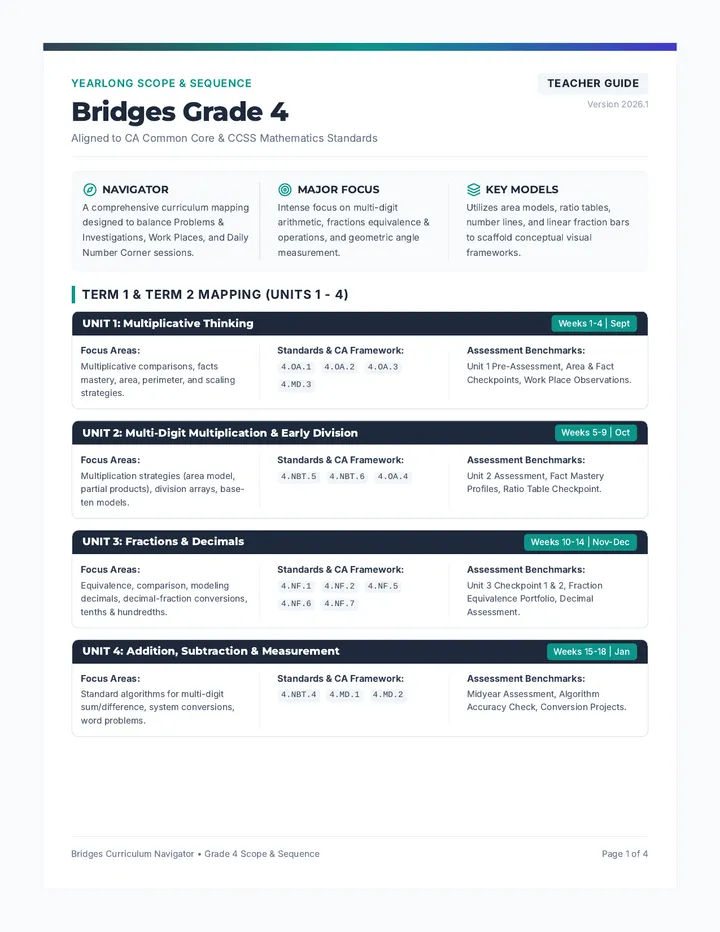
Bridges Yearlong Map Document

Bridges Curriculum Navigator

A comprehensive curriculum mapping, planning, and assessment suite for 4th Grade Bridges Math, fully aligned with Common Core and California State Standards (CCSS-M / CA Common Core). Includes a year-long scope and sequence, weekly and daily planning templates, and an assessment tracker.

AJ

Alexander Jacinto

7
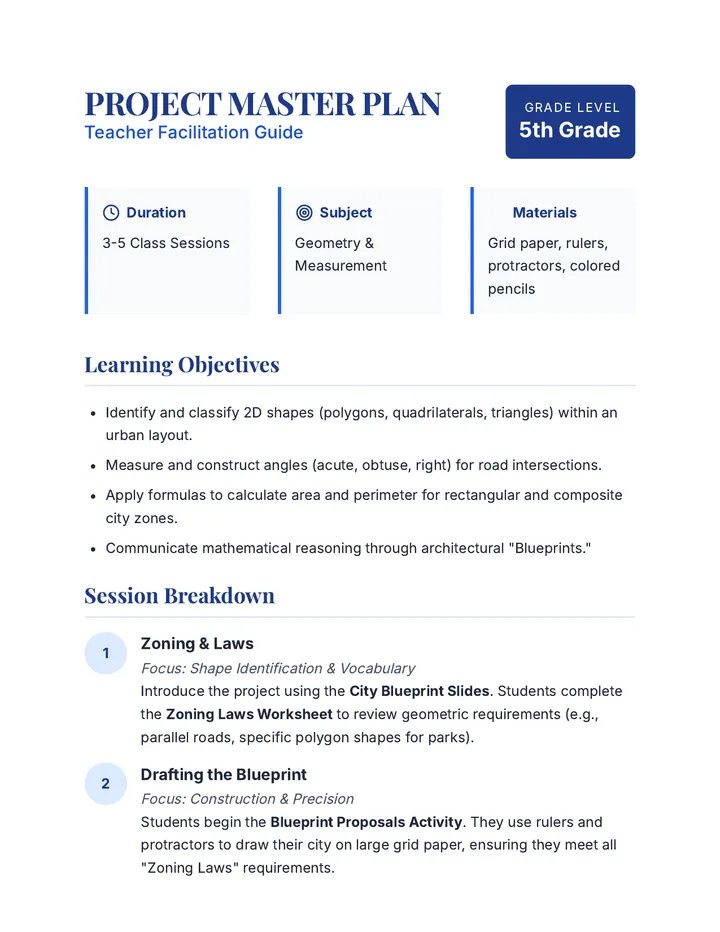
Planner Guide Teacher Resource

Geometric City Planners

A hands-on geometry project where students act as urban planners to design a city using specific geometric shapes, angles, and area/perimeter calculations. Students will bridge the gap between abstract geometry and real-world architecture.

KL

Kim Leary

6