Lenny.com
Explore
Create
ActivitiesNewMathEnglish Language ArtsScience & EngineeringSocial StudiesGlobal LanguagesHealth & Physical EducationSpecial EducationCounseling & Life SkillsArts & CreativityESL
Lenny.com
Lenny.com
Explore
Create
ActivitiesNewMathEnglish Language ArtsScience & EngineeringSocial StudiesGlobal LanguagesHealth & Physical EducationSpecial EducationCounseling & Life SkillsArts & CreativityESL
Lenny.com
Lenny.com

Solutions

Lenny for EducatorsLenny for SchoolsLenny for Districts

Product

ExploreSign inCreateSupportAbout

Resources

Getting startedMTSS Acceleration Program

© 2026 Lenny Learning Inc.

TermsPrivacyAccessibility
LinkedInInstagramX
Lenny

Fractions as Numbers

Numerical representation of parts of a whole and location on number lines. Develops understanding of fraction magnitude, equivalence, and the relationship between numerators and denominators.

Videos

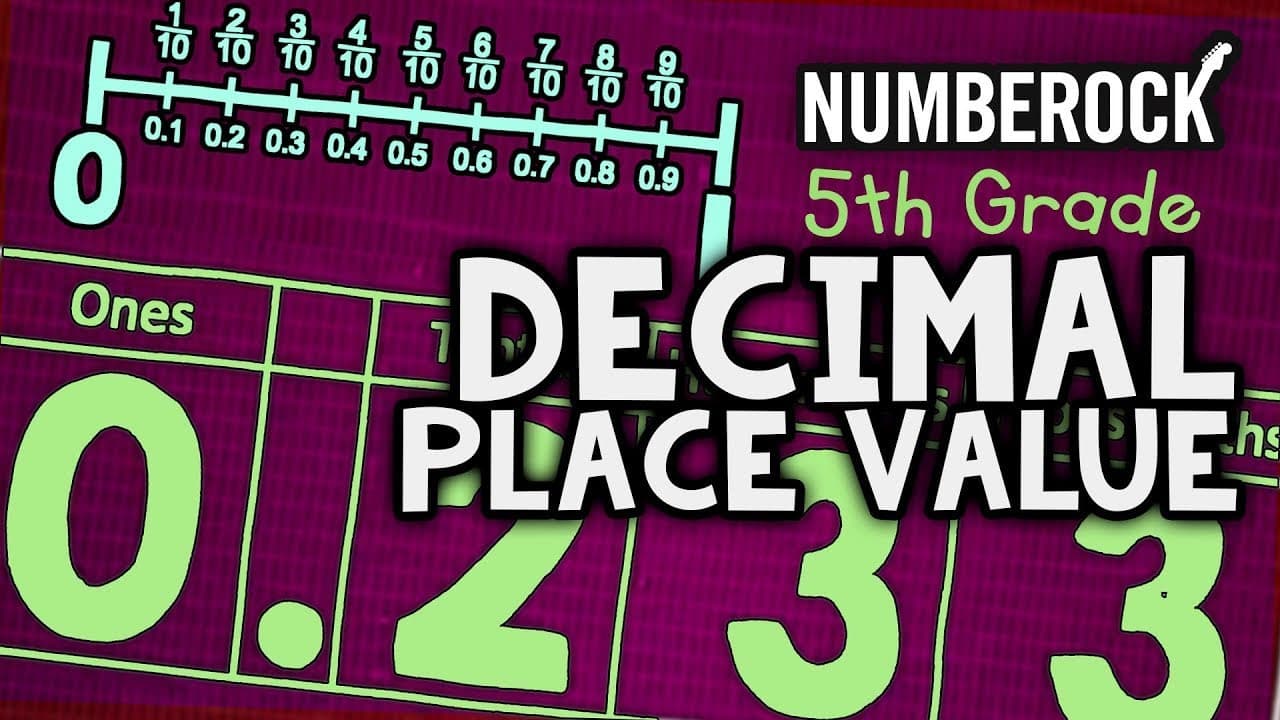
Exploring Decimal Place Value and Fractions

Exploring Decimal Place Value and Fractions

This engaging animated music video introduces and explains the concept of decimal place value through catchy lyrics and clear visual demonstrations. The video breaks down the relationship between whole numbers and decimals, specifically focusing on tenths, hundredths, and thousandths. It uses dynamic graphics to visualize how dividing the number one into ten equal parts creates tenths, and how further dividing those parts creates hundredths and thousandths, establishing the pattern of the base-ten system. The core themes include the equivalence between fractions and decimals (e.g., 1/10 = 0.1), the structure of the place value chart, and the concept of values getting smaller as they move to the right of the decimal point. The video also introduces the number line as a tool for visualizing where decimals live between whole numbers, demonstrating the concept of "zooming in" to find smaller and smaller values. For educators, this video serves as an excellent hook or review tool for upper elementary mathematics. It transforms abstract concepts into concrete visual models, making it ideal for introducing decimal notation, reinforcing the connection to fractions, or helping students visualize the relative size of decimal place values. The song's repetitive chorus helps memorize the directionality of place value (whole numbers left, decimals right), while the rap section provides a deeper conceptual explanation suitable for diverse learners.

Math Songs by NUMBEROCKMath Songs by NUMBEROCK

3mins 24s

Comparing and Ordering Like Fractions with Visuals

Comparing and Ordering Like Fractions with Visuals

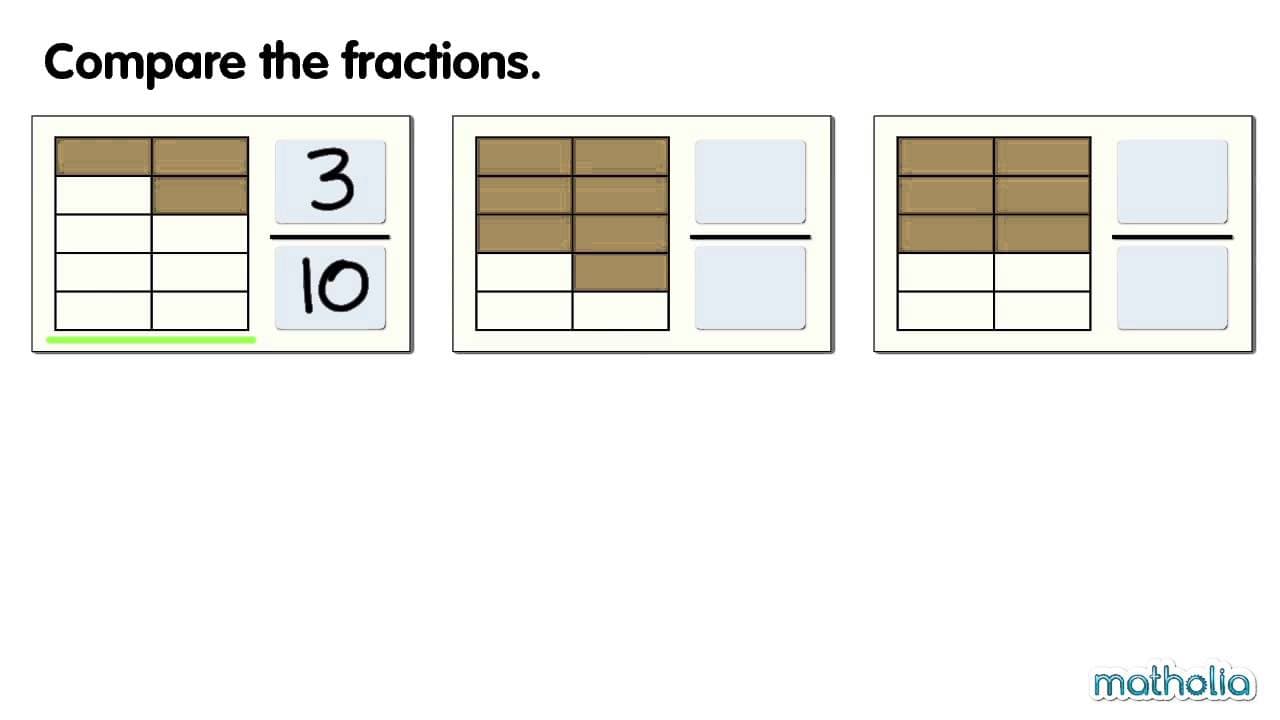
This educational video provides a clear, step-by-step demonstration on how to compare and order "like fractions"—fractions that share the same denominator. Through the use of clear visual aids, specifically divided pentagons and rectangular grids, the video illustrates the direct relationship between the shaded areas of a shape and their numerical fraction representations. It guides viewers through the process of identifying fractions, comparing their sizes based on visual shading, and subsequently ordering them from greatest to smallest or smallest to greatest. The core theme focuses on understanding the components of a fraction, specifically the role of the numerator and denominator in comparison. The video explicitly defines "like fractions" as those with equal denominators and introduces the fundamental rule: when denominators are the same, the fraction with the larger numerator is the greater fraction. This concept is reinforced through two distinct examples involving fifths and tenths. For educators, this video serves as an excellent visual anchor for introducing fraction comparison. It bridges the gap between concrete visual models and abstract numerical rules, making it highly effective for students who struggle to understand why a larger number (numerator) means a larger value in this specific context. Teachers can use this video to transition students from counting shaded parts to applying the mathematical rule for comparing numerators, providing a solid foundation for future work with unlike fractions.

MatholiaChannelMatholiaChannel

3mins 6s

Understanding and Converting Improper and Mixed Fractions

Understanding and Converting Improper and Mixed Fractions

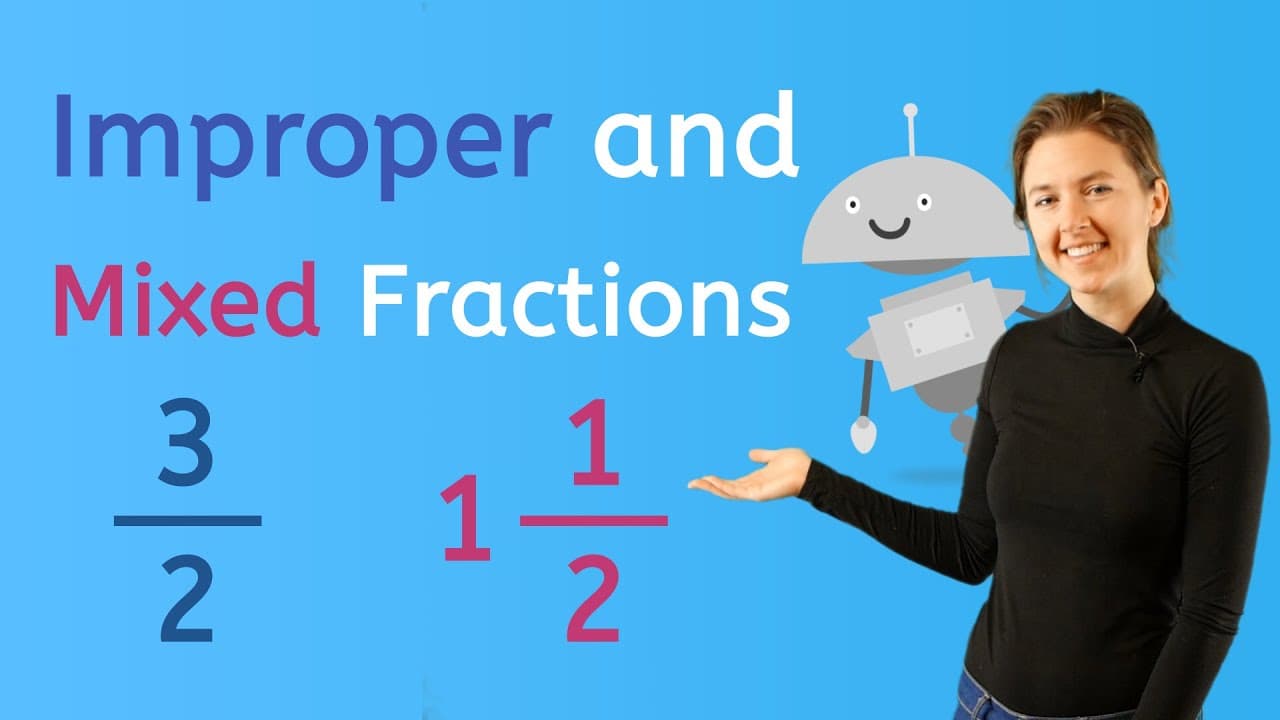
This educational video provides a clear and accessible introduction to the three main types of fractions: proper fractions, improper fractions, and mixed numbers. The host, Kylie, uses simple visual aids and on-screen text to define each term, helping students distinguish between fractions where the numerator is smaller than the denominator and those where it is greater. The pacing is deliberate and friendly, making potentially confusing terminology easy to digest for elementary learners. The core of the video focuses on the relationship between improper fractions and mixed numbers. Using the example of 3/2, the video visually demonstrates how three halves fill up one whole circle and half of another, proving that 3/2 is equivalent to 1 1/2. This visual proof is followed by a procedural "secret trick"—an algorithm for converting mixed numbers back into improper fractions by multiplying the whole number by the denominator and adding the numerator. Teachers can use this video to introduce fraction classification or to support lessons on converting mixed numbers. The dual approach—conceptual (using visual circle models) and procedural (using the multiplication algorithm)—supports different learning styles. The video is particularly useful for bridging the gap between understanding what a fraction represents and performing calculations with them.

Miacademy & MiaPrep Learning ChannelMiacademy & MiaPrep Learning Channel

6mins 23s

Mastering Fractions: Parts, Wholes, and Types Explained

Mastering Fractions: Parts, Wholes, and Types Explained

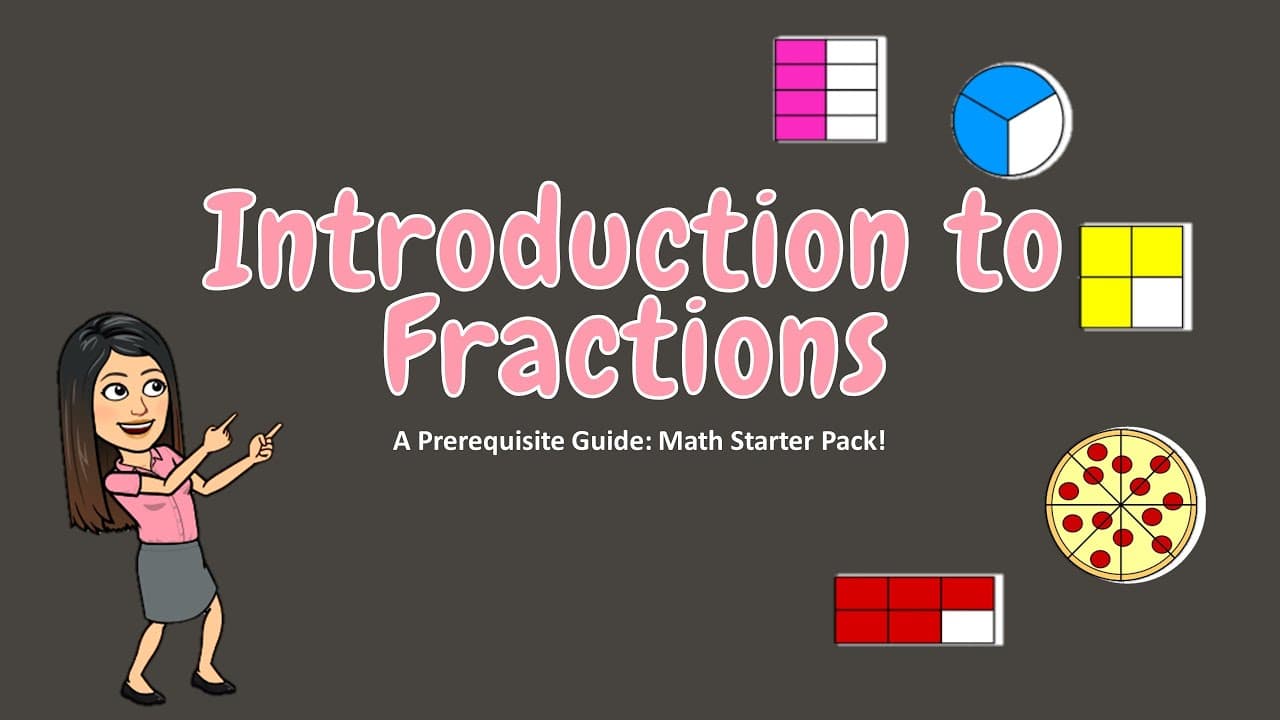
This educational video serves as a comprehensive introduction to fractions, designed specifically for elementary mathematics students. Using relatable and appetizing visual aids like pizza, chocolate bars, and birthday cake, the narrator breaks down the fundamental concept that fractions represent parts of a whole. The video moves from conceptual understanding to the mechanics of writing fractions, clearly defining the roles of the numerator and denominator.

Sheena DoriaSheena Doria

3mins 28s

Learning Fractions with Pizza and Shapes

Learning Fractions with Pizza and Shapes

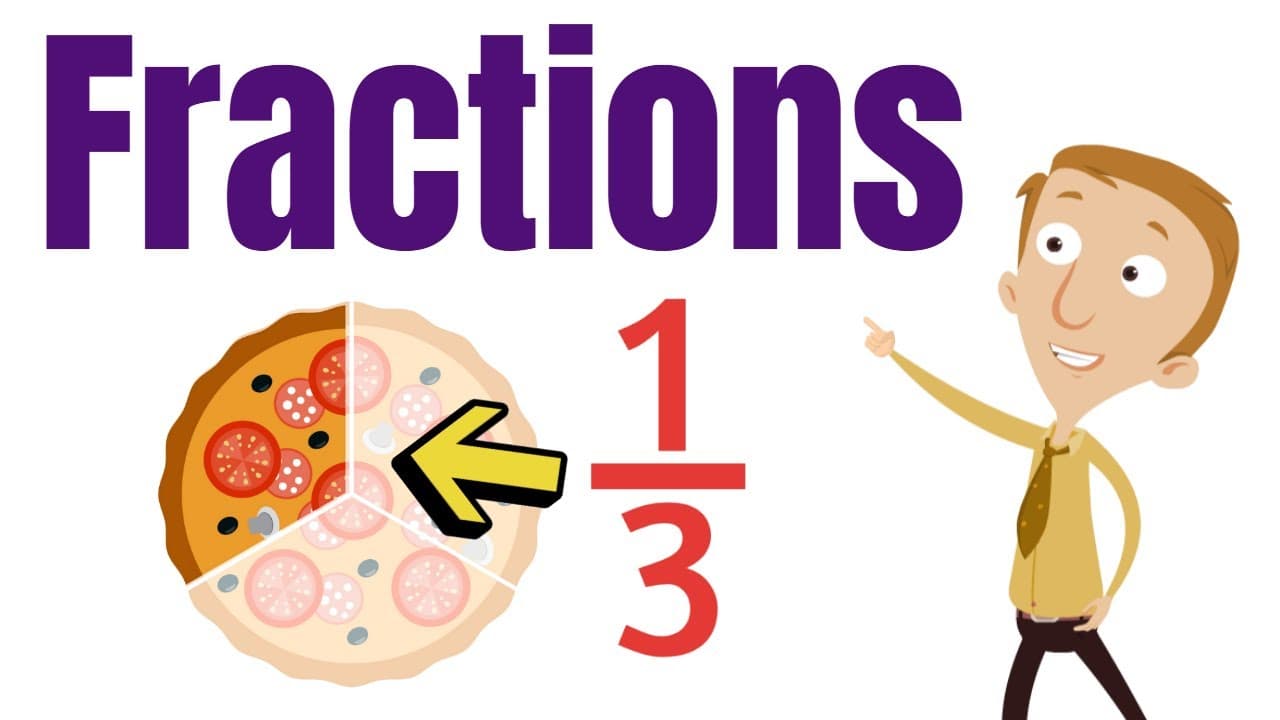
This engaging animated video introduces students to the fundamental concept of fractions using relatable real-world examples like pizza, watermelon, and cake. It defines a fraction as "a part of a whole" and carefully breaks down the anatomy of a fraction, clearly defining the terms "numerator" (the top number representing parts counted) and "denominator" (the bottom number representing total equal parts). The video employs humor and a clever mnemonic device involving "North Dakota" to help students remember the position of these terms. Themes explored include identifying equal parts, understanding fraction notation, and the relationship between division and fractions. The video visualizes common fractions such as 1/2, 1/3, 1/4, 2/3, 3/4, 4/5, and 3/8 through clear animations of food and geometric shapes. It emphasizes that for a fraction to be valid, the whole must be divided into equal parts. For the classroom, this video is an excellent instructional tool that combines direct instruction with interactive practice. It features a built-in "Game Time" segment where students must identify the shaded fraction of various shapes, providing an immediate opportunity for formative assessment. The pacing allows for natural pauses, making it perfect for whole-group instruction where teachers can check for understanding before revealing the answers.

Homeschool PopHomeschool Pop

10mins 34s

Finding Equivalent Fractions Using the Property of One

Finding Equivalent Fractions Using the Property of One

This engaging musical math video introduces students to the concept of equivalent fractions through a catchy rock song. The video uses kinetic typography to display lyrics that explain the mathematical procedure for generating equivalent fractions, specifically focusing on the strategy of multiplying or dividing by a "form of one" (such as 2/2 or 3/3). The visual style features a colorful, textured background with clear, easy-to-read text that synchronizes with the beat to support reading fluency and memorization. The core theme of the video is the Identity Property of Multiplication, simplified for elementary students as "the property of one." It emphasizes two critical conceptual understandings: first, that multiplying or dividing a number by one does not change its value; and second, that a fraction like 2/2, 3/3, or 5/5 is simply a "form of one." The song walks through specific examples, demonstrating how the fraction 1/2 can be transformed into 2/4, 3/6, 4/8, and 5/10 while remaining the same value. For educators, this video serves as an excellent hook or review tool for 3rd through 5th-grade math classrooms. It addresses the common student misconception that changing the numerator and denominator changes the size of the fraction. By repeatedly reinforcing the phrase "you change its name, but the value stays the same," the song provides a memorable mnemonic device that students can recall during independent practice. The rhythmic nature of the content appeals particularly to auditory and musical learners who may struggle with abstract mathematical rules.
Rock 2 the CoreRock 2 the Core

2mins 3s

MathNumbers & CountingCounting ObjectsNumber NamesComparing NumbersNumber OperationsCounting SequenceNumbers 0-10Place Value Understanding and SystemAdd and Subtract Within 20Addition and Subtraction ConceptsAddition and Subtraction EquationsAddition and Subtraction ProblemsFoundations for MultiplicationMultiplication and Division PropertiesMultiply and Divide Within 100Multiplication and Division ProblemsFactors and MultiplesProperties of OperationsPatterns and RelationshipsGenerate and Analyze PatternsMulti-Digit ArithmeticPlace Value OperationsMulti-Digit and Decimal OperationsNumerical ExpressionsFour Operations and PatternsFour Operations Problem SolvingMeasurement & DataMeasurable AttributesMeasuring LengthsMeasure and Estimate Lengths in Standard UnitsRelate Addition and Subtraction to LengthClassifying and Counting ObjectsTime and MoneyArea Concepts and MeasurementPerimeter and Area MeasuresAngle Concepts and MeasurementTime, Volume, and MassMeasurement Unit ConversionsGeometryIdentifying ShapesShapes and AttributesShape Attributes and ReasoningShapes and CompositionClassifying 2D FiguresGeometric Figures and RelationshipsLines, Angles, and ShapesAngle, Area, and VolumeGeometric MeasurementVolume of 3D ShapesCoordinate Plane ApplicationsTransformations in the PlaneCongruence and SimilarityUnderstand congruence in terms of rigid motionsSimilarity and TransformationsProve Theorems Involving SimilarityPythagorean TheoremTrigonometry for General TrianglesMake Geometric ConstructionsProve Geometric TheoremsTheorems About CirclesFind Arc Lengths And Areas of Sectors of CirclesVolume FormulasRelationships Between Two-Dimensional and Three-Dimensional ObjectsProve Simple Geometric Theorems AlgebraicallyTranslate Between Geometric Description and Equation for Conic SectionApply Geometric Concepts in Modeling SituationsFractions & DecimalsFractions as NumbersBuilding FractionsFraction Equivalence and OrderingAdding and Subtracting FractionsMultiplying and Dividing FractionsDividing FractionsDecimal FractionsMulti-Digit Computation and FactorsAdd, Subtract, Multiply, and Divide Rational NumbersRational Number SystemIrrational Numbers and ApproximationsRatiosRatios and ProportionsProportional RelationshipsUnit RateAlgebraAlgebraic ExpressionsGenerate Equivalent ExpressionsQuantitative RelationshipsProportional Relationships and Linear EquationsEquations and InequalitiesEquation Solving and ReasoningLinear Equations and SystemsGraph Equations and InequalitiesSystems of EquationsReal-World Algebraic ProblemsQuantitative Reasoning with UnitsExpression StructureEquivalent Expression FormsRadicals and Integer ExponentsRational ExponentsRational and Irrational NumbersPolynomial OperationsPolynomial IdentitiesPolynomial Zeros and FactorsRational ExpressionsComplex Number OperationsComplex Numbers in PolynomialsComplex Numbers on PlaneStatistics & ProbabilityRepresent and Interpret DataData DistributionsStatistical VariabilityProbability ModelsCompound Event ProbabilitiesStatistical SamplingInterpret Categorical and Quantitative DataBivariate Data PatternsInterpret Linear ModelsComparing Two PopulationsRandom Processes in StatisticsIndependence and Conditional ProbabilityExpected ValuesProbability-Based Decision MakingStatistical Inference and ConclusionsFunctionsFunction Concepts and NotationDefine and Compare FunctionsInterpret Functions in ContextAnalyze Function RepresentationsModel Relationships with FunctionsIdentify Linear vs Exponential GrowthDistinguish Between Function TypesCompare Growth RatesInterpret Function ExpressionsBuild Functions from RelationshipsConstruct and Model FunctionsTransform and Combine FunctionsModel Comparison and SelectionSolve Exponential EquationsTrigonometryTrigonometric Ratios Involving Right TrianglesTrigonometric Functions and Unit CircleModel with Trigonometric FunctionsTrigonometric IdentitiesVectors & MatricesIntroduction to Vectors and MatricesVector QuantitiesVector OperationsMatrix OperationsCalculusLimits and ContinuityDerivative Concepts and NotationDerivative Rules and TechniquesApplications of DerivativesOptimization ProblemsRelated RatesCurve Sketching and AnalysisIntegration Concepts and NotationAntiderivatives and Indefinite IntegralsDefinite Integrals and AreaFundamental Theorem of CalculusIntegration TechniquesApplications of IntegrationDifferential EquationsSequences and SeriesParametric and Polar FunctionsVector-Valued Functions

Materials

Fraction Line Equivalence Mat

Fraction Line Equivalence Mat

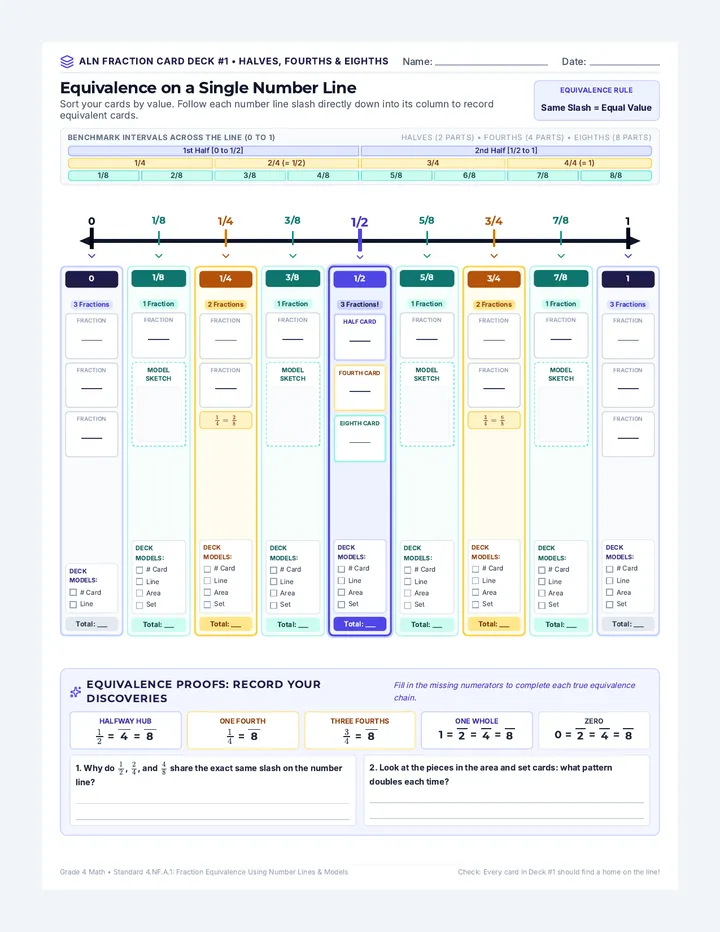
A 4th-grade math recording mat featuring a single benchmark number line from 0 to 1 for halves, fourths, and eighths. The number line slashes and labels are directly integrated and locked into the 9 sorting columns, with downward connector arrows leading into spacious card-sorting slots and equivalence discovery equations.

N

nmack

Fraction Multiplication Practice Test

Fraction Multiplication Practice Test

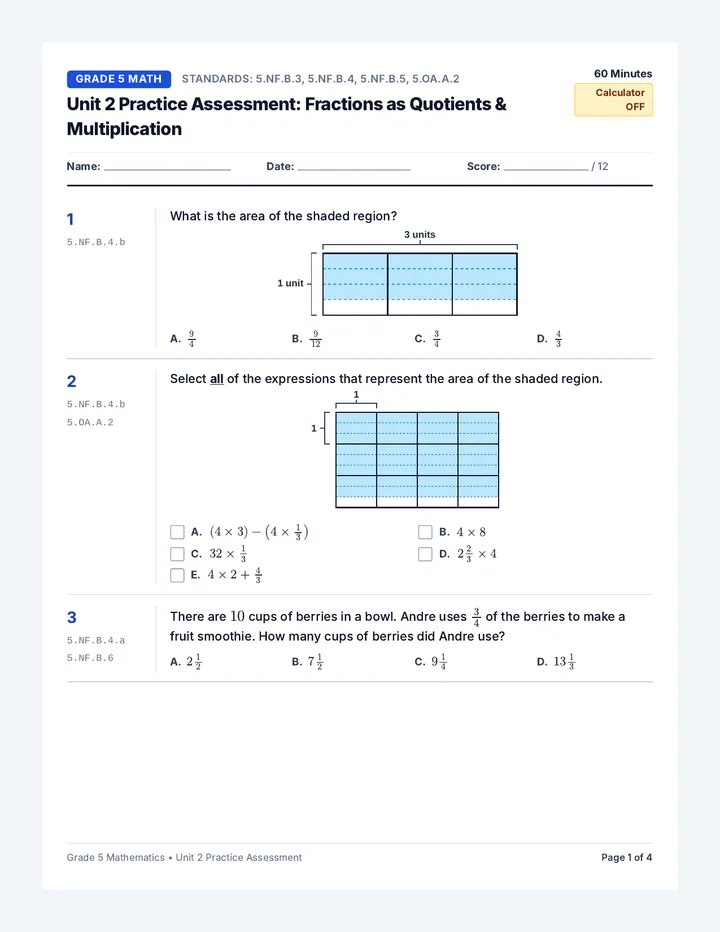
A comprehensive, print-ready practice assessment mirroring the Grade 5 Unit 2 exam on fractions as quotients, fraction multiplication, and scaling. Features 12 parallel items with authentic visual fraction models, constructed-response explanation prompts, and standards-aligned item structures.

DB

Douglas Baker

Equal Cuts Reference Sheet

Equal Cuts Reference Sheet

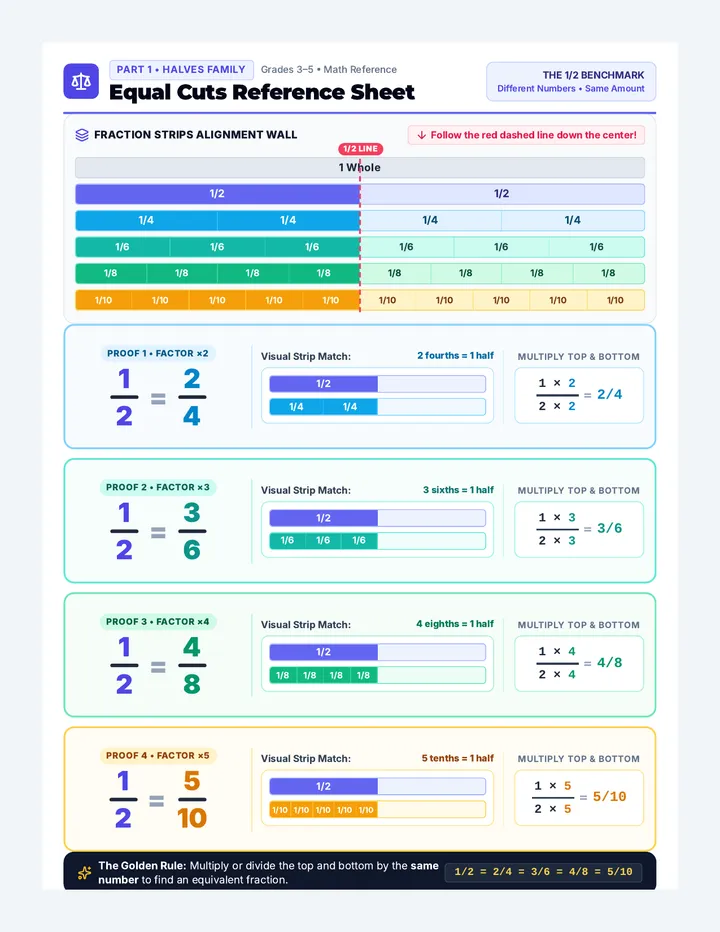
A 2-page student reference sheet on equivalent fractions. Page 1 focuses on the halves family (1/2 = 2/4, 3/6, 4/8, 5/10), and Page 2 focuses on thirds, fourths, and twelfths (3/4 = 9/12, 1/3 = 4/12, 2/3 = 4/6, and 1/12 = 3/36) with large typography and visual strip models.

SM

Susannah Malloy

Math Vocabulary Flashcards

Math Vocabulary Flashcards

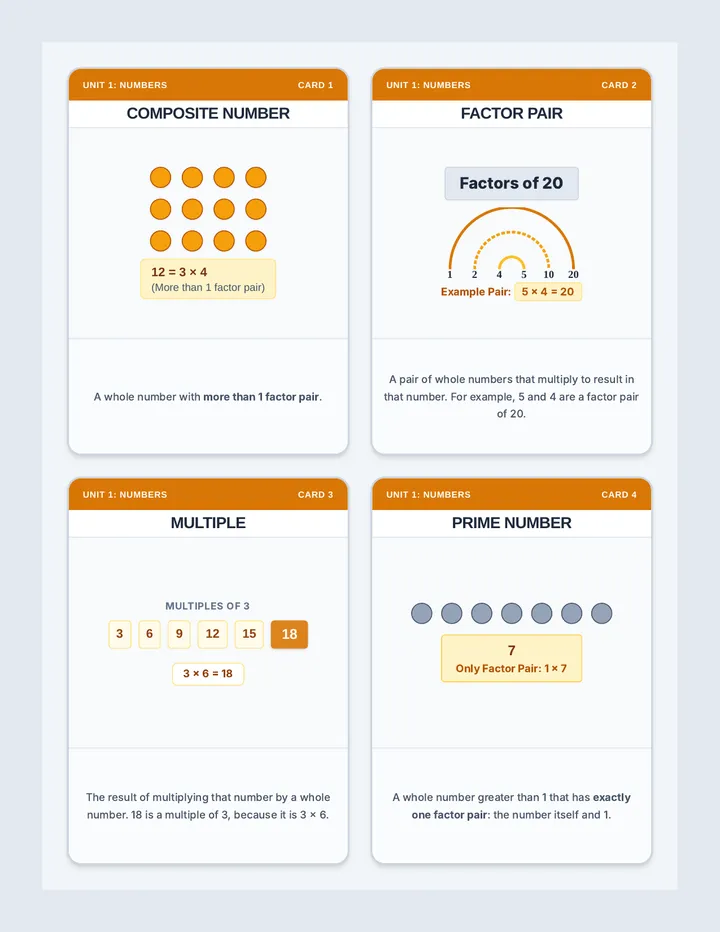
A complete, comprehensive classroom-ready set of 40 standard index-sized math vocabulary flashcards (4 per page) spanning Units 1 to 8. Includes unit fractions, mixed numbers, operations, geometry, and shape classifications with high-contrast diagrams and definitions.

N

nmack

Fraction Builder Worksheet

Fraction Builder Worksheet

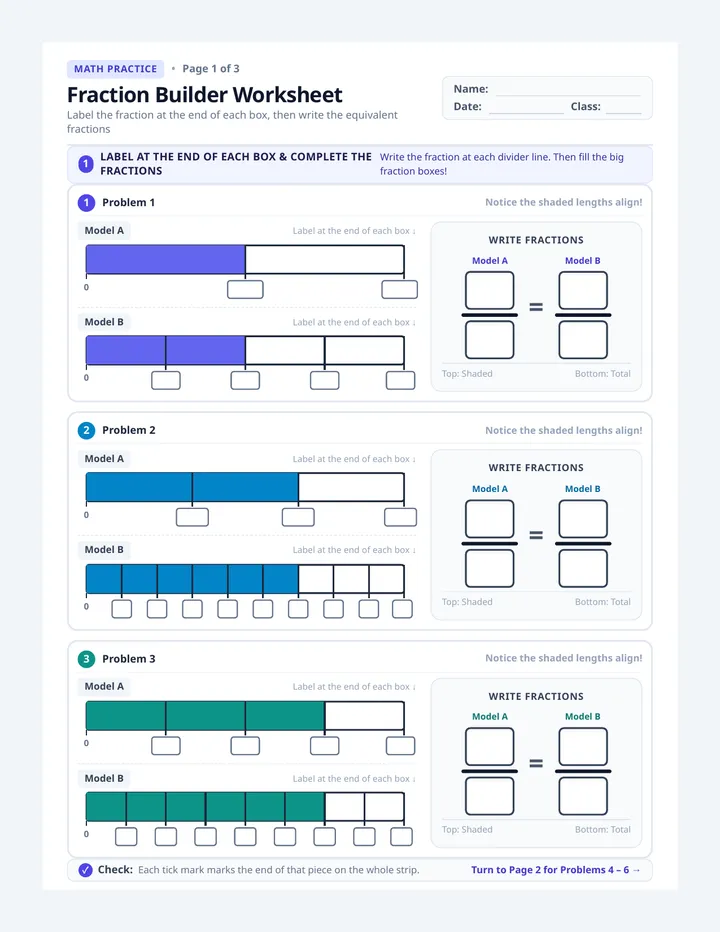
A three-page visual fraction worksheet featuring 8 equivalent fraction problems (3 on Page 1, 3 on Page 2, and 2 on Page 3 plus an Equivalence Pattern Detective synthesis activity). Every problem features separated Model A and Model B number-line bar strips with student labeling tick boxes positioned at partition boundary lines, generous 56x44px fraction handwriting boxes, and equivalence equations.

SM

Susannah Malloy

Fraction Lineup Worksheet

Fraction Lineup Worksheet

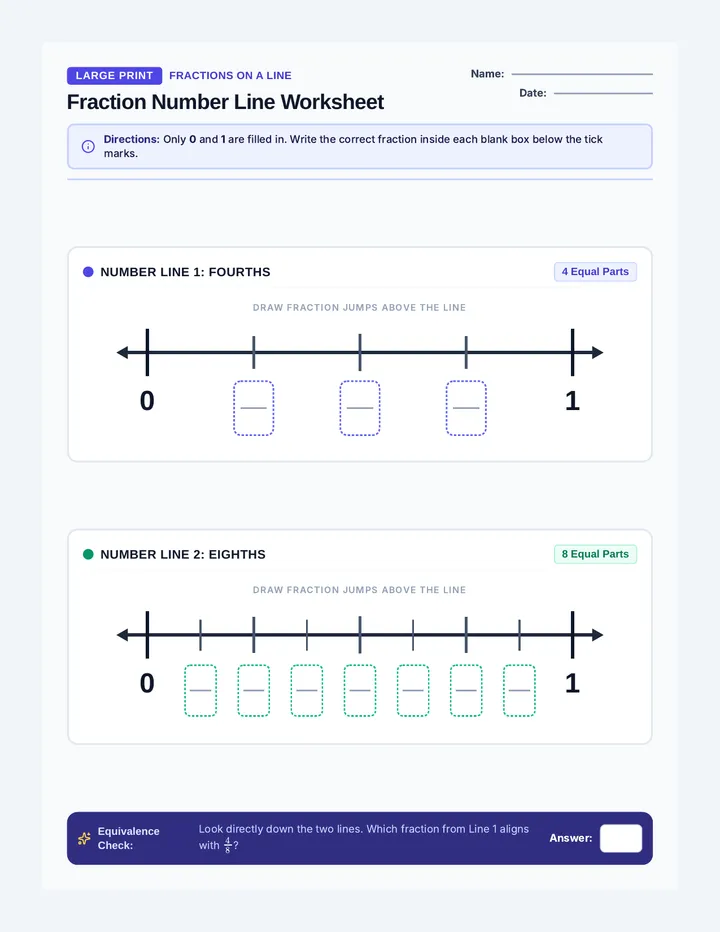
An extra-large printable fraction number line worksheet featuring bold, high-visibility number lines where only 0 and 1 are filled in. Designed with oversized tick marks, large endpoints, and generous student write-in boxes for fourths, eighths, sixths, and open partitioning.

SM

Susannah Malloy

Sequences

Blueprint Basics Teacher Guide

Master Builders Math Lab

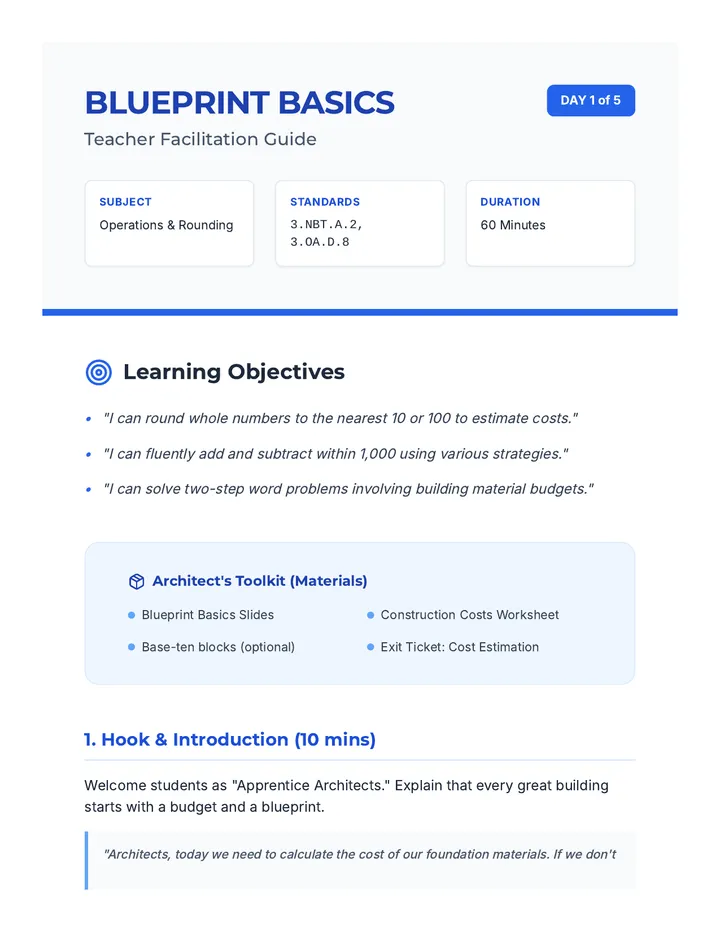
A 5-day intensive math sequence for 3rd grade covering multiplication, division, multi-digit operations, fractions, area, and rounding through a "Master Builder" architectural theme. Students act as apprentice architects solving construction-themed math challenges.

TD

Taylor Doucet

25
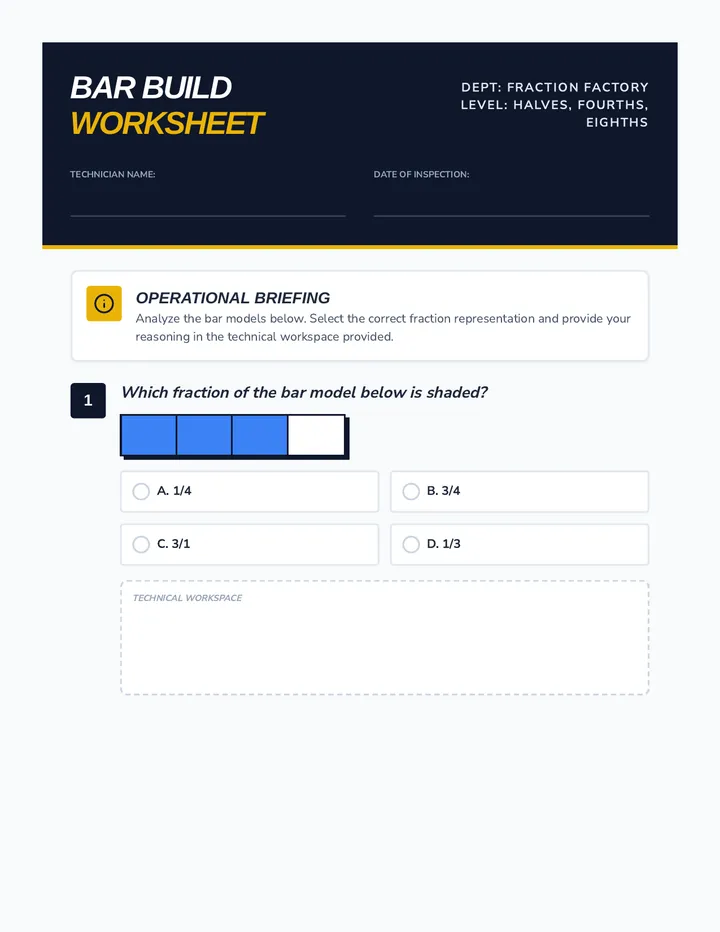
Bar Build Worksheet

Mastery Mission

A comprehensive review sequence covering core 3rd-grade math and ELA standards, designed to prepare students for end-of-grade assessments through rigorous practice and analysis.

A

astrid.rojastorres

12
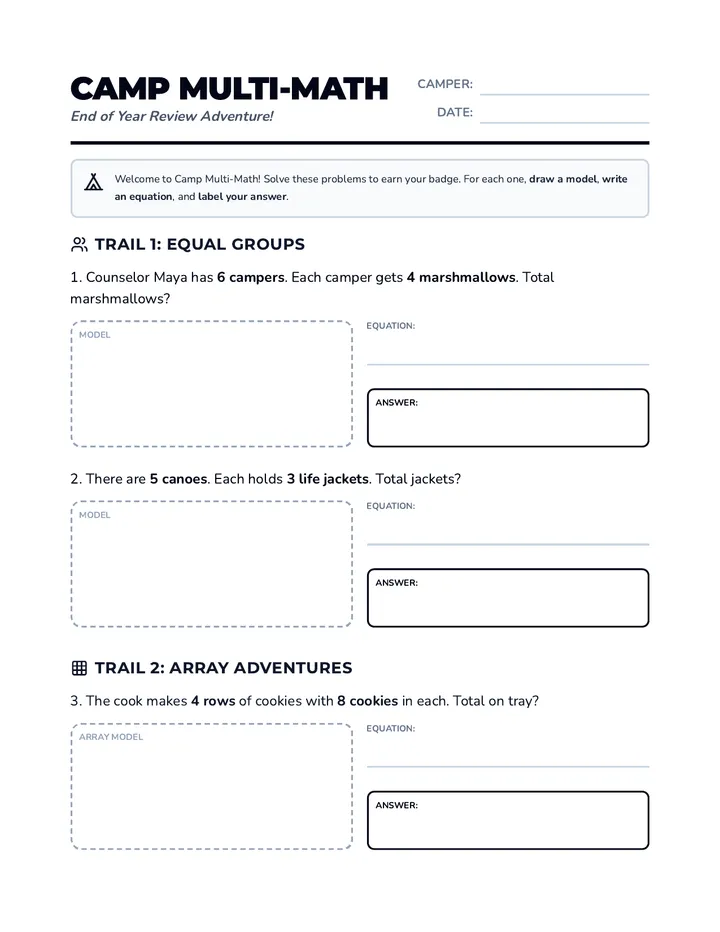
Camp Multi-Math Worksheet

Math Review Adventures

A collection of themed end-of-year math review adventures for different grade levels, focusing on spiraling key standards and problem-solving.

DB

Deborah Burton

21
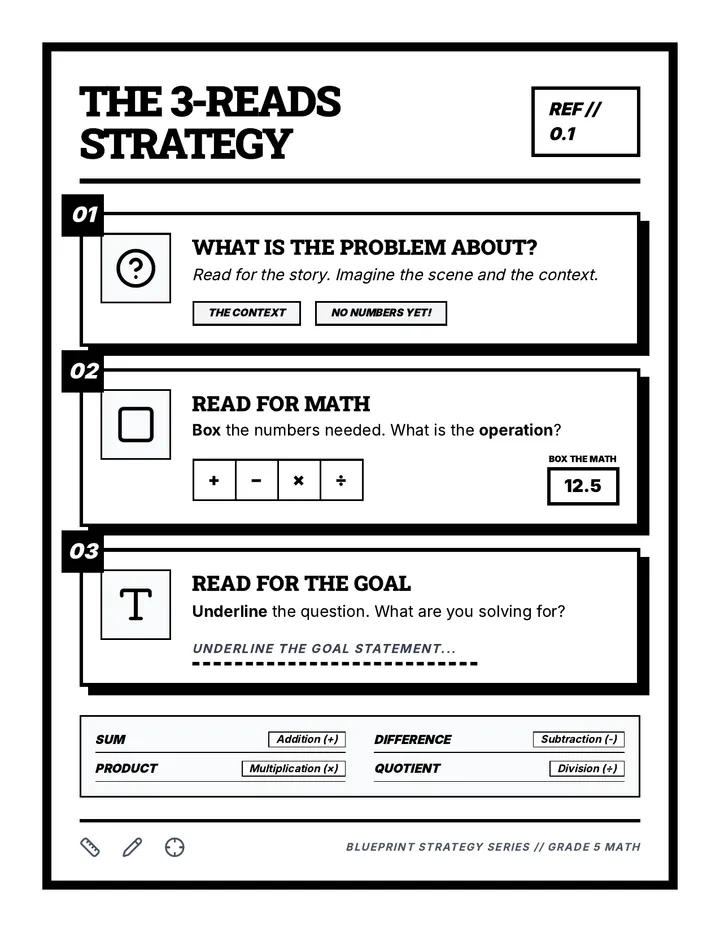
3 Reads Strategy Poster

Math Blueprints Grade 5

A comprehensive set of math supports for 5th-grade students in a co-taught environment. Each unit includes visual vocabulary, worked examples, cloze-style guided notes, and exit tickets featuring a 'Mistake of the Day' analysis.

HJ

Hope Joel

23
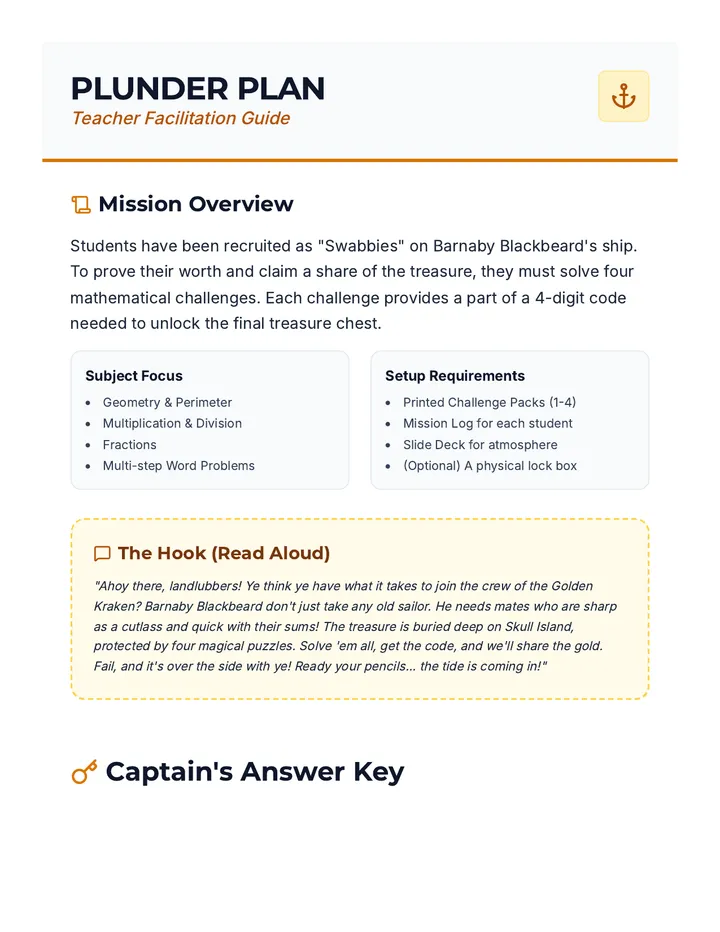
Plunder Plan Teacher Guide

Pirate Math Plunder

A pirate-themed 3rd grade math review escape room where students solve puzzles involving geometry, multiplication, division, fractions, and word problems to find the hidden treasure.

DG

Danielle Garland

12
Fraction Fundamentals Slides

Fraction Factory

A comprehensive 3-week unit covering the full spectrum of fraction operations, from basic identification and equivalence to multiplication and division, themed as a precision engineering factory.

C

corteza

15

Lessons

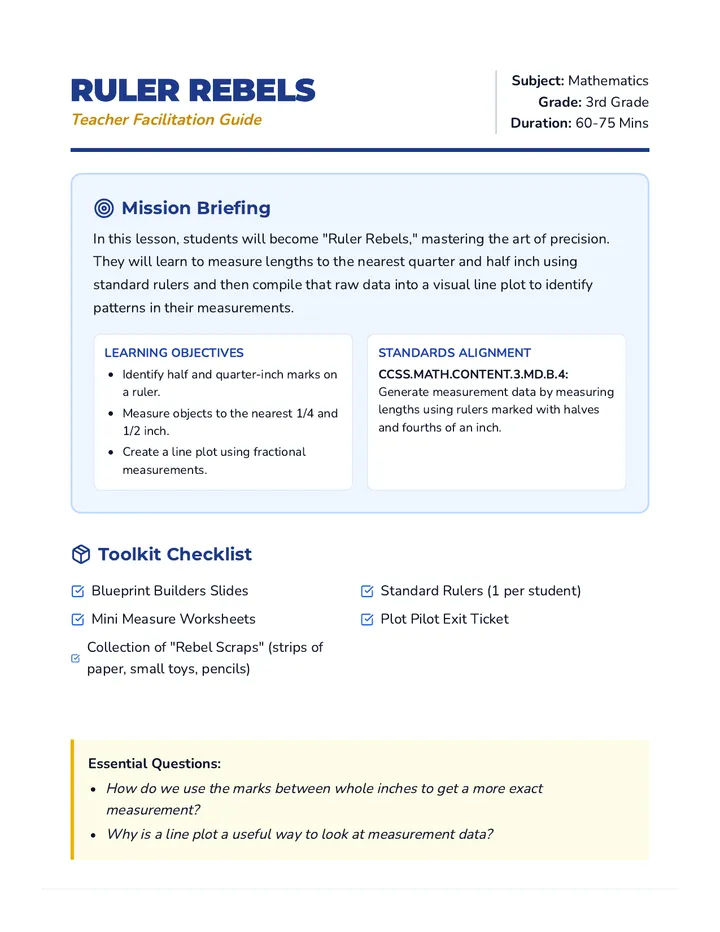
Ruler Rebels Lesson Plan

Ruler Rebels

A comprehensive lesson teaching 3rd-grade students how to measure objects to the nearest half and fourth inch and represent that data on a line plot. Students will transition from hands-on measurement to data visualization.

DP

Deana Padgett

5
Blueprint Builders Slides

Blueprint Builders

A comprehensive lesson on adding and subtracting mixed numbers using visual area models and improper fraction conversions, themed around architectural blueprints and construction.

G

goodev

6
Bridge Builders Slides

Bridge Builders

A hands-on board game where students practice identifying and placing fractions on a number line to build bridges across a canyon.

C

ckelly

5
Precision Blueprint Slides

Measurement Blueprint

A comprehensive lesson on 3.MD.4 focusing on measuring to the nearest quarter inch and displaying that data on a line plot. Students measure their hand lengths to generate authentic data for analysis.

KB

Krista Bodkin

5
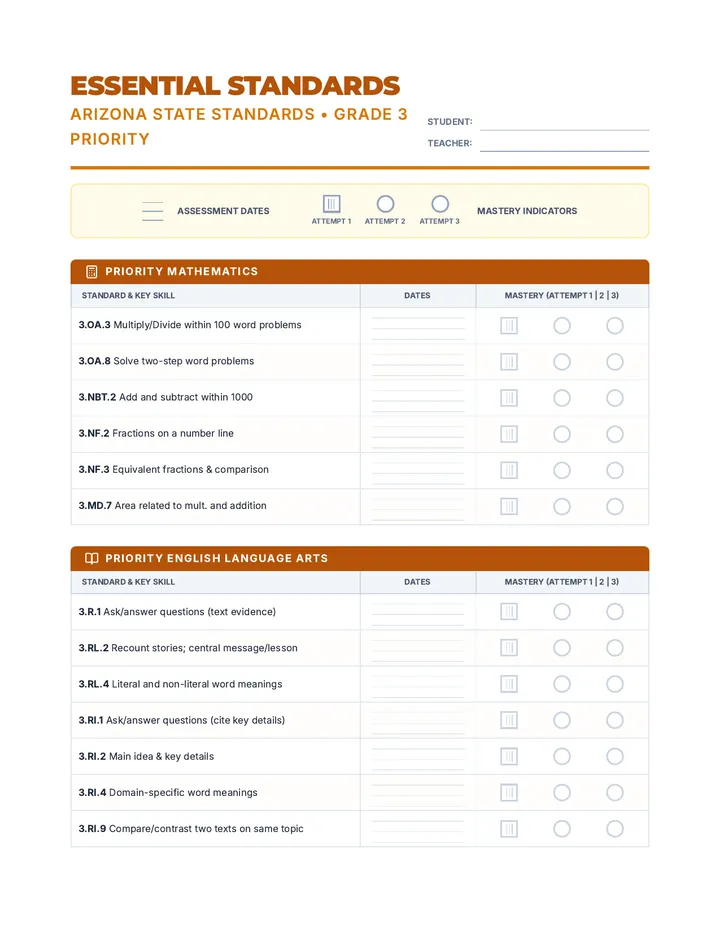
Essential Standards Tracker Document

Arizona Mastery Trackers

A collection of standards mastery tracking cards for Grade 3 Arizona students, covering Math and ELA with a consistent multi-attempt tracking system.

KB

Krista Bodkin

3
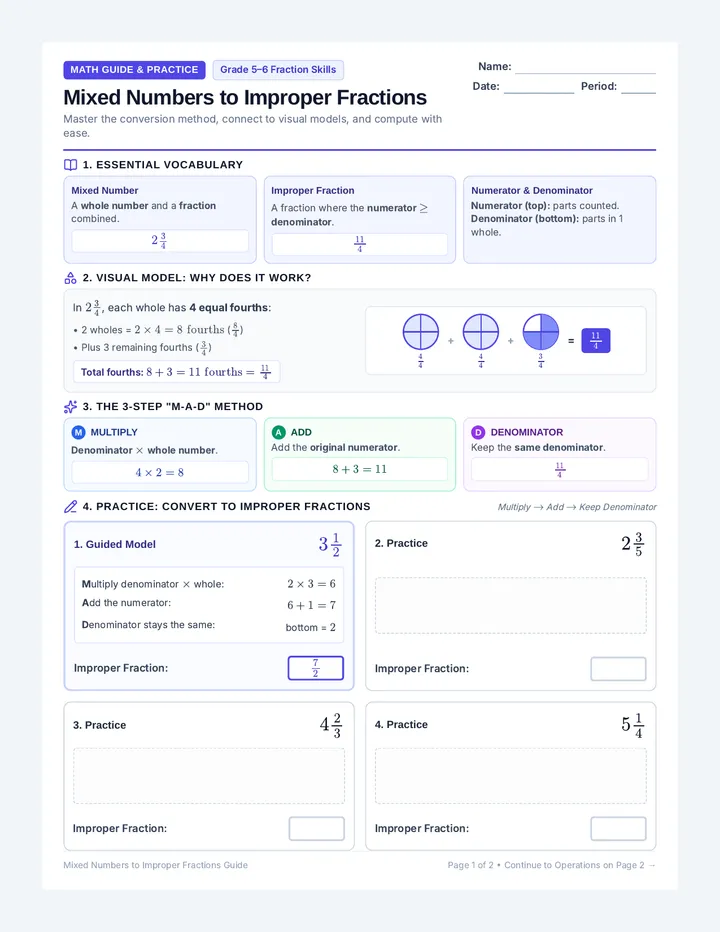
Mixed to Improper Worksheet

Fraction Transformations

A comprehensive math lesson on converting mixed numbers to improper fractions using visual models, structured scaffolding, and targeted practice for diverse learners.

AA

alicia accapezzato

5