Lenny.com
Explore
Create
ActivitiesNewMathEnglish Language ArtsScience & EngineeringSocial StudiesGlobal LanguagesHealth & Physical EducationSpecial EducationCounseling & Life SkillsArts & CreativityESL
Lenny.com
Lenny.com
Explore
Create
ActivitiesNewMathEnglish Language ArtsScience & EngineeringSocial StudiesGlobal LanguagesHealth & Physical EducationSpecial EducationCounseling & Life SkillsArts & CreativityESL
Lenny.com
Lenny.com

Solutions

Lenny for EducatorsLenny for SchoolsLenny for Districts

Product

ExploreSign inCreateSupportAbout

Resources

Getting startedMTSS Acceleration Program

© 2026 Lenny Learning Inc.

TermsPrivacyAccessibility
LinkedInInstagramX
Lenny

Expression Structure

Identification of terms, factors, and coefficients within algebraic expressions. Analyzes the relationship between expression components to simplify complex forms and identify equivalent structures.

MathNumbers & CountingCounting ObjectsNumber NamesComparing NumbersNumber OperationsCounting SequenceNumbers 0-10Place Value Understanding and SystemAdd and Subtract Within 20Addition and Subtraction ConceptsAddition and Subtraction EquationsAddition and Subtraction ProblemsFoundations for MultiplicationMultiplication and Division PropertiesMultiply and Divide Within 100Multiplication and Division ProblemsFactors and MultiplesProperties of OperationsPatterns and RelationshipsGenerate and Analyze PatternsMulti-Digit ArithmeticPlace Value OperationsMulti-Digit and Decimal OperationsNumerical ExpressionsFour Operations and PatternsFour Operations Problem SolvingMeasurement & DataMeasurable AttributesMeasuring LengthsMeasure and Estimate Lengths in Standard UnitsRelate Addition and Subtraction to LengthClassifying and Counting ObjectsTime and MoneyArea Concepts and MeasurementPerimeter and Area MeasuresAngle Concepts and MeasurementTime, Volume, and MassMeasurement Unit ConversionsGeometryIdentifying ShapesShapes and AttributesShape Attributes and ReasoningShapes and CompositionClassifying 2D FiguresGeometric Figures and RelationshipsLines, Angles, and ShapesAngle, Area, and VolumeGeometric MeasurementVolume of 3D ShapesCoordinate Plane ApplicationsTransformations in the PlaneCongruence and SimilarityUnderstand congruence in terms of rigid motionsSimilarity and TransformationsProve Theorems Involving SimilarityPythagorean TheoremTrigonometry for General TrianglesMake Geometric ConstructionsProve Geometric TheoremsTheorems About CirclesFind Arc Lengths And Areas of Sectors of CirclesVolume FormulasRelationships Between Two-Dimensional and Three-Dimensional ObjectsProve Simple Geometric Theorems AlgebraicallyTranslate Between Geometric Description and Equation for Conic SectionApply Geometric Concepts in Modeling SituationsFractions & DecimalsFractions as NumbersBuilding FractionsFraction Equivalence and OrderingAdding and Subtracting FractionsMultiplying and Dividing FractionsDividing FractionsDecimal FractionsMulti-Digit Computation and FactorsAdd, Subtract, Multiply, and Divide Rational NumbersRational Number SystemIrrational Numbers and ApproximationsRatiosRatios and ProportionsProportional RelationshipsUnit RateAlgebraAlgebraic ExpressionsGenerate Equivalent ExpressionsQuantitative RelationshipsProportional Relationships and Linear EquationsEquations and InequalitiesEquation Solving and ReasoningLinear Equations and SystemsGraph Equations and InequalitiesSystems of EquationsReal-World Algebraic ProblemsQuantitative Reasoning with UnitsExpression StructureEquivalent Expression FormsRadicals and Integer ExponentsRational ExponentsRational and Irrational NumbersPolynomial OperationsPolynomial IdentitiesPolynomial Zeros and FactorsRational ExpressionsComplex Number OperationsComplex Numbers in PolynomialsComplex Numbers on PlaneStatistics & ProbabilityRepresent and Interpret DataData DistributionsStatistical VariabilityProbability ModelsCompound Event ProbabilitiesStatistical SamplingInterpret Categorical and Quantitative DataBivariate Data PatternsInterpret Linear ModelsComparing Two PopulationsRandom Processes in StatisticsIndependence and Conditional ProbabilityExpected ValuesProbability-Based Decision MakingStatistical Inference and ConclusionsFunctionsFunction Concepts and NotationDefine and Compare FunctionsInterpret Functions in ContextAnalyze Function RepresentationsModel Relationships with FunctionsIdentify Linear vs Exponential GrowthDistinguish Between Function TypesCompare Growth RatesInterpret Function ExpressionsBuild Functions from RelationshipsConstruct and Model FunctionsTransform and Combine FunctionsModel Comparison and SelectionSolve Exponential EquationsTrigonometryTrigonometric Ratios Involving Right TrianglesTrigonometric Functions and Unit CircleModel with Trigonometric FunctionsTrigonometric IdentitiesVectors & MatricesIntroduction to Vectors and MatricesVector QuantitiesVector OperationsMatrix OperationsCalculusLimits and ContinuityDerivative Concepts and NotationDerivative Rules and TechniquesApplications of DerivativesOptimization ProblemsRelated RatesCurve Sketching and AnalysisIntegration Concepts and NotationAntiderivatives and Indefinite IntegralsDefinite Integrals and AreaFundamental Theorem of CalculusIntegration TechniquesApplications of IntegrationDifferential EquationsSequences and SeriesParametric and Polar FunctionsVector-Valued Functions

Videos

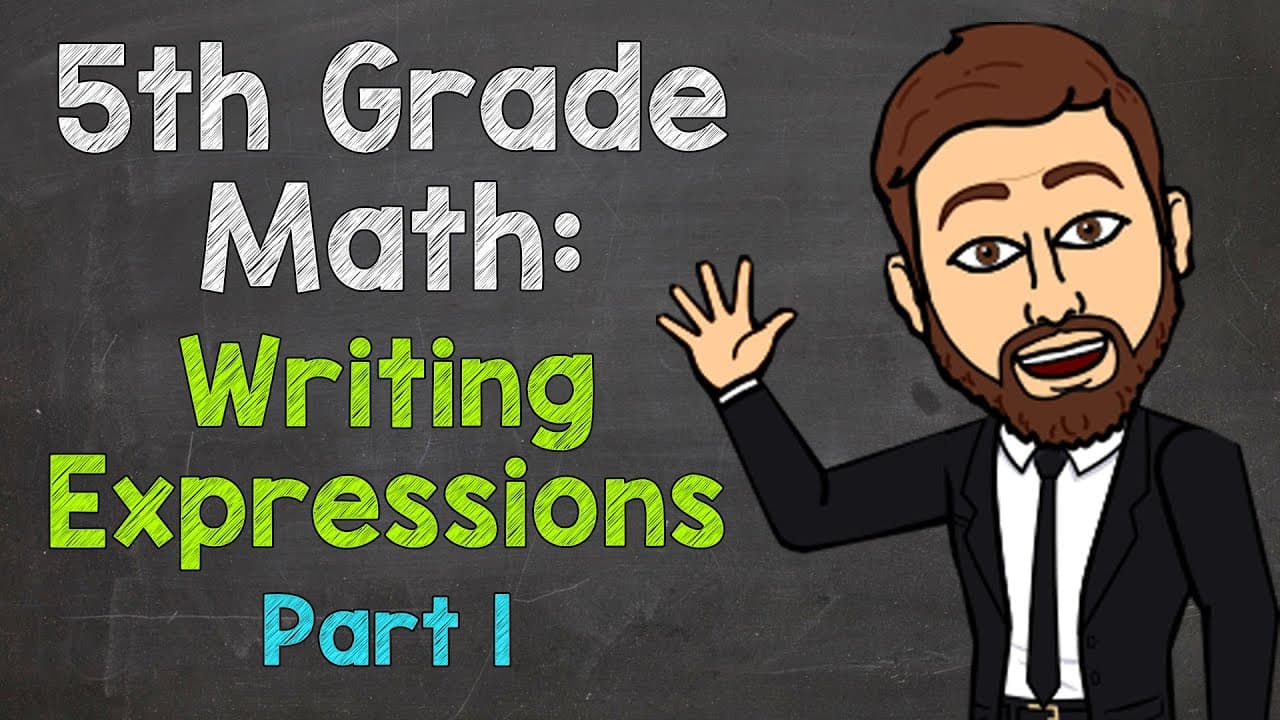
Translating Word Phrases into Algebraic Expressions

Translating Word Phrases into Algebraic Expressions

This educational math video introduces students to the fundamental skill of translating verbal phrases into mathematical expressions, a key stepping stone toward algebra. The presenter, Mr. J, walks viewers through ten distinct examples, ranging from simple addition and subtraction to introducing variables and algebraic notation. The video specifically focuses on identifying key vocabulary words like "sum," "quotient," "product," and "difference" that signal specific mathematical operations. The content explores several critical themes in early algebra, including the importance of operation order in subtraction and division versus the flexibility in addition and multiplication. A significant portion of the video is dedicated to explaining variables—letters that represent unknown numbers—and demonstrating various ways to write multiplication in algebra (such as using a dot, parentheses, or placing a number next to a variable) to avoid confusion with the letter 'x'. For educators, this video serves as an excellent direct instruction tool or review resource for 5th and 6th-grade math classrooms. It explicitly addresses common student misconceptions, particularly the "taken away from" phrasing that requires reversing the number order. The clear, step-by-step walkthroughs provide a model for student thinking, making it ideal for a "pause and solve" classroom activity or flipped classroom assignment.
Math with Mr. JMath with Mr. J

8mins 35s

Mastering Pre-Algebra: Integers, Equations, and Exponents

Mastering Pre-Algebra: Integers, Equations, and Exponents

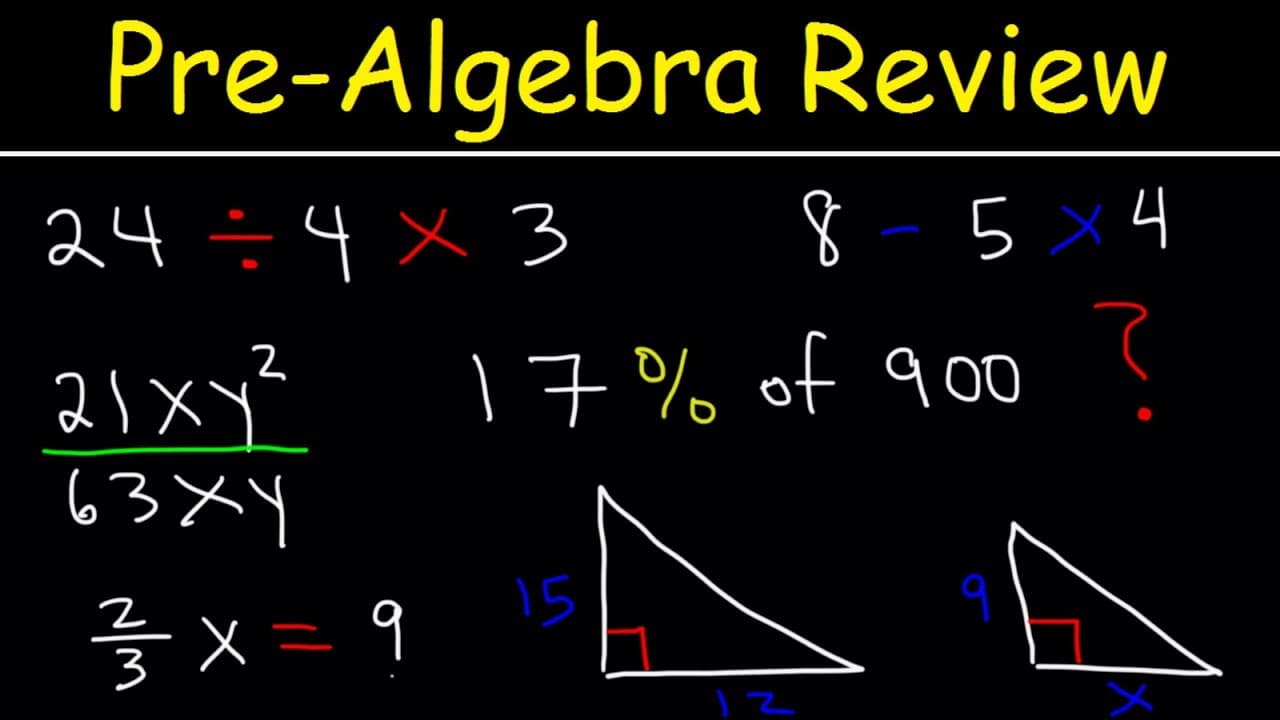
This comprehensive video tutorial serves as an extensive review of pre-algebra concepts, designed to build a strong mathematical foundation for middle school students. The video progresses systematically through fundamental topics, starting with operations on integers using a number line visualization, and advancing to more complex concepts like order of operations (PEMDAS), algebraic expressions, and linear equations. The instructor uses a digital blackboard format to demonstrate step-by-step problem solving, offering clear visual examples for every concept introduced.

The Organic Chemistry TutorThe Organic Chemistry Tutor

2mins 31s

How to Evaluate Algebraic Expressions Using Algebra Tiles

How to Evaluate Algebraic Expressions Using Algebra Tiles

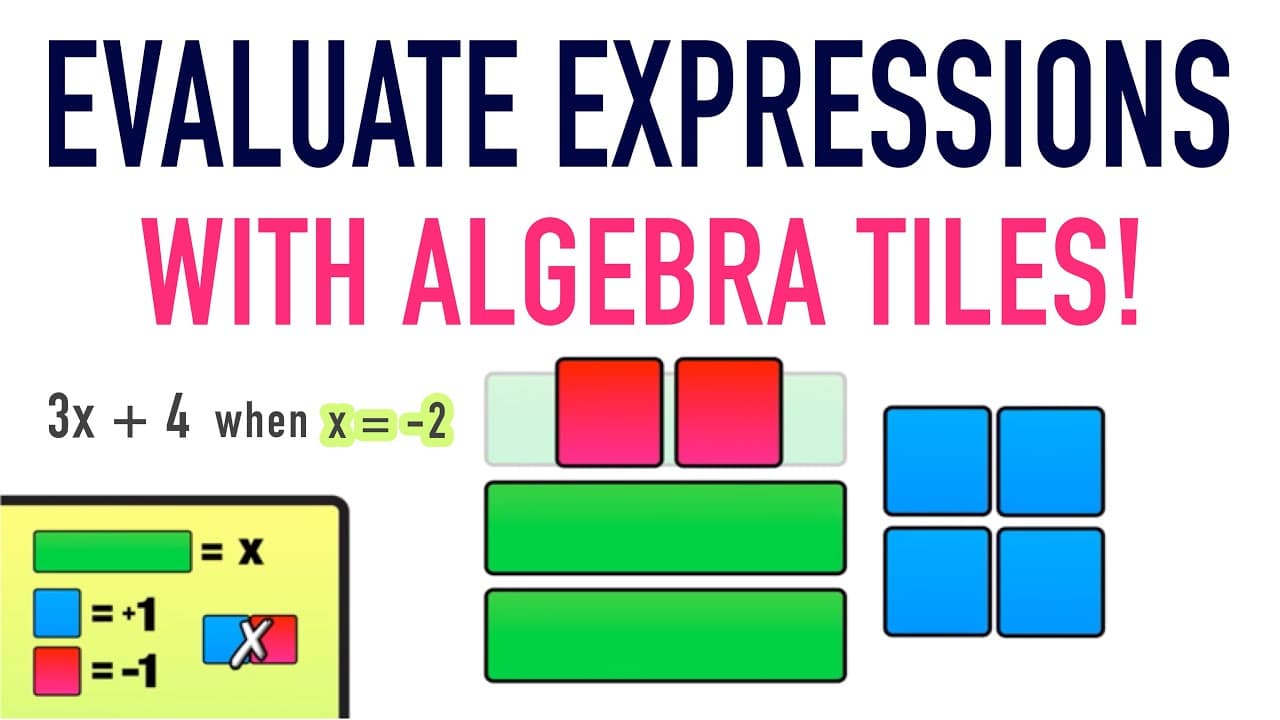
This educational video provides a clear, visual methodology for evaluating algebraic expressions using algebra tiles, a common mathematical manipulative. The video begins by defining the components of an algebraic expression—variables, operators, and numbers—before introducing a color-coded visual system where green rectangles represent variables (x), blue squares represent positive integers (+1), and red squares represent negative integers (-1). It establishes the crucial concept of "zero pairs," showing how positive and negative units cancel each other out, which is essential for understanding integer arithmetic. The core instruction demonstrates the process of substitution through two detailed examples. First, the narrator models evaluating 2x + 3 when x = 3, visually replacing variable tiles with the corresponding integer tiles to find the sum. Second, the video tackles a more complex problem involving negative numbers: evaluating 3x + 4 when x = -2. This example reinforces the zero pair concept as students watch red (negative) and blue (positive) tiles cancel out to reveal the final answer. Teachers can use this video to bridge the gap between concrete manipulatives and abstract algebraic notation. It is particularly valuable for introducing students to the concept of substitution and for reviewing integer rules in a tangible way. The video's step-by-step approach makes it an excellent tool for scaffolding lessons on evaluating expressions, helping visual learners grasp the underlying logic of algebraic operations before moving to purely symbolic calculation.

Mashup MathMashup Math

7mins 2s

How to Add Polynomials by Combining Like Terms

How to Add Polynomials by Combining Like Terms

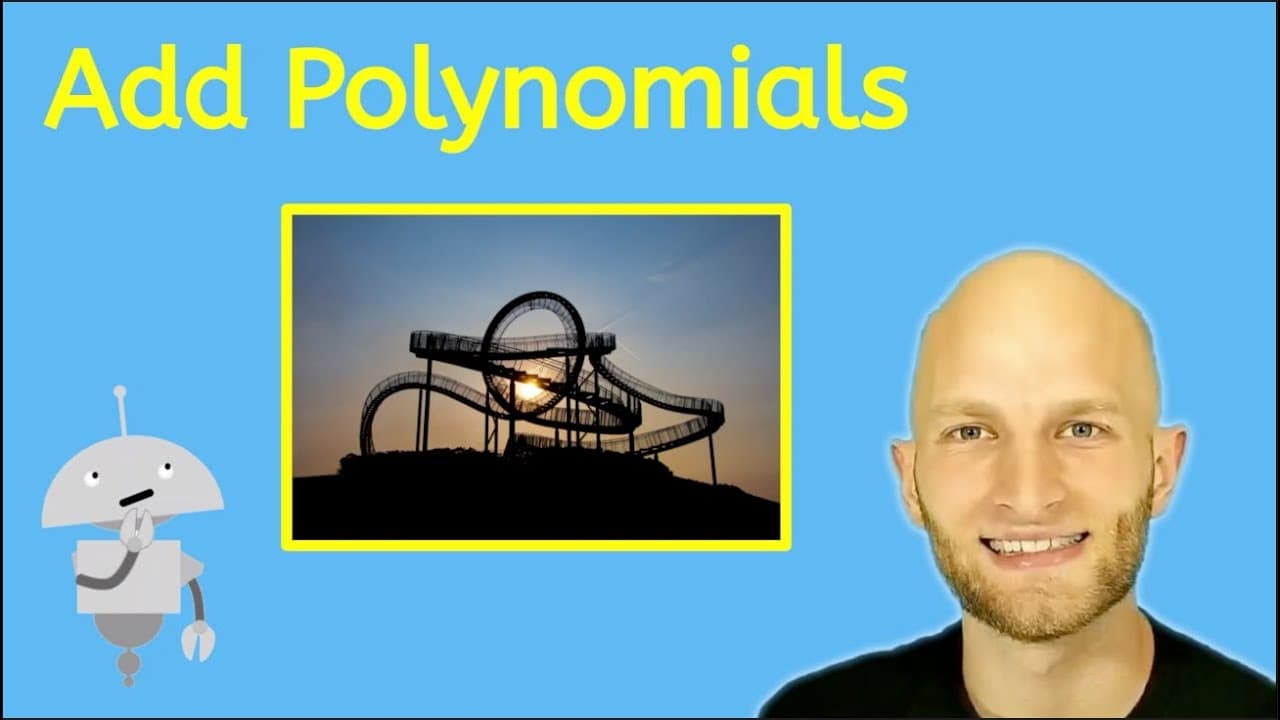
This educational video provides a clear, step-by-step tutorial on how to add polynomials by combining like terms. Hosted by Randy from MiaPrep, the lesson begins with real-world applications of polynomials, such as roller coaster design and traffic pattern analysis, before diving into the mathematical procedure. The core of the lesson focuses on identifying "like terms"—terms that share the exact same variable and exponent—and simplifying a complex expression involving two distinct polynomials. The video explores key algebraic themes including the definition of like terms, the role of variables and exponents, the conceptual understanding of constants (as terms with $x^0$), and the rules for handling parentheses during addition. It meticulously breaks down an example problem, $(2x^3 - 8x^2 - 6x + 5) + (-x^2 + 6x + 7)$, showing how to group terms and handle coefficients, including calculating sums that result in zero. For educators, this video serves as an excellent instructional tool for Algebra 1 units. It visually differentiates terms using circling techniques and addresses common stumbling blocks, such as understanding why constants can be combined or how to handle terms with no visible coefficient (like $-x^2$). The video effectively bridges abstract algebraic rules with concrete visual demonstrations, making it useful for introducing the topic or reinforcing concepts for struggling students.

Miacademy & MiaPrep Learning ChannelMiacademy & MiaPrep Learning Channel

5mins 59s

The Difference Between Math Expressions and Equations

The Difference Between Math Expressions and Equations

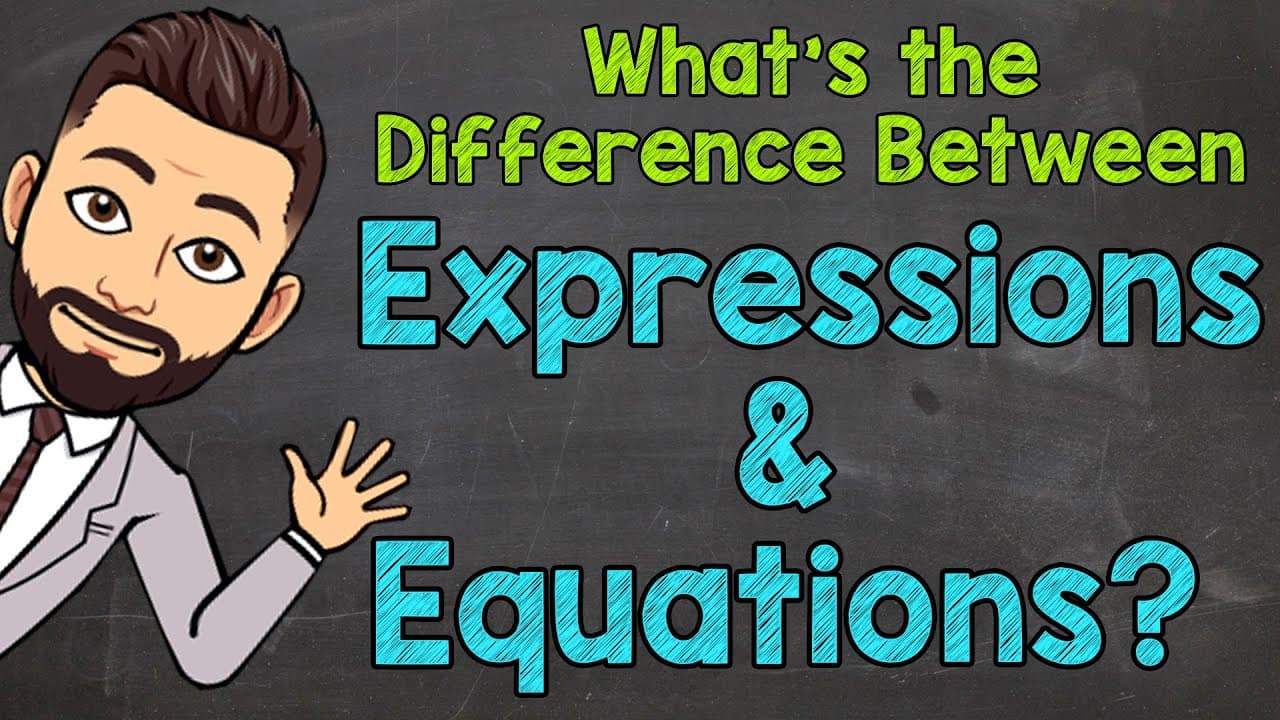
This concise and clear educational video explains the fundamental difference between mathematical expressions and equations. Using a blackboard aesthetic, 'Mr. J' breaks down the definitions of both terms, using the analogy of language: expressions are like phrases, while equations are like full sentences. The video highlights two primary distinctions: the presence of an equal sign and the behavior of variables (changing values in expressions versus fixed values in equations). The video walks viewers through four specific examples—two expressions and two equations—to demonstrate these concepts in action. It shows how to evaluate expressions by substituting different values for variables, and contrasts this with solving equations to find the single specific value that makes the statement true. The narrator also addresses implicit multiplication (e.g., '3d') and basic algebraic operations. This resource is highly valuable for introducing early algebra concepts in upper elementary and middle school classrooms. It directly addresses a common point of confusion for students transitioning from arithmetic to algebra. Teachers can use this video to introduce the vocabulary of algebra, support lessons on substitution and solving one-step equations, or as a review tool for students struggling to distinguish between simplifying expressions and solving equations.

Math with Mr. JMath with Mr. J

3mins 41s

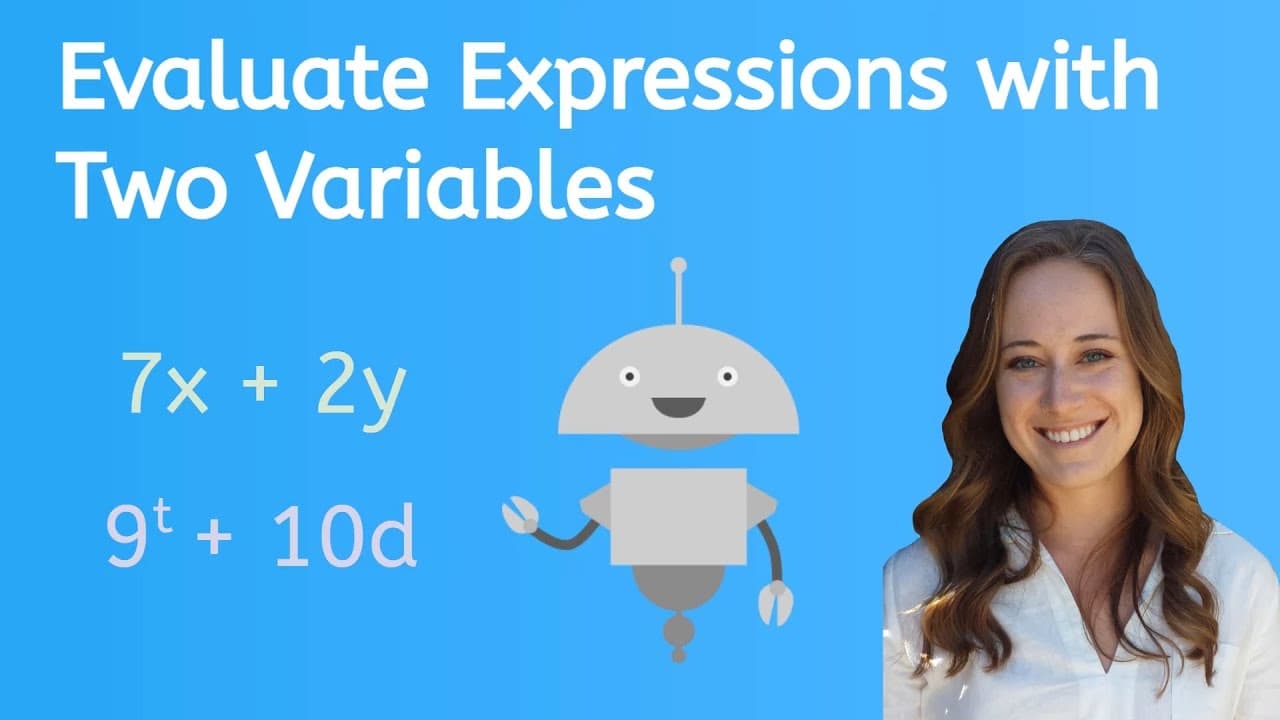
How to Evaluate Algebraic Expressions with Two Variables

How to Evaluate Algebraic Expressions with Two Variables

This educational video provides a clear, step-by-step guide on how to evaluate algebraic expressions containing two variables. Hosted by an instructor named Kailey, the lesson builds upon prior knowledge of single-variable expressions and order of operations. It walks viewers through the process of substituting specific values for variables like 'x' and 'y' and then simplifying the expression to find a final numerical answer. The video uses a digital whiteboard format where the instructor writes out the steps in real-time, making the mathematical process easy to follow visually. The video explores key algebraic themes including the difference between coefficients and variables, the importance of distinguishing between different variables (like 'g' vs 'f'), and the strict application of the order of operations (PEMDAS). It progresses from a simple linear expression to a more complex one involving exponents and products of variables. A significant portion of the video is dedicated to answering the "why do we need to learn this?" question by introducing a real-world application: automotive engineering and crash safety testing using Newton's Second Law (F=ma). For educators, this video serves as an excellent bridge between basic arithmetic and pre-algebra or introductory algebra. It demystifies abstract symbols by showing they simply represent numbers waiting to be substituted. The inclusion of the physics example (calculating force during a car crash test) provides cross-curricular value, demonstrating how algebra is an essential tool in science and engineering. Teachers can use this to introduce the concept of substitution or to reinforce order of operations within an algebraic context.

Miacademy & MiaPrep Learning ChannelMiacademy & MiaPrep Learning Channel

7mins 27s

Materials

Figurative Patterns Slides Orientation Fix

Figurative Patterns Slides Orientation Fix

Fixed Slide 6 where the visualization of two paired triangular numbers forming a rectangle was missing. Replaced the previous layout with explicit flex rows to ensure the dots render correctly and clearly show how $T_4$ and its twin create a $4 \times 5$ rectangle. Label positioning and container sizing were also refined for better clarity. Adjusted Slide 4 to fill vertical space more effectively.

BC

Brenda Coombs

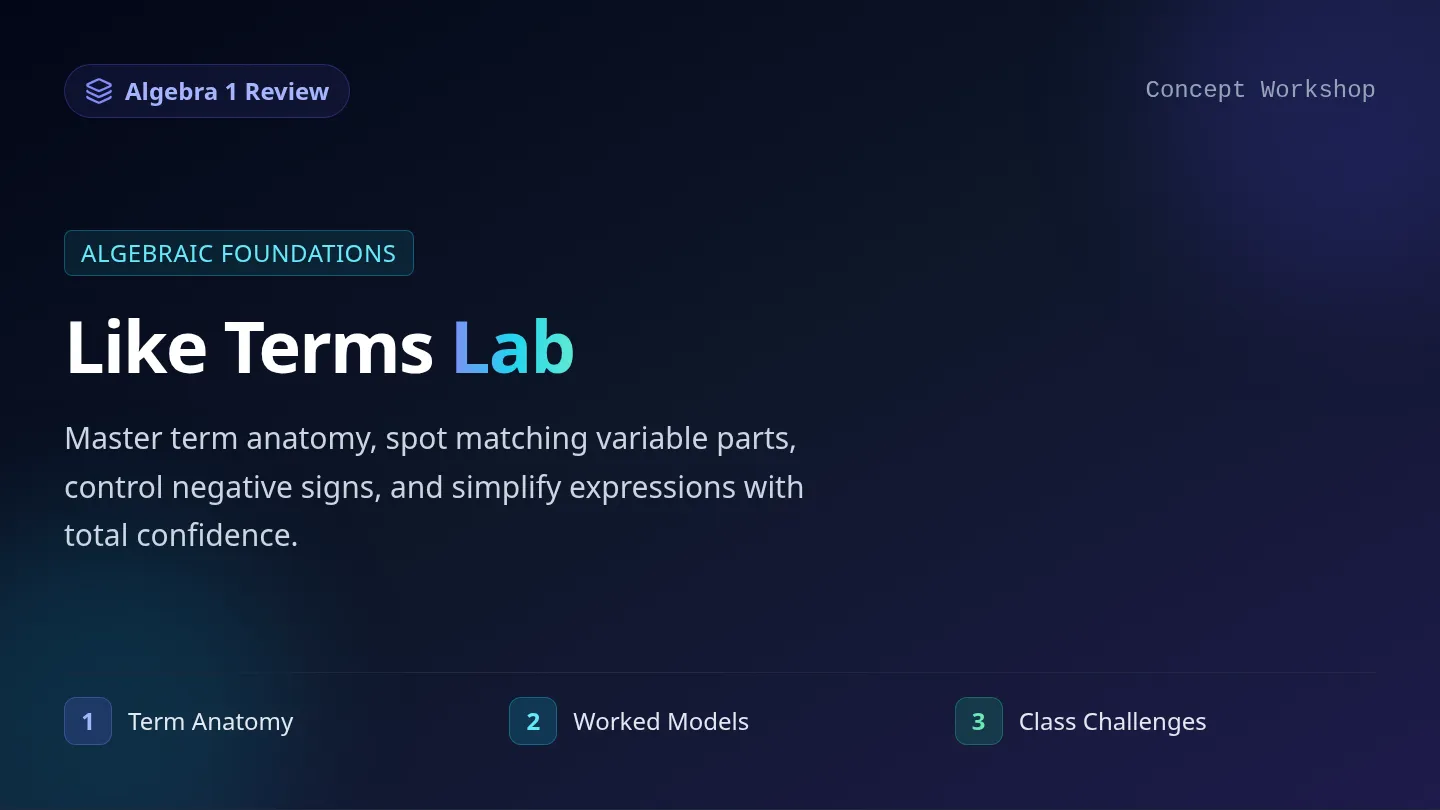
Like Terms Lab Slides

Like Terms Lab Slides

A comprehensive slide deck reviewing combining like terms, covering term anatomy, like vs. unlike rules, sign ownership, step-by-step worked examples, common trap warnings, and guided class practice.

R

Rebecca.Heimann

Simplificar Expresiones Cuaderno Bilingue

Simplificar Expresiones Cuaderno Bilingue

Cuaderno de 11 páginas en español con explicaciones simplificadas, lenguaje directo, modelos visuales claros y apoyos paso a paso para estudiantes ELL.

SP

Sheridan Pickett

Equations with Variables Scaffolded Packet

Equations with Variables Scaffolded Packet

A comprehensive 6-page scaffolded student packet for 8th Grade Math Lesson 7 (Standard 8.EE.C.7b). Features a Codebreaker lesson hook, 3-color coding system, pizza delivery distribution storyboard, dual order of operations model (PEMDAS vs. SADMEP), number line jump tracks, a 1-minute multiplication fluency sprint, and tiered practice workspaces.

SP

Sheridan Pickett

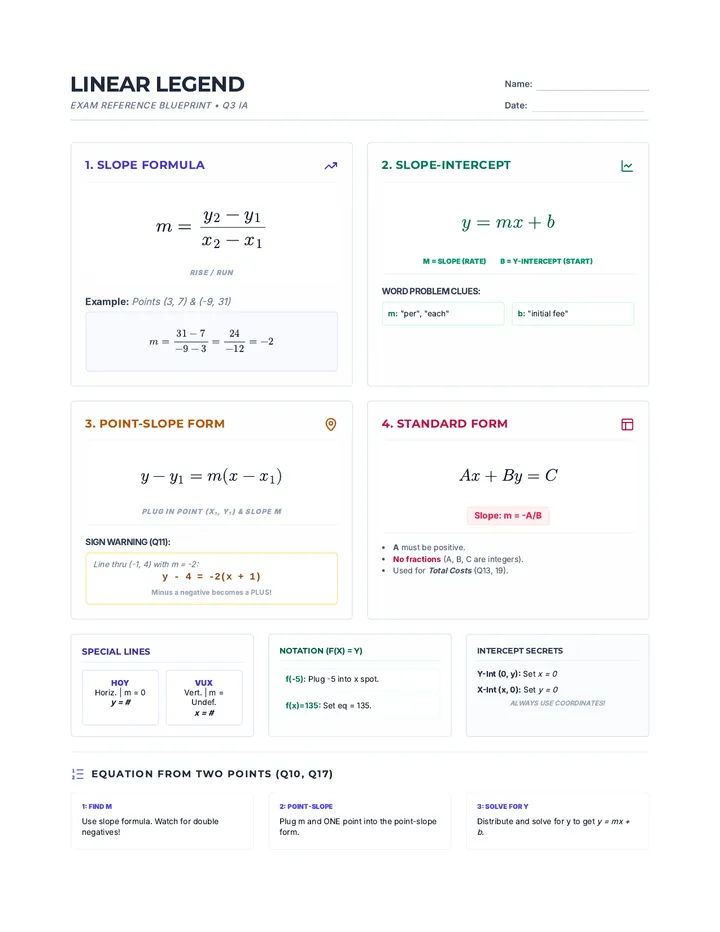
Linear Legend Formula Sheet Slice

Linear Legend Formula Sheet Slice

A print-optimized, one-page formula sheet for linear equations. Features reduced font sizes and a minimalist white-background design for high legibility and low ink usage. Includes slope formulas, all linear forms with examples, sign flip warnings, and step-by-step strategies.

D

david.marques

Algebra Foundations Reference Sheet

Algebra Foundations Reference Sheet

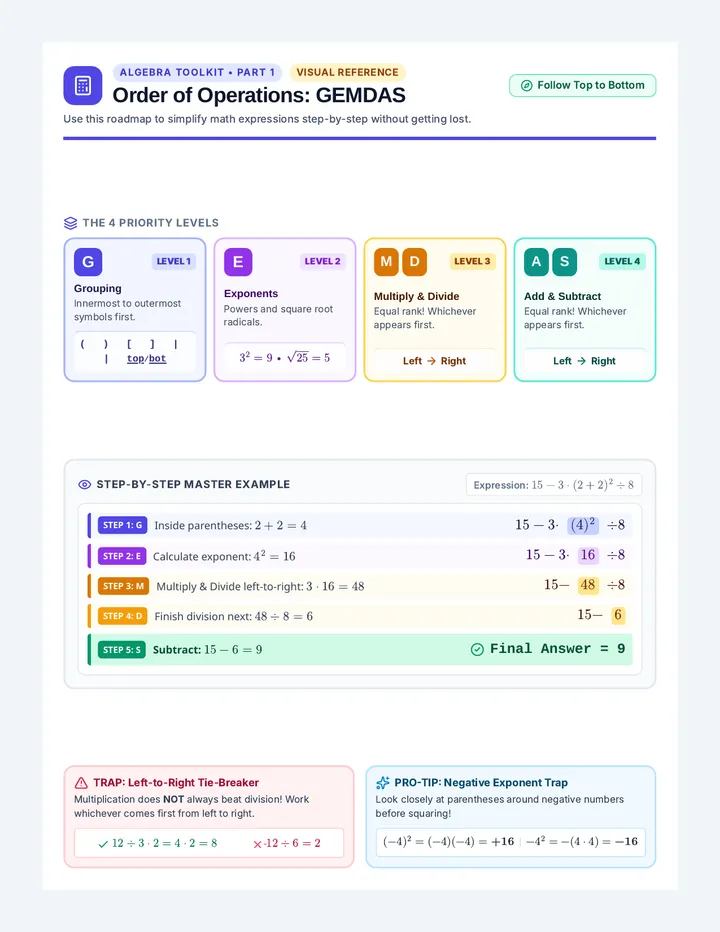
A high-contrast, visually structured 2-page printable anchor chart and reference sheet for 9th-grade SPED Algebra students, covering the Order of Operations (GEMDAS) and Combining Like Terms with step-by-step visual models and sign rule aids.

KW

Kevin Wells

Sequences

Equation Balancing Student Packet

Distance Detectives

A highly visual geometry unit focused on applying algebraic formulas to coordinate planes. Students use coordinate grids, step-by-step graphic organizers, and tactile representations to solve real-world distance and segment length problems.

D

deeohnny.jackson

64
Math Blueprint Week 1 Booklet (Definitive)

Math Blueprint Spiral

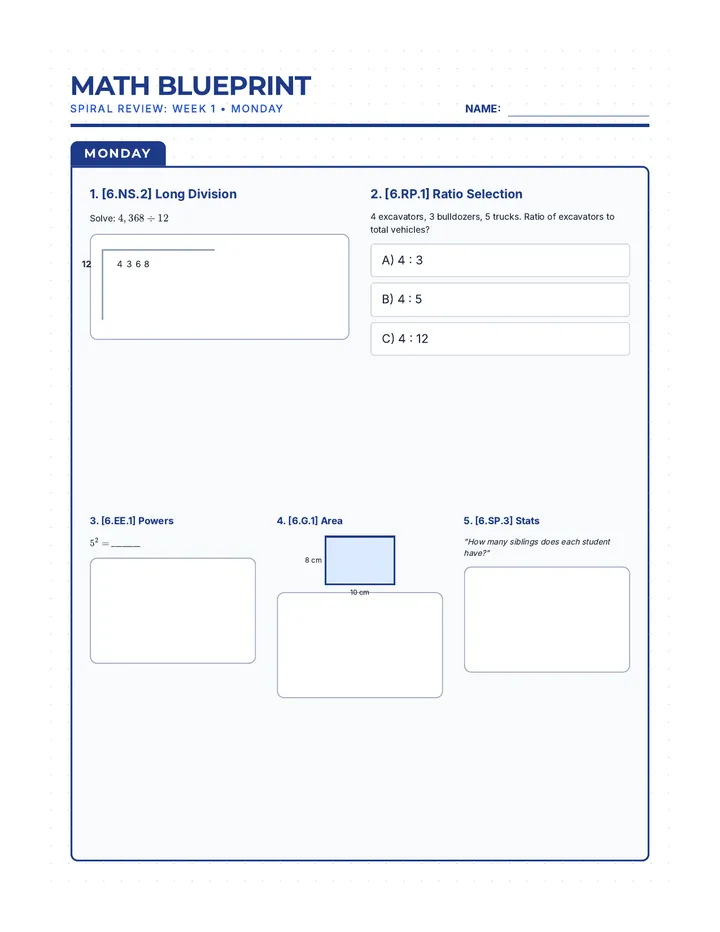
A 7-week comprehensive math review sequence designed to prepare 6th-grade students for North Carolina state testing, covering Number Systems, Ratios, Expressions, Geometry, and Statistics.

MK

Michell Kisler

27
Blueprint Basics Slides

Foundational Math Builders

A foundational math sequence for special education students (grades 5-6) focusing on algebraic thinking and spatial reasoning through highly visual, themed units.

JS

Janette Sullivan

37
Ratio Rumble Worksheet

Math Quest Review

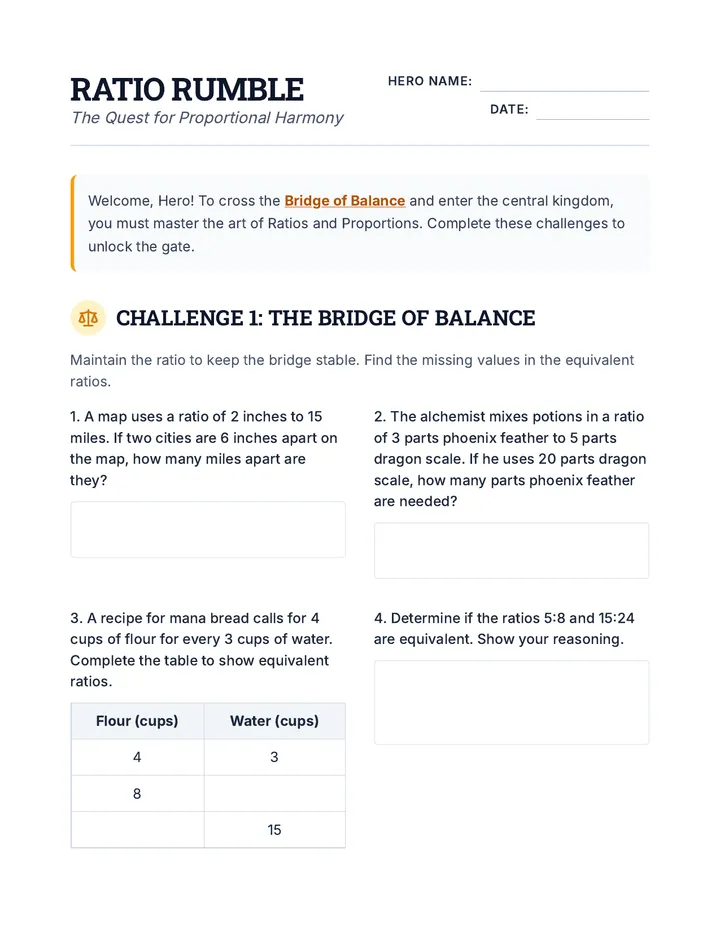
A week-long adventure-themed 6th-grade math review covering major clusters: Ratios & Proportions, Number System, Expressions & Equations, and Geometry. The sequence culminates in a mixed-review 'Quest Finale' to assess student mastery and readiness.

C

carlsond

15
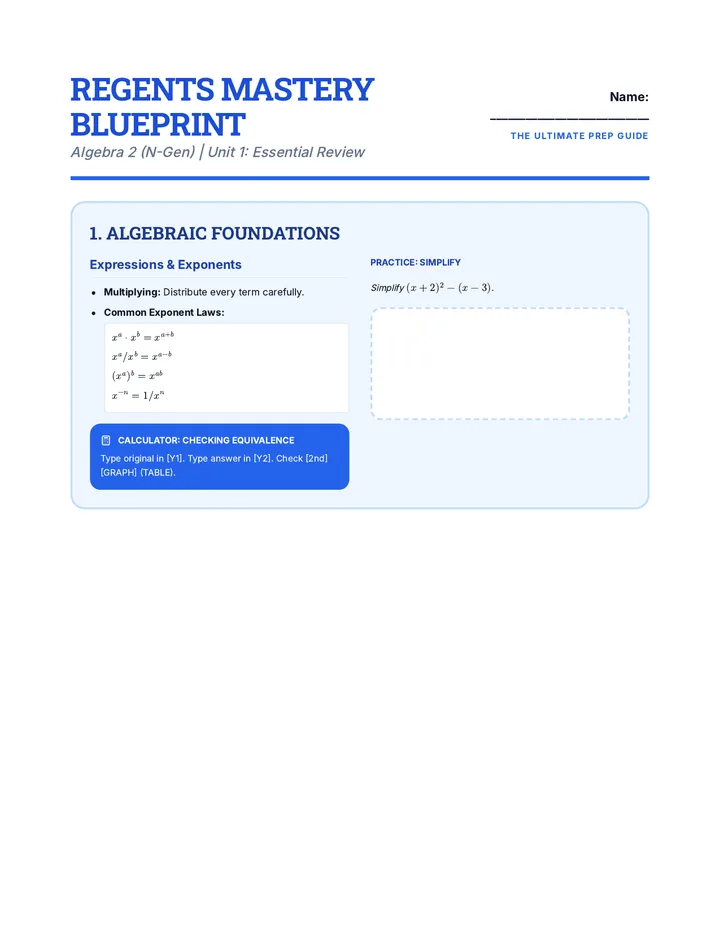
Regents Mastery Blueprint Study Guide

Regents Mastery Suite

A comprehensive review suite for the New York State Mathematics Regents exams, including Algebra 1, Geometry, and Algebra 2, featuring mastery blueprints, calculator strategies, and exam-taking tips.

KB

Kayla Borozny

15
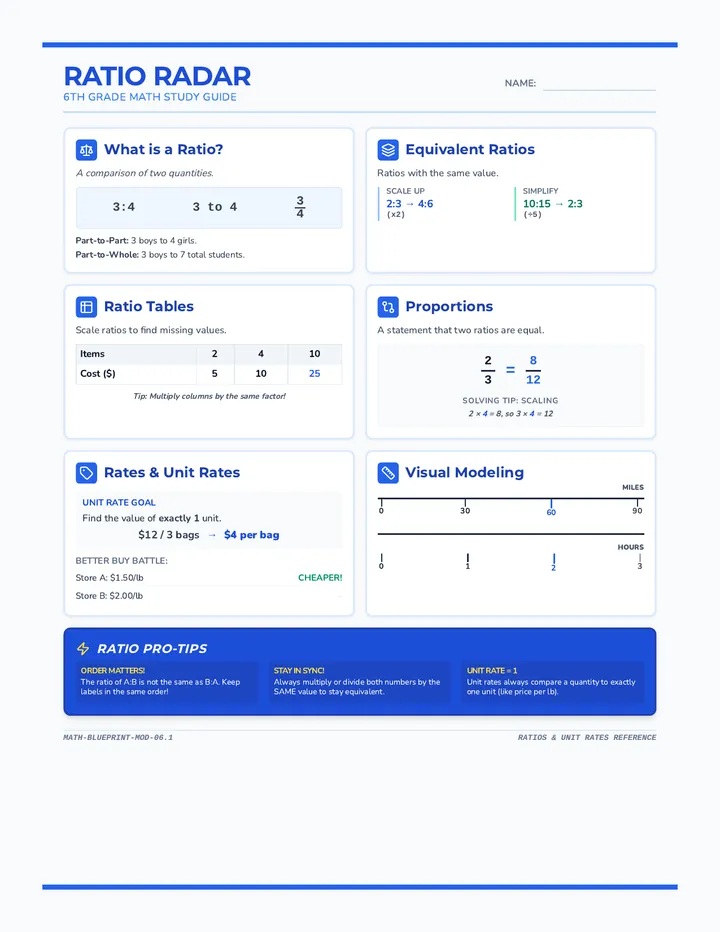
Ratio Radar Cheat Sheet

Math Mastery Guide

A collection of high-quality study tools and practice resources for 6th-grade math, focusing on Ratios, Proportions, Expressions, and Equations.

FB

Faith Bain-Lucey

24

Lessons

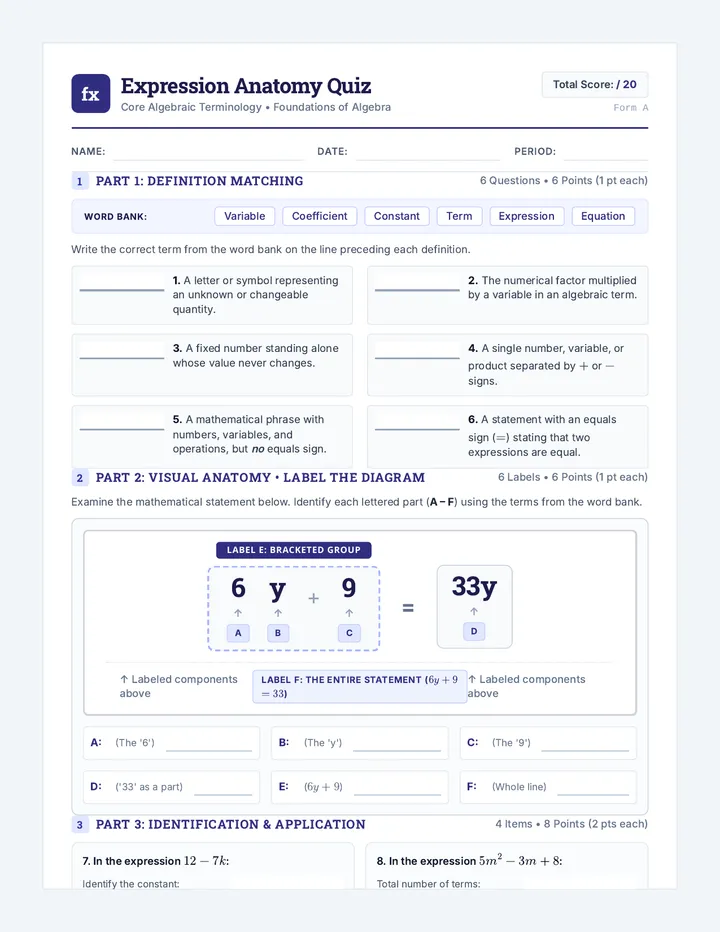
Expression Anatomy Quiz

Expression Anatomy

A focused lesson targeting essential algebraic vocabulary, helping students master variables, coefficients, constants, terms, expressions, and equations. Includes a comprehensive student assessment and an educator reference key with detailed solutions and instructional notes.

K

kgreene

2
Expression Duel Answer Key

Variable Victory

A high-energy review lesson where students evaluate algebraic expressions with whole numbers, decimals, and fractions through a secret agent themed mission.

MK

Michell Kisler

12
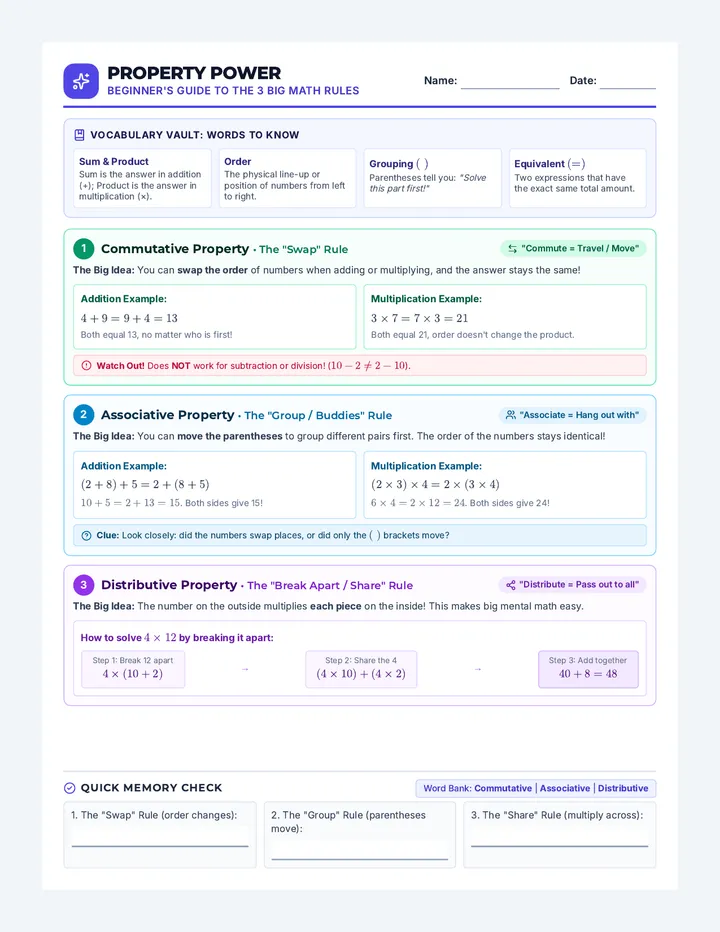
Property Power Handout

Property Powerhouse

A foundational math lesson exploring the Commutative, Associative, and Distributive properties through relatable memory hooks, visual models, guided practice, and mental math strategies.

H

Harlston

6
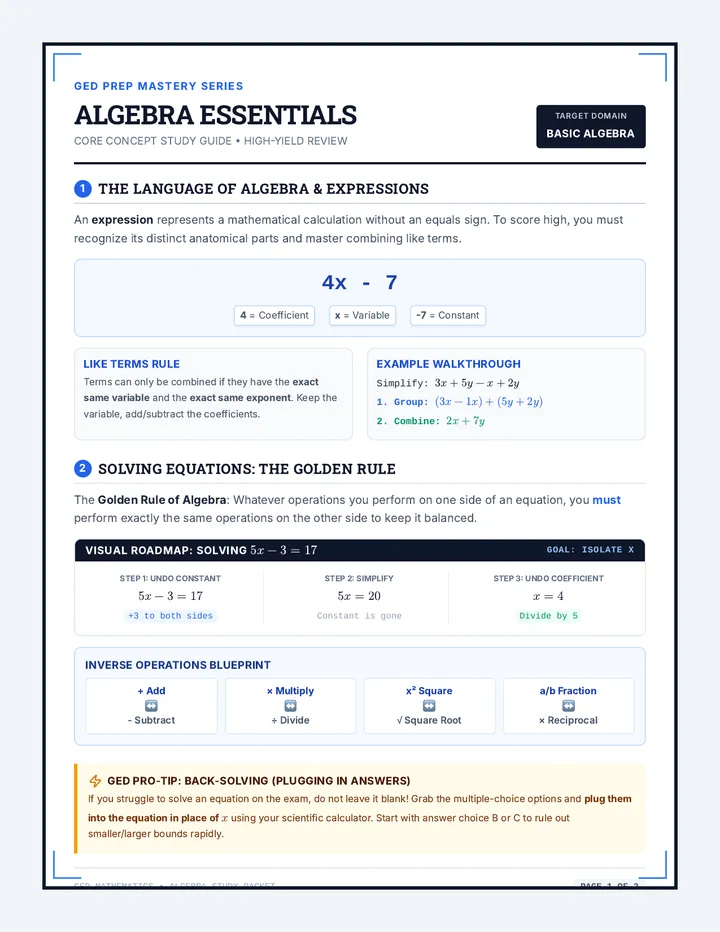
Algebra Essentials Study Guide

Algebra Essentials

A high-yield GED prep lesson targeting core algebraic reasoning, including linear equations, inequalities, simplifying expressions, and coordinate functions. Includes a comprehensive study guide, practice worksheet, and step-by-step explanatory answer key.

CJ

Cindy Jennings

3
Interest Blueprint Notes

Interest Architect

A guided exploration of discrete and continuous compound interest formulas through visual organizers and structured notes.

CK

Cheydon Krysl

4
Code Cracker Slides

Code Cracker Expressions

Students practice simplifying algebraic expressions and identifying equivalent expressions through a collaborative card-matching game. They will combine like terms and use the distributive property to 'decode' complex expressions into their simplest forms.

MK

Michell Kisler

5