Lenny.com
Explore
Create
ActivitiesNewMathEnglish Language ArtsScience & EngineeringSocial StudiesGlobal LanguagesHealth & Physical EducationSpecial EducationCounseling & Life SkillsArts & CreativityESL
Lenny.com
Lenny.com
Explore
Create
ActivitiesNewMathEnglish Language ArtsScience & EngineeringSocial StudiesGlobal LanguagesHealth & Physical EducationSpecial EducationCounseling & Life SkillsArts & CreativityESL
Lenny.com
Lenny.com

Solutions

Lenny for EducatorsLenny for SchoolsLenny for Districts

Product

ExploreSign inCreateSupportAbout

Resources

Getting startedMTSS Acceleration Program

© 2026 Lenny Learning Inc.

TermsPrivacyAccessibility
LinkedInInstagramX
Lenny
MathNumbers & CountingCounting ObjectsNumber NamesComparing NumbersNumber OperationsCounting SequenceNumbers 0-10Place Value Understanding and SystemAdd and Subtract Within 20Addition and Subtraction ConceptsAddition and Subtraction EquationsAddition and Subtraction ProblemsFoundations for MultiplicationMultiplication and Division PropertiesMultiply and Divide Within 100Multiplication and Division ProblemsFactors and MultiplesProperties of OperationsPatterns and RelationshipsGenerate and Analyze PatternsMulti-Digit ArithmeticPlace Value OperationsMulti-Digit and Decimal OperationsNumerical ExpressionsFour Operations and PatternsFour Operations Problem SolvingMeasurement & DataMeasurable AttributesMeasuring LengthsMeasure and Estimate Lengths in Standard UnitsRelate Addition and Subtraction to LengthClassifying and Counting ObjectsTime and MoneyArea Concepts and MeasurementPerimeter and Area MeasuresAngle Concepts and MeasurementTime, Volume, and MassMeasurement Unit ConversionsGeometryIdentifying ShapesShapes and AttributesShape Attributes and ReasoningShapes and CompositionClassifying 2D FiguresGeometric Figures and RelationshipsLines, Angles, and ShapesAngle, Area, and VolumeGeometric MeasurementVolume of 3D ShapesCoordinate Plane ApplicationsTransformations in the PlaneCongruence and SimilarityUnderstand congruence in terms of rigid motionsSimilarity and TransformationsProve Theorems Involving SimilarityPythagorean TheoremTrigonometry for General TrianglesMake Geometric ConstructionsProve Geometric TheoremsTheorems About CirclesFind Arc Lengths And Areas of Sectors of CirclesVolume FormulasRelationships Between Two-Dimensional and Three-Dimensional ObjectsProve Simple Geometric Theorems AlgebraicallyTranslate Between Geometric Description and Equation for Conic SectionApply Geometric Concepts in Modeling SituationsFractions & DecimalsFractions as NumbersBuilding FractionsFraction Equivalence and OrderingAdding and Subtracting FractionsMultiplying and Dividing FractionsDividing FractionsDecimal FractionsMulti-Digit Computation and FactorsAdd, Subtract, Multiply, and Divide Rational NumbersRational Number SystemIrrational Numbers and ApproximationsRatiosRatios and ProportionsProportional RelationshipsUnit RateAlgebraAlgebraic ExpressionsGenerate Equivalent ExpressionsQuantitative RelationshipsProportional Relationships and Linear EquationsEquations and InequalitiesEquation Solving and ReasoningLinear Equations and SystemsGraph Equations and InequalitiesSystems of EquationsReal-World Algebraic ProblemsQuantitative Reasoning with UnitsExpression StructureEquivalent Expression FormsRadicals and Integer ExponentsRational ExponentsRational and Irrational NumbersPolynomial OperationsPolynomial IdentitiesPolynomial Zeros and FactorsRational ExpressionsComplex Number OperationsComplex Numbers in PolynomialsComplex Numbers on PlaneStatistics & ProbabilityRepresent and Interpret DataData DistributionsStatistical VariabilityProbability ModelsCompound Event ProbabilitiesStatistical SamplingInterpret Categorical and Quantitative DataBivariate Data PatternsInterpret Linear ModelsComparing Two PopulationsRandom Processes in StatisticsIndependence and Conditional ProbabilityExpected ValuesProbability-Based Decision MakingStatistical Inference and ConclusionsFunctionsFunction Concepts and NotationDefine and Compare FunctionsInterpret Functions in ContextAnalyze Function RepresentationsModel Relationships with FunctionsIdentify Linear vs Exponential GrowthDistinguish Between Function TypesCompare Growth RatesInterpret Function ExpressionsBuild Functions from RelationshipsConstruct and Model FunctionsTransform and Combine FunctionsModel Comparison and SelectionSolve Exponential EquationsTrigonometryTrigonometric Ratios Involving Right TrianglesTrigonometric Functions and Unit CircleModel with Trigonometric FunctionsTrigonometric IdentitiesVectors & MatricesIntroduction to Vectors and MatricesVector QuantitiesVector OperationsMatrix OperationsCalculusLimits and ContinuityDerivative Concepts and NotationDerivative Rules and TechniquesApplications of DerivativesOptimization ProblemsRelated RatesCurve Sketching and AnalysisIntegration Concepts and NotationAntiderivatives and Indefinite IntegralsDefinite Integrals and AreaFundamental Theorem of CalculusIntegration TechniquesApplications of IntegrationDifferential EquationsSequences and SeriesParametric and Polar FunctionsVector-Valued Functions

Secondary Mastery Series

A master sequence containing curriculum-aligned lessons for Malaysian secondary school students. It covers Form 5 Mathematics and Form 2 English UASA revision.

AMArrthy Muthamilselvan
Trig Graphs Masterclass

Form 5 Mathematics Lesson on trigonometric functions, covering graphing of sine, cosine, and tangent curves, exploring key features like amplitude, period, intercepts, and asymptotes. Includes assessment for learning, collaboration, and differentiated instruction.

UASA Transfer Masterclass

Form 2 English lesson focusing on the UASA Information Transfer format. Teaches scanning, keywording, and exact-phrase transcription strategies through real-world texts, hands-on graphic organizers, peer collaboration, and a post-lesson assessment.

Secondary Mastery Series

A master sequence containing curriculum-aligned lessons for Malaysian secondary school students. It covers Form 5 Mathematics and Form 2 English UASA revision.

AMArrthy Muthamilselvan
\(y = \sin x\)
\(y = \cos x\)
\(y = \tan x\)
Maximum value & \(x\)-point
Minimum value & \(x\)-point
Amplitude ValuePrefilled: Undefined
Period of the Function
\(x\)-intercept points
Asymptote EquationsNoneNone

Critical Analytical Challenge:

Explain why the function \(y = \tan x\) has no maximum value, referencing its definition in relation to sine and cosine.

EXIT SLIP (Formative Check)

1. A continuous wave starts at height 0 and goes down to minimum \(-1\) at \(270^\circ\). What function is it?

2. Give one similarity between \(y = \sin x\) and \(y = \tan x\).

Self-Rating Check

Confident (Green)

Need practice (Yellow)

Help needed (Red)

Tick your choice above.

Trig Masterclass • Student Worksheet Page 2 of 2

Geometric Property\(y = \sin x\)\(y = \cos x\)\(y = \tan x\)
Max Value & Position1 (at \(90^\circ\))1 (at \(0^\circ, 360^\circ\))None (\(\infty\))
Min Value & Position-1 (at \(270^\circ\))-1 (at \(180^\circ\))None (\(-\infty\))
Amplitude Value11Undefined
Period\(360^\circ\)\(360^\circ\)\(180^\circ\)
\(x\)-intercept points\(0^\circ, 180^\circ, 360^\circ\)\(90^\circ, 270^\circ\)\(0^\circ, 180^\circ, 360^\circ\)
Asymptote LinesNoneNone\(x = 90^\circ, 270^\circ\)

Suggested Solution: Critical Analytical Challenge

"Explain why the function \(y = \tan x\) has no maximum value..."

• Since \(\tan x = \frac{\sin x}{\cos x}\), as \(x \to 90^\circ\) from the left side, \(\sin x \to 1\) while \(\cos x \to 0\).

• Dividing a positive number near 1 by an extremely small positive value near 0 makes the ratio approach \(\infty\) (positive infinity).

• Therefore, there is no maximum bounded value for the function, and it shoots upward indefinitely alongside the vertical asymptote line.

EXIT SLIP SUGGESTED ANSWER SCHEME (SPM grading)

Q1. A continuous wave starts at height 0 and goes down to minimum \(-1\) at \(270^\circ\). What function is it?

Answer: \(y = \sin x\) (Because \(\sin(270^\circ) = -1\) and starts at origin \((0,0)\).)

Q2. Give one similarity between \(y = \sin x\) and \(y = \tan x\).

Accept any one of:

  • Both pass exactly through the origin \((0, 0)\).
  • Both cross the x-axis at \(0^\circ\), \(180^\circ\), and \(360^\circ\) (\(x\)-intercepts match).

Trig Masterclass • Teacher Guide Page 2 of 2

UASA Blueprint

01

Read Organiser First

Before diving into the text, read the questions or tables. Know exactly what details you are scanning for!

02

Identify Keywords

Circle names, prepositions (on, in, under, at), and key nouns in the question prompts to find anchors.

03

Scan & Highlight

Let your eyes glide over the text rapidly without reading word-for-word until you reach your keyword.

04

Copy EXACT Words

Do NOT paraphrase or rewrite verb endings! Copy matching text letter-for-letter directly from the passage.

05

Check Spelling

In UASA, single spelling errors or minor grammatical slips result in zero marks. Double check letters!

Remember: A single wrong letter transforms 1 mark to 0 marks.

Slide 4 of 10


Teaching Delivery (10 mins)

Let's Model It: Reading Passage vs Organiser

Step-by-Step Guide

UASA Sample Text

The Cyber Safety Campaign aims to educate secondary school students. It will feature several sessions. Mr. Julian Wong, a prominent online security advisor, will present the keynote speech regarding online threats. In addition, there is a workshop on passcode creation located in the Computer Laboratory on the third floor.

PROMPT: Name of Event

Cyber Safety Campaign

Found exactly in sentence 1 of text.

PROMPT: Key Speaker

Mr. Julian Wong

Located via clue phrase: "...will present the keynote speech."

PROMPT: Venue of Workshop

Computer Laboratory

Preposition in the led us directly to this noun phrase.

[Differentiation: Scaffolded modeling highlighting preposition clues]

Slide 5 of 10


Exam Pitfalls

Spot the Traps: UASA Error Analysis

[AfL Tool: Danger Zones]

UASA examiners strictly reject answers with the following flaws. Learn what NOT to do!

1. Exceeding Word Limits

Most UASA organisers have a strict instruction: "No more than 3 words". If you copy 4 words, you lose the mark immediately, even if the content is correct!

Limit: MAX 3 Words

2. Careless Spelling Slips

Omitting letters, skipping capitalization of proper nouns (e.g. julian wong instead of Julian Wong) or adding extra letters results in 0 MARKS.

Match letter-for-letter!

3. Unnecessary Editing

Students often rewrite text verbs to make them sound correct (e.g. changing "organising event" to "organise events"). Do NOT change anything! Copy the word verbatim.

Strict copy-paste policy!

Always check spelling against the text before submitting!

Slide 6 of 10


Active Exercise (15 mins)

Independent & Collaborative Practice

[Worksheet Task]

Get ready for the UASA Info Transfer Practice Worksheet. Follow these active collaboration phases:

Phase 1 10 mins

Independent Scan

Read the passage and complete the Graphic Organiser independently. Focus on keywords and strict spelling checks.

Phase 2 3 mins

Partner Compare

Compare responses with your partner. Discuss any differences in spelling, capitalization, or word boundaries.

Phase 3 2 mins

Class Review

Identify where answers were located in the text and clarify common pitfalls. Correct your sheet with a red pen.

Note: Pay attention to names and proper nouns in the passage!

Countdown: 15:00

Form 2 Revision • UASA Transfer Masterclass

Slide 7 of 10


Post-Lesson Check (10 mins)

Speed Fill-In Challenge

[AfL Exit Check]

Quick Reading Passage

Due to heavy rain, the English Language Quiz has been moved from the Open Courtyard to the Main Hall. The starting time remains 2:15 p.m.. The supervisor is Madam Shanti. Please arrive 10 minutes early.

Complete the missing info:

Peer Check: Exchange notes with your partner. Ensure spelling matches perfectly!

Form 2 Revision • UASA Transfer Masterclass

Slide 8 of 10


Exam Standards

UASA Marking Philosophy

Marking Key

Awarded 1 Mark if:

  • The spelling matches the reading text letter-for-letter.
  • Capital letters are placed correctly for names, dates, and locations.
  • The words written are within the required maximum limit.

Rejected (0 Marks) if:

  • There is any spelling omission or punctuation mistake.
  • Lower case is used for proper nouns (e.g. "computer laboratory").
  • Extra unnecessary words are added which exceed the limit.

Pro Tip: Read your transferred words out loud silently in your head. Do they match the prompt's structural sense?

Form 2 Revision • UASA Transfer Masterclass

Slide 9 of 10


Self-Assessment

Reviewing our Success Criteria

[Metacognitive Reflection]

Golden Rules Checklist

  • Scan, do not read word-for-word initially.
  • Identify clues (by, in, on, at, name) in organizer.
  • Maintain exact spelling and capitalization rules.
  • Check that you have not exceeded word limits!

My Confidence Rating

Confident (Green): I can locate facts instantly and copy exact phrases without error.

Developing (Yellow): I can locate answers but need to double-check my spelling slips.

Need Help (Red): I struggle to find keywords or identify word boundaries.

Worksheet Exit Slip: Complete the 3-minute quick table check at the back of your worksheet and hand it in before you leave!

Form 2 Revision • UASA Transfer Masterclass

Slide 10 of 10

Mistake:

Corrected answer:

Prompt: Morning Guide Name

encik rosli hamide

Mistake: Spelling error ("hamide") and lowercase title.

Corrected answer:

Prompt: Location

beautiful Botanical Gardens

Mistake: Unnecessary word "beautiful" copied from imagination.
Corrected answer:

TASK 3: Post-Lesson Quick Speed Fill-In (Individually)

Read the paragraph on the screen and complete the table of details. Work individually!

EXIT TICKET: Metacognitive Reflection

1. Why are marks lost if we write "nature club" instead of "Nature Club" in UASA?

2. What is the most important lesson you learned about copying answers today?

Self-Rating

I got this! (Green)

Need practice (Yellow)

Help needed (Red)

Tick your choice above.

Form 2 English UASA Revision • Information Transfer Page 2 of 2

TASK 3 SOLUTIONS: Post-Lesson Quick Speed Fill-In Key

Remediation Pathways (Based on Student Self-Ratings)

GREEN (Confident) Give them a stretch task: "Formulate paraphrased questions that target these same answers but use alternative synonyms."

YELLOW (Developing) Provide them with highlighter sheets. Have them trace preposition linkages explicitly on the worksheets.

RED (Needs Support) Sit in a support circle. Guide them sentence-by-sentence to pinpoint keywords using literal matching blocks.

Form 2 English UASA Revision • Answer Key Page 2 of 2

You might also like

Autumn Warmup Packet

Daily Spark Warmups

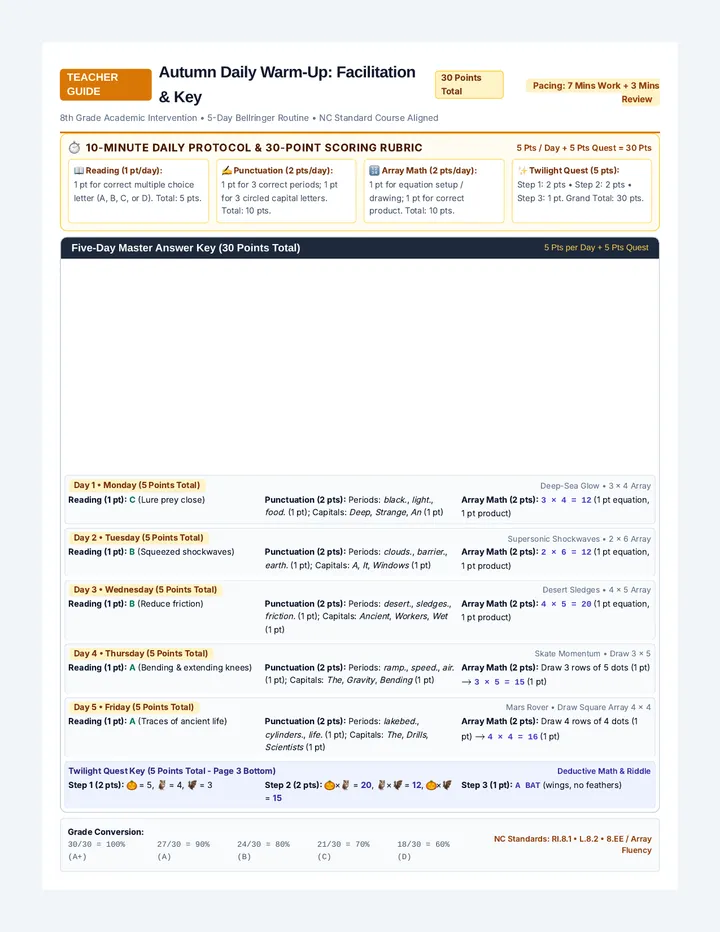
A five-day daily warm-up sequence for 8th grade intervention classrooms featuring reading comprehension, sentence mechanics, and multiplication array modeling across three compact print pages.

KS

Kathleen Suther

3
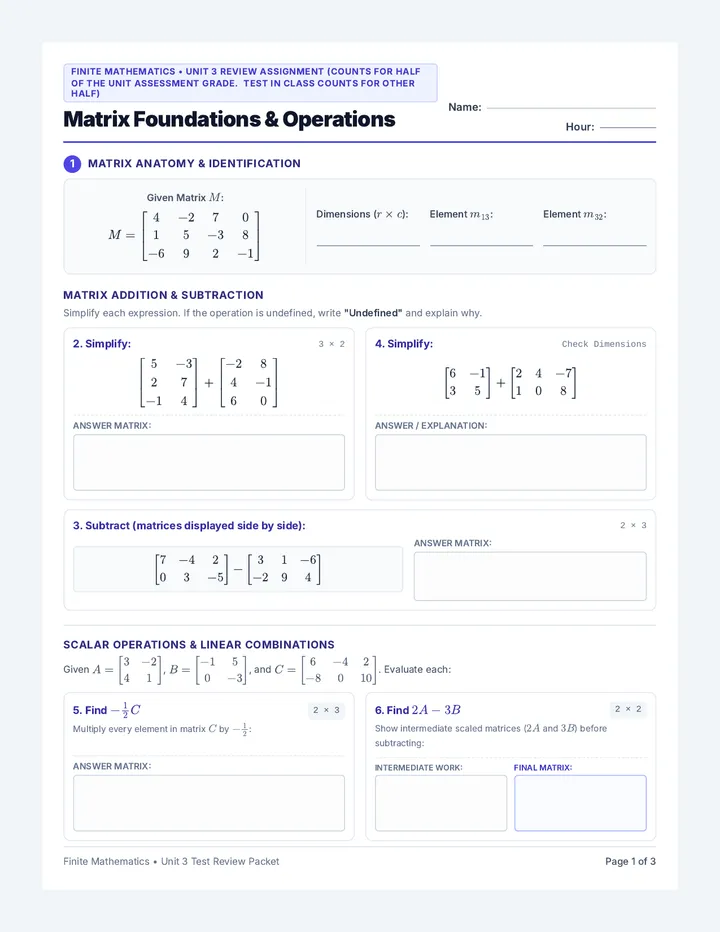
Matrix Systems Review Worksheet

Matrix Mastery

A high school finite mathematics unit review introducing matrix anatomy, operations, matrix multiplication, linear systems solved by graphing and elimination, and augmented matrices with calculator-based RREF applications.

RB

Ronald Berg

2
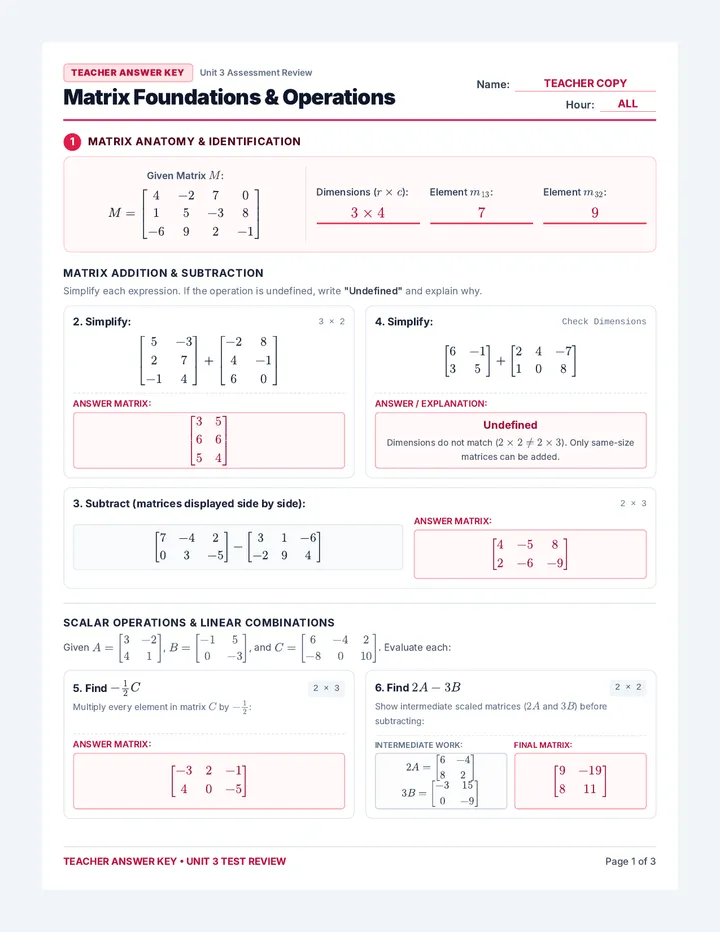
Matrix Systems Answer Key

Matrix Systems Answer Key

Teacher answer key for the 3-page Matrix Systems Review Worksheet, providing complete step-by-step solutions, intermediate matrix calculations, plotted graphing lines with coordinates, RREF output matrices, and final solutions for all 14 problems.

RB

Ronald Berg

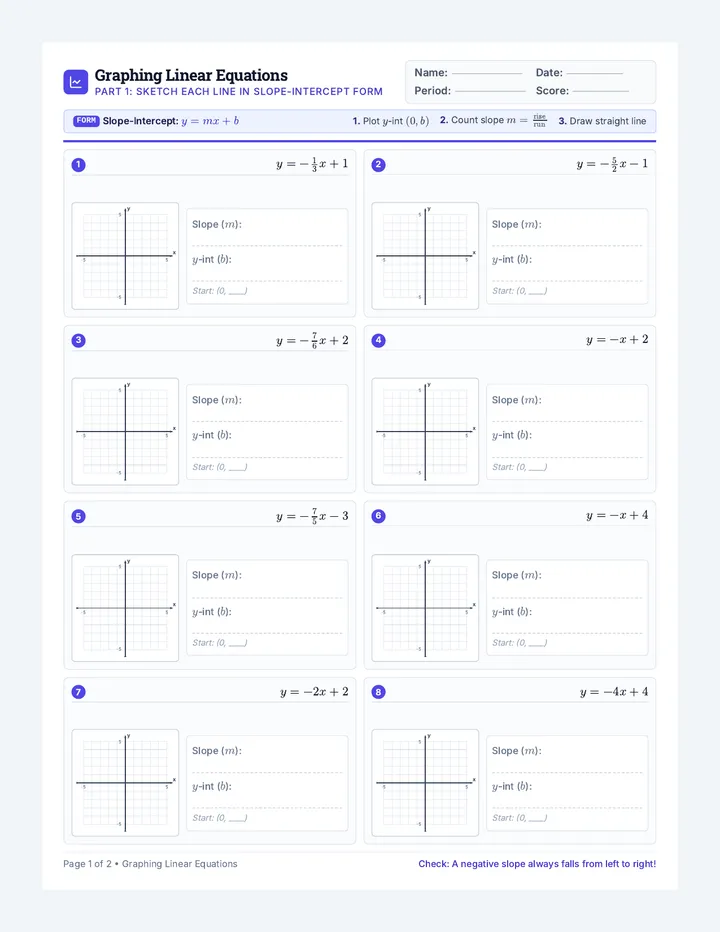
Linear Equations Practice Worksheet

Coordinate Geometry Mastery

A secondary mathematics curriculum sequence exploring linear functions and geometric transformations on the Cartesian coordinate plane, featuring print-ready guided practice and teacher keys.

FM

Fernando Mancini

4
Autumn Warmup Packet

Autumn Spark Week

Complete five-day daily warm-up unit featuring an all-in-one three-page student journal packet and classroom review slides with autumn science themes, reading comprehension, run-on punctuation, and print-friendly multiplication arrays.

KS

Kathleen Suther

3
Matrix Systems Review Worksheet

Matrix Systems Review Worksheet

A streamlined 3-page test review assignment worksheet for high school finite mathematics covering matrix features, operations, multiplication, systems by graphing and elimination, augmented matrices with RREF technology, and an applied word problem. Page 1 header updated to remove the Date field and provide an extended Name line with a dedicated Hour line.

RB

Ronald Berg

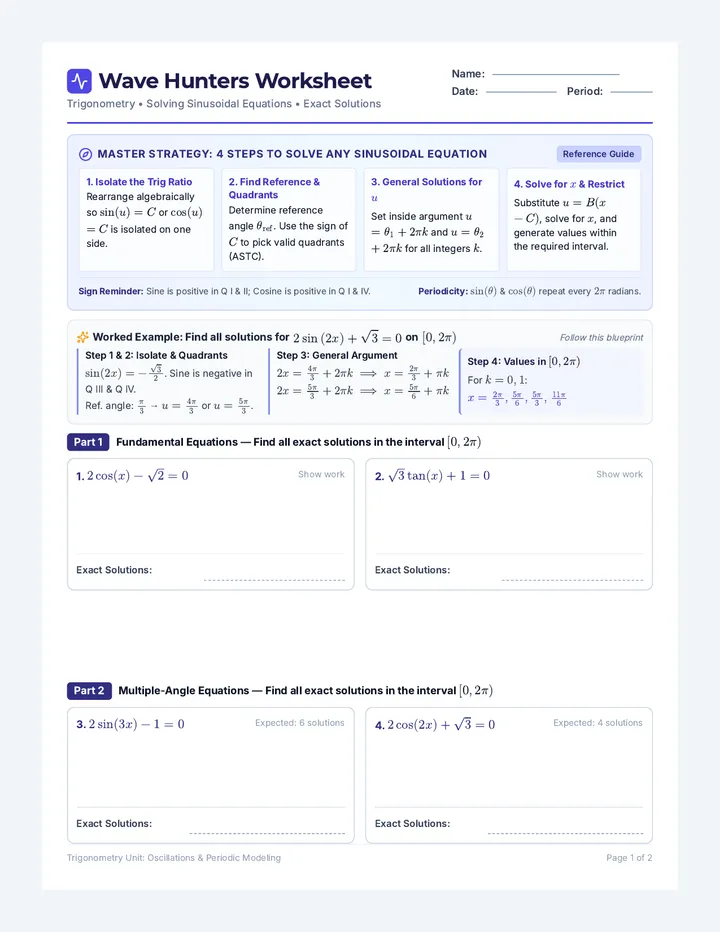
Wave Hunters Worksheet

Math and Economics

A secondary curriculum sequence covering advanced mathematical modeling alongside foundational economic systems and financial literacy concepts.

JT

Jasia Tahir

4
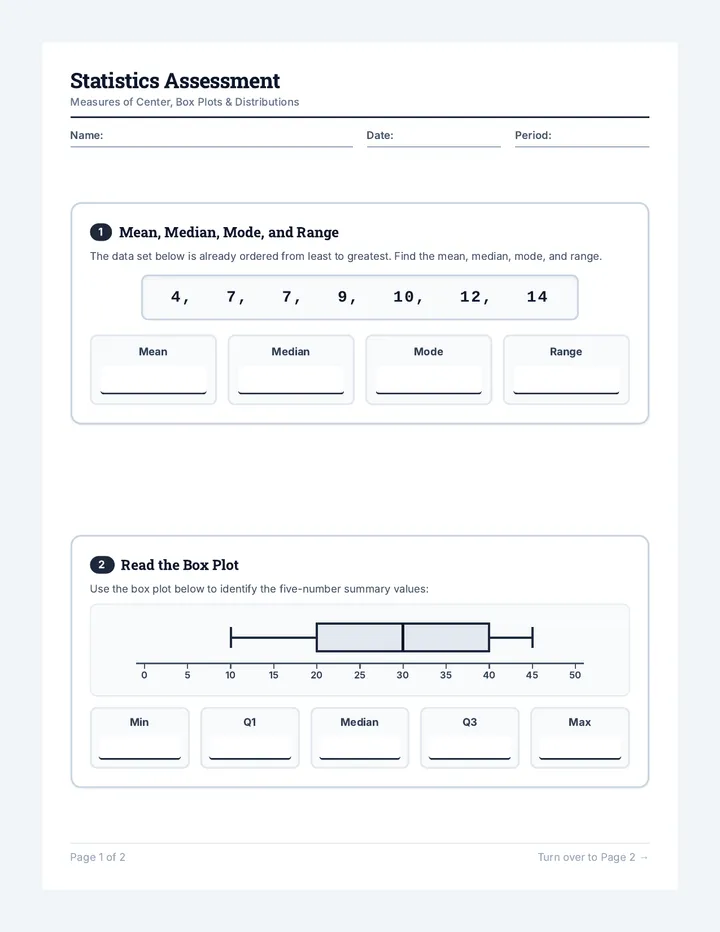
Data Detective Assessment

Statistics Foundations

A foundational statistics lesson focusing on calculating measures of center and spread, constructing and interpreting box plots, and recognizing distribution shapes.

CF

Chad Forde

2
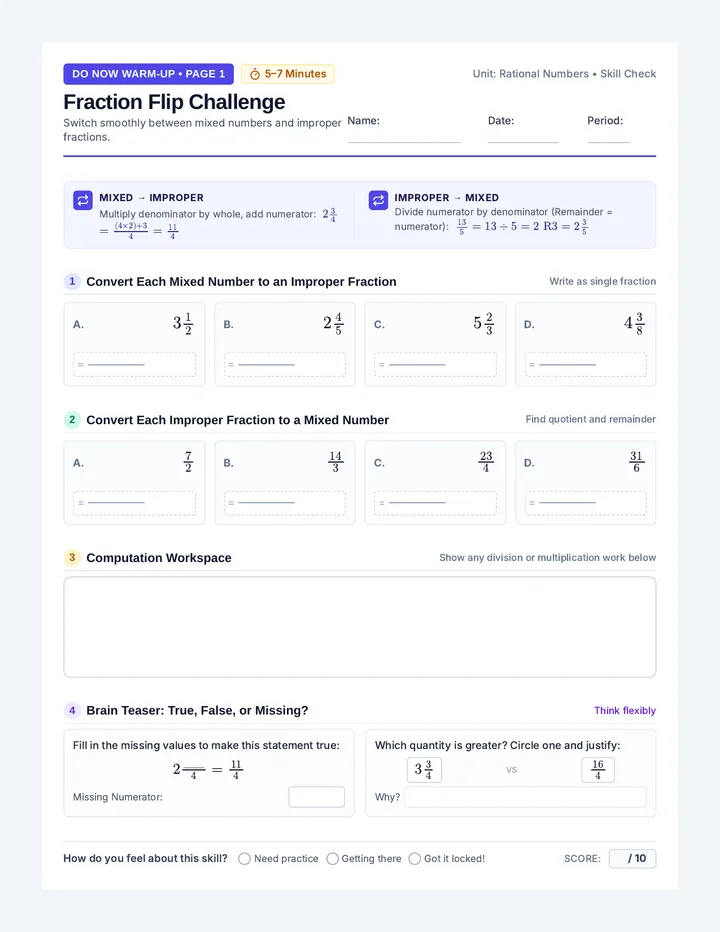
Fraction Flip Do Now

Fraction Flip Do Now

A two-page print-ready Do Now warm-up packet for middle school math students to practice converting between mixed numbers and improper fractions. Page 1 includes visual anchor strategies, conversion drills, an open computation workspace, and a brain teaser comparison; Page 2 offers a parallel practice set with an error analysis task in place of the brain teaser.

KD

Khadija Diop

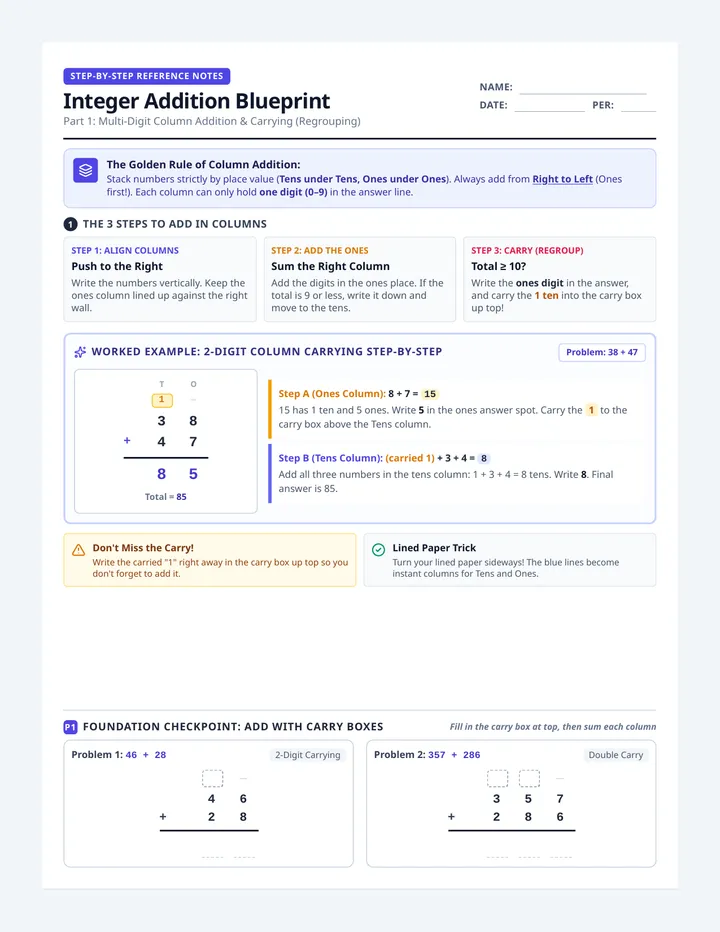
Integer Addition Blueprint Notes Sheet

Integer Operations Mastery

A comprehensive 9th-grade algebra readiness sequence covering addition with regrouping and conceptual integer multiplication through skip counting and repeated addition.

S

Shannon

3
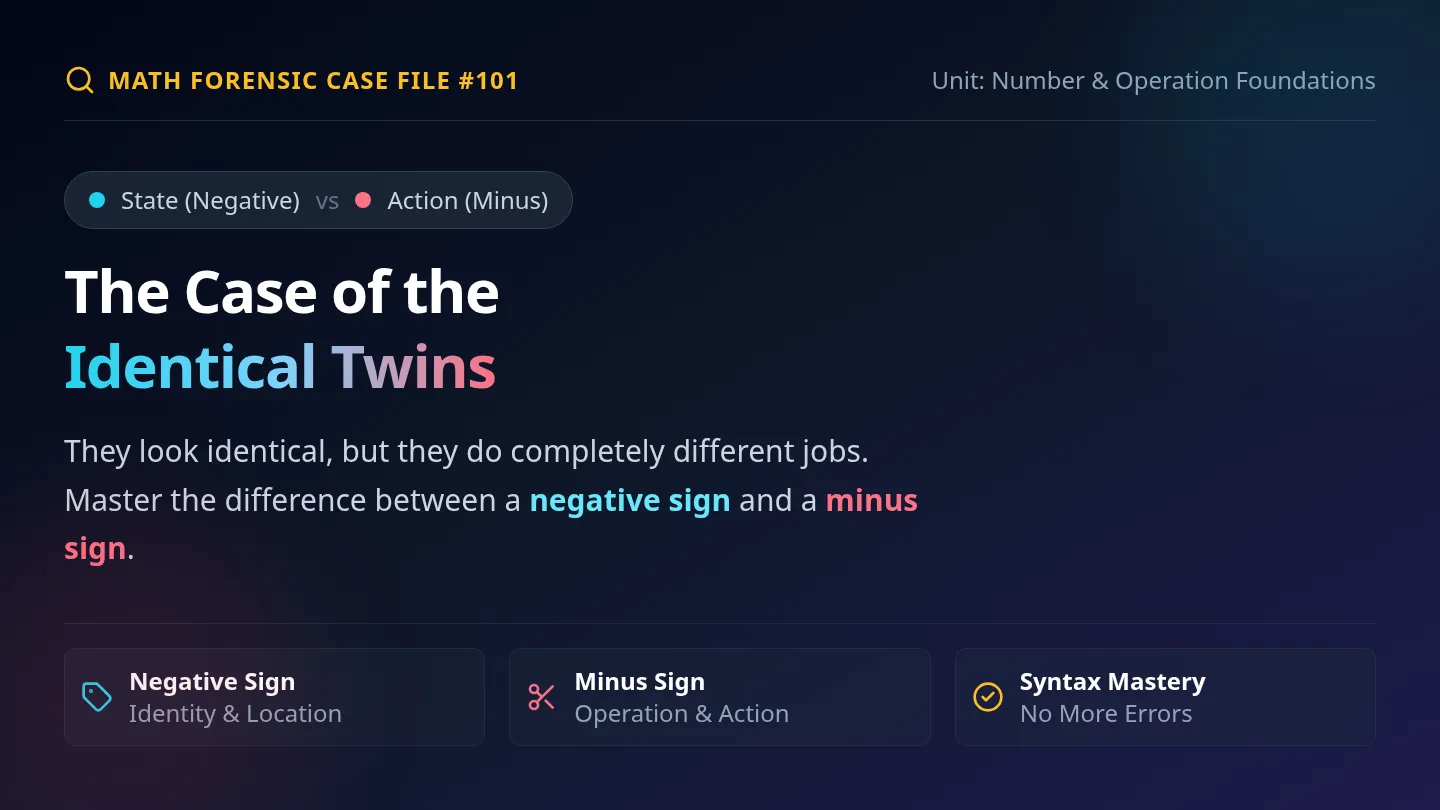
Sign Sleuths Slides

Sign Sleuths

A focused mini-unit that demystifies the difference between negative signs (numerical state) and minus signs (operational action). Students master visual identification, read-aloud conventions, calculator syntax, and algebraic expressions.

H

Harlston

4
Autumn Teacher Guide

Autumn Teacher Guide

Updated one-page teacher facilitation guide and master key detailing the 30-point grading system, section point breakdowns, and percentage conversion scale.

KS

Kathleen Suther