Lenny.com
Explore
Create
ActivitiesNewMathEnglish Language ArtsScience & EngineeringSocial StudiesGlobal LanguagesHealth & Physical EducationSpecial EducationCounseling & Life SkillsArts & CreativityESL
Lenny.com
Lenny.com
Explore
Create
ActivitiesNewMathEnglish Language ArtsScience & EngineeringSocial StudiesGlobal LanguagesHealth & Physical EducationSpecial EducationCounseling & Life SkillsArts & CreativityESL
Lenny.com
Lenny.com

Solutions

Lenny for EducatorsLenny for SchoolsLenny for Districts

Product

ExploreSign inCreateSupportAbout

Resources

Getting startedMTSS Acceleration Program

Newsletters

School Funding Newsletter

© 2026 Lenny Learning Inc.

TermsPrivacyAccessibility
LinkedInInstagramX
Lenny
MathNumbers & CountingCounting ObjectsNumber NamesComparing NumbersNumber OperationsCounting SequenceNumbers 0-10Place Value Understanding and SystemAdd and Subtract Within 20Addition and Subtraction ConceptsAddition and Subtraction EquationsAddition and Subtraction ProblemsFoundations for MultiplicationMultiplication and Division PropertiesMultiply and Divide Within 100Multiplication and Division ProblemsFactors and MultiplesProperties of OperationsPatterns and RelationshipsGenerate and Analyze PatternsMulti-Digit ArithmeticPlace Value OperationsMulti-Digit and Decimal OperationsNumerical ExpressionsFour Operations and PatternsFour Operations Problem SolvingMeasurement & DataMeasurable AttributesMeasuring LengthsMeasure and Estimate Lengths in Standard UnitsRelate Addition and Subtraction to LengthClassifying and Counting ObjectsTime and MoneyArea Concepts and MeasurementPerimeter and Area MeasuresAngle Concepts and MeasurementTime, Volume, and MassMeasurement Unit ConversionsGeometryIdentifying ShapesShapes and AttributesShape Attributes and ReasoningShapes and CompositionClassifying 2D FiguresGeometric Figures and RelationshipsLines, Angles, and ShapesAngle, Area, and VolumeGeometric MeasurementVolume of 3D ShapesCoordinate Plane ApplicationsTransformations in the PlaneCongruence and SimilarityUnderstand congruence in terms of rigid motionsSimilarity and TransformationsProve Theorems Involving SimilarityPythagorean TheoremTrigonometry for General TrianglesMake Geometric ConstructionsProve Geometric TheoremsTheorems About CirclesFind Arc Lengths And Areas of Sectors of CirclesVolume FormulasRelationships Between Two-Dimensional and Three-Dimensional ObjectsProve Simple Geometric Theorems AlgebraicallyTranslate Between Geometric Description and Equation for Conic SectionApply Geometric Concepts in Modeling SituationsFractions & DecimalsFractions as NumbersBuilding FractionsFraction Equivalence and OrderingAdding and Subtracting FractionsMultiplying and Dividing FractionsDividing FractionsDecimal FractionsMulti-Digit Computation and FactorsAdd, Subtract, Multiply, and Divide Rational NumbersRational Number SystemIrrational Numbers and ApproximationsRatiosRatios and ProportionsProportional RelationshipsUnit RateAlgebraAlgebraic ExpressionsGenerate Equivalent ExpressionsQuantitative RelationshipsProportional Relationships and Linear EquationsEquations and InequalitiesEquation Solving and ReasoningLinear Equations and SystemsGraph Equations and InequalitiesSystems of EquationsReal-World Algebraic ProblemsQuantitative Reasoning with UnitsExpression StructureEquivalent Expression FormsRadicals and Integer ExponentsRational ExponentsRational and Irrational NumbersPolynomial OperationsPolynomial IdentitiesPolynomial Zeros and FactorsRational ExpressionsComplex Number OperationsComplex Numbers in PolynomialsComplex Numbers on PlaneStatistics & ProbabilityRepresent and Interpret DataData DistributionsStatistical VariabilityProbability ModelsCompound Event ProbabilitiesStatistical SamplingInterpret Categorical and Quantitative DataBivariate Data PatternsInterpret Linear ModelsComparing Two PopulationsRandom Processes in StatisticsIndependence and Conditional ProbabilityExpected ValuesProbability-Based Decision MakingStatistical Inference and ConclusionsFunctionsFunction Concepts and NotationDefine and Compare FunctionsInterpret Functions in ContextAnalyze Function RepresentationsModel Relationships with FunctionsIdentify Linear vs Exponential GrowthDistinguish Between Function TypesCompare Growth RatesInterpret Function ExpressionsBuild Functions from RelationshipsConstruct and Model FunctionsTransform and Combine FunctionsModel Comparison and SelectionSolve Exponential EquationsTrigonometryTrigonometric Ratios Involving Right TrianglesTrigonometric Functions and Unit CircleModel with Trigonometric FunctionsTrigonometric IdentitiesVectors & MatricesIntroduction to Vectors and MatricesVector QuantitiesVector OperationsMatrix OperationsCalculusLimits and ContinuityDerivative Concepts and NotationDerivative Rules and TechniquesApplications of DerivativesOptimization ProblemsRelated RatesCurve Sketching and AnalysisIntegration Concepts and NotationAntiderivatives and Indefinite IntegralsDefinite Integrals and AreaFundamental Theorem of CalculusIntegration TechniquesApplications of IntegrationDifferential EquationsSequences and SeriesParametric and Polar FunctionsVector-Valued Functions

Fraction Flip Do Now

A two-page print-ready Do Now warm-up packet for middle school math students to practice converting between mixed numbers and improper fractions. Page 1 includes visual anchor strategies, conversion drills, an open computation workspace, and a brain teaser comparison; Page 2 offers a parallel practice set with an error analysis task in place of the brain teaser.

KDKhadija Diop

You might also like

Rise and Run Slides

Slope Intercept Studio

A two-day 8th-grade math sequence on graphing linear equations in slope-intercept form ($y = mx + b$). Day 1 builds fluency converting any slope into rise over run, and Day 2 extends mastery to special cases, reversed terms, and backward stepping.

L

Logan-Greene

5
Rise and Run Slides

Rise and Run

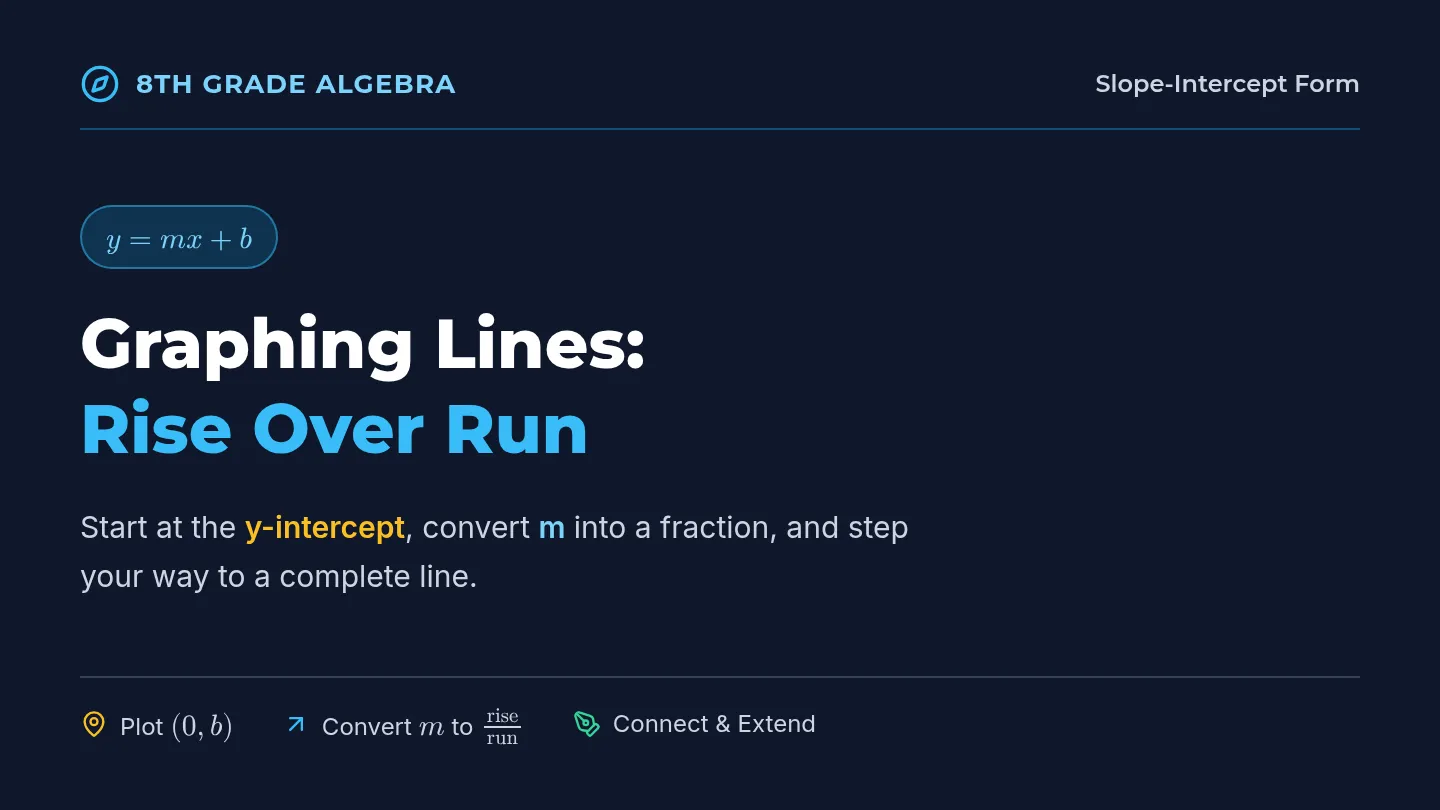
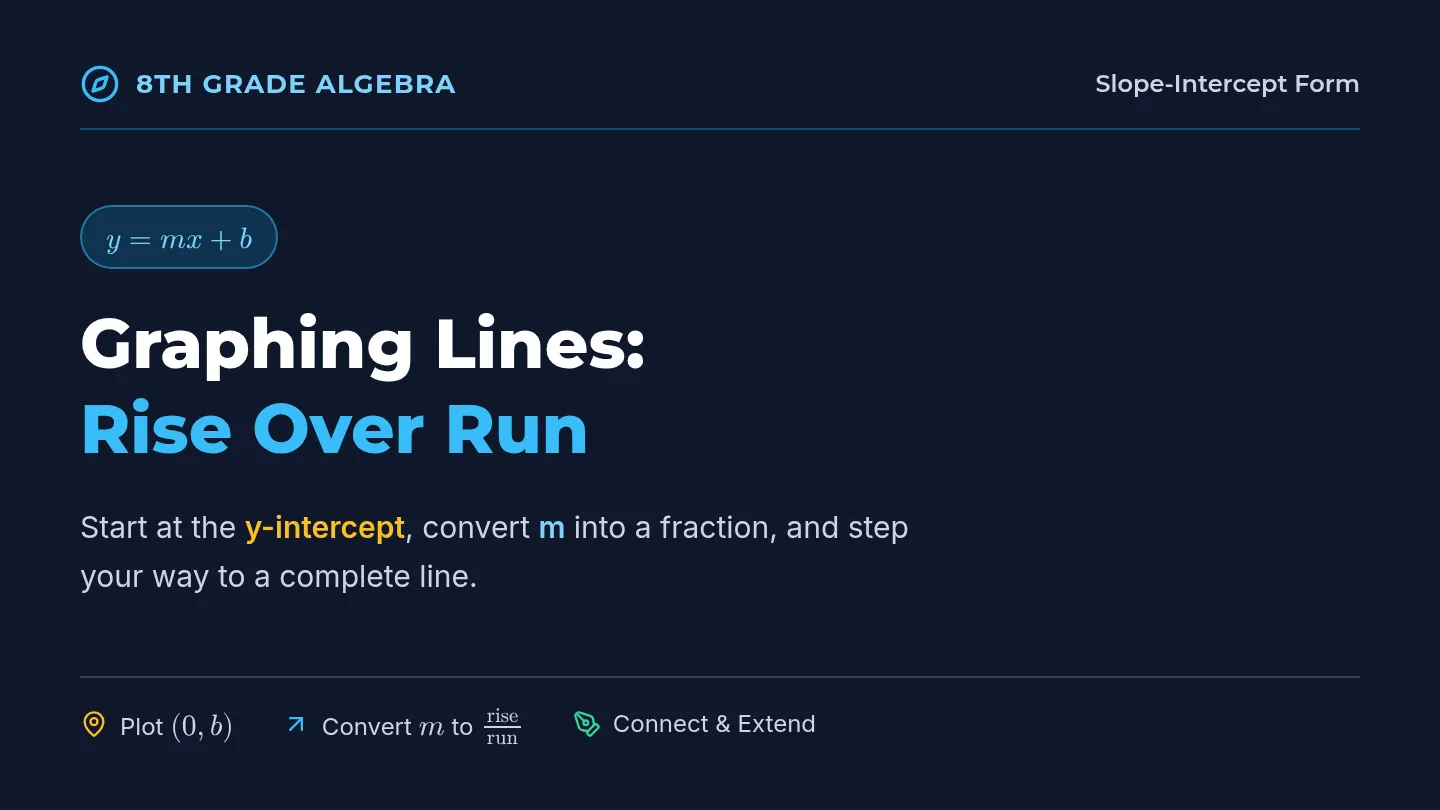
An 8th-grade math lesson building on plotting the y-intercept in slope-intercept form ($y = mx + b$) by teaching students how to convert any slope $m$ into rise over run and graph the full line. Includes instructional slides, a two-page student practice worksheet, and a matching answer key.

L

Logan-Greene

4
Ratio Mastery Reference Guide

Ratio Mastery Reference Guide

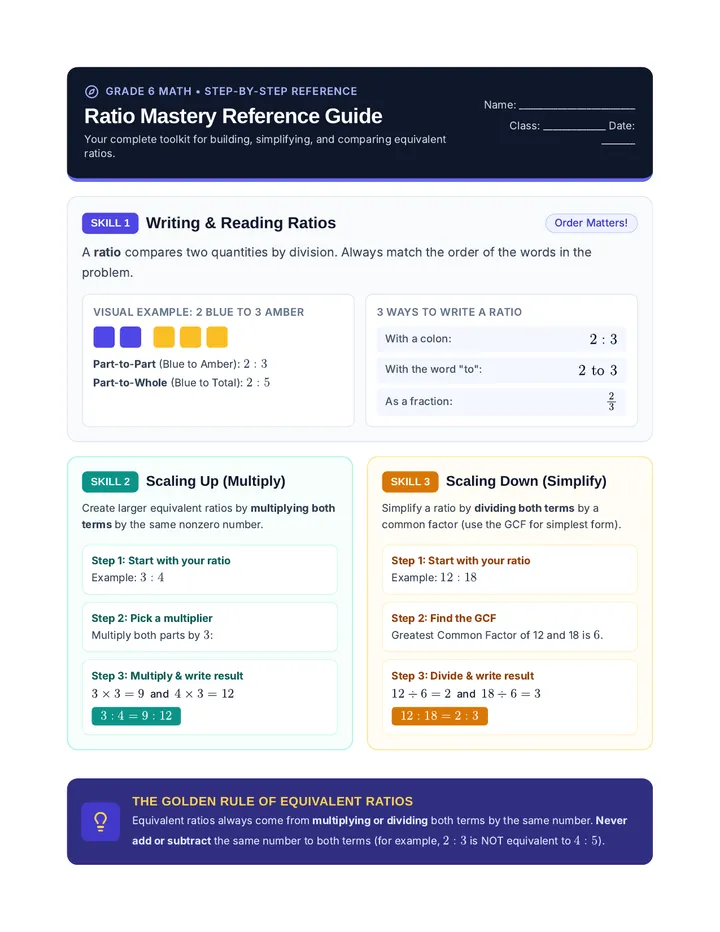
A comprehensive 3-page Grade 6 math step-by-step reference guide covering all equivalent ratio skills: writing ratios, scaling up and down, ratio tables, double number lines, tape diagrams, unit rates, comparing ratios, and solving for missing values. Designed with a clean math studio blueprint theme for classroom binders and print use.

EF

Elyse Farhi

Zero Hero Worksheet

Math Tune Up

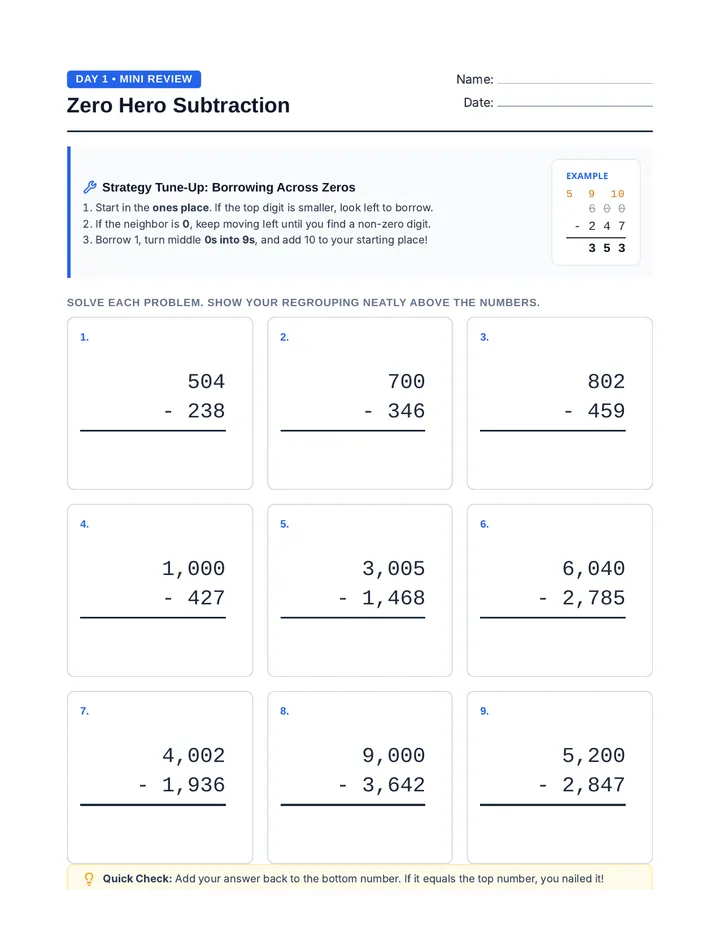
A 6-day mini review sequence targeting essential upper-elementary arithmetic skills: subtraction across zeros, one-step word problems, quick multiplication facts, 2-digit by 2-digit box method multiplication, tiered GEMDAS order of operations, and decimal rounding. Each day includes a focused practice worksheet with a strategy refresher and a matching answer key.

AA

alicia accapezzato

14
Interim Benchmark Exam

Ratio & Number Benchmark

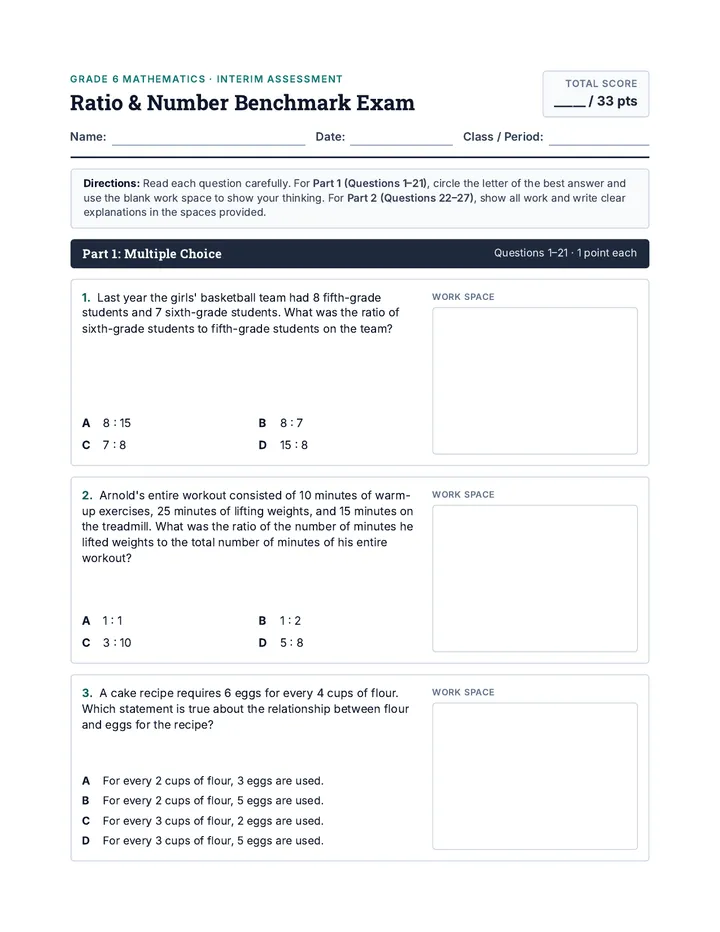
A Grade 6 Mathematics interim benchmark assessment bundle covering Ratios and Proportional Relationships (6.RP.1–6.RP.3) and The Number System (6.NS.1, 6.NS.4), adapted from a 28-slide review deck into a printable exam, complete answer key with scoring rubrics, and a teacher administration guide.

JS

jerell saint phar

3
Rise and Run Reference Sheet

Rise and Run Reference Sheet

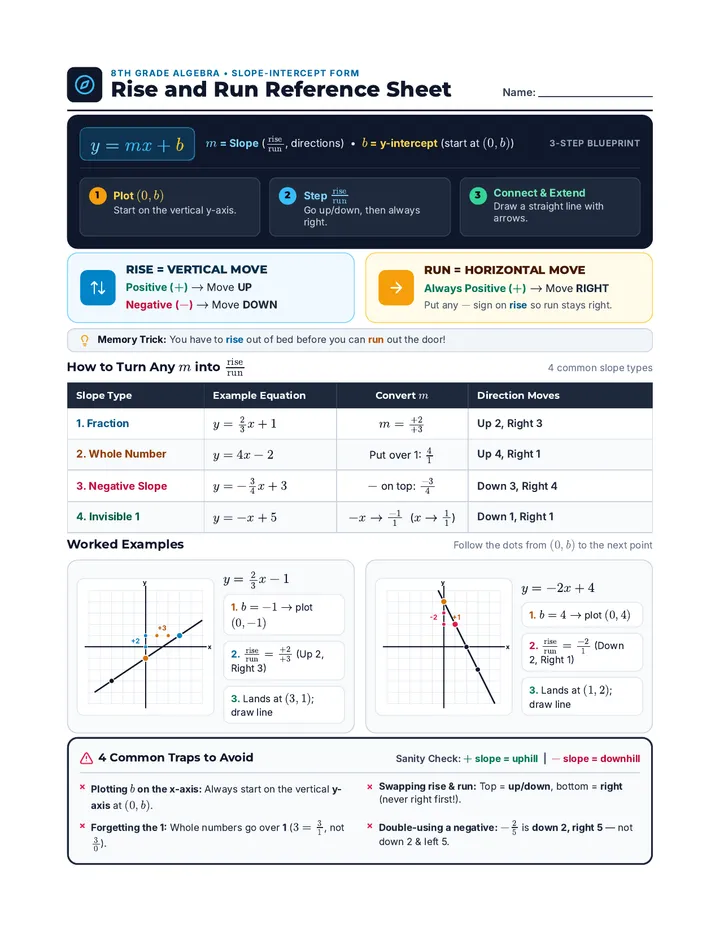
A one-page printable student reference sheet summarizing how to graph lines in slope-intercept form ($y = mx + b$) using rise over run. Covers the 3-step graphing blueprint, rise/run direction rules, converting fractions, integers, negative slopes, and invisible 1s, two worked visual examples, and common mistakes to avoid.

L

Logan-Greene

Fraction Equation Teacher Script

Fraction Equation Mastery

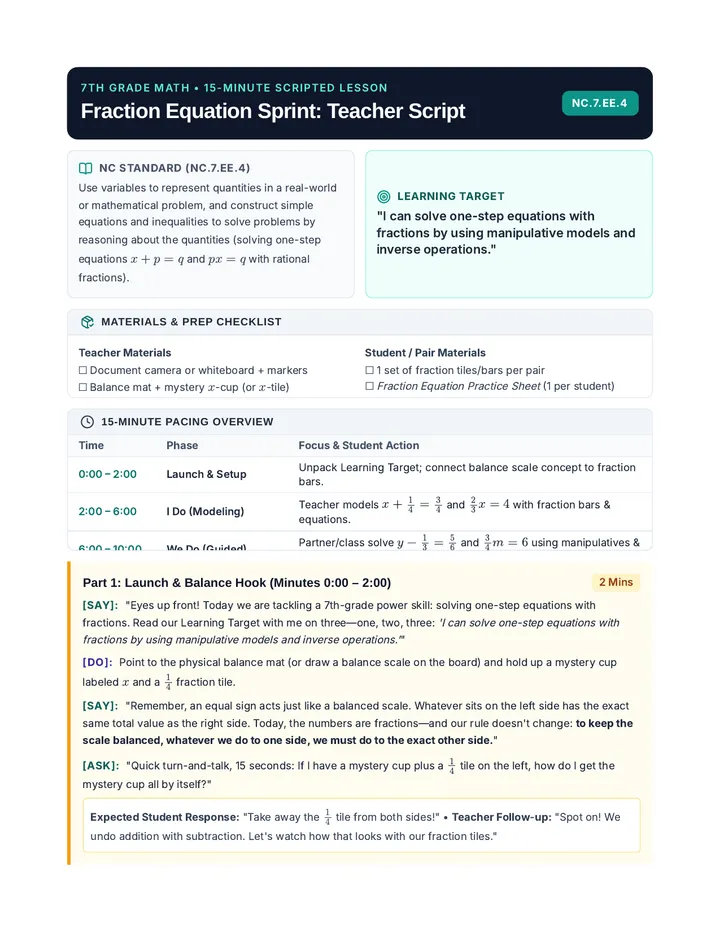
A two-lesson 7th-grade math sequence aligned to NC.7.EE.4 progressing from solving one-step fraction equations with manipulatives to clearing denominators using the Multiplication Property of Equality.

M

morticia.walston

14
Line Builders Worksheet

Line Builders

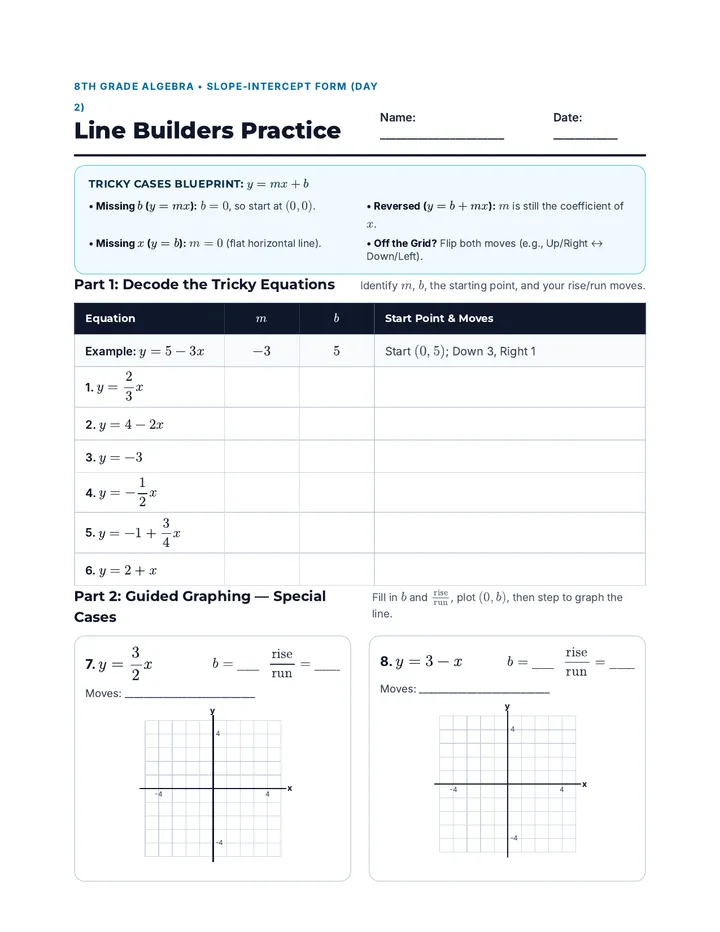
A Day 2 8th-grade math lesson extending $y = mx + b$ graphing to tricky cases including $b = 0$, zero-slope horizontal lines, equations written out of order ($y = b + mx$), and stepping backward when a move goes off the grid.

L

Logan-Greene

2
Rise and Run Answer Key

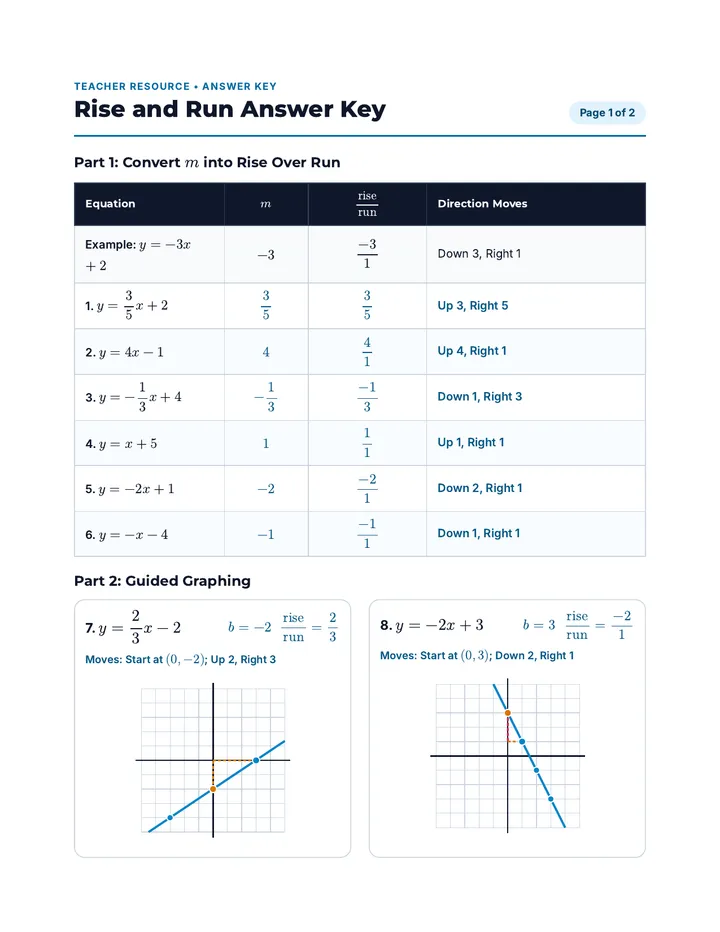
Rise and Run Answer Key

A two-page teacher answer key matching the Rise and Run Worksheet, providing completed rise-over-run conversions, graphed lines with plotted points and step indicators, and a sample explanation for the error-analysis exit check.

L

Logan-Greene

Slap Battles Slides

Slap Battles Math Arena

A two-lesson special education multiplication unit themed around Slap Battles, teaching both the Standard Algorithm (Glove Combo) and the Decompose Area Model (Split & Smash) for 2-digit and 3-digit multiplication.

MB

Michelle Bentley

20
Rise and Run Slides

Rise and Run

An 8th-grade math lesson building on plotting the y-intercept in slope-intercept form ($y = mx + b$) by teaching students how to convert any slope $m$ into rise over run and graph the full line. Includes instructional slides, a two-page student practice worksheet, and a matching answer key.

L

Logan-Greene

3
Rise and Run Worksheet

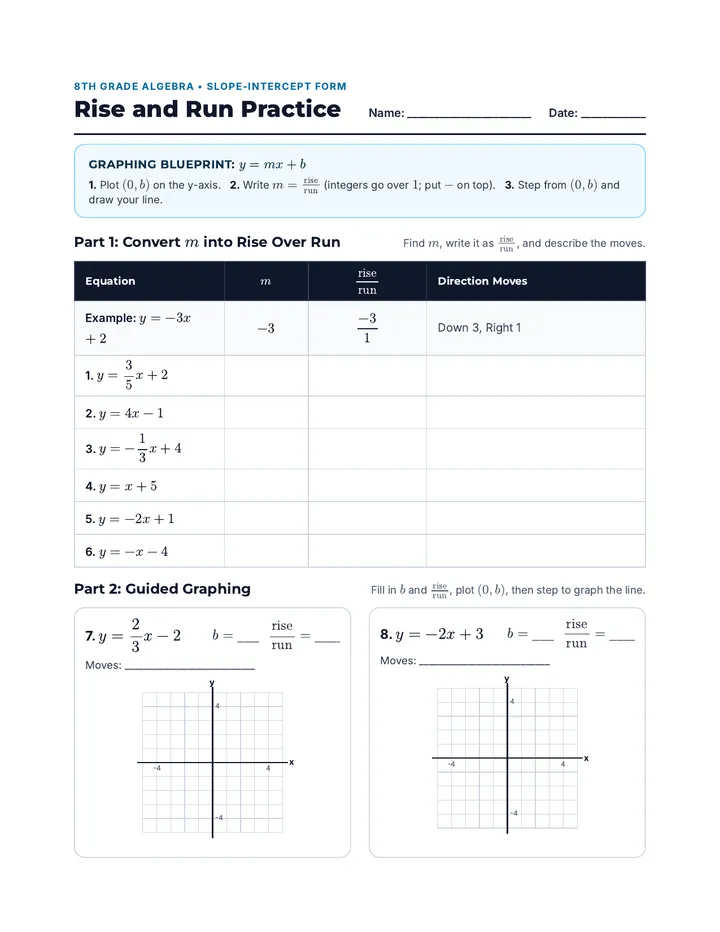
Rise and Run Worksheet

A two-page 8th-grade student practice worksheet with a quick-reference blueprint, a 6-problem table for converting slope m into rise over run, 2 guided graphing problems, 4 independent graphing problems, and an error-analysis exit check.

L

Logan-Greene