Lenny.com
Explore
Create
ActivitiesNewMathEnglish Language ArtsScience & EngineeringSocial StudiesGlobal LanguagesHealth & Physical EducationSpecial EducationCounseling & Life SkillsArts & CreativityESL
Lenny.com
Lenny.com
Explore
Create
ActivitiesNewMathEnglish Language ArtsScience & EngineeringSocial StudiesGlobal LanguagesHealth & Physical EducationSpecial EducationCounseling & Life SkillsArts & CreativityESL
Lenny.com
Lenny.com

Solutions

Lenny for EducatorsLenny for SchoolsLenny for Districts

Product

ExploreSign inCreateSupportAbout

Resources

Getting startedMTSS Acceleration Program

© 2026 Lenny Learning Inc.

TermsPrivacyAccessibility
LinkedInInstagramX
Lenny
MathNumbers & CountingCounting ObjectsNumber NamesComparing NumbersNumber OperationsCounting SequenceNumbers 0-10Place Value Understanding and SystemAdd and Subtract Within 20Addition and Subtraction ConceptsAddition and Subtraction EquationsAddition and Subtraction ProblemsFoundations for MultiplicationMultiplication and Division PropertiesMultiply and Divide Within 100Multiplication and Division ProblemsFactors and MultiplesProperties of OperationsPatterns and RelationshipsGenerate and Analyze PatternsMulti-Digit ArithmeticPlace Value OperationsMulti-Digit and Decimal OperationsNumerical ExpressionsFour Operations and PatternsFour Operations Problem SolvingMeasurement & DataMeasurable AttributesMeasuring LengthsMeasure and Estimate Lengths in Standard UnitsRelate Addition and Subtraction to LengthClassifying and Counting ObjectsTime and MoneyArea Concepts and MeasurementPerimeter and Area MeasuresAngle Concepts and MeasurementTime, Volume, and MassMeasurement Unit ConversionsGeometryIdentifying ShapesShapes and AttributesShape Attributes and ReasoningShapes and CompositionClassifying 2D FiguresGeometric Figures and RelationshipsLines, Angles, and ShapesAngle, Area, and VolumeGeometric MeasurementVolume of 3D ShapesCoordinate Plane ApplicationsTransformations in the PlaneCongruence and SimilarityUnderstand congruence in terms of rigid motionsSimilarity and TransformationsProve Theorems Involving SimilarityPythagorean TheoremTrigonometry for General TrianglesMake Geometric ConstructionsProve Geometric TheoremsTheorems About CirclesFind Arc Lengths And Areas of Sectors of CirclesVolume FormulasRelationships Between Two-Dimensional and Three-Dimensional ObjectsProve Simple Geometric Theorems AlgebraicallyTranslate Between Geometric Description and Equation for Conic SectionApply Geometric Concepts in Modeling SituationsFractions & DecimalsFractions as NumbersBuilding FractionsFraction Equivalence and OrderingAdding and Subtracting FractionsMultiplying and Dividing FractionsDividing FractionsDecimal FractionsMulti-Digit Computation and FactorsAdd, Subtract, Multiply, and Divide Rational NumbersRational Number SystemIrrational Numbers and ApproximationsRatiosRatios and ProportionsProportional RelationshipsUnit RateAlgebraAlgebraic ExpressionsGenerate Equivalent ExpressionsQuantitative RelationshipsProportional Relationships and Linear EquationsEquations and InequalitiesEquation Solving and ReasoningLinear Equations and SystemsGraph Equations and InequalitiesSystems of EquationsReal-World Algebraic ProblemsQuantitative Reasoning with UnitsExpression StructureEquivalent Expression FormsRadicals and Integer ExponentsRational ExponentsRational and Irrational NumbersPolynomial OperationsPolynomial IdentitiesPolynomial Zeros and FactorsRational ExpressionsComplex Number OperationsComplex Numbers in PolynomialsComplex Numbers on PlaneStatistics & ProbabilityRepresent and Interpret DataData DistributionsStatistical VariabilityProbability ModelsCompound Event ProbabilitiesStatistical SamplingInterpret Categorical and Quantitative DataBivariate Data PatternsInterpret Linear ModelsComparing Two PopulationsRandom Processes in StatisticsIndependence and Conditional ProbabilityExpected ValuesProbability-Based Decision MakingStatistical Inference and ConclusionsFunctionsFunction Concepts and NotationDefine and Compare FunctionsInterpret Functions in ContextAnalyze Function RepresentationsModel Relationships with FunctionsIdentify Linear vs Exponential GrowthDistinguish Between Function TypesCompare Growth RatesInterpret Function ExpressionsBuild Functions from RelationshipsConstruct and Model FunctionsTransform and Combine FunctionsModel Comparison and SelectionSolve Exponential EquationsTrigonometryTrigonometric Ratios Involving Right TrianglesTrigonometric Functions and Unit CircleModel with Trigonometric FunctionsTrigonometric IdentitiesVectors & MatricesIntroduction to Vectors and MatricesVector QuantitiesVector OperationsMatrix OperationsCalculusLimits and ContinuityDerivative Concepts and NotationDerivative Rules and TechniquesApplications of DerivativesOptimization ProblemsRelated RatesCurve Sketching and AnalysisIntegration Concepts and NotationAntiderivatives and Indefinite IntegralsDefinite Integrals and AreaFundamental Theorem of CalculusIntegration TechniquesApplications of IntegrationDifferential EquationsSequences and SeriesParametric and Polar FunctionsVector-Valued Functions

Grid Navigator

A comprehensive foundational lesson on the coordinate plane covering anatomy, quadrants, ordered pairs, and step-by-step procedures for plotting and reading coordinates.

CChad.Wimmenauer

Grid Navigator

A comprehensive foundational lesson on the coordinate plane covering anatomy, quadrants, ordered pairs, and step-by-step procedures for plotting and reading coordinates.

CChad.Wimmenauer

\(N(-5, -3)\)

\(P(3, 0)\)

\(Q(-2, 1)\)

\(R(5, 2)\)

*Tip: Double check! Did you start at \((0,0)\), count \(x\) left/right, then \(y\) down/up?

x y -5 -3 -1 1 3 5 5 3 1 -1 -3 -5 0

4 Part 4: Coordinate Mystery Shape

4 Points

Four vertices of a geometric shape are located at: \(W(-3, 3)\), \(X(4, 3)\), \(Y(4, -1)\), and \(Z(-3, -1)\).

a) Horizontal Length (\(WX\)):

Distance between \(-3\) and \(4\):

units

b) Vertical Height (\(XY\)):

Distance between \(3\) and \(-1\):

units

c) Name of Polygon & Area:

Shape name & Area (\(l \times w\)):

sq. units

5 Part 5: Error Analysis (Find the Flaw!)

2 Points

Marcus was asked to plot the ordered pair \((-2, 4)\). Instead, Marcus started at the origin, moved 2 units down, and then 4 units right, placing his point at \((4, -2)\).

Explain both errors Marcus made, and state what quadrant the correct point \((-2, 4)\) belongs in:

Coordinate Geometry Unit • Student Practice Page 2 of 2

P2

Plotting Coordinates & Shape Navigator (Solutions)

Teacher Grading Key • Page 2

3 Part 3: Plotted Target Points Key

8 Points (1 pt each)

Target Points & Locations:

\(J(-4, 3)\) Quad II

\(K(2, 5)\) Quad I

\(L(0, -4)\) y-axis

\(M(4, -2)\) Quad IV

\(N(-5, -3)\) Quad III

\(P(3, 0)\) x-axis

\(Q(-2, 1)\) Quad II

\(R(5, 2)\) Quad I

x y -5 -3 -1 1 3 5 5 3 1 -1 -3 -5 J(-4,3) K(2,5) L(0,-4) M(4,-2) N(-5,-3) P(3,0) Q(-2,1) R(5,2)

4 Part 4: Coordinate Mystery Shape (Solutions)

4 Points

Vertices: \(W(-3, 3)\), \(X(4, 3)\), \(Y(4, -1)\), and \(Z(-3, -1)\).

a) Horizontal Length (\(WX\)):

\(4 - (-3) = 4 + 3 =\)

7 units

b) Vertical Height (\(XY\)):

\(3 - (-1) = 3 + 1 =\)

4 units

c) Name & Area:

Rectangle | \(\text{Area} = 7 \times 4\):

28 square units

5 Part 5: Error Analysis Solution Guide

2 Points

Marcus's Errors Explained:

  • Error 1 (Inverted order): Marcus treated \(-2\) as a vertical movement and \(4\) as a horizontal movement, confusing the \(x\) and \(y\) coordinates.
  • Error 2 (Sign reversal): He moved down for the first coordinate and right for the second, ending at \((4, -2)\).
  • Correct Procedure: For \((-2, 4)\), he must move 2 units Left (negative \(x\)) and 4 units Up (positive \(y\)).
  • Correct Location: \((-2, 4)\) is in Quadrant II.

Coordinate Geometry Unit • Teacher Answer Key Page 2 of 2

You might also like

Single Digit Sub Guide

Multiplication Mastery Week

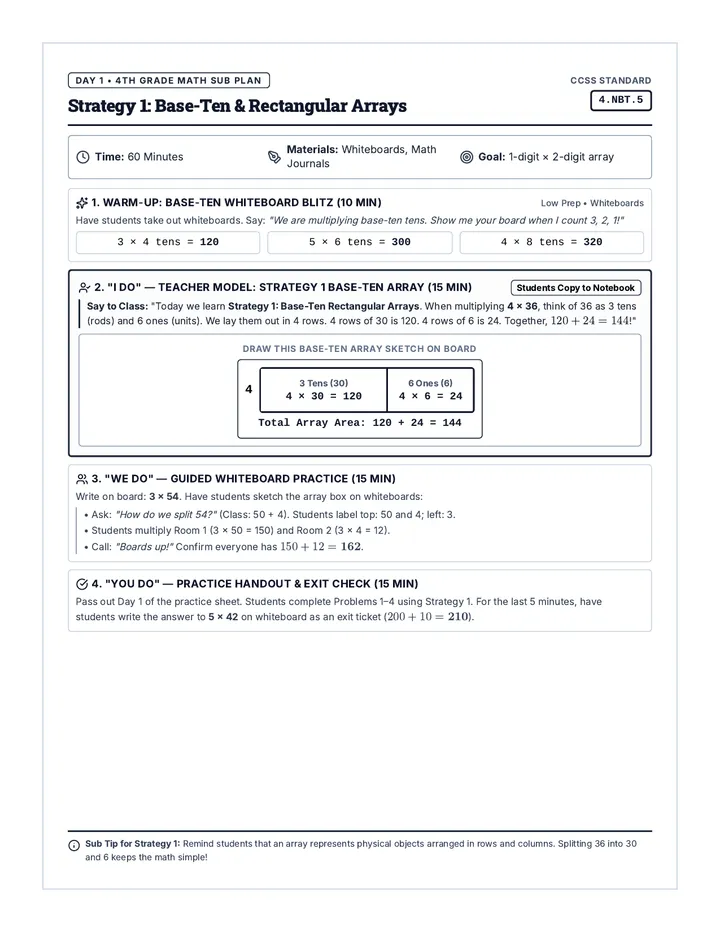
A comprehensive 5-day math curriculum sequence for 4th Grade standard 4.NBT.5, featuring scripted sub plans with gradual release, low-prep whiteboard and manipulative routines, student notebook guides, and a spiraled weekly homework packet.

RM

Rodnesha Minor

7
Compound Events Mastery Worksheet

Compound Probability

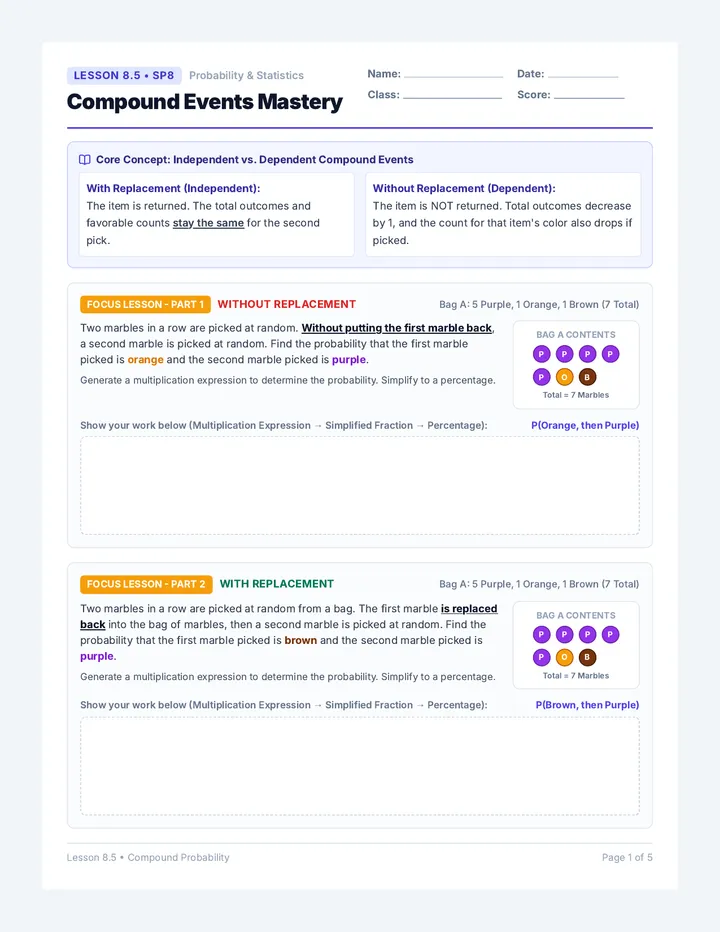
A comprehensive lesson exploring independent and dependent compound events through marble bag experiments, tree diagrams, sample space analysis, and multi-stage trials.

D

dlspadaro

2
Function Faceoff Handout

Function Faceoff Handout

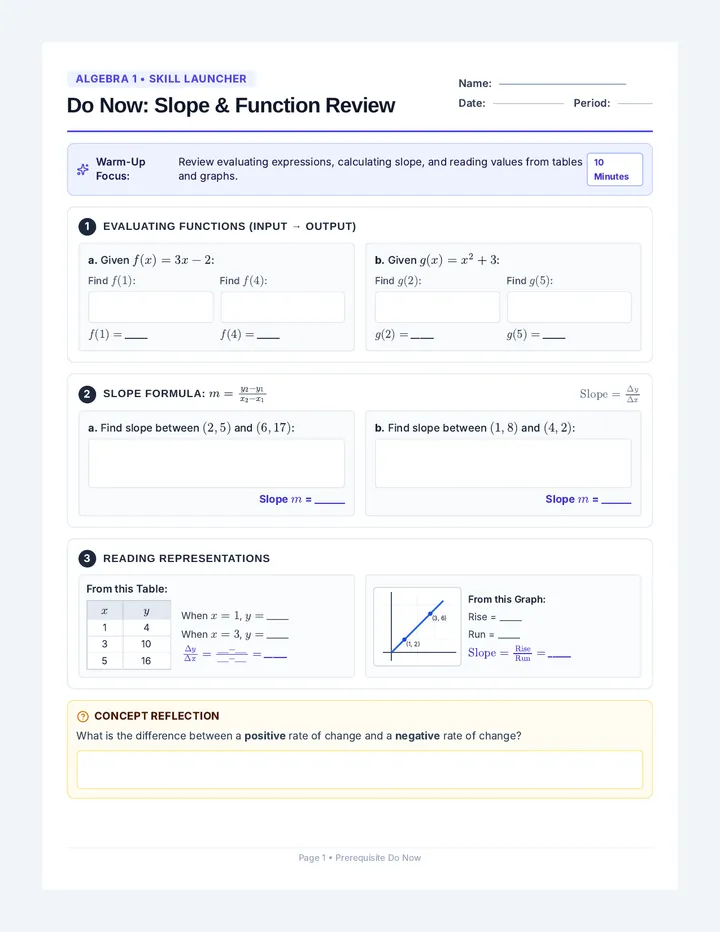
A 5-page mastery packet on comparing average rates of change across equations, graphs, and tables. Includes a dedicated full-page Do Now reviewing prerequisite skills, a comprehensive strategy notes page, two distinct pages of tiered guided practice and function showdowns, and the prompt's exact multi-representation challenge as the final exit ticket.

BT

Brianna Taracena

Clue Words Presentation

Code Breakers Squad

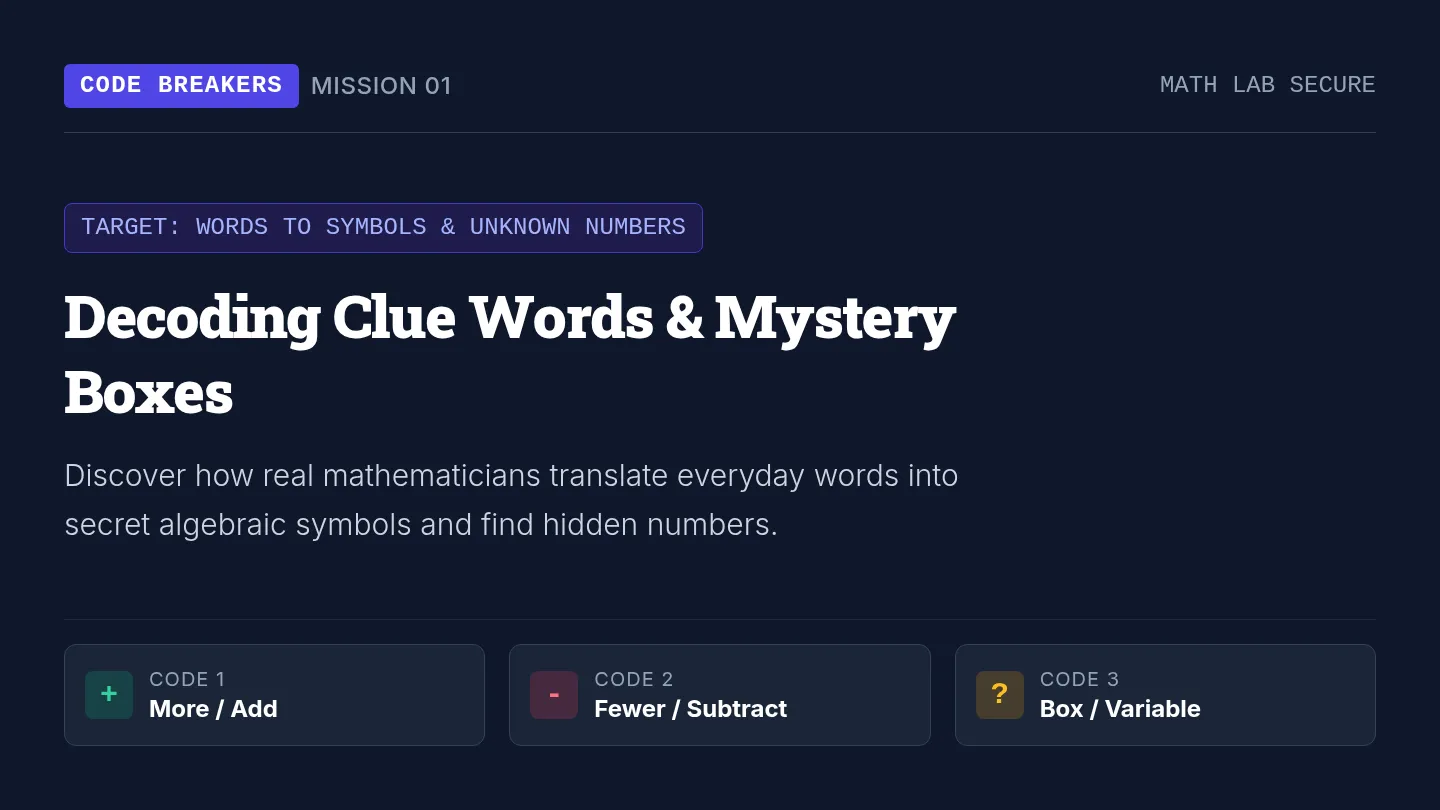
A scaffolded pre-algebra sequence designed for sixth graders building confidence from second-grade arithmetic foundations. Students use code-breaking visual models, mystery boxes, number swaps, and equal-group arrays to master algebraic concepts without cognitive overload. Each lesson bridges concrete representations to symbolic expressions with age-respectful styling and supportive pacing.

MJ

Meg Jones

9
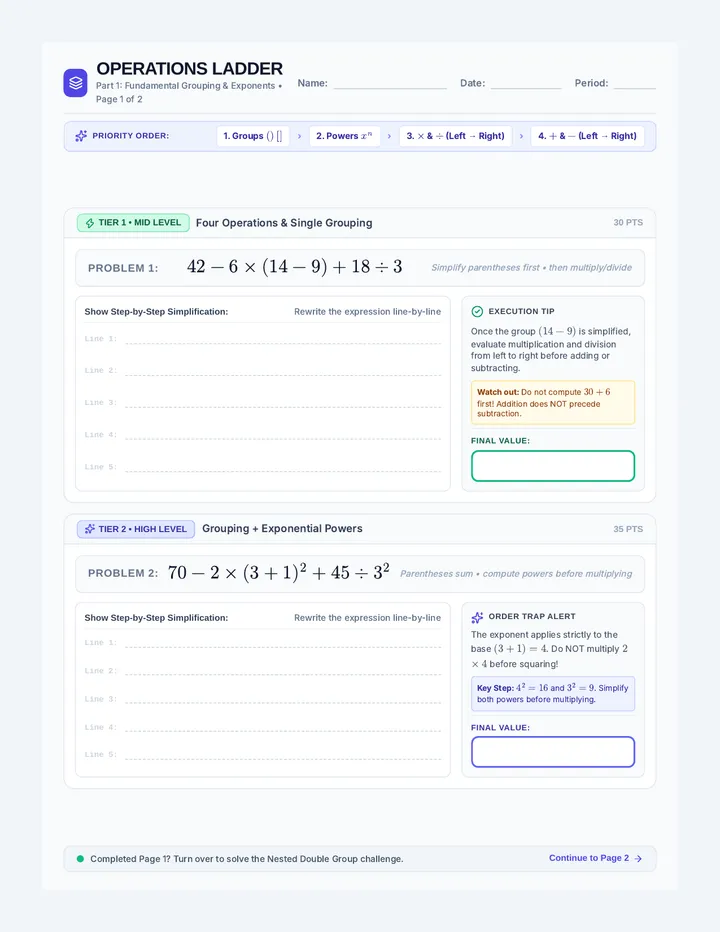
Operations Ladder Worksheet

Operations Ladder

A foundational 50-minute order of operations lesson featuring real-world visual models, scaffolded breakdown moments, and step-by-step practice.

AA

alicia accapezzato

2
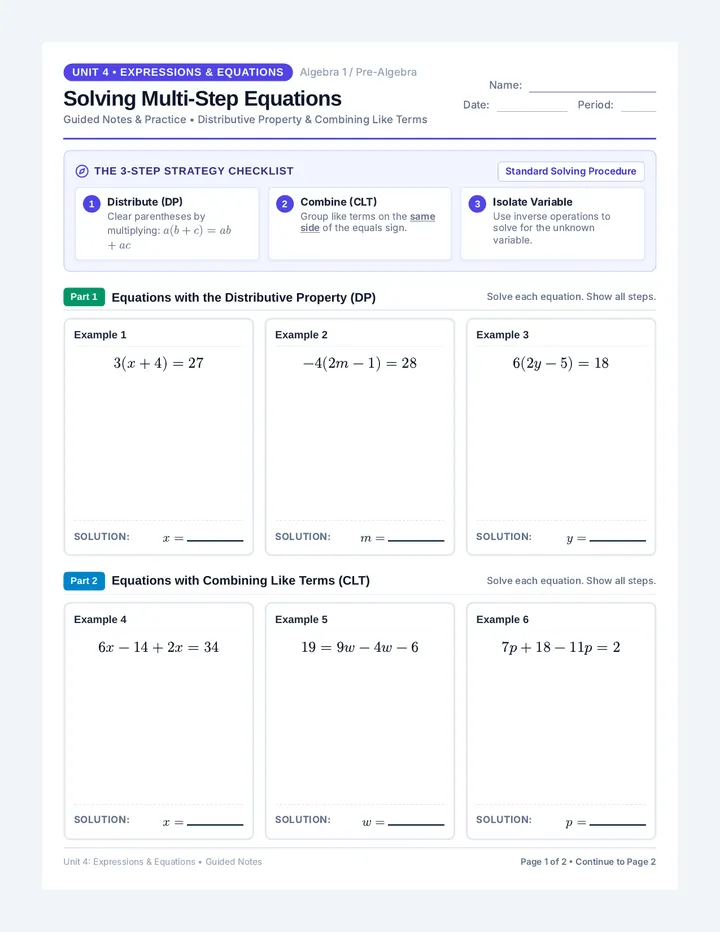
Multi-Step Equations Guided Notes

Multi-Step Equations Guided Notes

Extended the work boxes on the back page for Examples 7–10 and the Error Analysis workspace by maximizing vertical handwriting space.

CD

Craig Davis

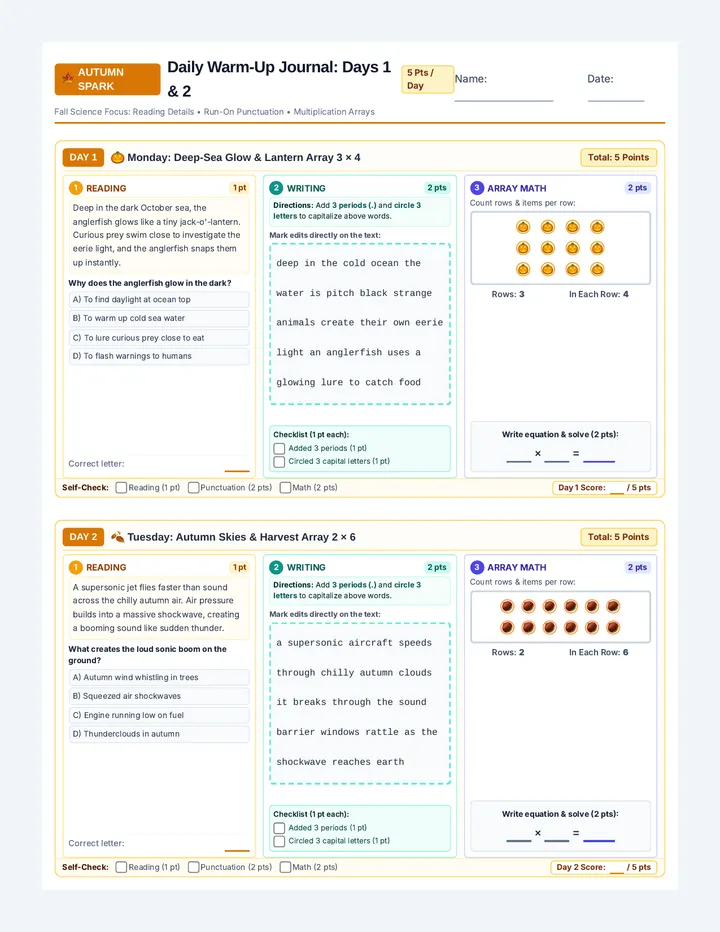
Autumn Warmup Packet

Daily Spark Warmups

A five-day daily warm-up sequence for 8th grade intervention classrooms featuring reading comprehension, sentence mechanics, and multiplication array modeling across three compact print pages.

KS

Kathleen Suther

3
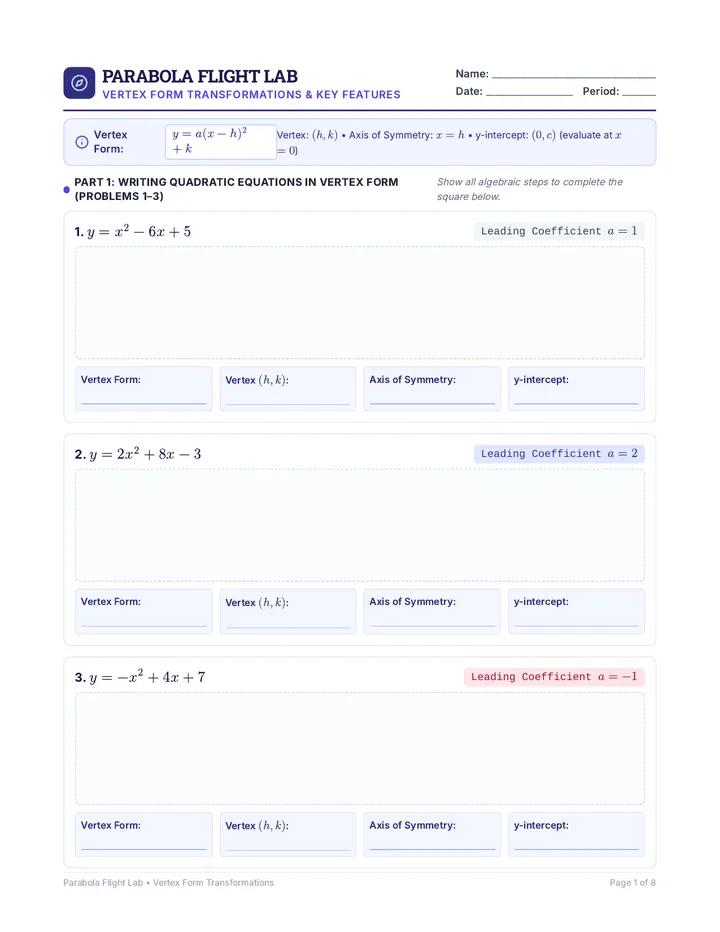
Parabola Flight Worksheet

Parabola Flight Lab

A comprehensive quadratic functions lesson exploring vertex form transformations, graphing quadratic equations and inequalities, and modeling vertical motion projectile problems. Students master completing the square, key feature identification, and real-world trajectory analysis.

AR

Angie Rice

2
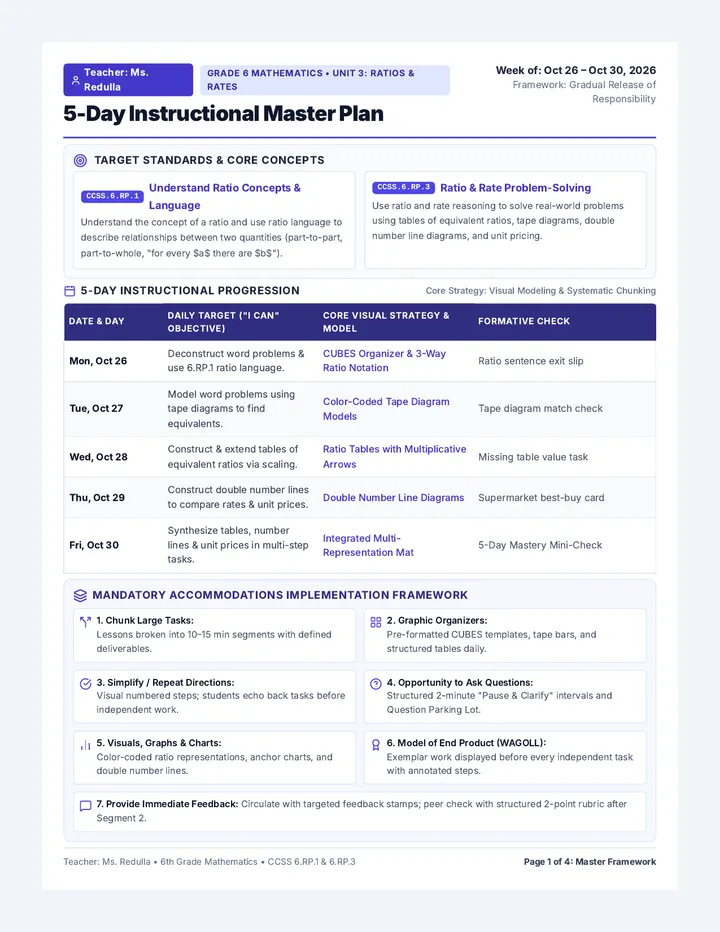
Ratio Reasoning Lesson Plan

Ratio Reasoning Lesson Plan

A comprehensive 5-day mathematics lesson plan for 6th Grade covering standards 6.RP.1 and 6.RP.3 from October 26 to October 30, authored for Ms. Redulla. Features day-by-day instructional routines, visual representations with tape diagrams, ratio tables, and double number lines, plus explicit integration of seven mandatory accommodations.

SM

Syrel Marie Redulla

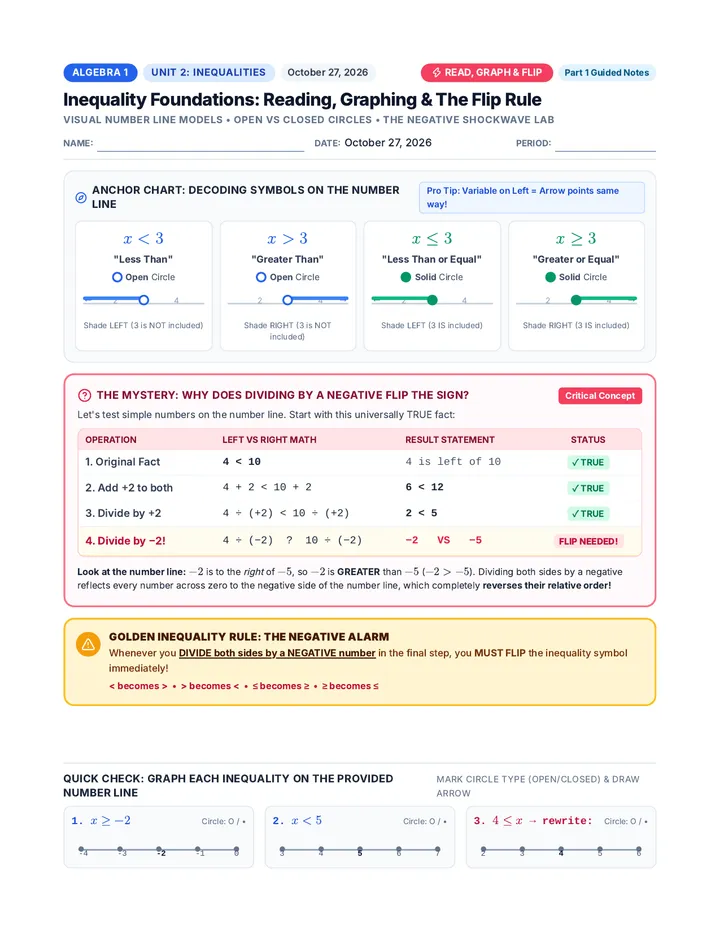
Sign Flip Foundations Handout

Sign Flip Showdown

A comprehensive Regents-aligned Algebra 1 sequence guiding students from reading and graphing inequalities on number lines to mastering multi-step linear inequalities using the visual Boxes and Circles cross-cross method.

H

Harlston

5
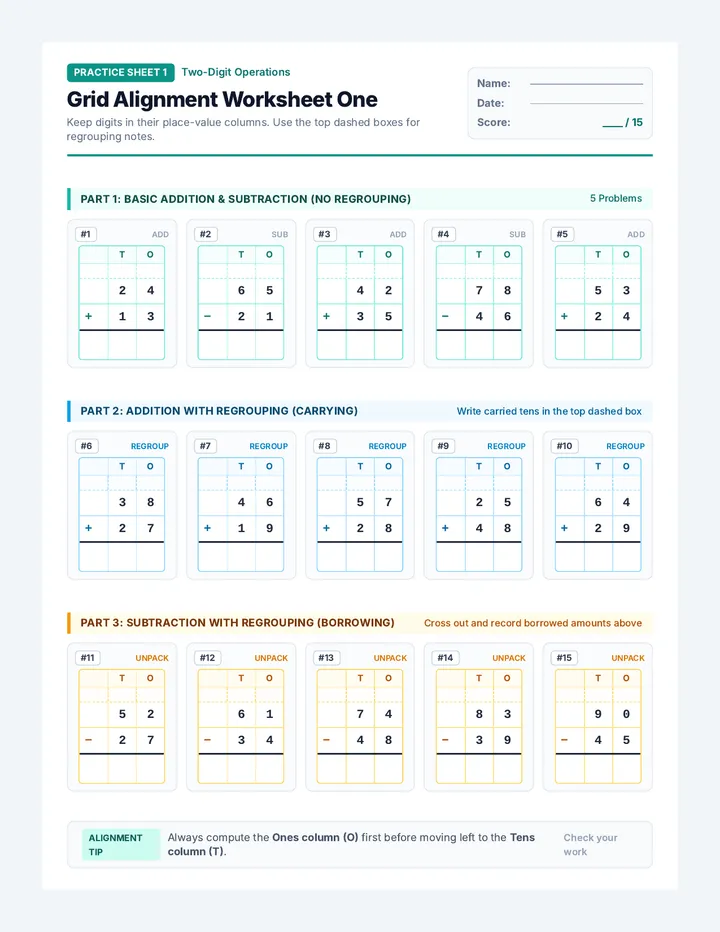
Grid Alignment Worksheet One

Grid Math Masters

A targeted two-digit addition and subtraction lesson utilizing graph paper grids to reinforce place-value alignment, basic fact fluency, and regrouping strategies.

SW

Stephanie Wooten

4
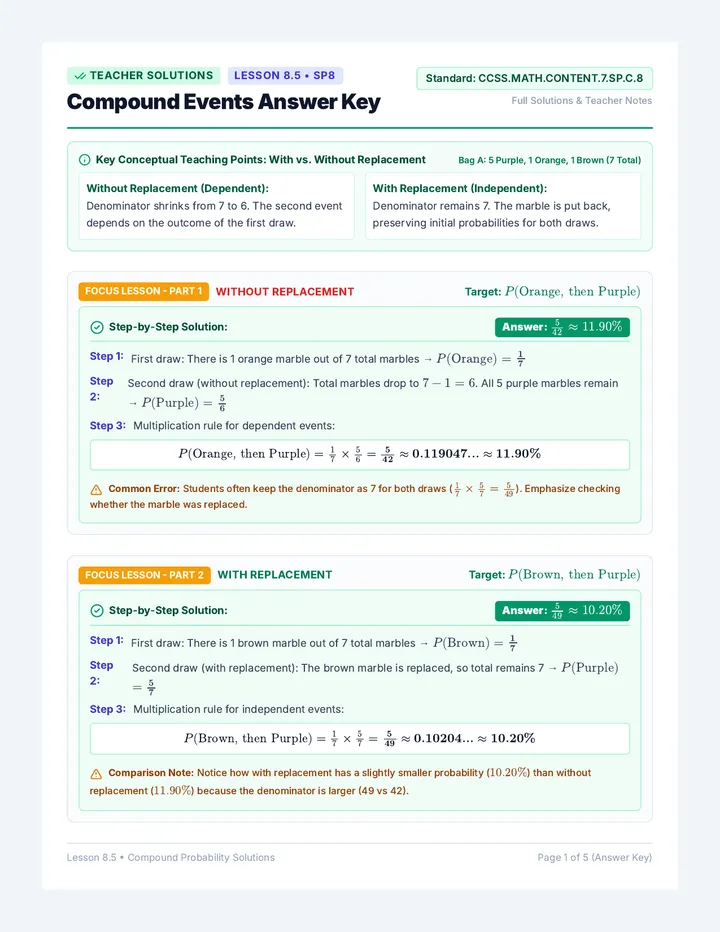
Compound Events Answer Key

Compound Events Answer Key

A complete 5-page teacher answer key and solutions guide for the Compound Events Mastery Worksheet, featuring step-by-step probability calculations, fraction simplifications, percentage equivalents, and common misconception teaching notes.

D

dlspadaro