Week 1 Blueprints Worksheet Week 1 • Phase 1: Heavy Scaffolds
Operation Blueprints
Name: _______________________
Date: ____________
Worked Example — Follow the Blueprint Order: ( ) → × / ÷ → + / −
Expression
\(4 + 3 \times (7 - 2)\)
Step 1: ( ) First
\(7 - 2 = 5\)
\(4 + 3 \times 5\)
Step 2: Multiply
\(3 \times 5 = 15\)
\(4 + 15\)
Step 3: Add
\(4 + 15 = 19\)
Answer: 19
1 \(6 + 2 \times (9 - 4)\)
Checklist: ☐ ( ) Parentheses ☐ × Multiply ☐ + Add
Step 1: Solve ( )
Step 2: Multiply
Step 3: Add & Final
2 \((8 + 4) \times 3 - 5\)
Checklist: ☐ ( ) Parentheses ☐ × Multiply ☐ − Subtract
Step 1: Solve ( )
Step 2: Multiply
Step 3: Subtract & Final
Week 1: Operation Blueprints (Continued) Name: _______________________
3 \(20 - 3 \times (2 + 3)\)
Checklist: ☐ ( ) Parentheses ☐ × Multiply ☐ − Subtract
Step 1: Solve ( )
Step 2: Multiply
Step 3: Subtract & Final
4 \(5 \times (10 - 6) + 7\)
Checklist: ☐ ( ) Parentheses ☐ × Multiply ☐ + Add
Step 1: Solve ( )
Step 2: Multiply
Step 3: Add & Final
5 \((15 - 9) \times 4 - 8\)
Checklist: ☐ ( ) Parentheses ☐ × Multiply ☐ − Subtract
Step 1: Solve ( )
Step 2: Multiply
Step 3: Subtract & Final
Goal Progress & Adult Prompt Tracker
Adult Prompts Used: ☐ 0 ☐ 1 ☐ 2 ☐ 3 (Target: ≤ 2–3 prompts)
Score: _____ / 5 (_____%)
Target: 4/5 = 80% Accuracy
Week 1 Blueprints Answer Key Teacher Resource • Answer Key
Week 1: Operation Blueprints
Phase 1: Heavy Scaffolds
Goal: 80% (4/5) with ≤ 2–3 Prompts
Problem 1 \(6 + 2 \times (9 - 4)\)
Step 1: \(9 - 4 = 5 \rightarrow 6 + 2 \times 5\)
Step 2: \(2 \times 5 = 10 \rightarrow 6 + 10\)
Step 3: \(6 + 10 = 16\)
Final Answer: 16
Problem 2 \((8 + 4) \times 3 - 5\)
Step 1: \(8 + 4 = 12 \rightarrow 12 \times 3 - 5\)
Step 2: \(12 \times 3 = 36 \rightarrow 36 - 5\)
Step 3: \(36 - 5 = 31\)
Final Answer: 31
Problem 3 \(20 - 3 \times (2 + 3)\)
Step 1: \(2 + 3 = 5 \rightarrow 20 - 3 \times 5\)
Step 2: \(3 \times 5 = 15 \rightarrow 20 - 15\)
Step 3: \(20 - 15 = 5\)
Final Answer: 5
Problem 4 \(5 \times (10 - 6) + 7\)
Step 1: \(10 - 6 = 4 \rightarrow 5 \times 4 + 7\)
Step 2: \(5 \times 4 = 20 \rightarrow 20 + 7\)
Step 3: \(20 + 7 = 27\)
Final Answer: 27
Problem 5 \((15 - 9) \times 4 - 8\)
Step 1: \(15 - 9 = 6 \rightarrow 6 \times 4 - 8\)
Step 2: \(6 \times 4 = 24 \rightarrow 24 - 8\)
Step 3: \(24 - 8 = 16\)
Final Answer: 16
Week 1 Prompting Guide
Model the Worked Example aloud before the student begins Problem 1.
Watch for common errors in Problem 3 (\(20 - 3\) before multiplying).
Use verbal cues like "Check your checklist—what comes first?" and tally each prompt at the bottom.
Mastery Benchmark: 4/5 (80%)
Week 2 Operation Flow Worksheet Week 2 • Phase 1: Heavy Scaffolds
Four Operation Flow
Name: _______________________
Date: ____________
Worked Example — Multiply & Divide Left to Right 1. ( ) 2. × or ÷ (L→R) 3. + or − (L→R)
Expression
\(18 \div (2 + 4) + 5 \times 2\)
Step 1: ( ) First
\(2 + 4 = 6\)
\(18 \div 6 + 5 \times 2\)
Step 2: ÷ and ×
\(18 \div 6 = 3\), \(5 \times 2 = 10\)
\(3 + 10\)
Step 3: Add
\(3 + 10 = 13\)
Answer: 13
1 \(24 \div (3 + 5) + 7\)
Hint: Add inside ( ) first, then divide.
Step 1: ( )
Step 2: × / ÷
Step 3: + / − & Final
2 \((14 - 2) \div 3 \times 4\)
Hint: After ( ), work left to right!
Step 1: ( )
Step 2: Left Operation
Step 3: Final Step
Week 2: Four Operation Flow (Continued) Name: _______________________
3 \(30 - 16 \div (2 \times 2)\)
Use the 3-step blueprint
Step 1
Step 2
Step 3 (Final)
4 \((9 + 6) \div 5 + 3 \times 4\)
Use the 3-step blueprint
Step 1
Step 2
Step 3 (Final)
5 \(40 \div (10 - 2) + 9\)
Use the 3-step blueprint
Step 1
Step 2
Step 3 (Final)
Goal Progress & Adult Prompt Tracker
Adult Prompts Used: ☐ 0 ☐ 1 ☐ 2 ☐ 3 (Target: ≤ 2–3 prompts)
Score: _____ / 5 (_____%)
Target: 4/5 = 80% Accuracy
Week 2 Operation Flow Answer Key Teacher Resource • Answer Key
Week 2: Four Operation Flow
Phase 1: Heavy Scaffolds
Goal: 80% (4/5) with ≤ 2–3 Prompts
Problem 1 \(24 \div (3 + 5) + 7\)
Step 1: \(3 + 5 = 8 \rightarrow 24 \div 8 + 7\)
Step 2: \(24 \div 8 = 3 \rightarrow 3 + 7\)
Step 3: \(3 + 7 = 10\)
Final Answer: 10
Problem 2 \((14 - 2) \div 3 \times 4\)
Step 1: \(14 - 2 = 12 \rightarrow 12 \div 3 \times 4\)
Step 2: \(12 \div 3 = 4 \rightarrow 4 \times 4\)
Step 3: \(4 \times 4 = 16\)
Final Answer: 16
Problem 3 \(30 - 16 \div (2 \times 2)\)
Step 1: \(2 \times 2 = 4 \rightarrow 30 - 16 \div 4\)
Step 2: \(16 \div 4 = 4 \rightarrow 30 - 4\)
Step 3: \(30 - 4 = 26\)
Final Answer: 26
Problem 4 \((9 + 6) \div 5 + 3 \times 4\)
Step 1: \(9 + 6 = 15 \rightarrow 15 \div 5 + 3 \times 4\)
Step 2: \(15 \div 5 = 3,\; 3 \times 4 = 12 \rightarrow 3 + 12\)
Step 3: \(3 + 12 = 15\)
Final Answer: 15
Problem 5 \(40 \div (10 - 2) + 9\)
Step 1: \(10 - 2 = 8 \rightarrow 40 \div 8 + 9\)
Step 2: \(40 \div 8 = 5 \rightarrow 5 + 9\)
Step 3: \(5 + 9 = 14\)
Final Answer: 14
Week 2 Prompting Guide
Notice that Problems 3–5 remove operation labels from the step boxes to begin fading support.
Watch Problem 2: students often multiply \(3 \times 4\) before dividing \(12 \div 3\). Prompt: "Which comes first from left to right?"
Mastery Benchmark: 4/5 (80%)
Week 3 Exponent Power Worksheet Week 3 • Phase 1: Heavy Scaffolds
Exponent Power Up
Name: _______________________
Date: ____________
Worked Example — Exponents Come Right After Grouping! P/B → E → M/D → A/S
Expression
\(2 + 3^2 \times (8 - 5)\)
Step 1: ( )
\(8 - 5 = 3\)
\(2 + 3^2 \times 3\)
Step 2: Exponents
\(3^2 = 3 \times 3 = 9\)
\(2 + 9 \times 3\)
Step 3: × then +
\(9 \times 3 = 27 \rightarrow 2 + 27\)
Answer: 29
1 \(4^2 - (3 + 5) + 6\)
Reminder: \(4^2 = 4 \times 4\)
Step 1
Step 2
Step 3 (Final)
2 \(5 \times 2^3 - (10 - 4)\)
Reminder: \(2^3 = 2 \times 2 \times 2\)
Step 1
Step 2
Step 3 (Final)
Week 3: Exponent Power Up (Continued) Name: _______________________
3 \((6 - 2)^2 \div 4 + 9\)
Step 1
Step 2
Step 3 (Final)
4 \(30 \div [2 + 3] + 2^2\)
Step 1
Step 2
Step 3 (Final)
5 \(3^2 \times (7 - 4) - 12\)
Step 1
Step 2
Step 3 (Final)
Goal Progress & Adult Prompt Tracker
Adult Prompts Used: ☐ 0 ☐ 1 ☐ 2 ☐ 3 (Target: ≤ 2–3 prompts)
Score: _____ / 5 (_____%)
Target: 4/5 = 80% Accuracy
Week 3 Exponent Power Answer Key Teacher Resource • Answer Key
Week 3: Exponent Power Up
Phase 1: Heavy Scaffolds
Goal: 80% (4/5) with ≤ 2–3 Prompts
Problem 1 \(4^2 - (3 + 5) + 6\)
Step 1: \(3 + 5 = 8 \rightarrow 4^2 - 8 + 6\)
Step 2: \(4^2 = 16 \rightarrow 16 - 8 + 6\)
Step 3: \(8 + 6 = 14\)
Final Answer: 14
Problem 2 \(5 \times 2^3 - (10 - 4)\)
Step 1: \(10 - 4 = 6 \rightarrow 5 \times 2^3 - 6\)
Step 2: \(2^3 = 8 \rightarrow 5 \times 8 - 6\)
Step 3: \(40 - 6 = 34\)
Final Answer: 34
Problem 3 \((6 - 2)^2 \div 4 + 9\)
Step 1: \(6 - 2 = 4 \rightarrow 4^2 \div 4 + 9\)
Step 2: \(4^2 = 16 \rightarrow 16 \div 4 + 9\)
Step 3: \(4 + 9 = 13\)
Final Answer: 13
Problem 4 \(30 \div [2 + 3] + 2^2\)
Step 1: \(2 + 3 = 5 \rightarrow 30 \div 5 + 2^2\)
Step 2: \(2^2 = 4 \rightarrow 30 \div 5 + 4\)
Step 3: \(6 + 4 = 10\)
Final Answer: 10
Problem 5 \(3^2 \times (7 - 4) - 12\)
Step 1: \(7 - 4 = 3 \rightarrow 3^2 \times 3 - 12\)
Step 2: \(3^2 = 9 \rightarrow 9 \times 3 - 12\)
Step 3: \(27 - 12 = 15\)
Final Answer: 15
Week 3 Prompting Guide
Watch for \(2^3 = 6\) errors; remind students exponents mean repeated multiplication.
In Problem 4, brackets \([ \; ]\) work just like parentheses.
Before Phase 2, administer the Week 3 Review Worksheet .
Mastery Benchmark: 4/5 (80%)
Week 3 Review Worksheet Checkpoint 1 • Weeks 1–3 Review
Phase 1 Mastery Review
Name: _______________________
Date: ____________
Strategy Check: 1. Grouping ( ) or [ ] → 2. Exponents \(a^n\) → 3. × / ÷ (Left to Right) → 4. + / − (Left to Right)
1 \(7 + 3 \times (8 - 3)\)
2 \(36 \div (4 + 2) \times 3\)
Phase 1 Mastery Review (Continued) Name: _______________________
3 \(5^2 - 4 \times (9 - 6)\)
4 \((11 - 7)^2 + 12 \div 3\)
5 \(2 \times [15 - (3 + 4)]\)
Phase 1 Checkpoint Tracker
Adult Prompts Used: ☐ 0 ☐ 1 ☐ 2 ☐ 3 (Target: ≤ 2–3 prompts)
Score: _____ / 5 (_____%)
Ready for Phase 2 at 80% (4/5)
Week 3 Review Answer Key Teacher Resource • Review Key
Phase 1 Mastery Review Answer Key
Weeks 1–3 Checkpoint
Goal: 80% (4/5) with ≤ 2–3 Prompts
Problem 1 \(7 + 3 \times (8 - 3)\)
Step 1: \(8 - 3 = 5 \rightarrow 7 + 3 \times 5\)
Step 2: \(3 \times 5 = 15 \rightarrow 7 + 15\)
Step 3: \(7 + 15 = 22\)
Final Answer: 22
Problem 2 \(36 \div (4 + 2) \times 3\)
Step 1: \(4 + 2 = 6 \rightarrow 36 \div 6 \times 3\)
Step 2: \(36 \div 6 = 6 \rightarrow 6 \times 3\)
Step 3: \(6 \times 3 = 18\)
Final Answer: 18
Problem 3 \(5^2 - 4 \times (9 - 6)\)
Step 1: \(9 - 6 = 3 \rightarrow 5^2 - 4 \times 3\)
Step 2: \(5^2 = 25 \rightarrow 25 - 4 \times 3\)
Step 3: \(25 - 12 = 13\)
Final Answer: 13
Problem 4 \((11 - 7)^2 + 12 \div 3\)
Step 1: \(11 - 7 = 4 \rightarrow 4^2 + 12 \div 3\)
Step 2: \(4^2 = 16,\; 12 \div 3 = 4 \rightarrow 16 + 4\)
Step 3: \(16 + 4 = 20\)
Final Answer: 20
Problem 5 \(2 \times [15 - (3 + 4)]\)
Step 1: \(3 + 4 = 7 \rightarrow 2 \times [15 - 7]\)
Step 2: \(15 - 7 = 8 \rightarrow 2 \times 8\)
Step 3: \(2 \times 8 = 16\)
Final Answer: 16
Phase 2 Readiness Check
80%+ (4–5/5) & ≤ 3 prompts: Advance to Week 4 (Phase 2: Moderate Scaffolds).< 80%: Revisit missed operation type (exponents vs. left-to-right ×/÷) before fading step boxes.
Phase 1 Complete!
Week 4 Fading Guides Worksheet Week 4 • Phase 2: Moderate Scaffolds
Fading Step Guides
Name: _______________________
Date: ____________
Order Reminder: 1. Grouping ( ) [ ] → 2. Exponents \(a^n\) → 3. × / ÷ (L→R) → 4. + / − (L→R)
1 \(3^2 + 4 \times (10 - 6) - 5\)
☐ Checked each step
Step 1:
Step 2:
Step 3:
Step 4 (Final):
2 \(48 \div (2 + 4) + 3^2 \times 2\)
☐ Checked each step
Step 1:
Step 2:
Step 3:
Step 4 (Final):
Week 4: Fading Step Guides (Continued) Name: _______________________
3 \((9 - 4)^2 - 18 \div 3 + 2\)
☐ Checked each step
Step 1:
Step 2:
Step 3 (Final):
4 \(6 \times (5 + 2) - 4^2 \div 2\)
☐ Checked each step
Step 1:
Step 2:
Step 3:
Step 4 (Final):
5 \(50 - [2^3 + (12 \div 4)] \times 3\)
☐ Checked each step
Step 1:
Step 2:
Step 3:
Step 4 (Final):
Goal Progress & Adult Prompt Tracker
Adult Prompts Used: ☐ 0 ☐ 1 ☐ 2 ☐ 3 (Target: ≤ 2–3 prompts)
Score: _____ / 5 (_____%)
Target: 4/5 = 80% Accuracy
Week 4 Fading Guides Answer Key Teacher Resource • Answer Key
Week 4: Fading Step Guides
Phase 2: Moderate Scaffolds
Goal: 80% (4/5) with ≤ 2–3 Prompts
Problem 1 \(3^2 + 4 \times (10 - 6) - 5\)
Step 1: \(3^2 + 4 \times 4 - 5\)
Step 2: \(9 + 4 \times 4 - 5\)
Step 3: \(9 + 16 - 5\)
Step 4: \(25 - 5 = 20\)
Final Answer: 20
Problem 2 \(48 \div (2 + 4) + 3^2 \times 2\)
Step 1: \(48 \div 6 + 3^2 \times 2\)
Step 2: \(48 \div 6 + 9 \times 2\)
Step 3: \(8 + 18\)
Step 4: \(26\)
Final Answer: 26
Problem 3 \((9 - 4)^2 - 18 \div 3 + 2\)
Step 1: \(5^2 - 18 \div 3 + 2\)
Step 2: \(25 - 6 + 2\)
Step 3: \(19 + 2 = 21\)
Final Answer: 21
Problem 4 \(6 \times (5 + 2) - 4^2 \div 2\)
Step 1: \(6 \times 7 - 4^2 \div 2\)
Step 2: \(6 \times 7 - 16 \div 2\)
Step 3: \(42 - 8\)
Step 4: \(34\)
Final Answer: 34
Problem 5 \(50 - [2^3 + (12 \div 4)] \times 3\)
Step 1: \(50 - [2^3 + 3] \times 3\)
Step 2: \(50 - [8 + 3] \times 3 = 50 - 11 \times 3\)
Step 3: \(50 - 33\)
Step 4: \(17\)
Final Answer: 17
Week 4 Prompting Guide
Worked examples are now removed. Encourage students to point to the top Order Reminder before starting.
In Problem 5, prompt "Start with the innermost parentheses" only if needed.
Mastery Benchmark: 4/5 (80%)
Week 5 Double Grouping Worksheet Week 5 • Phase 2: Moderate Scaffolds
Double Grouping Labs
Name: _______________________
Date: ____________
Lab Tip: Work from inside ( ) out to [ ]. A fraction bar \(\frac{a}{b}\) groups the top and bottom before dividing! P → E → M/D → A/S
1 \(2 \times [18 - (4 + 5)] + 3^2\)
=
=
=
=
2 \(\dfrac{24 + 12}{6} + 4 \times (7 - 2)\)
=
=
=
=
Week 5: Double Grouping Labs (Continued) Name: _______________________
3 \([3^2 + (10 - 4)] \div 5 \times 6\)
=
=
=
4 \(\dfrac{5^2 - 5}{4} \times 3 - 7\)
=
=
=
5 \(45 - [(2 + 3)^2 - 4 \times 2]\)
=
=
=
Goal Progress & Adult Prompt Tracker
Adult Prompts Used: ☐ 0 ☐ 1 ☐ 2 ☐ 3 (Target: ≤ 2–3 prompts)
Score: _____ / 5 (_____%)
Target: 4/5 = 80% Accuracy
Week 5 Double Grouping Answer Key Teacher Resource • Answer Key
Week 5: Double Grouping Labs
Phase 2: Moderate Scaffolds
Goal: 80% (4/5) with ≤ 2–3 Prompts
Problem 1 \(2 \times [18 - (4 + 5)] + 3^2\)
\(= 2 \times [18 - 9] + 3^2\)
\(= 2 \times 9 + 9\)
\(= 18 + 9 = 27\)
Final Answer: 27
Problem 2 \(\frac{24 + 12}{6} + 4 \times (7 - 2)\)
\(= \frac{36}{6} + 4 \times 5\)
\(= 6 + 20 = 26\)
Final Answer: 26
Problem 3 \([3^2 + (10 - 4)] \div 5 \times 6\)
\(= [3^2 + 6] \div 5 \times 6\)
\(= [9 + 6] \div 5 \times 6 = 15 \div 5 \times 6\)
\(= 3 \times 6 = 18\)
Final Answer: 18
Problem 4 \(\frac{5^2 - 5}{4} \times 3 - 7\)
\(= \frac{25 - 5}{4} \times 3 - 7 = \frac{20}{4} \times 3 - 7\)
\(= 5 \times 3 - 7 = 15 - 7 = 8\)
Final Answer: 8
Problem 5 \(45 - [(2 + 3)^2 - 4 \times 2]\)
\(= 45 - [5^2 - 4 \times 2]\)
\(= 45 - [25 - 8] = 45 - 17 = 28\)
Final Answer: 28
Week 5 Prompting Guide
Step labels are now replaced with blank "=" lines.
For fraction bars (Problems 2 & 4), prompt: "Simplify the top first, then divide."
Mastery Benchmark: 4/5 (80%)
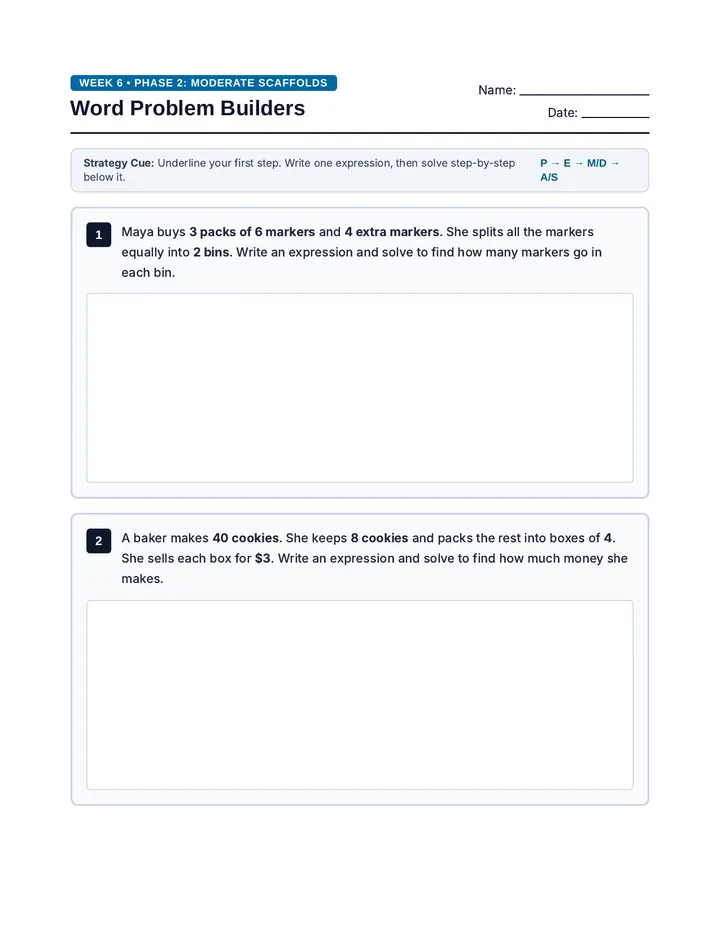
Week 6 Word Builders Worksheet Week 6 • Phase 2: Moderate Scaffolds
Word Problem Builders
Name: _______________________
Date: ____________
Strategy Cue: Underline your first step. Write one expression, then solve step-by-step below it. P → E → M/D → A/S
1
Maya buys 3 packs of 6 markers and 4 extra markers . She splits all the markers equally into 2 bins . Write an expression and solve to find how many markers go in each bin.
2
A baker makes 40 cookies . She keeps 8 cookies and packs the rest into boxes of 4 . She sells each box for $3 . Write an expression and solve to find how much money she makes.
Week 6: Word Problem Builders (Continued) Name: _______________________
3
Leo has $50 . He buys 2 books for $9 each and a backpack for \(4^2\) dollars . Write an expression and solve to find how much money Leo has left.
4 \(6^2 \div (2 + 4) \times 3 - 5\)
5 \(8 + [2 \times (9 - 6)]^2 \div 9\)
Goal Progress & Adult Prompt Tracker
Adult Prompts Used: ☐ 0 ☐ 1 ☐ 2 ☐ 3 (Target: ≤ 2–3 prompts)
Score: _____ / 5 (_____%)
Target: 4/5 = 80% Accuracy
Week 6 Word Builders Answer Key Teacher Resource • Answer Key
Week 6: Word Problem Builders
Phase 2: Moderate Scaffolds
Goal: 80% (4/5) with ≤ 2–3 Prompts
Problem 1 (Markers)
\((3 \times 6 + 4) \div 2\)
\(= (18 + 4) \div 2\)
\(= 22 \div 2 = 11\)
Final Answer: 11 markers
Problem 2 (Cookies)
\((40 - 8) \div 4 \times 3\)
\(= 32 \div 4 \times 3\)
\(= 8 \times 3 = 24\)
Final Answer: $24
Problem 3 (Leo's Money)
\(50 - (2 \times 9 + 4^2)\)
\(= 50 - (18 + 16)\)
\(= 50 - 34 = 16\)
Final Answer: $16
Problem 4 \(6^2 \div (2 + 4) \times 3 - 5\)
\(= 6^2 \div 6 \times 3 - 5 = 36 \div 6 \times 3 - 5\)
\(= 6 \times 3 - 5 = 18 - 5 = 13\)
Final Answer: 13
Problem 5 \(8 + [2 \times (9 - 6)]^2 \div 9\)
\(= 8 + [2 \times 3]^2 \div 9 = 8 + 6^2 \div 9\)
\(= 8 + 36 \div 9 = 8 + 4 = 12\)
Final Answer: 12
Week 6 Prompting Guide
For word problems, prompt: "Which numbers need to be grouped in parentheses first?"
Administer the Week 6 Review Worksheet before moving to Phase 3 (Independent).
Mastery Benchmark: 4/5 (80%)
Week 6 Review Worksheet Checkpoint 2 • Weeks 4–6 Review
Phase 2 Mastery Review
Name: _______________________
Date: ____________
Show every step clearly on its own line. P → E → M/D → A/S
1 \(4^2 + 3 \times (12 - 7) - 6\)
2 \(54 \div (3 + 6) + 2^3 \times 2\)
Phase 2 Mastery Review (Continued) Name: _______________________
3 \(\dfrac{30 + 18}{8} \times 5 - 3^2\)
4 \(60 - [4^2 + (14 \div 2)] \times 2\)
5
Sam saves $15 each week for 4 weeks . He spends $12 on a game and splits the rest equally into 3 jars . Write an expression and solve to find how much money goes in each jar.
Phase 2 Checkpoint Tracker
Adult Prompts Used: ☐ 0 ☐ 1 ☐ 2 ☐ 3 (Target: ≤ 2–3 prompts)
Score: _____ / 5 (_____%)
Ready for Phase 3 at 80% (4/5)
Week 6 Review Answer Key Teacher Resource • Review Key
Phase 2 Mastery Review Answer Key
Weeks 4–6 Checkpoint
Goal: 80% (4/5) with ≤ 2–3 Prompts
Problem 1 \(4^2 + 3 \times (12 - 7) - 6\)
\(= 4^2 + 3 \times 5 - 6 = 16 + 15 - 6\)
\(= 31 - 6 = 25\)
Final Answer: 25
Problem 2 \(54 \div (3 + 6) + 2^3 \times 2\)
\(= 54 \div 9 + 8 \times 2\)
\(= 6 + 16 = 22\)
Final Answer: 22
Problem 3 \(\frac{30 + 18}{8} \times 5 - 3^2\)
\(= \frac{48}{8} \times 5 - 9 = 6 \times 5 - 9\)
\(= 30 - 9 = 21\)
Final Answer: 21
Problem 4 \(60 - [4^2 + (14 \div 2)] \times 2\)
\(= 60 - [16 + 7] \times 2 = 60 - 23 \times 2\)
\(= 60 - 46 = 14\)
Final Answer: 14
Problem 5 (Sam's Jars)
\((15 \times 4 - 12) \div 3\)
\(= (60 - 12) \div 3 = 48 \div 3 = 16\)
Final Answer: $16
Phase 3 Readiness Check
80%+ (4–5/5) & ≤ 3 prompts: Advance to Week 7 (Phase 3: Minimal Scaffolds / Independent).In Phase 3, all PEMDAS charts and hints are removed.
Phase 2 Complete!
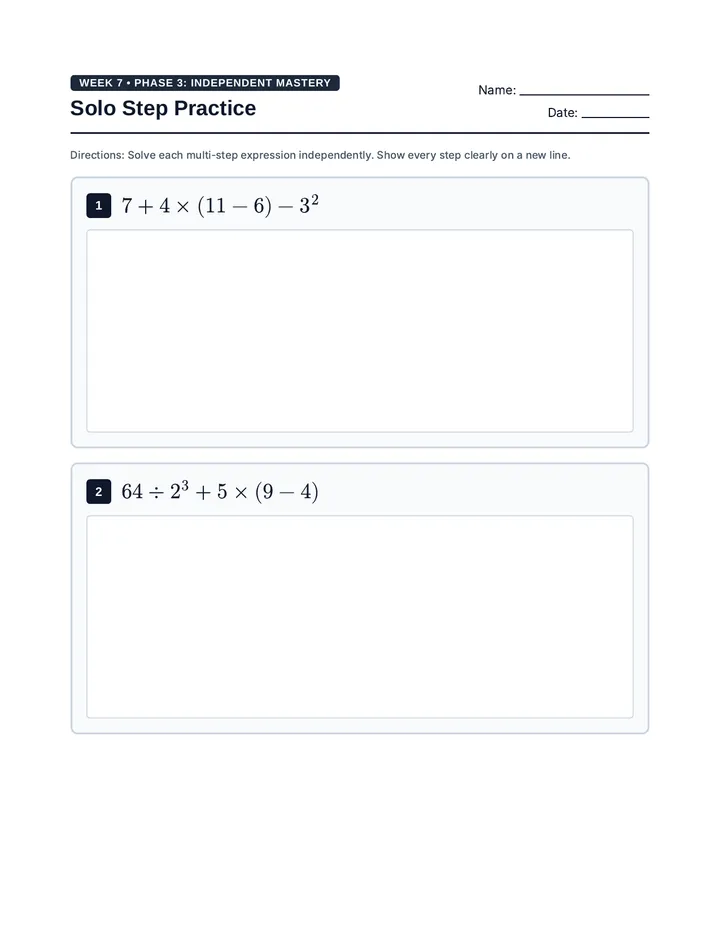
Week 7 Solo Practice Worksheet Week 7 • Phase 3: Independent Mastery
Solo Step Practice
Name: _______________________
Date: ____________
Directions: Solve each multi-step expression independently. Show every step clearly on a new line.
1 \(7 + 4 \times (11 - 6) - 3^2\)
2 \(64 \div 2^3 + 5 \times (9 - 4)\)
Week 7: Solo Step Practice (Continued) Name: _______________________
3 \([30 - (4 + 8)] \div 3 + 2^3\)
4 \(\dfrac{6^2 - 12}{4} + 3 \times 7\)
5 \(100 - [2 \times (4 + 3)^2 - 50]\)
Goal Progress & Adult Prompt Tracker
Adult Prompts Used: ☐ 0 ☐ 1 ☐ 2 ☐ 3 (Target: ≤ 2–3 prompts)
Score: _____ / 5 (_____%)
Target: 4/5 = 80% Accuracy
Week 7 Solo Practice Answer Key Teacher Resource • Answer Key
Week 7: Solo Step Practice
Phase 3: Independent Mastery
Goal: 80% (4/5) with ≤ 2–3 Prompts
Problem 1 \(7 + 4 \times (11 - 6) - 3^2\)
\(= 7 + 4 \times 5 - 9\)
\(= 7 + 20 - 9 = 27 - 9 = 18\)
Final Answer: 18
Problem 2 \(64 \div 2^3 + 5 \times (9 - 4)\)
\(= 64 \div 8 + 5 \times 5\)
\(= 8 + 25 = 33\)
Final Answer: 33
Problem 3 \([30 - (4 + 8)] \div 3 + 2^3\)
\(= [30 - 12] \div 3 + 8 = 18 \div 3 + 8\)
\(= 6 + 8 = 14\)
Final Answer: 14
Problem 4 \(\frac{6^2 - 12}{4} + 3 \times 7\)
\(= \frac{36 - 12}{4} + 21 = \frac{24}{4} + 21\)
\(= 6 + 21 = 27\)
Final Answer: 27
Problem 5 \(100 - [2 \times (4 + 3)^2 - 50]\)
\(= 100 - [2 \times 7^2 - 50] = 100 - [2 \times 49 - 50]\)
\(= 100 - [98 - 50] = 100 - 48 = 52\)
Final Answer: 52
Week 7 Prompting Guide
No visual PEMDAS chart is provided. Allow 10–15 seconds of wait time before offering a prompt.
Keep adult support to ≤ 2–3 brief verbal prompts across the entire worksheet.
Mastery Benchmark: 4/5 (80%)
Week 8 Error Sprint Worksheet Week 8 • Phase 3: Independent Mastery
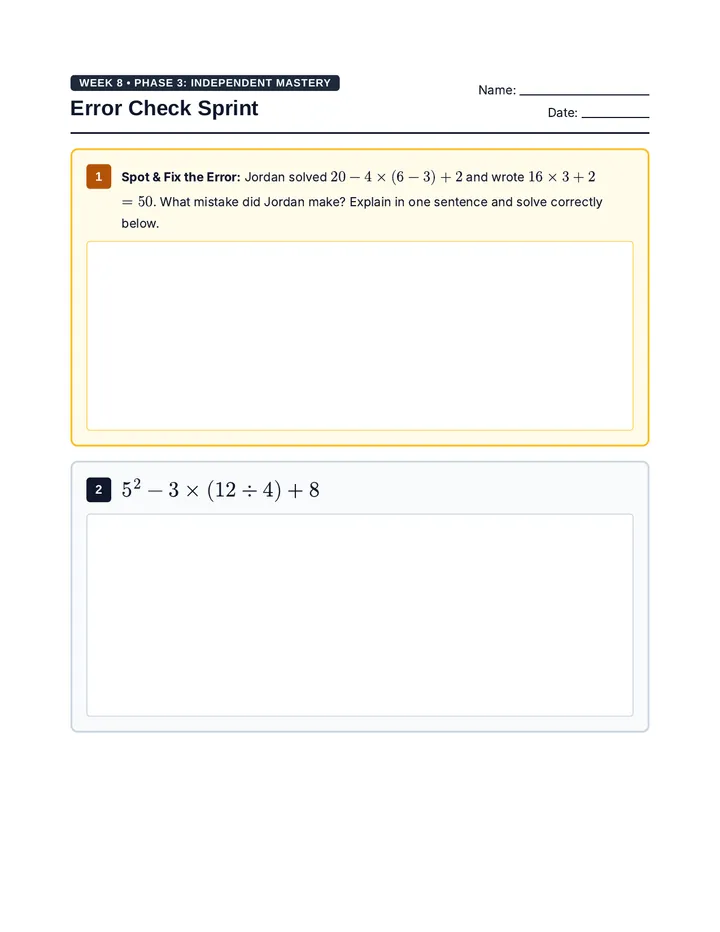
Error Check Sprint
Name: _______________________
Date: ____________
1
Spot & Fix the Error: Jordan solved \(20 - 4 \times (6 - 3) + 2\) and wrote \(16 \times 3 + 2 = 50\). What mistake did Jordan make? Explain in one sentence and solve correctly below.
2 \(5^2 - 3 \times (12 \div 4) + 8\)
Week 8: Error Check Sprint (Continued) Name: _______________________
3 \((15 - 9)^2 \div (2 + 4) \times 5\)
4 \(\dfrac{4^2 + 8}{6} \times (11 - 7)\)
5 \(75 - [2^3 \times (9 - 5) + 10]\)
Goal Progress & Adult Prompt Tracker
Adult Prompts Used: ☐ 0 ☐ 1 ☐ 2 ☐ 3 (Target: ≤ 2–3 prompts)
Score: _____ / 5 (_____%)
Target: 4/5 = 80% Accuracy
Week 8 Error Sprint Answer Key Teacher Resource • Answer Key
Week 8: Error Check Sprint
Phase 3: Independent Mastery
Goal: 80% (4/5) with ≤ 2–3 Prompts
Problem 1 (Error Check)
Mistake: Jordan subtracted \(20 - 4\) before multiplying \(4 \times 3\).
\(= 20 - 4 \times 3 + 2 = 20 - 12 + 2 = 10\)
Final Answer: 10
Problem 2 \(5^2 - 3 \times (12 \div 4) + 8\)
\(= 25 - 3 \times 3 + 8\)
\(= 25 - 9 + 8 = 16 + 8 = 24\)
Final Answer: 24
Problem 3 \((15 - 9)^2 \div (2 + 4) \times 5\)
\(= 6^2 \div 6 \times 5 = 36 \div 6 \times 5\)
\(= 6 \times 5 = 30\)
Final Answer: 30
Problem 4 \(\frac{4^2 + 8}{6} \times (11 - 7)\)
\(= \frac{16 + 8}{6} \times 4 = \frac{24}{6} \times 4\)
\(= 4 \times 4 = 16\)
Final Answer: 16
Problem 5 \(75 - [2^3 \times (9 - 5) + 10]\)
\(= 75 - [8 \times 4 + 10] = 75 - [32 + 10]\)
\(= 75 - 42 = 33\)
Final Answer: 33
Week 8 Prompting Guide
Error analysis builds self-monitoring so students catch subtraction-before-multiplication traps on their own.
Track prompts carefully; aim for 0–2 prompts before Week 9.
Mastery Benchmark: 4/5 (80%)
Week 9 Mastery Worksheet Week 9 • Phase 3: Independent Mastery
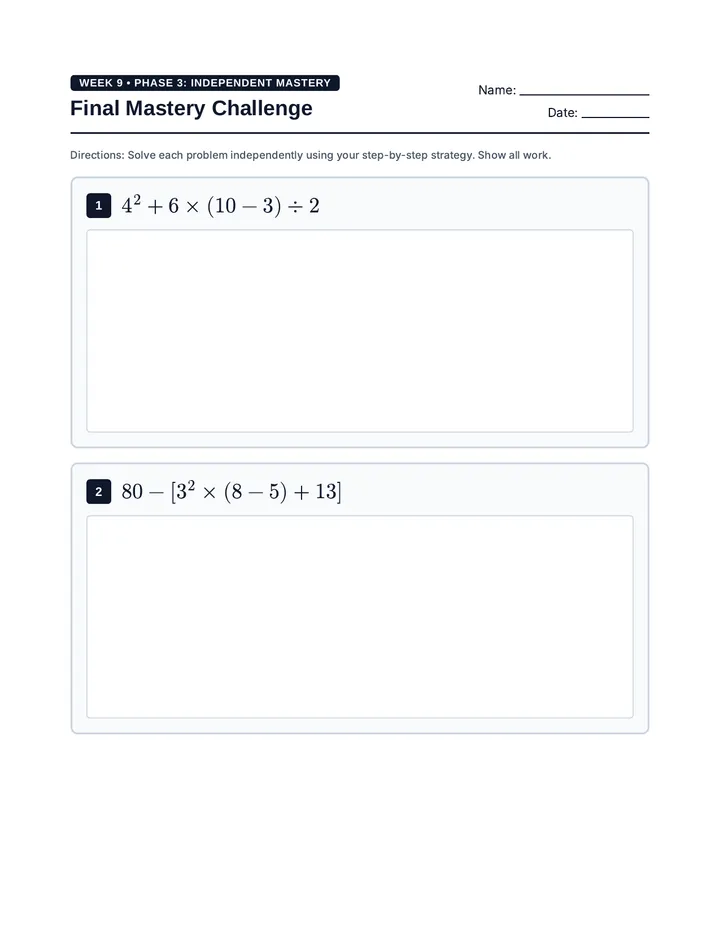
Final Mastery Challenge
Name: _______________________
Date: ____________
Directions: Solve each problem independently using your step-by-step strategy. Show all work.
1 \(4^2 + 6 \times (10 - 3) \div 2\)
2 \(80 - [3^2 \times (8 - 5) + 13]\)
Week 9: Final Mastery Challenge (Continued) Name: _______________________
3 \(\dfrac{7^2 - 9}{5} \times (6 - 2) + 4\)
4 \((3 + 5)^2 \div 4 - 2^3 + 7\)
5
A school orders 5 boxes of 12 notebooks and 10 extra notebooks , then divides all of them equally among 7 classrooms . Write an expression and solve to find how many notebooks each classroom gets.
Annual Goal Mastery Tracker
Adult Prompts Used: ☐ 0 ☐ 1 ☐ 2 ☐ 3 (Target: ≤ 2–3 prompts)
Score: _____ / 5 (_____%)
Goal Met at 4/5 (80%)!
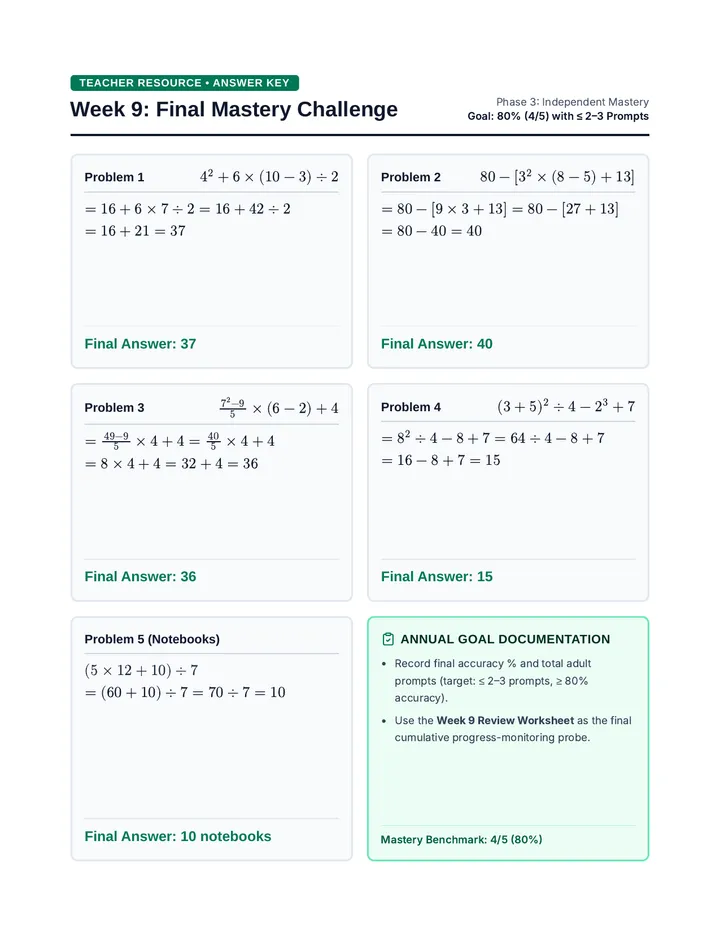
Week 9 Mastery Answer Key Teacher Resource • Answer Key
Week 9: Final Mastery Challenge
Phase 3: Independent Mastery
Goal: 80% (4/5) with ≤ 2–3 Prompts
Problem 1 \(4^2 + 6 \times (10 - 3) \div 2\)
\(= 16 + 6 \times 7 \div 2 = 16 + 42 \div 2\)
\(= 16 + 21 = 37\)
Final Answer: 37
Problem 2 \(80 - [3^2 \times (8 - 5) + 13]\)
\(= 80 - [9 \times 3 + 13] = 80 - [27 + 13]\)
\(= 80 - 40 = 40\)
Final Answer: 40
Problem 3 \(\frac{7^2 - 9}{5} \times (6 - 2) + 4\)
\(= \frac{49 - 9}{5} \times 4 + 4 = \frac{40}{5} \times 4 + 4\)
\(= 8 \times 4 + 4 = 32 + 4 = 36\)
Final Answer: 36
Problem 4 \((3 + 5)^2 \div 4 - 2^3 + 7\)
\(= 8^2 \div 4 - 8 + 7 = 64 \div 4 - 8 + 7\)
\(= 16 - 8 + 7 = 15\)
Final Answer: 15
Problem 5 (Notebooks)
\((5 \times 12 + 10) \div 7\)
\(= (60 + 10) \div 7 = 70 \div 7 = 10\)
Final Answer: 10 notebooks
Annual Goal Documentation
Record final accuracy % and total adult prompts (target: ≤ 2–3 prompts, ≥ 80% accuracy).
Use the Week 9 Review Worksheet as the final cumulative progress-monitoring probe.
Mastery Benchmark: 4/5 (80%)
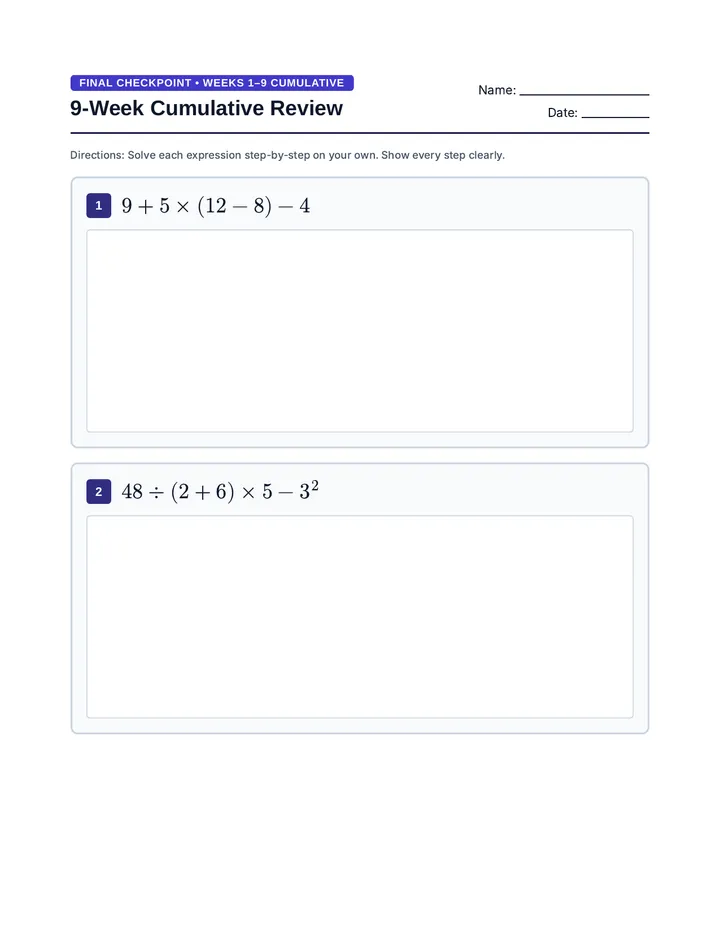
Week 9 Review Worksheet Final Checkpoint • Weeks 1–9 Cumulative
9-Week Cumulative Review
Name: _______________________
Date: ____________
Directions: Solve each expression step-by-step on your own. Show every step clearly.
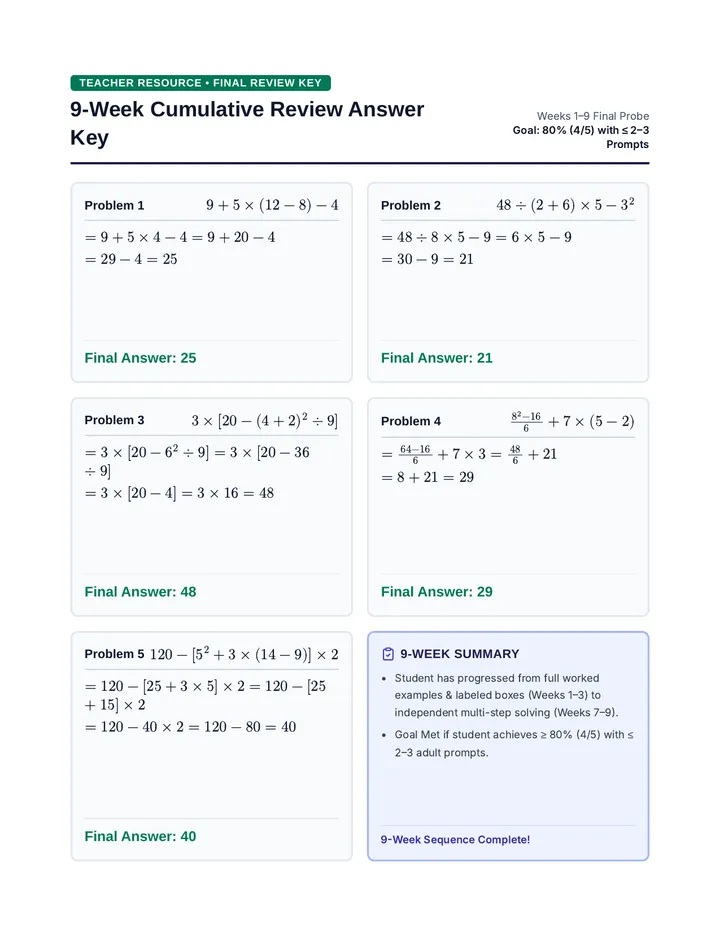
1 \(9 + 5 \times (12 - 8) - 4\)
2 \(48 \div (2 + 6) \times 5 - 3^2\)
9-Week Cumulative Review (Continued) Name: _______________________
3 \(3 \times [20 - (4 + 2)^2 \div 9]\)
4 \(\dfrac{8^2 - 16}{6} + 7 \times (5 - 2)\)
5 \(120 - [5^2 + 3 \times (14 - 9)] \times 2\)
Final Cumulative Mastery Tracker
Adult Prompts Used: ☐ 0 ☐ 1 ☐ 2 ☐ 3 (Target: ≤ 2–3 prompts)
Score: _____ / 5 (_____%)
Annual Goal Target: 80% (4/5)
Week 9 Review Answer Key Teacher Resource • Final Review Key
9-Week Cumulative Review Answer Key
Weeks 1–9 Final Probe
Goal: 80% (4/5) with ≤ 2–3 Prompts
Problem 1 \(9 + 5 \times (12 - 8) - 4\)
\(= 9 + 5 \times 4 - 4 = 9 + 20 - 4\)
\(= 29 - 4 = 25\)
Final Answer: 25
Problem 2 \(48 \div (2 + 6) \times 5 - 3^2\)
\(= 48 \div 8 \times 5 - 9 = 6 \times 5 - 9\)
\(= 30 - 9 = 21\)
Final Answer: 21
Problem 3 \(3 \times [20 - (4 + 2)^2 \div 9]\)
\(= 3 \times [20 - 6^2 \div 9] = 3 \times [20 - 36 \div 9]\)
\(= 3 \times [20 - 4] = 3 \times 16 = 48\)
Final Answer: 48
Problem 4 \(\frac{8^2 - 16}{6} + 7 \times (5 - 2)\)
\(= \frac{64 - 16}{6} + 7 \times 3 = \frac{48}{6} + 21\)
\(= 8 + 21 = 29\)
Final Answer: 29
Problem 5 \(120 - [5^2 + 3 \times (14 - 9)] \times 2\)
\(= 120 - [25 + 3 \times 5] \times 2 = 120 - [25 + 15] \times 2\)
\(= 120 - 40 \times 2 = 120 - 80 = 40\)
Final Answer: 40
9-Week Summary
Student has progressed from full worked examples & labeled boxes (Weeks 1–3) to independent multi-step solving (Weeks 7–9).
Goal Met if student achieves ≥ 80% (4/5) with ≤ 2–3 adult prompts.
9-Week Sequence Complete!