Day 1 Tutoring Packet Day 1 Tutoring Packet • Grade 6 Ratios
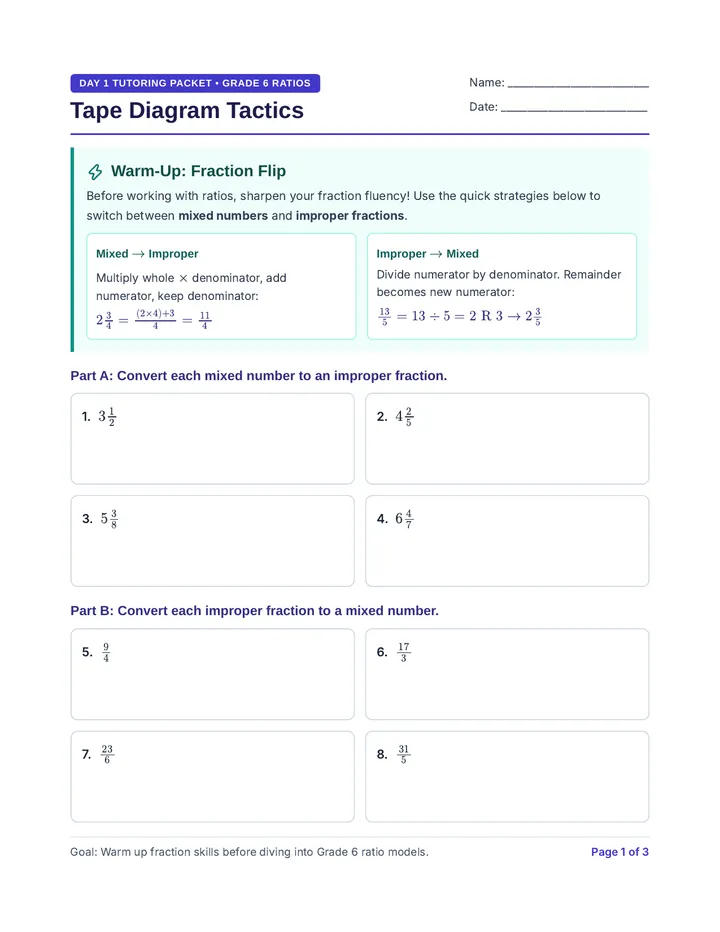
Tape Diagram Tactics
Name: ___________________________
Date: ____________________________
Warm-Up: Fraction Flip
Before working with ratios, sharpen your fraction fluency! Use the quick strategies below to switch between mixed numbers and improper fractions .
Mixed \(\rightarrow\) Improper
Multiply whole \(\times\) denominator, add numerator, keep denominator:
\(2\frac{3}{4} = \frac{(2 \times 4) + 3}{4} = \frac{11}{4}\)
Improper \(\rightarrow\) Mixed
Divide numerator by denominator. Remainder becomes new numerator:
\(\frac{13}{5} = 13 \div 5 = 2\text{ R }3 \rightarrow 2\frac{3}{5}\)
Part A: Convert each mixed number to an improper fraction.
1. \(\; 3\frac{1}{2}\)
2. \(\; 4\frac{2}{5}\)
3. \(\; 5\frac{3}{8}\)
4. \(\; 6\frac{4}{7}\)
Part B: Convert each improper fraction to a mixed number.
5. \(\; \frac{9}{4}\)
6. \(\; \frac{17}{3}\)
7. \(\; \frac{23}{6}\)
8. \(\; \frac{31}{5}\)
Goal: Warm up fraction skills before diving into Grade 6 ratio models. Page 1 of 3
Skill Builder: Part-to-Part Ratios & Totals
Quiz Skill 1
Guided Example: Using Equal Units
A bag has a total of 30 green and yellow marbles. The ratio of green marbles to yellow marbles is 2 : 3 . How many green marbles are in the bag?
Green
6
6
Yellow
6
6
6
Step 1: Total units \(= 2 + 3 = 5\) units.
Step 2: Each unit \(= 30 \div 5 = 6\) marbles.
Step 3: Green \(= 2 \times 6 = \mathbf{12}\) marbles.
1. There are a total of 36 black markers and silver markers in an art bin. The ratio of the number of black markers to the number of silver markers is \(5 : 4\). How many black markers are in the bin?
A. 4
B. 16
C. 20
D. 24
2. A fruit basket has a total of 48 apples and oranges. The ratio of the number of apples to the number of oranges is \(3 : 5\). Draw a tape diagram and find how many oranges are in the basket.
There are ____________ oranges in the basket.
Tip: Always check that all boxes in your tape diagram represent the same value. Page 2 of 3
Challenge Practice: Shifting Ratios
Quiz Skill 2
3. The tape diagram below represents the ratio of the number of stickers in Folder A to the number of stickers in Folder B.
Number of Stickers in Folder A
Number of Stickers in Folder B
Part A
Maya moves \(\frac{1}{5}\) of the stickers in Folder A to Folder B. Draw a new tape diagram that represents the new ratio of the number of stickers in Folder A to the number of stickers in Folder B.
Part B
Circle an answer choice from each list to make each statement true.
The new ratio of the number of stickers in Folder A to the number of stickers in Folder B is (A) .
5 : 3
4 : 4
4 : 3
1 : 4
Now, Folder A has (B) Folder B.
fewer stickers than
more stickers than
the same number of stickers as
If Folder A originally had 30 stickers, then Folder B now has (C) stickers.
18
24
30
36
Check: Did the total number of boxes stay at 8 after moving 1 box? Page 3 of 3
Day 1 Tutor Key Tutor Guide & Answer Key • Day 1
Tape Diagram Tactics Key
Target: Grade 6 M1 Topic B
Session Time: 45–60 min
Suggested Tutoring Pacing
1. Warm-Up (10 min)
Review mixed \(\leftrightarrow\) improper steps. Have student talk aloud through #1 and #5 before independent work.
2. Skill Builder (15 min)
Walk through the marble example. Emphasize finding the value of one unit first.
3. Challenge (20 min)
Use physical counters or sketch arrows to show \(\frac{1}{5}\) of Folder A moving to Folder B.
Warm-Up: Fraction Flip Answers
Part A: Mixed \(\rightarrow\) Improper
1. \(3\frac{1}{2} = \frac{(3 \times 2) + 1}{2} = \mathbf{\frac{7}{2}}\)
2. \(4\frac{2}{5} = \frac{(4 \times 5) + 2}{5} = \mathbf{\frac{22}{5}}\)
3. \(5\frac{3}{8} = \frac{(5 \times 8) + 3}{8} = \mathbf{\frac{43}{8}}\)
4. \(6\frac{4}{7} = \frac{(6 \times 7) + 4}{7} = \mathbf{\frac{46}{7}}\)
Part B: Improper \(\rightarrow\) Mixed
5. \(\frac{9}{4} = 9 \div 4 = 2\text{ R }1 \rightarrow \mathbf{2\frac{1}{4}}\)
6. \(\frac{17}{3} = 17 \div 3 = 5\text{ R }2 \rightarrow \mathbf{5\frac{2}{3}}\)
7. \(\frac{23}{6} = 23 \div 6 = 3\text{ R }5 \rightarrow \mathbf{3\frac{5}{6}}\)
8. \(\frac{31}{5} = 31 \div 5 = 6\text{ R }1 \rightarrow \mathbf{6\frac{1}{5}}\)
Skill Builder: Part-to-Part Ratios Answers
1. Black & Silver Markers — Answer: C (20)
Total units \(= 5 + 4 = 9\) units. Value of 1 unit \(= 36 \div 9 = 4\) markers. Black markers \(= 5 \times 4 = \mathbf{20}\).
Watch Out: Students who pick A (4) found 1 unit and stopped; students who pick B (16) found silver markers instead of black.
2. Apples & Oranges — Answer: 30 oranges
Tape diagram shows 3 boxes for apples and 5 boxes for oranges (8 boxes total). \(48 \div 8 = 6\) per box. Oranges \(= 5 \times 6 = \mathbf{30}\).
Day 1 Tutor Key • Eureka Math² G6 M1 Topic B Support Page 1 of 2
Challenge Practice: Shifting Ratios Key
Question 3 Solutions
Part A: New Tape Diagram
Folder A starts with 5 equal units. Moving \(\frac{1}{5}\) of Folder A means moving 1 unit from Folder A to Folder B. Now Folder A has 4 units and Folder B has \(3 + 1 = 4\) units.
Stickers in Folder A (Now)
Stickers in Folder B (Now)
+1
Part B: Statement Answers
(A) 4 : 4 — Folder A has 4 units and Folder B now has 4 units. (Note: if a student simplifies to \(1:1\), affirm that it is equivalent, though \(4:4\) matches the list.)
(B) the same number of stickers as — Both folders have 4 equal units, so they hold the exact same amount.
(C) 24 — Folder A originally had 30 stickers across 5 units, so 1 unit \(= 30 \div 5 = 6\) stickers. Folder B now has 4 units: \(4 \times 6 = \mathbf{24}\) stickers.
Common Misconception: Students may divide 30 by 4 instead of 5 because Folder A now has 4 boxes. Remind them the prompt says "originally had 30 stickers" (5 boxes).
End-of-Session Check Questions
"If you know the total number of items and the ratio, what is always your first step?" (Add the ratio parts to find total units, then divide.)
"When \(\frac{1}{5}\) of a 5-box bar moves to the other bar, why does the total number of boxes stay the same?" (Nothing was added or removed from the whole system—just shifted.)
Day 1 Tutor Key • Eureka Math² G6 M1 Topic B Support Page 2 of 2
Day 2 Tutoring Packet Day 2 Tutoring Packet • Grade 6 Ratios
Ratio Graph Lab
Name: ___________________________
Date: ____________________________
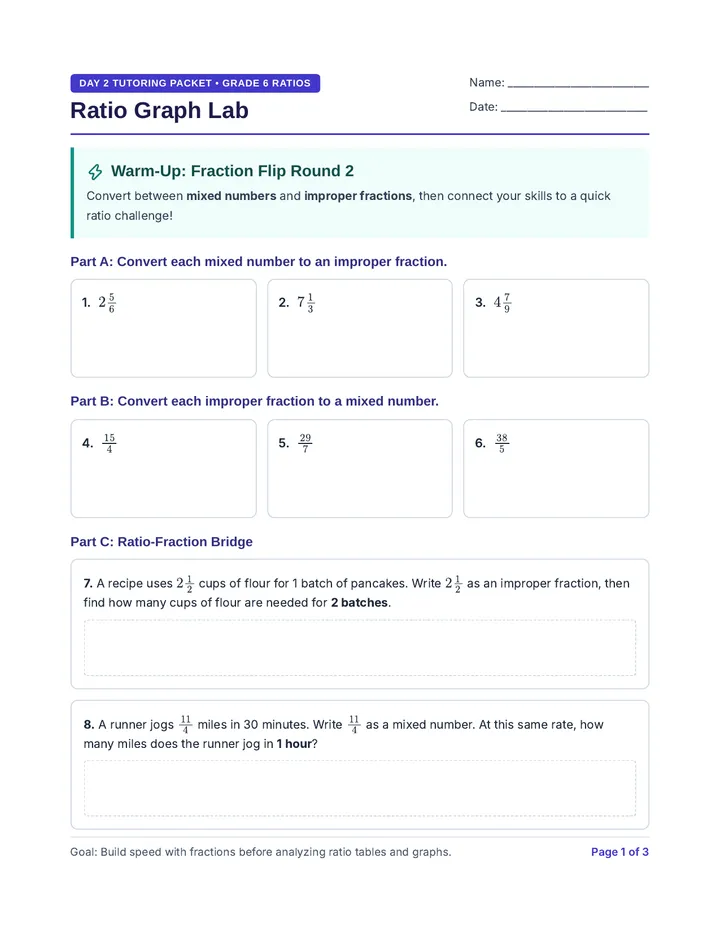
Warm-Up: Fraction Flip Round 2
Convert between mixed numbers and improper fractions , then connect your skills to a quick ratio challenge!
Part A: Convert each mixed number to an improper fraction.
1. \(\; 2\frac{5}{6}\)
2. \(\; 7\frac{1}{3}\)
3. \(\; 4\frac{7}{9}\)
Part B: Convert each improper fraction to a mixed number.
4. \(\; \frac{15}{4}\)
5. \(\; \frac{29}{7}\)
6. \(\; \frac{38}{5}\)
Part C: Ratio-Fraction Bridge
7. A recipe uses \(2\frac{1}{2}\) cups of flour for 1 batch of pancakes. Write \(2\frac{1}{2}\) as an improper fraction, then find how many cups of flour are needed for 2 batches .
8. A runner jogs \(\frac{11}{4}\) miles in 30 minutes. Write \(\frac{11}{4}\) as a mixed number. At this same rate, how many miles does the runner jog in 1 hour ?
Goal: Build speed with fractions before analyzing ratio tables and graphs. Page 1 of 3
Skill Builder: True Ratio Representations
Quiz Skill 3
1. Maya makes trail mix using 10 pretzels and 5 almonds for each snack bag. Which representations show the relationship between the number of pretzels and the number of almonds Maya uses? Choose all that apply.
A.
Number of Pretzels
Number of Almonds
10
5
20
10
30
15
50
25
D.
Number of Pretzels
Number of Almonds
10
5
20
15
30
25
50
45
B.
For every 4 snack bags Maya makes, she uses 40 almonds.
E.
For every 6 snack bags Maya makes, she uses 30 almonds.
C.
0 5 10 15 20 25 30 10 20 30 40 50 Number of Pretzels Number of Almonds
F.
0 10 20 30 40 50 5 10 15 20 25 30 Number of Pretzels Number of Almonds
Explain how you spotted one incorrect choice:
Tip: Check both the ratio values AND which quantity is on the x-axis vs. y-axis! Page 2 of 3
Challenge Practice: Tables, Graphs & Rates
Quiz Skill 4
2. Liam walks dogs for 3 hours and earns a total of $27 .
Part A
Complete the table to show the total amount Liam earns for each given number of hours.
Hours of Dog Walking
Total Amount Earned ($)
1
3
6
9
Part C
Use your unit rate to complete each statement.
Liam must walk dogs for _________ hours to earn $108.
When Liam walks dogs for 8 hours, he earns $_________.
Part B
Use the table from Part A to plot four points in the coordinate plane.
0 1 2 3 4 5 6 7 8 9 10 11 12 9 18 27 36 45 54 63 72 81 90 Number of Hours of Dog Walking Total Amount Earned (dollars)
Check: Do your 4 plotted points form a straight line starting from (0, 0)? Page 3 of 3
Day 2 Tutor Key Tutor Guide & Answer Key • Day 2
Ratio Graph Lab Key
Target: Grade 6 M1 Topic B
Session Time: 45–60 min
Suggested Tutoring Pacing
1. Warm-Up (10 min)
Time Parts A & B for fluency, then connect improper fractions to doubling rates in Part C.
2. Skill Builder (15 min)
Have student test each option A–F against the \(10:5\) (or \(2:1\)) multiplicative rule.
3. Challenge (20 min)
Find the unit rate ($9/hr) first, fill in the table, plot carefully, then answer Part C.
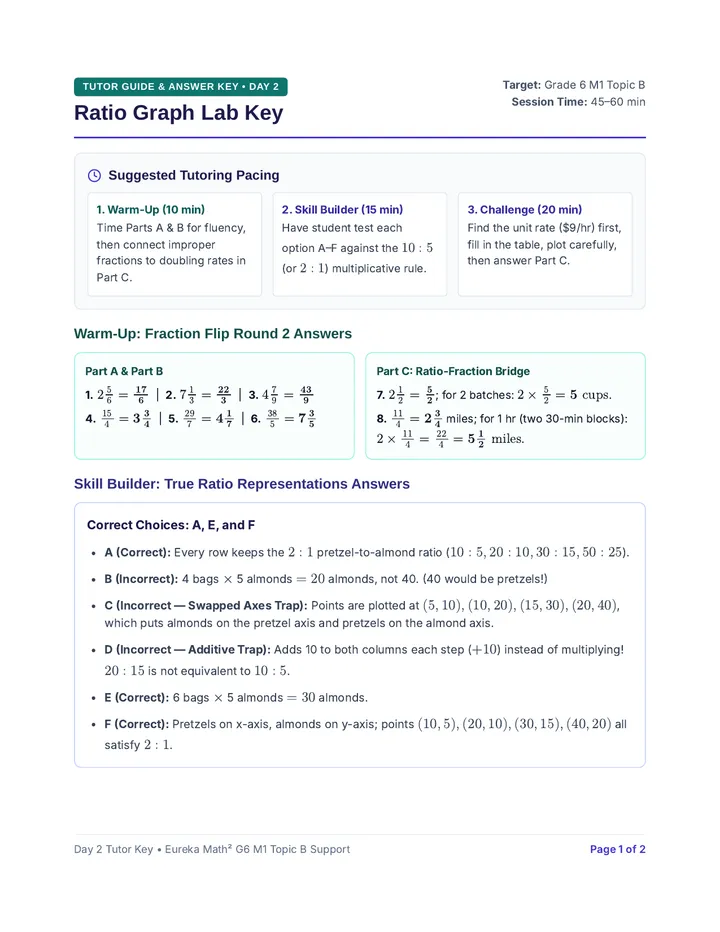
Warm-Up: Fraction Flip Round 2 Answers
Part A & Part B
1. \(2\frac{5}{6} = \mathbf{\frac{17}{6}}\) | 2. \(7\frac{1}{3} = \mathbf{\frac{22}{3}}\) | 3. \(4\frac{7}{9} = \mathbf{\frac{43}{9}}\)
4. \(\frac{15}{4} = \mathbf{3\frac{3}{4}}\) | 5. \(\frac{29}{7} = \mathbf{4\frac{1}{7}}\) | 6. \(\frac{38}{5} = \mathbf{7\frac{3}{5}}\)
Part C: Ratio-Fraction Bridge
7. \(2\frac{1}{2} = \mathbf{\frac{5}{2}}\); for 2 batches: \(2 \times \frac{5}{2} = \mathbf{5\text{ cups}}\).
8. \(\frac{11}{4} = \mathbf{2\frac{3}{4}}\) miles; for 1 hr (two 30-min blocks): \(2 \times \frac{11}{4} = \frac{22}{4} = \mathbf{5\frac{1}{2}\text{ miles}}\).
Skill Builder: True Ratio Representations Answers
Correct Choices: A, E, and F
A (Correct): Every row keeps the \(2:1\) pretzel-to-almond ratio (\(10:5, 20:10, 30:15, 50:25\)).B (Incorrect): 4 bags \(\times\) 5 almonds \(= 20\) almonds, not 40. (40 would be pretzels!)C (Incorrect — Swapped Axes Trap): Points are plotted at \((5, 10), (10, 20), (15, 30), (20, 40)\), which puts almonds on the pretzel axis and pretzels on the almond axis.D (Incorrect — Additive Trap): Adds 10 to both columns each step (\(+10\)) instead of multiplying! \(20:15\) is not equivalent to \(10:5\).E (Correct): 6 bags \(\times\) 5 almonds \(= 30\) almonds.F (Correct): Pretzels on x-axis, almonds on y-axis; points \((10, 5), (20, 10), (30, 15), (40, 20)\) all satisfy \(2:1\).
Day 2 Tutor Key • Eureka Math² G6 M1 Topic B Support Page 1 of 2
Challenge Practice: Tables, Graphs & Rates Key
Question 2 Solutions
Part A: Completed Table
Unit rate: \(\$27 \div 3\text{ hours} = \mathbf{\$9\text{ per hour}}\).
Hours
Earned ($)
1
9
3
27
6
54
9
81
Part C: Prediction Statements
1. 12 hours: \(\$108 \div \$9/\text{hr} = \mathbf{12\text{ hours}}\).
2. $72: \(8\text{ hours} \times \$9/\text{hr} = \mathbf{\$72}\).
Tutor Tip: If the student struggles with \(108 \div 9\), use the table: 9 hours is $81, plus 3 more hours ($27) = $108!
Part B: Plotted Points \((1, 9), (3, 27), (6, 54), (9, 81)\)
0 1 3 6 9 12 9 27 54 81 Number of Hours of Dog Walking Total Amount Earned (dollars)
Topic B Quiz Readiness Check
☐ Can find 1 unit from a total + ratio (Day 1)
☐ Can spot additive vs. multiplicative tables (Day 2)
☐ Can redraw tape diagrams after a shift (Day 1)
☐ Can plot \((x, y)\) pairs without swapping axes (Day 2)
Day 2 Tutor Key • Eureka Math² G6 M1 Topic B Support Page 2 of 2