Ratio and Rational Packet Day 1 • Fluency Do Now
Rational Fluency & Equation Warm-Up
Name: ________________________
Date: _______________
Directions: Complete all 10 fluency items. Show your work in the blank space for each problem. 10 Questions
Evaluate: \(-14 + 9.5\)
Evaluate: \(-6.2 - (-3.8)\)
Evaluate: \(\left(-\frac{3}{4}\right) \cdot \left(-\frac{8}{9}\right)\)
Find the reciprocal of \(\frac{5}{8}\).
Find the reciprocal of \(-2\frac{1}{3}\).
Write an equation: A number \(n\) decreased by \(7\) is \(-12\).
Write an equation: Tickets cost \(\$8.50\) each. Buying \(t\) tickets costs \(\$51\).
Solve for \(x\): \(x + 11 = -4\)
Solve for \(y\): \(-5y = 35\)
Solve for \(m\): \(\frac{3}{4}m = 12\)
Day 1 • Modules 1 & 2
Proportional Relationships & Rational Numbers
Quick Reference & Worked Examples
1. Constant of Proportionality (\(k\))
Two quantities are proportional if the ratio \(k = \frac{y}{x}\) is constant. The equation is \(y = kx\).
Example: A runner travels \(\frac{3}{4}\) mile in \(\frac{1}{6}\) hour. Find the unit rate in miles per hour.
2. Rational Number Operations
Subtracting a number is the same as adding its opposite: \(a - b = a + (-b)\). Same signs multiply/divide to positive; different signs to negative.
Example: Evaluate \(-12.4 - (-5.8)\).Example: \((-2.5) \cdot \frac{2}{5} = -\frac{5}{2} \cdot \frac{2}{5} = -1\)
State Test Tip: When a rate problem gives two fractions, write it as a complex fraction \(\frac{\text{units of } y}{\text{units of } x}\) and multiply by the reciprocal. Always check the sign of your final rational answer!
Guided Practice
A. A bakery uses \(2\frac{1}{4}\) cups of flour to make \(1\frac{1}{2}\) dozen muffins. What is the unit rate in cups of flour per dozen muffins? Write an equation relating cups of flour (\(y\)) to dozens of muffins (\(x\)).
B. At 6:00 AM, the temperature in a mountain town was \(-8.5^\circ\text{F}\). By noon, the temperature rose \(14.2^\circ\text{F}\). By 9:00 PM, it dropped \(11.7^\circ\text{F}\). What was the temperature at 9:00 PM? Show your steps.
Day 1 • State Test-Prep: Multiple Choice
Show work in the box beside each item
A leaking pipe loses \(\frac{2}{5}\) gallon of water every \(\frac{1}{10}\) hour. At this constant rate, how many gallons of water does the pipe lose in \(3\) hours?
A. \(\frac{3}{25}\) gallon
B. \(4\) gallons
C. \(12\) gallons
D. \(15\) gallons
Which table represents a proportional relationship between \(x\) and \(y\)?
A.
B.
C.
D.
A submarine is at an elevation of \(-145.5\) meters relative to sea level. It descends \(38.25\) meters, then rises \(62.5\) meters. What is the submarine's new elevation?
A. \(-246.25\text{ m}\)
B. \(-169.75\text{ m}\)
C. \(-121.25\text{ m}\)
D. \(-44.75\text{ m}\)
What is the value of the expression below? \[\left(-3\frac{1}{2}\right) \div \left(-\frac{7}{4}\right) + (-4)\]
A. \(-6\)
B. \(-2\)
C. \(2\)
D. \(6\)
Day 1 • Short Answer & Constructed Response
Explain & Justify Your Reasoning
Two streaming services charge a proportional rate based on the number of months subscribed.
StreamPlus: Charges \(\$38.25\) for \(3\) months.CineBox: Models cost with the equation \(C = 11.95m\), where \(C\) is total cost in dollars and \(m\) is months.
Part A: Find the unit rate (cost per month) for StreamPlus. Which service is less expensive per month?
Part B: How much money would a customer save over \(12\) months by choosing the less expensive service? Show your work.
Maya's checking account starts with a balance of \(\$42.50\). Over four days, she records the following transactions:
Monday: Spent \(\$18.75\) on lunch
Tuesday: Deposited \(\$25.00\) from tutoring
Wednesday: Bought \(3\) notebooks at \(\$4.50\) each
Thursday: Charged a \(\$30.00\) fee for a returned check
Part A: Write a single numerical expression using rational numbers to represent Maya's balance at the end of Thursday.
Part B: Find her ending balance. How much must she deposit on Friday to bring her balance back to \(\$0.00\) (or explain if it is already positive)?
Day 2 • Fluency Do Now
Rational Fluency & Equation Warm-Up
Name: ________________________
Date: _______________
Directions: Complete all 10 fluency items. Show your work in the blank space for each problem. 10 Questions
Evaluate: \(-18.4 - 6.6\)
Evaluate: \((-4.5) \div (-0.5)\)
Evaluate: \(-\frac{5}{6} + \frac{1}{3}\)
Find the reciprocal of \(-\frac{4}{9}\).
Find the reciprocal of \(6\).
Write an equation: Three times a number \(x\) equals \(-27\).
Write an equation: A diver starts at \(d\) meters and rises \(15\) meters to reach \(-20\) meters.
Solve for \(a\): \(a - 9.5 = -3.5\)
Solve for \(k\): \(\frac{k}{-4} = 7\)
Solve for \(p\): \(-\frac{2}{5}p = 10\)
Day 2 • Module 2 & Test Prep
Expressions, Equations & Multi-Step Reasoning
Quick Reference & Worked Examples
1. Simplifying Expressions
Distribute negative signs carefully to every term inside parentheses, then combine like terms.
Example: Simplify \(5x - 3(2x - 4) + 7\).
2. Solving Two-Step Equations
Undo addition/subtraction first (or distribute/divide first for \(p(x+q)=r\)), then undo multiplication/division.
Example: Solve \(-4(x - 3) = 20\).
State Test Tip: Watch out for a minus sign in front of parentheses! In \(8 - (3x - 5)\), distribute \(-1\) to get \(8 - 3x + 5 = -3x + 13\). Always substitute your equation solution back in to check.
Guided Practice
A. Write an equivalent expression in simplest form for \(\frac{1}{2}(6n - 10) - (4n - 3)\).
B. Solve the equation \(-\frac{2}{3}x + 5 = 17\) for \(x\). Check your solution.
Day 2 • State Test-Prep: Multiple Choice
Show work in the box beside each item
Which expression is equivalent to \(-3(2y - 5) + 4y - 7\)?
A. \(-2y - 22\)
B. \(-2y - 12\)
C. \(-2y + 8\)
D. \(10y + 8\)
A gym charges a \(\$35\) sign-up fee plus \(\$24.50\) per month. Jordan spent a total of \(\$182\) at the gym. Which equation can be used to find \(m\), the number of months Jordan was a member?
A. \(35m + 24.50 = 182\)
B. \(24.50m + 35 = 182\)
C. \(24.50(m + 35) = 182\)
D. \(24.50m - 35 = 182\)
What value of \(x\) makes the equation true? \[3.5(x - 4) = -10.5\]
A. \(x = -7\)
B. \(x = -1\)
C. \(x = 1\)
D. \(x = 7\)
A rectangle has a width of \(w\) centimeters and a length of \((2w + 5)\) centimeters. If the perimeter of the rectangle is \(58\) centimeters, what is the width \(w\)?
A. \(8\text{ cm}\)
B. \(16\text{ cm}\)
C. \(17.7\text{ cm}\)
D. \(21\text{ cm}\)
Day 2 • Short Answer & Constructed Response
Explain & Justify Your Reasoning
A school club is selling \(\$12\) t-shirts to raise money for a field trip. Each shirt costs the club \(\$4.50\) to print, and the club also paid a one-time \(\$30\) design fee. Their goal is to make a profit of \(\$270\).
Part A: Write an equation that represents the number of t-shirts, \(t\), the club must sell to reach its \(\$270\) profit goal.
Part B: Solve your equation to find how many t-shirts the club needs to sell. Show all steps.
Devon simplified the expression \(9 - 2(3x - 4) + x\) as shown below:
Step 1: \(9 - 6x - 8 + x\)
Part A: Identify the mistake Devon made in Step 1 and explain why it is incorrect.
Part B: Correctly simplify the expression, then evaluate your simplified expression when \(x = -3\).
Ratio and Rational Tutor Guide Tutor Guide & Answer Key
Eureka Math² Modules 1 & 2 Tutoring Plan
Grade 7 • 2-Day Sprint
Recommended Session Pacing (50–65 Minutes per Day)
Segment
Time
Tutor Facilitation Moves
1. Fluency Do Now
5–8 min
Student completes all 10 fluency items independently. Spot-check reciprocals and inverse operations before starting the mini-lesson.
2. Mini-Lesson
10 min
Walk through the two Quick Reference examples. Have the student verbalize why each step works (e.g., multiplying by the reciprocal or distributing \(-1\)).
3. Guided Practice
10–12 min
Complete Problem A together ("I do / We do"), then have the student lead Problem B while thinking aloud.
4. Test-Prep MCQs
12–15 min
Student works independently on Items 1–4 using the work boxes. Review distractors immediately after so errors don't stick.
5. Short Answer
15–18 min
Coach the student to label units, define variables, and write a complete sentence for "Explain" prompts (mirroring state-test rubrics).
Day 1 Teaching Notes: Proportional Relationships & Rational Numbers
Module 1 Alignment: Focuses on unit rates with complex fractions and identifying \(k = \frac{y}{x}\) from tables, equations, and verbal descriptions.Common Misconception (Unit Rate Order): Students often divide \(x \div y\) instead of \(y \div x\). Prompt them to write the unit fraction with words first (e.g., \(\frac{\text{cups}}{\text{dozens}}\)).Common Misconception (Table Check): In MCQ 2, students may only check the first two rows. Remind them to test every pair in the table for the same \(k\).Module 2 Rational Numbers: Reinforce additive inverses (\(a - b = a + (-b)\)) and sign rules for multiplication/division before combining with order of operations.
Day 2 Teaching Notes: Expressions, Equations & Multi-Step Reasoning
Module 2 Alignment: Connects rational number fluency to generating equivalent expressions (distributive property, combining like terms) and solving \(px + q = r\) and \(p(x + q) = r\).Common Misconception (Negative Distribution): The #1 state-test error is dropping the negative on the second term, e.g., \(-2(3x - 4) \neq -6x - 8\). Have students draw arrows from \(-2\) to both \(3x\) and \(-4\).Equation Strategy: For \(3.5(x - 4) = -10.5\), show that dividing both sides by \(3.5\) first is faster and less error-prone than distributing decimals.Word Problem Setup: Encourage students to identify the rate (multiplied by the variable) vs. the one-time fee (constant) before choosing or writing an equation.
Day 1 • Complete Answer Key & Solutions
Modules 1 & 2
Fluency Do Now (1–10)
1. \(-4.5\)
6. \(n - 7 = -12\)
2. \(-2.4\)
7. \(8.50t = 51\) (or \(8.5t = 51\))
3. \(\frac{2}{3}\)
8. \(x = -15\)
4. \(\frac{8}{5}\) (or \(1\frac{3}{5}\))
9. \(y = -7\)
5. \(-\frac{3}{7}\) (convert \(-2\frac{1}{3} = -\frac{7}{3}\) first)
10. \(m = 16\)
Guided Practice
A. \(2\frac{1}{4} \div 1\frac{1}{2} = \frac{9}{4} \div \frac{3}{2} = \frac{9}{4} \cdot \frac{2}{3} = \frac{18}{12} = 1.5\) (or \(1\frac{1}{2}\)) cups of flour per dozen muffins. Equation: \(y = 1.5x\) (or \(y = \frac{3}{2}x\)).
B. \(-8.5 + 14.2 - 11.7 = 5.7 - 11.7 = -6.0^\circ\text{F}\) (or \(-6^\circ\text{F}\)).
Multiple Choice
Item
Answer
Worked Solution & Distractor Notes
1
C
Unit rate: \(\frac{2/5}{1/10} = \frac{2}{5} \cdot 10 = 4\text{ gal/hr}\). In \(3\text{ hr}\): \(4 \cdot 3 = 12\text{ gal}\). (B forgets to multiply by 3.)
2
B
Every pair in B has \(k = \frac{y}{x} = 1.5\). In C and D, the first two pairs match, but the third pair breaks the ratio.
3
C
\(-145.5 - 38.25 + 62.5 = -183.75 + 62.5 = -121.25\text{ m}\). (A adds all magnitudes as negative.)
4
B
\((-\frac{7}{2}) \div (-\frac{7}{4}) + (-4) = (-\frac{7}{2})(-\frac{4}{7}) - 4 = 2 - 4 = -2\). (A comes from \(-2 + (-4)\).)
Short Answer & Constructed Response
5. Streaming Services (2 points)
Part A: StreamPlus unit rate: \(\$38.25 \div 3 = \$12.75\text{/month}\). CineBox is \(\$11.95\text{/month}\), so CineBox is less expensive per month.
Part B: Monthly savings: \(\$12.75 - \$11.95 = \$0.80\). Over \(12\) months: \(12 \times \$0.80 = \mathbf{\$9.60}\) saved.
6. Maya's Checking Account (2 points)
Part A: \(42.50 - 18.75 + 25.00 - 3(4.50) - 30.00\) (or equivalent using addition of negatives).
Part B: \(42.50 - 18.75 = 23.75\); \(23.75 + 25.00 = 48.75\); \(48.75 - 13.50 = 35.25\); \(35.25 - 30.00 = \mathbf{\$5.25}\). Her ending balance is already positive, so she does not need to deposit any money to reach \(\$0.00\).
Day 2 • Complete Answer Key & Solutions
Module 2 & Test Prep
Fluency Do Now (1–10)
1. \(-25\)
6. \(3x = -27\)
2. \(9\)
7. \(d + 15 = -20\)
3. \(-\frac{1}{2}\)
8. \(a = 6\)
4. \(-\frac{9}{4}\) (or \(-2\frac{1}{4}\))
9. \(k = -28\)
5. \(\frac{1}{6}\)
10. \(p = -25\)
Guided Practice
A. \(\frac{1}{2}(6n - 10) - (4n - 3) = 3n - 5 - 4n + 3 = \mathbf{-n - 2}\).
B. \(-\frac{2}{3}x + 5 = 17 \implies -\frac{2}{3}x = 12 \implies x = 12 \cdot (-\frac{3}{2}) = \mathbf{-18}\). Check: \(-\frac{2}{3}(-18) + 5 = 12 + 5 = 17\).
Multiple Choice
Item
Answer
Worked Solution & Distractor Notes
1
C
\(-3(2y - 5) + 4y - 7 = -6y + 15 + 4y - 7 = -2y + 8\). (A comes from writing \(-15\) instead of \(+15\).)
2
B
\(\$24.50\) per month (\(24.50m\)) plus the one-time \(\$35\) sign-up fee equals \(\$182\).
3
C
Divide both sides by \(3.5\): \(x - 4 = -3\), so \(x = 1\). (A comes from \(-3 - 4 = -7\).)
4
A
Perimeter: \(2w + 2(2w + 5) = 58 \implies 6w + 10 = 58 \implies 6w = 48 \implies w = 8\text{ cm}\). (C only adds one width and one length.)
Short Answer & Constructed Response
5. T-Shirt Fundraiser (2 points)
Part A: \(12t - 4.50t - 30 = 270\) or \(7.50t - 30 = 270\) (or \((12 - 4.50)t - 30 = 270\)).
Part B: \(7.50t - 30 = 270 \implies 7.50t = 300 \implies t = \mathbf{40}\) t-shirts.
6. Error Analysis & Evaluation (2 points)
Part A: In Step 1, Devon distributed \(-2\) to \(3x\) to get \(-6x\), but forgot to multiply \(-2\) by \(-4\). Because a negative times a negative is positive, \((-2)(-4)\) should be \(+8\), not \(-8\).
Part B: Correct simplification: \(9 - 6x + 8 + x = \mathbf{-5x + 17}\). Evaluating at \(x = -3\): \(-5(-3) + 17 = 15 + 17 = \mathbf{32}\).
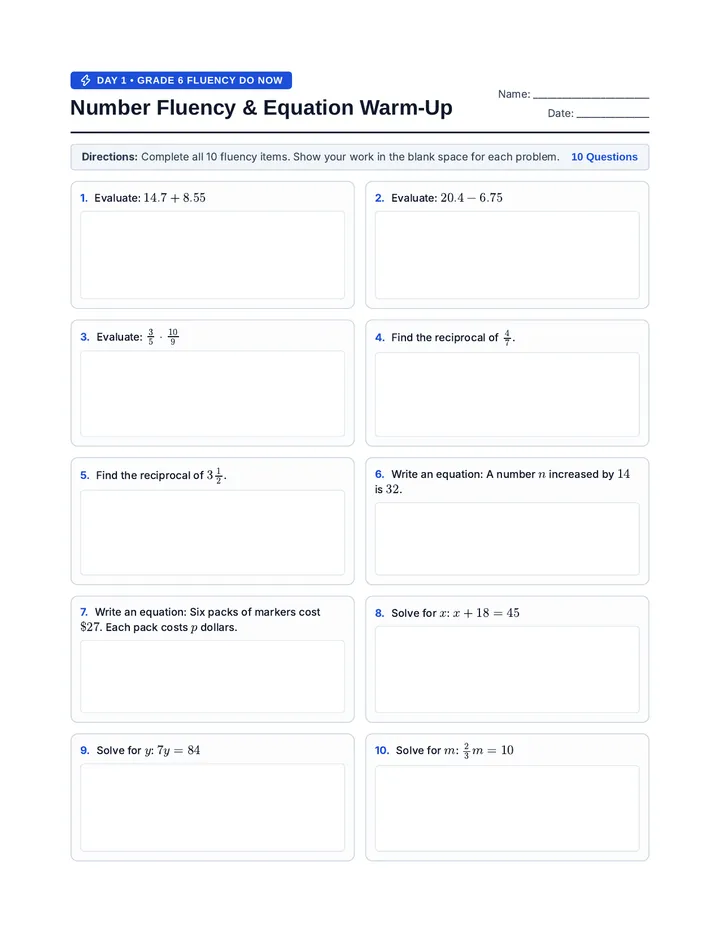
Ratio and Fraction Packet Day 1 • Grade 6 Fluency Do Now
Number Fluency & Equation Warm-Up
Name: ________________________
Date: _______________
Directions: Complete all 10 fluency items. Show your work in the blank space for each problem. 10 Questions
Evaluate: \(14.7 + 8.55\)
Evaluate: \(20.4 - 6.75\)
Evaluate: \(\frac{3}{5} \cdot \frac{10}{9}\)
Find the reciprocal of \(\frac{4}{7}\).
Find the reciprocal of \(3\frac{1}{2}\).
Write an equation: A number \(n\) increased by \(14\) is \(32\).
Write an equation: Six packs of markers cost \(\$27\). Each pack costs \(p\) dollars.
Solve for \(x\): \(x + 18 = 45\)
Solve for \(y\): \(7y = 84\)
Solve for \(m\): \(\frac{2}{3}m = 10\)
Day 1 • Grade 6 Module 1
Ratios, Unit Rates & Percents
Quick Reference & Worked Examples
1. Equivalent Ratios & Unit Rates
A unit rate tells how much for \(1\) unit. Divide the total cost or distance by the number of units.
Example: \(12\) notebooks cost \(\$18\). Find the cost of \(5\) notebooks.
2. Percents as Rates per 100
A percent is a ratio out of \(100\): \(p\% = \frac{p}{100}\). Multiply the rate by the whole to find the part.
Example: Find \(35\%\) of \(80\).
State Test Tip: In a ratio table, multiply or divide both quantities by the same number—never add or subtract! For unit price, always divide dollars ÷ items .
Guided Practice
A. A granola recipe uses \(3\) cups of oats for every \(5\) cups of flour. How many cups of oats are needed for \(20\) cups of flour? Show your reasoning with a ratio table or equivalent ratio.
B. A jacket normally costs \(\$60\). It is on sale for \(25\%\) off. How much money do you save, and what is the sale price of the jacket?
Day 1 • State Test-Prep: Multiple Choice
Show work in the box beside each item
A car travels \(210\) miles in \(3.5\) hours at a constant speed. What is the car's unit rate in miles per hour?
A. \(50\text{ mph}\)
B. \(55\text{ mph}\)
C. \(60\text{ mph}\)
D. \(70\text{ mph}\)
Which ratio table shows equivalent ratios of \(4\) blue beads to \(7\) red beads?
A.
B.
C.
D.
In a 6th-grade class of \(40\) students, \(30\%\) of the students walk to school. How many students walk to school?
A. \(12\) students
B. \(15\) students
C. \(28\) students
D. \(30\) students
A \(16\)-ounce bottle of juice costs \(\$3.84\). What is the unit price per ounce?
A. \(\$0.18\)
B. \(\$0.20\)
C. \(\$0.22\)
D. \(\$0.24\)
Day 1 • Short Answer & Constructed Response
Explain & Justify Your Reasoning
Two grocery stores sell the same brand of granola bars:
FreshMart: \(8\) bars for \(\$6.00\)ValueClub: \(12\) bars for \(\$8.40\)
Part A: Find the unit price (cost per bar) for each store. Which store has the better buy?
Part B: How much would a customer save by buying \(24\) bars from the less expensive store instead of the more expensive store?
Liam is saving money to buy a \(\$120\) skateboard. So far, he has saved \(\$42\).
Part A: What percent of the \(\$120\) goal has Liam saved so far? Show your work.
Part B: If Liam saves \(\$13\) each week, how many more weeks will it take him to reach the full \(\$120\)?
Day 2 • Grade 6 Fluency Do Now
Number Fluency & Equation Warm-Up
Name: ________________________
Date: _______________
Directions: Complete all 10 fluency items. Show your work in the blank space for each problem. 10 Questions
Evaluate: \(4.6 \times 2.5\)
Evaluate: \(15.6 \div 0.4\)
Evaluate: \(\frac{5}{6} - \frac{1}{4}\)
Find the reciprocal of \(\frac{9}{5}\).
Find the reciprocal of \(8\).
Write an equation: A ribbon of length \(r\) is cut into \(5\) equal pieces, each \(12\) inches long.
Write an equation: After spending \(\$9\), Maya has \(\$23\) left. She started with \(m\) dollars.
Solve for \(a\): \(a - 14.5 = 9.5\)
Solve for \(k\): \(\frac{k}{6} = 8\)
Solve for \(p\): \(\frac{3}{5}p = 15\)
Day 2 • Grade 6 Module 2
Fraction Division & Decimal Operations
Quick Reference & Worked Examples
1. Dividing Fractions
Dividing by a fraction is the same as multiplying by its reciprocal: \(\frac{a}{b} \div \frac{c}{d} = \frac{a}{b} \cdot \frac{d}{c}\).
Example: Evaluate \(\frac{3}{4} \div \frac{1}{8}\).
2. Dividing Multi-Digit Decimals
Multiply both the dividend and divisor by \(10\), \(100\), or \(1{,}000\) so the divisor is a whole number.
Example: Evaluate \(7.2 \div 0.15\).
State Test Tip: Convert mixed numbers to improper fractions before multiplying by the reciprocal. For decimal multiplication, count the total decimal places in both factors!
Guided Practice
A. A baker has \(3\frac{1}{2}\) cups of sugar. Each batch of cookies requires \(\frac{1}{4}\) cup of sugar. How many batches of cookies can the baker make?
B. A \(4.5\)-pound bag of apples costs \(\$8.10\). What is the cost per pound? Show your division steps.
Day 2 • State Test-Prep: Multiple Choice
Show work in the box beside each item
What is the value of the expression below? \[\frac{5}{8} \div \frac{1}{4}\]
A. \(\frac{5}{32}\)
B. \(\frac{2}{5}\)
C. \(2\frac{1}{2}\)
D. \(5\)
A carpenter has a board that is \(4\frac{1}{2}\) feet long. He cuts the board into pieces that are each \(\frac{3}{4}\) foot long. How many pieces does he get?
A. \(3\) pieces
B. \(6\) pieces
C. \(8\) pieces
D. \(12\) pieces
What is the product of \(3.24 \times 1.5\)?
A. \(4.86\)
B. \(4.96\)
C. \(48.6\)
D. \(486\)
What is the quotient of \(19.2 \div 0.24\)?
A. \(0.8\)
B. \(8\)
C. \(48\)
D. \(80\)
Day 2 • Short Answer & Constructed Response
Explain & Justify Your Reasoning
A hiking trail is \(5\frac{1}{4}\) miles long. Rest stops are placed every \(\frac{3}{4}\) mile along the trail, starting \(\frac{3}{4}\) mile from the trailhead and ending at the finish.
Part A: Write a division expression to represent the number of rest stops along the trail.
Part B: Find the number of rest stops. Show your work using the reciprocal.
Elena divided \(6.48 \div 0.8\) by rewriting the problem as \(648 \div 8\) and got \(81\).
Part A: Identify the mistake Elena made and explain why her answer is incorrect.
Part B: Find the correct quotient of \(6.48 \div 0.8\), and check your answer using multiplication.
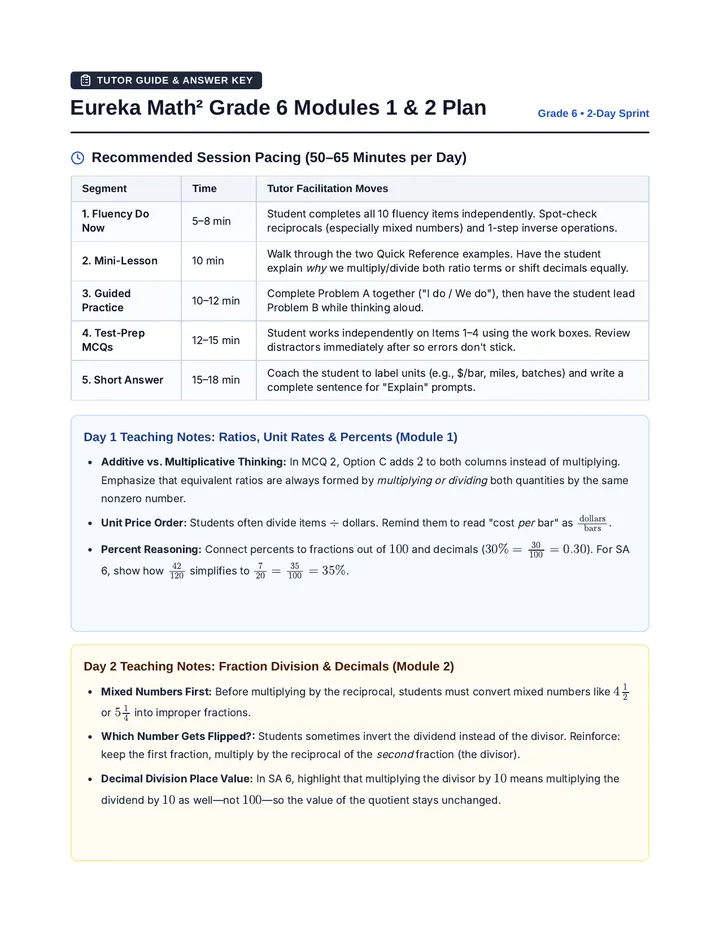
Ratio and Fraction Tutor Guide Tutor Guide & Answer Key
Eureka Math² Grade 6 Modules 1 & 2 Plan
Grade 6 • 2-Day Sprint
Recommended Session Pacing (50–65 Minutes per Day)
Segment
Time
Tutor Facilitation Moves
1. Fluency Do Now
5–8 min
Student completes all 10 fluency items independently. Spot-check reciprocals (especially mixed numbers) and 1-step inverse operations.
2. Mini-Lesson
10 min
Walk through the two Quick Reference examples. Have the student explain why we multiply/divide both ratio terms or shift decimals equally.
3. Guided Practice
10–12 min
Complete Problem A together ("I do / We do"), then have the student lead Problem B while thinking aloud.
4. Test-Prep MCQs
12–15 min
Student works independently on Items 1–4 using the work boxes. Review distractors immediately after so errors don't stick.
5. Short Answer
15–18 min
Coach the student to label units (e.g., $/bar, miles, batches) and write a complete sentence for "Explain" prompts.
Day 1 Teaching Notes: Ratios, Unit Rates & Percents (Module 1)
Additive vs. Multiplicative Thinking: In MCQ 2, Option C adds \(2\) to both columns instead of multiplying. Emphasize that equivalent ratios are always formed by multiplying or dividing both quantities by the same nonzero number.Unit Price Order: Students often divide items \(\div\) dollars. Remind them to read "cost per bar" as \(\frac{\text{dollars}}{\text{bars}}\).Percent Reasoning: Connect percents to fractions out of \(100\) and decimals (\(30\% = \frac{30}{100} = 0.30\)). For SA 6, show how \(\frac{42}{120}\) simplifies to \(\frac{7}{20} = \frac{35}{100} = 35\%\).
Day 2 Teaching Notes: Fraction Division & Decimals (Module 2)
Mixed Numbers First: Before multiplying by the reciprocal, students must convert mixed numbers like \(4\frac{1}{2}\) or \(5\frac{1}{4}\) into improper fractions.Which Number Gets Flipped?: Students sometimes invert the dividend instead of the divisor. Reinforce: keep the first fraction, multiply by the reciprocal of the second fraction (the divisor).Decimal Division Place Value: In SA 6, highlight that multiplying the divisor by \(10\) means multiplying the dividend by \(10\) as well—not \(100\)—so the value of the quotient stays unchanged.
Day 1 • Complete Answer Key & Solutions
Grade 6 Module 1
Fluency Do Now (1–10)
1. \(23.25\)
6. \(n + 14 = 32\)
2. \(13.65\)
7. \(6p = 27\)
3. \(\frac{2}{3}\)
8. \(x = 27\)
4. \(\frac{7}{4}\) (or \(1\frac{3}{4}\))
9. \(y = 12\)
5. \(\frac{2}{7}\) (convert \(3\frac{1}{2} = \frac{7}{2}\) first)
10. \(m = 15\)
Guided Practice
A. \(5 \times 4 = 20\) cups of flour, so multiply oats by \(4\): \(3 \times 4 = \mathbf{12}\) cups of oats.
B. Savings: \(0.25 \times \$60 = \mathbf{\$15}\). Sale price: \(\$60 - \$15 = \mathbf{\$45}\).
Multiple Choice
Item
Answer
Worked Solution & Distractor Notes
1
C
\(210 \div 3.5 = 2100 \div 35 = 60\text{ mph}\).
2
B
All pairs multiply by \(2\) then \(2\) again (\(4:7\), \(8:14\), \(16:28\)). C adds \(2\) to both rows.
3
A
\(30\%\) of \(40 = 0.30 \times 40 = 12\) students. (C is \(70\%\), the students who do not walk.)
4
D
\(\$3.84 \div 16 = \$0.24\) per ounce.
Short Answer & Constructed Response
5. Granola Bar Unit Prices (2 points)
Part A: FreshMart: \(\$6.00 \div 8 = \$0.75\text{/bar}\). ValueClub: \(\$8.40 \div 12 = \$0.70\text{/bar}\). ValueClub is the better buy.
Part B: Savings per bar: \(\$0.75 - \$0.70 = \$0.05\). For \(24\) bars: \(24 \times \$0.05 = \mathbf{\$1.20}\) saved (or \(\$18.00 - \$16.80 = \$1.20\)).
6. Skateboard Savings Goal (2 points)
Part A: \(\frac{42}{120} = \frac{7}{20} = \frac{35}{100} = \mathbf{35\%}\).
Part B: Remaining amount: \(\$120 - \$42 = \$78\). Weeks needed: \(\$78 \div \$13 = \mathbf{6}\) weeks.
Day 2 • Complete Answer Key & Solutions
Grade 6 Module 2
Fluency Do Now (1–10)
1. \(11.5\)
6. \(\frac{r}{5} = 12\) (or \(r \div 5 = 12\))
2. \(39\)
7. \(m - 9 = 23\)
3. \(\frac{7}{12}\)
8. \(a = 24\)
4. \(\frac{5}{9}\)
9. \(k = 48\)
5. \(\frac{1}{8}\)
10. \(p = 25\)
Guided Practice
A. \(3\frac{1}{2} \div \frac{1}{4} = \frac{7}{2} \cdot \frac{4}{1} = \frac{28}{2} = \mathbf{14}\) batches of cookies.
B. \(8.10 \div 4.5 = 81 \div 45 = \mathbf{\$1.80}\) per pound.
Multiple Choice
Item
Answer
Worked Solution & Distractor Notes
1
C
\(\frac{5}{8} \cdot \frac{4}{1} = \frac{20}{8} = \frac{5}{2} = 2\frac{1}{2}\). (A multiplies \(\frac{5}{8} \cdot \frac{1}{4}\) without inverting.)
2
B
\(4\frac{1}{2} \div \frac{3}{4} = \frac{9}{2} \cdot \frac{4}{3} = \frac{36}{6} = 6\) pieces.
3
A
\(324 \times 15 = 4{,}860\); with \(3\) total decimal places, \(4.860 = 4.86\).
4
D
Multiply both by \(100\): \(1{,}920 \div 24 = 80\). (B comes from forgetting to add the zero to \(19.2\).)
Short Answer & Constructed Response
5. Hiking Trail Rest Stops (2 points)
Part A: \(5\frac{1}{4} \div \frac{3}{4}\)
Part B: \(\frac{21}{4} \div \frac{3}{4} = \frac{21}{4} \cdot \frac{4}{3} = \frac{21}{3} = \mathbf{7}\) rest stops.
6. Decimal Division Error Analysis (2 points)
Part A: Elena multiplied \(0.8\) by \(10\) to get \(8\), but she multiplied \(6.48\) by \(100\) instead of \(10\). Both numbers must be multiplied by the same power of \(10\).
Part B: \(64.8 \div 8 = \mathbf{8.1}\). Check: \(8.1 \times 0.8 = 6.48\).