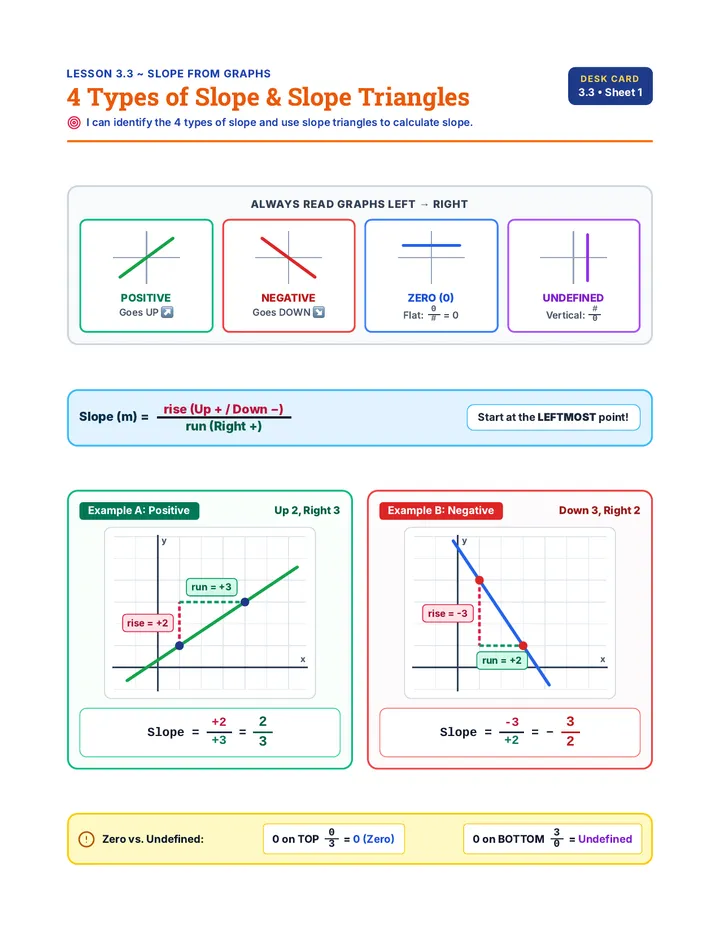
Clue Decoder Slides Day 1 • Codebreaker Lab
Translating Clues:
Multi-Step Equations
Learn how to turn real-world word problems into algebraic equations and solve them step by step.
Grade 7–8 Algebra Objective: Model & solve multi-step word problems
Warm-Up: Crack the Code
3 Minutes
1. Translate into Algebra
a) Five more than twice a number \(n\)
b) Three less than four times a number \(x\)
c) The sum of a number \(k\) and its double
2. Solve the Equation
\(3x + 7 = 22\)
Be ready to explain which operation you undid first and why!
Tip: "More than" and "less than" often flip the order when translating!
The 4-Step Codebreaker Protocol
1. Read & Spot Clues
Identify the total , any fixed fees , and any per-item rates or comparisons.
2. Define the Variable
Write a clear "Let" statement: e.g., Let \(x =\) the number of hours .
3. Build the Equation
Connect the parts with \(+\), \(-\), or \(\times\) and set them equal to the total (or another plan).
4. Solve & Check
Simplify, use inverse operations, and check that your answer makes sense in the story.
Always include units (dollars, feet, hours) in your final answer!
Example 1: Escape Room Hints
Fixed Fee + Rate
Maya spent $54 at an escape room. Admission was $18 , plus $6 per puzzle hint . How many puzzle hints did Maya buy?
Set Up
Let \(h =\) number of puzzle hints
Fixed admission: \(18\)
Hint cost: \(6h\)
Equation: \(6h + 18 = 54\)
Solve
\(6h + 18 - 18 = 54 - 18\)
\(6h = 36\)
\(h = 6\)
Maya bought 6 hints.
Example 2: Vault Door Perimeter
Distributive Property
A rectangular vault door has a perimeter of 56 feet . The length is 4 feet more than twice the width . Find the width of the door.
Set Up
Let \(w =\) width (ft)
Length \(= 2w + 4\)
Perimeter \(= 2w + 2(2w + 4)\)
\(2w + 2(2w + 4) = 56\)
Solve
\(2w + 4w + 8 = 56\)
\(6w + 8 = 56 \Rightarrow 6w = 48\)
\(w = 8\)
The width is 8 feet.
Example 3: Consecutive Numbers
Combining Like Terms
Three lockers in a row have consecutive integer numbers whose sum is 78 . What is the smallest locker number?
Set Up
1st locker \(= n\)
2nd locker \(= n + 1\)
3rd locker \(= n + 2\)
\(n + (n + 1) + (n + 2) = 78\)
Solve
\(3n + 3 = 78\)
\(3n = 75\)
\(n = 25\)
Smallest locker: 25 (25, 26, 27)
Example 4: Comparing Two Plans
Variables on Both Sides
Streaming Plan A costs $20 sign-up plus $5 per month . Plan B costs $8 sign-up plus $8 per month . After how many months do both plans cost the same?
Set Up
Let \(m =\) number of months
Plan A: \(20 + 5m\)
Plan B: \(8 + 8m\)
\(20 + 5m = 8 + 8m\)
Solve
Subtract \(5m\): \(20 = 8 + 3m\)
Subtract \(8\): \(12 = 3m\)
Divide by \(3\): \(m = 4\)
Same cost after 4 months ($40).
Example 5: Equal Perimeters
Both Sides + Distribute
A square has side length \(x + 5\) . An equilateral triangle has side length \(2x + 2\) . If both shapes have the same perimeter, find \(x\).
Set Up
Square perimeter: \(4(x + 5)\)
Triangle perimeter: \(3(2x + 2)\)
\(4(x + 5) = 3(2x + 2)\)
Solve
Distribute: \(4x + 20 = 6x + 6\)
Subtract \(4x\): \(20 = 2x + 6\)
Subtract \(6\): \(14 = 2x \Rightarrow x = 7\)
\(x = 7\) (Both perimeters = 48)
Your Turn: Partner Decode
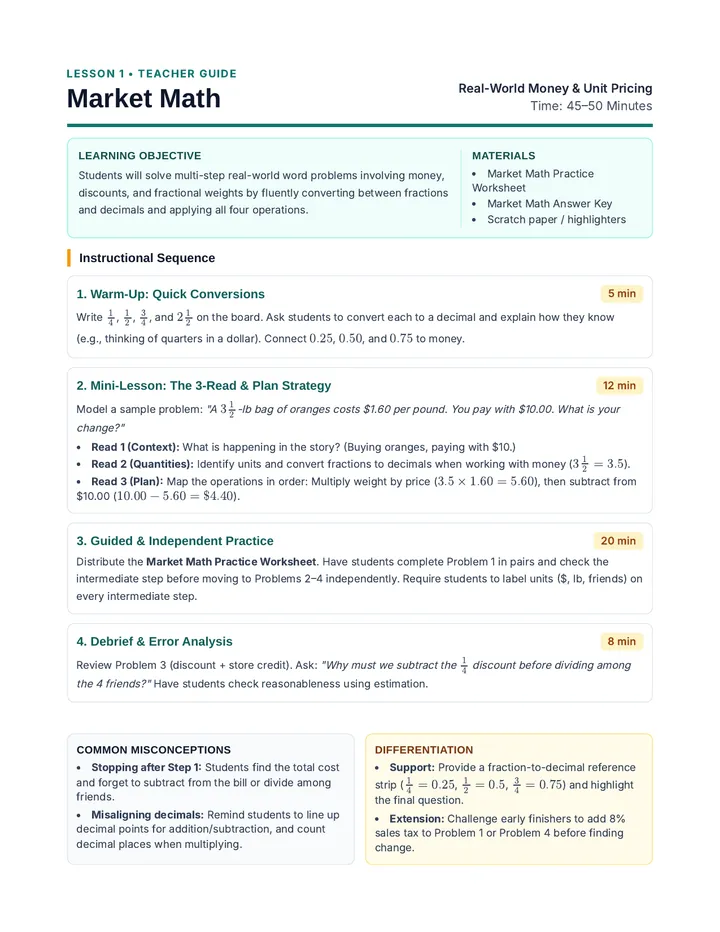
Drone A starts at 120 feet high and descends 6 feet per second . Drone B starts at 20 feet high and rises 4 feet per second . After how many seconds are both drones at the same height?
1. Define your variable
2. Write both-sides equation
3. Solve & label units
Next up: Complete your Clue Decoder Practice sheet!
Clue Decoder Practice Day 1 • Codebreaker Lab
Clue Decoder Practice
Name: _________________________
Date: ______________
1. Spot clues & total 2. Define variable 3. Write equation 4. Solve & label units
1 A streaming arcade charges a $12 membership fee plus $4 for each tournament entry. Jordan spent $40 in total. How many tournament entries did Jordan buy?
2 Priya bought 3 identical hardcover books and a $9 bookmark. She paid $54 before tax. What was the price of one hardcover book?
3 Three consecutive integers have a sum of 63. Write and solve an equation to find the three integers.
Clue Decoder Practice — Continued
Show All Steps
4 A rectangular garden has a perimeter of 46 meters. The length is 5 meters more than the width. Find the width and length of the garden.
5 • Both Sides A square has side length \(x + 4\) cm. A regular pentagon (5 equal sides) has side length \(x + 1\) cm. If both shapes have the same perimeter, find \(x\).
6 • Both Sides Amina has $45 in her savings jar and adds $6 each week. Ben has $15 in his jar and adds $11 each week. After how many weeks will they have the same amount of money?
Clue Decoder Answer Key Teacher Resource • Day 1
Clue Decoder Answer Key
Pacing: 20m Slides • 20m Practice • 5m Debrief
Slides Key: Warm-Up: 1a) \(2n + 5\), 1b) \(4x - 3\), 1c) \(k + 2k = 3k\); 2) \(x = 5\). | Partner Try-It (Drones): \(120 - 6t = 20 + 4t \Rightarrow 100 = 10t \Rightarrow t = 10\text{ seconds}\).
1. Streaming Arcade
Let \(t =\) tournament entries
\(4t + 12 = 40\)
\(4t = 28 \Rightarrow t = 7\)
Answer: 7 tournament entries
2. Hardcover Books
Let \(b =\) price of one book
\(3b + 9 = 54\)
\(3b = 45 \Rightarrow b = 15\)
Answer: $15 per book
3. Consecutive Integers
Let \(n, n+1, n+2 =\) integers
\(n + (n+1) + (n+2) = 63 \Rightarrow 3n + 3 = 63\)
\(3n = 60 \Rightarrow n = 20\)
Answer: 20, 21, and 22
4. Garden Perimeter
Let \(w =\) width, \(w + 5 =\) length
\(2w + 2(w + 5) = 46 \Rightarrow 4w + 10 = 46\)
\(4w = 36 \Rightarrow w = 9\), \(w + 5 = 14\)
Answer: Width 9 m, Length 14 m
5. Equal Perimeters (Both Sides)
Square: \(4(x + 4)\), Pentagon: \(5(x + 1)\)
\(4(x + 4) = 5(x + 1) \Rightarrow 4x + 16 = 5x + 5\)
\(11 = x\)
Answer: \(x = 11\) (Perimeter = 60 cm)
6. Savings Jars (Both Sides)
Let \(w =\) number of weeks
\(45 + 6w = 15 + 11w\)
\(30 = 5w \Rightarrow w = 6\)
Answer: 6 weeks ($81 each)
Common Misconceptions & Differentiation
Watch Out For:
Forgetting to distribute in #5 (\(4x + 4 = 5x + 1\) instead of \(4x + 16 = 5x + 5\)).
Adding \(6w + 11w\) across the equals sign in #6 instead of subtracting \(6w\) from both sides.
Quick Supports & Extensions:
Support: Have students highlight the two expressions being set equal in #5–#6.Extend: Ask early finishers to write a real-world story for \(30 + 4x = 12 + 10x\). Vault Break Slides Day 2 • Codebreaker Lab
Vault Break Review:
Team Equation Showdown
Work with your squad to crack quiz-style word problems, race along the Vault Trail, and unlock the final vault.
Grade 7–8 Algebra Game + Independent Exit Check
Quick Recap Warm-Up
3 Minutes
A movie theater charges $9 per ticket plus a $5 online booking fee for the whole order. Sam paid $41 total . How many tickets did Sam buy?
Step 1–2: Define your variable & write the equation.
Step 3–4: Solve and check your answer in the story.
Remember the 4 steps: Spot Clues • Define Variable • Write Equation • Solve & Check!
How to Play: Vault Break
1. Solve Solo First
Draw a Challenge Card (or listen to the round). Everyone writes & solves the equation on scratch paper first.
2. Team Huddle & Lock In
Compare steps, fix any errors together, and lock in one final team answer with units.
3. Advance the Trail
Correct = move +2 spaces (or +3 spaces for Gold Cards!). Incorrect = stay put and review.
4. Special Spaces
Shortcut (+1): Jump ahead! Laser Trap (-1): Step back unless you explain your steps!
First team to reach Space 16 (THE VAULT) wins—every team that unlocks the vault earns bonus pride!
Squad Roles (Rotate Every Round)
Clue Reader
Reads the Challenge Card aloud and highlights the total & rates.
Equation Builder
Leads the huddle to make sure everyone's variable and equation match.
Solution Checker
Plugs the answer back into the word problem to verify it makes sense.
Trail Navigator
Checks the answer key after locking in and moves the team token.
Everyone solves every problem—roles only guide who leads each step!
Final Lock: Independent Exit Ticket
Great teamwork! Now show what you can decode on your own.
Clear your desk except for a pencil and your Exit Ticket.
Define your variable, write the equation, and show all solving steps.
Circle your final answer with units.
Turn in your Vault Break Exit Ticket before leaving class!
Vault Trail Game Board Day 2 • Team Board Game
Vault Trail Game Board
Team Name: _____________________
1
START
Place tokens here →
2
→
3
→
4
SHORTCUT!
Move ahead +1 space ↓
↓
8
↓
7
LASER TRAP!
← -1 unless you explain steps
6
←
5
←
↓
9
→
10
GOLD DRAW!
Next card worth +3 →
11
→
12
LASER TRAP!
-1 unless you explain steps ↓
↓
16
THE VAULT!
Code Cracked!
15
←
14
SHORTCUT!
← Move ahead +1 space
13
←
Quick Rules
1. Draw a Challenge Card. Every player solves it independently first, then compare and agree on one team answer. 2. Check with the teacher or key: Standard Cards = +2 spaces ; Gold Cards = +3 spaces . 3. Land on Shortcut (+1) or Laser Trap (-1 unless you explain your steps aloud) .
Cut Along Dashed Lines
Quiz-Style Challenge Cards (1–12)
Cards 1–8: +2 Spaces • Cards 9–12: +3 Spaces
CARD 1+2 Spaces
A bowling alley charges $6 for shoe rental plus $4 per game. Leo spent $26. How many games did he bowl?
Write equation & solve.
CARD 2+2 Spaces
Mia bought 5 notebooks and a $7 pen set for $27 total. What was the cost of one notebook?
Write equation & solve.
CARD 3+2 Spaces
Three consecutive integers have a sum of 51. What is the largest of the three integers?
Write equation & solve.
CARD 4+2 Spaces
Mia has $64 and spends $5 per day. Noah has $16 and saves $3 per day. After how many days will they have the same amount?
Variables on both sides!
CARD 5+2 Spaces
Noah has 4 fewer than twice as many trading cards as Sam. Together they have 44 cards. How many does Sam have?
Write equation & solve.
CARD 6+2 Spaces
A square with side \(2x + 1\) has the same perimeter as an equilateral triangle with side \(3x - 2\). Find \(x\).
Variables on both sides!
CARD 7+2 Spaces
An online store charges $8 shipping plus $15 per t-shirt. Ava paid $83. How many t-shirts did she order?
Write equation & solve.
CARD 8+2 Spaces
Cloud Arcade charges $18 to join plus $4 per game. Pixel Zone charges $6 to join plus $7 per game. After how many games do both cost the same?
Variables on both sides!
GOLD 9+3 Spaces
Four friends bought identical concert tickets and each paid a $5 service fee. Their total was $140. What was one ticket's base price?
Gold Challenge!
GOLD 10+3 Spaces
Company A charges $35 per hour plus a $40 setup fee. Company B charges $45 per hour with no setup fee. For how many hours do both charge the same?
Gold • Both Sides!
GOLD 11+3 Spaces
Three consecutive even integers have a sum of 72. What is the smallest of the three integers?
Gold Challenge!
GOLD 12+3 Spaces
Tank A holds 84 gallons and drains 5 gal/min. Tank B holds 24 gallons and fills 7 gal/min. After how many minutes do both tanks hold the same amount?
Gold • Both Sides!
Vault Break Exit Ticket Day 2 • Independent Check
Vault Break Exit Ticket
Name: _________________________
Date: ______________
Directions: For each problem, define your variable, write a multi-step equation, show all solving steps, and label your final answer with units.
1 A kayak rental shop charges a $14 life-vest fee plus $9 per hour. Mateo paid $59 in total. How many hours did Mateo rent the kayak?
2 One number is 7 more than 3 times another number. Their sum is 43. Write and solve an equation to find both numbers.
3 • Both Sides Gym A charges $30 to join plus $15 per month. Gym B charges $10 to join plus $20 per month. After how many months will both gyms cost the same?
Vault Break Teacher Guide Teacher Resource • Day 2
Vault Break Teacher Guide
Pacing: 5m Warm-Up • 30m Game • 10m Exit Ticket
Game Setup (Teams of 3–4)
Print 1 Vault Trail Game Board & 1 set of cut Challenge Cards per team (or project cards quiz-style for whole-class rounds).
Use coins, erasers, or paperclips as team tokens on Space 1.
Warm-Up Slide Key
Let \(t =\) number of tickets.
\(9t + 5 = 41 \Rightarrow 9t = 36 \Rightarrow t = 4\)
Answer: 4 movie tickets
Challenge Cards Answer Key (Cards 1–8 • +2 Spaces)
Card 1 (Bowling): \(4g + 6 = 26 \Rightarrow g = 5\)
Card 2 (Notebooks): \(5n + 7 = 27 \Rightarrow n = 4\)
Card 3 (Consecutive Integers): \(3n + 3 = 51 \Rightarrow n = 16\) (16, 17, 18)
Card 4 (Savings • Both Sides): \(64 - 5d = 16 + 3d \Rightarrow 48 = 8d \Rightarrow d = 6\)
Card 5 (Trading Cards): \(s + (2s - 4) = 44 \Rightarrow 3s - 4 = 44 \Rightarrow s = 16\)
Card 6 (Perimeters • Both Sides): \(4(2x + 1) = 3(3x - 2) \Rightarrow 8x + 4 = 9x - 6 \Rightarrow x = 10\)
Card 7 (T-Shirts): \(15t + 8 = 83 \Rightarrow 15t = 75 \Rightarrow t = 5\)
Card 8 (Arcade Plans • Both Sides): \(18 + 4g = 6 + 7g \Rightarrow 12 = 3g \Rightarrow g = 4\)
Vault Break Teacher Guide — Continued
Gold Cards & Exit Ticket Key
Gold Challenge Cards (Cards 9–12 • +3 Spaces)
Gold 9 (Concert Tickets):
Gold 10 (Service Companies • Both Sides):
Gold 11 (Consecutive Even Integers):
Gold 12 (Water Tanks • Both Sides):
Vault Break Exit Ticket Answer Key
1. Kayak Rental: Let \(h =\) hours rented. \(9h + 14 = 59 \Rightarrow 9h = 45 \Rightarrow h = 5\).
2. Two Numbers: Let \(x =\) smaller number, \(3x + 7 =\) larger number. \(x + (3x + 7) = 43 \Rightarrow 4x + 7 = 43 \Rightarrow 4x = 36 \Rightarrow x = 9\); \(3(9) + 7 = 34\).
3. Gym Memberships (Both Sides): Let \(m =\) months. \(30 + 15m = 10 + 20m \Rightarrow 20 = 5m \Rightarrow m = 4\).
Quick Mastery Check: 3/3 = Ready for multi-step inequalities & literal equations. • 2/3 = Solid; review moving variables across the equals sign or combining like terms. • 0–1/3 = Small-group reteach on defining variables and setting up equations.