Lenny.com
Explore
Create
ActivitiesNewMathEnglish Language ArtsScience & EngineeringSocial StudiesGlobal LanguagesHealth & Physical EducationSpecial EducationCounseling & Life SkillsArts & CreativityESL
Lenny.com
Lenny.com
Explore
Create
ActivitiesNewMathEnglish Language ArtsScience & EngineeringSocial StudiesGlobal LanguagesHealth & Physical EducationSpecial EducationCounseling & Life SkillsArts & CreativityESL
Lenny.com
Lenny.com

Solutions

Lenny for EducatorsLenny for SchoolsLenny for Districts

Product

ExploreSign inCreateSupportAbout

Resources

Getting startedMTSS Acceleration Program

© 2026 Lenny Learning Inc.

TermsPrivacyAccessibility
LinkedInInstagramX
Lenny
MathNumbers & CountingCounting ObjectsNumber NamesComparing NumbersNumber OperationsCounting SequenceNumbers 0-10Place Value Understanding and SystemAdd and Subtract Within 20Addition and Subtraction ConceptsAddition and Subtraction EquationsAddition and Subtraction ProblemsFoundations for MultiplicationMultiplication and Division PropertiesMultiply and Divide Within 100Multiplication and Division ProblemsFactors and MultiplesProperties of OperationsPatterns and RelationshipsGenerate and Analyze PatternsMulti-Digit ArithmeticPlace Value OperationsMulti-Digit and Decimal OperationsNumerical ExpressionsFour Operations and PatternsFour Operations Problem SolvingMeasurement & DataMeasurable AttributesMeasuring LengthsMeasure and Estimate Lengths in Standard UnitsRelate Addition and Subtraction to LengthClassifying and Counting ObjectsTime and MoneyArea Concepts and MeasurementPerimeter and Area MeasuresAngle Concepts and MeasurementTime, Volume, and MassMeasurement Unit ConversionsGeometryIdentifying ShapesShapes and AttributesShape Attributes and ReasoningShapes and CompositionClassifying 2D FiguresGeometric Figures and RelationshipsLines, Angles, and ShapesAngle, Area, and VolumeGeometric MeasurementVolume of 3D ShapesCoordinate Plane ApplicationsTransformations in the PlaneCongruence and SimilarityUnderstand congruence in terms of rigid motionsSimilarity and TransformationsProve Theorems Involving SimilarityPythagorean TheoremTrigonometry for General TrianglesMake Geometric ConstructionsProve Geometric TheoremsTheorems About CirclesFind Arc Lengths And Areas of Sectors of CirclesVolume FormulasRelationships Between Two-Dimensional and Three-Dimensional ObjectsProve Simple Geometric Theorems AlgebraicallyTranslate Between Geometric Description and Equation for Conic SectionApply Geometric Concepts in Modeling SituationsFractions & DecimalsFractions as NumbersBuilding FractionsFraction Equivalence and OrderingAdding and Subtracting FractionsMultiplying and Dividing FractionsDividing FractionsDecimal FractionsMulti-Digit Computation and FactorsAdd, Subtract, Multiply, and Divide Rational NumbersRational Number SystemIrrational Numbers and ApproximationsRatiosRatios and ProportionsProportional RelationshipsUnit RateAlgebraAlgebraic ExpressionsGenerate Equivalent ExpressionsQuantitative RelationshipsProportional Relationships and Linear EquationsEquations and InequalitiesEquation Solving and ReasoningLinear Equations and SystemsGraph Equations and InequalitiesSystems of EquationsReal-World Algebraic ProblemsQuantitative Reasoning with UnitsExpression StructureEquivalent Expression FormsRadicals and Integer ExponentsRational ExponentsRational and Irrational NumbersPolynomial OperationsPolynomial IdentitiesPolynomial Zeros and FactorsRational ExpressionsComplex Number OperationsComplex Numbers in PolynomialsComplex Numbers on PlaneStatistics & ProbabilityRepresent and Interpret DataData DistributionsStatistical VariabilityProbability ModelsCompound Event ProbabilitiesStatistical SamplingInterpret Categorical and Quantitative DataBivariate Data PatternsInterpret Linear ModelsComparing Two PopulationsRandom Processes in StatisticsIndependence and Conditional ProbabilityExpected ValuesProbability-Based Decision MakingStatistical Inference and ConclusionsFunctionsFunction Concepts and NotationDefine and Compare FunctionsInterpret Functions in ContextAnalyze Function RepresentationsModel Relationships with FunctionsIdentify Linear vs Exponential GrowthDistinguish Between Function TypesCompare Growth RatesInterpret Function ExpressionsBuild Functions from RelationshipsConstruct and Model FunctionsTransform and Combine FunctionsModel Comparison and SelectionSolve Exponential EquationsTrigonometryTrigonometric Ratios Involving Right TrianglesTrigonometric Functions and Unit CircleModel with Trigonometric FunctionsTrigonometric IdentitiesVectors & MatricesIntroduction to Vectors and MatricesVector QuantitiesVector OperationsMatrix OperationsCalculusLimits and ContinuityDerivative Concepts and NotationDerivative Rules and TechniquesApplications of DerivativesOptimization ProblemsRelated RatesCurve Sketching and AnalysisIntegration Concepts and NotationAntiderivatives and Indefinite IntegralsDefinite Integrals and AreaFundamental Theorem of CalculusIntegration TechniquesApplications of IntegrationDifferential EquationsSequences and SeriesParametric and Polar FunctionsVector-Valued Functions

Launchpad Benchmarks

A collection of start-of-year diagnostics designed to baseline entering 8th graders. Includes math benchmark resources aligned with Illustrative Mathematics and reading benchmark resources aligned with the American Reading Company (ARC) curriculum.

MGMICHELLE GRIMALDI
Math Launchpad

An 8th-grade math diagnostic assessment and grading system aligned with Illustrative Mathematics. This lesson includes a comprehensive printable student diagnostic test and a detailed teacher grading guide mapping back to 7th-grade prerequisite units to target interventions.

Reading Launchpad

An 8th-grade reading diagnostic designed to baseline students against the American Reading Company (ARC) curriculum framework. Includes a complex, multi-genre reading comprehension test focusing on perspective, structure, context clues, and textual evidence, paired with an ARC IRLA-aligned teacher scoring and placement guide.

Launchpad Benchmarks

A collection of start-of-year diagnostics designed to baseline entering 8th graders. Includes math benchmark resources aligned with Illustrative Mathematics and reading benchmark resources aligned with the American Reading Company (ARC) curriculum.

MGMICHELLE GRIMALDI

MATH LAUNCHPAD TEACHER GRADING GUIDE PAGE 1 OF 2

Section C: Algebra, Equations & Inequalities Solutions

7.EE.A.1, 7.EE.B.4

Question 6: Expand & Simplify Expression 7.EE.A.1 | IM Unit 6

Steps: Distribute: \(3.5(4x) - 3.5(8) = 14x - 28\). Distribute negative: \(-(2x + 5) = -2x - 5\). Combine like terms: \((14x - 2x) + (-28 - 5) = \) 12x - 33.

Common Error: Forgetting to distribute the negative to the \(5\) in the second term, resulting in \(12x - 23\).

Question 7: Multi-Step Equation Solver 7.EE.B.4a | IM Unit 6

Steps: Divide both sides by \(-2\): \(w - 7.2 = \frac{18.4}{-2} \Rightarrow w - 7.2 = -9.2\). Add \(7.2\) to both sides: \(w = -9.2 + 7.2 \Rightarrow w = \) -2.

Question 8: Multi-Step Inequality & Graph 7.EE.B.4b | IM Unit 6

Steps: \(3p - 15 > -6 \Rightarrow 3p > 9 \Rightarrow \) p > 3. Graph representation: Open circle at 3 with shading/arrow extending to the right (towards 5).

Sections D & E: Geometry & Probability Solutions

7.G.B.4, 7.G.B.5, 7.SP.A.2

Question 9: Intersecting Supplementary Angles 7.G.B.5 | IM Unit 7

Steps: Angles are supplementary (sum to \(180^\circ\)): \((3x + 10) + (2x - 5) = 180 \Rightarrow 5x + 5 = 180 \Rightarrow 5x = 175 \Rightarrow \) x = 35. Substitute \(x = 35\) for \(\angle AEC\): \(3(35) + 10 = 105 + 10 = \) 115^\circ.

Question 10: Semicircle Area calculation 7.G.B.4 | IM Unit 3

Steps: Area of full circle: \(A = \pi r^2 \approx \frac{22}{7} \times 14 \times 14 = 22 \times 2 \times 14 = 616\text{ m}^2\). Area of semicircle: \(\frac{1}{2} \times 616 = \) 308 m².

Question 11: Statistical Sampling Inference 7.SP.A.2 | IM Unit 8

Steps: Ratio of robotics choice: \(\frac{32}{80} = 40\% = 0.4\). Apply to total school population: \(0.4 \times 450 = \) 180 students expected.

Diagnostics & Intervention Matrix

ItemsMissed Concept Prerequisite8th Grade Entry Unit At-RiskTargeted 8th Grade Remediation
Q1, Q2, Q3Proportionality & Scale (7.RP / 7.G.A)Unit 1 (Rigid Transformations)Scaffold dilations using 7th grade grid scale activities.
Q4, Q5Rational Number Ops (7.NS.A)Unit 2 & 4 (Dilations / Linear Equations)Provide fraction-decimal quick reference charts.
Q6, Q7, Q8Solving Multi-Step Equations (7.EE.B)Unit 4 (Linear Equations / Systems)Incorporate daily warmups on algebraic balance scales.
Q9, Q10Angle Systems & Circles (7.G.B)Unit 1 & 7 (Transformations & Volume)Scaffold angle properties when studying parallel transversals.

MATH LAUNCHPAD TEACHER GRADING GUIDE PAGE 2 OF 2

Part B: Which sentence from the passage best supports the answer to Part A?

A "Billions of dollars are channeled into cosmic voyages..." (Paragraph 1) B "They point to the exorbitant cost of constructing specialized submersibles..." (Paragraph 2) C "To turn away from the depths is to forfeit the key to future scientific breakthroughs." (Paragraph 3)

Passage 2: Literary Text

Lexile 980L • ARC Level 4D

The Iron Pulse

by S. J. Finch

[1] Liam stood at the threshold of Foundry Seven, his lungs instantly contracting against the thick, sulfurous air. Around him, the industrial basin hummed with a primal, rhythmic heartbeat. Towering cauldrons of molten iron glided along overhead tracks, casting a fierce, amber glare over the soot-crusted floor. The older craftsmen moved like ghosts through the steam, their faces shielded behind tinted safety masks, their hands guiding levers with an unspoken, intuitive grace.

[2] To Liam, the environment felt hostile, a mechanical monster threatening to consume anyone who faltered. His task was simple yet daunting: clear the cooling channels of debris before the next pour. Armed with a heavy iron scraping rod, he stepped forward, his boots melting slightly against the warm bricks.

[3] “Don’t fight the heat, kid,” a gravelly voice echoed. It was Old Joseph, the master smith. “The metal has a temper, yes, but it also has a pulse. Work with it, not against it. Watch the flow, anticipate the pressure, and keep your hands steady.” Liam gripped the scrap metal rod tighter, taking a deep breath of the scorched air. He closed his eyes for a split second, trying to find the rhythm in the thunderous noise, searching for the pulse beneath the chaos.

8TH GRADE READING BENCHMARK PAGE 2 OF 3

Questions for Passage 2 (Literary)

  1. In Paragraph 2, the author describes Foundry Seven as a "mechanical monster." How does this metaphor develop the tone of the passage?

A It creates a feeling of wonder and technological joy. B It emphasizes the dangerous and intimidating setting. C It highlights Liam's lack of respect for industrial art. D It mocks the old craftsmen's superstitious traditions.

  1. How does Old Joseph’s perspective on the foundry contrast with Liam’s initial perspective?

A Liam views the factory as a hazardous prison, whereas Joseph views it as a biological laboratory. B Liam is focused on escaping the heat, whereas Joseph wants to push the machines beyond their limits. C Liam senses only overwhelming peril, whereas Joseph perceives a predictable rhythm and flow.

Section C: Comparative Synthesis Response

5. Synthesis Prompt: Analyze how both the scientist in Passage 1 and the apprentice/smiths in Passage 2 interact with challenging, extreme environments. How does each passage suggest that humans can overcome or work within hostile conditions? Cite evidence from both texts to support your analysis.

Lined Workspace — Support with citations

8TH GRADE READING BENCHMARK PAGE 3 OF 3

Clear, structured writing with minimal errors that do not impede comprehension.
2 - Developing (Target 3D)Fails to fully compare; may write about one passage much more than the other. Superficial analysis.Mentions details but fails to cite text specifically, or cites from only one passage.Fragmented thoughts, repetitive vocabulary, or spelling issues.

ARC READING PLACEMENT GUIDE PAGE 1 OF 2

ARC IRLA Placement & Level Diagnostic Matrix

Use student performance across the entire 5-question test to assign a preliminary IRLA reading level band. This baseline allows you to place students immediately into their initial independent reading groups and target specific skills.

Diagnostic ScoreIndicated ARC LevelELA Reading Behavior ProfileImmediate Action Step
5 correct OR 4 correct + Rubric score 4Level 5D / Black Band
(Above 8th Grade Level)Reads with fluid critical insight. Understands subtext, identifies multi-layered themes, and accurately dissects conflicting perspectives. Defends points with strong textual citations.Provide advanced non-fiction and complex literary novels. Challenge with comparative essay writing.
3-4 correct AND Rubric score 3Level 4D / Gold Band
(At 8th Grade Target)Understands complex vocabulary via context. Identifies main arguments and basic metaphors. Successfully retrieves citations to answer analytical questions.Reinforce critical structural choices and deeper tone-shifts in grade-level class discussions.
1-2 correct OR Rubric score 1-2Level 3D / White Band
(Below 8th Grade Level)Struggles with academic vocabulary in context. Answers simple direct-retrieval questions but fails to support analytical assertions with specific text lines.Conduct immediate small-group conferences focusing on vocabulary acquisition and evidence hunting.

Strategic ELA Interventions for ARC Units 1-4

Vocabulary Scaffolding

To support students struggling with Tier 2 vocabulary (e.g. exorbitant, chemosynthesis, sulfurous), implement weekly contextual clues strategies. Teach prefixes/suffixes roots, and have students create interactive cards mapping vocabulary in their research notebooks.

Evidence Graphic Organizers

For Level 3D students, utilize "Claim-Evidence-Reasoning" (CER) tables during independent reading. Do not permit students to make a claim about their book unless they can supply a physical sticky note marking the exact paragraph or sentence containing the evidence.

Tone & Metaphor Workshops

Conduct short focus group workshops comparing literal descriptions with figurative comparisons (e.g., comparing "a loud factory" to "a mechanical monster"). Prompt students to identify how figurative language changes reader emotion and author perspective.

ARC READING PLACEMENT GUIDE PAGE 2 OF 2
You might also like

Autumn Warmup Packet

Daily Spark Warmups

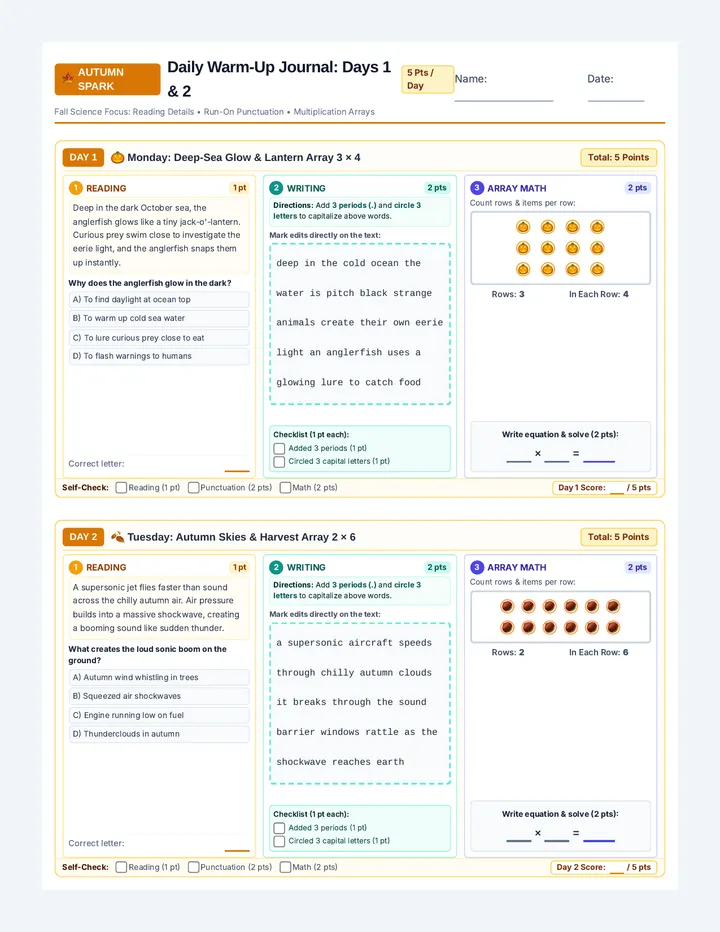
A five-day daily warm-up sequence for 8th grade intervention classrooms featuring reading comprehension, sentence mechanics, and multiplication array modeling across three compact print pages.

KS

Kathleen Suther

3
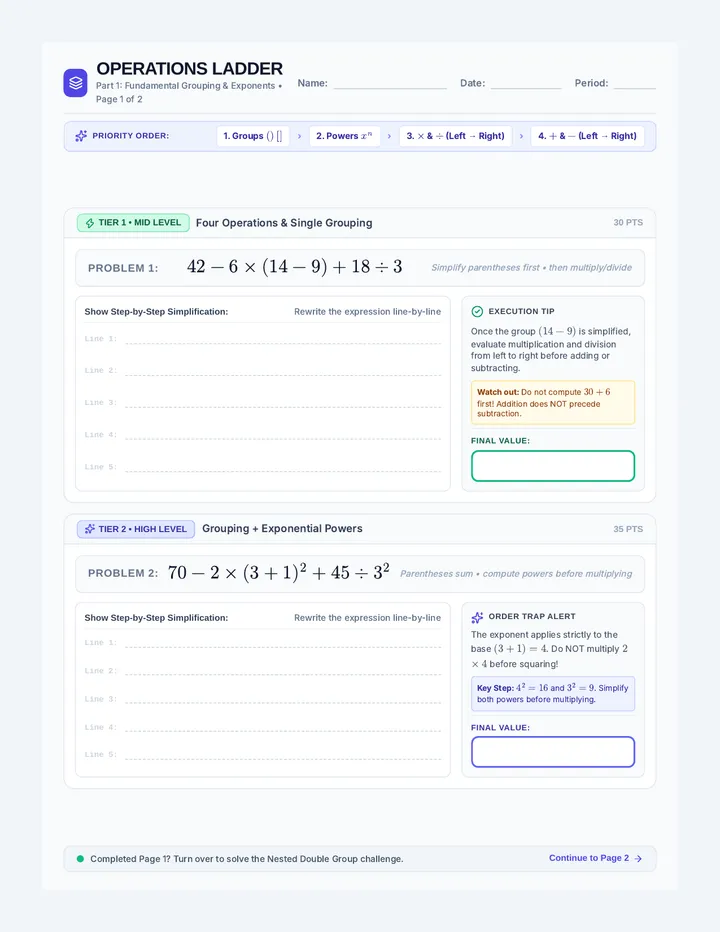
Operations Ladder Worksheet

Operations Ladder

A foundational 50-minute order of operations lesson featuring real-world visual models, scaffolded breakdown moments, and step-by-step practice.

AA

alicia accapezzato

2
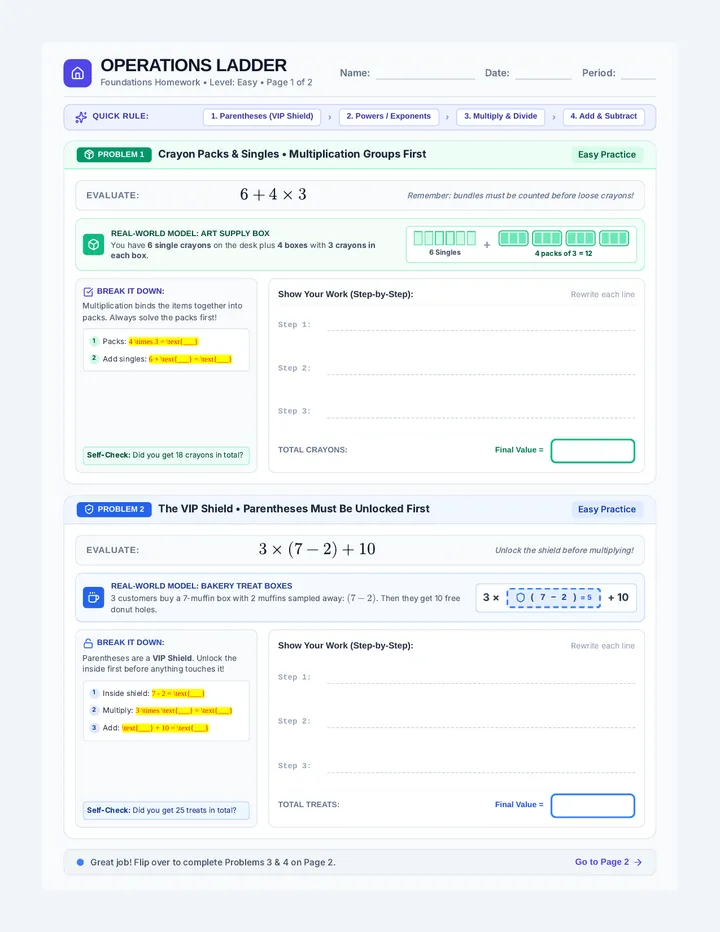
Operations Ladder Homework

Operations Ladder Homework

An accessible, two-page easy-level order of operations homework assignment mirroring classwork structures with four half-page problems, real-world visual models (crayon boxes, muffin packs, funnel ladders, and 2x2 square grids), and step-by-step breakdown checklists.

AA

alicia accapezzato

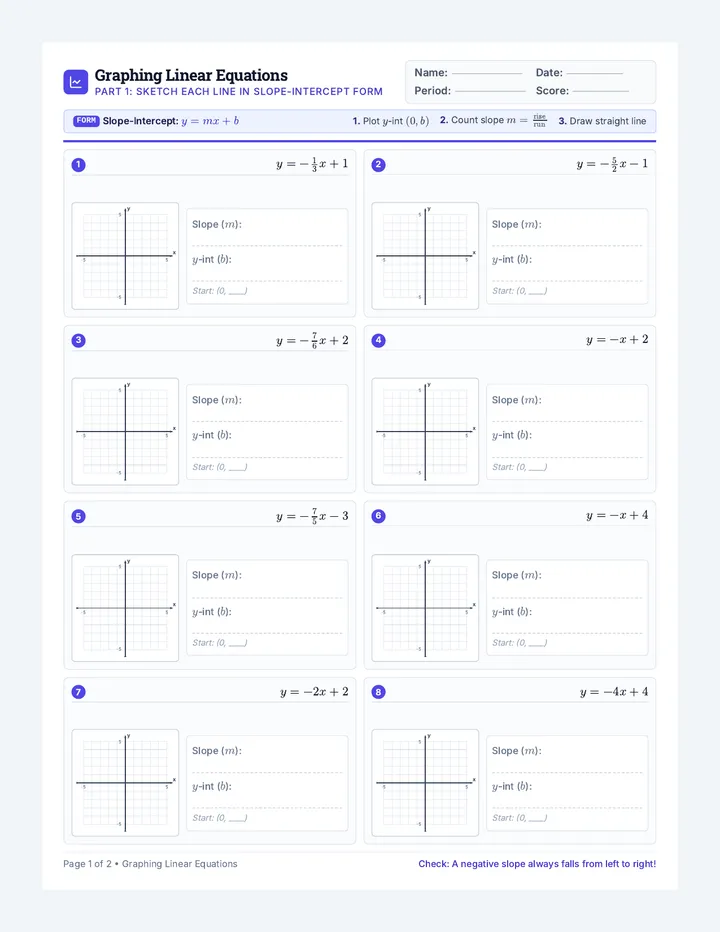
Linear Equations Practice Worksheet

Coordinate Geometry Mastery

A secondary mathematics curriculum sequence exploring linear functions and geometric transformations on the Cartesian coordinate plane, featuring print-ready guided practice and teacher keys.

FM

Fernando Mancini

4
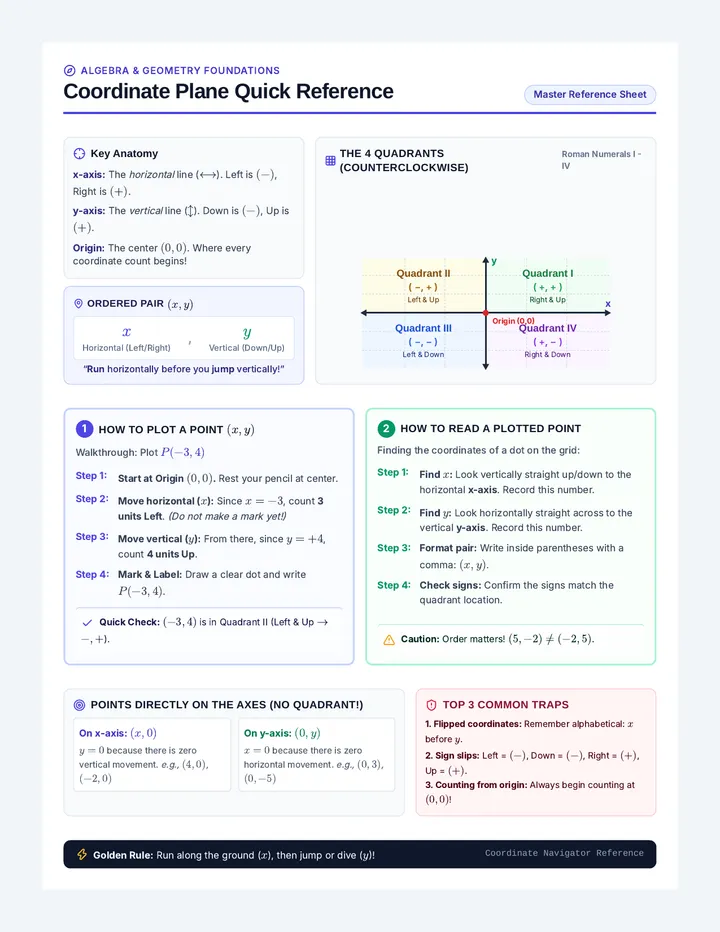
Grid Navigator Reference Sheet

Grid Navigator

A comprehensive foundational lesson on the coordinate plane covering anatomy, quadrants, ordered pairs, and step-by-step procedures for plotting and reading coordinates.

C

Chad.Wimmenauer

3
Slope Sprint Worksheet

Slope Sprint Worksheet

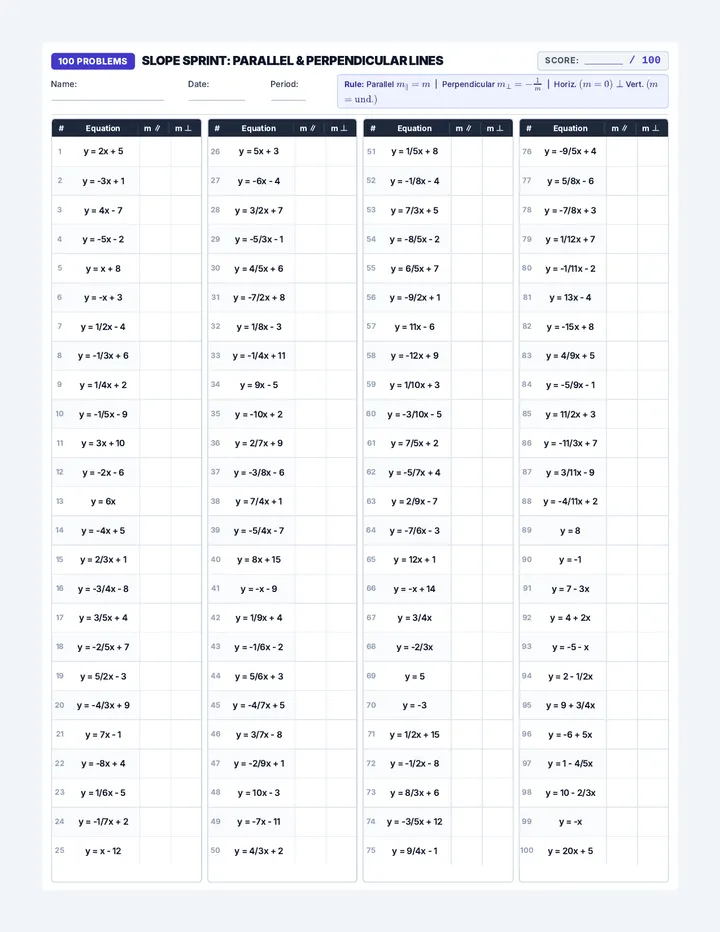
A high-density 100-question practice worksheet designed for rapid mastery of parallel and perpendicular slopes from slope-intercept equations. All one hundred problems are compactly formatted onto a single printable page with dedicated answer columns and single-line equations.

J

jeffreychadwick.inspiretx

Angle Types Slides

Angle Architects

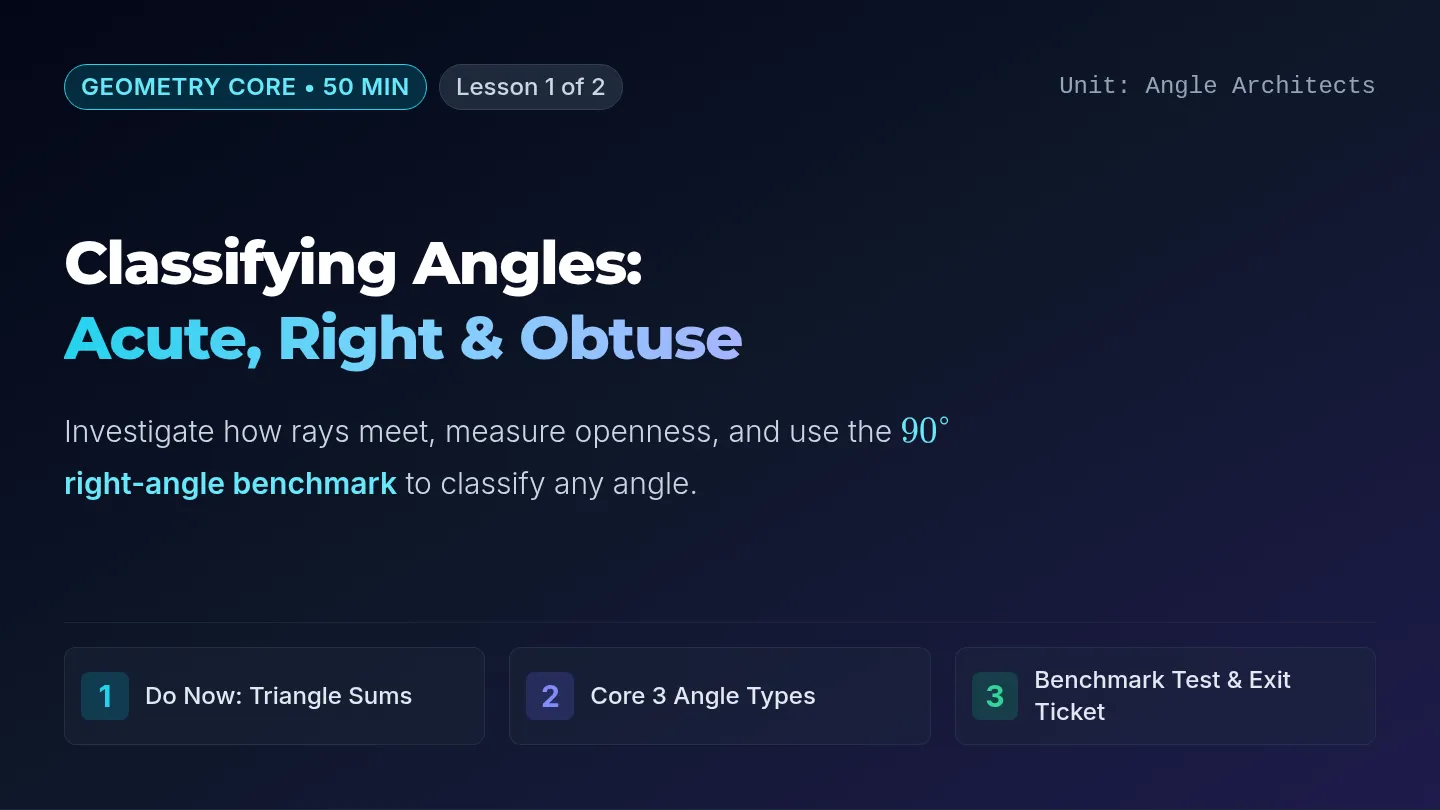
A two-part 50-minute geometry unit exploring angle classifications and angle pair relationships through rich geometric diagrams, guided algebraic problem-solving, and visual practice.

AA

alicia accapezzato

6
Autumn Warmup Packet

Autumn Spark Week

Complete five-day daily warm-up unit featuring an all-in-one three-page student journal packet and classroom review slides with autumn science themes, reading comprehension, run-on punctuation, and print-friendly multiplication arrays.

KS

Kathleen Suther

3
Slope Review Practice Worksheet

Slope Review Practice Worksheet

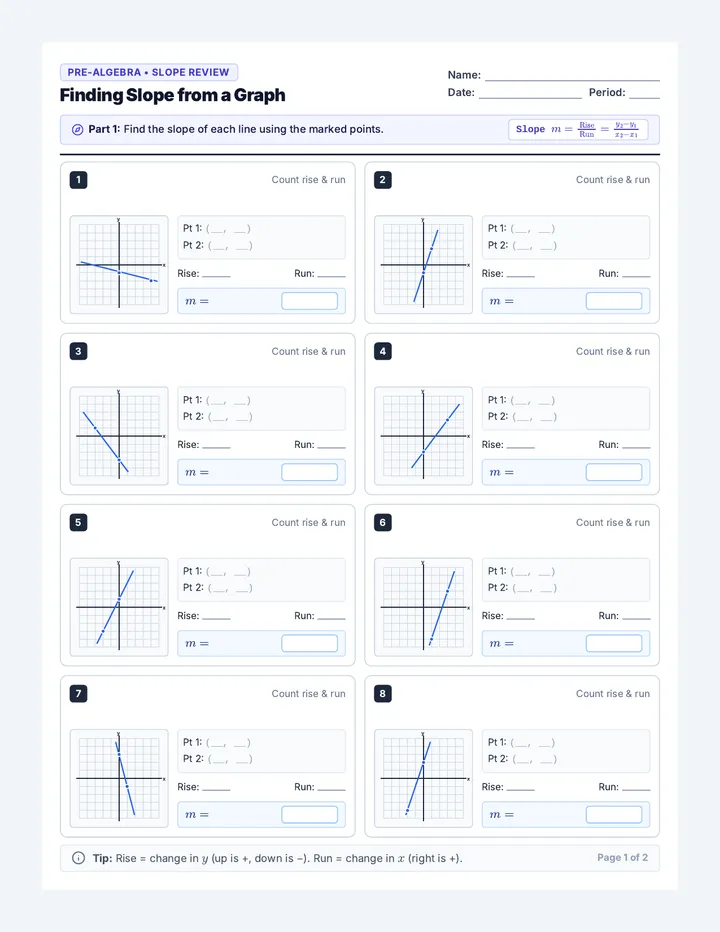
A refined 2-page slope review worksheet that eliminates formula hints on problems 9-16 and balances spacing across Parts 2 and 3 with clean, dedicated student workspaces.

FM

Fernando Mancini

Compound Inequalities Bonus Worksheet

Equations and Inequalities

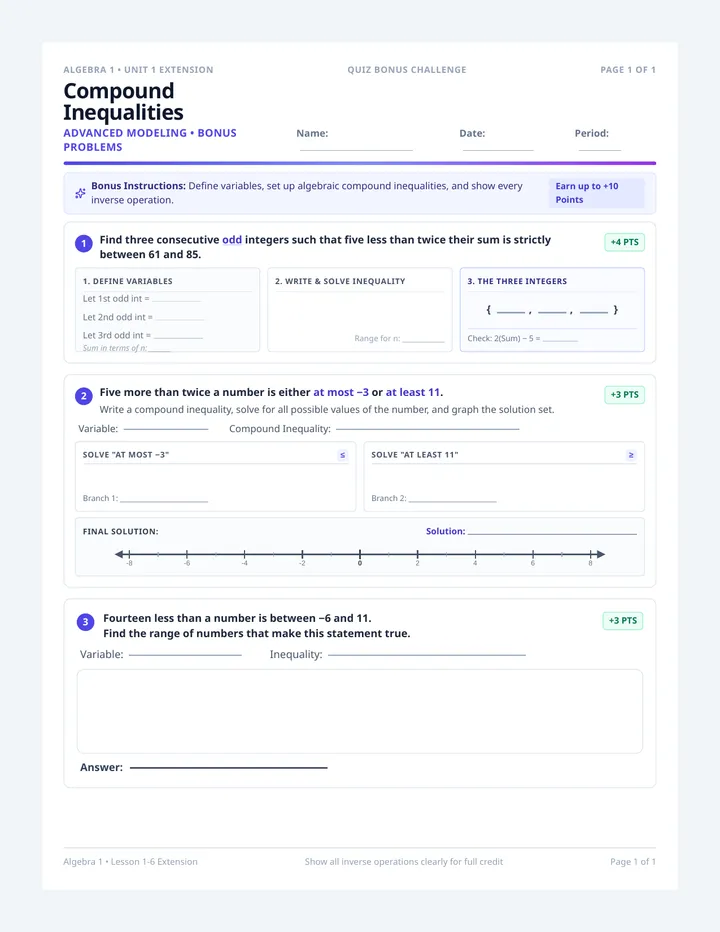
A comprehensive unit covering linear and compound inequalities, absolute value equations and inequalities, and real-world modeling applications.

FM

Fernando Mancini

16
Data Detective Assessment

Statistics Foundations

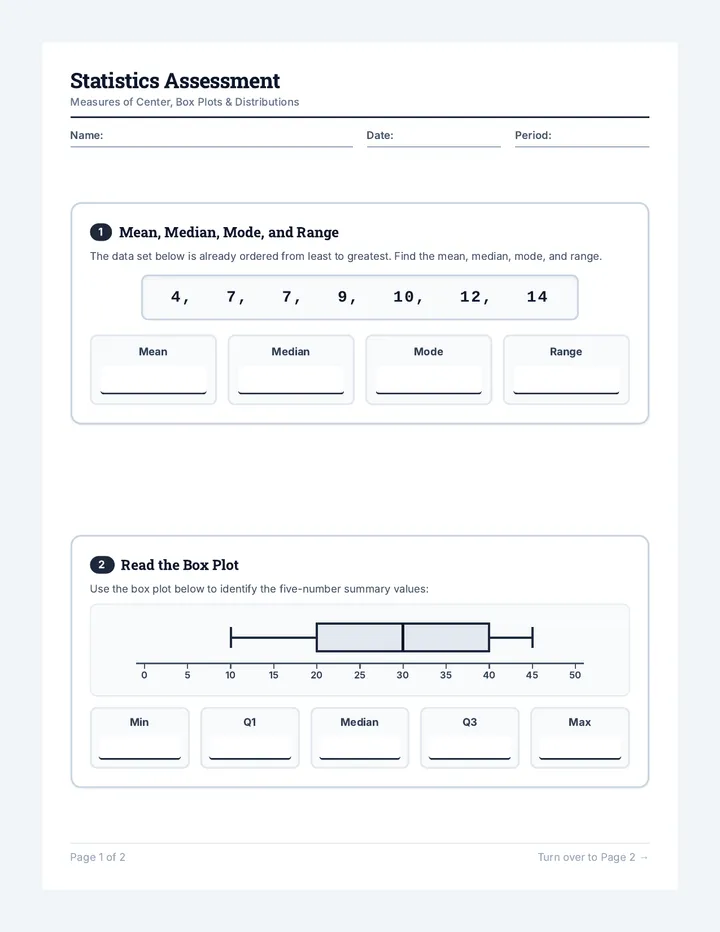
A foundational statistics lesson focusing on calculating measures of center and spread, constructing and interpreting box plots, and recognizing distribution shapes.

CF

Chad Forde

2
Grid Navigator Answer Key

Grid Navigator Answer Key

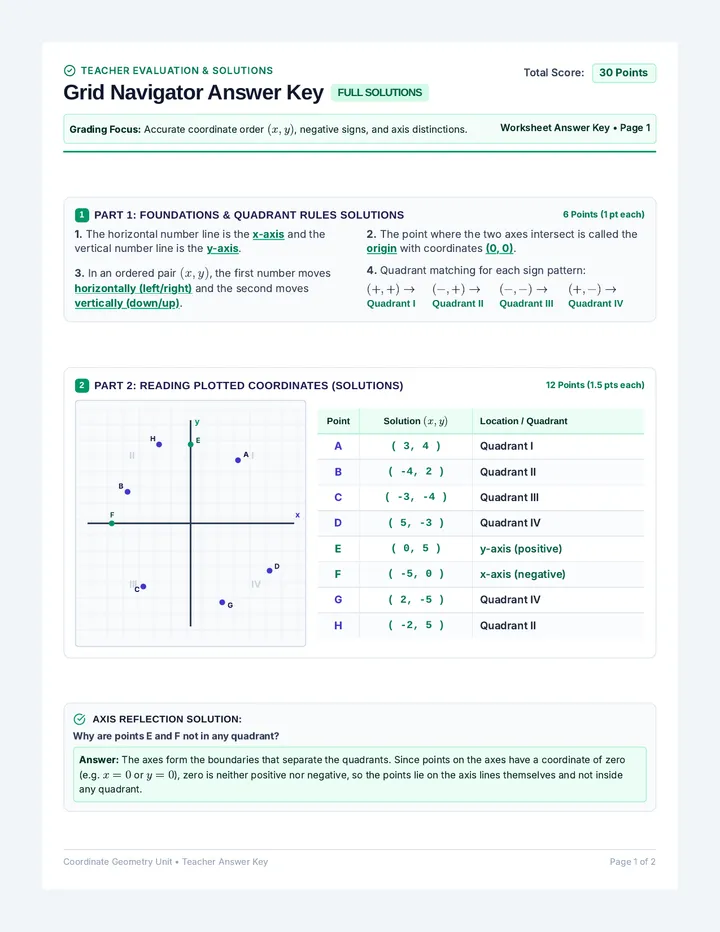
A comprehensive two-page teacher answer key for the Grid Navigator practice worksheet featuring worked solutions, plotted answer grids, and grading notes.

C

Chad.Wimmenauer