Parallelogram RICAS Practice SetGrade 6 Mathematics RICAS Practice: Area of a Parallelogram Name: Date: Directions: Read each question carefully and answer as well as you can. You may not use a calculator. For multiple-choice questions, darken the circle next to your answer. For gridded-response and open-response questions, write your answer and show your work in the space provided. 1 The diagram shows a parallelogram and its dimensions. 6 cm 14 cm 9 cm What is the area, in square centimeters, of the parallelogram? A 46 B 54 C 84 D 126 2 A parallelogram is drawn on this grid. Each square on the grid has a side length of 2 inches. 2 in. What is the area of the parallelogram? A 15 square inches B 30 square inches C 60 square inches D 64 square inches Grade 6 Mathematics RICAS Practice: Area of a Parallelogram 3 A parallelogram has an area of 72 square meters. Which of the following pairs of dimensions could represent the base and height of the parallelogram? Select the two correct answers. A base = 6 meters, height = 12 meters B base = 8 meters, height = 8 meters C base = 18 meters, height = 4 meters D base = 24 meters, height = 12 meters E base = 36 meters, height = 36 meters 4 A parallelogram and its dimensions are shown below. What is the area, in square centimeters, of the parallelogram? Enter your answer in the answer boxes at the top of the answer grid and completely fill the matching circles. − 000000 111111 222222 333333 444444 555555 666666 777777 888888 999999 8.5 cm 4.2 cm 5 cm 5 Parallelogram \(PQRS\) is shown on this coordinate plane. x y −4−2 24 24 −2−4 P Q R S What is the area, in square units, of parallelogram \(PQRS\)? A 22 square units B 24 square units C 30 square units D 40 square units Grade 6 Mathematics RICAS Practice: Area of a Parallelogram This question has two parts. 6 A rectangular banner and a parallelogram-shaped banner have the same area. The rectangular banner has a length of 12 feet and a width of 4 feet. Part A What is the area, in square feet, of the rectangular banner? A 16 B 32 C 48 D 96 Part B The parallelogram-shaped banner has a base of 6 feet. What is the height, in feet, of the parallelogram-shaped banner? A 4 feet B 8 feet C 10 feet D 42 feet 7 A garden bed is shaped like a parallelogram with a base of \(6\frac{1}{2}\) feet and a height of 4 feet, as shown. What is the area, in square feet, of the garden bed? 4 ft 6½ ft A \(10\frac{1}{2}\) square feet B \(21\) square feet C \(24\frac{1}{2}\) square feet D \(26\) square feet 8 A student decomposed a parallelogram into a right triangle and a trapezoid, and then rearranged the pieces to form a rectangle. Which statement about the rectangle and the original parallelogram is true? A The rectangle has a greater area than the parallelogram because its corners are right angles. B The rectangle has a smaller perimeter and a smaller area than the parallelogram. C The rectangle and the parallelogram have the same area because no part was added or removed. D The rectangle and the parallelogram have the same perimeter because their side lengths did not change. Grade 6 Mathematics RICAS Practice: Area of a Parallelogram 9 A rectangular wall sign measures 20 inches by 15 inches. A parallelogram-shaped logo with a base of 12 inches and a height of 8 inches is painted in the center of the sign, as shown. 20 in. 15 in. 12 in. 8 in. What is the area, in square inches, of the part of the sign that is not covered by the logo? Show your work. Answer: square inches This question has three parts. Be sure to label each part of your response. 10 Maya is designing a tile mosaic using parallelogram-shaped tiles. Each tile has a base of 10 centimeters, a height of 4.5 centimeters, and a slanted side length of 6 centimeters. A. Explain why you should use 4.5 centimeters instead of 6 centimeters to find the area of one tile. B. What is the area, in square centimeters, of one parallelogram tile? Show or explain how you got your answer. C. Maya wants to cover a rectangular board that has an area of 540 square centimeters using only these tiles, with no gaps or overlaps. How many tiles does Maya need? Show or explain how you got your answer. 4.5 cm 10 cm 6 cm
Parallelogram RICAS Answer KeyGrade 6 Mathematics · Teacher Resource RICAS Practice Answer Key Parallelogram RICAS Practice: Answer Key & Scoring Guide Standard Alignment: 6.G.A.1 (Find the area of right triangles, other triangles, special quadrilaterals, and polygons by composing into rectangles or decomposing into triangles and other shapes.) Quick-Reference Answer Key (Questions 1–9) Item Question Type Correct Answer Key Skill / Focus 1 Multiple Choice C (84) Using perpendicular height instead of slant side 2 Multiple Choice C (60 in.²) Finding area on a scaled grid (2 in. per unit) 3 Multi-Select A, C Identifying base-height pairs for a given area 4 Answer Grid 35.7 Multiplying decimal dimensions with external height 5 Multiple Choice C (30) Finding base and height on a coordinate plane 6 Two-Part MC Part A: C · Part B: B Finding missing height given equal area and base 7 Multiple Choice D (26 ft²) Multiplying mixed-number base by whole-number height 8 Multiple Choice C Conservation of area during decomposition 9 Short Response 204 in.² Subtracting parallelogram area from rectangle area Worked Solutions (Questions 1–6) 1. Answer: C (84) — Use \(A = b \times h\). The base is \(14\text{ cm}\) and the perpendicular height is \(6\text{ cm}\), so \(A = 14 \times 6 = 84\text{ cm}^2\). (Distractors: A is perimeter \(46\); B is \(9 \times 6 = 54\); D uses the slant side \(14 \times 9 = 126\).) 2. Answer: C (60 square inches) — The base spans 5 grid units (\(5 \times 2 = 10\text{ in.}\)) and the height spans 3 grid units (\(3 \times 2 = 6\text{ in.}\)). Therefore, \(A = 10 \times 6 = 60\text{ in.}^2\). (Distractor A forgets the 2 in. scale; B scales only one dimension.) 3. Answer: A, C — Check \(b \times h = 72\): Choice A gives \(6 \times 12 = 72\) and Choice C gives \(18 \times 4 = 72\). (Choice B is \(64\); D is \(288\); E adds \(36 + 36 = 72\) instead of multiplying.) 4. Answer: 35.7 — The base is \(8.5\text{ cm}\) and the external perpendicular height is \(4.2\text{ cm}\) (ignore the \(5\text{ cm}\) slant side). \(A = 8.5 \times 4.2 = 35.7\text{ cm}^2\). Students enter 35.7 in the answer grid. 5. Answer: C (30 square units) — Base \(PQ\) runs horizontally from \(x = -4\) to \(x = 2\), giving a length of \(6\text{ units}\). The vertical height runs from \(y = -2\) to \(y = 3\), giving \(5\text{ units}\). \(A = 6 \times 5 = 30\text{ square units}\). 6. Answer: Part A: C (48), Part B: B (8 feet) — Part A: \(A = 12 \times 4 = 48\text{ ft}^2\). Part B: Since the parallelogram has the same area, \(48 = 6 \times h\), so \(h = 48 \div 6 = 8\text{ feet}\). Grade 6 Mathematics · Teacher Resource RICAS Practice Answer Key Worked Solutions (Questions 7–9) 7. Answer: D (26 square feet) — Multiply \(6\frac{1}{2} \times 4\). Using the distributive property: \((6 \times 4) + (\frac{1}{2} \times 4) = 24 + 2 = 26\text{ ft}^2\) (or \(\frac{13}{2} \times 4 = 26\)). 8. Answer: C — Decomposing a figure and rearranging its pieces without overlapping or removing parts preserves the total area. The perimeter changes because slanted sides are replaced by shorter vertical sides. 9. Answer: 204 square inches — Area of the rectangular sign: \(20 \times 15 = 300\text{ in.}^2\). Area of the parallelogram logo: \(12 \times 8 = 96\text{ in.}^2\). Uncovered area: \(300 - 96 = 204\text{ in.}^2\). Question 10: Constructed-Response Exemplar & Scoring Guide Part A Exemplar (1 point): You must use \(4.5\text{ cm}\) because the height of a parallelogram must be perpendicular (form a right angle) to the base. The \(6\text{ cm}\) side is slanted and is not perpendicular to the \(10\text{ cm}\) base. Part B Exemplar (1 point): \(A = b \times h = 10 \times 4.5 = 45\text{ square centimeters}\). One parallelogram tile has an area of \(45\text{ cm}^2\). Part C Exemplar (1 point): Divide the total area of the board by the area of one tile: \(540 \div 45 = 12\). Maya needs 12 tiles. Score RICAS-Style Scoring Criteria 3 Points Student demonstrates a thorough understanding by correctly answering and explaining Parts A, B, and C. 2 Points Student correctly completes 2 of the 3 parts (or makes a single computation error in Part B carried correctly into Part C). 1 Point Student correctly completes 1 of the 3 parts with valid work or explanation. 0 Points Response is incorrect, irrelevant, or blank. Common Misconceptions to Watch For Multiplying base by slant side (Items 1, 4, 10): Students often confuse a slanted side length with the perpendicular height. Emphasize locating the right-angle symbol. Ignoring grid scale (Item 2): Students count grid squares accurately but forget to multiply each dimension by the \(2\text{ in.}\) scale before finding the area. Adding instead of multiplying (Item 3, Choice E): Students seeing \(36 + 36 = 72\) may confuse perimeter-like addition with area multiplication.
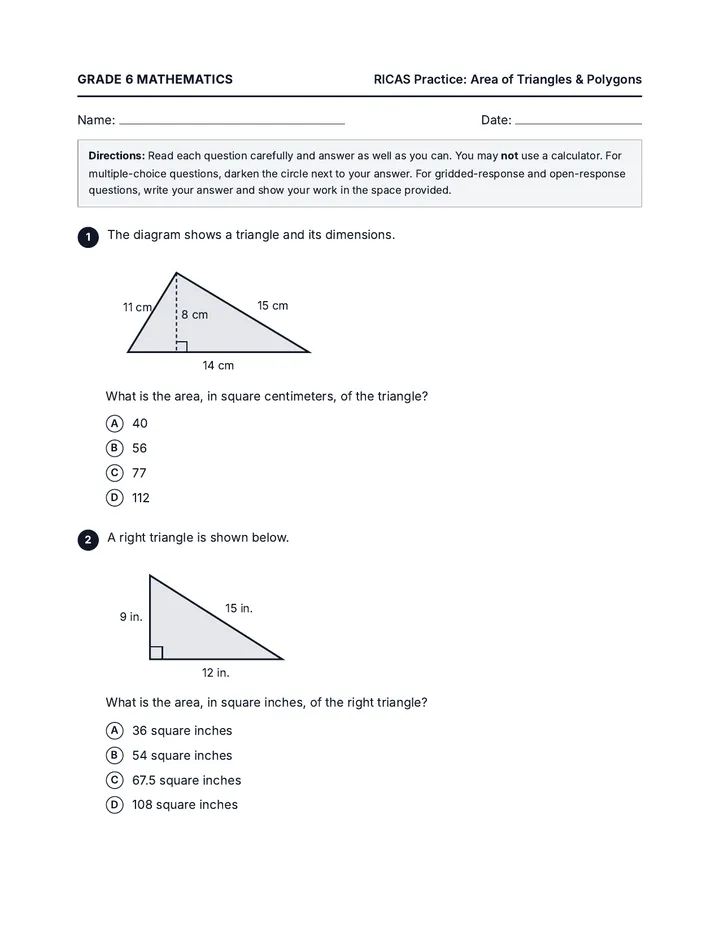
Triangles & Polygons RICAS Practice SetGrade 6 Mathematics RICAS Practice: Area of Triangles & Polygons Name: Date: Directions: Read each question carefully and answer as well as you can. You may not use a calculator. For multiple-choice questions, darken the circle next to your answer. For gridded-response and open-response questions, write your answer and show your work in the space provided. 1 The diagram shows a triangle and its dimensions. 8 cm 14 cm 11 cm 15 cm What is the area, in square centimeters, of the triangle? A 40 B 56 C 77 D 112 2 A right triangle is shown below. 9 in. 12 in. 15 in. What is the area, in square inches, of the right triangle? A 36 square inches B 54 square inches C 67.5 square inches D 108 square inches Grade 6 Mathematics RICAS Practice: Area of Triangles & Polygons 3 A triangle has a base of 16 meters and a height of 6 meters. Which of the following rectangles have the same area as the triangle? Select the two correct answers. A a 12-meter by 4-meter rectangle B a 16-meter by 6-meter rectangle C an 8-meter by 6-meter rectangle D a 10-meter by 5-meter rectangle E a 24-meter by 4-meter rectangle 4 A triangle and its dimensions are shown below. What is the area, in square centimeters, of the triangle? Enter your answer in the answer boxes at the top of the answer grid and completely fill the matching circles. − 000000 111111 222222 333333 444444 555555 666666 777777 888888 999999 7 cm 4.5 cm 5 A polygon is drawn on this grid. Each square on the grid represents 1 square unit. What is the area, in square units, of the polygon? A 18 square units B 21 square units C 24 square units D 30 square units Grade 6 Mathematics RICAS Practice: Area of Triangles & Polygons This question has two parts. 6 A patio is shaped like the trapezoid shown below. 8 ft 16 ft 6 ft 10 ft Part A If the patio is decomposed into a rectangle and a right triangle, what is the area, in square feet, of the rectangle? A28 B48 C60 D96 Part B What is the total area, in square feet, of the patio? A72 square feet B80 square feet C96 square feet D120 square feet 7 A rectangular poster board measures 16 inches by 10 inches. A right triangle with a base of 6 inches and a height of 4 inches is cut away from one corner, as shown. What is the area, in square inches, of the remaining poster board? 16 in. 10 in. 6 in. 4 in. A136 square inches B148 square inches C150 square inches D172 square inches 8 Two identical triangles are joined together along one side to form a parallelogram with a base of \(b\) units and a height of \(h\) units. Which expression represents the area, in square units, of one of the triangles? A\(b + h\) B\(b \cdot h\) C\(\frac{1}{2} \cdot b \cdot h\) D\(2 \cdot b \cdot h\) Grade 6 Mathematics RICAS Practice: Area of Triangles & Polygons 9 The polygon below represents the floor plan of a hallway. All corners form right angles. 9 m 4 m 6 m 8 m 15 m 12 m What is the total area, in square meters, of the hallway floor? Show your work. Answer: square meters This question has three parts. Be sure to label each part of your response. 10 A community center is carpeting a room shaped like the polygon shown below. A. Show or explain how to decompose the polygon into a rectangle and a triangle. What are the base and height of the triangle? B. What is the total area, in square feet, of the room? Show or explain how you got your answer. C. New carpet costs $3 per square foot. What is the total cost to carpet the entire room? Show or explain how you got your answer. 18 ft 26 ft 12 ft
Triangles & Polygons RICAS Answer KeyGrade 6 Mathematics · Teacher Resource RICAS Practice Answer Key Triangles & Polygons RICAS Practice: Answer Key & Scoring Guide Standard Alignment: 6.G.A.1 (Find the area of right triangles, other triangles, special quadrilaterals, and polygons by composing into rectangles or decomposing into triangles and other shapes.) Quick-Reference Answer Key (Questions 1–9) Item Question Type Correct Answer Key Skill / Focus 1 Multiple Choice B (56) Using \(A = \frac{1}{2}bh\) with perpendicular height 2 Multiple Choice B (54 in.²) Identifying legs of a right triangle as base and height 3 Multi-Select A, C Comparing triangle area to rectangle dimensions 4 Answer Grid 15.75 Finding area of an obtuse triangle with external height 5 Multiple Choice C (24) Decomposing a pentagon on a unit grid 6 Two-Part MC Part A: B · Part B: A Decomposing a trapezoid into a rectangle and triangle 7 Multiple Choice B (148 in.²) Finding area by subtracting a cut-out triangle 8 Multiple Choice C Deriving triangle area as half of a parallelogram 9 Short Response 156 m² Decomposing an L-shaped composite polygon Worked Solutions (Questions 1–6) 1. Answer: B (56) — Use \(A = \frac{1}{2}bh\). The base is \(14\text{ cm}\) and the perpendicular height is \(8\text{ cm}\), so \(A = \frac{1}{2}(14)(8) = 56\text{ cm}^2\). (Distractors: A is perimeter \(40\); C uses slant side \(11\); D forgets \(\frac{1}{2}\).) 2. Answer: B (54 square inches) — The two perpendicular legs are the base and height: \(A = \frac{1}{2}(12)(9) = 54\text{ in.}^2\). (Ignore the \(15\text{ in.}\) hypotenuse.) 3. Answer: A, C — The triangle's area is \(\frac{1}{2}(16)(6) = 48\text{ m}^2\). Choice A has area \(12 \times 4 = 48\text{ m}^2\) and Choice C has area \(8 \times 6 = 48\text{ m}^2\). 4. Answer: 15.75 — The base is \(7\text{ cm}\) and the external perpendicular height is \(4.5\text{ cm}\). \(A = \frac{1}{2}(7)(4.5) = 3.5 \times 4.5 = 15.75\text{ cm}^2\). Students enter 15.75 in the answer grid. 5. Answer: C (24 square units) — Decompose horizontally into a bottom \(6 \times 3\) rectangle (\(18\text{ sq units}\)) and a top triangle with base \(6\) and height \(2\) (\(\frac{1}{2} \times 6 \times 2 = 6\text{ sq units}\)). Total = \(18 + 6 = 24\). 6. Answer: Part A: B (48), Part B: A (72 square feet) — Part A: Rectangle is \(8 \times 6 = 48\text{ ft}^2\). Part B: The remaining right triangle has base \(16 - 8 = 8\text{ ft}\) and height \(6\text{ ft}\), so its area is \(\frac{1}{2}(8)(6) = 24\text{ ft}^2\). Total area = \(48 + 24 = 72\text{ ft}^2\). Grade 6 Mathematics · Teacher Resource RICAS Practice Answer Key Worked Solutions (Questions 7–9) 7. Answer: B (148 square inches) — Full rectangle area: \(16 \times 10 = 160\text{ in.}^2\). Cut-out triangle area: \(\frac{1}{2}(6)(4) = 12\text{ in.}^2\). Remaining area: \(160 - 12 = 148\text{ in.}^2\). 8. Answer: C — Because the parallelogram is made of two identical triangles, each triangle has half the area of the parallelogram: \(\frac{1}{2} \cdot b \cdot h\). 9. Answer: 156 square meters — Decompose vertically: \((9 \times 12) + (6 \times 8) = 108 + 48 = 156\text{ m}^2\). (Alternatively, subtract the missing corner from the full \(15 \times 12\) rectangle: \(180 - 24 = 156\text{ m}^2\).) Question 10: Constructed-Response Exemplar & Scoring Guide Part A Exemplar (1 point): Draw a vertical line straight down from the top-right corner to the bottom side to split the room into an \(18\text{ ft}\) by \(12\text{ ft}\) rectangle and a right triangle. The triangle has a base of \(26 - 18 = 8\text{ feet}\) and a height of \(12\text{ feet}\). Part B Exemplar (1 point): Rectangle area = \(18 \times 12 = 216\text{ ft}^2\). Triangle area = \(\frac{1}{2}(8)(12) = 48\text{ ft}^2\). Total area = \(216 + 48 = 264\text{ square feet}\). Part C Exemplar (1 point): Multiply the total area by the cost per square foot: \(264 \times \$3 = \$792\). The total cost to carpet the room is $792. Score RICAS-Style Scoring Criteria 3 Points Student demonstrates a thorough understanding by correctly answering and explaining Parts A, B, and C. 2 Points Student correctly completes 2 of the 3 parts (or makes a single computation error in Part B carried correctly into Part C). 1 Point Student correctly completes 1 of the 3 parts with valid work or explanation. 0 Points Response is incorrect, irrelevant, or blank. Common Misconceptions to Watch For Forgetting to multiply by \(\frac{1}{2}\) (Items 1, 2, 3): Students often compute \(b \times h\) and stop. Remind them that a triangle is half of a rectangle or parallelogram with the same base and height. Using the full bottom side as the triangle's base (Items 6, 10): When decomposing a trapezoid, students sometimes use the entire bottom length (\(16\text{ ft}\) or \(26\text{ ft}\)) instead of subtracting the top base to find the triangle's base. Confusing slant sides with height (Items 1, 2, 4): Encourage students to trace the right-angle symbol first to identify the perpendicular base and height.
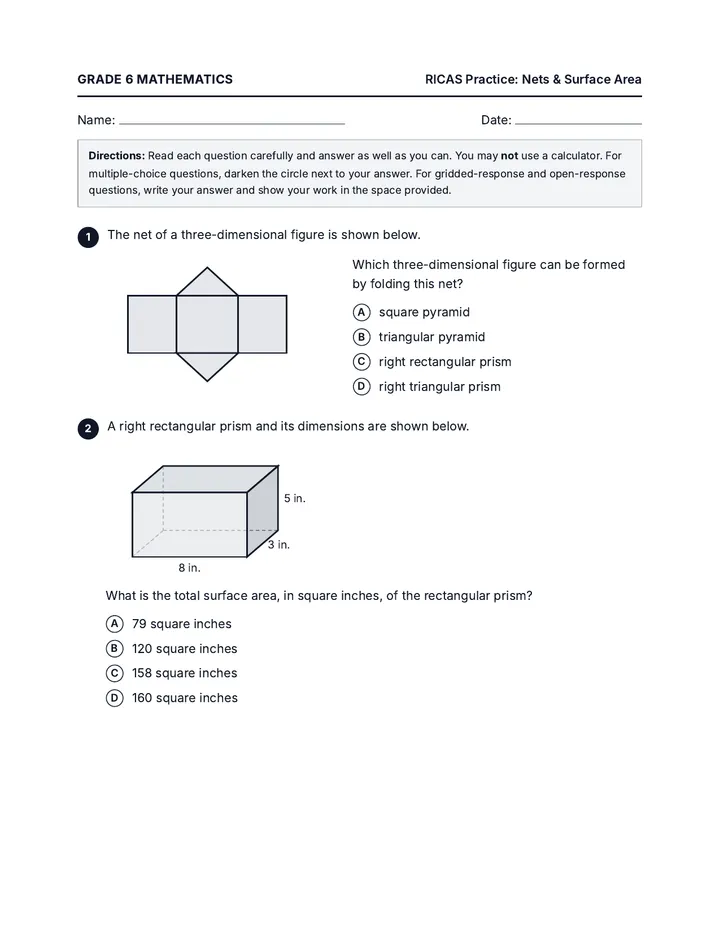
Surface Area Nets RICAS Practice SetGrade 6 Mathematics RICAS Practice: Nets & Surface Area Name: Date: Directions: Read each question carefully and answer as well as you can. You may not use a calculator. For multiple-choice questions, darken the circle next to your answer. For gridded-response and open-response questions, write your answer and show your work in the space provided. 1 The net of a three-dimensional figure is shown below. Which three-dimensional figure can be formed by folding this net? Asquare pyramid Btriangular pyramid Cright rectangular prism Dright triangular prism 2 A right rectangular prism and its dimensions are shown below. 8 in. 3 in. 5 in. What is the total surface area, in square inches, of the rectangular prism? A79 square inches B120 square inches C158 square inches D160 square inches Grade 6 Mathematics RICAS Practice: Nets & Surface Area 3 A right rectangular prism has a length of 10 centimeters, a width of 4 centimeters, and a height of 4 centimeters. Which expressions represent the total surface area, in square centimeters, of the prism? Select the two correct answers. A\(4(10 \cdot 4) + 2(4 \cdot 4)\) B\(10 \cdot 4 \cdot 4\) C\(2(10 \cdot 4) + 2(10 \cdot 4) + 2(4 \cdot 4)\) D\((10 \cdot 4) + (4 \cdot 4)\) E\(6(10 \cdot 4)\) 4 An artist builds a hollow metal sculpture in the shape of a cube with an edge length of \(\frac{1}{2}\) meter. What is the total surface area, in square meters, of the cube? Enter your answer as a decimal in the answer boxes at the top of the answer grid and completely fill the matching circles. − 000000 111111 222222 333333 444444 555555 666666 777777 888888 999999 ½ m 5 Which figure is a net that can be folded to form a cube? A B C D Grade 6 Mathematics RICAS Practice: Nets & Surface Area This question has two parts. 6 The net of a square pyramid is shown below. Each triangular face has a height of 5 inches, and the square base has a side length of 6 inches. 5 in. 6 in. Part A What is the area, in square inches, of one triangular face of the pyramid? A11 B15 C30 D36 Part B What is the total surface area, in square inches, of the square pyramid? A60 square inches B66 square inches C96 square inches D156 square inches 7 A net of a right triangular prism and its dimensions are shown below. What is the total surface area, in square centimeters, of the triangular prism? 6 cm 8 cm 10 cm 12 cm 6 cm A288 square centimeters B312 square centimeters C336 square centimeters D384 square centimeters 8 All four faces of a triangular pyramid are identical equilateral triangles. Each triangle has a base of 8 centimeters and a height of 6.9 centimeters. What is the total surface area, in square centimeters, of the triangular pyramid? A27.6 square centimeters B55.2 square centimeters C110.4 square centimeters D220.8 square centimeters Grade 6 Mathematics RICAS Practice: Nets & Surface Area 9 A storage room is in the shape of a right rectangular prism that is 11 feet long, 8 feet wide, and 9 feet tall. Marcus paints the four walls and the ceiling, but not the floor. What is the total area, in square feet, that Marcus paints? Show your work. Answer: square feet This question has three parts. Be sure to label each part of your response. 10 A skateboard ramp is shaped like a right triangular prism, as shown. The triangular ends are right triangles with legs of 3 feet and 4 feet and a third side of 5 feet. The ramp is 6 feet long. A. How many triangular faces and how many rectangular faces make up a net for this ramp? B. What is the combined area, in square feet, of the two triangular faces? Show or explain how you got your answer. C. What is the total surface area, in square feet, of the entire ramp? Show or explain how you got your answer. 3 ft 4 ft 5 ft 6 ft
Surface Area Nets RICAS Answer KeyGrade 6 Mathematics · Teacher Resource RICAS Practice Answer Key Nets & Surface Area RICAS Practice: Answer Key & Scoring Guide Standard Alignment: 6.G.A.4 (Represent three-dimensional figures using nets made up of rectangles and triangles, and use the nets to find the surface area of these figures.) Quick-Reference Answer Key (Questions 1–9) Item Question Type Correct Answer Key Skill / Focus 1 Multiple Choice D Identifying a right triangular prism from its net 2 Multiple Choice C (158 in.²) Surface area of a right rectangular prism 3 Multi-Select A, C Equivalent expressions for prism surface area 4 Answer Grid 1.5 Surface area of a cube with a fractional edge 5 Multiple Choice B Recognizing a valid net for a cube 6 Two-Part MC Part A: B · Part B: C Surface area of a square pyramid from its net 7 Multiple Choice C (336 cm²) Surface area of a triangular prism from its net 8 Multiple Choice C (110.4 cm²) Surface area of a triangular pyramid 9 Short Response 430 ft² Partial surface area (excluding floor) Worked Solutions (Questions 1–6) 1. Answer: D (right triangular prism) — The net has 2 triangular bases and 3 rectangular lateral faces, which folds into a right triangular prism. 2. Answer: C (158 square inches) — Sum the 3 pairs of faces: \(2(8 \cdot 3) + 2(8 \cdot 5) + 2(3 \cdot 5) = 48 + 80 + 30 = 158\text{ in.}^2\). (Distractor A is half the surface area; B is volume.) 3. Answer: A, C — The prism has four \(10 \times 4\) rectangular faces and two \(4 \times 4\) square faces. Both \(4(10 \cdot 4) + 2(4 \cdot 4)\) and \(2(10 \cdot 4) + 2(10 \cdot 4) + 2(4 \cdot 4)\) equal \(192\text{ cm}^2\). 4. Answer: 1.5 — Area of one square face: \(\frac{1}{2} \times \frac{1}{2} = \frac{1}{4} = 0.25\text{ m}^2\). A cube has 6 faces: \(6 \times 0.25 = 1.5\text{ m}^2\). Students enter 1.5 in the answer grid. 5. Answer: B — Net B has 4 squares in a central strip with 1 square on each opposite side, so all 6 faces fold without overlapping. Nets A, C, and D produce overlapping faces. 6. Answer: Part A: B (15), Part B: C (96 square inches) — Part A: \(\frac{1}{2}(6)(5) = 15\text{ in.}^2\). Part B: Square base is \(6 \times 6 = 36\text{ in.}^2\), plus 4 triangles: \(36 + 4(15) = 36 + 60 = 96\text{ in.}^2\). Grade 6 Mathematics · Teacher Resource RICAS Practice Answer Key Worked Solutions (Questions 7–9) 7. Answer: C (336 square centimeters) — Three rectangles: \((6 \cdot 12) + (8 \cdot 12) + (10 \cdot 12) = 72 + 96 + 120 = 288\text{ cm}^2\). Two triangles: \(2 \cdot \frac{1}{2}(6 \cdot 8) = 48\text{ cm}^2\). Total = \(288 + 48 = 336\text{ cm}^2\). 8. Answer: C (110.4 square centimeters) — Area of one triangle: \(\frac{1}{2}(8)(6.9) = 27.6\text{ cm}^2\). Four identical faces: \(4 \times 27.6 = 110.4\text{ cm}^2\). 9. Answer: 430 square feet — Ceiling: \(11 \times 8 = 88\text{ ft}^2\). Two long walls: \(2(11 \times 9) = 198\text{ ft}^2\). Two short walls: \(2(8 \times 9) = 144\text{ ft}^2\). Total = \(88 + 198 + 144 = 430\text{ ft}^2\). Question 10: Constructed-Response Exemplar & Scoring Guide Part A Exemplar (1 point): A net for the skateboard ramp is made of 2 triangular faces and 3 rectangular faces. Part B Exemplar (1 point): Each right triangle has base \(4\text{ ft}\) and height \(3\text{ ft}\), so one triangle has area \(\frac{1}{2}(4)(3) = 6\text{ ft}^2\). Two triangular faces have a combined area of \(2 \times 6 = 12\text{ square feet}\). Part C Exemplar (1 point): Three rectangular faces: \((3 \times 6) + (4 \times 6) + (5 \times 6) = 18 + 24 + 30 = 72\text{ ft}^2\). Add the triangular faces: \(72 + 12 = 84\text{ square feet}\). Score RICAS-Style Scoring Criteria 3 Points Student demonstrates a thorough understanding by correctly answering and explaining Parts A, B, and C. 2 Points Student correctly completes 2 of the 3 parts (or makes a single computation error in Part B carried correctly into Part C). 1 Point Student correctly completes 1 of the 3 parts with valid work or explanation. 0 Points Response is incorrect, irrelevant, or blank. Common Misconceptions to Watch For Confusing volume with surface area (Items 2, 3): Students multiply \(l \times w \times h\) instead of summing the areas of all 6 faces. Adding only one of each face pair (Item 2, Choice A): Students find \(lw + lh + wh\) and forget to double each pair of opposite faces. Including excluded faces in real-world problems (Item 9): Remind students to read carefully for open tops or unpainted floors.