Grid Blueprint Slides Decimals Decoded • Lesson 1
NY-5.NBT.7
Grid Blueprint:
Visual Decimal Addition & Subtraction
Building rock-solid understanding of tenths and hundredths using area models, place value grids, and regrouping.
100 Small Squares = 1 Whole (1.0)
1 Column = 1 Tenth (0.1)
1 Square = 1 Hundredth (0.01)
The Hundredths Grid Blueprint
Core Concept
Decomposing One Whole (1.00)
Model shows 3 tenths + 4 hundredths = 0.34
1 Full Column = 0.1 = 0.10
A tenth is 10 hundredths grouped together. 3 tenths = 30 hundredths.
1 Small Square = 0.01
One out of 100 equal parts. Never confuse 0.1 (a full rod) with 0.01 (one tiny unit)!
Key Rule of Place Value
You can only combine like units: tenths with tenths, hundredths with hundredths!
Lesson 1: Visual Grids Slide 2 of 5
Visual Addition: 0.35 + 0.42
Step-by-Step
1 Shade 1st Addend
Shade 0.35
Color 3 full columns (3 tenths = 30 hundredths) plus 5 individual squares.
35 hundredths
2 Add 2nd Addend
Add 0.42
Starting right where 0.35 ended, shade 42 more squares in a second color.
+ 42 hundredths
3 Total Shaded Area
Count the Whole
7 full columns (0.7) and 7 extra hundredths (0.07) are shaded.
Sum = 0.77
Tenths + Tenths = 0.7 | Hundredths + Hundredths = 0.07 Slide 3 of 5
Visual Subtraction: 0.74 - 0.28
Take Away Strategy
1. Shade the Starting Amount
Shade exactly 0.74 (7 tenths and 4 hundredths).
2. Cross Out or Erase 0.28
Remove 2 full columns (0.20) and 8 hundredths (0.08). Notice you need to unpack one tenth into 10 hundredths!
3. Count What Remains
4 full columns and 6 hundredths remain shaded.
0.74 - 0.28 = 0.46
Decomposition Blueprint
Starting: 7 tenths, 4 hundredths
Regroup 1 tenth: 6 tenths, 14 hundredths
Subtract 0.28: - 2 tenths, 8 hundredths
Difference: 4 tenths, 6 hundredths (0.46)
Regrouping means trading 1 tenth for 10 hundredths Slide 4 of 5
Turn & Talk: Spot the Misconception!
Critical Thinking
Maya solved: 0.5 + 0.08 = 0.13
She says: "5 plus 8 equals 13, so the answer must be 0.13!"
Discuss with your partner:
What mistake did Maya make with place value?
How would a hundredths grid prove she is incorrect?
Grid Truth:
0.50 (50 squares) + 0.08 (8 squares) = 0.58
Ready for the Grid Blueprint Worksheet! Slide 5 of 5
Grid Shading Worksheet Decimals Decoded • Lesson 1
Grid Shading Worksheet
Name: ______________________
Date: ____________
Class: ______
Grid Key: Entire 10×10 Grid = 1.00 (One Whole)
1 Column = 0.10 (1 Tenth) 1 Square = 0.01 (1 Hundredth)
A Model & Add Using 10×10 Grids
Shade the first addend lightly, then shade the second addend darker.
1. \( 0.34 + 0.45 = \) 34h + 45h
Tenths shaded: ________
Hundredths shaded: ____
Total squares: ________
Equation: 0.34 + 0.45 = ____
2. \( 0.28 + 0.56 = \) 28h + 56h
Tenths shaded: ________
Hundredths shaded: ____
Total squares: ________
Equation: 0.28 + 0.56 = ____
B Model & Subtract Using 10×10 Grids
Shade the starting decimal, then cross out (X) the amount subtracted.
3. \( 0.82 - 0.35 = \) Take away 35h
Start squares (0.82): 82
Squares crossed out: ___
Squares remaining: _____
Difference: _________
4. \( 0.60 - 0.27 = \) Take away 27h
Start squares (0.60): 60
Squares crossed out: ___
Squares remaining: _____
Difference: _________
NY-5.NBT.7 • Adding & Subtracting Decimals with Concrete Models Page 1 of 2
Decimals Decoded • Lesson 1 Practice
Crossing the Whole & Place Value Decomposition
Sum > 1.0
C Crossing One Whole: \( 0.76 + 0.48 \)
Shade 0.76 on the first grid. Then shade 0.48 across the remaining spaces and onto the second grid.
Grid 1 (1.00)
Grid 2 (1.00)
Total Squares Shaded: _______ hundredths
Full Grids Filled: _______ whole(s)
Final Decimal Value: 0.76 + 0.48 = _______
D Decompose by Place Value
Problem Ones (1s) Tenths (0.1s) Hundredths (0.01s) Final Total 0.47 + 0.38 0 4 + 3 = 7 tenths 7 + 8 = 15 hundredths 0.85 0.59 + 0.36 _____ _____ tenths _____ hundredths ________ 0.93 - 0.47 _____
Lineup Strategy Slides Decimals Decoded • Lesson 2
NY-5.NBT.7
Place Value Lineup:
Precision, Regrouping & the Algorithm
Connecting visual place value to the standard algorithm. Learn why the decimal point is your anchor for exact calculations.
Rule 1: Line up the Decimal Points
Rule 2: Annex Zeros (Ghost Zeros)
Rule 3: Regroup by Tens
The Decimal Point is Your Anchor
Fundamental Rule
Right-Align Trap (WRONG)
14.8
+ 3.25
18.05 ?
Tenths got added to hundredths! This changes the actual values entirely.
Decimal-Aligned (CORRECT)
14.80
+ 03.25
18.05
Points line up: Tens with tens, ones with ones, tenths with tenths!
When points align, all place values automatically lock into position. Slide 2 of 5
The Power of Annexing Zeros ("Ghost Zeros")
Essential Skill
Problem: 5.4 - 2.18
Students often see an empty spot above the 8 and simply write "8" in the difference. That is a fatal error!
Step-by-Step Regrouping:
5.40 ← Annex zero in hundredths!
- 2.18
3.22
1. Annex the Zero
5.4 = 5.40 (5 wholes, 4 tenths, 0 hundredths).
2. Regroup from Tenths
Cannot do 0 - 8 hundredths. Trade 1 tenth for 10 hundredths: 10 - 8 = 2.
Annexing zeros gives every place value an explicit partner! Slide 3 of 5
Regrouping Across Wholes and Tenths
Model to Algorithm
Solve: 7.14 - 3.86
Regrouping Notation:
6 10 14
7 . 1 4
- 3 . 8 6
3 . 2 8
Step 1: Hundredths Column
4 hundredths < 6 hundredths. Regroup 1 tenth (0 left) to make 14 hundredths. 14 - 6 = 8.
Step 2: Tenths Column
0 tenths < 8 tenths. Regroup 1 whole from 7 (6 left) to make 10 tenths. 10 - 8 = 2.
Step 3: Ones & Decimal Point
6 - 3 = 3. Bring straight down the decimal point!
Check with inverse operation: 3.28 + 3.86 = 7.14! Slide 4 of 5
Math Detective: Spot the Algorithm Crime!
Error Analysis
Case A: The Floating Point
9.20
+ 1.45
106.5
Why does 9 wholes + 1 whole equaling 106 make no sense?
Place Value Showdown Worksheet Decimals Decoded • Lesson 2
Place Value Showdown Worksheet
Name: ______________________
Date: ____________
Class: ______
Lineup Rules: 1. Align decimal points | 2. Annex zeros if needed | 3. Regroup across places
NY-5.NBT.7
A Align & Add with Place Value Charts
Rewrite each horizontally written equation vertically, aligning place values.
1. \( 14.6 + 8.75 \)
TensOnes.TenthsHund.
Sum:
2. \( 3.84 + 19.5 \)
TensOnes.TenthsHund.
Sum:
3. \( 27.09 + 6.94 \)
TensOnes.TenthsHund.
Sum:
B Annexing Zeros & Subtraction Regrouping
Annex a zero in empty decimal places before subtracting!
4. \( 7.4 - 2.65 \)
Annex 0 to write 7.40
Difference:
5. \( 15.1 - 6.84 \)
Annex 0 to write 15.10
Difference:
6. \( 8 - 3.42 \)
Rewrite 8 as 8.00
Difference:
NY-5.NBT.7 • Standard Algorithm & Place-Value Alignment Page 1 of 2
Decimals Decoded • Lesson 2 Practice
Error Surgery & Application Problems
Regrouping & Analysis
C Algorithm Error Surgery
Analyze the student's incorrect solution. Identify the exact error, then solve the problem correctly.
Case 1: Sam's Work Incorrect
6.5
- 2.18
4.42 ?
What mistake did Sam make?
Correct Solution:
Case 2: Priya's Work Incorrect
18.4
+ 2.36
4.20 ?
What mistake did Priya make?
Correct Solution:
D Word Problems & Calculations
7. Track & Field: During track practice, Jordan ran the 400-meter dash in 58.45 seconds . In the second trial, Jordan ran it in 56.80 seconds . How much faster was Jordan's second trial?
Answer:
8. Science Project: An empty beaker weighs 14.2 grams . After pouring in chemical solution A (8.65 g ) and solution B (12.75 g ), what is the total weight of the beaker and both solutions combined?
Total Weight:
Market Math Slides Decimals Decoded • Lesson 3
NY-5.NBT.7
Market Math:
Budgeting, Estimation & Multi-Step Problems
Put your decimal powers to work! Navigate real-world financial scenarios, calculate totals, determine exact change, and estimate reasonableness.
Multi-Step Expense Tracking
Estimation Benchmark Checks
Calculating Change from Bills
Estimation: Your Mathematical Radar
Reasonableness Check
Estimate BEFORE you calculate!
Rounding addends to the nearest whole dollar gives an instant target so you know if your decimal calculation makes sense.
Example: Farmers Market Cart
Organic Honey: $8.85 ≈ $9.00
Artisan Bread: $4.15 ≈ $4.00
Local Cheese: $6.95 ≈ $7.00
Target Estimate:
$9 + $4 + $7 = $20.00
Exact Calculation:
$8.85 + $4.15 + $6.95 = $19.95
Exact total ($19.95) is within 5 cents of our estimate ($20.00). Confirmed reasonable!
If a student got $199.50 or $1.99, their estimate would immediately spot the misplaced point! Slide 2 of 5
Multi-Step Budgeting: Calculating Change
Two-Step Problem
1 Step 1: Total Cost
Add up all purchases by aligning the decimal points.
12.49
+ 6.75
19.24
Total Spent: $19.24
2 Step 2: Change from $20
Subtract total from $20.00. Notice the annexed zeros!
1 9 9 10
20.00
- 19.24
0.76
Change Received: $0.76
Always write whole-dollar bills with two zeros: $20.00 or $50.00! Slide 3 of 5
Mental Math Hacks: Friendly Numbers
Strategy
The "Plus $0.99" Compensation
Adding $4.99 is tricky, but adding $5.00 is easy!
Problem: 7.65 + 4.99
Step 1: 7.65 + 5.00 = 12.65
Step 2: 12.65 - 0.01 = 12.64
Add the friendly whole number, then subtract the extra 1 cent!
Making Whole Tenths First
Combine complementary hundredths pairs that make a whole tenth (0.03 + 0.07 = 0.10).
Problem: 3.24 + 1.56
4 hundredths + 6 hundredths = 1 tenth (0.10)
3.20 + 1.50 + 0.10 = 4.80
Market Budget Task Decimals Decoded • Lesson 3 Culminating Task
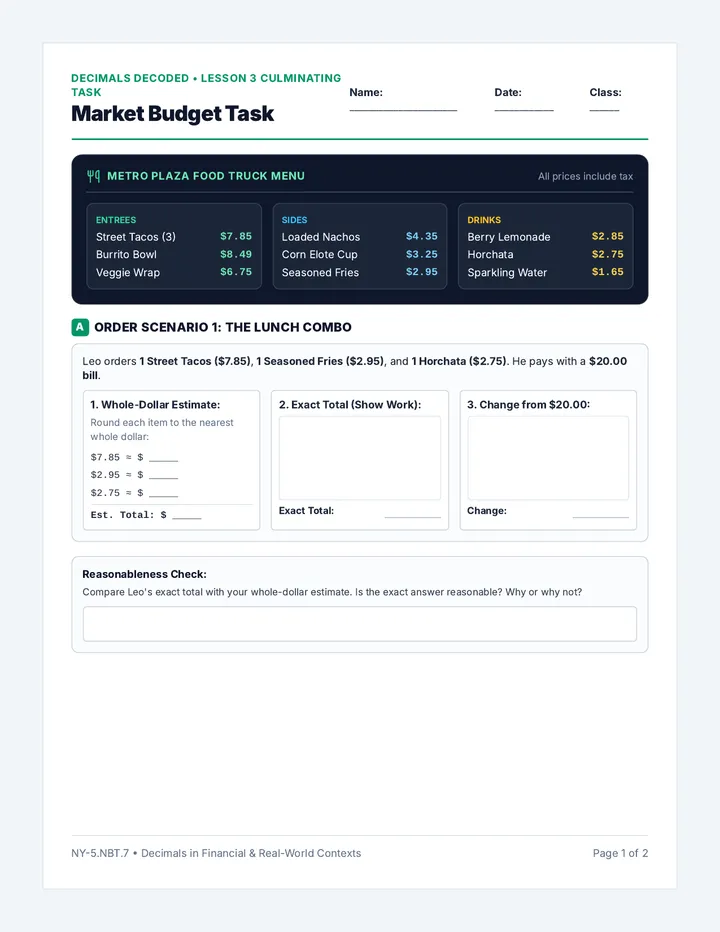
Market Budget Task
Name: ______________________
Date: ____________
Class: ______
Metro Plaza Food Truck Menu
All prices include tax
Entrees
Street Tacos (3)$7.85
Burrito Bowl$8.49
Veggie Wrap$6.75
Sides
Loaded Nachos$4.35
Corn Elote Cup$3.25
Seasoned Fries$2.95
Drinks
Berry Lemonade$2.85
Horchata$2.75
Sparkling Water$1.65
A Order Scenario 1: The Lunch Combo
Leo orders 1 Street Tacos ($7.85) , 1 Seasoned Fries ($2.95) , and 1 Horchata ($2.75) . He pays with a $20.00 bill .
1. Whole-Dollar Estimate:
Round each item to the nearest whole dollar:
$7.85 ≈ $ _____
$2.95 ≈ $ _____
$2.75 ≈ $ _____
Est. Total: $ _____
2. Exact Total (Show Work):
Exact Total:
3. Change from $20.00:
Change:
Reasonableness Check:
Compare Leo's exact total with your whole-dollar estimate. Is the exact answer reasonable? Why or why not?
NY-5.NBT.7 • Decimals in Financial & Real-World Contexts Page 1 of 2
Decimals Decoded • Lesson 3 Practice & Check
Custom Budget Challenge & Unit Exit Ticket
$25 Budget Limit
C The $25.00 Partner Meal Challenge
Select exactly 2 Entrees , 1 Side , and 2 Drinks from the menu on Page 1. Your total cannot exceed $25.00.
Selected Itemized Receipt:
Entree 1: __________________$ _______
Entree 2: __________________$ _______
Side: ______________________$ _______
Drink 1: ___________________$ _______
Drink 2: ___________________$ _______
Subtotal:$ _______
Show Vertical Addition Work:
Remaining Balance from $25.00:
D Sequence Mastery Check (NY-5.NBT.7)
Solve each problem with precision. Show your regrouping markings.
1. Standard Addition
38.75 + 16.89
Answer:
2. Subtraction with Zeros
50.2 - 24.68
Answer:
3. Decimal Word Problem