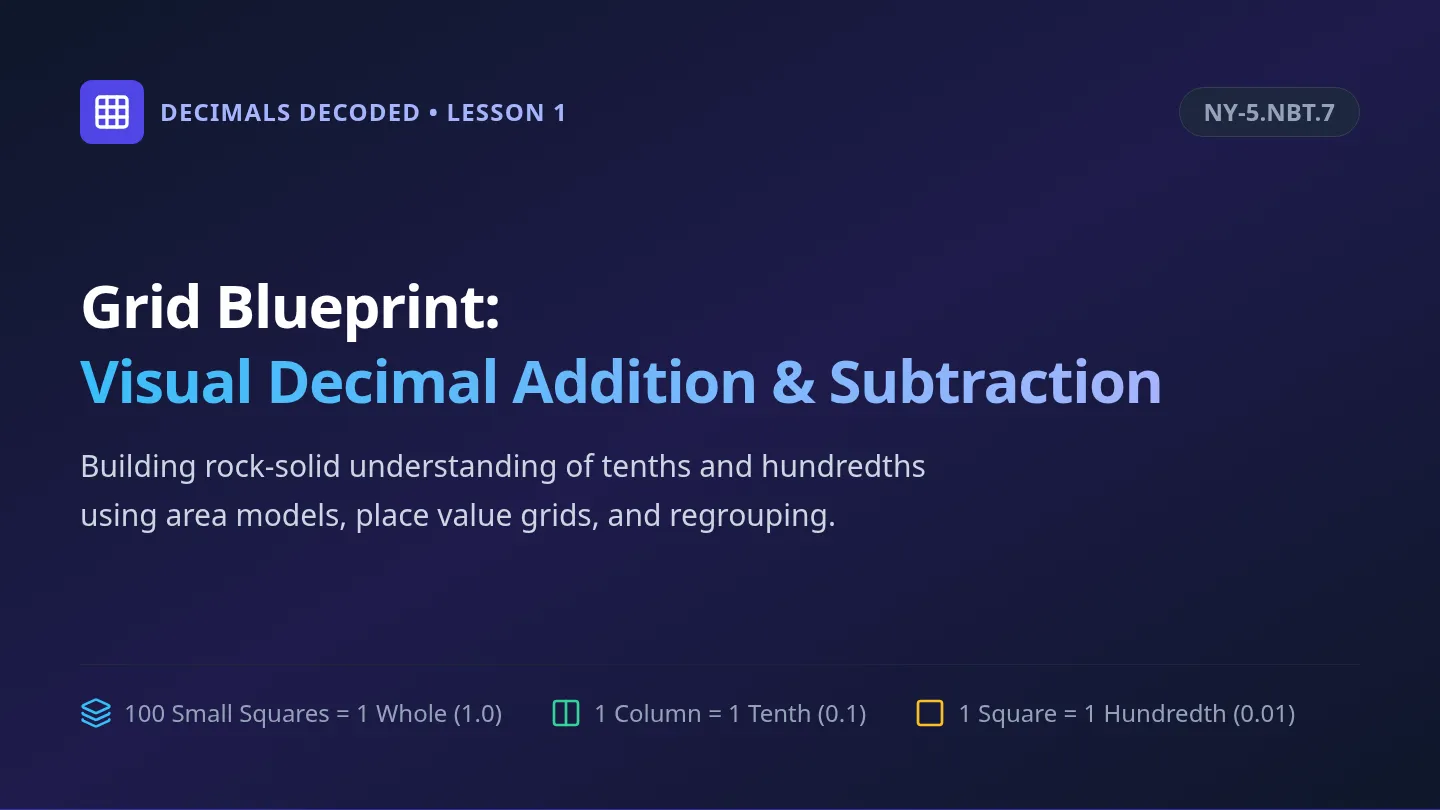
Decimal Detectives Lesson Plan
Formal Observation Plan NYS Next Generation Standards
Danielson Framework Aligned
Decimal Detectives: Adding Decimals
Grade 5 Mathematics • Module: Decimal Operations & Place Value • Lesson 1 of 5
Duration: 55 Minutes
Setting: Whole Group / Pairs / Solo
Target Standard: NY-5.NBT.7
Add, subtract, multiply, and divide decimals to hundredths, using concrete models or drawings and strategies based on place value, properties of operations, and/or the relationship between operations; relate the strategy to a written method and explain reasoning.
Mathematical Practices
- MP.1: Make sense & persevere in solving.
- MP.6: Attend to precision (aligning values).
- MP.7: Look for & make use of structure.
Measurable Learning Objectives (SWBAT)
- Content: Students will accurately add decimals to hundredths with and without regrouping using the standard algorithm with ≥80% accuracy on the Solo Mission.
- Language / Reasoning: Students will orally explain and write justifications for aligning decimal points and annexing placeholder zeros using place-value vocabulary.
Success Criteria ("I Can" Statements)
- "I can line up addends by their decimal points so like place values match."
- "I can annex placeholder zeros to equivalent decimals without changing their total value."
- "I can estimate before adding to confirm that my calculated sum is reasonable."
Essential Questions
1. How does our knowledge of whole-number place value guide how we add decimals?
2. Why does annexing a zero to the right of a decimal not alter the quantity?
Academic Language & Discourse Supports
Tier 3 Vocabulary: Tenths, hundredths, place value, decimal point, regroup/compose, annex, addend, sum, reasonableness.
Sentence Frames: "I aligned the decimal points because tenths must be added to ________." • "Annexing a zero changes 3.6 to 3.60, which has the exact same value because ________."
Universal Design for Learning (UDL) & Differentiated Supports
ELL / MLL Support
- Visual color-coding (Tenths = Blue, Hundredths = Green).
- Bilingual word wall with visual place-value chart.
- Partner talk rehearsal before whole-group sharing.
IEP / 504 / Tier 2
- Lined grid paper to keep columns vertically aligned.
- Base-ten blocks for concrete modeling (Flats = 1, Rods = 0.1).
- Chunked Solo Mission: verify items 1–4 before continuing.
Early Finishers / Extension
- Error-Analysis Detective Card: identify faulty student work.
- Multi-addend challenge ($14.09 + 8.7 + 0.95 + 6$).
- Create a real-world receipt addition problem.
Decimal Detectives Formal Lesson Plan • NY-5.NBT.7 Page 1 of 3 • Lesson Setup & Foundations
Instructional Sequence | Phases 1 & 2: Launch & Direct Instruction
NYS Grade 5 • NY-5.NBT.7
Anticipated Misconceptions & Planned Proactive Interventions
1. Right-Aligning Digits:
Students align digits to the right as in whole numbers, adding $2.45 + 1.7$ as $2.45 + 0.17 = 2.62$.
Intervention: Use place-value columns; show 4 tenths + 7 tenths = 11 tenths (regroup).
2. "Adding Zeros Changes Value":
Believing $3.60 > 3.6$ because 60 is bigger than 6.
Intervention: Base-ten flat demonstration: 6 rods equal 60 cubes; both represent $6/10$.
3. Whole Numbers Without Decimals:
Confused by $9 + 0.67$, lining up 9 under 7 hundredths.
Intervention: "Every whole number has an invisible decimal point at its end ($9 = 9.00$)."
Phase 1: Launch
Mission 1: Crack the Case! | Try-It (Packet Page 1)
10 Minutes
Instructional Purpose:
Activate prior knowledge of whole-number addition and place value. Spark productive struggle with unequal decimal lengths ($2.45 + 1.7$).
Materials: Try-It Page 1, whiteboards, dry-erase markers.
Teacher Script & Actions:
"Welcome, Decimal Detectives! Today we have two crime scene cases to crack on Page 1. In Case 1, we must combine $2.45$ and $1.7$. Without me telling you the trick, use your mathematical clues to solve both cases and write your reasoning in the box."
Active Student Role:
Independent attempt (3 mins) $\rightarrow$ Turn-and-Talk with table partner (3 mins): "How did you set up the two numbers? Did you add 5 and 7, or 4 and 7?" Whole-class brief share-out (4 mins).
Observation Look-For (Domain 3b & 3c): Teacher circulates noting who lines up by right digit vs. who aligns decimal points. Teacher selects two contrasting anonymous student work samples to display.
Phase 2: Mini-Lesson
Detective Toolkit | Guided Notes (Packet Page 2)
15 Minutes
Key Concept Delivery:
Explicit modeling of the 6 Detective Rules: column alignment, placeholder zero annexing, right-to-left addition, regrouping 10-for-1, and reasonableness check.
High-Leverage Question:
"Why can we write a 0 at the end of 1.7 to make 1.70? Does 7 tenths change value when written as 70 hundredths?"
Teacher Modeling (I Do / We Do):
- Place-Value Alignment: Under document camera, model filling the Toolkit table for $3.6 + 2.45$. Place 3 in Ones, 6 in Tenths, and annex a zero in Hundredths.
- Place-Value Addition: Add hundredths ($0 + 5 = 5$), add tenths ($6 + 4 = 10$ tenths $\rightarrow$ regroup 1 one into Ones column), add ones ($1 + 3 + 2 = 6$). Bring down decimal point directly. Sum = $6.05$.
- Reasonableness Check: "Let's round to benchmark numbers: $3.6 \approx 4$, $2.45 \approx 2.5$. $4 + 2.5 = 6.5$. Is $6.05$ reasonable? Yes!"
- Guided Practice Case 2: Solve $6.08 + 5.74$ collaboratively. Call on non-volunteers to guide regrouping from hundredths to tenths ($8 + 4 = 12$ hundredths $\rightarrow$ 1 tenth, 2 hundredths). Sum = $11.82$.
Student Action: Complete Page 2 reminders: $3.4 = 3.40$, $9 = 9.00$. Write written explanation: "We can annex zeros because 7 tenths is equal to 70 hundredths; they represent the same amount of the whole."
Decimal Detectives Formal Lesson Plan • NY-5.NBT.7 Page 2 of 3 • Instructional Delivery & Modeling
Practice & Assessment | Phases 3, 4 & 5: Collaboration, Solo Mission & Debrief
NYS Grade 5 • NY-5.NBT.7
Phase 3: Team Challenge
Whole-Class & Partner Practice (Packet Page 3)
12 Minutes
Collaboration Protocol: "Detective Duos"
• Partner A: Re-writes the horizontal problem vertically, checking that decimal points align and annexing zeros.
• Partner B: Adds column-by-column, verbalizing regrouping steps and estimating for reasonableness. Switch roles each problem.
Target Problems & Solutions:
1. $3.6 + 2.45 = \mathbf{6.05}$ 2. $12.5 + 8.76 = \mathbf{21.26}$ 3. $0.84 + 6.7 + 2.09 = \mathbf{9.63}$
Teacher Facilitation (Domain 3d): Circulate with formative checklist. Target Problem 3 (three addends with different lengths). Guide pairs to annex $6.70$ before adding.
Phase 4: Solo Mission
Independent Practice / Exit Ticket (Packet Page 4)
12 Minutes
Structure & Differentiated Benchmarks:
Students complete 10 cases independently, rewriting vertically.
- Cases 1–4 (Foundational): Basic alignment & simple regrouping ($4.3 + 2.5$; $7.25 + 1.3$; $5.68 + 2.47$; $12.6 + 4.85$).
- Cases 5–8 (Proficiency): Unequal lengths & whole numbers ($0.94 + 3.8$; $8.76 + 5.29$; $16.45 + 7.8$; $9 + 0.67$).
- Cases 9–10 (Mastery): 3-addends & regrouping across ones ($2.35 + 1.8 + 0.46$; $6.75 + 8.5$).
Teacher Actions & Immediate Tier 2 Intervention:
Perform rapid circulation to observe Problem 8 ($9 + 0.67$). Identify students writing 9 under hundredths. Immediately pull a 3-minute "Hot Desk" intervention group to model converting 9 to $9.00$ with place-value chips.
Student Metacognitive Check: Students mark their confidence: [ ] Got it! [ ] More practice [ ] Help me, please! Collected as primary formative artifact.
Phase 5: Closure
Synthesis & Debrief
6 Minutes
• Student Detective Share: Invite a student who successfully solved Case 8 ($9 + 0.67 = 9.67$) to share their strategy on the board: "Where did you put the decimal point on the whole number 9, and why?"
• Essential Question Synthesis: Class choral response: "When we add decimals, we always line up the ________ points so that ________ are added to tenths and ________ are added to hundredths!"
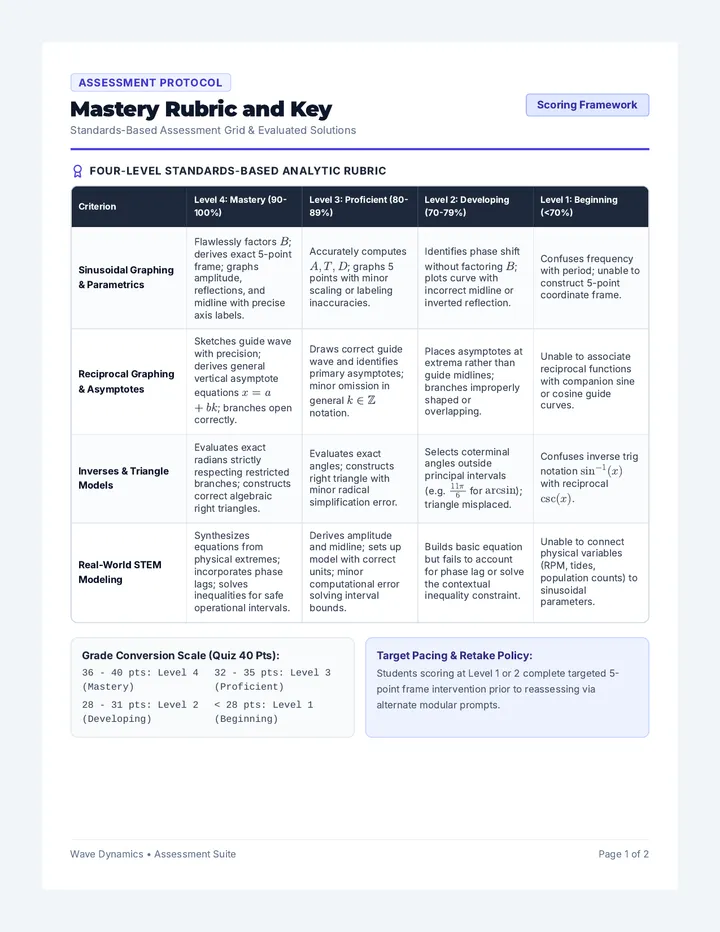
Solo Mission Evaluation Rubric (NYS Standard NY-5.NBT.7 Mastery)
Level 4: Exceeding (9–10)
Accurately aligns all cases including whole numbers and 3-addends. Clearly explains reasonableness.
Level 3: Proficient (7–8)
Correctly aligns decimal points; annexes zeros; accurately regroups across hundredths and tenths.
Level 2: Developing (5–6)
Understands basic alignment; makes minor regrouping errors or struggles with whole numbers ($9 + 0.67$).
Level 1: Needs Support (<5)
Persistently right-aligns digits ignoring decimal points. Requires small-group Tier 2 re-teaching.
Danielson Framework / NYS Teaching Standards Alignment Crosswalk Formal Observation Evidence Notes
Domain 1 (Planning): Coherent progression from Try-It struggle to explicit algorithm and independent application (1a, 1c, 1e).
Domain 2 (Environment): Detective theme builds high engagement, risk-free turn-and-talk, and mutual accountability (2a, 2b).
Domain 3 (Instruction): High-level questioning on place-value equivalence; active partner discourse; real-time formative checks (3b, 3c, 3d).
Domain 4 (Professional): Immediate exit ticket data used to group students for Day 2 Decimal Subtraction (4a, 4b).
Decimal Detectives Formal Lesson Plan • NY-5.NBT.7 Page 3 of 3 • Practice, Assessment & Evaluation