System Solver Graphic Organizer
Systems of Equations
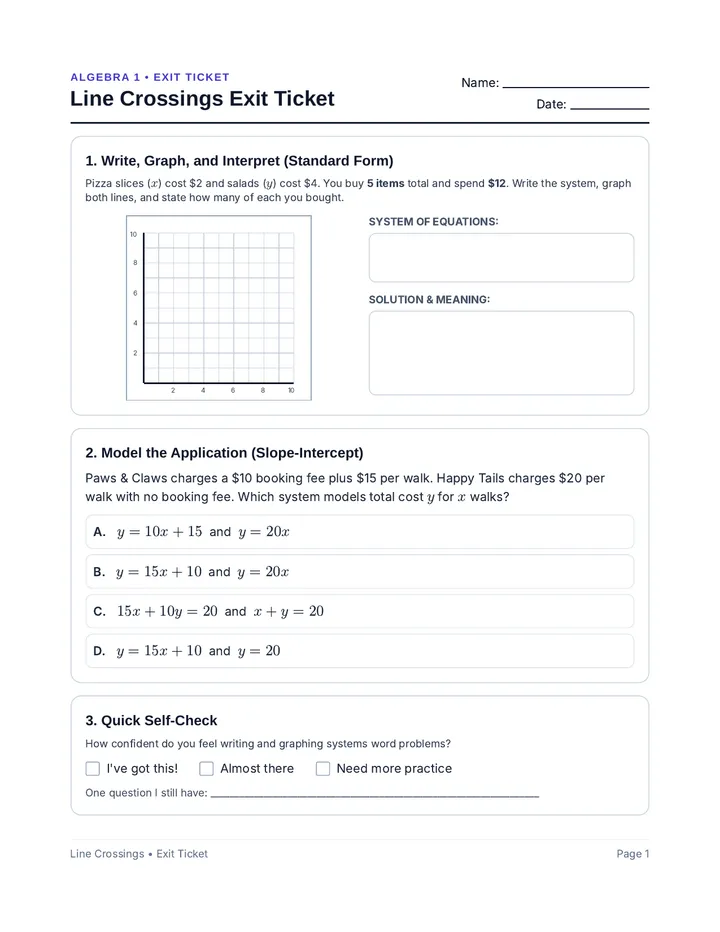
A system of equations is two or more equations with the same variables. Its solution is an ordered pair \((x, y)\) that makes all equations true.
Name:
Date:
1
Solving by Graphing
Best for \(y = mx + b\) form
Steps
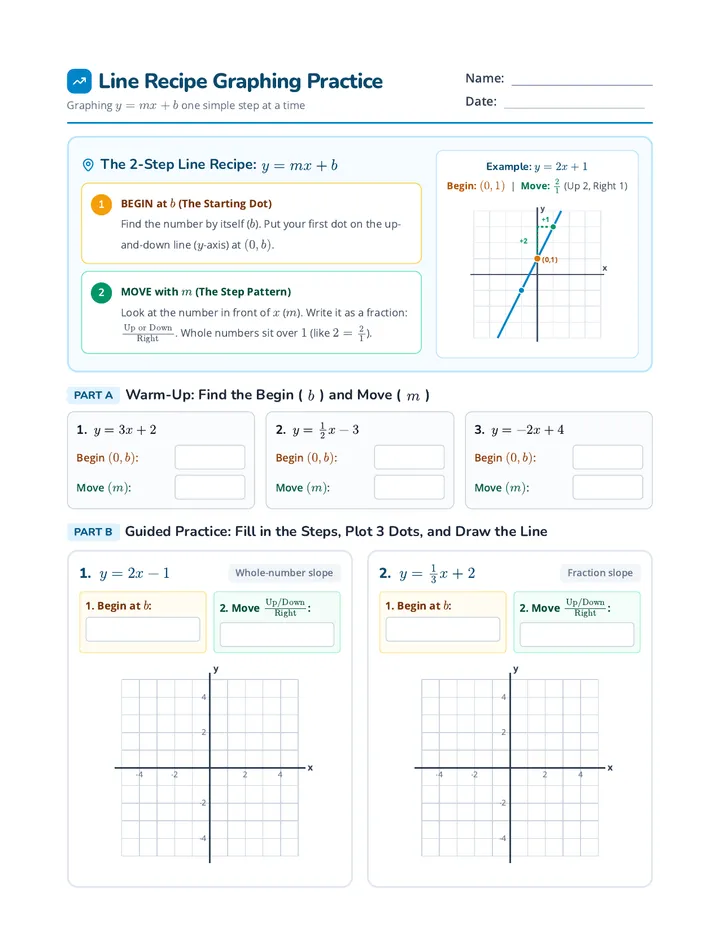
- Write each equation in slope-intercept form: \(y = mx + b\).
- Plot the \(y\)-intercept \((0, b)\) and use the slope \(m\) to graph both lines.
- Find the intersection point \((x, y)\) where the lines cross.
- Check the ordered pair in both original equations.
Tip: Use a ruler! Small drawing errors can shift the intersection.
Example \(y = 2x - 1\) & \(y = -x + 5\)
x y 1 2 3 4 1 2 3 4 (2, 3)
Solution: \((2, 3)\)
2
Solving from a Table
Best for comparing outputs
Steps
- Create a separate \(x / y\) table for each equation.
- Choose the same \(x\)-values (e.g., \(0, 1, 2, 3\)) and calculate \(y\) in each table.
- Compare both tables to find the exact same \((x, y)\) pair.
- Write the matching \((x, y)\) ordered pair as the solution.
Tip: If the \(y\)-values get closer together, keep going in that direction!
Example Two Separate Tables
\(y = 3x + 1\)
| \(x\) |
\(y\) |
| \(0\) |
\(1\) |
| \(1\) |
\(4\) |
| \(2\) |
\(7\) |
| \(3\) |
\(10\) |
\(y = x + 5\)
| \(x\) |
\(y\) |
| \(0\) |
\(5\) |
| \(1\) |
\(6\) |
| \(2\) |
\(7\) |
| \(3\) |
\(8\) |
Both tables match at \((2, 7)\) → Solution: \((2, 7)\)
Three Possible Types of Solutions
One Solution \((x, y)\)
Different slopes; lines intersect at 1 point.
No Solution
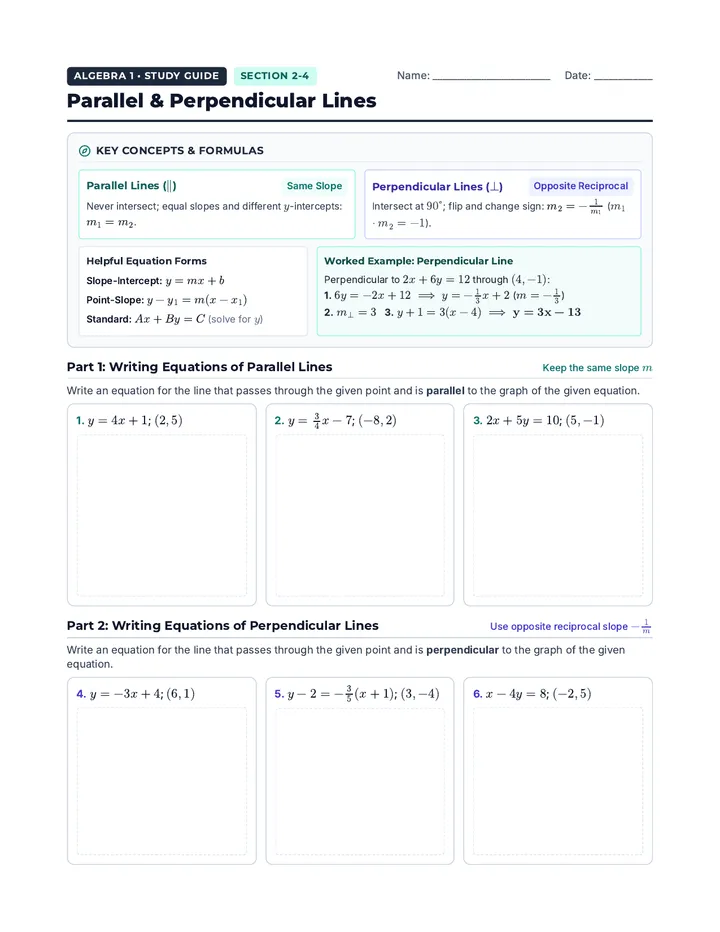
Same slope, different \(y\)-intercepts; parallel lines.
Infinitely Many
Same slope & \(y\)-intercept; same line.
Algebraic Methods
Use algebra for exact answers—especially fractions or large numbers
3
Solving by Substitution
Best when \(x\) or \(y\) is isolated
Steps
- Isolate one variable in either equation (if not already isolated).
- Substitute that expression into the other equation using parentheses.
- Solve the resulting single-variable equation.
- Plug your answer back into either equation to find the other variable.
Watch out: Always use parentheses when substituting to distribute negatives correctly!
Example
Equation 1: \(y = 2x + 1\)
Equation 2: \(3x + y = 11\)
1. Substitute: \(3x + (2x + 1) = 11\)
2. Solve for \(x\): \(5x + 1 = 11 \Rightarrow 5x = 10 \Rightarrow x = 2\)
3. Find \(y\): \(y = 2(2) + 1 = 5\)
Solution: \((2, 5)\)
4
Solving by Elimination
Best for \(Ax + By = C\) form
Steps
- Line up like terms (\(x\), \(y\), \(=\), and constants) vertically.
- Multiply if needed so one variable has opposite coefficients (like \(+y\) and \(-y\)).
- Add the equations together to eliminate that variable, then solve.
- Substitute back to find the remaining variable.
Tip: Adding opposite terms prevents sign errors that happen when subtracting.
Example
Equation 1: \(2x + y = 9\)
Equation 2: \(3x - y = 6\)
\(2x + y = 9\)
\(+\;3x - y = 6\)
\(5x + 0 = 15\)
1. Solve for \(x\): \(5x = 15 \Rightarrow x = 3\)
2. Find \(y\): \(2(3) + y = 9 \Rightarrow y = 3\)
Solution: \((3, 3)\)
Special Situations: When All Variables Cancel Out
No Solution (False Statement) \(0 = 5\)
If the variables disappear and leave a false equation (like \(0 = 5\) or \(3 = -2\)), the lines are parallel and never intersect.
Infinitely Many Solutions (Identity) \(4 = 4\)
If the variables disappear and leave an identity (always true, like \(0 = 0\) or \(4 = 4\)), both equations represent the exact same line.