Line Crossings Slides Algebra 1 • Direct Instruction
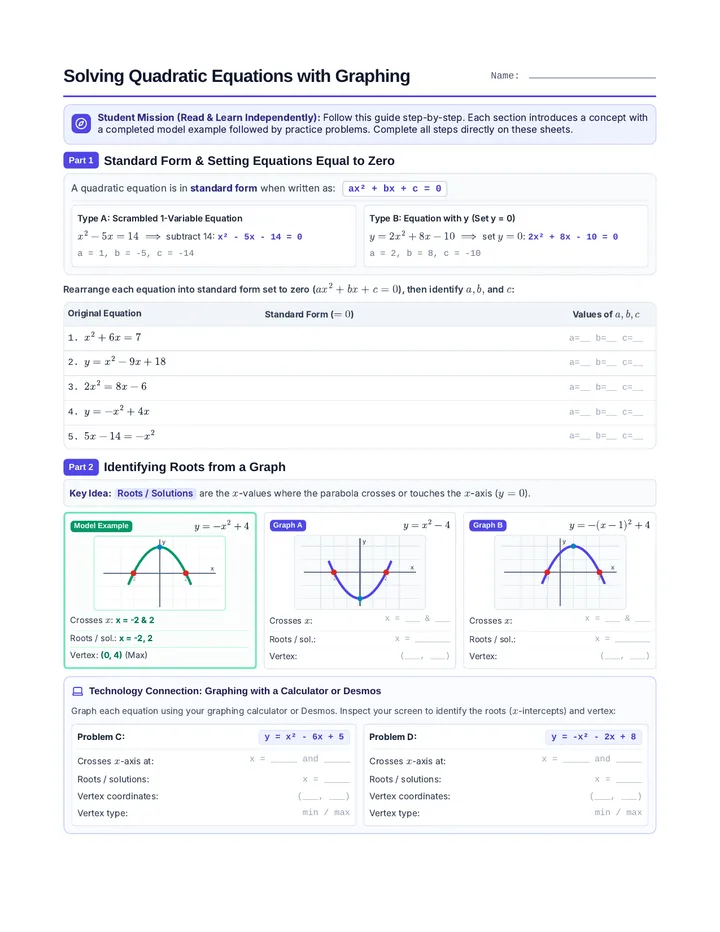
Line Crossings
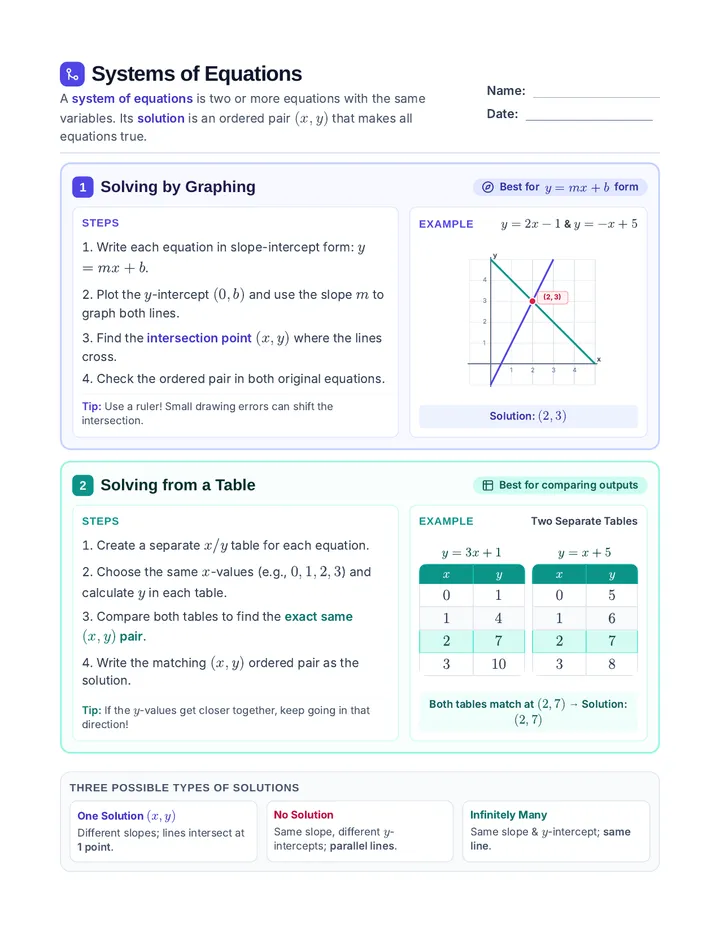
Solving Systems of Linear Equations by Graphing
Find the intersection Verify with algebra
WARM-UP • 8 MIN
Two Scooter Shops
You want to rent an electric scooter downtown. Two companies offer different pricing:
ZipScoot
$4 unlock fee + $1 per minute
\(y = 1x + 4\)
VoltRide
$0 unlock fee + $2 per minute
\(y = 2x\)
Turn & Talk: At how many minutes do both scooters cost the exact same amount?
Today's Learning Target
I can solve a system of two linear equations by graphing both lines and verifying their point of intersection.
Key Vocabulary
System of Equations
Two or more equations using the same variables (usually \(x\) and \(y\)) considered together.
Solution to a System
An ordered pair \((x, y)\) that makes every equation in the system true—visually, where the lines cross!
The 3-Step Graphing Method
1
Graph Line 1
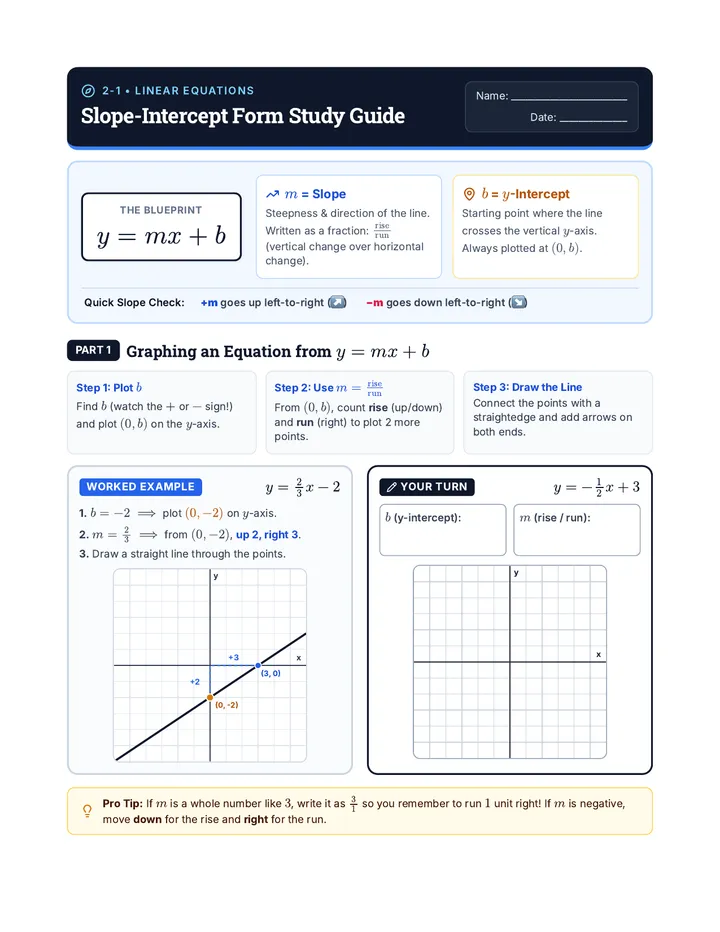
Use \(y = mx + b\). Plot the \(y\)-intercept \(b\) first, then use slope \(m\) to plot more points.
2
Graph Line 2
Graph the second equation on the same coordinate plane. Extend both lines with a ruler!
3
Find & Check
Write the intersection as \((x, y)\). Plug it into both equations to verify it's true.
I DO • EXAMPLE 1
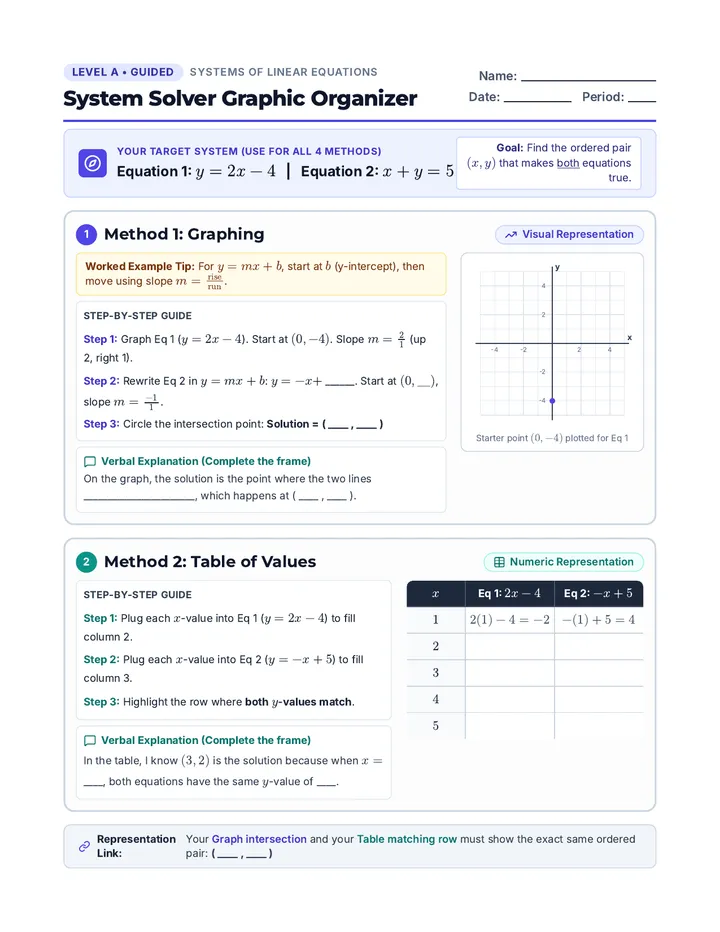
Graph & Solve the System
Line 1: \(y = 2x - 1\)
Slope \(m = \frac{2}{1}\) (up 2, right 1) • \(b = -1\)
Line 2: \(y = -x + 5\)
Slope \(m = \frac{-1}{1}\) (down 1, right 1) • \(b = 5\)
Intersection: \((2, 3)\)
(2, 3)
I DO • STEP 3
Always Check Your Solution!
Plug \((2, 3)\) into both equations (\(x = 2\), \(y = 3\)):
Equation 1: \(y = 2x - 1\)
\(3 \stackrel{?}{=} 2(2) - 1\)
\(3 \stackrel{?}{=} 4 - 1\)
\(3 = 3\) (True!)
Equation 2: \(y = -x + 5\)
\(3 \stackrel{?}{=} -(2) + 5\)
\(3 \stackrel{?}{=} -2 + 5\)
\(3 = 3\) (True!)
Three Possible Outcomes
One Solution
Intersecting lines
Different slopes
Example: \((2, 3)\)
No Solution
Parallel lines (never cross)
Same slope, different \(y\)-intercepts
Ex: \(y = 2x + 1\) & \(y = 2x - 3\)
Infinitely Many
Same exact line
Same slope, same \(y\)-intercept
Ex: \(y = x + 2\) & \(2y = 2x + 4\)
WE DO • 15 MIN
Graph Together in Your Notes
Problem A
\(y = x + 1\)
\(y = -2x + 4\)
Plot both lines on your grid and check your intersection!
Problem B
\(y = \frac{1}{2}x - 2\)
\(y = \frac{1}{2}x + 3\)
Look closely at the slopes before you even graph!
YOU DO • 25 MIN
Practice & Exit Ticket
Complete the Line Crossings Practice Worksheet (use a straightedge!).
Always plug your \((x, y)\) answer back into both equations to be 100% sure.
Final 10 minutes: Complete the Exit Ticket independently.
Line Crossings Guided Notes Algebra 1 • Guided Notes
Line Crossings: Solving Systems by Graphing
Name: __________________________
Date: ______________
Learning Target
I can solve a system of two linear equations by graphing both lines and verifying their point of intersection.
1. Key Vocabulary
System of Linear Equations
Two or more equations using the same _______________________ considered together.
Solution to a System
An ordered pair \((x, y)\) where the two lines _______________________, making both equations true.
2. The 3-Step Graphing Method
Step 1: Graph Line 1
Write in \(y = mx + b\). Plot \(b\) on the \(y\)-axis, then use slope \(m\) to plot more points.
Step 2: Graph Line 2
Graph the second line on the same grid. Use a straightedge to extend both lines.
Step 3: Find & Check
Write the intersection \((x, y)\). Plug it into both equations to verify.
3. Worked Example (I Do)
Line 1: \(y = 2x - 1\) (\(m = \underline{\hspace{0.8cm}},\ b = \underline{\hspace{0.8cm}}\))
Line 2: \(y = -x + 5\) (\(m = \underline{\hspace{0.8cm}},\ b = \underline{\hspace{0.8cm}}\))
y x 4 2 -2 -4 2 4 -2 -4
Intersection Point (Solution):
Check in Both Equations:
Tip: Always label your axes and use at least 3 points per line for accuracy. Page 1
4. Three Possible Outcomes (Special Cases)
Outcome
What the Graph Looks Like
Slopes & \(y\)-Intercepts
Quick Sketch
One Solution
Lines intersect at _____ point.
Different slopes
No Solution
_____________ lines (never cross).
_______ slope, different \(y\)-intercepts
Infinitely Many Solutions
Same exact line (overlap).
_______ slope, _______ \(y\)-intercept
5. Guided Practice (We Do)
Problem A
\(y = x + 1\)
\(y = -2x + 4\)
2 4 -2 -4 2 4 -2 -4
Solution:
Check:
Problem B
\(y = \frac{1}{2}x - 2\)
\(y = \frac{1}{2}x + 3\)
2 4 -2 -4 2 4 -2 -4
Solution:
Why? (Explain using slopes):
Line Crossings • Guided Notes Page 2
Line Crossings Practice Worksheet Algebra 1 • Independent Practice
Line Crossings Practice
Name: __________________________
Date: ______________
Part A: Verify a Solution
Directions: Plug the given ordered pair into both equations to determine if it is a solution to the system. Show your work.
1. Is \((3, 1)\) a solution?
\(y = x - 2\) and \(y = -x + 4\)
2. Is \((-1, 2)\) a solution?
\(y = 2x + 4\) and \(y = -3x + 1\)
Part B: Graph & Solve
Directions: Graph both equations on the same coordinate plane using a straightedge. Write the solution (or "No Solution" / "Infinitely Many Solutions") and check your answer.
Problem 3
\(y = x - 2\)
\(y = -2x + 4\)
24 -2-4 24 -2-4
Solution:
Check:
Problem 4
\(y = \frac{1}{3}x + 1\)
\(y = -x + 5\)
24 -2-4 24 -2-4
Solution:
Check:
Line Crossings • Practice Worksheet Page 1
Part B (continued): Graph & Solve
Problem 5
\(y = -2x + 3\)
\(y = -2x - 1\)
24 -2-4 24 -2-4
Solution:
Explain:
Problem 6
\(y = 3x - 4\)
\(y = -x + 4\)
24 -2-4 24 -2-4
Solution:
Check:
Part C: Scooter Showdown (Real-World Application)
Remember our Warm-Up? Let \(x\) = minutes ridden and \(y\) = total cost in dollars. ZipScoot: \(y = x + 4\) | VoltRide: \(y = 2x\).
24 68 24 68
\(x\): Minutes | \(y\): Cost ($)
7. At how many minutes do both scooters cost the same? What is that cost?
8. Which scooter is cheaper for a 6-minute ride? Explain using your graph.
Line Crossings • Practice Worksheet Page 2
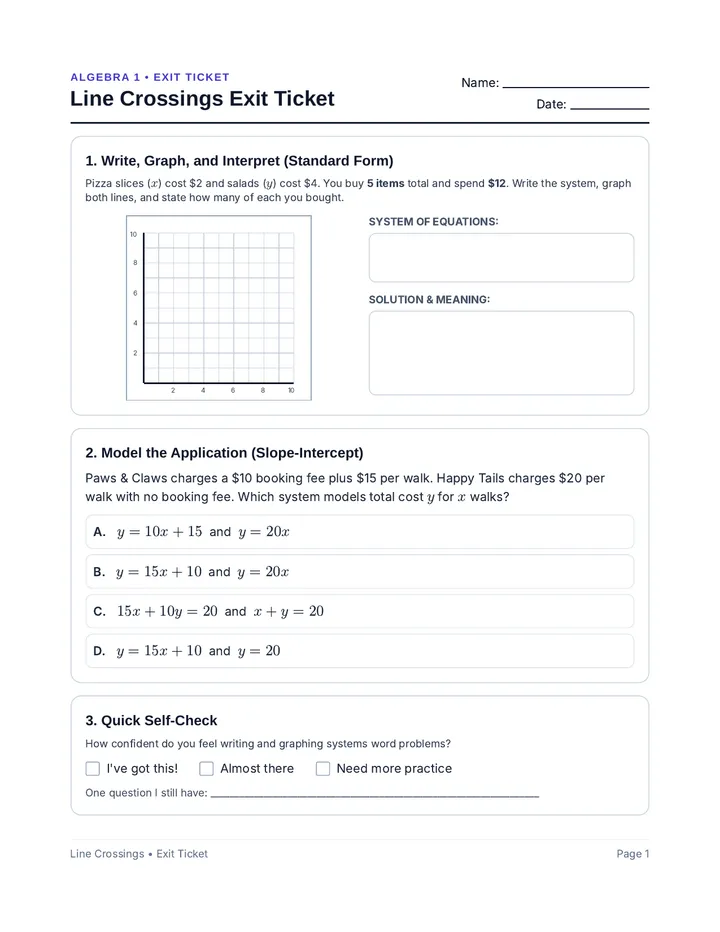
Line Crossings Exit Ticket Algebra 1 • Exit Ticket
Line Crossings Exit Ticket
Name: __________________________
Date: ______________
1. Graph, Solve, and Check
Solve the system by graphing both lines on the coordinate plane below. Write your solution as an ordered pair and check it in both equations.
Line 1: \(y = 2x - 3\)
Line 2: \(y = -x + 3\)
42 -2-4 24 -2-4
Solution \((x, y)\):
Algebraic Check (Both Equations):
2. Concept Check
Without graphing, how many solutions does the system \(y = 4x - 1\) and \(y = 4x + 5\) have?
A. One solution at \((0, 4)\)
B. One solution at \((4, 0)\)
C. No solution because the lines are parallel
D. Infinitely many solutions because they are the same line
3. Quick Self-Check
How confident do you feel solving systems of equations by graphing?
I've got this! Almost there Need more practice
One question I still have: ____________________________________________________________________
Line Crossings • Exit Ticket Page 1
Line Crossings Teacher Guide Algebra 1 • Teacher Guide
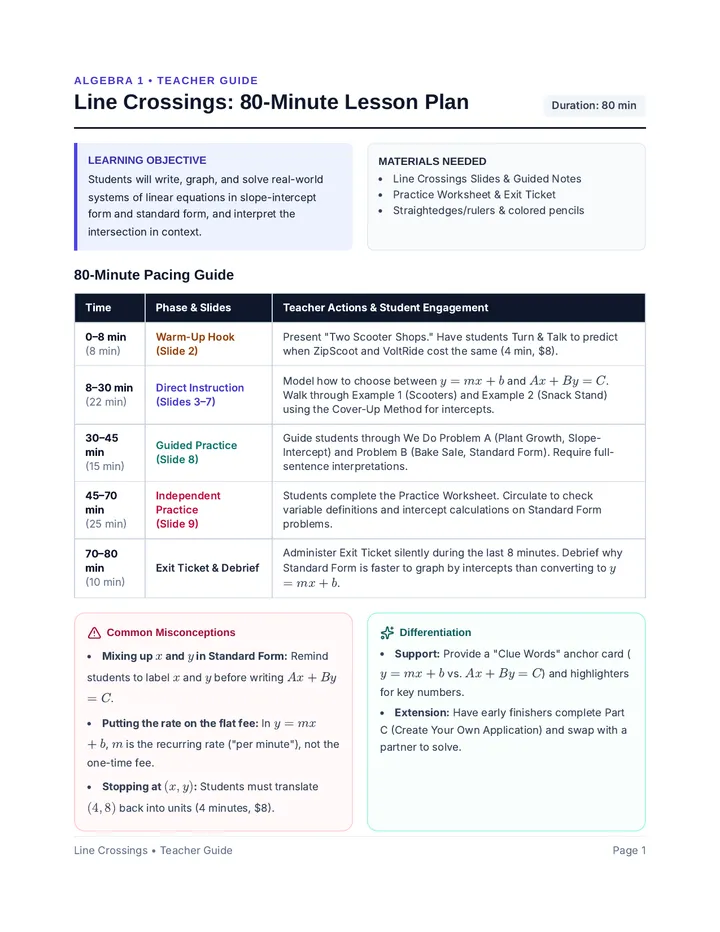
Line Crossings: 80-Minute Lesson Plan
Duration: 80 min
Learning Objective
Students will solve systems of two linear equations by graphing, identify special cases (parallel/coinciding), and verify solutions algebraically.
Materials Needed
Line Crossings Slides & Guided Notes
Practice Worksheet & Exit Ticket
Straightedges/rulers & colored pencils
80-Minute Pacing Guide
Time
Phase & Slides
Teacher Actions & Student Engagement
0–8 min
(8 min)
Warm-Up Hook
(Slide 2)
Present "Two Scooter Shops." Have students Turn & Talk to guess when ZipScoot and VoltRide cost the same (4 min, $8). Do not reveal the graph yet—build curiosity.
8–30 min
(22 min)
Direct Instruction
(Slides 3–7)
Students complete Guided Notes Sections 1–4. Model the 3-Step Method on Example 1 using two colors. Emphasize extending lines with a ruler and checking \((2,3)\) in both equations.
30–45 min
(15 min)
Guided Practice
(Slide 8)
Work through We Do Problems A & B together. Pause before Problem B to ask: "What do you notice about the slopes?" Circulate to check \(y\)-intercept placement.
45–70 min
(25 min)
Independent Practice
(Slide 9)
Students complete the Practice Worksheet individually or in pairs. Pull a small group for students struggling with negative slopes or fraction slopes.
70–80 min
(10 min)
Exit Ticket & Debrief
Collect Exit Tickets silently during the last 8 minutes. Use the final 2 minutes to preview tomorrow's topic (solving systems by substitution).
Common Misconceptions
Swapping \(m\) and \(b\): Plotting slope on the \(y\)-axis instead of \(b\).Checking only one equation: A point on Line 1 is not a solution unless it is also on Line 2.Parallel lines = \((0,0)\): Remind students that parallel lines never cross, so the answer is No Solution .
Differentiation
Support: Provide two different colored pencils (teal/rose) and a slope-intercept reference card (\(y = mx + b\)).Extension: Ask early finishers to write their own system that has a solution at \((-2, 5)\) or has infinitely many solutions.
Line Crossings • Teacher Guide Page 1
Complete Answer Keys
Guided Notes Key
1. Vocabulary: variables ; intersect (cross)
3. Worked Example: Line 1 (\(m = 2, b = -1\)); Line 2 (\(m = -1, b = 5\)). Intersection: \((2, 3)\) . Check: \(3 = 2(2)-1 \Rightarrow 3=3\); \(3 = -(2)+5 \Rightarrow 3=3\).
4. Special Cases: One Solution (1 point, different slopes); No Solution (Parallel lines, same slope, different \(y\)-intercepts); Infinitely Many (Same slope, same \(y\)-intercept).
5. We Do: Problem A: \((1, 2)\) [Check: \(2 = 1+1\), \(2 = -2(1)+4\)]. | Problem B: No Solution (Both lines have \(m = \frac{1}{2}\) and different \(y\)-intercepts, so they are parallel).
Practice Worksheet Key
Part A — Verify a Solution:
#1: Yes, \((3, 1)\) is a solution. \(1 = 3 - 2\) (True) and \(1 = -3 + 4\) (True).#2: No, \((-1, 2)\) is NOT a solution. \(2 = 2(-1) + 4\) (True), but \(2 \neq -3(-1) + 1 = 4\) (False).
Part B — Graph & Solve:
#3: \((2, 0)\) | Check: \(0 = 2 - 2\) and \(0 = -2(2) + 4\).#4: \((3, 2)\) | Check: \(2 = \frac{1}{3}(3) + 1\) and \(2 = -3 + 5\).#5: No Solution (Parallel lines; both have slope \(m = -2\) and different \(y\)-intercepts \(3\) and \(-1\)).#6: \((2, 2)\) | Check: \(2 = 3(2) - 4\) and \(2 = -2 + 4\).
Part C — Scooter Showdown:
#7: Both scooters cost the same at 4 minutes , and that cost is $8 . (Intersection at \((4, 8)\)).#8: ZipScoot is cheaper for a 6-minute ride ($10 vs. VoltRide's $12), because after \(x = 4\), the ZipScoot line stays below the VoltRide line.
Exit Ticket Key
#1: Solution is \((2, 1)\) . Check: \(1 = 2(2) - 3 \Rightarrow 1 = 1\) (True) and \(1 = -(2) + 3 \Rightarrow 1 = 1\) (True).
#2: C. No solution because the lines are parallel (both have slope \(m = 4\) and different \(y\)-intercepts \(-1\) and \(5\)).
Line Crossings • Teacher Guide & Answer Key Page 2