A comprehensive SPIRE Level 5 assessment covering -tion, -sion, and -dge. Includes sections for spelling selection, rule application, and a dictation area for teacher-led testing.
A comprehensive guide for teachers including the correct narrative sequence, learning objectives, and discussion prompts to deepen student understanding.
A worksheet for students to transcribe their ordered sentences into a cohesive narrative. Includes a reflection question to identify the moral of the story.
A printable set of sentence strips from the story for students to cut out and manually arrange. Encourages tactile engagement and logical sequencing of the narrative events.
A vibrant slide deck to introduce the story of 'The Shepherd Boy' and guide students through the sequencing activity. Features clear, large text and visual cues to support narrative comprehension.
An educator's answer key for the 'Weaver of Whispers' packet. It includes high-level sample responses with specific guidance for grading gifted learners and optimized page breaks for educator use.
A professional facilitation guide for the 3-day folklore lesson. It provides teacher-facing pacing, high-level discussion prompts, standards mapping, and AIG-specific differentiation strategies, optimized for print with clean page breaks.
A comprehensive student packet for the 'Weaver of Whispers' folklore lesson. It features an original passage, tiered analysis questions mapped to ELA standards, and a creative writing 'Origin' prompt with drafting space, optimized for clear page breaks.
A 7-slide presentation designed for a 3-day folklore lesson. It includes agendas, anchor questions, story context, and a vocabulary spotlight focused on gifted learner standards.
A teacher-facing annotation guide for the 'Maya's Big Splash' story. It highlights and categorizes the setting, characters, problem, attempts to resolve, and the final solution within the text using kid-friendly language for the summary analysis.
A teacher-facing scoring guide for the writing prompts. Includes the prompt text, a 2-point rubric for character change, and a 4-point rubric for identifying the story's central message. Aligned with NYS ELA standards.
A student-facing writing prompt document with two tasks: a short response about character change and an extended response about the story's central message. Includes structured writing lines and a student self-assessment checklist. Revised to focus on theme analysis and fix formatting.
A teacher-facing answer key for the 'Maya's Big Splash' comprehension worksheet. Revised to include full answer text, improve table legibility, and ensure the entire key fits on a single page.
A student-facing worksheet featuring a narrative passage called 'Maya's Big Splash' and six multiple-choice comprehension questions modeled after the NYS ELA test format. The story explores the theme of overcoming fear and determination. Revised to fit passage on one page and improve page breaks for questions.
An exit ticket for Chapter 13 of The Watsons Go to Birmingham, analyzing Byron's character development after arriving in Alabama, including an evidence bank and sentence starters.
An exit ticket for Chapter 12 of The Watsons Go to Birmingham, focusing on the development of the Birmingham setting with an evidence bank and sentence starters.
A teacher's answer key for the 'Shadows and Summits' worksheet, providing exemplar responses and analysis of the themes in Chapter 10 of 'The Watsons Go to Birmingham'.
A student worksheet featuring text-dependent questions about Chapter 10 of 'The Watsons Go to Birmingham', focusing on the symbolic use of nature and darkness to explore racial tension.
A teacher-facing answer key and scoring rubric for the Storm Chaser Quiz, including specific evidence requirements for each question.
A comprehensive assessment for RI.3.1 where students must answer questions about extreme weather and provide direct textual evidence to support their claims.
A grade-appropriate informational reading passage covering tornadoes, hurricanes, and blizzards, designed for evidence-based questioning practice.
A structured graphic organizer for students to record their questions, answers, and the specific text evidence found during their weather investigation.
A visually engaging anchor chart for RI.3.1 that teaches students the steps to finding textual evidence and the 5 W's of questioning.
A detailed 5-day teacher pacing guide for the Extreme Weather unit, outlining daily goals, instructional focuses, and required materials for teaching RI.3.1.
Answer key for the History Hunter Weekly Worksheet, providing specific text-based answers for each historical biography question. Polished layout with consistent branding and improved page breaks.
A week-long series of 3rd grade reading warm-ups (Do Nows) based on historical biographies, focusing on RI.3.1 standards for EOG test preparation. Now with improved page breaks, standardized formatting, and better student work areas.
A student-facing choice board for 3rd-5th grade students featuring 6 "missions" like the Wall Crusher and Cargo Crawl. Uses a "Training Manual" theme to keep heavy work engaging and age-appropriate for intermediate learners. Adjusted layout to prevent content cutoff.
A one-page fridge reference sheet for parents of 3rd-5th grade students, listing age-appropriate "active missions" and functional home chores that provide proprioceptive input. Branded with "Andy's OT Toolbox Resource." Tightened layout to prevent content cutoff and added checkboxes for tracking.
A parent guidebook explaining proprioception and sensory seeking for 3rd-5th grade students. Features "Andy's OT Toolbox Resource" branding and focuses on "strength challenges," functional tasks, and transition strategies for growing bodies.
An answer key and evaluation guide for the 'Story Blueprint' worksheet, providing example sentences and teaching tips for Grade 2 ESL narration.
A short assessment for students to demonstrate their understanding of narrative signal words and basic sentence construction at the end of the 'Story Lab' lesson.
A set of visual vocabulary cards featuring sequential signal words and action verbs to support Grade 2 ESL students in building narrative sentences.
A student worksheet for drafting a narrative sequence about 'Making a Sandwich'. Includes a word bank of action verbs and dedicated spaces for students to draw and write using sequential signal words.
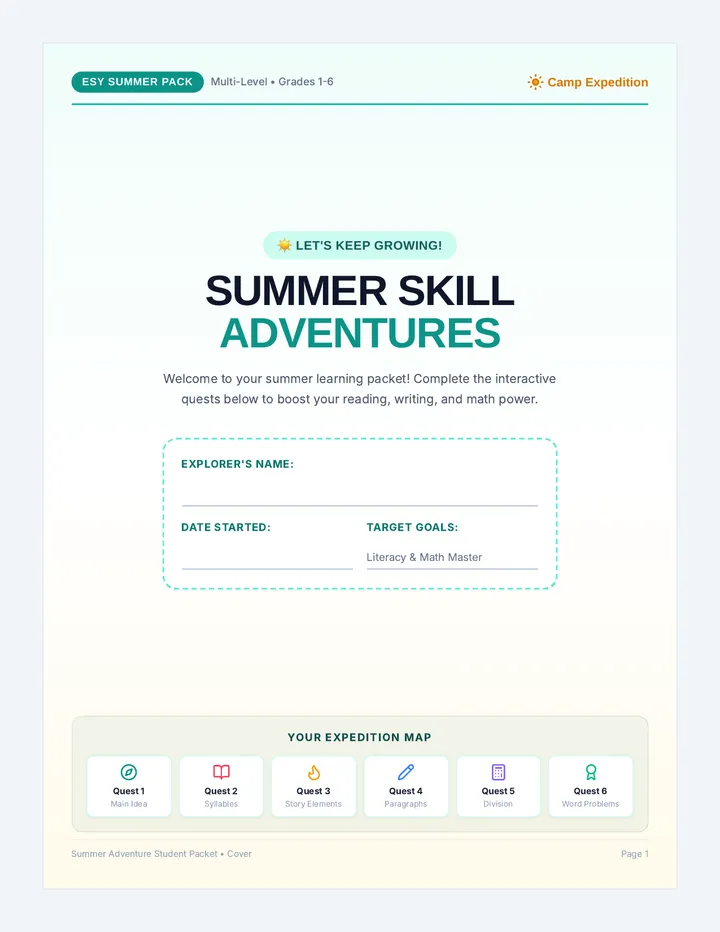
A high-impact slide deck for teaching narration to Grade 2 ESL students, focusing on sequential signal words and academic story structure through visual prompts and collaborative discussion.
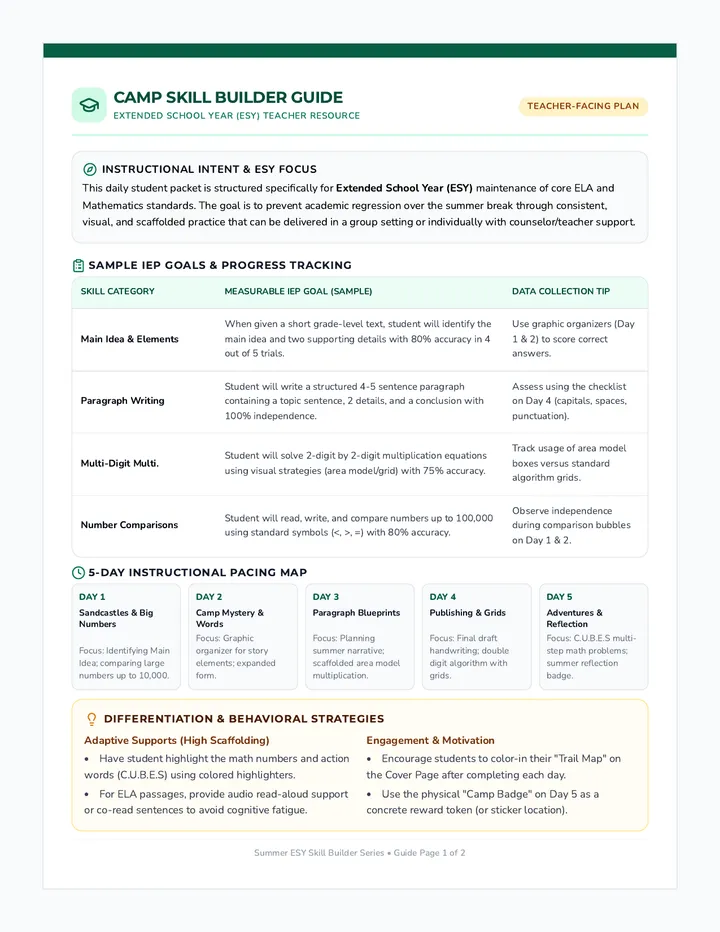
A teacher facilitation guide for the 'Story Lab' narration lesson, featuring WIDA-aligned instructional steps, language objectives, and differentiation strategies for Grade 2 ESL students.
A student-facing choice board for K-3 students featuring four common animal walks. Helps students with intellectual disabilities choose their own proprioceptive movement activities during transitions or breaks. Adjusted layout to fit printable area and tightened content to prevent page breaks.
A one-page fridge reference sheet for parents of K-3 students, listing playful heavy work activities and animal walks, branded with "Andy's OT Toolbox Resource" for consistency. Removed height constraints to prevent cutoffs.
A playful parent guidebook explaining proprioception and sensory seeking for K-3 students. Features "Andy's OT Toolbox Resource" branding and focuses on animal walks, play-based heavy work, and simple routines. Removed specific diagnostic terminology for a broader audience.
Sound Cipher phonics worksheet for B and Wh words. Includes Elkonin boxes for phoneme mapping (3-sound and 2-sound words) and a Heart Word mapping section for irregular spellings. Revised to improve student work areas and task clarity.