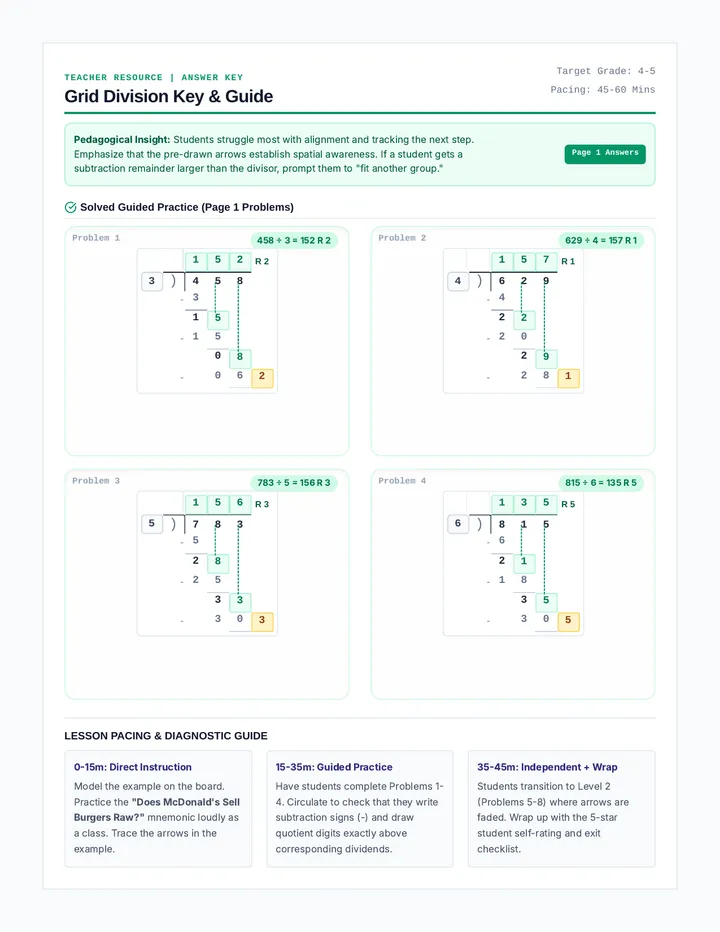
Teacher answer key for the Shape Studio Worksheet, providing correct drawings, logical justifications, and hierarchy explanations for the geometry tasks.
An answer key for the Mixed Conversion Worksheet, providing the step-by-step calculation (denominator * whole + numerator) and the final improper fraction for all 10 problems.
A structured worksheet for converting mixed numbers into improper fractions. It includes a visual "Circle Strategy" example at the top and provides dedicated space for showing work and writing the final improper fraction for 10 problems. Improved layout with CSS fractions to ensure PDF rendering consistency. Reduced to 2 pages with a professional 2-column layout. Labeling added to all student work areas.
A visual cheat sheet for converting between improper fractions and mixed numbers. It includes clear definitions of key terms and illustrated step-by-step examples for both conversion processes. Optimized for single-page printing. Visual "Circle" cues and remainder labeling added. Page break and icon clarity fixed.
A detailed teacher answer key for the Blueprint Bounds Exit Ticket. It provides definitive step-by-step logic and clear final answers for all 10 problems. All logic has been verified for mathematical consistency based on the updated exit ticket diagrams.
A 5-page exit ticket designed with a clean blueprint theme. It contains 10 problems that challenge students to find missing side lengths and calculate area using formulas for rectangles and complex rectilinear shapes. All diagrams and labels have been optimized for clarity and high contrast. All logic has been verified for mathematical consistency. All label positioning has been refined to prevent overlapping and clipping. Header terminology is consistent across all pages. Workspace layout is uniform. Content is technically complete and solvable without assumptions.
Answer key for the Missing Factor Worksheet.
A worksheet focusing on the relationship between division and multiplication, asking students to find the missing factor to solve division problems.
A teacher's answer key for the Ticket to Time Activity and the Departure Board Worksheet, providing clear, highlighted solutions for easy grading.
A summative assessment worksheet themed around a central transit hub, testing students' ability to read multi-column schedules and solve elapsed time word problems with increasing complexity.
A hands-on activity sheet where students act as "Time Navigators" to calculate elapsed time for various imaginary historical and futuristic stops on the Chronos Line.
A visually engaging slide deck designed for direct instruction on reading schedules and calculating elapsed time using a transit theme and the "Jump Strategy" visual method.
A comprehensive teacher's guide for the Time Travelers Transit lesson, featuring learning objectives, standard alignments, step-by-step procedures, and differentiation strategies.
The answer key for the Fact Fusion Worksheet, providing correct solutions for all multiplication and division problems. Designed for quick teacher reference on a single page.
A 4th-grade math worksheet featuring 5 multiplication and 5 division problems up to 12x12. The layout is clean and professional with dedicated work space for each problem.
A comprehensive answer key for the Fraction Link Worksheet, detailing the "opposite denominator" strategy for each problem. Includes step-by-step intermediate fractions and simplified final answers.
A structured worksheet for adding and subtracting fractions with unlike denominators. It utilizes the "opposite denominator" strategy and provides a spacious graphic organizer for each problem, including dedicated areas for intermediate multiplication steps and simplification. Corrected pagination and added fraction bars to the graphic organizer. 4th page includes conversion cheat sheet.
A final reflection activity where students compare their theoretical predictions to experimental results, analyze the difference, and reflect on the fairness of their carnival game.
A scorecard worksheet for students to record outcomes (wins vs. losses) during their carnival gameplay, ensuring they collect enough experimental data for analysis.
A design activity document where students plan their carnival game, list materials, and calculate the theoretical probability of winning before construction.
An engaging slide deck for 'The Chance Fair' introducing probability concepts, theoretical vs. experimental outcomes, and project rules.
A comprehensive teacher lesson plan for 'The Chance Fair', including learning objectives, required materials, a step-by-step facilitation guide, and differentiation strategies.
A revised answer key for the Fraction Blueprint Worksheet. Features explicit legend for notation, better space utilization, and page-break avoidance to keep problems intact.
A revised structured worksheet for adding and subtracting fractions with unlike denominators. Improved layout with page-break avoidance, better problem distribution (5/5 split over 2 pages), and box-style student work areas for better organization and legibility.
Answer key for the high-school statistics test, featuring detailed algebraic steps, frequency table summations, and conceptual justifications. Standardized layout for better teacher reference.
A comprehensive high-school level statistics assessment covering central tendency, algebraic solving, frequency tables, and outlier analysis with a professional academic aesthetic. Revised for improved layout and student writing space. Unicode mean symbol used for stability.
Answer key for the Academy Final Evaluation, featuring step-by-step solutions, correct extraction orders, and grading tips for the final assessment. Standardized layout for better teacher reference.
A comprehensive assessment covering Level 1, Level 2, and Level 3 data analysis, designed to evaluate mastery of mean, median, mode, and range in both numerical and narrative contexts. Improved layout for student handwriting.
A set of printable "Spec Cards" for an angle scavenger hunt, challenging students to find and measure specific angle types in their environment.
A student worksheet for recording shadow angle measurements at different times of day, including sketching areas and analysis questions.
An instructional slide deck for introducing angle measurement and the shadow investigation mission. Includes visual aids for protractor use and angle types.
A comprehensive teacher facilitation guide for the 'Angle Architects' lesson, including pacing, materials, prep, and differentiation strategies.
Updated slide deck for SIFE students that moves beyond the 5/3 example to show halves (3/2), the concept of 'top = bottom' equaling one whole, and multiple number line examples. It maintains high-contrast visuals and minimal text.
A visual anchor chart for SIFE students demonstrating that when the numerator and denominator are the same, the fraction equals one whole. It uses high-contrast models for halves, thirds, and fourths to show the pattern across different denominators.
A visual sorting activity where SIFE students categorize visual fraction models into 'Part' (less than 1), '1 Whole' (exactly 1), and 'More' (greater than 1). The cards use variety in shapes (circles, strips, squares) and denominators (halves, thirds, fourths) to build conceptual understanding beyond a single example.
Answer key for the Mystery Logs worksheet, featuring step-by-step extraction logic, calculations, and analytical verdicts for the narrative problems. Standardized layout for better teacher reference.
A series of narrative-based word problems themed as mystery investigations, requiring students to extract data sets from text and calculate central tendency and range. Standardized layout and improved work areas for better usability.
Instructional slides teaching students how to parse word problems for data, identify keywords like "average", and avoid common traps like selecting the median from unsorted narrative data. Now includes additional practice missions.
A visual slide presentation designed for SIFE students to understand fractions greater than one. It uses high-contrast visuals, minimal text (24px+), and clear step-by-step counting animations (implied layout) to show how 5/3 is built from unit fractions.