Quadratic Forms Note Sheet
Algebra II • Quadratic Functions
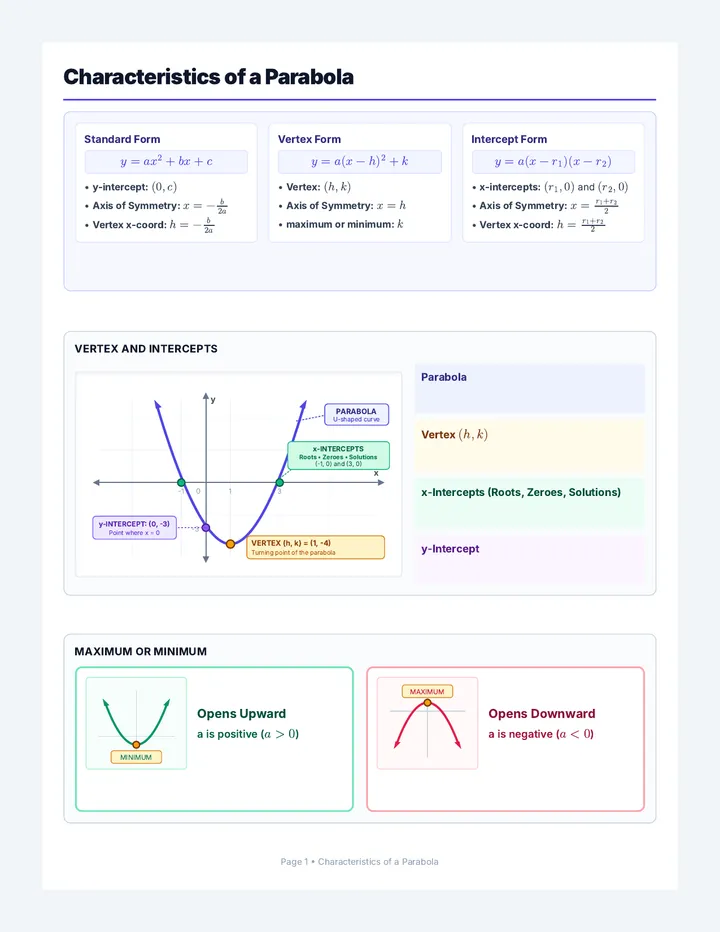
Quadratic Forms: Vertex Form
Name:
Date:
Period:
Standard Vertex Form \( y = a(x - h)^2 + k \)
Anchor: Vertex \( (h, k) \)
Vertex \( (h, k) \): Turning point (peak or trough). Because of \( (x - h) \), the horizontal value \( h \) reverses its apparent sign!
Axis of Symmetry: The vertical fold line \( x = h \). Every point on one side reflects directly across it.
Scale Factor \( a \): Sign dictates direction (\( + \) up, \( - \) down). Magnitude stretches (\( |a| > 1 \)) or compresses (\( |a| < 1 \)).
Visual Anatomy 1 grid unit = 1
x y A.O.S. x = h Vertex (h, k) = (2, -1.5) Given Point (x₁, y₁) = (4, 0.5)
(h, k): Anchors parabola position.
(x₁, y₁): Arbitrary curve point solves for \( a \).
The 3-Step Strategy to Solve for \( a \) Algebraic Blueprint
1
Substitute the Vertex \( (h, k) \)
Insert \( h \) and \( k \) into the vertex template: \( y = a(x - h)^2 + k \)
2
Plug in the Arbitrary Point \( (x_1, y_1) \)
Replace \( x \) with \( x_1 \) and \( y \) with \( y_1 \), leaving \( a \) as the only unknown: \( y_1 = a(x_1 - h)^2 + k \)
3
Solve for \( a \) & Write Final Equation
Evaluate \( (x_1 - h)^2 \), isolate \( a \), and write the complete vertex form.
Caution: Do not distribute \( a \) before squaring! Always calculate \( (x - h)^2 \) first.
Model Example: Complete Algebraic Walkthrough Given: Vertex \( (3, -2) \) • Point \( (5, 6) \)
Step 1: Insert \( (h, k) \)
\( h = 3 \), \( k = -2 \)
\( y = a(x - 3)^2 - 2 \)
Step 2: Plug in \( (5, 6) \)
Let \( x = 5 \) and \( y = 6 \)
\( 6 = a(5 - 3)^2 - 2 \)
Step 3: Solve for \( a \)
\( 6 = a(2)^2 - 2 \implies 6 = 4a - 2 \)
\( 8 = 4a \implies \mathbf{a = 2} \)
\( y = 2(x - 3)^2 - 2 \)
Your Turn • Practice Problem A Vertex: \( (-2, 4) \) | Arbitrary Point: \( (0, -8) \)
1. Write template with \( (h,k) \):
2. Substitute point & solve for \( a \):
3. Final Vertex Form Equation:
\( y = \underline{\hspace{35px}}(x \ \underline{\hspace{20px}})^2 \ \underline{\hspace{20px}} \)
Quadratic Functions Note Packet • Page 1: Vertex Form Turn over for Intercept Form →
Algebra II • Quadratic Functions
Quadratic Forms: Intercept Form
Name:
Date:
Period:
Factored / Intercept Form \( y = a(x - r_1)(x - r_2) \)
Anchors: Roots \( (r_1, 0) \) & \( (r_2, 0) \)
Roots / Zeros \( r_1, r_2 \): The \( x \)-coordinates where the curve meets the x-axis at \( (r_1, 0) \) and \( (r_2, 0) \).
Axis of Symmetry: Directly midway between roots: \( x = \frac{r_1 + r_2}{2} \).
Leading Factor \( a \): Width & direction. Given roots alone, an infinite family of parabolas exists until \( a \) is fixed!
Visual Anatomy 1 grid unit = 1
x y A.O.S. x = (r₁+r₂)/2 Root (r₁, 0) = (-1, 0) Root (r₂, 0) = (3, 0) Given Point (x₁, y₁) = (0, -1.5)
(r₁, 0), (r₂, 0): Establish the horizontal roots.
(x₁, y₁): Any non-intercept point uniquely nails down \( a \).
The 3-Step Strategy to Solve for \( a \) Algebraic Blueprint
1
Substitute Roots \( r_1 \) and \( r_2 \)
Plug roots into the factored template. If a root is negative, say \( r_1 = -4 \), \( (x - (-4)) = (x + 4) \): \( y = a(x - r_1)(x - r_2) \)
2
Plug in the Arbitrary Point \( (x_1, y_1) \)
Substitute \( x_1 \) for both \( x \)'s and \( y_1 \) for \( y \). Note \( (x_1, y_1) \) cannot be an intercept: \( y_1 = a(x_1 - r_1)(x_1 - r_2) \)
3
Multiply Factors & Isolate \( a \)
Multiply the two evaluated numeric values, divide both sides, and write the final intercept form equation.
Tip for Finding the Vertex: Average the roots: \( h = \frac{r_1+r_2}{2} \), then evaluate \( y(h) \) to get the vertex \( (h, k) \)!
Model Example: Complete Algebraic Walkthrough Given: Intercepts \( (-3, 0), (1, 0) \) • Point \( (2, 10) \)
Step 1: Insert Roots
\( r_1 = -3 \), \( r_2 = 1 \)
\( y = a(x + 3)(x - 1) \)
Step 2: Plug in \( (2, 10) \)
Let \( x = 2 \) and \( y = 10 \)
\( 10 = a(2 + 3)(2 - 1) \)
Step 3: Solve for \( a \)
\( 10 = a(5)(1) \implies 10 = 5a \)
\( 10 = 5a \implies \mathbf{a = 2} \)
\( y = 2(x + 3)(x - 1) \)
Decision Matrix: Which form should you choose?
Given Vertex \( (h,k) \) + 1 Point → Vertex Form Given 2 Roots \( (r_1,0),(r_2,0) \) + 1 Point → Intercept Form
Your Turn • Practice Problem B Roots: \( (2, 0) \) and \( (6, 0) \) | Arbitrary Point: \( (4, -8) \)
1. Write template with \( r_1, r_2 \):
2. Substitute point & solve for \( a \):
3. Final Intercept Form Equation:
\( y = \underline{\hspace{35px}}(x \ \underline{\hspace{20px}})(x \ \underline{\hspace{20px}}) \)
Quadratic Functions Note Packet • Page 2: Intercept Form Summary & Practice Check Completed