Lenny.com
Explore
Create
ActivitiesNewMathEnglish Language ArtsScience & EngineeringSocial StudiesGlobal LanguagesHealth & Physical EducationSpecial EducationCounseling & Life SkillsArts & CreativityESL
Lenny.com
Lenny.com
Explore
Create
ActivitiesNewMathEnglish Language ArtsScience & EngineeringSocial StudiesGlobal LanguagesHealth & Physical EducationSpecial EducationCounseling & Life SkillsArts & CreativityESL
Lenny.com
Lenny.com

Solutions

Lenny for EducatorsLenny for SchoolsLenny for Districts

Product

ExploreSign inCreateSupportAbout

Resources

Getting startedMTSS Acceleration Program

© 2026 Lenny Learning Inc.

TermsPrivacyAccessibility
LinkedInInstagramX
Lenny
MathNumbers & CountingCounting ObjectsNumber NamesComparing NumbersNumber OperationsCounting SequenceNumbers 0-10Place Value Understanding and SystemAdd and Subtract Within 20Addition and Subtraction ConceptsAddition and Subtraction EquationsAddition and Subtraction ProblemsFoundations for MultiplicationMultiplication and Division PropertiesMultiply and Divide Within 100Multiplication and Division ProblemsFactors and MultiplesProperties of OperationsPatterns and RelationshipsGenerate and Analyze PatternsMulti-Digit ArithmeticPlace Value OperationsMulti-Digit and Decimal OperationsNumerical ExpressionsFour Operations and PatternsFour Operations Problem SolvingMeasurement & DataMeasurable AttributesMeasuring LengthsMeasure and Estimate Lengths in Standard UnitsRelate Addition and Subtraction to LengthClassifying and Counting ObjectsTime and MoneyArea Concepts and MeasurementPerimeter and Area MeasuresAngle Concepts and MeasurementTime, Volume, and MassMeasurement Unit ConversionsGeometryIdentifying ShapesShapes and AttributesShape Attributes and ReasoningShapes and CompositionClassifying 2D FiguresGeometric Figures and RelationshipsLines, Angles, and ShapesAngle, Area, and VolumeGeometric MeasurementVolume of 3D ShapesCoordinate Plane ApplicationsTransformations in the PlaneCongruence and SimilarityUnderstand congruence in terms of rigid motionsSimilarity and TransformationsProve Theorems Involving SimilarityPythagorean TheoremTrigonometry for General TrianglesMake Geometric ConstructionsProve Geometric TheoremsTheorems About CirclesFind Arc Lengths And Areas of Sectors of CirclesVolume FormulasRelationships Between Two-Dimensional and Three-Dimensional ObjectsProve Simple Geometric Theorems AlgebraicallyTranslate Between Geometric Description and Equation for Conic SectionApply Geometric Concepts in Modeling SituationsFractions & DecimalsFractions as NumbersBuilding FractionsFraction Equivalence and OrderingAdding and Subtracting FractionsMultiplying and Dividing FractionsDividing FractionsDecimal FractionsMulti-Digit Computation and FactorsAdd, Subtract, Multiply, and Divide Rational NumbersRational Number SystemIrrational Numbers and ApproximationsRatiosRatios and ProportionsProportional RelationshipsUnit RateAlgebraAlgebraic ExpressionsGenerate Equivalent ExpressionsQuantitative RelationshipsProportional Relationships and Linear EquationsEquations and InequalitiesEquation Solving and ReasoningLinear Equations and SystemsGraph Equations and InequalitiesSystems of EquationsReal-World Algebraic ProblemsQuantitative Reasoning with UnitsExpression StructureEquivalent Expression FormsRadicals and Integer ExponentsRational ExponentsRational and Irrational NumbersPolynomial OperationsPolynomial IdentitiesPolynomial Zeros and FactorsRational ExpressionsComplex Number OperationsComplex Numbers in PolynomialsComplex Numbers on PlaneStatistics & ProbabilityRepresent and Interpret DataData DistributionsStatistical VariabilityProbability ModelsCompound Event ProbabilitiesStatistical SamplingInterpret Categorical and Quantitative DataBivariate Data PatternsInterpret Linear ModelsComparing Two PopulationsRandom Processes in StatisticsIndependence and Conditional ProbabilityExpected ValuesProbability-Based Decision MakingStatistical Inference and ConclusionsFunctionsFunction Concepts and NotationDefine and Compare FunctionsInterpret Functions in ContextAnalyze Function RepresentationsModel Relationships with FunctionsIdentify Linear vs Exponential GrowthDistinguish Between Function TypesCompare Growth RatesInterpret Function ExpressionsBuild Functions from RelationshipsConstruct and Model FunctionsTransform and Combine FunctionsModel Comparison and SelectionSolve Exponential EquationsTrigonometryTrigonometric Ratios Involving Right TrianglesTrigonometric Functions and Unit CircleModel with Trigonometric FunctionsTrigonometric IdentitiesVectors & MatricesIntroduction to Vectors and MatricesVector QuantitiesVector OperationsMatrix OperationsCalculusLimits and ContinuityDerivative Concepts and NotationDerivative Rules and TechniquesApplications of DerivativesOptimization ProblemsRelated RatesCurve Sketching and AnalysisIntegration Concepts and NotationAntiderivatives and Indefinite IntegralsDefinite Integrals and AreaFundamental Theorem of CalculusIntegration TechniquesApplications of IntegrationDifferential EquationsSequences and SeriesParametric and Polar FunctionsVector-Valued Functions

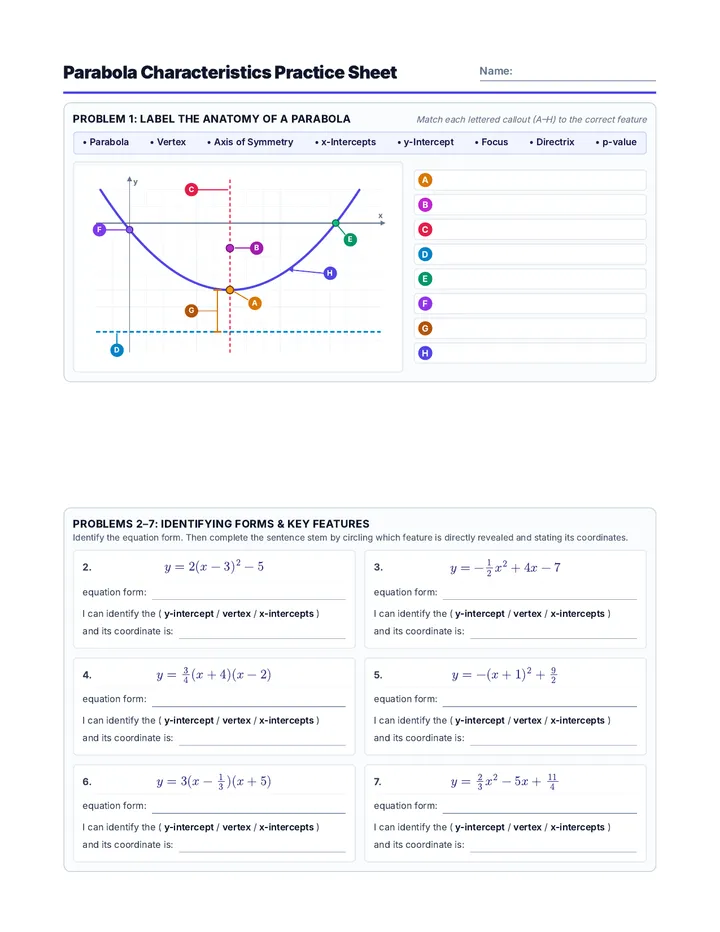
Parabola Characteristics

A comprehensive lesson covering parabola anatomy, algebraic forms, graphical properties, geometric conic definitions, and domain and range applications.

PTPatrick Timmons

Parabola Characteristics

A comprehensive lesson covering parabola anatomy, algebraic forms, graphical properties, geometric conic definitions, and domain and range applications.

PTPatrick Timmons

\(y = -3(x - 5)^2 + 1\)

Value of \(a\):

\(a\) is: ( Positive / Negative )

Opens: ( Upward / Downward )

\(y = \frac{2}{5}x^2 - 8x + 3\)

Value of \(a\):

\(a\) is: ( Positive / Negative )

Opens: ( Upward / Downward )

\(y = -\frac{7}{3}(x + 2)(x - 6)\)

Value of \(a\):

\(a\) is: ( Positive / Negative )

Opens: ( Upward / Downward )

\(y = 4(x + 1)(x + 7)\)

Value of \(a\):

\(a\) is: ( Positive / Negative )

Opens: ( Upward / Downward )

\(y = -0.75x^2 + 12\)

Value of \(a\):

\(a\) is: ( Positive / Negative )

Opens: ( Upward / Downward )

\(y = \frac{1}{6}(x - 4)^2 - \frac{8}{3}\)

Value of \(a\):

\(a\) is: ( Positive / Negative )

Opens: ( Upward / Downward )

Problems 17–20: Graphing & Finding Invisible Features

• Determine which feature is missing between Directrix, Focus, and Vertex.

• Write the coordinates of the vertex and focus

• Sketch the missing feature.

• Write the equation of the axis of symmetry and the directrix

• Sketch the parabola opening up or down.

• Write the value of p

17. Given: Vertex & Focus

x y Vertex Focus

Vertex:

Focus:

Axis of Sym:

Directrix:

p-value:

18. Given: Vertex & Directrix

x y Directrix Vertex

Vertex:

Focus:

Axis of Sym:

Directrix:

p-value:

19. Given: Focus & Directrix

x y Focus Directrix

Vertex:

Focus:

Axis of Sym:

Directrix:

p-value:

20. Given: Vertex & Focus

x y Vertex Focus

Vertex:

Focus:

Axis of Sym:

Directrix:

p-value:

Part 6: Determining Domain & Range (Equation Only vs. Word Problems)

A. Technology Graphing (Pure Mathematical Equations)

Graph each quadratic equation using your graphing calculator or graphing software. State the vertex coordinate, opening direction, domain, and range.

\(y = 3(x - 2)^2 - 8\)

Vertex coordinate:

Opens: ( Upward / Downward )

Domain:

Range:

\(y = -\frac{1}{2}(x + 4)^2 + 10\)

Vertex coordinate:

Opens: ( Upward / Downward )

Domain:

Range:

B. Contextual Word Problems (Physical Reality Constraints)

Real-world situations place natural physical boundaries on variables (such as time \(\ge 0\) and height above the ground). Determine the realistic domain and range.

23. High Dive Scenario

A cliff diver jumps from a platform into the ocean. Her height \(h(t)\) in feet above the water is given by \(h(t) = -16t^2 + 8t + 24\), where \(t\) represents elapsed time in seconds. She reaches a maximum height of 25 feet at \(t = 0.25\) seconds and enters the water (\(h = 0\)) at \(t = 1.5\) seconds.

Realistic Domain:

Realistic Range:

Explanation: Why is the domain of this scenario restricted instead of being all real numbers?

24. Model Rocket Flight

A science class launches a model rocket from ground level (\(h = 0\)). Its altitude \(h(t)\) in meters after \(t\) seconds is modeled by the function \(h(t) = -5t^2 + 40t\). The rocket reaches its peak altitude of 80 meters at \(t = 4\) seconds and parachutes back to the ground at \(t = 8\) seconds.

Realistic Domain:

Realistic Range:

Explanation: Explain what physical event sets the upper bound of the domain:

Part 7: Parabola Transformations & Vertex Form Analysis

Solved Example

Position: Inside / Outside Type: Horizontal / Vertical Vertical reflection Position: Inside / Outside Type: Horizontal / Vertical Shift right 3 units y = − 2 (x − 3 )² + 5 Position: Inside / Outside Type: Horizontal / Vertical Vertical stretch by a factor of 2 Position: Inside / Outside Type: Horizontal / Vertical Shift up 5 units

Problem 25

Position: ( Inside / Outside ) Type: ( Horizontal / Vertical ) DESCRIBE TRANSFORMATION: Position: ( Inside / Outside ) Type: ( Horizontal / Vertical ) DESCRIBE TRANSFORMATION: y = 2 (x − 4 )² + 3 Position: ( Inside / Outside ) Type: ( Horizontal / Vertical ) DESCRIBE TRANSFORMATION:

Problem 26

Position: ( Inside / Outside ) Type: ( Horizontal / Vertical ) DESCRIBE TRANSFORMATION: Position: ( Inside / Outside ) Type: ( Horizontal / Vertical ) DESCRIBE TRANSFORMATION: y = − 1 2 (x + 5 )² − 6 Position: ( Inside / Outside ) Type: ( Horizontal / Vertical ) DESCRIBE TRANSFORMATION: Position: ( Inside / Outside ) Type: ( Horizontal / Vertical ) DESCRIBE TRANSFORMATION:

Problem 27

y = 3(x + 2)² − 8

Problem 28

y =  −

1 4

(x − 6)² + 7
You might also like

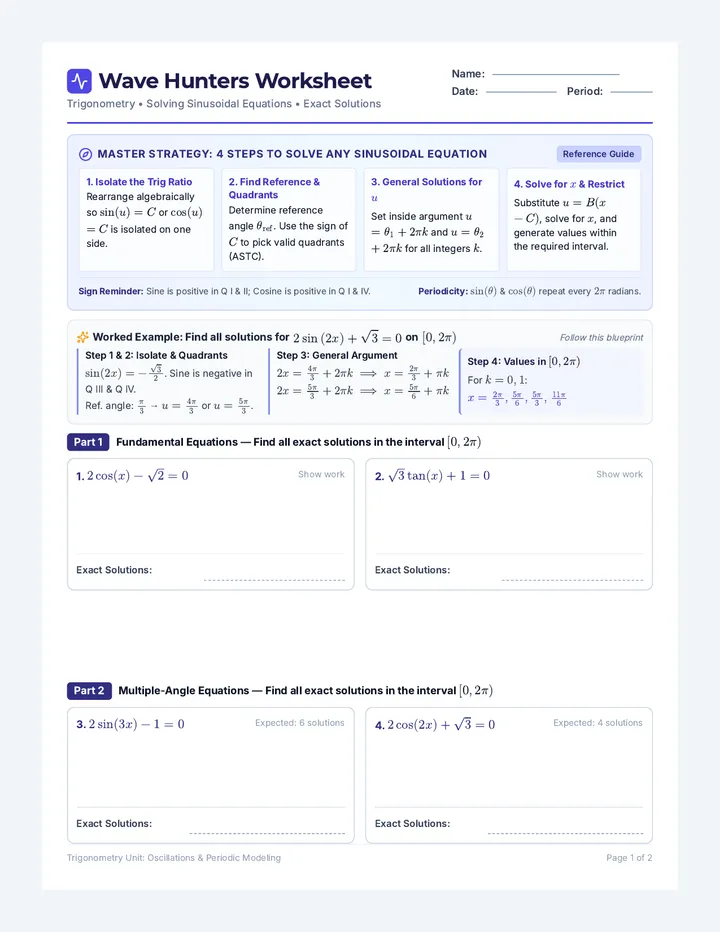
Wave Hunters Worksheet

Math and Economics

A secondary curriculum sequence covering advanced mathematical modeling alongside foundational economic systems and financial literacy concepts.

JT

Jasia Tahir

4
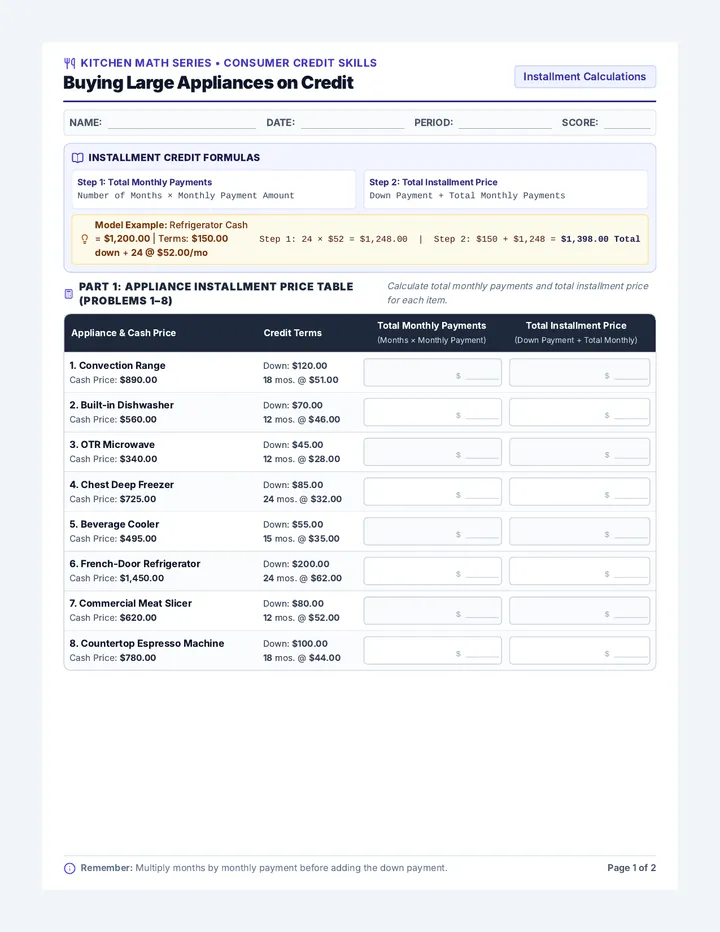
Kitchen Credit Crunch Worksheet

Kitchen Credit Math

A practical consumer math lesson on understanding installment purchase agreements, calculating total monthly payments, and finding total installment prices for major kitchen appliances.

CD

Cheri Donahoe

2
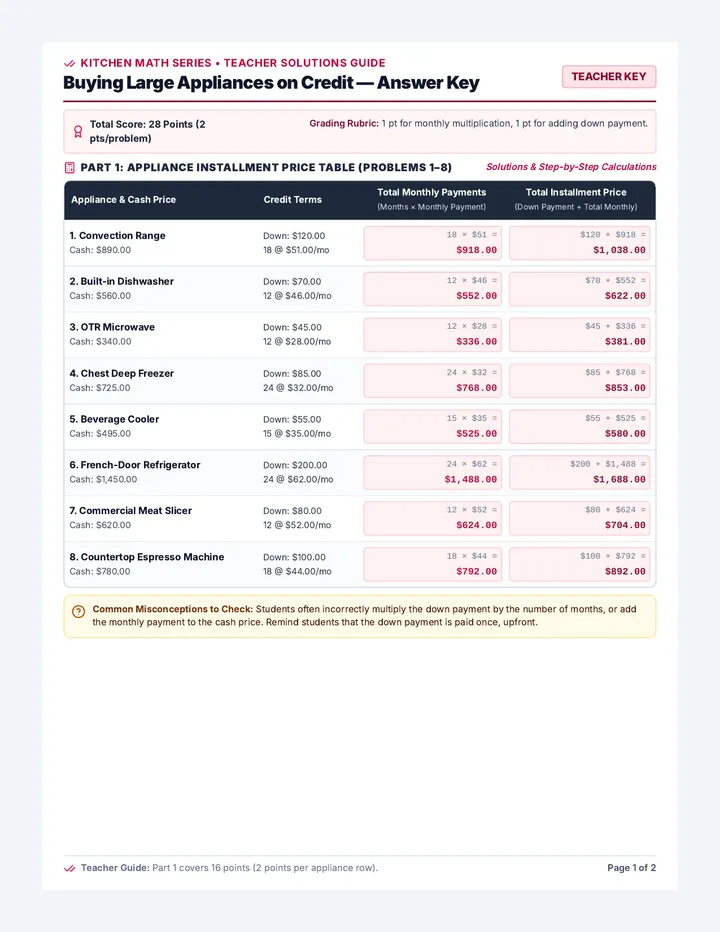
Kitchen Credit Crunch Answer Key

Kitchen Credit Crunch Answer Key

Complete teacher answer key and solutions guide for the 14-problem Kitchen Credit Crunch Worksheet, displaying step-by-step arithmetic and final answers for all appliance installment calculations.

CD

Cheri Donahoe

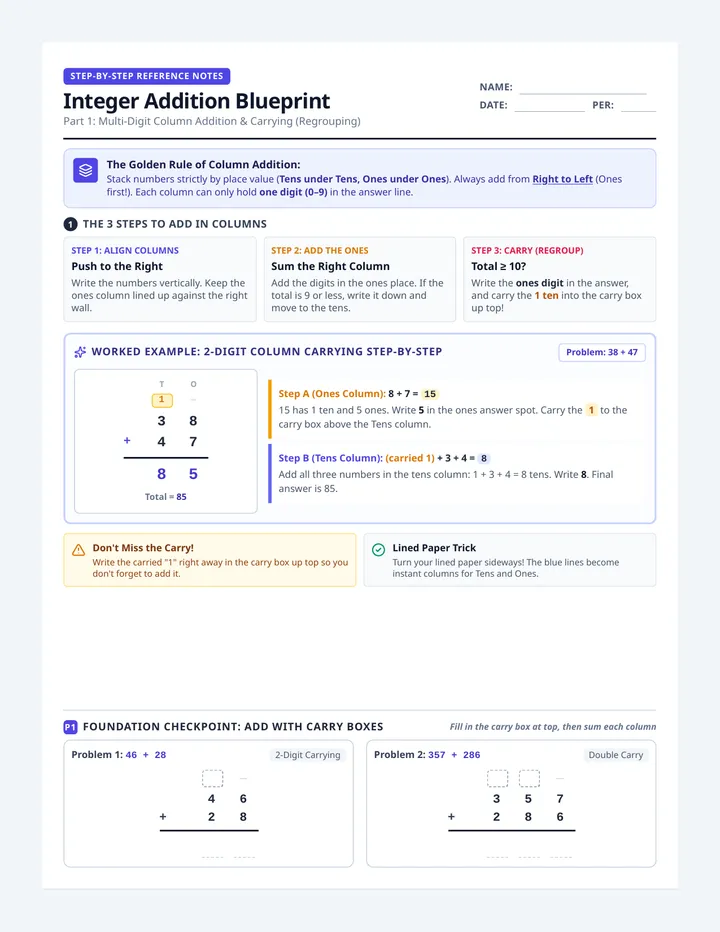
Integer Addition Blueprint Notes Sheet

Integer Operations Mastery

A comprehensive 9th-grade algebra readiness sequence covering addition with regrouping and conceptual integer multiplication through skip counting and repeated addition.

S

Shannon

3
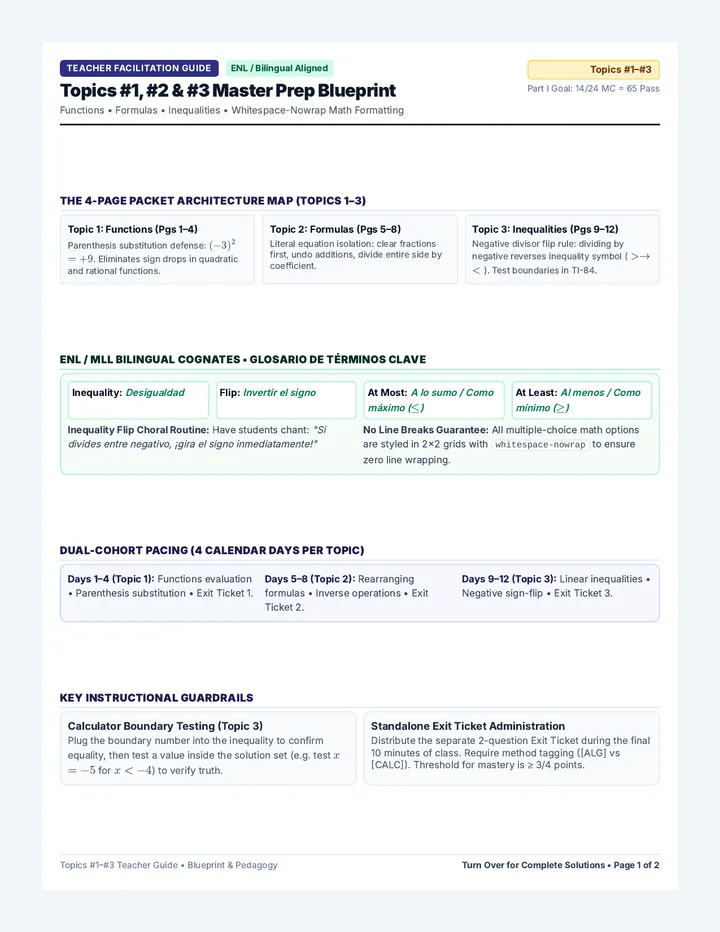
Function Vault Teacher Guide

Function Vault

A laser-focused Regents preparation lesson on evaluating functions algebraically and via TI-84 calculator shortcuts. Designed for a 45-minute dual-cohort rotation, it arms students with foolproof parenthesis defenses and calculator backsolving techniques.

TO

Thomas Oliveri

5
Kitchen Credit Crunch Worksheet

Kitchen Credit Crunch Worksheet

An expanded two-page consumer math worksheet featuring 14 total problems on installment pricing and credit totals without finance charges. Includes an 8-appliance calculation table on Page 1 and 6 applied kitchen credit scenario problems on Page 2, complete with model formulas and student workspaces.

CD

Cheri Donahoe

Graph Steepness Slides

Rise and Run

A hands-on, two-part unit exploring slope as a rate of change, visual steepness on coordinate planes, and algebraic calculations using coordinate pairs. Students transition smoothly from counting rise and run on graphs to mastering the slope formula in real-world contexts.

K

kstanfield

6
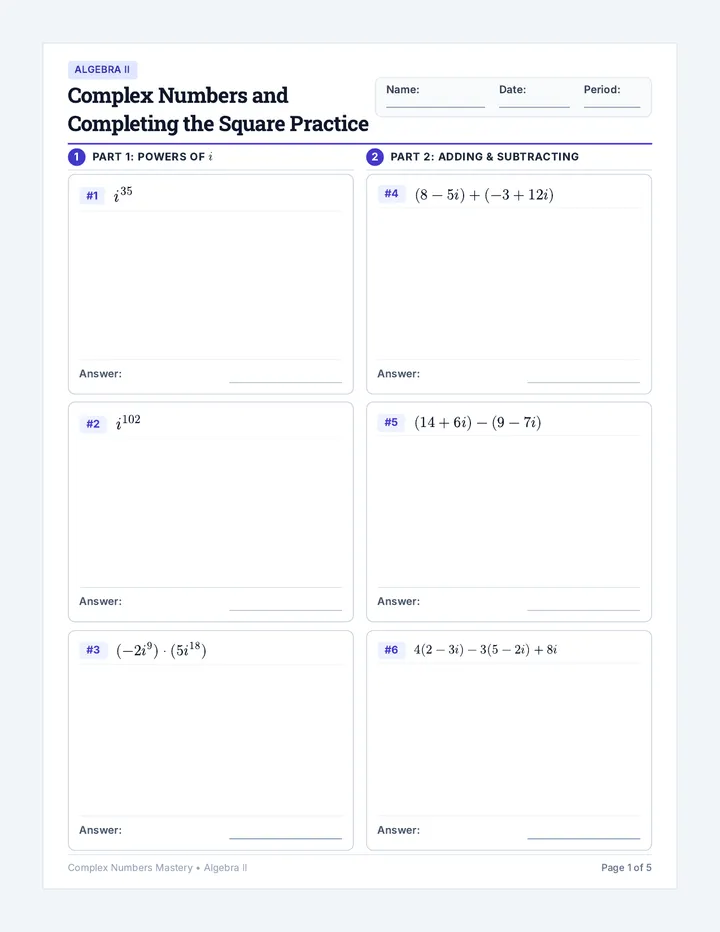
Complex Numbers and Complete Square Mastery Worksheet

Complex Numbers Mastery

A comprehensive 11th grade algebra lesson covering complex number operations, rationalization with conjugates, complex equations, and completing the square with complex roots.

AR

Angie Rice

3
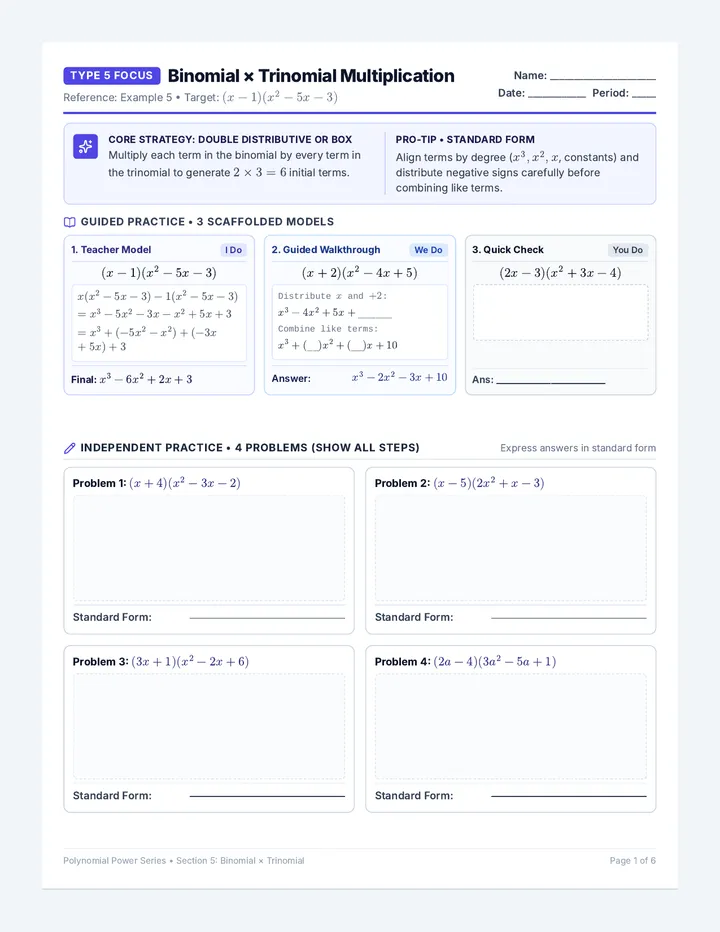
Polynomial Power Guided Notes

Polynomial Power Guided Notes

A comprehensive 6-page guided practice and independent practice document covering six core polynomial multiplication types: binomial by trinomial, binomial by binomial with a>1 and a=1, square of a sum, square of a difference, and difference of squares. Each page includes an instructional strategy anchor, three scaffolded guided practice problems (I Do, We Do, You Do), and four dedicated independent practice problems with generous handwriting workspace.

MR

Mahuya Roy Chowdhury

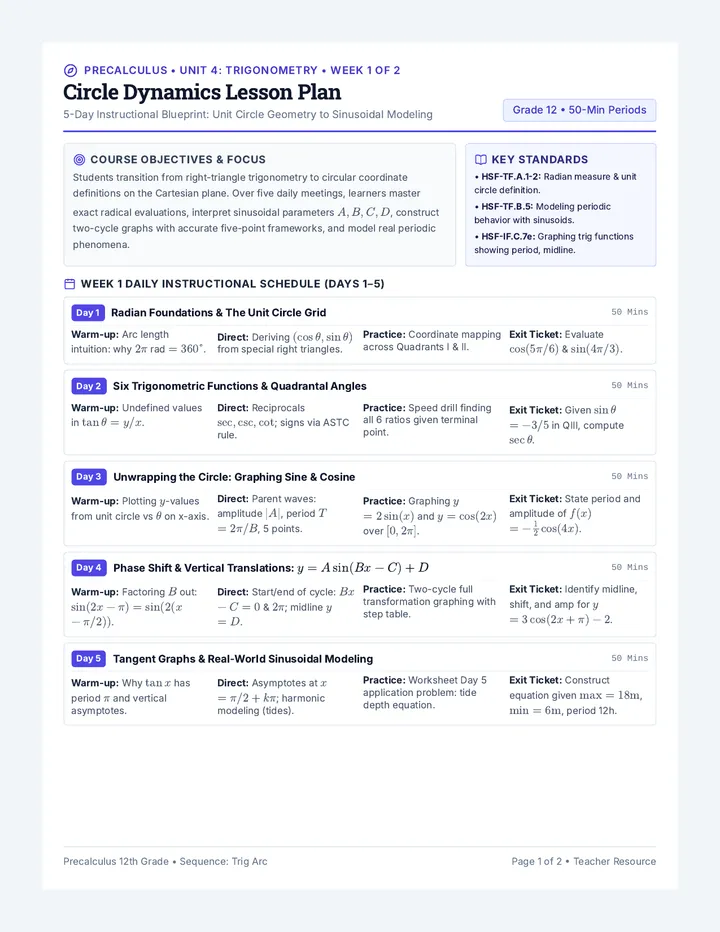
Circle Dynamics Lesson Plan

Trig Arc

A complete 10-day Precalculus trigonometry unit for 12th grade spanning two weeks of daily classes, covering radian foundations, unit circle values, sinusoidal graphs and transformations, periodic modeling, analytical identities, and equation solving.

JT

Jasia Tahir

24
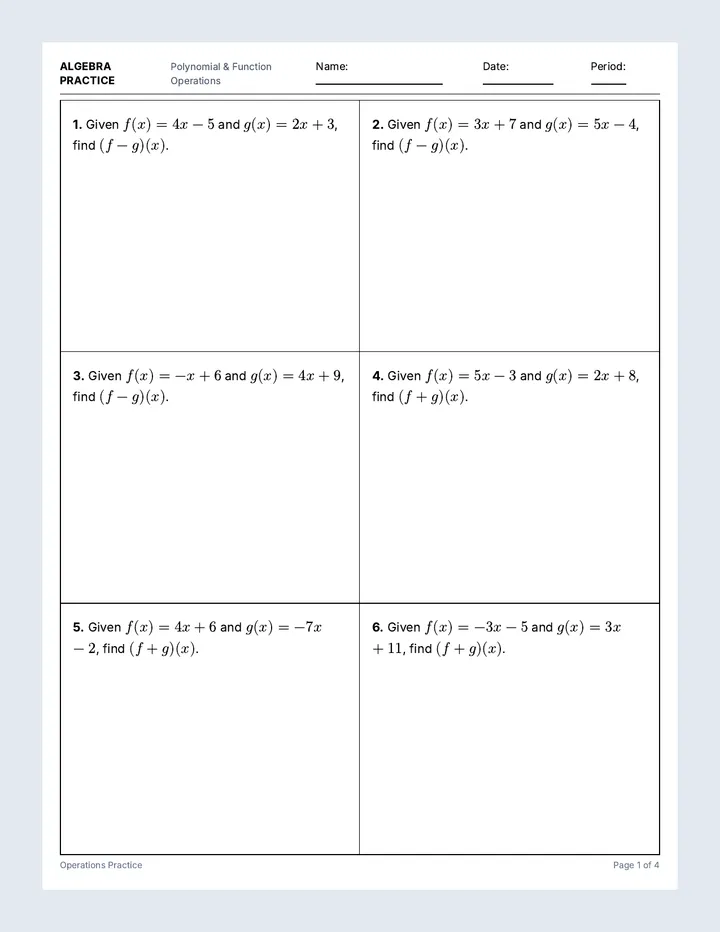
Operations Mastery Practice Worksheet

Operations Mastery

A targeted practice module featuring structured companion problems and step-by-step worked solutions for linear function operations, linear expression distribution, polynomial subtraction, and monomial-polynomial distribution.

MR

Mahuya Roy Chowdhury

2
Parabola Characteristics Practice Sheet

Parabola Characteristics Practice Sheet

Updated Parabola Characteristics Practice Sheet to remove all page footers and replace the light gray background with pure white to eliminate margins.

PT

Patrick Timmons