Numbers Operations Goal Guide
Grade 3 Math • IEP / MTSS Standards-Aligned Framework
Numbers & Operations Goal Blueprint
Core Strands: 3.OA, 3.NBT, & 3.NF • Target: Grade-Level Fluency & Applied Problem Solving
Target Year: 2026–2027
Evaluation: Quarterly Probes
Overarching Measurable Annual Goal
By the end of the 36-week instructional year, when presented with grade-level numbers and operations tasks (including operations within 1,000, single-digit multiplication/division facts, and fraction representations), the student will demonstrate procedural fluency and conceptual problem-solving by solving 2-steps and computation probes with at least 80% accuracy across 3 consecutive bi-weekly assessments as measured by curriculum-based measurement (CBM) and student work portfolios.
Fluency Focus: Efficient, flexible mental & written strategies; automaticity with facts (0–10) within 3 seconds.
Problem-Solving Focus: Model scenarios using visual representations (strip diagrams, number lines, arrays) & justify reasonableness.
Quarterly Scaffolded Objectives (Part 1: Base Ten & Operations)
Concrete → Representational → Abstract (CRA)
Quarter 1 Objective
Place Value & Addition/Subtraction within 1,000
Standard: 3.NBT.A.1, 3.NBT.A.2
Objective: Given 3-digit addition and subtraction equations within 1,000, the student will use place value strategies (decomposing by hundreds, tens, and ones, number line leaps, and compensation) to calculate sums and differences with 85% accuracy over 4 consecutive weekly probes.
Scaffold Stages
- Base-10 block regrouping
- Open number line jumps
- Standard algorithm check
Fluency Target
Compute 10 multidigit problems in 8 minutes with ≥ 85% accuracy without reliance on counters.
Problem-Solving Target
Draw tape diagrams for 1-step comparison word problems; estimate sums to the nearest 10 or 100.
Quarter 2 Objective
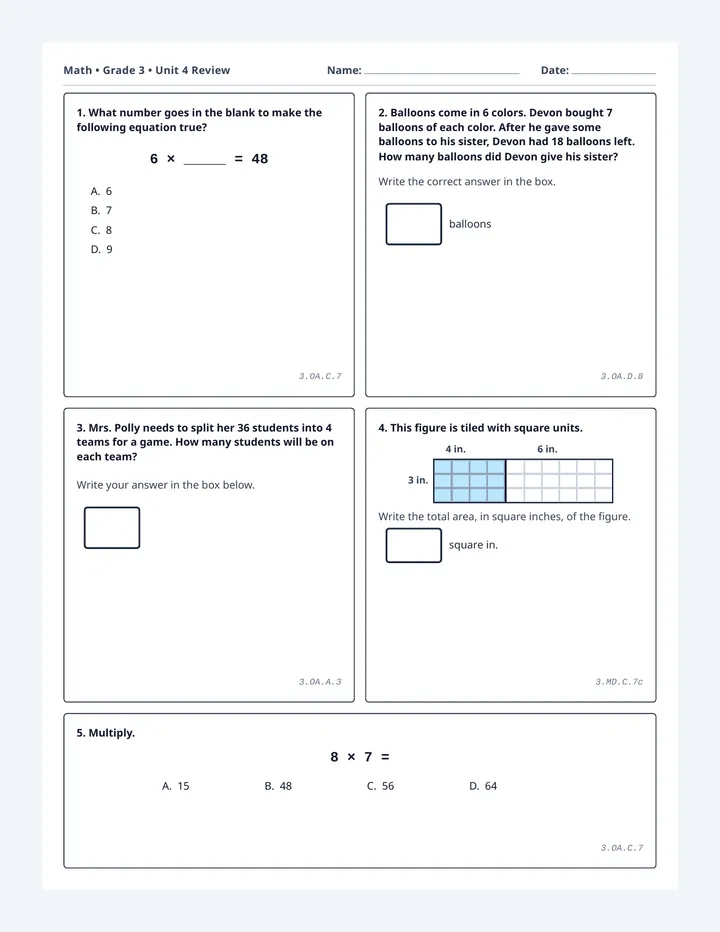
Multiplication & Division Meaning and Fact Fluency
Standard: 3.OA.A.1, 3.OA.A.2, 3.OA.C.7
Objective: Given single-digit multiplication and division facts (products to 100), the student will demonstrate conceptual understanding using equal groups, arrays, and area models, and achieve automaticity with foundational facts (0, 1, 2, 5, 10) and derived facts (3, 4, 6, 8, 9) with 80% accuracy within 3 seconds per fact across 3 probes.
Scaffold Stages
- Physical counters in equal bowls
- Array grids & area decomposition
- Fact family triangles (\(a \times b = c\))
Fluency Target
20 mixed multiplication/division facts in 60 seconds (rate: ≥ 16 facts correct per minute).
Problem-Solving Target
Represent equal sharing and measurement division contexts using labeled array diagrams.
Section 1 of 2 • Mastery Blueprint Grade 3 Numbers & Operations • Page 1
Quarterly Scaffolding & Measurement Guide
Fractions, Application & Progress Monitoring
Part 2: Objectives 3–4
Progress Protocol: Bi-Weekly CBM
Quarter 3 Objective
Unit Fractions & Equivalent Representations
Standard: 3.NF.A.1, 3.NF.A.2, 3.NF.A.3
Objective: When presented with visual area models, bar fraction strips, and number lines between 0 and 1, the student will identify, label unit fractions (\(\frac{1}{2}, \frac{1}{3}, \frac{1}{4}, \frac{1}{6}, \frac{1}{8}\)), and generate equivalent fractions (e.g., \(\frac{1}{2} = \frac{2}{4}\)) with 80% accuracy across 4 trials.
Scaffold Stages
- Folding paper fraction strips
- Plotting intervals on number lines
- Comparing like-denominator pairs
Fluency Target
Rapidly identify shaded fraction bars and place fraction tick marks correctly within 10 seconds.
Problem-Solving Target
Solve real-world sharing word problems (e.g., pizza, ribbons) justifying size relationships.
Quarter 4 Objective
Two-Step Word Problems & Integrated Strategy Transfer
Standard: 3.OA.D.8, 3.OA.D.9
Objective: Given two-step real-world word problems involving all four operations with an unknown quantity represented by a letter or box, the student will write an equation, apply efficient computational strategies, and assess reasonableness using mental math and rounding with 80% accuracy across 3 consecutive probes.
Scaffold Stages
- CUBES/Schema graphic organizer
- Segmenting problem into Step 1/Step 2
- Estimation boundary checks
Fluency Target
Select correct operational path and execute required multi-digit or fact calculation reliably.
Problem-Solving Target
Write full mathematical explanations stating why an answer makes sense compared to estimated roundings.
Assessment Protocol & 4-Point Analytic Rubric
Bi-Weekly Probe Schedule
| Dimension |
Level 1 (Emerging) |
Level 2 (Developing) |
Level 3 (Proficient - Mastery) |
Level 4 (Advanced) |
| Computation Fluency |
<60% accuracy; heavy finger counting; errors in regrouping. |
60–79% accuracy; slow recall (>5 sec/fact); inconsistent algorithms. |
≥80% accuracy; automatic foundational facts (≤3 sec); efficient strategies. |
≥95% accuracy; instant recall (≤2 sec); mental math compensation. |
| Visual Problem Solving |
Cannot represent problem visually; guesses operation. |
Incomplete model; solves 1 of 2 steps; forgets reasonableness check. |
Accurate bar model/array; correct 2-step equation; validates reasonableness. |
Creates multiple visual models; articulates generalizations and patterns. |
Tiered Instructional Scaffolds & Accommodations
Manipulatives / Concrete Place-value disks, magnetic fraction tiles, unifix cubes for array building.
Visual Organizers Blank number lines, 100s chart, strip diagram templates, CUBES step guide.
Testing Modifications Oral read-aloud of word problems, extended time (1.5x), reduced item density.
Documentation: Special Education Case Manager / Math Interventionist / Gen-Ed Teacher Grade 3 Numbers & Operations • Page 2