Day One Packet Worksheet Desert Quest • Day 1
Equal Parts Pioneers
Name:
Date:
Today's Trail: Math: Intro to Fractions Reading: Desert Tortoise Science: Sun & Producers
Math New Concept: Equal Parts & Unit Fractions
3.G.A.2 • 3.NF.A.1
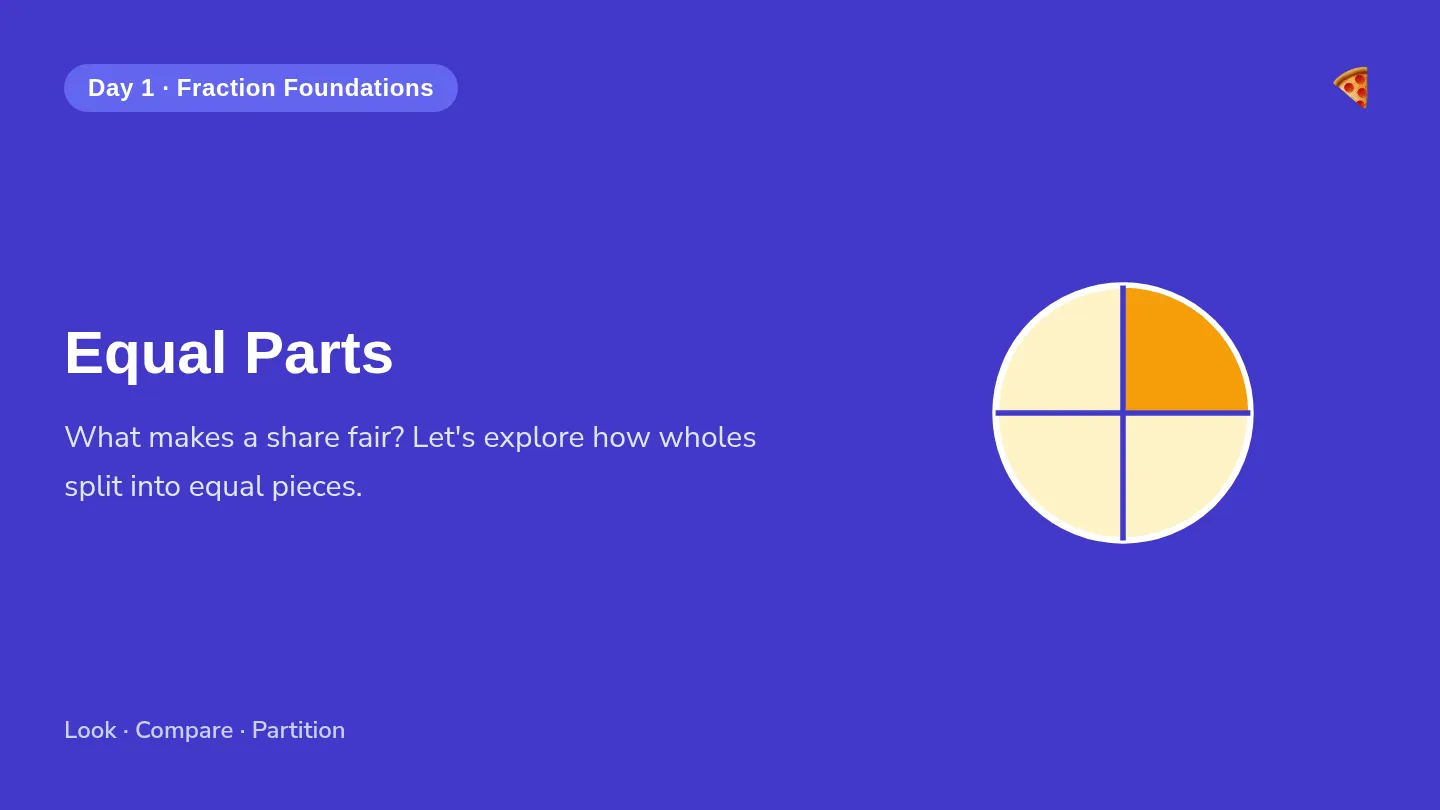
A fraction names an equal part of a whole. To make a fraction, all parts of the whole shape must have the exact same area (size) . A unit fraction names 1 equal part of a whole, like \(\frac{1}{2}\), \(\frac{1}{3}\), or \(\frac{1}{4}\).
Equal Parts: \(\frac{1}{2}\) shaded
3 Equal Parts: \(\frac{1}{3}\) shaded
NOT Equal Parts!
1. Equal or Not Equal? Circle YES or NO under each shape.
YESNO
YESNO
YESNO
YESNO
2. Write the unit fraction for the shaded part of each shape.
3. Partition each rectangle into equal parts and shade the unit fraction.
a) Partition into 6 equal parts. Shade \(\frac{1}{6}\).
b) Partition into 3 equal parts. Shade \(\frac{1}{3}\).
4. Leo cuts a granola bar into 4 equal pieces and eats 1 piece. What unit fraction of the granola bar did Leo eat? Explain how you know.
Reading Review • Day 1
Asking Questions & Character Traits
3.RL.1 • 3.RL.3
Toby the Careful Tortoise
Every morning in the Sonoran Desert, Toby the desert tortoise poked his wrinkled head out of his cool underground burrow. While the jackrabbits zoomed past in a blur of dust, Toby never rushed. He checked the sky for hawks, sniffed the warm air, and took slow, steady steps toward his favorite prickly pear cactus.
One afternoon, dark clouds rolled over the red mountains. A sudden summer monsoon storm was coming! The jackrabbits panicked and hopped in circles, unsure where to hide. Toby stayed calm. Because he always paid close attention to the desert, he remembered a dry wash with an overhanging rock ledge nearby.
"Follow me!" Toby called out in his low, steady voice. He led two shaky jackrabbits under the wide rock shelf just as fat raindrops began to splash onto the sand. Safe and dry, the rabbits thanked Toby for his wise thinking. Toby simply smiled and munched on a juicy cactus pad while the rain cooled the desert floor.
1. Where did Toby lead the jackrabbits when the storm arrived? (3.RL.1)
A. Into his underground burrow
B. Under a rock ledge in a dry wash
C. Behind a tall saguaro cactus
D. Up to the top of the red mountains
2. Which word best describes Toby's character? Use a detail from the story to support your answer. (3.RL.3)
3. How did Toby's actions during the storm change what happened to the jackrabbits? (3.RL.3)
Reading Tip: Always look back in the text and underline the exact sentence that proves your answer!
Science • Day 1
Sun Power & Desert Producers
AZ Science: Energy & Food Webs
Where Does Food Energy Begin?
Almost all energy in a desert food web begins with the Sun . Plants—such as saguaro cacti, mesquite trees, and desert wildflowers—are called producers . They use sunlight, water, and air to make their own food!
☀️ Sunlight Energy
→
🌵 Producer (Plant)
→
🌿 Stored Food Energy
1. Circle the organisms below that are PRODUCERS (make their own food using sunlight).
🌵 Saguaro Cactus
🦎 Desert Iguana
🌼 Brittlebush
🦅 Red-Tailed Hawk
2. Draw and label one Arizona desert producer receiving energy from the Sun. Show an arrow from the Sun to the plant.
3. Why are producers important to every animal in the desert?
Fun Fact: A giant saguaro cactus can store hundreds of gallons of water inside its ribs after a desert rainstorm!
Day One Answer Key Answer Key & Helper Guide
Day 1: Equal Parts Pioneers
3.G.A.2 • 3.NF.A.1 • 3.RL.1/3 • Science
Math: Introduction to Fractions
1. Equal or Not Equal? (Left to right): YES (3 equal rectangles), NO (parts are different sizes), YES (4 equal triangles), NO (top triangle is smaller than bottom trapezoid).2. Write the Unit Fraction: Left: \(\frac{1}{4}\) | Middle: \(\frac{1}{5}\) | Right: \(\frac{1}{8}\) 3. Partition & Shade: a) Rectangle split into 6 equal parts with 1 part shaded (\(\frac{1}{6}\)). b) Rectangle split into 3 equal parts with 1 part shaded (\(\frac{1}{3}\)).4. Word Problem: \(\frac{1}{4}\) . Explanation: The granola bar has 4 equal parts, and Leo ate 1 of those 4 equal parts.
Reading: Toby the Careful Tortoise
1. Multiple Choice: B. Under a rock ledge in a dry wash 2. Character Trait (3.RL.3): Sample answer: Calm / wise / observant. When the storm arrived, Toby stayed calm and remembered a dry wash with an overhanging rock ledge nearby.3. Cause & Effect (3.RL.3): Because Toby stayed calm and led the jackrabbits to the rock ledge, the rabbits stayed safe and dry instead of panicking in the storm.
Science: Sun Power & Desert Producers
1. Circle Producers: 🌵 Saguaro Cactus and 🌼 Brittlebush (plants that make their own food using sunlight).2. Drawing: Student draws the Sun with an arrow pointing to an Arizona plant (such as a cactus, mesquite tree, or wildflower).3. Written Response: Sample answer: Producers capture energy from the Sun and turn it into food. Without producers, desert animals would not have food energy to survive.
Parent / Helper Note:
In 3rd grade, students learn that fractions only work when a whole is divided into equal-sized parts. If your student draws uneven parts in #3, remind them to check that each piece is about the same size. In Science, emphasize that the arrow in a food chain always points in the direction energy flows (from Sun → Plant).
Day Two Packet Worksheet Desert Quest • Day 2
Fraction Builders
Name:
Date:
Today's Trail: Math: Non-Unit Fractions Reading: Central Message Science: Desert Consumers
Math New Concept: Non-Unit Fractions
3.NF.A.1
A non-unit fraction names more than 1 equal part of a whole! In the fraction \(\frac{a}{b}\):
Numerator (top number): counts how many equal parts are shaded or chosen.
Denominator (bottom number): tells the total number of equal parts in 1 whole.
\(\frac{3}{4}\)
3 out of 4 equal parts
1. Write the fraction for the shaded part of each whole.
2. Shade each model to match the given fraction.
Shade \(\frac{3}{5}\)
Shade \(\frac{5}{8}\)
Shade \(\frac{4}{4}\) (1 whole)
3. In the fraction \(\frac{4}{6}\), what does the 4 tell you? What does the 6 tell you?
4. Maya baked a tray of cornbread and cut it into 8 equal squares. Her family ate 5 squares. What fraction of the cornbread was eaten? What fraction is left?
Reading Review • Day 2
Recounting Stories & Central Message
3.RL.2
Coyote and the Sharing Gourd
During a dry summer in the canyon, Little Mouse found a giant desert gourd filled with cool, sweet water. Knowing how thirsty his neighbors were, Mouse invited Quail and Lizard to take turns sipping from the gourd.
Clever Coyote trotted up and sniffed the air. "Why share with tiny creatures?" Coyote laughed. When Mouse turned around, Coyote snatched the heavy gourd and ran behind a boulder so he could drink it all by himself.
Coyote tipped the gourd high, but it was too heavy for one animal to hold steady. The gourd slipped from his paws, cracked open on a sharp stone, and every drop of water soaked into the thirsty sand. Coyote licked his dry lips in regret. Meanwhile, Mouse, Quail, and Lizard worked together to dig a small basin under a dripping rock and shared the fresh spring water they found.
1. Recount the story in order: What happened at the beginning, middle, and end? (3.RL.2)
Beginning:
Middle:
End:
2. What is the central message (lesson) of this folktale? (3.RL.2)
A. Coyotes are faster than mice and lizards.
B. Greed leads to loss, while sharing brings reward.
C. Desert gourds are too heavy to carry.
D. Always hide water behind a boulder.
3. Which key detail from the story supports the central message? (3.RL.2)
Reading Tip: A central message is a life lesson that applies to anyone, not just the characters in the story!
Science • Day 2
Desert Consumers & Food Chains
AZ Science: Energy & Food Webs
How Do Animals Get Energy?
Animals cannot make their own food from sunlight. They are called consumers because they must eat (consume) plants or other animals to get energy!
🐇 Herbivore
Eats only plants (like a desert tortoise or jackrabbit).
🦅 Carnivore
Eats only other animals (like a rattlesnake or hawk).
🦝 Omnivore
Eats both plants and animals (like a coyote or roadrunner).
1. Write Herbivore , Carnivore , or Omnivore next to each Arizona animal.
Mule Deer (eats desert grasses, leaves, and cactus buds)
Diamondback Rattlesnake (eats mice, lizards, and rabbits)
Javelina (eats prickly pear cactus, roots, insects, and lizards)
2. Complete this desert food chain by writing one organism from the box in each blank.
Word Bank: Red-Tailed Hawk • Prickly Pear Cactus • Sun • Jackrabbit
→
→
→
3. What do the arrows in your food chain show?
Fun Fact: Roadrunners are omnivores! They eat desert fruits and seeds, as well as insects, lizards, and even small rattlesnakes.
Day Two Answer Key Answer Key & Helper Guide
Day 2: Fraction Builders
3.NF.A.1 • 3.RL.2 • Science
Math: Non-Unit Fractions
1. Write the Fraction: Left: \(\frac{2}{3}\) | Middle: \(\frac{2}{3}\) (2 of 3 circle wedges) | Right: \(\frac{5}{6}\) 2. Shade the Model: \(\frac{3}{5}\) = 3 of 5 parts shaded; \(\frac{5}{8}\) = 5 of 8 parts shaded; \(\frac{4}{4}\) = all 4 parts shaded (1 whole).3. Numerator & Denominator: The 4 (numerator) tells how many equal parts are counted or shaded. The 6 (denominator) tells the total number of equal parts in 1 whole.4. Word Problem: Eaten: \(\frac{5}{8}\) | Left: \(\frac{3}{8}\)
Reading: Coyote and the Sharing Gourd
1. Recount (Beginning, Middle, End): Beginning: Mouse finds a gourd of water and shares it with Quail and Lizard. Middle: Coyote steals the gourd to drink it all himself. End: Coyote drops and breaks the gourd, losing the water, while Mouse, Quail, and Lizard work together to find and share spring water.2. Central Message: B. Greed leads to loss, while sharing brings reward. 3. Supporting Detail: Coyote tried to keep all the water for himself and ended up with none when the gourd cracked, while the animals who shared worked together and found more water.
Science: Desert Consumers & Food Chains
1. Classify Consumers: Mule Deer = Herbivore ; Diamondback Rattlesnake = Carnivore ; Javelina = Omnivore .2. Desert Food Chain: Sun → Prickly Pear Cactus → Jackrabbit → Red-Tailed Hawk 3. What Arrows Show: The arrows show the flow of energy from one organism to the next (who gives energy to whom).
Parent / Helper Note:
When checking #4 in Math, help your child notice that \(\frac{5}{8} + \frac{3}{8} = \frac{8}{8} = 1\text{ whole}\) tray. Tomorrow (Day 3), they will practice building non-unit fractions out of unit fractions!
Day Three Packet Worksheet Desert Quest • Day 3
Unit Stackers
Name:
Date:
Today's Trail: Math: Building Fractions Reading: Word Meanings Science: Decomposers
Math New Concept: Building from Unit Fractions
3.NF.A.1
Every non-unit fraction is built by putting together unit fractions ! Just like building a wall from bricks, we can stack unit fractions of the same size:
1/5 1/5 1/5
\(\frac{1}{5} + \frac{1}{5} + \frac{1}{5} = \frac{3}{5}\)
1. Complete the unit fraction addition equation for each shaded bar.
+ + =
+ + + =
2. Write each fraction as a sum of unit fractions, or write the total fraction.
a) \(\frac{2}{3} =\)
b) \(\frac{5}{8} =\)
c) \(\frac{1}{6} + \frac{1}{6} + \frac{1}{6} + \frac{1}{6} + \frac{1}{6} =\)
d) 7 copies of \(\frac{1}{8} =\)
3. Elena walks \(\frac{1}{4}\) mile to the mailbox and back 3 times in one week. What total fraction of a mile did Elena walk? Write an addition equation using unit fractions to prove your answer.
Reading Review • Day 3
Word Meanings & Nonliteral Language
3.RL.4
The Desert's Painted Sky
Mateo and his grandfather sat on the porch as the blazing afternoon heat finally began to fade. "Look up, Mateo," Grandpa whispered. "The sky is a giant box of spilled watercolors tonight."
Mateo squinted toward the western horizon. Ribbons of tangerine, plum, and gold stretched across the clouds. A cool breeze rustled the mesquite leaves, singing a soft lullaby after a scorching day.
"I'm all ears for one of your desert stories, Grandpa," Mateo said, leaning forward. Grandpa chuckled, his eyes twinkling like distant stars, and began to tell the tale of how the cactus wren built its thorny nest.
1. What does Grandpa mean when he says, "The sky is a giant box of spilled watercolors tonight"? (3.RL.4)
A. Someone dropped paint on the porch.
B. The sunset sky is filled with bright, blended colors.
C. Rain clouds are pouring water on the sand.
D. Mateo needs to clean up his art supplies.
2. In paragraph 2, what does the word scorching mean? Which clue in the passage helps you know? (3.RL.4)
3. Mateo says, "I'm all ears." Is this literal or nonliteral language? Explain what it really means. (3.RL.4)
Reading Tip: Literal means the exact dictionary meaning. Nonliteral language paints a picture in your mind!
Science • Day 3
Decomposers: Nature's Recyclers
AZ Science: Energy & Food Webs
What Happens to Dead Plants and Animals?
When desert plants drop leaves or animals die, decomposers get to work! Decomposers—like fungi (mushrooms), beetles, earthworms, and bacteria —break down dead matter and animal waste. They return rich nutrients back into the soil so new producers (plants) can grow!
🌵 Producers → 🐇 Consumers → 🍄 Decomposers → 🌱 Rich Soil for New Producers!
1. Label each organism as a Producer , Consumer , or Decomposer .
🍄 Desert Mushroom
🌵 Mesquite Tree
🪲 Darkling Beetle
🦊 Kit Fox
2. Why are decomposers called "nature's recyclers"? Explain how they help plants.
3. Imagine all decomposers disappeared from the Sonoran Desert. What would happen to the desert floor over time?
Fun Fact: Termites are tiny desert decomposers that help break down dead saguaro wood and return nutrients to the sandy soil!
Day Three Answer Key Answer Key & Helper Guide
Day 3: Unit Stackers
3.NF.A.1 • 3.RL.4 • Science
Math: Building from Unit Fractions
1. Fraction Bar Equations: Top: \(\frac{1}{4} + \frac{1}{4} + \frac{1}{4} = \frac{3}{4}\) | Bottom: \(\frac{1}{6} + \frac{1}{6} + \frac{1}{6} + \frac{1}{6} = \frac{4}{6}\) 2. Sums & Totals: a) \(\frac{1}{3} + \frac{1}{3}\) | b) \(\frac{1}{8} + \frac{1}{8} + \frac{1}{8} + \frac{1}{8} + \frac{1}{8}\) | c) \(\frac{5}{6}\) | d) \(\frac{7}{8}\) 3. Word Problem: \(\frac{3}{4}\) mile . Equation: \(\frac{1}{4} + \frac{1}{4} + \frac{1}{4} = \frac{3}{4}\).
Reading: The Desert's Painted Sky
1. Multiple Choice: B. The sunset sky is filled with bright, blended colors. 2. Word Meaning (scorching): Means very hot . Clues: "blazing afternoon heat" and the breeze cooling things down after a scorching day.3. Nonliteral Language ("I'm all ears"): Nonliteral. It means Mateo is listening very closely and is eager to hear the story (not that his body is literally made of ears).
Science: Decomposers
1. Organism Roles: Desert Mushroom = Decomposer ; Mesquite Tree = Producer ; Darkling Beetle = Decomposer ; Kit Fox = Consumer .2. Nature's Recyclers: Decomposers break down dead plants and animals into nutrients that go back into the soil, helping new plants grow.3. Missing Decomposers: Dead plants, leaves, and animal remains would pile up on the desert floor, and the soil would lose nutrients needed for plants to grow.
Parent / Helper Note:
Notice that when adding unit fractions with the same denominator (\(\frac{1}{8} + \frac{1}{8} + \frac{1}{8}\)), the denominator stays the same (8) because the size of each piece doesn't change—only the top number (count of pieces) adds up!
Day Four Packet Worksheet Desert Quest • Day 4
Number Line Navigators
Name:
Date:
Today's Trail: Math: Number Lines Reading: Stanzas Science: Food Web Changes
Math New Concept: Fractions on a Number Line
3.NF.A.2
A fraction is a number that lives between 0 and 1 on a number line! To read a fraction on a number line, count the equal spaces (jumps) between 0 and 1—not the tick marks!
0 1/4 2/4 3/4 1 4 equal spaces from 0 to 1 → 3 jumps from 0 lands at \(\frac{3}{4}\)
1. Write the fraction that names the dot on each number line.
0 1
0 1
0 1
2. Draw a dot on the number line to show \(\frac{5}{8}\).
0 1
3. Sam says the dot on a number line with 4 equal spaces is at \(\frac{2}{5}\) because he counted 5 tick marks. What mistake did Sam make?
Reading Review • Day 4
How Story & Poem Parts Build
3.RL.5
Night Song of the Sonoran
Stanza 1
The yellow sun sinks low and red,
Stanza 2
Then silver moonlight paints the sand,
Stanza 3
An owl glides past a tall saguaro,
1. What happens in Stanza 1 of the poem? (3.RL.5)
A. An owl hunts by a saguaro cactus.
B. The sun sets and daytime animals go to sleep.
C. Morning arrives and wakes the trees.
D. Silver moonlight shines on the sand.
2. How does Stanza 2 build on Stanza 1? (3.RL.5)
3. Why does the poet put Stanza 3 at the end instead of the beginning? How does it connect to Stanza 2? (3.RL.5)
Reading Tip: A stanza is a group of lines in a poem. Notice how each stanza moves the time or action forward!
Science • Day 4
Food Web Interdependence
AZ Science: Energy & Food Webs
Everything in a Food Web Is Connected!
A food web shows how many food chains overlap in an ecosystem. Because organisms depend on one another for energy, a change in one population affects the other organisms in the web!
🌾 Desert Grass
→
🐭 Kangaroo Rat
→
🐍 Rattlesnake
→
🦅 Hawk
1. Suppose a disease lowers the number of Kangaroo Rats in this desert food web. What might happen to the Desert Grass ? Explain why.
2. In the same scenario (fewer Kangaroo Rats), what might happen to the Rattlesnakes ? Explain why.
3. Why is it helpful for a hawk to eat both snakes and jackrabbits instead of only one kind of food?
Think Like a Scientist: Healthy ecosystems have many different plants and animals so the food web stays balanced!
Day Four Answer Key Answer Key & Helper Guide
Day 4: Number Line Navigators
3.NF.A.2 • 3.RL.5 • Science
Math: Fractions on a Number Line
1. Name the Dot: Top: \(\frac{2}{3}\) | Middle: \(\frac{4}{6}\) | Bottom: \(\frac{3}{5}\) 2. Plot \(\frac{5}{8}\): Student draws a dot on the 5th tick mark after 0 (5 equal jumps from 0 out of 8 total spaces).3. Sam's Mistake: Sam counted the 5 tick marks instead of the 4 equal spaces between 0 and 1. The denominator should be 4, so the dot is at \(\frac{2}{4}\).
Reading: Night Song of the Sonoran
1. Multiple Choice: B. The sun sets and daytime animals go to sleep. 2. How Stanza 2 Builds on Stanza 1: Stanza 1 shows sunset and daytime lizards going to sleep; Stanza 2 continues the timeline into night, describing the moonlight and stars appearing over the quiet desert.3. Stanza 3 Connection: Stanza 3 belongs at the end because it shows the nocturnal animals (owl and kangaroo rat) waking up to hunt and play during the night introduced in Stanza 2, leading into dawn.
Science: Food Web Interdependence
1. Desert Grass: There would likely be more desert grass because fewer kangaroo rats are eating it.2. Rattlesnakes: There might be fewer rattlesnakes (or they would have to eat more jackrabbits) because one of their main food sources decreased.3. Multiple Food Sources: If one prey animal becomes scarce, the hawk can still survive by eating the other animal.
Parent / Helper Note:
Counting tick marks instead of spaces is the #1 mistake 3rd graders make on fraction number lines! Have your child draw little "frog hops" from 0 to 1 to count the denominator, then hop from 0 to the dot to find the numerator.
Day Five Packet Worksheet Desert Quest • Day 5
Partitioning Pros
Name:
Date:
Today's Trail: Math: Partitioning Lines Reading: Compare Stories Science: Full Food Web
Math New Concept: Partitioning & Unit Fractions
3.NF.A.2 • 3.NF.A.2a
To locate a unit fraction \(\frac{1}{b}\) on a blank number line from 0 to 1: 1) Partition (split) the whole space between 0 and 1 into \(b\) equal parts . 2) The very first mark after 0 is \(\frac{1}{b}\) !
0 1/3 1
1. Partition each number line into equal parts and draw a dot at the unit fraction.
a) Partition into 2 equal parts . Locate and label \(\frac{1}{2}\).
0 1
b) Partition into 4 equal parts . Locate and label \(\frac{1}{4}\).
0 1
c) Partition into 6 equal parts . Locate and label \(\frac{1}{6}\).
0 1
2. A trail from 0 to 1 mile has a water station at \(\frac{1}{3}\) mile. Look at your \(\frac{1}{2}\) and \(\frac{1}{4}\) marks above—is \(\frac{1}{4}\) closer to 0 than \(\frac{1}{2}\)? Explain why!
Reading Review • Day 5
Comparing Desert Stories
3.RL.8 (Story Connections)
Story A: Gila Monster's Shade
At noon, the desert sand grew blazing hot. Gila Monster needed a cool place to rest, so he searched under a pile of flat rocks. The rocks were too warm! Next, he crawled beneath a shady mesquite bush, but a noisy roadrunner chased him away. Finally, Gila Monster dug a deep, cool tunnel under an old boulder. "Home sweet home," he sighed, curling up out of the sun.
Story B: Elf Owl's Home
Tiny Elf Owl flew across the desert looking for a safe nest. First, she tried a low creosote bush, but the branches swayed in the wind. Next, she peeked inside a canyon crack, but a packrat already lived there! At last, Elf Owl spotted a round hole high up in a giant saguaro cactus, carved out by a woodpecker long ago. It was safe, quiet, and just her size.
1. How are Story A and Story B alike? (3.RL.8)
A. Both animals live inside a saguaro cactus.
B. Both animals try two spots before finding the right shelter.
C. Both stories take place during a monsoon storm.
D. Both animals are chased away by a roadrunner.
2. Name one way the settings or shelters in Story A and Story B are different.
3. What lesson do both Gila Monster and Elf Owl show the reader?
Reading Tip: When comparing two stories, look at the problem , setting , and how the characters solve it !
Science • Day 5
Sonoran Desert Food Web Challenge
AZ Science: Energy & Food Webs
1. Draw and label a complete Sonoran Desert Food Web in the box below!
Include: 1) The Sun , 2) A Producer , 3) An Herbivore , 4) A Carnivore or Omnivore , and 5) A Decomposer . Draw arrows showing which way the energy flows!
2. In your food web above, explain how energy travels from the Sun all the way to the top consumer and back to the soil.
Desert Quest Complete!
You finished all 5 days of Math, Reading, and Science. Great job keeping your brain sharp!
🌵⭐🏆
Day Five Answer Key Answer Key & Helper Guide
Day 5: Partitioning Pros
3.NF.A.2a • 3.RL.8 • Science
Math: Partitioning & Unit Fractions
1a. Partition into 2 equal parts: 1 tick mark right in the middle between 0 and 1; dot labeled \(\frac{1}{2}\) .1b. Partition into 4 equal parts: 3 evenly spaced tick marks between 0 and 1; dot on the 1st mark after 0 labeled \(\frac{1}{4}\) .1c. Partition into 6 equal parts: 5 evenly spaced tick marks between 0 and 1; dot on the 1st mark after 0 labeled \(\frac{1}{6}\) .2. Comparing \(\frac{1}{4}\) and \(\frac{1}{2}\): Yes , \(\frac{1}{4}\) is closer to 0 than \(\frac{1}{2}\) because when a whole is split into 4 equal parts instead of 2, each part is smaller, so 1 jump from 0 is shorter.
Reading: Comparing Desert Stories
1. Multiple Choice: B. Both animals try two spots before finding the right shelter. 2. Differences: Gila Monster finds a cool underground tunnel under a boulder (on the ground), while Elf Owl finds a hole high up in a saguaro cactus.3. Shared Lesson: Both stories show that if you keep trying and don't give up when things don't work at first, you will find what you need.
Science: Sonoran Desert Food Web Challenge
1. Food Web Diagram: Check that the student included all 5 parts (Sun, Producer, Herbivore, Carnivore/Omnivore, Decomposer) and drew arrows pointing in the direction energy flows (e.g., Sun → Cactus → Jackrabbit → Hawk → Beetle/Mushroom → Soil/Cactus).2. Energy Explanation: Sunlight gives energy to plants (producers) to make food; herbivores eat plants, carnivores/omnivores eat other animals, and decomposers break down dead organisms to return nutrients to the soil.
Parent / Helper Note:
Tip for partitioning into 6 equal parts: have your student split the line in half first (at \(\frac{1}{2}\)), then split each half into 3 equal parts! This week-long packet is ready to return to school.