Price Tag Pros Slides GRADE 6 MATH • UNIT RATES
Price Tag Pros
Today's Goal
I can find a unit rate by dividing to find the cost for 1 item.
WARM-UP Think & Share
Which is the better deal?
Deal A: Value Pack
🍫 🍫 🍫 🍫
4 granola bars
Total Price: $8
Deal B: Single Bar
🍫
1 granola bar
Total Price: $3
How can we compare them fairly? Find the price for 1 bar!
KEY WORDS
Rate vs. Unit Rate
Rate
Compares two quantities with different units .
$8 for 4 bars
Unit Rate
A rate where the second number is 1.
$2 for 1 bar
("$2 per bar")
GUIDED EXAMPLE Step 1 of 2
3 juice boxes cost $6. What is the cost for 1 juice box?
Step 1: Write the Rate
Put the money on top and the items on bottom .
🧃 🧃 🧃 = 💵 $6
$6
3 boxes
GUIDED EXAMPLE Step 2 of 2
Divide top and bottom by the bottom number!
$6
3 boxes
÷ 3
÷ 3
=
$2
1 box
Unit Rate = $2 per juice box
LET'S TRY ONE
5 pencils cost $10. What is the cost for 1 pencil?
1. Write the Rate
$10
5 pencils
2. Divide by 5
10 ÷ 5 = ?
5 ÷ 5 = 1
3. Unit Rate
$___ per pencil
COMPARE DEALS
Find BOTH unit rates, then pick the lower price!
Bag A: 2 cookies for $4
$4 ÷ 2 = $2 per cookie
Bag B: 3 cookies for $3
$3 ÷ 3 = $1 per cookie
Lower price = Better deal! Bag B ($1 per cookie)
YOUR TURN
3-Step Unit Rate Checklist
1
Write the rate with money on top and items on bottom .
2
Divide the top and bottom by the bottom number.
3
Write your answer with the unit label (per 1 item ).
WRAP-UP
Reflect & Share
Why does finding the cost for 1 item help us compare prices at the store?
Sentence Starter:
"Finding the unit rate helps because..."
Unit Rate Practice Worksheet Unit Rate Practice
Name: _______________________ Date: ____________
Remember: Unit Rate = Cost for 1 Item
UNIT = 1
Step 1: Write Rate
Put money on top , items on bottom.
Step 2: Divide
Divide top & bottom by the bottom number .
Step 3: Label
Write your answer as $___ per item .
GUIDED EXAMPLE Let's do this together!
3 juice boxes cost $6. What is the cost for 1 juice box?
1. Rate
$6
3 boxes
→
2. Divide by 3
6 ÷ 3 =
3 ÷ 3 = 1
=
3. Unit Rate
$
per box
PRACTICE 1 Fill in the boxes
4 notebooks cost $12. What is the cost for 1 notebook?
1. Write the Rate
$
notebooks
→
2. Divide by Bottom #
=
3. Unit Rate
$
per notebook
Check your work: Does your unit rate tell the cost for 1 item? Page 1 of 3
Unit Rate Practice (Continued)
Name: _______________________
PRACTICE 2
5 apples cost $10. What is the unit rate (cost for 1 apple)?
1. Write the Rate:
2. Divide Top & Bottom:
3. Final Answer (with label):
PRACTICE 3
4 water bottles cost $16. What is the unit rate (cost for 1 water bottle)?
1. Write the Rate:
2. Divide Top & Bottom:
3. Final Answer (with label):
PRACTICE 4 • COMPARE DEALS
Store A sells 2 markers for $6. Store B sells 3 markers for $6. Which store has the lower price per marker?
Store A Unit Rate (2 markers for $6):
Store B Unit Rate (3 markers for $6):
Better Deal (lower price per marker):
Remember: Money goes on top, items go on bottom! Page 2 of 3
Unit Rate Practice (Page 3)
Name: _______________________
PRACTICE 5 • COMPARE DEALS
Pack X has 5 erasers for $15. Pack Y has 4 erasers for $8. Which pack has the lower price per eraser?
Pack X Unit Rate (5 erasers for $15):
Pack Y Unit Rate (4 erasers for $8):
Better Deal (lower price per eraser):
QUICK CHECK Circle the correct answer
6 stickers cost $12. What is the unit rate?
A) $2 per sticker
B) $6 per sticker
C) $12 per sticker
Great job! Remember: Unit Rate = Cost for 1 item. Page 3 of 3
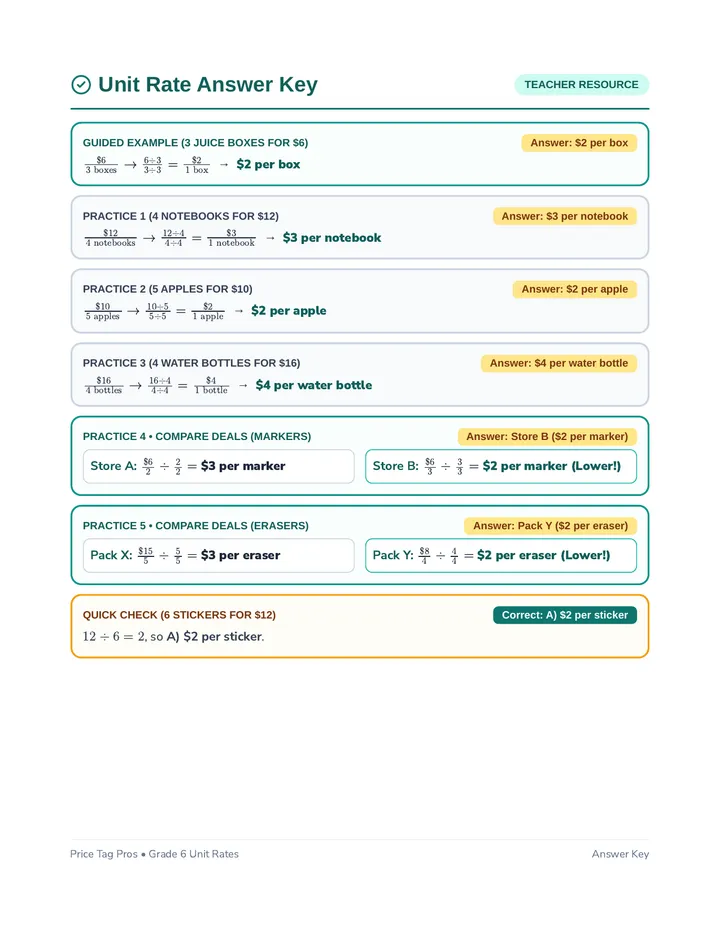
Unit Rate Answer Key Unit Rate Answer Key
TEACHER RESOURCE
Guided Example (3 juice boxes for $6) Answer: $2 per box
\(\frac{\$6}{3\text{ boxes}} \rightarrow \frac{6 \div 3}{3 \div 3} = \frac{\$2}{1\text{ box}}\) → $2 per box
Practice 1 (4 notebooks for $12) Answer: $3 per notebook
\(\frac{\$12}{4\text{ notebooks}} \rightarrow \frac{12 \div 4}{4 \div 4} = \frac{\$3}{1\text{ notebook}}\) → $3 per notebook
Practice 2 (5 apples for $10) Answer: $2 per apple
\(\frac{\$10}{5\text{ apples}} \rightarrow \frac{10 \div 5}{5 \div 5} = \frac{\$2}{1\text{ apple}}\) → $2 per apple
Practice 3 (4 water bottles for $16) Answer: $4 per water bottle
\(\frac{\$16}{4\text{ bottles}} \rightarrow \frac{16 \div 4}{4 \div 4} = \frac{\$4}{1\text{ bottle}}\) → $4 per water bottle
Practice 4 • Compare Deals (Markers) Answer: Store B ($2 per marker)
Store A: \(\frac{\$6}{2} \div \frac{2}{2} = \) $3 per marker
Store B: \(\frac{\$6}{3} \div \frac{3}{3} = \) $2 per marker (Lower!)
Practice 5 • Compare Deals (Erasers) Answer: Pack Y ($2 per eraser)
Pack X: \(\frac{\$15}{5} \div \frac{5}{5} = \) $3 per eraser
Pack Y: \(\frac{\$8}{4} \div \frac{4}{4} = \) $2 per eraser (Lower!)
Quick Check (6 stickers for $12) Correct: A) $2 per sticker
\(12 \div 6 = 2\), so A) $2 per sticker .
Price Tag Pros • Grade 6 Unit Rates Answer Key
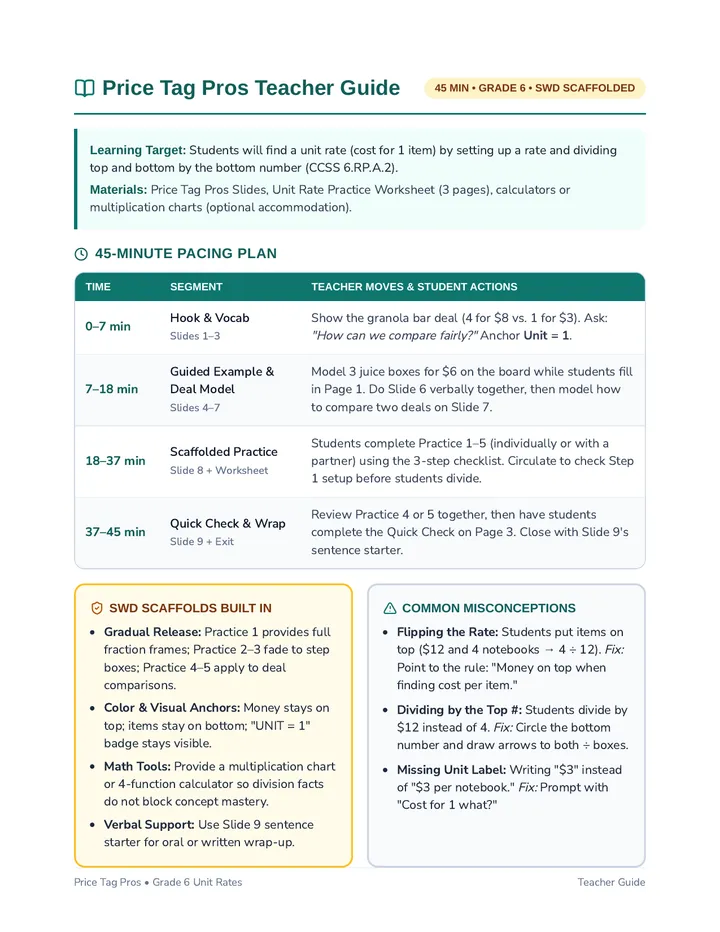
Price Tag Pros Teacher Guide Price Tag Pros Teacher Guide
45 MIN • GRADE 6 • SWD SCAFFOLDED
Learning Target: Students will find a unit rate (cost for 1 item) by setting up a rate and dividing top and bottom by the bottom number (CCSS 6.RP.A.2).
Materials: Price Tag Pros Slides, Unit Rate Practice Worksheet (3 pages), calculators or multiplication charts (optional accommodation).
45-Minute Pacing Plan
Time
Segment
Teacher Moves & Student Actions
0–7 min
Hook & Vocab
Slides 1–3
Show the granola bar deal (4 for $8 vs. 1 for $3). Ask: "How can we compare fairly?" Anchor Unit = 1 .
7–18 min
Guided Example & Deal Model
Slides 4–7
Model 3 juice boxes for $6 on the board while students fill in Page 1. Do Slide 6 verbally together, then model how to compare two deals on Slide 7.
18–37 min
Scaffolded Practice
Slide 8 + Worksheet
Students complete Practice 1–5 (individually or with a partner) using the 3-step checklist. Circulate to check Step 1 setup before students divide.
37–45 min
Quick Check & Wrap
Slide 9 + Exit
Review Practice 4 or 5 together, then have students complete the Quick Check on Page 3. Close with Slide 9's sentence starter.
SWD Scaffolds Built In
Gradual Release: Practice 1 provides full fraction frames; Practice 2–3 fade to step boxes; Practice 4–5 apply to deal comparisons.Color & Visual Anchors: Money stays on top; items stay on bottom; "UNIT = 1" badge stays visible.Math Tools: Provide a multiplication chart or 4-function calculator so division facts do not block concept mastery.Verbal Support: Use Slide 9 sentence starter for oral or written wrap-up.
Common Misconceptions
Flipping the Rate: Students put items on top ($12 and 4 notebooks → 4 ÷ 12). Fix: Point to the rule: "Money on top when finding cost per item."Dividing by the Top #: Students divide by $12 instead of 4. Fix: Circle the bottom number and draw arrows to both ÷ boxes.Missing Unit Label: Writing "$3" instead of "$3 per notebook." Fix: Prompt with "Cost for 1 what?"
Price Tag Pros • Grade 6 Unit Rates Teacher Guide