Division Fractions Reference Sheet
Grade 5 Math Reference Guide CCSS 5.NF.B.3
Fractions as Division Reference Sheet
Unit 2 • Lesson 6 \(a \div b = \frac{a}{b}\)
1. The Big Law: Division is Always a Fraction
Dividend \(\div\) Divisor = \(\frac{\text{Dividend}}{\text{Divisor}}\)
Dividend \(a\)
\(\div\)
Divisor \(b\)
=
Fraction \(\frac{a}{b}\)
Top: Numerator (\(a\))
• Total amount being shared
• How many parts each person gets
Bottom: Denominator (\(b\))
• Number of equal shares / people
• The size of each piece (e.g. thirds)
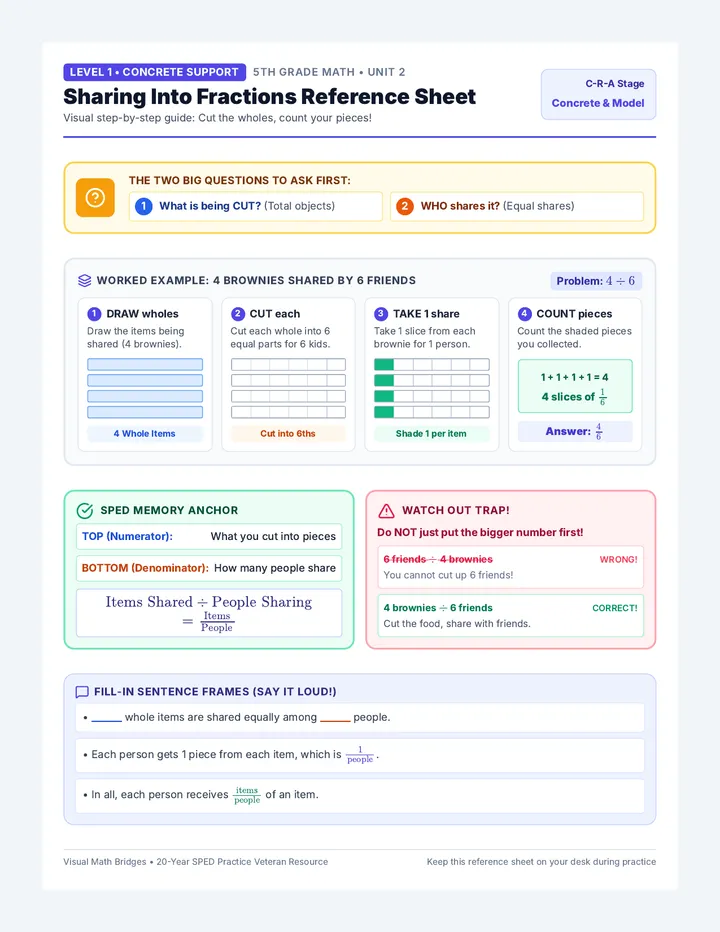
Visual Sharing Model
3 brownies shared by 4 friends: Cut each whole into 4 fourths. Each friend gets 1 fourth from each brownie:
\(\rightarrow \frac{1}{4} + \frac{1}{4} + \frac{1}{4} = \mathbf{\frac{3}{4}}\)
\(3 \div 4 = \mathbf{\frac{3}{4}}\) of a brownie each
2. Converting Improper Fractions to Mixed Numbers
When Numerator > Denominator
1 Divide with Remainder
Divide the top (numerator) by the bottom (denominator).
\(8 \div 3 = \mathbf{2}\) remainder \(\mathbf{2}\)
2 Assign the Parts
• Quotient (2) = Whole Number
• Remainder (2) = New Numerator
Whole = \(\mathbf{2}\), Remainder = \(\mathbf{2}\)
3 Keep the Denominator
The denominator remains exactly the same as the original.
\(\frac{8}{3} = \mathbf{2\frac{2}{3}}\)
3. Solving Story Problems: The "GST" Strategy
Equation: \(\text{Total} \div \text{Groups} = \frac{\text{Total}}{\text{Groups}}\)
Example A: Sharing Cookies Result > 1
"3 friends equally share 11 cookies. How many cookies does each friend get?"
Total (T)11 cookies
Groups (G)3 friends
Size (S)\(11 \div 3\)
\(11 \div 3 = \mathbf{\frac{11}{3}} = \mathbf{3\frac{2}{3}}\) cookies per person
Example B: Sharing Water Result < 1
"5 campers equally share 3 liters of water. How many liters does each camper get?"
Total (T)3 liters
Groups (G)5 campers
Size (S)\(3 \div 5\)
\(3 \div 5 = \mathbf{\frac{3}{5}}\) liter per camper
4. Common Traps to Avoid
Watch Your Steps!
Trap 1: Flipping the Fraction
\(18 \div 5\) is \(\frac{18}{5}\), NOT \(\frac{5}{18}\). The first number ALWAYS goes on top.
Trap 2: Mixed # Confusion
\(\frac{5}{2}\) does NOT equal \(5\frac{1}{2}\)! \(\frac{5}{2}\) means 5 halves, which equals \(2\frac{1}{2}\) wholes.
Trap 3: Whole Number Results
Fractions can also equal whole numbers! \(\frac{6}{2} = 6 \div 2 = \mathbf{3}\) wholes, because six halves make three complete wholes.
5. Quick Reference Conversion Bank
Keep in your binder or notebook
| Division Expression | Fraction Form | Mixed # or Whole | Verbal Meaning / Explanation |
|---|
| \(2 \div 3\) | \(\frac{2}{3}\) | — (proper fraction) | 2 wholes shared equally by 3 people; each gets \(\frac{2}{3}\) |
| \(5 \div 2\) | \(\frac{5}{2}\) | \(2\frac{1}{2}\) | 5 wholes shared by 2 people; each gets 2 wholes and 1 half |
| \(7 \div 4\) | \(\frac{7}{4}\) | \(1\frac{3}{4}\) | 7 fourths grouped together make 1 whole and \(\frac{3}{4}\) |
| \(8 \div 5\) | \(\frac{8}{5}\) | \(1\frac{3}{5}\) | 8 wholes divided into 5 equal parts gives \(\frac{1}{5}\) from each whole (\(\frac{8}{5}\)) |
Golden Rule: The fraction bar means division! \(\frac{a}{b}\) literally reads "a divided by b". 5th Grade Mathematics • Illustrative Math Aligned