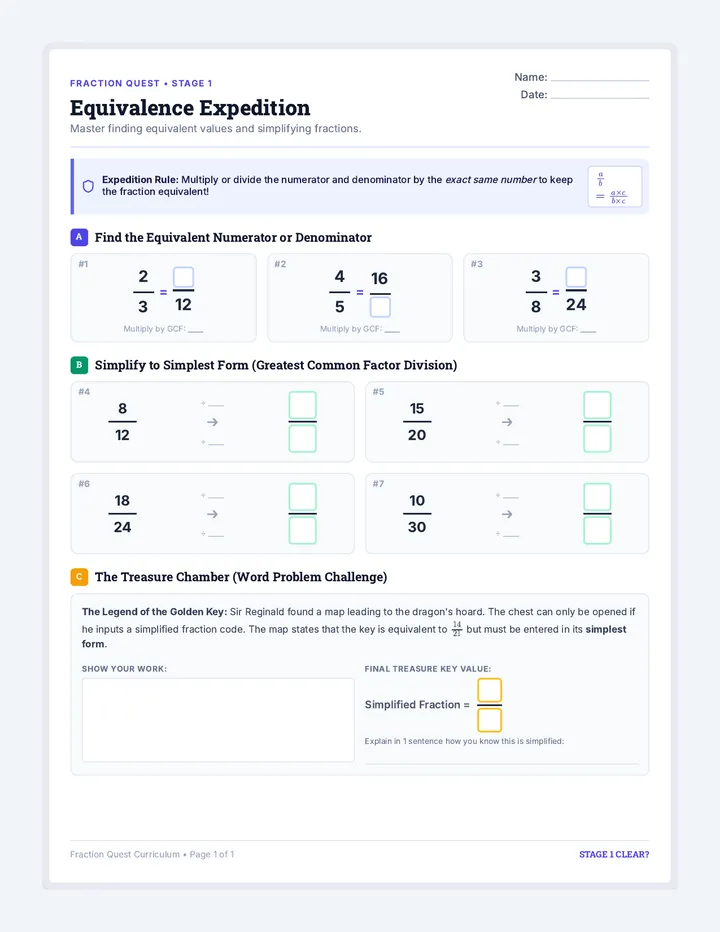
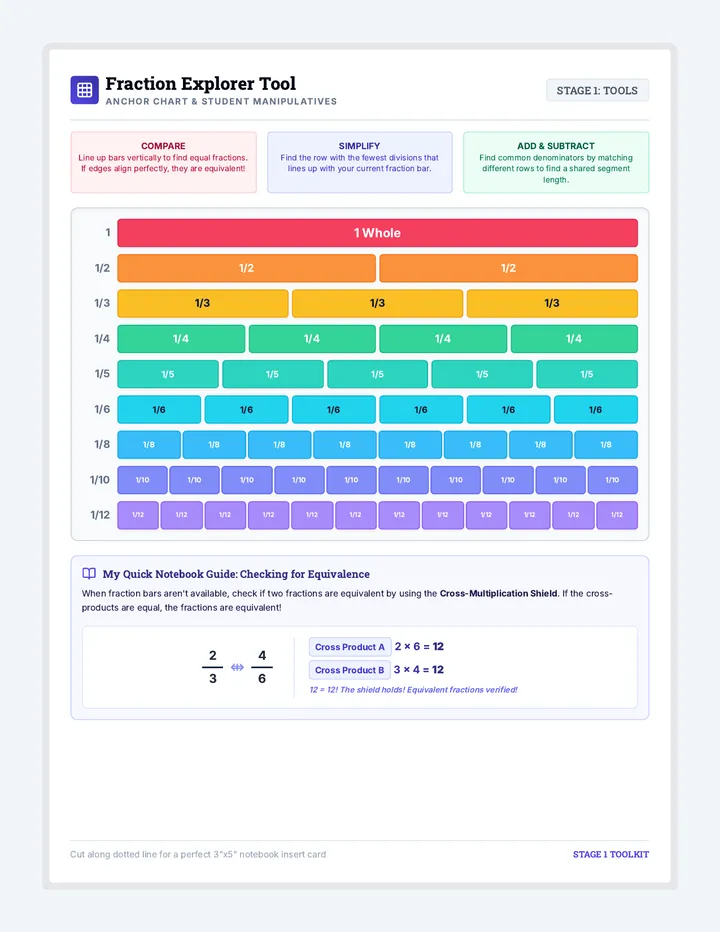
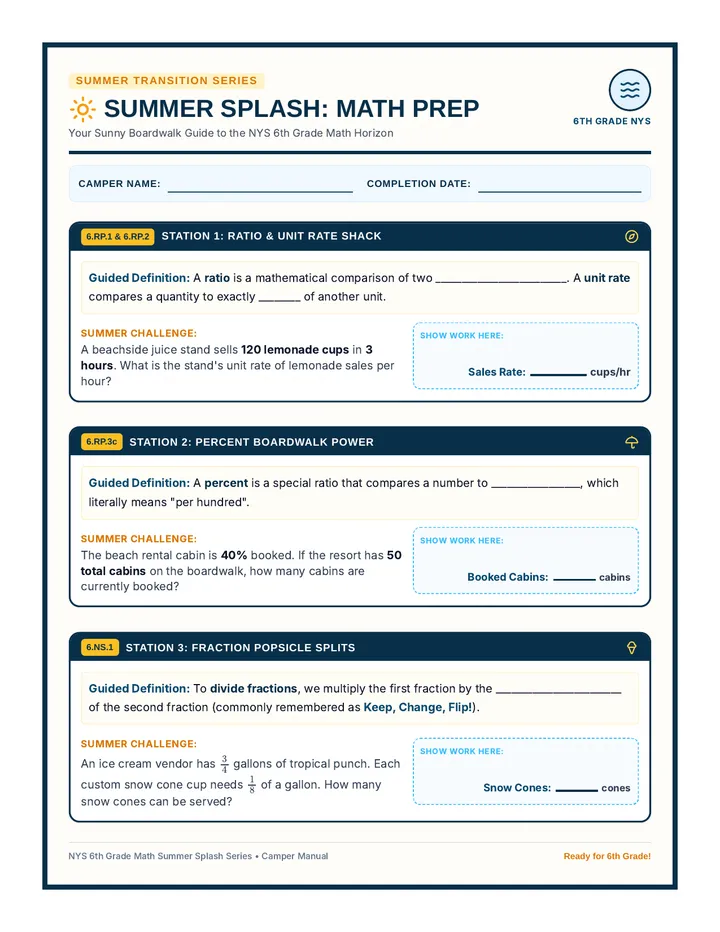
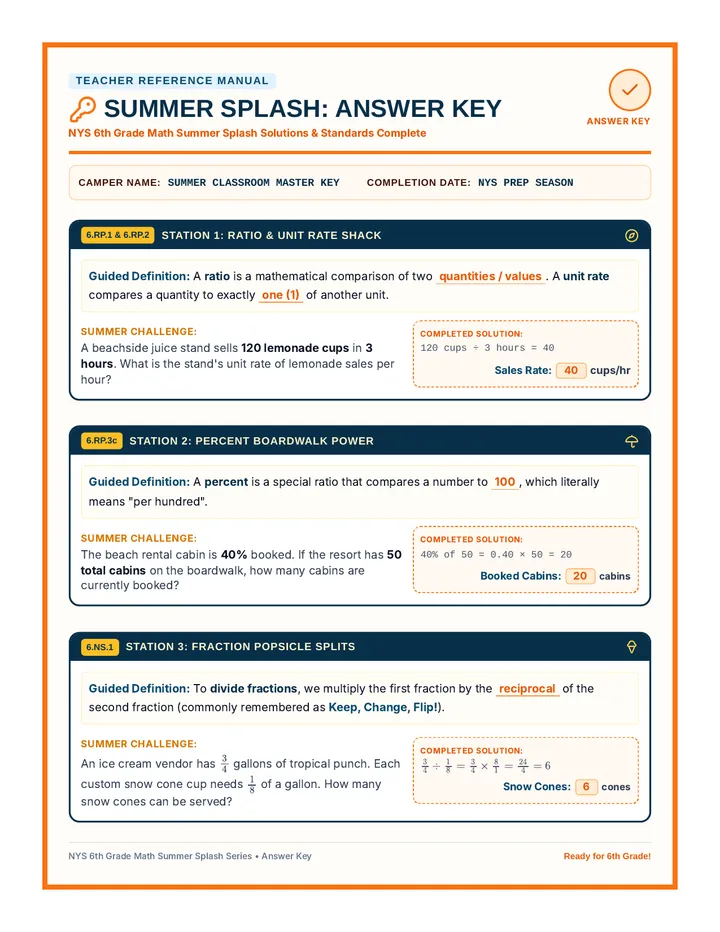
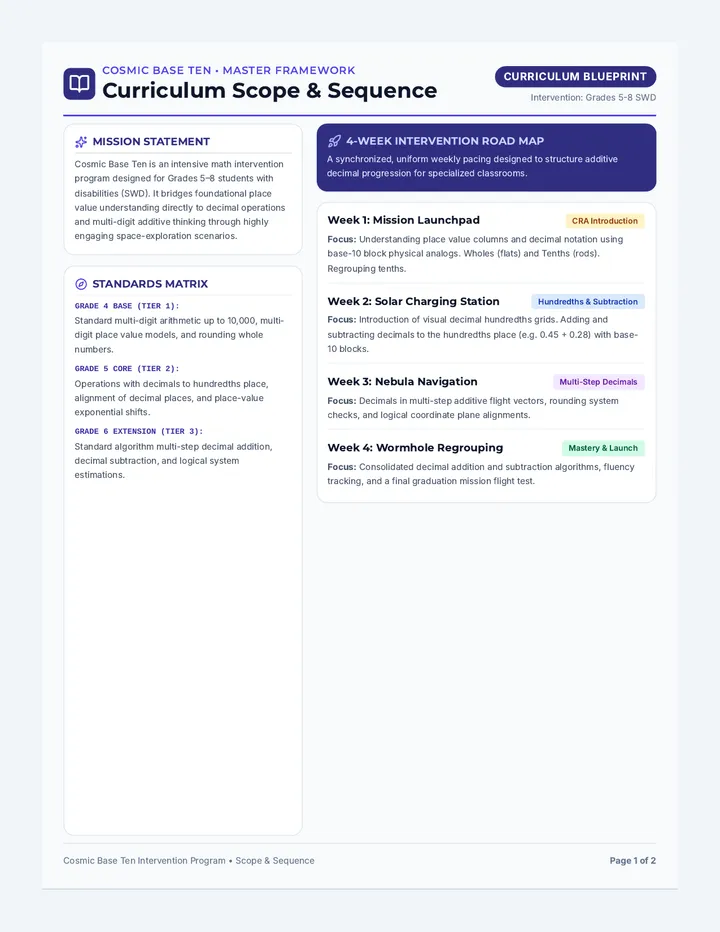
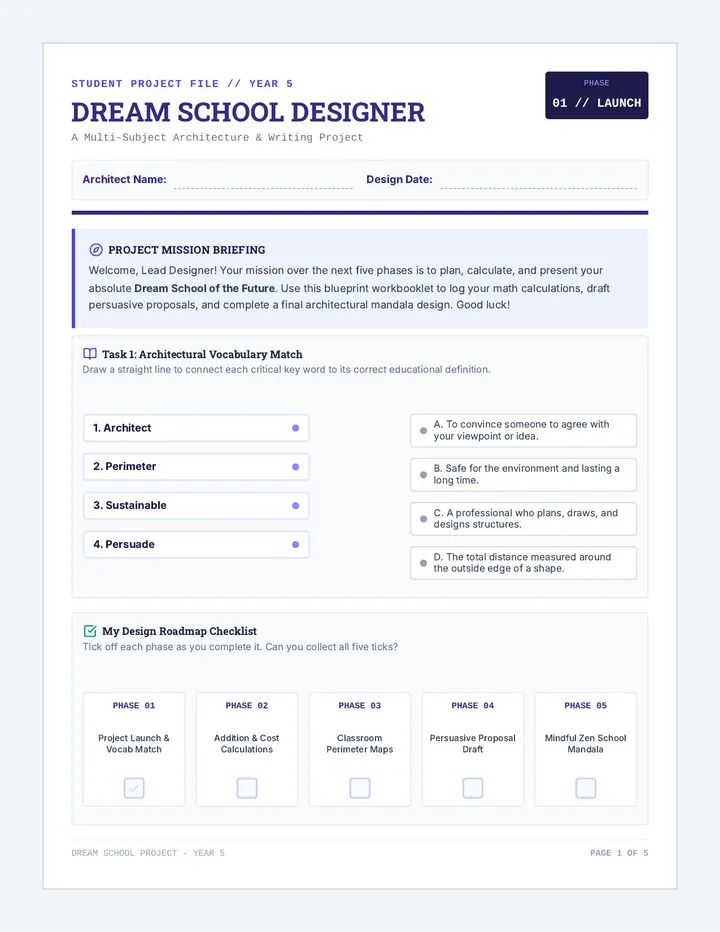
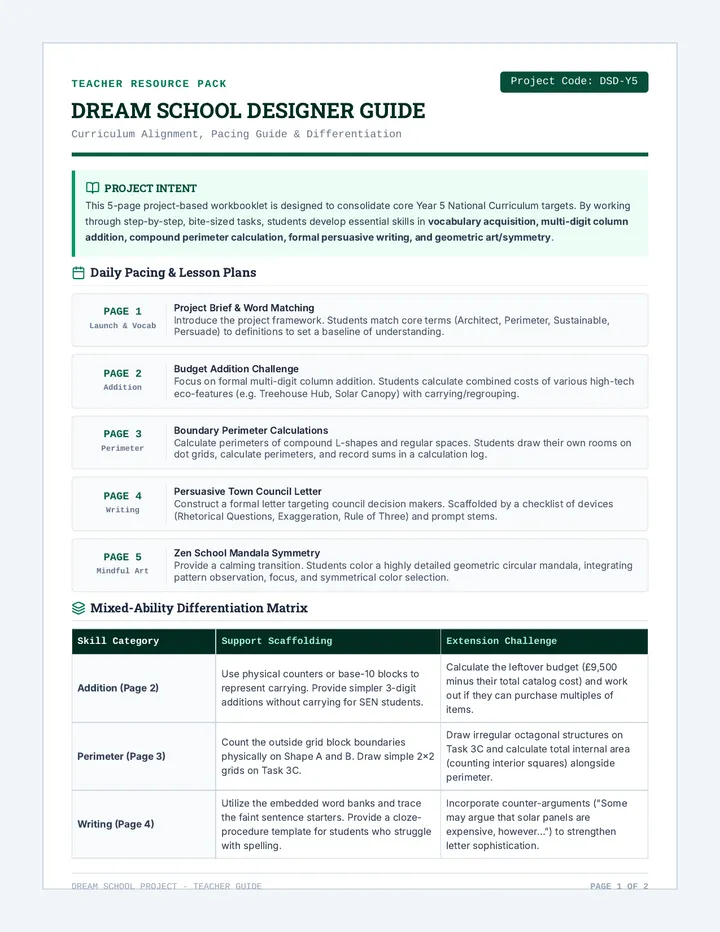
A practice sheet where students identify equivalent fractions using bakery-themed visual models and number sentences, covering denominators 2, 3, 4, 6, and 8. Optimized with fixed widths and centered layouts to prevent overlapping.
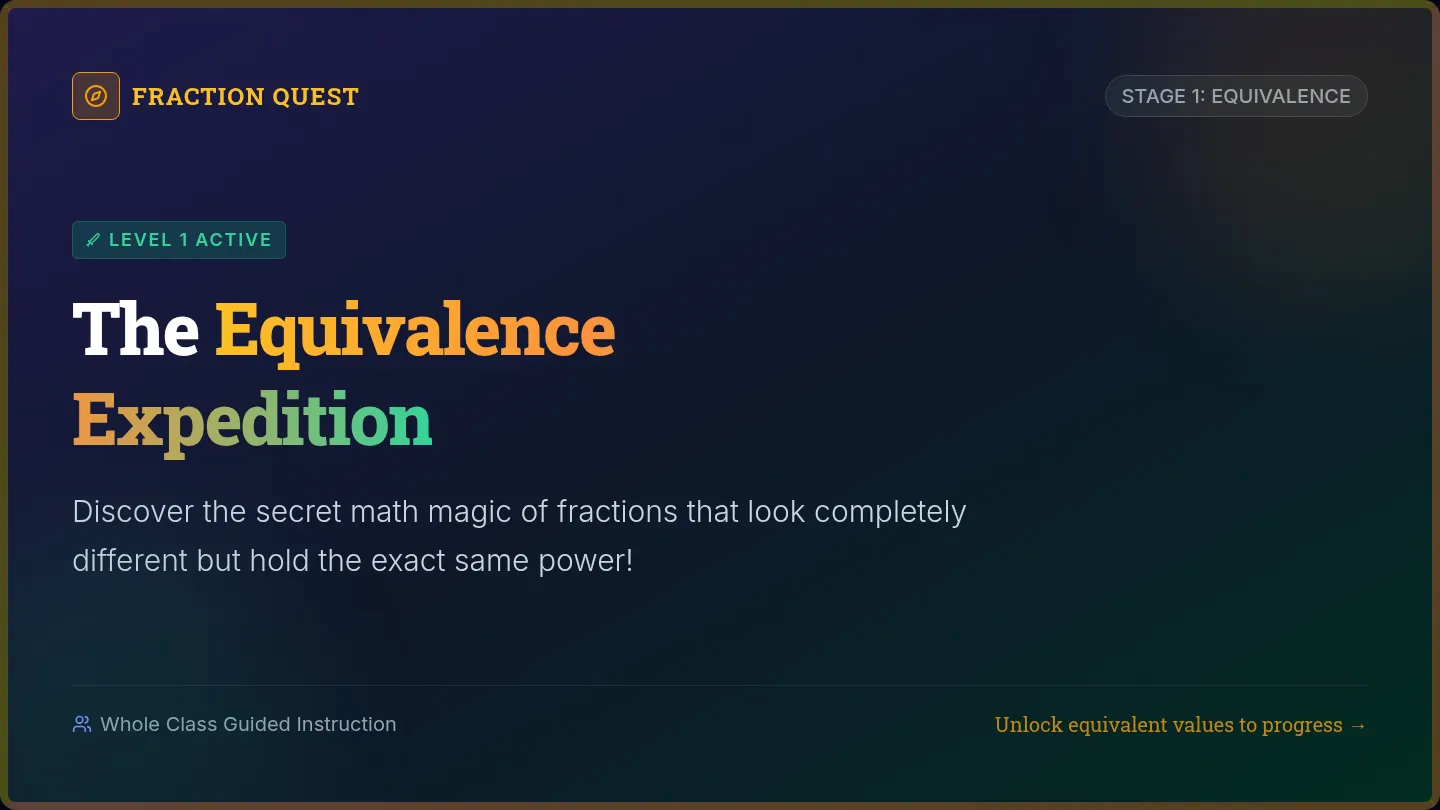
Answer key for the Level 2 Exit Ticket, with a breakdown of calculations and pedagogical notes for teachers.
Level 2 exit ticket with double-digit numbers, duplicated on one page for paper saving. Scaffolding added to support double-digit calculations.
Answer key for the Level 2 worksheet, including detailed calculations for double-digit central tendency across all five missions.
Level 2 worksheet focusing on double-digit data sets, expanded with five missions including guided practice and independent cases across two pages. Layout optimized for clean page breaks.
Instructional slides for Level 2 data analysis, focusing on the added complexity of multi-digit numbers while maintaining core statistical concepts.
Comprehensive answer key for the unit. Revised for clarity, correct data references, and page break efficiency.
Handouts for Lessons 3 and 4. Revised to keep Activity 4 on one page, fix wrapping, and improve work area visibility.
Bilingual slides for Lesson 4 (Interpreting Line Plots). Focuses on analyzing data representations, identifying differences between lists and plots, and verifying statements based on data. Revised for populated data and alignment.
Bilingual slides for Lesson 3 (Equivalence and Mixed Numbers). Explores recording lengths in multiple ways and visualizing mixed number partitioning. Revised for ruler accuracy and visible diagrams.
Bilingual slides for Lesson 2 (Measuring in Fourths). Includes estimation exploration, partitioning activities, and a cool-down involving choosing the right tool for precision. Revised for ruler accuracy and alignment.
Recording sheets for measuring activities in Lessons 1 and 2. Bilingual format. Revised to prevent table splits and improve name/date formatting.
Bilingual slide deck for the Measurement unit, covering Unit Goals, Rubric, and Lesson 1 (Measuring in Halves). Includes specific terminology in both English and Japanese. Revised for ruler accuracy and alignment.
Answer key for the Stat Squad Exit Ticket, featuring clear breakdowns of calculations and common error patterns.
A half-page exit ticket for a quick assessment of mean, median, mode, and range with a single-digit data set. Duplicate copies on one page to save paper.
A printable set of challenge cards for the Protocol Pursuit board game, including Encoder (expressions) and Sync (patterns) tasks with an answer key on a separate page. Fixed layout for no-bleed printing.
A printable circuit-themed board game for students to practice numerical expressions and patterns, featuring special 'Glitch' and 'Boost' spaces for added engagement. White-background theme for print efficiency.
A professional grading rubric for the Blueprint Park Architect project, assessing student performance across calculation accuracy, constraint adherence, design quality, and written reflection.
A student-facing worksheet for the Blueprint Park Architect project, featuring a coordinate grid for park design and a calculation log for tracking area and perimeter requirements.
A visually engaging slide deck for the Blueprint Park Architect lesson, introducing area and perimeter concepts through the lens of urban planning and architectural design.
A comprehensive teacher guide for the Blueprint Park Architect lesson, including learning objectives, standards alignment, instructional sequence, and answer key guidelines.
An advanced word problem set for the Pattern Protocol lesson, featuring complex scenarios involving cloud storage, battery management, and bandwidth comparison to master numerical expressions and pattern relationships. Corrected coordinate plane labels and empty work areas.
Answer key and teacher guide for the Stat Squad Training worksheet, including step-by-step solutions and common student misconceptions.
A guided practice worksheet for calculating mean, median, mode, and range with visual aids, step-by-step scaffolds, and single-digit data sets.
Instructional slides defining mean, median, mode, and range with visual examples and step-by-step logic for single-digit whole numbers.
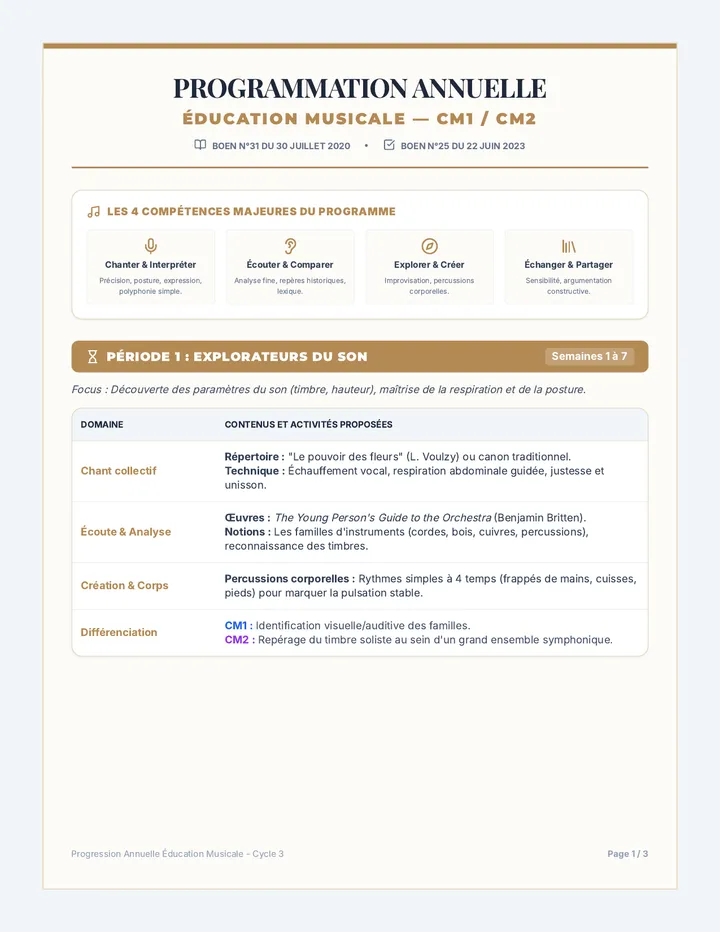
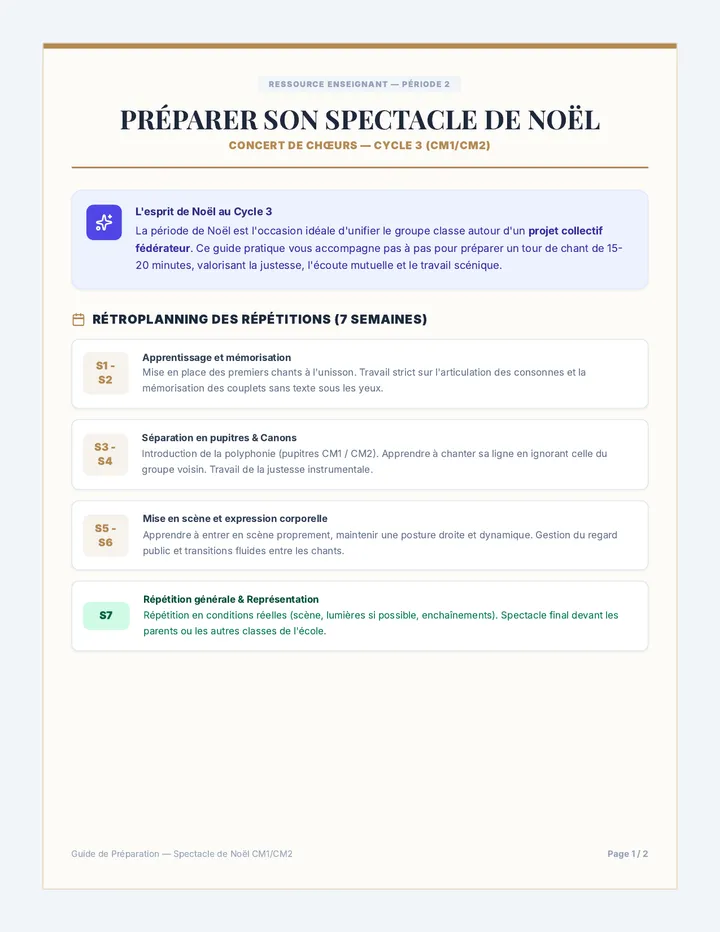
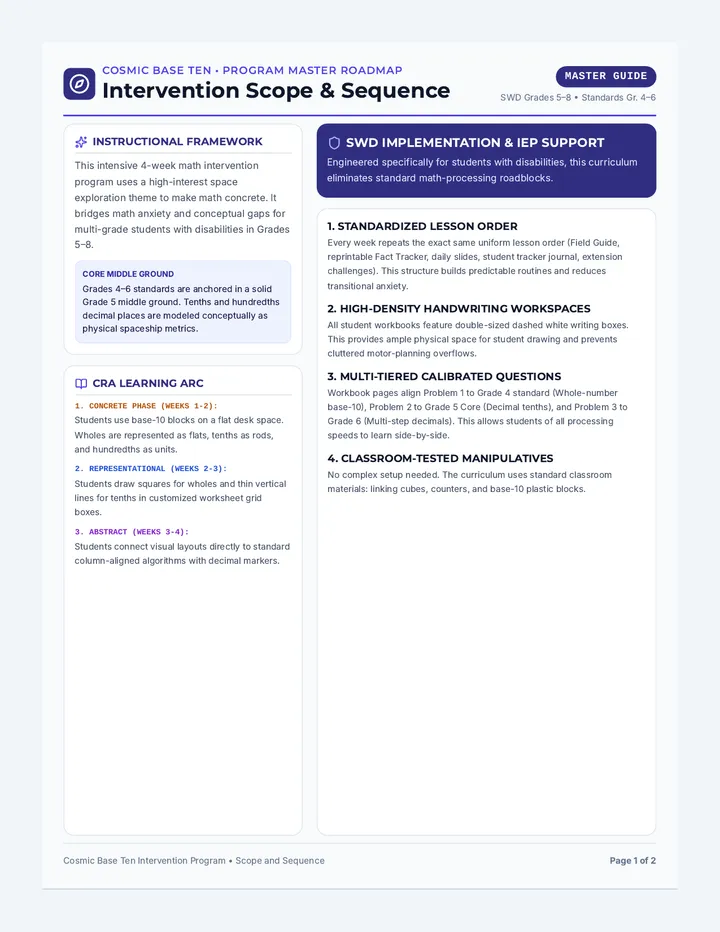
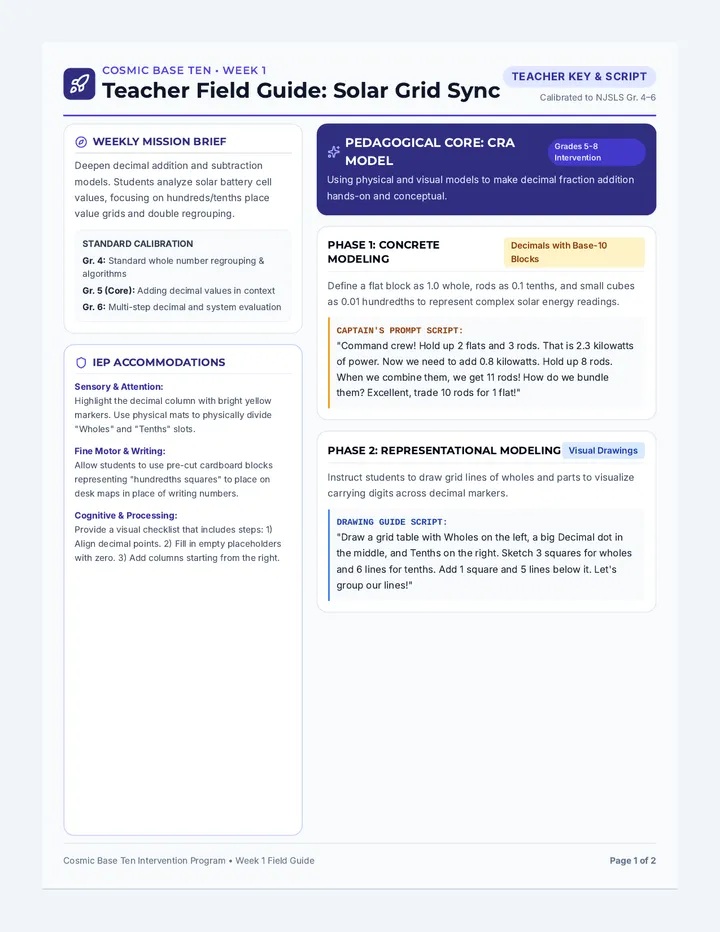
A set of 8 printable task cards designed for small group or station work, covering numerical expression writing and analyzing mathematical pattern relationships with a high-tech theme.
Comprehensive answer key for the Pattern Protocol lesson materials, including solutions for the Circuit Stories problem set, task cards, worksheet, and assessment. Corrected Task Card 5 values and logic contrast.
Final summative assessment for the Pattern Protocol lesson, testing students on numerical expression writing, pattern generation, coordinate pairs, and complex word problems with a high-tech diagnostic theme.
A compact exit ticket for quick assessment of expression writing and pattern relationships, designed with a clean digital theme and two-to-a-page layout for easy printing.
Practice worksheet for the Pattern Protocol lesson, featuring expression writing from phrases, dual pattern generation and graphing, and complex word problem applications with a tech-inspired aesthetic.
Instructional slide deck for the Pattern Protocol lesson, featuring vibrant visuals, code-inspired themes, and clear explanations for numerical expressions and coordinate graphing.
A technical rubric for evaluating architectural designs based on calculation accuracy, geometric complexity, sustainable principles, and blueprint quality.
A detailed teacher lesson plan for the Pattern Protocol lesson, covering standards NC.5.OA.2 and NC.5.OA.3 with instructional steps, differentiation strategies, and common misconceptions.
A student-facing drafting worksheet with a grid area for floor plan design and a structured table for calculating the perimeter and area of complex polygons, including spaces for fractional measurements.
An architectural-themed slide deck that introduces students to the role of an architect, reviews how to decompose complex polygons, and demonstrates area calculations with fractional side lengths.