Differentiation of interdependent variables with respect to time using the chain rule. Connects geometric formulas with algebraic manipulation to solve problems involving moving objects, fluid flow, and changing dimensions.
This advanced sequence explores related rates through the lens of geometric similarity and trigonometry, focusing on shadows and angular motion. Students move from linear proportions to complex angular derivatives, culminating in a mastery-based problem-solving seminar.
This sequence explores the calculus of related rates through the lens of 3D geometry and fluid dynamics. Students progress from simple spherical expansion to complex conical substitution and industrial net-flow applications.
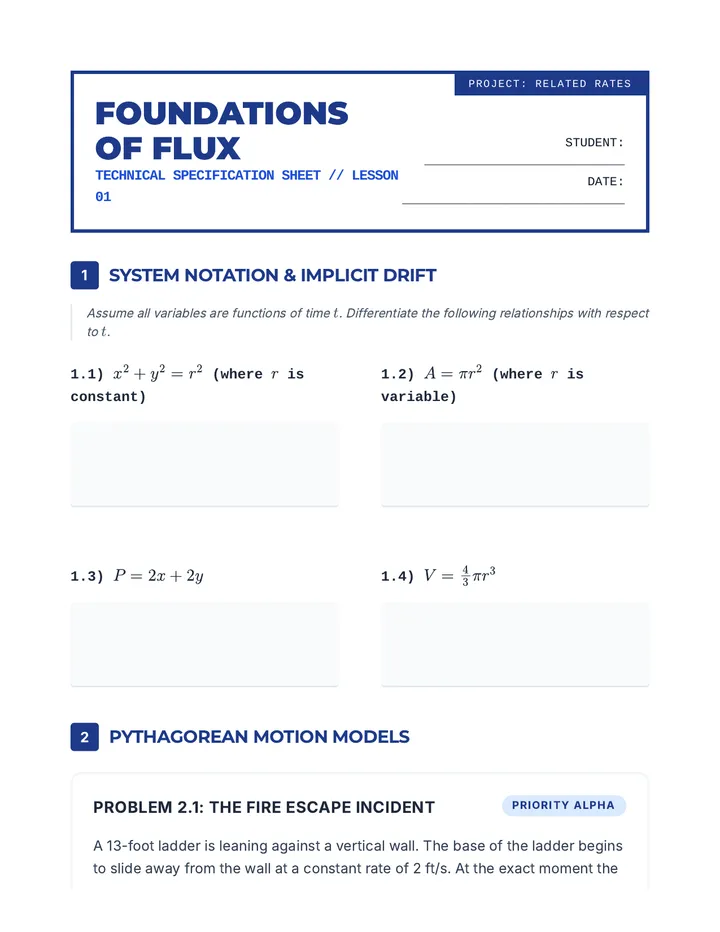
A comprehensive exploration of Related Rates using Pythagorean geometry, moving from basic ladder problems to complex multi-object motion. Students master the calculus of moving triangles through inquiry, digital modeling, and skill-building workshops.
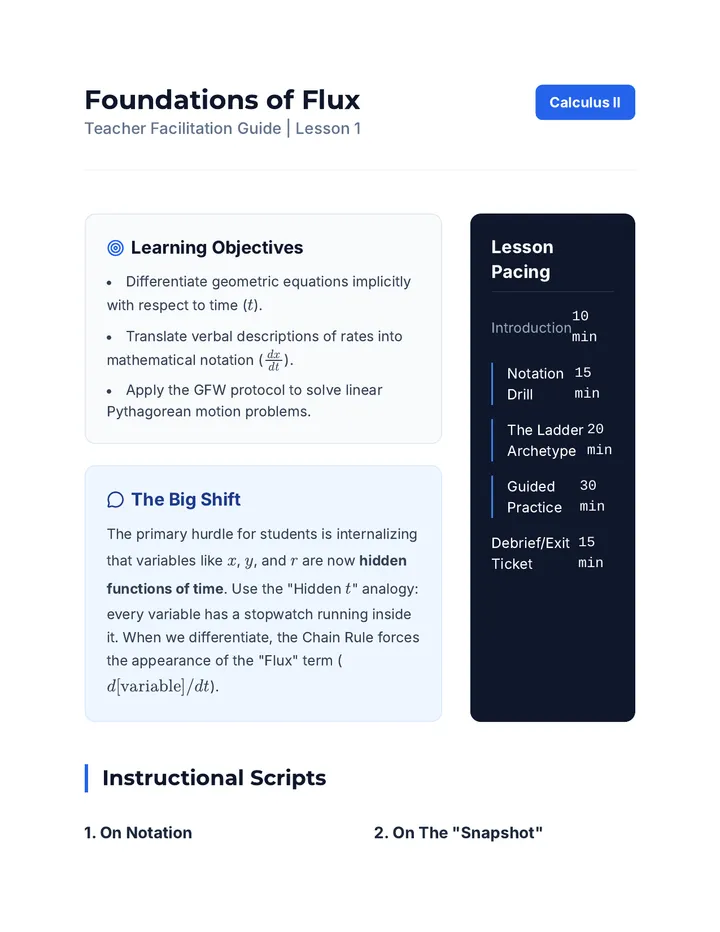
A foundational sequence for 11th-grade students on Related Rates in Calculus. Students move from static derivatives to dynamic, time-dependent rates of change, establishing a rigorous 4-step problem-solving protocol.
A calculus sequence for undergraduate students exploring related rates through environmental, engineering, and mechanical lenses. Students analyze dynamic systems like oil spills, reservoir drainage, and piston mechanics to understand the physical significance of time-dependent derivatives.
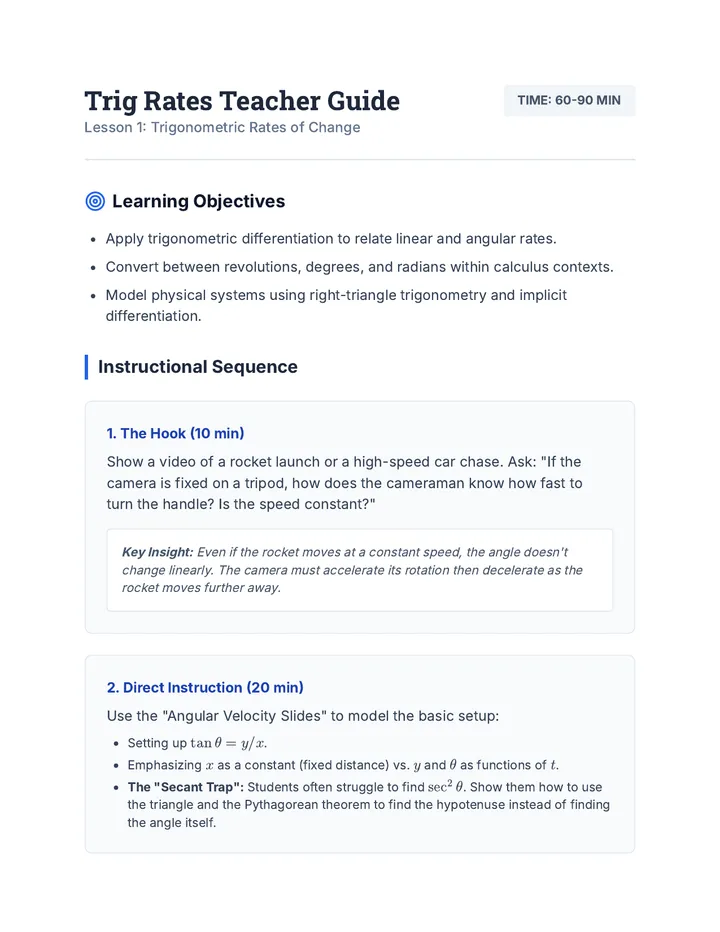
A systematic workshop-style approach to mastering related rates in Calculus. Students progress from foundational implicit differentiation to complex geometric modeling involving Pythagorean theorem, volume expansion, conical constraints, and trigonometric rates.
A high-level calculus sequence for 12th-grade students focused on related rates in complex physical and engineering contexts. Students explore trigonometric rates, multi-variable dependencies like the Ideal Gas Law, relative motion, and conclude with an engineering design project focused on safety protocols.
This sequence explores related rates in calculus through geometric modeling of 3D systems, including fluid dynamics and shadow propagation. Students progress from 2D similar triangle models to complex 3D variable elimination in conical tanks.
This sequence establishes the foundational skills for related rates in Calculus. It covers implicit differentiation with respect to time, translating word problems into notation, and solving problems involving Pythagorean relationships and geometric shapes.
A condensed 3-part Calculus sequence on Related Rates, moving from linear motion models to complex geometric constraints and angular velocity.
This sequence guides undergraduate students through the modeling and solution of related rates problems, bridging the gap between static algebraic formulas and dynamic calculus concepts. Students will master implicit differentiation with respect to time and apply it to linear motion, geometric expansion, angular velocity, and fluid dynamics.
A comprehensive 12th-grade Calculus sequence on Related Rates, focusing on modeling dynamic physical systems through implicit differentiation and geometric relationships.