Application of derivatives to identify absolute extrema within constrained systems. Addresses problems in surface area maximization, cost minimization, and physical efficiency.
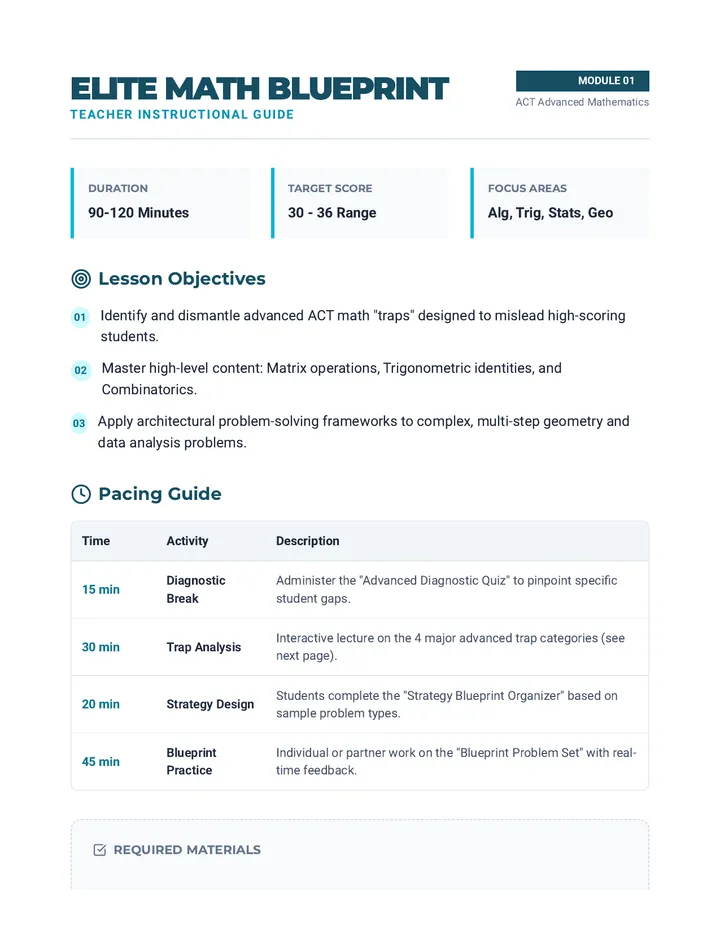
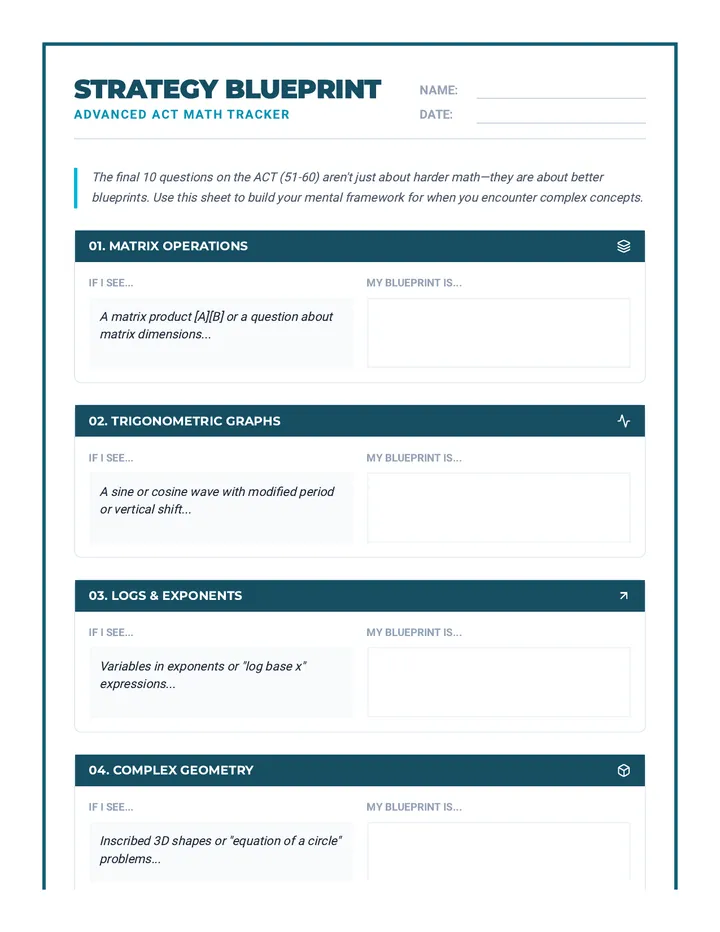
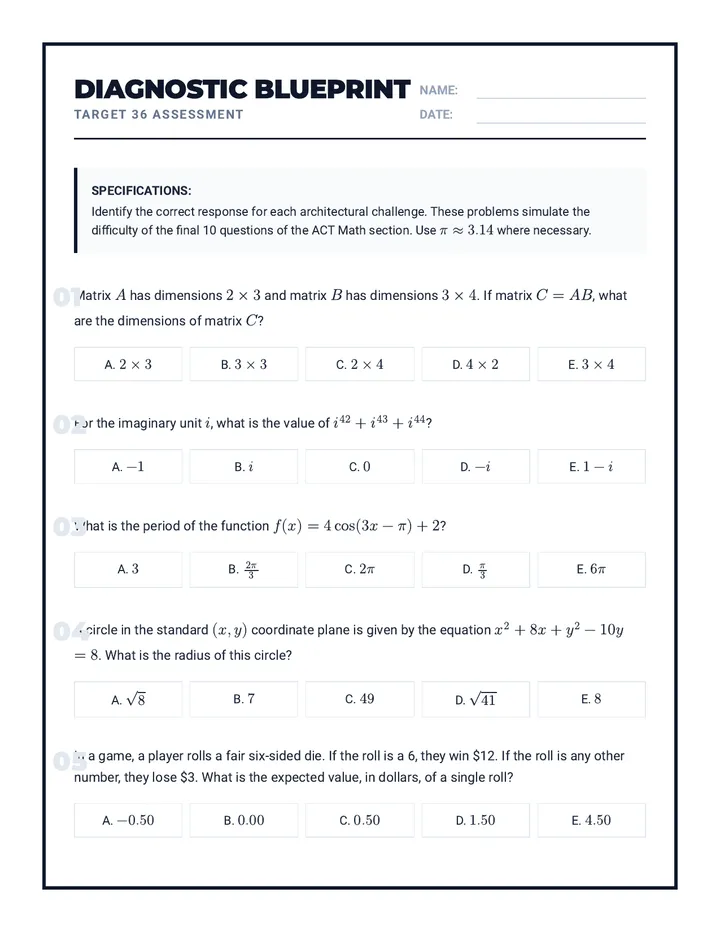
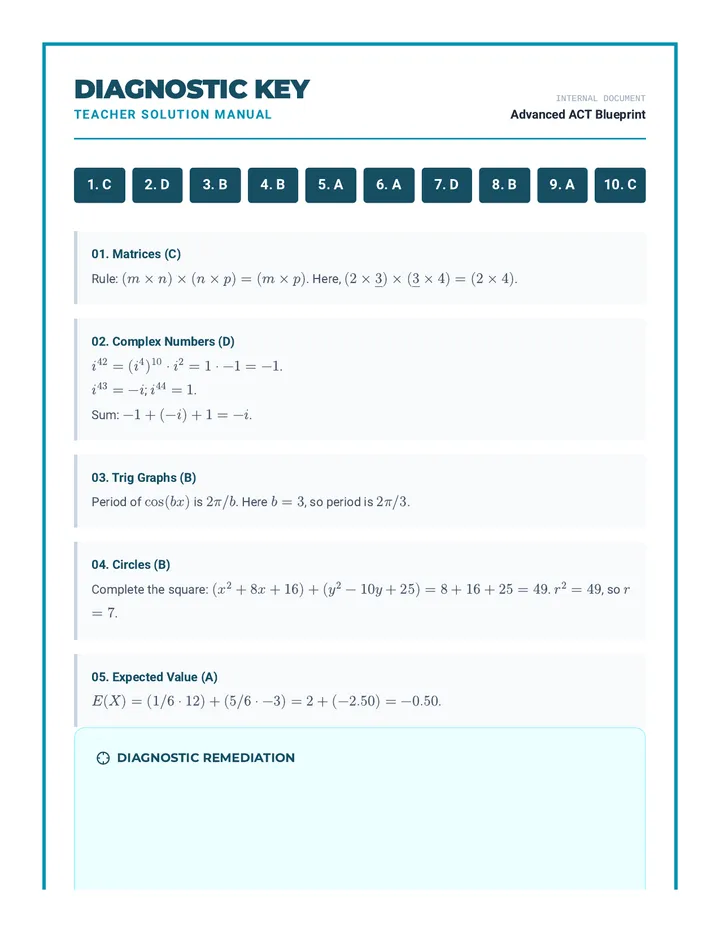
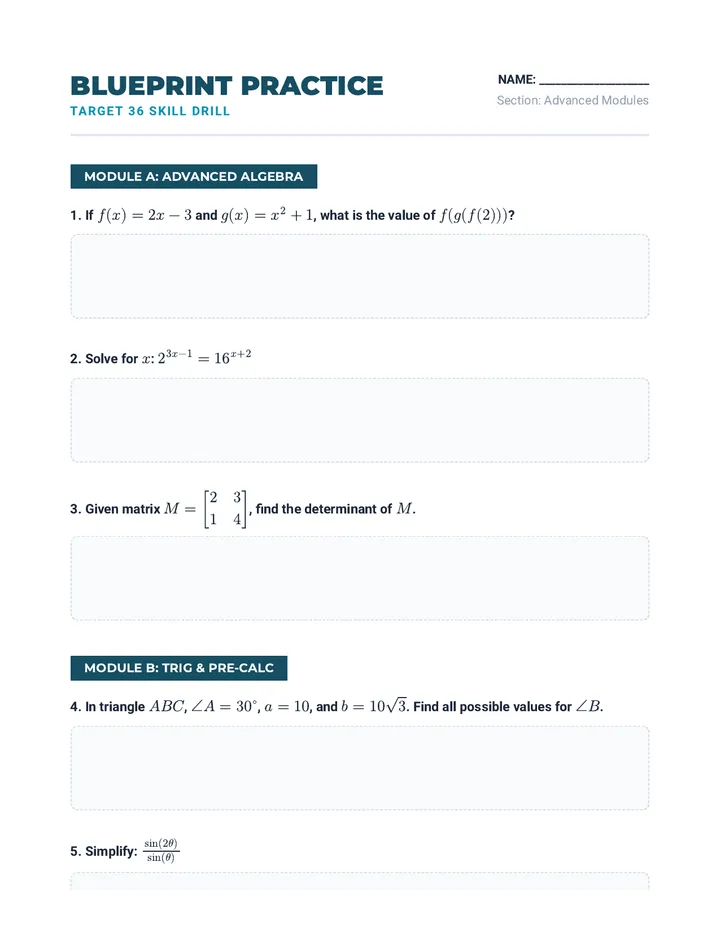
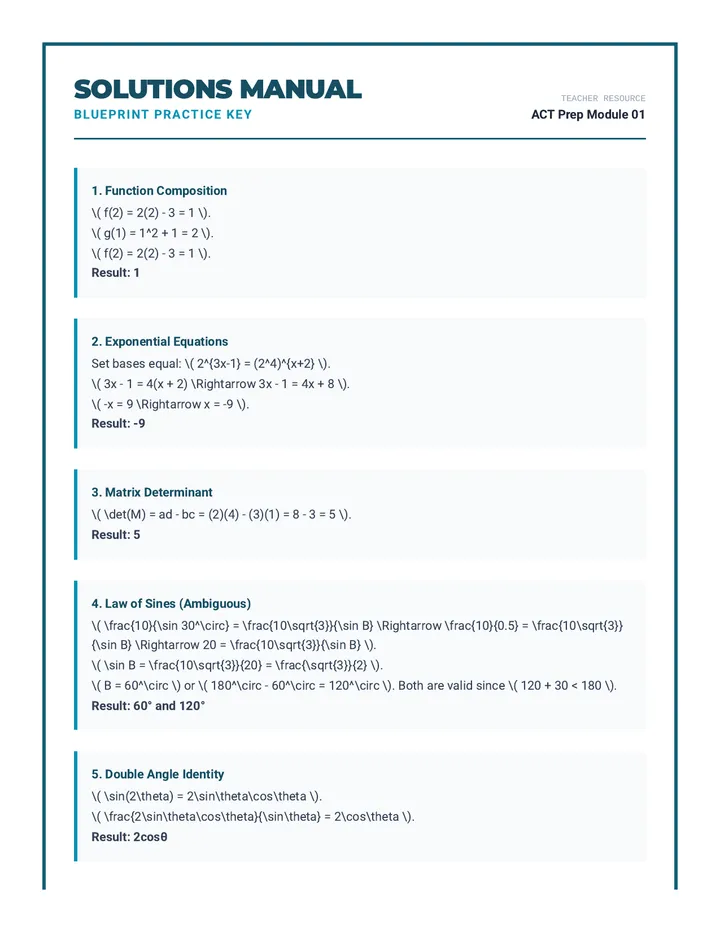
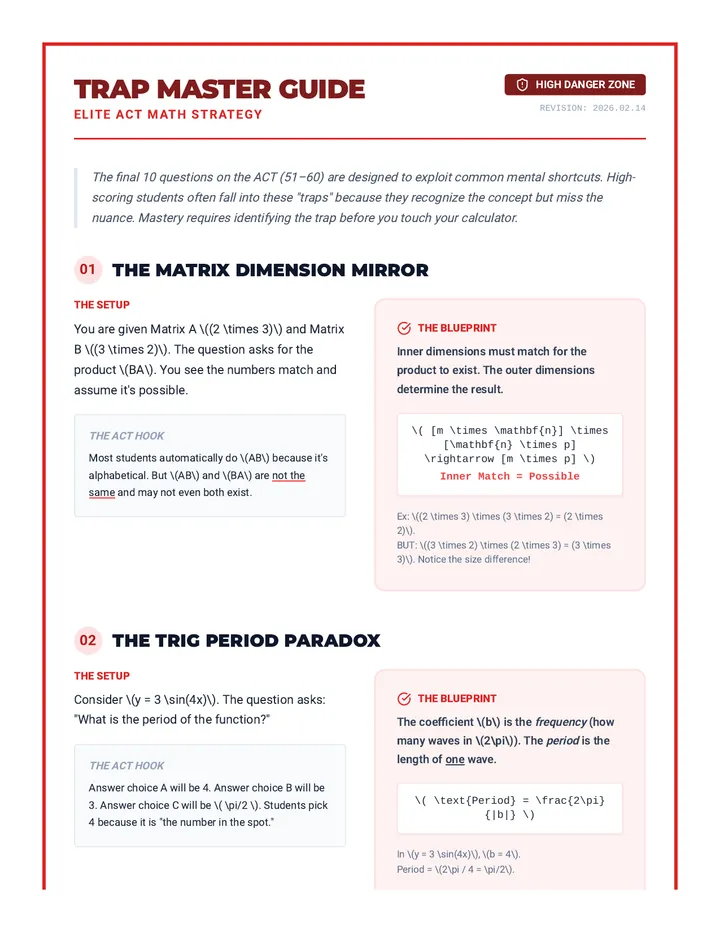
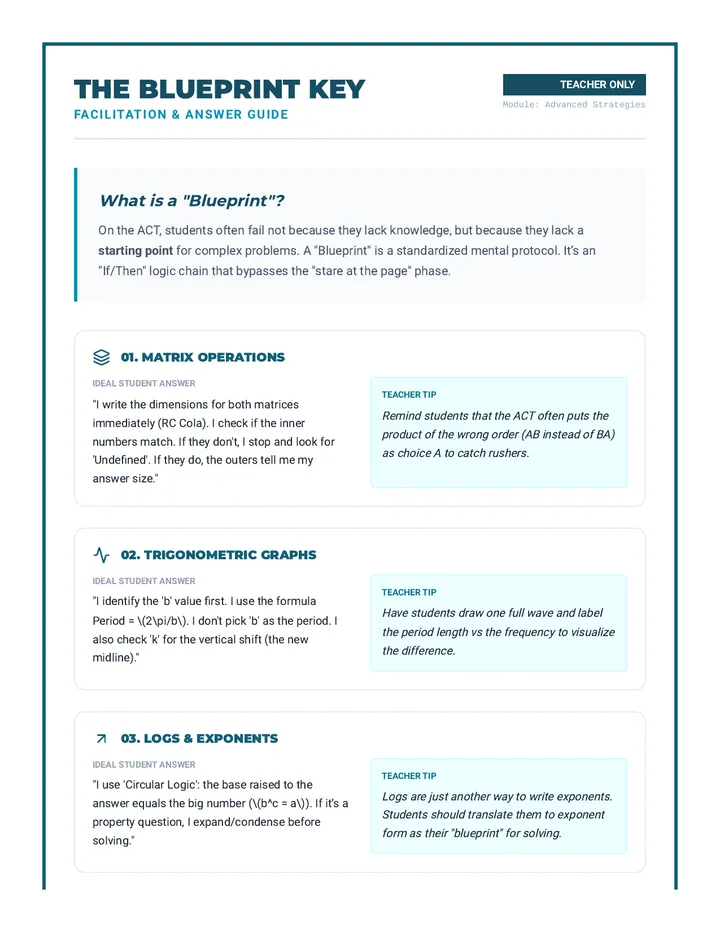
A comprehensive prep sequence for the most challenging questions on the ACT Math and Science sections. It focuses on high-level conceptual blueprints for math topics like complex numbers and matrices, alongside speed-reading and data-interpretation strategies for the Science section.
An advanced exploration of vector-valued functions and their applications in modeling 2D motion and force, preparing students for multivariable calculus.
A comprehensive unit for 12th Grade Calculus students focusing on the derivation and application of derivatives in polar coordinates. Students transition from Cartesian slope to polar slope, analyze horizontal and vertical tangency, investigate behavior at the pole, and solve optimization problems involving polar curves.
This sequence explores the calculus of polar functions, focusing on differentiation techniques. Students will learn to calculate slopes of tangent lines, identify horizontal and vertical tangents, analyze behavior at the pole, and apply optimization to find maximum and minimum distances from the origin.
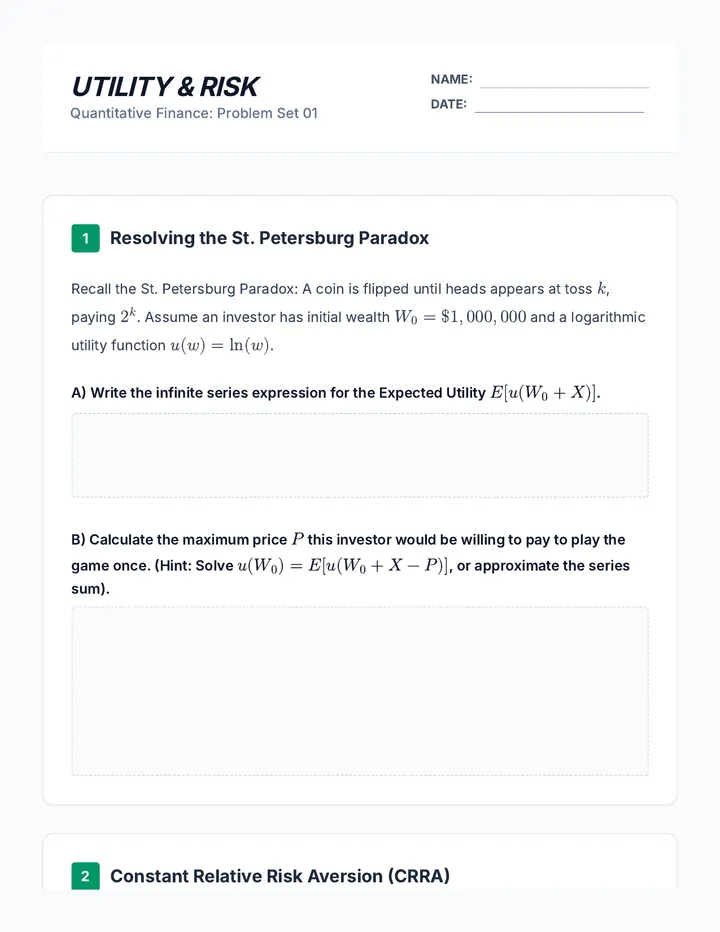
A graduate-level exploration of expected value applications in finance, covering utility theory, portfolio optimization, risk-neutral pricing, and tail risk metrics. Students transition from theoretical foundations to computational implementation using Monte Carlo methods.
A graduate-level exploration of the Calculus of Variations, focusing on optimizing functionals. Students derive the Euler-Lagrange equation and apply it to physics and geometry problems like the Brachistochrone and Isoperimetric challenges.
A graduate-level sequence on constrained optimization, covering Lagrange Multipliers, KKT conditions, and sensitivity analysis for economics and engineering applications.
A comprehensive graduate-level exploration of numerical optimization algorithms, moving from first-order gradient descent to second-order Newton methods and computationally efficient Quasi-Newton approaches. Students analyze convergence rates, stability, and strategies for navigating complex, non-convex landscapes.
This sequence establishes the rigorous mathematical underpinnings necessary for advanced optimization work, moving beyond procedural calculus to analysis-based proofs. Students explore the intersection of topology, set theory, and multivariate calculus to determine the existence and uniqueness of optimal solutions.
An inquiry-based exploration of calculus optimization, focusing on real-world efficiency in travel time, infrastructure cost, and business profit. Students progress from geometric shortest-paths to complex rate-based modeling.
A comprehensive workshop series on optimization in calculus. Students master the Extreme Value Theorem, learn to translate complex word problems into mathematical models, and apply differentiation to find optimal outcomes in number theory and geometric contexts.
A project-based calculus sequence where students use optimization to design efficient packaging. They transition from physical modeling to algebraic functions and derivative-based solutions to maximize volume and minimize material costs.