Subzero Summit Teacher Guide Grades 6–7 Mathematics • 80-Minute Lesson Plan
Subzero to Summit: Teacher Guide
Topic
Comparing Integers
NJSLS-M Standards
6.NS.C.5: Use positive and negative numbers to represent real-world quantities; explain the meaning of 0.
6.NS.C.6: Represent rational numbers as points on horizontal and vertical number lines.
6.NS.C.7a–b: Interpret inequalities as relative position on a number line; write and explain order in real-world contexts.
7.NS.A.1 (Bridge): Compare signed values and distances on number lines.
Learning Targets
• Plot positive and negative integers on horizontal and vertical number lines.
• Compare two integers using \(<\), \(>\), and \(=\) based on number line position.
• Order sets of integers from least to greatest and greatest to least.
• Write and explain inequality statements in elevation and temperature contexts.
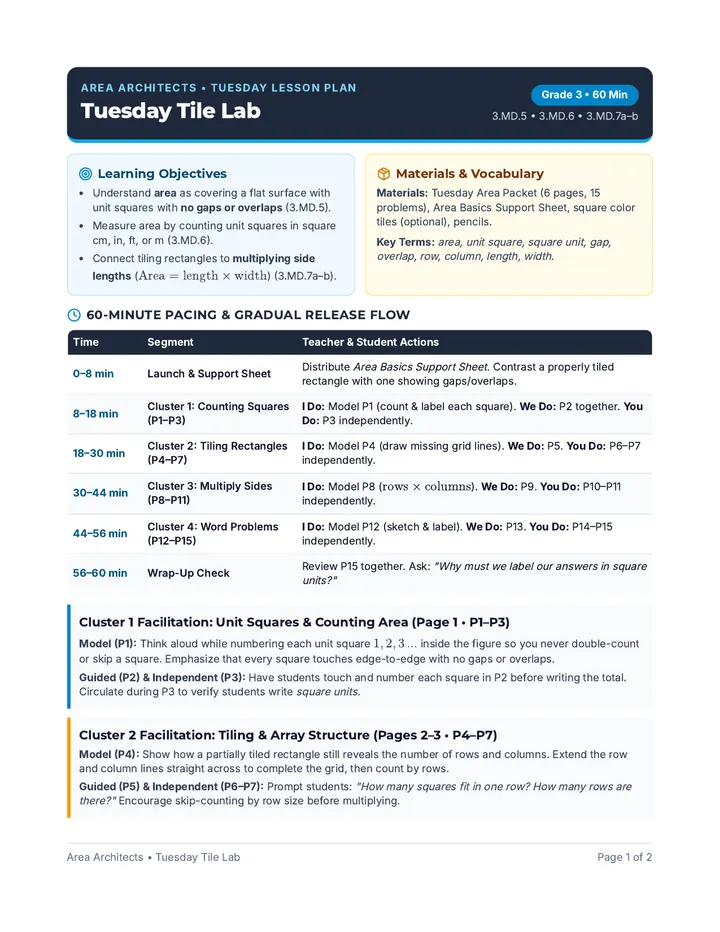
80-Minute Pacing Breakdown
Time
Phase & Material
Instructional Moves
0–10 min
(10 min)
Launch: Sea Level Snap
Slides 1–3
Display the 4 real-world clues (Death Valley, Mount Washington, Submarine, Freezing Point). Ask students to assign an integer to each and explain what \(0\) represents in each context.
10–28 min
(18 min)
Direct Instruction & Guided Practice
Slides 4–7
Model horizontal vs. vertical number lines. Emphasize the Golden Rule: numbers further right (or higher up) are always greater. Address the "Negative Trap" (\(-12\) vs. \(-4\)) and complete Slide 7 whiteboard checks.
28–48 min
(20 min)
Partner Expedition
Slide 8 + Whiteboards
Pairs generate 5 temperature/elevation pairs, plot both on a shared number line, write two equivalent inequalities (e.g., \(-8 < -2\) and \(-2 > -8\)), and justify which is warmer/higher.
48–68 min
(20 min)
Independent Practice
Elevation Depth Worksheet
Students complete Parts 1–4 independently. Circulate to check that students are plotting negative integers to the left of zero in decreasing order (\(-1, -2, -3\dots\)) rather than backwards.
68–80 min
(12 min)
Debrief & Exit Ticket
Summit Check Exit Ticket
Review 1 tricky problem from Part 4 together (3 min), then administer the Summit Check Exit Ticket silently (7 min). Collect for next-day small-group sorting (2 min).
Materials Needed: Slide Deck, Elevation Depth Worksheet (1 per student), Summit Check Exit Ticket (1 per student), dry-erase boards/markers for pairs.
Instructional Support & Differentiation
Subzero to Summit • Page 2
Key Vocabulary
Integer
The set of whole numbers and their opposites: \(\{\dots, -3, -2, -1, 0, 1, 2, 3, \dots\}\).
Inequality
A mathematical sentence comparing two values using symbols such as \(<\) (less than) or \(>\) (greater than).
Opposite Numbers
Two numbers that are the same distance from \(0\) on a number line, in opposite directions (e.g., \(-6\) and \(6\)).
Sea Level / Reference Zero
The starting point \(0\) used to measure quantities above/below or positive/negative.
Common Misconceptions & Fixes
1. "Bigger Digit = Greater Number" (\(-15 > -4\))
Fix: Anchor to temperature or debt. Ask: "Would you rather have \(-15^\circ\text{C}\) or \(-4^\circ\text{C}\)?" or "Which is further left on the number line?" Reinforce that \(-15\) is further from \(0\) in the negative direction, so \(-15 < -4\).
2. Reversing Negative Labels on a Number Line
Fix: Students sometimes label left of \(0\) as \(-5, -4, -3, -2, -1\) moving outward. Have students start at \(0\) and count outward: \(-1, -2, -3\dots\)
Differentiation (Grades 6–7 & Multilingual Learners)
Grade 6 / Support
Provide a laminated desk number line from \(-20\) to \(20\). Use sentence frames: "____ is to the right of ____, so ____ > ____."
Grade 7 / Extension
Include rational numbers (\(-3.5\) vs. \(-3\frac{1}{4}\)) and ask students to calculate the vertical distance between two elevations (7.NS.A.1).
MLL / Visual Support
Pair inequality symbols with directional arrows (\(<\) points left to smaller values; \(>\) points right/open to larger values) and thermometer visuals.
High-Leverage Discussion Prompts
• "If \(a\) is to the left of \(b\) on a horizontal number line, what are two true inequalities you can write?"
• "Can a negative number ever be greater than zero? How do you know?"
• "Why does \(-2^\circ\text{C} > -9^\circ\text{C}\) make sense in the real world even though \(9\) is larger than \(2\)?"
Aligned to NJSLS-M 6.NS.C.5, 6.NS.C.6, 6.NS.C.7a–b, 7.NS.A.1 Grade 6/7 Mathematics
Subzero Summit Slides Grades 6–7 Mathematics NJSLS-M: 6.NS.C.5–7 & 7.NS.A.1
Expedition Field Guide
Subzero to Summit
Comparing and ordering positive and negative integers across elevations, ocean depths, and extreme temperatures.
Above Sea Level (+)
Sea Level (0)
Below Sea Level (−)
Today's Mission • 80 Minutes
What You Will Master
1. Plot & Locate
Place positive and negative integers accurately on horizontal and vertical number lines.
2. Compare & Order
Use \(<\), \(>\), and \(=\) to compare integers and order sets from least to greatest.
3. Explain Context
Describe what inequality statements mean in elevation and temperature scenarios.
Launch • 10 Minutes
Warm-Up: Sea Level Snap
Write an integer for each clue
A. Death Valley, California
282 feet below sea level
B. Mount Washington, NH
6,288 feet above sea level
C. Arctic Research Sub
14 degrees Celsius below zero
D. Ocean Surface
Right at sea level
Turn & Talk: What does 0 represent in elevation? What does 0 represent in temperature?
Core Concept
The Number Line Compass
← Smaller / Colder / Deeper 0 (Reference Point) Larger / Warmer / Higher →
−5
−4
−3
−2
−1
0
1
2
3
4
5
Counting Left from 0:
Numbers move \(−1, −2, −3, −4\dots\) getting smaller in value.
Vertical Number Lines:
Higher up = greater . Lower down = less .
NJSLS-M 6.NS.C.7a
The Golden Rule of Comparing
On a horizontal number line, the number further to the RIGHT is ALWAYS greater.
The number further to the LEFT is ALWAYS less.
Example: Compare \(−3\) and \(−7\)
\(−3 > −7\)
Because \(−3\) is to the right of \(−7\) on the number line.
Two Ways to Write It
\(−7 < −3\) or \(−3 > −7\)
In temperature: \(−3^\circ\text{C}\) is warmer than \(−7^\circ\text{C}\).
Common Mistake Alert
Watch Out for the Negative Trap!
The Trap
"12 is bigger than 4, so \(−12 > −4\)."
This works for positive numbers, NOT negative numbers!
The Truth
\(−12 < −4\)
\(−12\) is 12 steps below zero—much colder and deeper than \(−4\).
Memory Hook: With negative numbers, the bigger the digit , the smaller the value !
Guided Practice • Whiteboards
Let's Compare Together!
Challenge 1
Compare: \(−9 \quad \bigcirc \quad −2\)
Use \(<\), \(>\), or \(=\)
Challenge 2
Compare: \(0 \quad \bigcirc \quad −15\)
Which is further right?
Challenge 3 (Order Least to Greatest)
\(4, \quad −8, \quad 0, \quad −11, \quad 2\)
Smallest to Largest
Collaborative Station • 20 Minutes
Partner Mission: Expedition Logbook
Your Steps (5 Rounds):
1. Partner A picks a real-world elevation or temperature between \(−20\) and \(+20\).
2. Partner B picks a second integer in the same range.
3. Plot both points on your whiteboard number line.
4. Write two true inequalities (one with \(<\), one with \(>\)).
Example Log Entry
Partner A: −12°C | Partner B: −5°C
\(−12 < −5\) and \(−5 > −12\)
"−5°C is warmer than −12°C because −5 is to the right of −12."
Final 32 Minutes
Solo Climb & Summit Check
1. Elevation Depth Worksheet
Complete Parts 1–4 independently (20 minutes).
Check your number line direction before comparing!
2. Summit Check Exit Ticket
Show what you know silently on the 3-question exit ticket (12 minutes).
Remember to explain your reasoning in words!
Elevation Depth Worksheet Subzero to Summit • Independent Practice
Elevation & Depth Worksheet
Grades 6–7 Math
Name: ____________________________________ Date: ___________________
Part 1 Plot & Label on the Number Line
Plot each point on the number line below and label it with its letter.
A: \(4\)
B: \(-7\)
C: \(0\)
D: \(-2\)
E: \(-10\)
-10
-9
-8
-7
-6
-5
-4
-3
-2
-1
0
1
2
3
4
5
6
7
8
9
10
Based on your number line, which plotted point has the least value? ________ Which has the greatest value? ________
Part 2 Compare Integers
Write \(<\), \(>\), or \(=\) in each box to make a true statement.
1. \(-3\)
\(2\)
2. \(-8\)
\(-3\)
3. \(0\)
\(-5\)
4. \(-15\)
\(-22\)
5. \(6\)
\(-19\)
6. \(-1\)
\(-10\)
7. \(-45\)
\(-30\)
8. \(-100\)
\(0\)
NJSLS-M 6.NS.C.6, 6.NS.C.7a Page 1 of 2
Elevation & Depth Worksheet Name: ___________________________
Part 3 Order from Least to Greatest
Rewrite each set of integers in order from least (smallest) to greatest (largest).
9. \(5, \; -3, \; 0, \; -9, \; 2\)
10. \(-14, \; -2, \; -25, \; -8, \; -1\)
11. \(12, \; -18, \; 7, \; -6, \; 0, \; -12\)
12. (Challenge) \(-3.5, \; -4, \; 1.5, \; -1, \; -3\)
Part 4 Real-World Expedition Scenarios
Write an inequality for each situation, then explain what it means in words.
13. On Monday morning, the temperature in Fairbanks, Alaska was \(-18^\circ\text{C}\). On Tuesday morning, the temperature was \(-11^\circ\text{C}\).
a. Write an inequality comparing the two temperatures:
b. Explain which day was warmer and how you know using a number line:
14. A scuba diver is at an elevation of \(-42\) feet. A submarine is at an elevation of \(-185\) feet.
a. Write an inequality comparing the diver's elevation and the submarine's elevation:
b. Explain which one is closer to sea level (\(0\) feet):
NJSLS-M 6.NS.C.5, 6.NS.C.7b, 7.NS.A.1 Page 2 of 2
Summit Check Exit Ticket End-of-Lesson Check • 12 Minutes
Summit Check Exit Ticket
Name: ____________________________________ Date: ___________________
1. Which inequality statement is TRUE ?
A. \(-14 > -9\)
B. \(-6 < -11\)
C. \(-12 < -5\)
D. \(0 < -3\)
2. Order the following integers from least to greatest :
\(-4, \qquad 6, \qquad -15, \qquad 0, \qquad -1\)
3. In January, the low temperature in Newark, NJ was \(-2^\circ\text{C}\). On the same day, the low temperature in Montreal, Canada was \(-16^\circ\text{C}\).
a. Write an inequality comparing \(-2\) and \(-16\):
b. Explain which city was warmer and how you know using a number line:
Expedition Confidence Check (Circle One):
I'm still learning I've got the basics I'm ready to help others
NJSLS-M 6.NS.C.7a–b Summit Check Exit Ticket
Subzero Summit Answer Key Teacher Resource • Answer Key
Elevation & Depth Worksheet Key
Page 1 of 2
Part 1: Plot & Label on the Number Line
Order on number line from left to right: E (\(-10\)), B (\(-7\)), D (\(-2\)), C (\(0\)), A (\(4\)).
Least value: E (\(-10\)) | Greatest value: A (\(4\))
Part 2: Compare Integers
1. \(-3 \mathbf{\; < \;} 2\)
2. \(-8 \mathbf{\; < \;} -3\)
3. \(0 \mathbf{\; > \;} -5\)
4. \(-15 \mathbf{\; > \;} -22\)
5. \(6 \mathbf{\; > \;} -19\)
6. \(-1 \mathbf{\; > \;} -10\)
7. \(-45 \mathbf{\; < \;} -30\)
8. \(-100 \mathbf{\; < \;} 0\)
Part 3: Order from Least to Greatest
9. \(-9, \quad -3, \quad 0, \quad 2, \quad 5\)
10. \(-25, \quad -14, \quad -8, \quad -2, \quad -1\)
11. \(-18, \quad -12, \quad -6, \quad 0, \quad 7, \quad 12\)
12. (Challenge) \(-4, \quad -3.5, \quad -3, \quad -1, \quad 1.5\)
Part 4: Real-World Expedition Scenarios
13. Fairbanks Temperatures (\(-18^\circ\text{C}\) vs. \(-11^\circ\text{C}\))
a. \(-18 < -11\) (or \(-11 > -18\))
b. Sample Explanation: Tuesday (\(-11^\circ\text{C}\)) was warmer because \(-11\) is located to the right of \(-18\) on a horizontal number line (closer to \(0^\circ\text{C}\)).
14. Diver vs. Submarine (\(-42\) ft vs. \(-185\) ft)
a. \(-42 > -185\) (or \(-185 < -42\))
b. Sample Explanation: The scuba diver (\(-42\) ft) is closer to sea level (\(0\) ft) because \(-42\) is only \(42\) feet below \(0\), whereas \(-185\) is \(185\) feet below \(0\).
Subzero to Summit Answer Key Page 1 of 2
Teacher Resource • Answer Key
Summit Check Exit Ticket Key
Page 2 of 2
Question 1 (Multiple Choice)
Correct Answer: C. \(-12 < -5\)
Distractor Analysis: A (\(-14 > -9\)) and B (\(-6 < -11\)) reflect the "bigger digit = larger value" misconception; D (\(0 < -3\)) reverses the sign of zero.
Question 2 (Ordering Least to Greatest)
\(-15, \quad -4, \quad -1, \quad 0, \quad 6\)
Question 3 (Real-World Context)
a. Inequality: \(-2 > -16\) (or \(-16 < -2\))
b. Sample Explanation: Newark (\(-2^\circ\text{C}\)) was warmer than Montreal (\(-16^\circ\text{C}\)) because \(-2\) is to the right of \(-16\) on a horizontal number line (and higher on a thermometer).
Next-Day Small-Group Sorting Guide
• 3/3 Correct: Ready for Grade 7 rational number comparisons and integer addition/subtraction on number lines (7.NS.A.1).
• 2/3 Correct (Missed Q1 or Q2): Quick 5-minute number line orientation warm-up focusing on counting left from \(0\).
• 0–1/3 Correct: Pull for small-group reteach using vertical thermometer visuals and physical number line cards.
Subzero to Summit Answer Key Page 2 of 2