Octopus Genius Reading Worksheet Name:
Date:
Grade 5 Reading Comprehension
Masters of Disguise and Logic
Read the passage carefully. Then answer the questions on the next page using evidence from the text.
[1] At first glance, an octopus looks like a creature built purely for hiding. With no bones in its body, a giant Pacific octopus can squeeze through an opening no wider than a quarter. Its skin contains millions of tiny pigment sacs called chromatophores , allowing it to shift colors and textures in less than a second to match nearby coral, sand, or kelp. Yet marine biologists have discovered that an octopus’s most impressive survival tool is not its flexible body—it is its remarkably complex brain.
[2] Unlike mammals, whose neurons are concentrated inside a single skull, an octopus distributes nearly two-thirds of its neurons throughout its eight arms. Each arm can taste, touch, and make basic decisions on its own while still communicating with the central brain. This unusual nervous system helps explain why octopuses excel at solving physical puzzles. In laboratory studies, researchers placed crabs inside screw-top glass jars. Without any training, octopuses used their suction cups to grip the lid, twisted it in the correct direction, and retrieved the food inside.
[3] In the wild, some species demonstrate even more advanced planning. The veined octopus of Indonesia collects discarded coconut shell halves from the ocean floor. Carrying the heavy shells beneath its body makes the octopus slower and more vulnerable while swimming, so it appears to be a risky choice at first. However, once the octopus stops on open sand where no rocks exist for shelter, it flips the two halves together to build a sturdy, portable fortress. Scientists classify this behavior as true tool use because the animal carries an object specifically for a future purpose.
[4] Octopuses also show clear signs of individual memory and observation. Aquarium keepers often report that octopuses recognize specific people. In one well-known study, a researcher wearing a red shirt consistently fed an octopus, while another wearing a blue shirt gently poked it with a bristled stick. After just a few days, the octopus eagerly approached the feeder in red and retreated to the back of its tank whenever the blue-shirted researcher appeared—even when neither person held food or a stick. From unscrewing jars to remembering faces, the octopus proves that intelligence in the ocean takes forms very different from our own.
Continue to Page 2 →
Masters of Disguise and Logic — Questions Name: ________________________
Part A: Core Comprehension
1. According to paragraph 2, how is an octopus’s nervous system different from a mammal’s?
A. Its brain is located inside a hard skull.
B. Most of its neurons are spread across its arms.
C. Its arms cannot feel touch or taste.
D. It has fewer neurons than any ocean animal.
2. Read this sentence from paragraph 3: "Carrying the heavy shells beneath its body makes the octopus slower and more vulnerable while swimming..." What does the word vulnerable mean as used in the passage?
A. Easier for predators to harm
B. Able to blend in with sand
C. Too heavy to sink to the floor
D. Ready to hunt for food
3. What is the main idea of paragraph 4? Support your answer with one specific detail from the paragraph.
Part B: Extension Challenges
4. Inference: Why does the author mention that the octopus reacted to the red and blue shirts "even when neither person held food or a stick" ? Explain what this proves about the octopus.
5. Synthesis & Evidence: Scientists define true tool use as carrying an object for a future purpose. Using evidence from paragraph 3, explain why a veined octopus using coconut shells is a better example of planning ahead than an octopus hiding behind a rock.
Octopus Genius Answer Key Teacher Answer Key • Grade 5 Reading
Masters of Disguise and Logic
Part A: Core Comprehension
1. Correct Answer: B — Most of its neurons are spread across its arms.
Text Evidence (Paragraph 2): "Unlike mammals, whose neurons are concentrated inside a single skull, an octopus distributes nearly two-thirds of its neurons throughout its eight arms."
2. Correct Answer: A — Easier for predators to harm
Context Clue (Paragraph 3): Carrying heavy shells makes the octopus slower and appears "risky" until it stops to build a shelter/fortress.
3. Main Idea & Detail (Paragraph 4)
Sample Response: The main idea of paragraph 4 is that octopuses have strong memories and can recognize individual people. For example, an octopus learned to approach a researcher in a red shirt who fed it and hide from a researcher in a blue shirt who poked it with a stick.
Scoring Note: Award full credit if the student states that octopuses can remember/recognize individuals (or observe differences) and cites either aquarium keepers' reports or the red/blue shirt study.
Part B: Extension Challenges
4. Inference (Red & Blue Shirts)
Sample Response: The author includes this detail to prove that the octopus was not just reacting to the sight of food or the stick itself. Instead, the octopus remembered the specific people by the color of their shirts and predicted how each person would treat it.
Scoring Note: Look for reasoning that connects the absence of food/stick to true memory, recognition, or prediction rather than simple reaction.
5. Synthesis & Evidence (Tool Use vs. Hiding)
Sample Response: Hiding behind a rock only uses something that is already there in the moment. In contrast, the veined octopus carries heavy coconut shells while swimming—even though it slows the octopus down and makes it more vulnerable—so that it can assemble a shelter later on open sand where no rocks exist. Carrying an object for a future need shows planning ahead.
Scoring Note: Full credit responses should reference at least two details from paragraph 3: carrying the heavy shells (despite the risk/slowness) and using them later on open sand where no rocks exist.
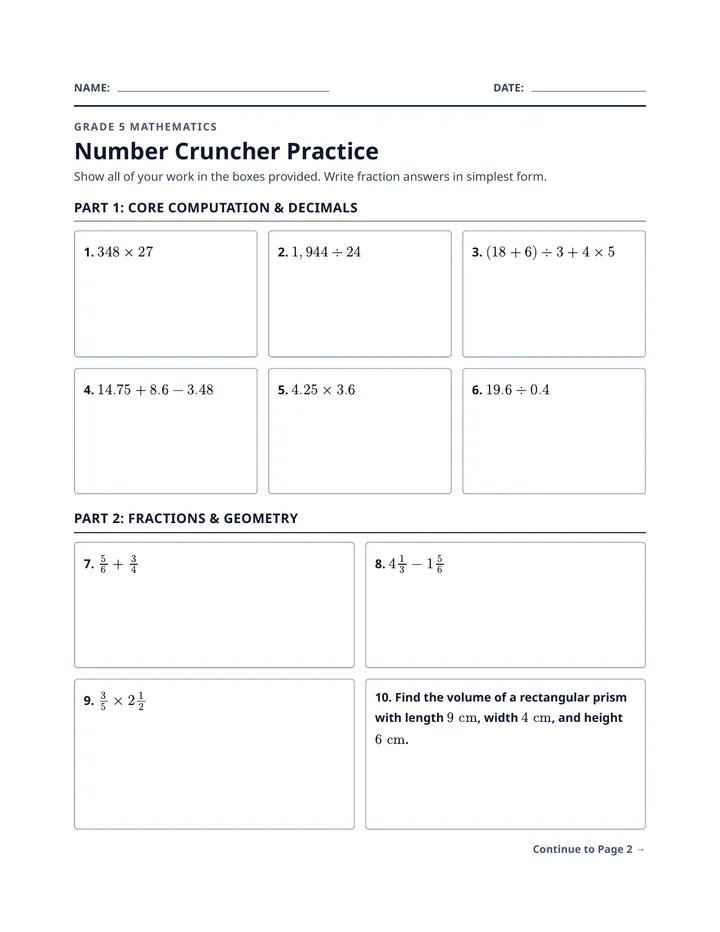
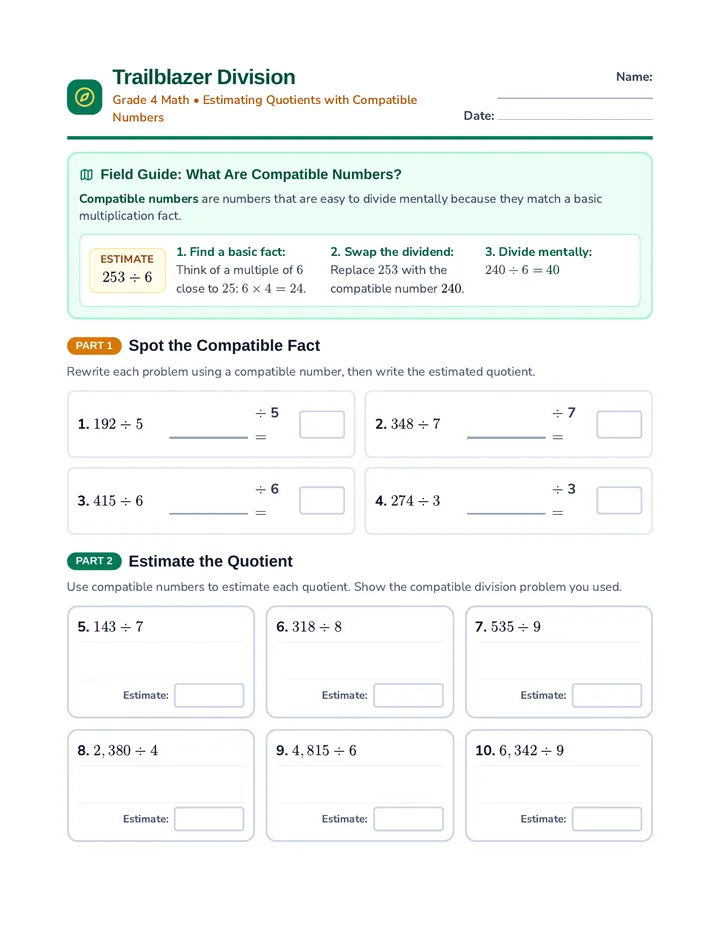
Number Cruncher Math Worksheet Name:
Date:
Grade 5 Mathematics
Number Cruncher Practice
Show all of your work in the boxes provided. Write fraction answers in simplest form.
Part 1: Core Computation & Decimals
1. \( 348 \times 27 \)
2. \( 1,944 \div 24 \)
3. \( (18 + 6) \div 3 + 4 \times 5 \)
4. \( 14.75 + 8.6 - 3.48 \)
5. \( 4.25 \times 3.6 \)
6. \( 19.6 \div 0.4 \)
Part 2: Fractions & Geometry
7. \( \frac{5}{6} + \frac{3}{4} \)
8. \( 4\frac{1}{3} - 1\frac{5}{6} \)
9. \( \frac{3}{5} \times 2\frac{1}{2} \)
10. Find the volume of a rectangular prism with length \( 9\text{ cm} \), width \( 4\text{ cm} \), and height \( 6\text{ cm} \).
Continue to Page 2 →
Number Cruncher Practice — Problem Solving Name: ________________________
Part 3: Multi-Step Word Problems
11. Maya has \( 3\frac{3}{4} \) yards of ribbon. She uses \( 1\frac{2}{3} \) yards for a science poster and \( \frac{5}{6} \) yard for a bookmark. How many yards of ribbon does she have left?
Answer: ______________________
12. A school robotics club buys 6 sensor kits at $14.85 each and 4 battery packs at $6.40 each. If the club pays with a $150.00 gift card, how much money remains on the card?
Answer: ______________________
Part 4: Extension Challenges
13. A storage bin is shaped like a rectangular prism with a base area of \( 48\text{ in}^2 \) and a height of \( 10\text{ in} \). A smaller box placed inside it has dimensions \( 4\text{ in} \times 3\text{ in} \times 5\text{ in} \). How much empty space (in cubic inches) remains inside the storage bin?
Answer: ______________________
14. Find two different fractions with unlike denominators whose sum is \( 1\frac{1}{12} \) and whose difference is \( \frac{1}{4} \). Show how you found and checked your answer.
Answer: ______________________
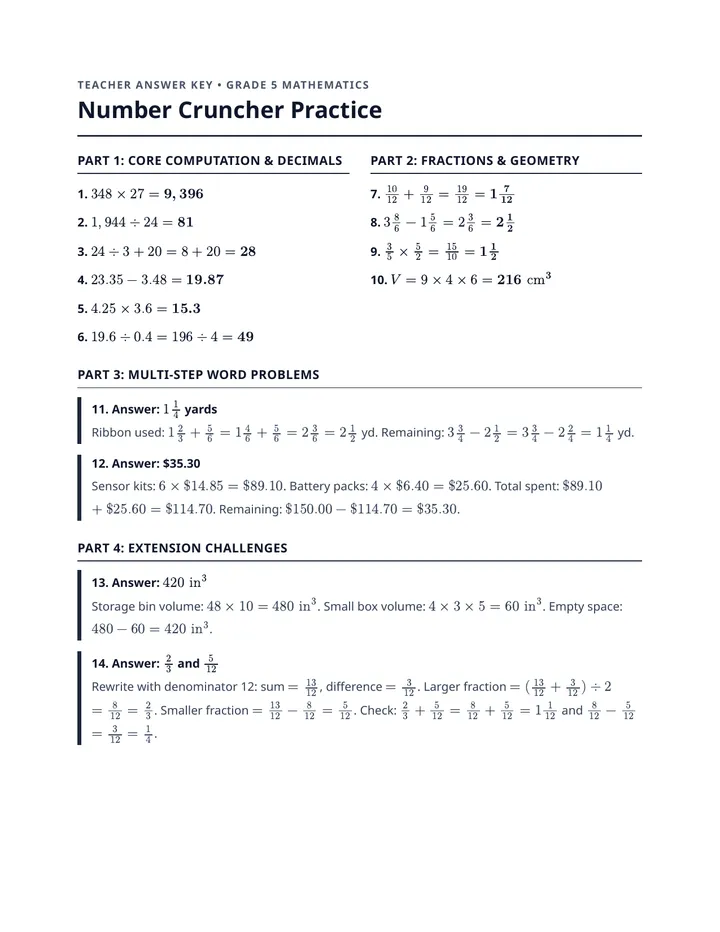
Number Cruncher Answer Key Teacher Answer Key • Grade 5 Mathematics
Number Cruncher Practice
Part 1: Core Computation & Decimals
1. \( 348 \times 27 = \mathbf{9,396} \)
2. \( 1,944 \div 24 = \mathbf{81} \)
3. \( 24 \div 3 + 20 = 8 + 20 = \mathbf{28} \)
4. \( 23.35 - 3.48 = \mathbf{19.87} \)
5. \( 4.25 \times 3.6 = \mathbf{15.3} \)
6. \( 19.6 \div 0.4 = 196 \div 4 = \mathbf{49} \)
Part 2: Fractions & Geometry
7. \( \frac{10}{12} + \frac{9}{12} = \frac{19}{12} = \mathbf{1\frac{7}{12}} \)
8. \( 3\frac{8}{6} - 1\frac{5}{6} = 2\frac{3}{6} = \mathbf{2\frac{1}{2}} \)
9. \( \frac{3}{5} \times \frac{5}{2} = \frac{15}{10} = \mathbf{1\frac{1}{2}} \)
10. \( V = 9 \times 4 \times 6 = \mathbf{216\text{ cm}^3} \)
Part 3: Multi-Step Word Problems
11. Answer: \( 1\frac{1}{4} \) yards
Ribbon used: \( 1\frac{2}{3} + \frac{5}{6} = 1\frac{4}{6} + \frac{5}{6} = 2\frac{3}{6} = 2\frac{1}{2} \) yd. Remaining: \( 3\frac{3}{4} - 2\frac{1}{2} = 3\frac{3}{4} - 2\frac{2}{4} = 1\frac{1}{4} \) yd.
12. Answer: $35.30
Sensor kits: \( 6 \times \$14.85 = \$89.10 \). Battery packs: \( 4 \times \$6.40 = \$25.60 \). Total spent: \( \$89.10 + \$25.60 = \$114.70 \). Remaining: \( \$150.00 - \$114.70 = \$35.30 \).
Part 4: Extension Challenges
13. Answer: \( 420\text{ in}^3 \)
Storage bin volume: \( 48 \times 10 = 480\text{ in}^3 \). Small box volume: \( 4 \times 3 \times 5 = 60\text{ in}^3 \). Empty space: \( 480 - 60 = 420\text{ in}^3 \).
14. Answer: \( \frac{2}{3} \) and \( \frac{5}{12} \)
Rewrite with denominator 12: sum \( = \frac{13}{12} \), difference \( = \frac{3}{12} \). Larger fraction \( = (\frac{13}{12} + \frac{3}{12}) \div 2 = \frac{8}{12} = \frac{2}{3} \). Smaller fraction \( = \frac{13}{12} - \frac{8}{12} = \frac{5}{12} \). Check: \( \frac{2}{3} + \frac{5}{12} = \frac{8}{12} + \frac{5}{12} = 1\frac{1}{12} \) and \( \frac{8}{12} - \frac{5}{12} = \frac{3}{12} = \frac{1}{4} \).