Structure Splitters Lesson Plan Teacher Guide
STRUCTURE SPLITTERS
Additive Volume • WA Standard M5SRMD5c
60 Minutes
Grade 5 Math Block
Objective
SWBAT decompose composite 3D shapes into two non-overlapping rectangular prisms, calculate separate volumes, and add them to find the total volume.
Materials
Linking cubes (30 per student pair), isometric grid whiteboards, Structure Splitters Practice Sheet, and Exit Ticket.
Common Pitfall
Students often add overlapping dimensions, counting shared block faces twice, or mismatch height values. Keep vertical splitting crisp.
1. Warm-Up: Build & Split (10 Mins)
Hands-On
Distribute linking cubes. Have students build a standard 2×3×2 prism and find its volume (12 units³). Then, ask them to build a 2×2×2 prism (8 units³). Connect the two prisms side-by-side to create an L-shaped structure.
Teacher Prompt: "If we joined these two solid buildings together, what is our new total volume? Do we need to count individual cubes, or can we use addition? Why?"
2. Direct Instruction: The Blueprint Strategy (15 Mins)
Core Model
Display Slide 3. Introduce the term composite solid . Explain that complex shapes are hard to measure all at once, but they can be sliced into smaller, simple rectangular prisms.
Slice Verbally: Model slicing the L-shape vertically ("Splitter A") and horizontally ("Splitter B"). Emphasize that total volume remains unchanged regardless of split direction.Identify Missing Measurements: Highlight that when we slice, some dimensions must be derived by subtraction (e.g., Total width minus Prism 1's width).
3. Guided Practice: Blueprints in Action (15 Mins)
Collaborative
Work through the first problem of the Structure Splitters Practice Sheet together. Guide students through labeling Prism A and Prism B.
Scaffold Prompt: "Look at the baseline. If the total length is 10 cm, and Prism A uses 6 cm, how much length is left for Prism B? Write \(10 - 6 = 4\) on your diagram immediately!"
4. Independent Practice & Exploration (15 Mins)
Individual
Students complete Page 2 of the worksheet independently. Circulate to check for students who apply the wrong height to the wrong prism. Encourage them to shade Prism A and Prism B in different colors to help visual separation.
5. Wrap-Up & Exit Ticket (5 Mins)
Check for Understanding
Distribute the Exit Ticket. Collect it to gauge individual student mastery on dividing and solving.
Scaffolding Support
Provide actual interlocking cubes for visual/tactile learners to build the composite solids in the worksheet. Use color-coded highlighters to match calculated dimensions with correct edges.
Extension Challenge
Have advanced students design a composite three-prism structure (such as a U-shape or a staircase) on isometric paper, label its dimensions, and challenge a peer to calculate its total volume.
Structure Splitters Slides Blueprints & Blocks
Grade 5 Math
STRUCTURE
SPLITTERS
Mastering the art of Additive Volume : Slicing compound structures to find total space.
WA Standard: M5SRMD5c
Let's Build!
The Challenge
Part 1
How do we measure an L-Shaped building?
Standard formulas like Volume = L × W × H only work for clean, simple rectangular boxes.
When shapes are combined, we call them composite solids . We need a way to dismantle them without losing their value!
Prism A
Prism B
One Solid Object • Two Joined Prisms
Total volume is simply the sum of all individual parts!
The Split Strategy
Part 2
Option A
The Vertical Slice
Slice straight down to create a left prism and a right prism.
Left
Right
Option B
The Horizontal Slice
Slice sideways to create a top prism sitting on a wider bottom base.
Top
Bottom
Both methods will always yield the exact same total volume!
Guided Solver
Part 3
6 cm
Prism A 4 × 3 × 3
Prism B 10 × 3 × 3
10 cm length
Let's calculate step-by-step:
1
Volume of Prism A (Top)
\(V_A = 4\text{ cm} \times 3\text{ cm} \times 3\text{ cm} = \mathbf{36\text{ cm}^3}\)
2
Volume of Prism B (Bottom)
\(V_B = 10\text{ cm} \times 3\text{ cm} \times 3\text{ cm} = \mathbf{90\text{ cm}^3}\)
3
Add Them Together!
\(36 + 90 = \mathbf{126\text{ cm}^3}\)
Ensure the unit is always in cubic centimeters (\(\text{cm}^3\)) or cubic units!
CFU Challenge
Part 4
Before you slice your worksheets, remember these three blueprint rules:
1
Clean Cuts
Slice completely through so you get two regular rectangular boxes. No diagonal cuts allowed!
2
Verify Dimensions
Check if a dimension has been split. You might need to subtract to find a missing width or height.
3
Double Check Sum
Add carefully. Use columns or quick mental math checks. Total volume must equal both parts combined.
Structure Splitters Practice Sheet STRUCTURE SPLITTERS
Workspace Practice • WA Standard M5SRMD5c
Name:
Date:
How to Split structures
Slice the composite shape into two regular, non-overlapping rectangular prisms.Identify the length, width, and height of each individual prism.Multiply to find both volumes, then add them together for the total!
Problem 1 Value: 4 pts
Slice this stair-step structure vertically into two prisms (Prism A on the left, Prism B on the right). Calculate both volumes, and find the total sum.
5 cm 6 cm depth = 4 cm 9 cm 3 cm
Prism A (Left)
Length = 6 cm, Width = 4 cm, Height = 5 cm
Volume =
\(cm^3\)
Prism B (Right)
Length = 9 cm, Width = 4 cm, Height = 3 cm
Volume =
\(cm^3\)
Show addition to find total volume:
=
Problem 2 Value: 6 pts
Find the missing dimension marked with ? . Slice the figure horizontally, show your work below, and find the total volume.
10 m 5 m 15 m (total length) 5 m ? length depth = 2 m
1. Find missing bottom length (?):
2. Work Space (Prism A & B Volumes):
Total Volume:
\(m^3\)
Structure Splitters Worksheet Page 1 of 2
STRUCTURE SPLITTERS
Independent Blueprint Challenge
Student Copy
Problem 3 Value: 6 pts
The Monument: A park designer is constructing a concrete step bench. Calculate the total volume of concrete needed to pour this structure. Slice either vertically or horizontally.
total height = 9 ft total length = 16 ft depth = 5 ft 8 ft 4 ft
1. Write dimension math for Prism 1:
2. Write dimension math for Prism 2:
Total Concrete Volume Required:
\(ft^3\)
Problem 4 Value: 4 pts
The Cargo Ship: An cargo vessel consists of two major cargo decks side-by-side. The small cargo deck is \(4\text{ m} \times 3\text{ m} \times 2\text{ m}\). The main cargo deck is \(8\text{ m} \times 3\text{ m} \times 5\text{ m}\). What is the total holding volume of both decks together?
Workspace (Show all equations and final sum):
Total Cargo Deck Volume:
\(m^3\)
Structure Splitters Exit Ticket Quick Check
EXIT TICKET: STRUCTURE SPLITTERS
WA Standard M5SRMD5c • Additive Volume
Name:
Date:
1 Concept Connection (2 pts)
Which statement best describes how to find the total volume of a 3D composite solid formed by joining two rectangular blocks together?
A
Multiply the total overall length by the total overall height, and ignore depth completely.
B
Measure the volume of the larger block, and subtract the volume of the smaller block from it.
C
Slice the building cleanly into two separate rectangular boxes, calculate their individual volumes, and add them.
D
Count only the outer tiles of the building and multiply the final sum by twelve.
2 The Master Splitter Check (3 pts)
Slice this architectural structure horizontally or vertically. Write your calculation formulas in the blank workspace below and write the final total volume in the box.
4 cm 5 cm 14 cm 4 cm depth = 3 cm
Show Your Calculations Here:
Total Volume Solution:
\(cm^3\)
Score:
/ 5 points
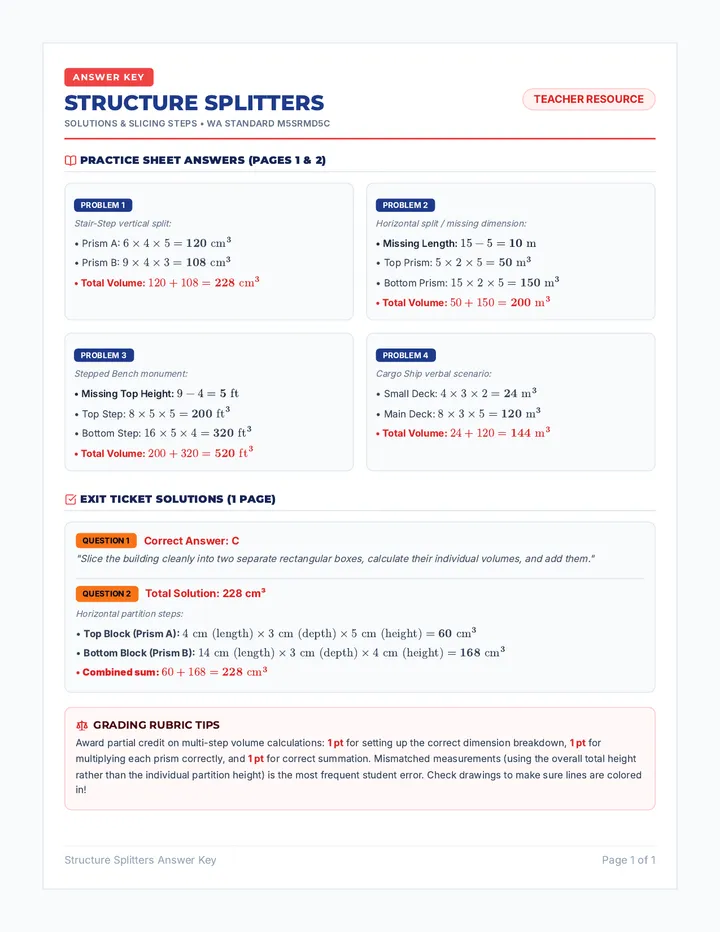
Structure Splitters Answer Key Answer Key
STRUCTURE SPLITTERS
Solutions & Slicing Steps • WA Standard M5SRMD5c
Teacher Resource
Practice Sheet Answers (Pages 1 & 2)
Problem 1
Stair-Step vertical split:
• Prism A: \(6 \times 4 \times 5 = \mathbf{120\text{ cm}^3}\)
• Prism B: \(9 \times 4 \times 3 = \mathbf{108\text{ cm}^3}\)
• Total Volume: \(120 + 108 = \mathbf{228\text{ cm}^3}\)
Problem 2
Horizontal split / missing dimension:
• Missing Length: \(15 - 5 = \mathbf{10\text{ m}}\)
• Top Prism: \(5 \times 2 \times 5 = \mathbf{50\text{ m}^3}\)
• Bottom Prism: \(15 \times 2 \times 5 = \mathbf{150\text{ m}^3}\)
• Total Volume: \(50 + 150 = \mathbf{200\text{ m}^3}\)
Problem 3
Stepped Bench monument:
• Missing Top Height: \(9 - 4 = \mathbf{5\text{ ft}}\)
• Top Step: \(8 \times 5 \times 5 = \mathbf{200\text{ ft}^3}\)
• Bottom Step: \(16 \times 5 \times 4 = \mathbf{320\text{ ft}^3}\)
• Total Volume: \(200 + 320 = \mathbf{520\text{ ft}^3}\)
Problem 4
Cargo Ship verbal scenario:
• Small Deck: \(4 \times 3 \times 2 = \mathbf{24\text{ m}^3}\)
• Main Deck: \(8 \times 3 \times 5 = \mathbf{120\text{ m}^3}\)
• Total Volume: \(24 + 120 = \mathbf{144\text{ m}^3}\)
Exit Ticket Solutions (1 Page)
Question 1 Correct Answer: C
"Slice the building cleanly into two separate rectangular boxes, calculate their individual volumes, and add them."
Question 2 Total Solution: 228 cm³
Horizontal partition steps:
• Top Block (Prism A): \(4\text{ cm (length)} \times 3\text{ cm (depth)} \times 5\text{ cm (height)} = \mathbf{60\text{ cm}^3}\)
• Bottom Block (Prism B): \(14\text{ cm (length)} \times 3\text{ cm (depth)} \times 4\text{ cm (height)} = \mathbf{168\text{ cm}^3}\)
• Combined sum: \(60 + 168 = \mathbf{228\text{ cm}^3}\)
Grading Rubric Tips
Award partial credit on multi-step volume calculations: 1 pt for setting up the correct dimension breakdown, 1 pt for multiplying each prism correctly, and 1 pt for correct summation. Mismatched measurements (using the overall total height rather than the individual partition height) is the most frequent student error. Check drawings to make sure lines are colored in!