Step Boss Slides Math Life Skills 9th Grade Support
Step Boss GEMDAS
Mastering the order of operations in daily life—one step at a time, like a boss.
Visual Lesson Guide
Slide 1 of 10
Why Order Matters
Slide 2 of 10
The Wrong Order
Put on your shoes first , and then try to pull your socks over them .
Result: A giant mess and a funny look!
The Boss Order
Put on your socks first , and then put your shoes over them .
Result: Perfect! You are ready to walk.
Math works the same way. Doing steps in the wrong order gives the wrong final answer!
Meet the Step Boss: GEMDAS
Slide 3 of 10
1
G
Grouping
Parentheses ( ) or brackets first. Work inside them!
E
Exponents
Tiny high numbers like \(2^2\). (We'll skip these today!)
2
M & D
Multiply / Divide
Work left to right. Whichever comes first in line!
3
A & S
Add / Subtract
Last steps! Work left to right to finish up.
Today, we are zooming in on Grouping (G) , Multiplication (M) , and Addition (A) !
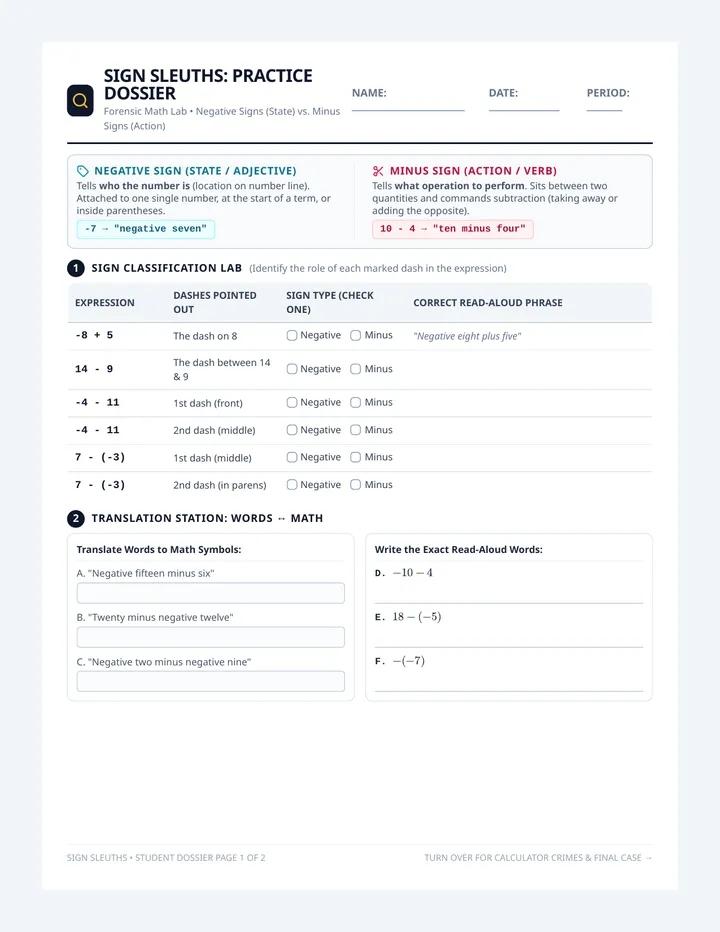
Scenario 1: Fast Food Bundle
Slide 4 of 10
The Shopping Order
You buy 2 bundle meals for you and a friend.
Each bundle has a burger ($5) and fries ($2).
How do we write this in math?
2 × (5 + 2)
What do we do first?
A Multiply \(2 \times 5\) first?
B Add \(5 + 2\) first?
Tip: Look for the Grouping symbols (parentheses)!
Let's solve this step-by-step on the next slide!
Solving Step-by-Step: The Food Bundle
Slide 5 of 10
Step 1: Grouping
2 × (5 + 2)
We always clear the G rouping first. Add the burger and fries.
\(5 + 2 = 7\)
Step 2: Rewrite
2 × 7
Bring down the 2 × and write your new number underneath.
Expression simplified!
Step 3: Solve
$14
Multiply \(2 \times 7\) to get the final total price.
Success! Total: $14
If we did multiplication first: \(2 \times 5 + 2 = 10 + 2 = 12\) (Wrong! We would miss paying for one friend's fries!)
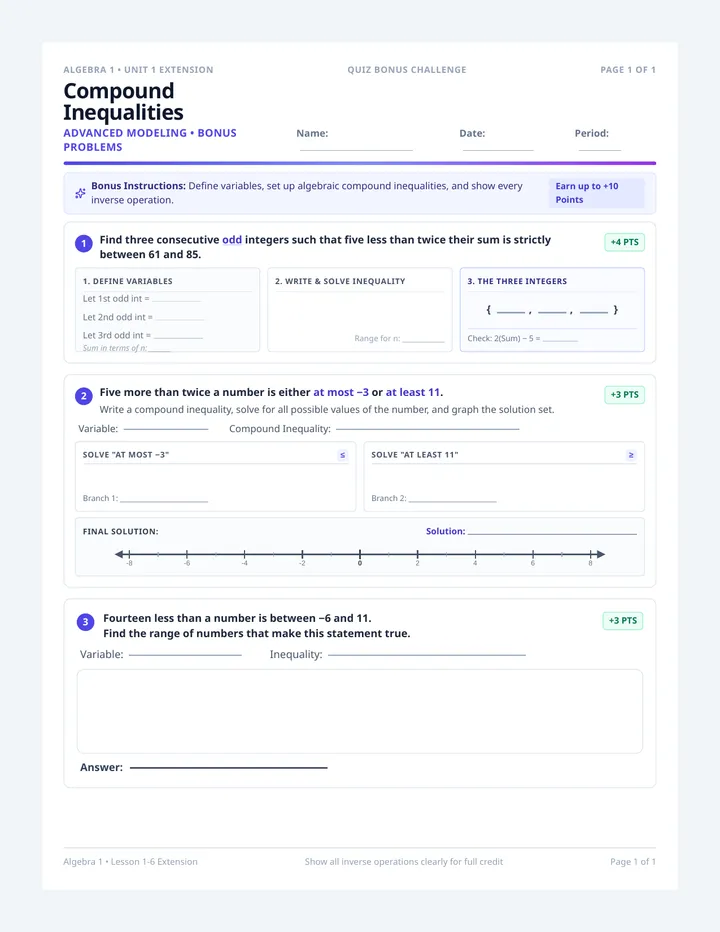
Scenario 2: The Payday Calculation
Slide 6 of 10
Job Math
You work at a store. You earn $10 per hour. You worked 8 hours today.
Your boss also gives you a $5 bonus tip for great service.
How do we write this in math?
10 × 8 + 5
What do we do first?
A Multiply \(10 \times 8\) first?
B Add \(8 + 5\) first?
Tip: There are no parentheses (Grouping) here. Check the GEMDAS list!
Let's solve this payday problem step-by-step next!
Solving Step-by-Step: Payday Math
Slide 7 of 10
Step 1: Multiplication
10 × 8 + 5
No Grouping (G) here! We jump down to M ultiplication. Find hourly pay first.
\(10 \times 8 = 80\)
Step 2: Rewrite
80 + 5
Bring down the + 5 bonus tip. Put your new number underneath.
Bonus ready to add!
Step 3: Solve
$85
Finally, A dd the $5 bonus to your $80 base earnings.
Success! Earned: $85
If we added first: \(10 \times (8 + 5) = 10 \times 13 = 130\) (We didn't work 13 hours! That would get us fired!)
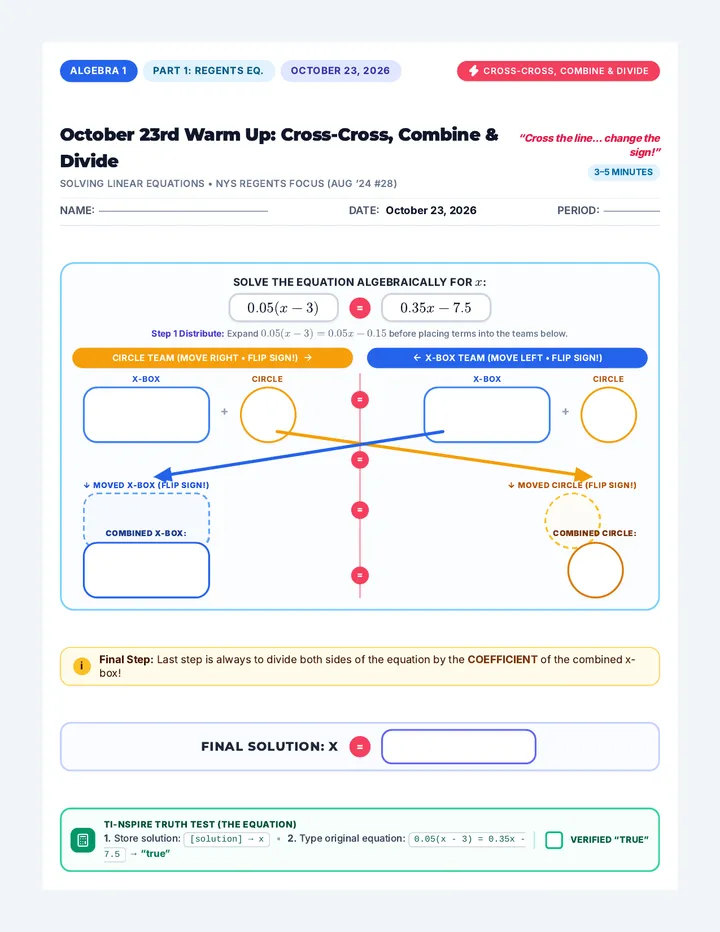
The "Step Boss" Funnel Template
Slide 8 of 10
How to write our calculations:
To prevent mistakes, we use a Funnel Organizer .
Every line gets shorter as we solve, forming a downward triangle pointing directly to our final answer.
No floating side-calculations
Rewrite the whole line every time
Draw a visual V to show the step
\(3 \times (4 + 2)\)
\(3 \times 6\)
18
Notice how it looks like a funnel or a pizza slice pointing to the answer!
Check Your Skills: What's First?
Slide 9 of 10
Problem 1
\(12 - (3 \times 2)\)
Which operation goes first?
Answer: Multiplication inside grouping! \((3 \times 2 = 6)\). Then do \(12 - 6 = 6\).
Problem 2
\(15 \div 3 + 2\)
Which operation goes first?
Answer: Division first! No grouping here. \(15 \div 3 = 5\). Then add \(5 + 2 = 7\).
Excellent thinking! You are ready for your notes sheet.
Step Boss GEMDAS Bundle
Slide 10 of 10
Open Your Guided Notes
Let's draw some funnels, check off our GEMDAS bosses, and solve these life-skills math problems together!
Get your pencils ready! Let's Go! 🚀
Step Boss Notes Math Worksheets
Step Boss Notes
Topic: GEMDAS Order of Operations (Real-World Applications)
Name:
Date:
The Order of Operations Checklist
G
Grouping (Parentheses) first!
E
Exponents (Skip for today!)
M / D
Multiply/Divide Left to right.
A / S
Add/Subtract Last steps!
The Pizza Funnel Trick
For every expression, you solve the first step, rewrite the leftover parts on the line below, and repeat! Your work naturally forms a downward-facing funnel pointing straight to the answer.
SPED Secret: Never do math in your head. Bring the whole problem down with you!
Visual Example
2 × (5 + 3)
2 × 8
16
Guided Problem 1
Buying Combo Meals
You buy 2 combo meals . Each has a burger ($5) and fries ($2).
Checklist
G M A
1
Expression: 2 × ( 5 + 2 )
2
Rewrite: 2 × ____
3
Answer: $ ____
Guided Questions:
Q1: What's inside the grouping symbols ( )?
Q2: Now, multiply 2 by your box total. Write the final answer!
Unit 1: Order of Operations Step Boss Guided Notes • Page 1 of 2 I can solve grouping expressions!
Math Worksheets
Step Boss Notes
Topic: GEMDAS Order of Operations (Real-World Applications)
Name:
Date:
Guided Problem 2
Hourly Job Pay
You earn $10 per hour . You worked 8 hours today. You also got a $5 cash tip .
Checklist
G M A
1
Expression: 10 × 8 + 5
2
Rewrite: ____ + 5
3
Answer: $ ____
Guided Questions:
Q1: No parentheses! What comes next on our GEMDAS list?
Q2: Now, add the + 5 tip to find the final total pay.
Guided Problem 3
Arcade Token Math
Step Boss Worksheets Practice Level 1
Step Boss Practice
Topic: Ordered Calculations in Real Life • Full Scaffolding
Name:
Date:
Your Goal:
Check off the GEMDAS boxes on the right. Fill in the dashed boxes below to solve each step of the pizza funnel!
Problem 1: Bus Ride Math
You buy 3 bus tickets. Each ticket has a $2 base price plus a $1 peak transfer fee.
CHECKLIST: G M
3 × ( 2 + 1 )
3 × ____
$ ____
Help Prompt:
1. Find grouping parentheses first! Add 2 + 1. Write it in the dashed box.
2. Multiply 3 × your box to find your final cost.
Problem 2: Phone Bill Bonus
Your phone bill is a flat $15. This month, you also bought 3 gigabytes of extra data for $5 each.
CHECKLIST: M A
15 + 3 × 5
15 + ____
$ ____
Help Prompt:
1. No grouping here! Multiply first: 3 × 5. Write the result in the box.
2. Add 15 + your box to find the total phone bill.
Problem 3: Coupon Discount
You buy 4 personal pizzas at $10 each. You use a single checkout coupon to take $5 off the total bill.
CHECKLIST: M S
4 × 10 - 5
____ - 5
$ ____
Help Prompt:
1. Multiply first to find the base pizza cost: 4 × 10. Write it in the box.
2. Subtract the coupon - 5 from your box to get the final bill.
Unit 1: Order of Operations Step Boss Worksheets • Page 1 of 2 Level 1 Complete • Let's try Level 2!
Practice Level 2
Step Boss Practice
Topic: Ordered Calculations in Real Life • Independent Mode
Name:
Date:
Independent Challenge:
You are the Step Boss now! Check off your own GEMDAS steps, draw your own V-lines , and write each step clearly in the grid boxes.
Problem 4: Discount Movie Tickets
You buy 2 matinee tickets. Matinee tickets are $8 each, but you have an early-bird $2 discount per ticket.
CHECKLIST: G M
V-FUNNEL
V-FUNNEL
2 × ( 8 - 2 )
Boss Tips:
1. Identify the grouping inside parentheses.
2. Draw your V connecting the grouping, solve, and write down the next row.
Final Price: $ ________
Step Boss Guide Teacher Resource
Step Boss Guide
Instructional Playbook & Common SPED Misconceptions
Target Level: 9th Grade SPED Topic: GEMDAS Foundations Math Transition & Life Skills
Lesson Pacing Guide (50-60 Minutes)
Time Lesson Phase Teacher Delivery Cues & Prompts 05 - 10 Min Hook & Metaphor Present Slide 2 (Socks and Shoes). Guide students to see that order dictates outcome. Ask: "What happens if you reverse your morning schedule?" 10 - 20 Min Direct Instruction Use Slides 3-7 to display grocery/paycheck math. Highlight that parentheses are "fences" grouping together bundled items. 20 - 35 Min Guided Notes Hand out Step Boss Notes . Solve the 3 guided problems as a class. Actively prompt students to draw physical "V-lines" connecting numbers. 35 - 50 Min Differentiated Practice Assign Step Boss Worksheets . Let SPED students start with Page 1 (scaffolded). Transition extension students to the Boss Mode Exponents Worksheet .
Key Accommodation Tactics
The Vertical Funnel: Encouraging a downwards triangle prevents horizontal scrolling and side math scratchwork, where SPED students typically lose track of active numbers.Physical Checklist Checkoff: The miniature GEMDAS checklists allow students to physically cross off operations they check, satisfying executive functioning needs.No Scratchwork Margin Rule: Advise students NOT to write side calculations. Encourage them to rewrite the entire simplified line every single row.
High-Frequency Student Errors
1. Left-to-Right Over-reliance: Cure: Have them circle all operators first. Force verification of the GEMDAS checklist hierarchy before writing.
2. Parentheses Disappearance: Cure: Use the "elevator bring-down" phrase. If you didn't touch it, it rides the elevator straight down!
Boss Mode Worksheet Advanced Extension
Boss Mode Worksheet
Topic: Advanced GEMDAS (Including Exponents & Division)
Name:
Date:
Exponent Boss Reminder!
An exponent (E ) tells you to multiply a number by itself . It is NOT multiplication by 2!
\(2^2 = 2 \times 2 = 4\)
\(3^2 = 3 \times 3 = 9\)
\(4^2 = 4 \times 4 = 16\)
Complete GEMDAS Order:
G rouping
E xponents
M ultiply
D ivide
A dd
S ubtract
Problem 1: Pizza Dough Prep
CHECKLIST: G E S
\( (3 + 1)^2 - 5 \) ____ Final: ____
Hint: Add the pizza toppings inside parentheses first, then raise that answer to the second power (\(x^2\)), and finally subtract 5!
Problem 2: Car Wash Tip Split
CHECKLIST: E M A
\( 2^3 \times 3 + 4 \) ____ Final: ____
Hint: Calculate \(2^3\) first (\(2 \times 2 \times 2\)). Then, multiply by 3, and add the $4 tip split at the end.
Problem 3: Sharing Arcade Tokens
CHECKLIST: G E D
\( 18 \div (4 - 1)^2 \) ____ Final: ____
Hint: Subtract \(4 - 1\) first. Raise that total to the second power. Lastly, divide 18 by that exponent total.
Problem 4: Gift Box Packing
CHECKLIST: G E S
\( (5 - 2)^2 - 3 \) ____ Final: ____
Hint: Solve grouping inside parentheses first. Then calculate the exponent, and finally subtract 3.
Problem 5: Grocery Checkout Bundle
CHECKLIST: E M A
\( 4^2 \times 2 + 10 \) ____ Final: ____
Hint: Square 4 first. Next, multiply by 2. Finally, add 10 to find the grand total checkout cost.
Unit 1: Order of Operations Boss Mode Extension • Page 1 of 2 Complete all 5 to unlock Phase 2!
Advanced Extension
Boss Mode Worksheet
Topic: Advanced GEMDAS (Including Exponents & Division)
Name:
Date:
Extreme Boss Mode (Problems 6-10):
Draw your own V-funnel connections down into the boxes below. Make sure to check off the operations as you go!
Problem 6: Stocking Shelves GEMDAS
\( 3 \times (2 + 1)^2 \)