Spooky Tens Slides 🎃 Kindergarten Math Magic
🦇 Monster Math Lab
Spooky Ten Frames!
Count, subitize, and build to 10 with our friendly Halloween creature friends!
👀 Look & Subitize
🎃 Count 1 to 10
⭐ Make a Full Ten!
Monster Rule #1
What is a Ten Frame?
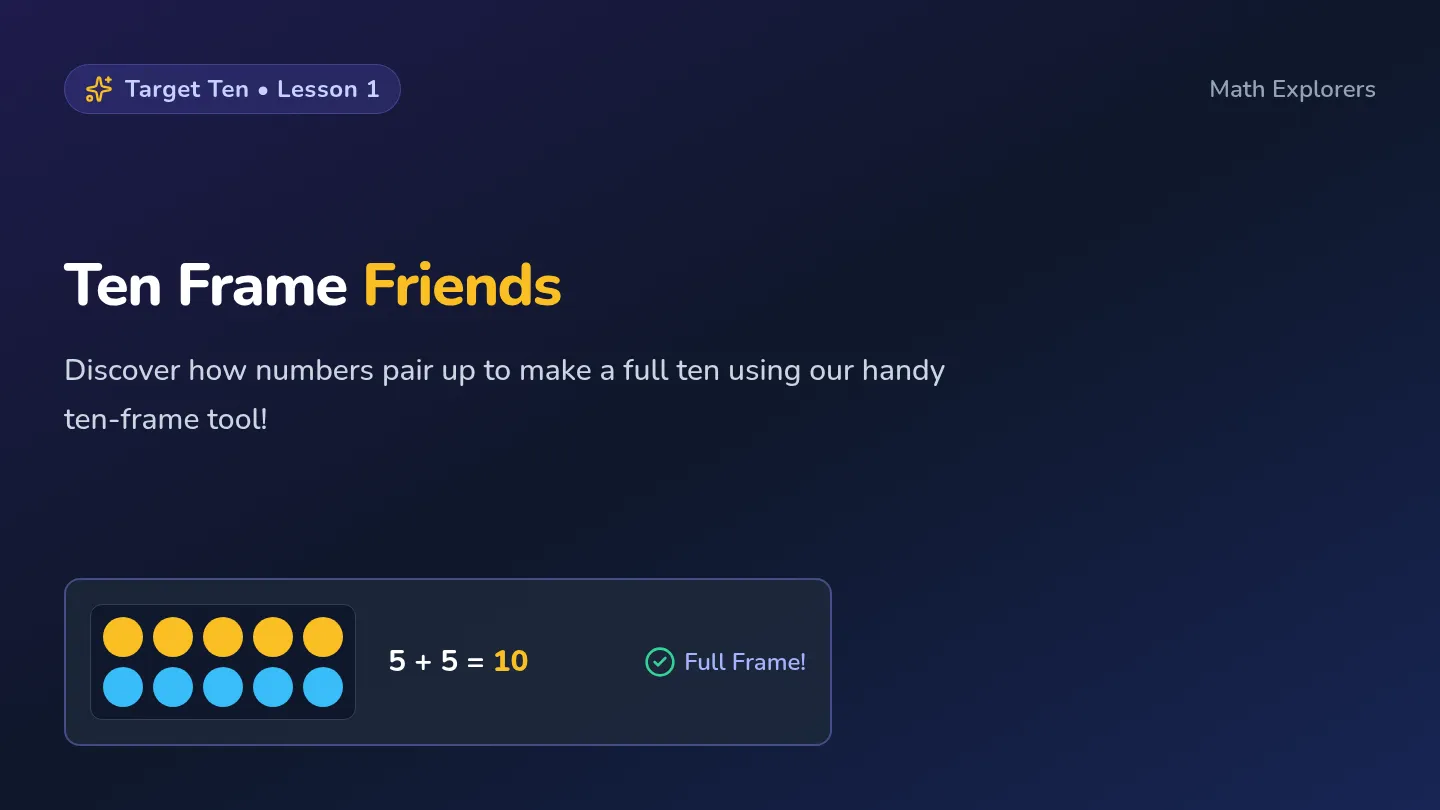
5 Top + 5 Bottom = 10
Fill the top row first from left to right!
🦇
🦇
🦇
🦇
🦇
6
7
8
9
10
When the top row is full, we know right away there are 5 bats! High Five! ✋
Quick Look Eyes 👀
How Many Pumpkins?
Don't count one by one!
🎃
🎃
🎃
🎃
❓
Almost a full top row!
Notice the Pattern:
The top row needs 5, but 1 is missing.
One less than 5 is 4!
How many empty spots are left in the whole ten frame?
6 empty spots! (4 + 6 = 10)
Show me 4 fingers like a pumpkin patch! 🎃
Numbers Past 5
Ghostly 5 and Some More!
5 + 2 More
👻
👻
👻
👻
👻
👻
👻
1
2
3
Ghosts on Top
5
Ghosts on Bottom
2
=
Total Ghosts
7
How many more ghosts do we need to make a full frame of 10? 3 more!
Witch's Potion Challenge 🧪
Make 10 Spooky Treats!
Partners Ready! 🤝
🍬
🍬
🍬
🍬
🍬
🍬
🍬
🍬
🫧
🫧
8 Sweet Candies in the Cauldron
The Witch's spell requires 10 treats:
"I have 8 treats... how many more bubbles do I need?"
8 + 2 = 10 🧙♀️✨
Let's whisper our magic math rhyme: "Eight on the mat, two in the hat, that makes ten just like that!"
Time to Explore!
Monster Math Center Stations
🎃
Station 1
Pumpkin Patch Mats
Place spooky counters on your giant ten-frame mat!
🧪
Station 2
Cauldron Worksheets
Color the frames and write the mystery numbers!
🦇
Station 3
Make 10 Match
Partner up and find pairs of cards that equal 10!
Grab your math witch hats and let's count! 🧙♂️🎉
Cauldron Counters Worksheet 🎃
Spooky Ten Frames
Kindergarten Math Adventure
Name:
Date:
Part 1: Count & Write
Count the spooky friends in each frame. Write the number in the box!
Fill Top Row First ➡️
Problem 1
🎃
🎃
🎃
Number
Problem 2
🦇
🦇
🦇
🦇
🦇
Number
Problem 3
👻
👻
👻
👻
👻
👻
👻
Number
Problem 4
🍬
🍬
🍬
🍬
🍬
🍬
🍬
🍬
🍬
🍬
Number
Part 2: Read & Draw Counters
Look at the target number. Draw circles or pumpkin dots 🎃 to match!
Start on Top Left!
4
8
Student Self-Check: Did you fill the top 5 first? Yes!
Page 1 of 2 • Spooky Math
🧪
Witch's Potion: Make 10!
Combinations that Make Ten
Name:
🧙♀️
Draw potion bubbles ⚪ in the empty spaces to make a full ten frame!
Then write the number of bubbles you drew to finish the math fact.
1
🎃
🎃
🎃
🎃
🎃
🎃
6 +
= 10
2
🦇
🦇
🦇
🦇
🦇
🦇
🦇
🦇
🦇
9 +
= 10
3
🕷️
🕷️
🕷️
🕷️
🕷️
5 +
= 10
4
👻
👻
2 +
= 10
⭐ Monster Challenge: If you have 10 pumpkins in your frame, how many empty spaces are left?
Pumpkin Patch Mats Activity 🎃
Pumpkin Patch Mat
Kindergarten Math Hands-On Center
Student: Station #____
👉
Rule of the Patch: Always fill the top row (1 to 5) before moving to the bottom row!
Target: 10 Treats
1 TOP ROW
2
3
4
5 ★ 5!
6 BOTTOM
7
8
9
10 ★ 10!
My Monster Math Sentence:
Spooky Treats on Mat
Empty Spaces
=
Total Needed
10
Teacher Tip: Laminate this mat for repeated use with dry-erase markers and Halloween mini-erasers!
Mat Page 1
✂️
Monster Math Task Cards
Cut apart for Center Activities & Manipulatives
6 Challenge Cards
CARD 1 🎃
Place 4 pumpkins on your ten frame.
How many empty spots are left to make 10?
Fact: 4 + ___ = 10
CARD 2 🦇
Fill the entire top row with bats!
How many bats are on the mat? How many more to 10?
Fact: 5 + ___ = 10
CARD 3 👻
Place 7 friendly ghosts on the mat.
Count the top row, then the bottom. How many empty?
Fact: 7 + ___ = 10
CARD 4 🍬
Put 9 candy corns in the frame.
Almost full! How many more treats does the witch need?
Fact: 9 + ___ = 10
CARD 5 🕷️
Place 3 creepy crawly spiders .
Count aloud how many empty spaces you see.
Fact: 3 + ___ = 10
CARD 6 🧙♀️
Fill all 10 boxes on your mat!
You made a full ten! How many empty boxes are left?
Fact: 10 + 0 = 10
✂️ Cut-Out Counters (Print & Cut) 10 Spooky Tokens
🎃
🎃
🎃
🦇
🦇
👻
👻
🍬
🍬
🕷️
Math Center Routine: Draw a card, build on your mat, say the number sentence to your partner!
Mat Page 2
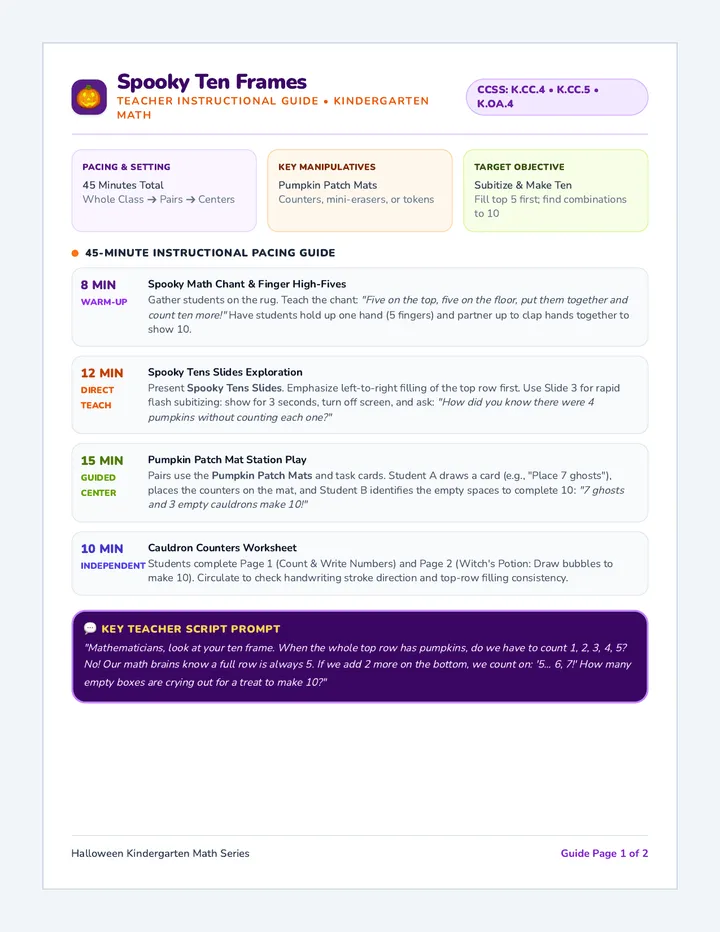
Spooky Frames Teacher Guide 🎃
Spooky Ten Frames
Teacher Instructional Guide • Kindergarten Math
CCSS: K.CC.4 • K.CC.5 • K.OA.4
Pacing & Setting
45 Minutes Total
Whole Class ➔ Pairs ➔ Centers
Key Manipulatives
Pumpkin Patch Mats
Counters, mini-erasers, or tokens
Target Objective
Subitize & Make Ten
Fill top 5 first; find combinations to 10
45-Minute Instructional Pacing Guide
8 MIN Warm-Up
Spooky Math Chant & Finger High-Fives
Gather students on the rug. Teach the chant: "Five on the top, five on the floor, put them together and count ten more!" Have students hold up one hand (5 fingers) and partner up to clap hands together to show 10.
12 MIN Direct Teach
Spooky Tens Slides Exploration
Present Spooky Tens Slides . Emphasize left-to-right filling of the top row first. Use Slide 3 for rapid flash subitizing: show for 3 seconds, turn off screen, and ask: "How did you know there were 4 pumpkins without counting each one?"
15 MIN Guided Center
Pumpkin Patch Mat Station Play
Pairs use the Pumpkin Patch Mats and task cards. Student A draws a card (e.g., "Place 7 ghosts"), places the counters on the mat, and Student B identifies the empty spaces to complete 10: "7 ghosts and 3 empty cauldrons make 10!"
10 MIN Independent
Cauldron Counters Worksheet
Students complete Page 1 (Count & Write Numbers) and Page 2 (Witch's Potion: Draw bubbles to make 10). Circulate to check handwriting stroke direction and top-row filling consistency.
💬 Key Teacher Script Prompt
"Mathematicians, look at your ten frame. When the whole top row has pumpkins, do we have to count 1, 2, 3, 4, 5? No! Our math brains know a full row is always 5. If we add 2 more on the bottom, we count on: '5... 6, 7!' How many empty boxes are crying out for a treat to make 10?"
Halloween Kindergarten Math Series Guide Page 1 of 2
Differentiation & Answer Key
Teacher Reference & Assessment Support
Spooky Ten Frames
⚠️ Misconceptions & Instructional Coaching
Misconception: Random Box Filling
Kindergarteners may scatter counters randomly across both rows instead of filling left-to-right along the top row.
Fix: Use the "Reading Rule" reminder: Just like reading a book, we start top-left and slide across!
Misconception: Counting from One Every Time