Length Detectives Lesson Plan Unit 3 • Lesson 1 • 30 Minutes
Length Detectives Lesson Plan
Focus Concept Direct Comparison & Endpoints
Big Ideas: To see how big something is, we can compare it to something else. We compare objects by placing them at the same starting point and seeing where they stop. If an object is shorter, it ends at an earlier point; if taller/longer, it ends at a farther point.
Learning Goals
Directly compare two classroom items along a common baseline.
Identify which object is longer and which is shorter .
Use the sentence stem: "The [X] is longer than [Y] because it stops further."
Materials & Prep
Manipulative baggies: unsharpened pencils, crayons, craft sticks, yarn strips.
Straightedge baseline (masking tape line on table or desk edge).
Student Practice Page 1 (Length Detectives Worksheet).
1 Manipulatives Exploration (5 Mins) Pairs / Free Touch
Distribute bags with 4 varied objects (crayon, new pencil, marker, paper clip). Give students 5 minutes to hold, stack, and line them up freely. Prompt: "Pick two items from your bag. Which one sticks out further when you hold their ends together?"
2 Teacher Model: The Baseline Rule (8 Mins) Whole Group
Demonstrate a common mistake: hold a short crayon higher than a long marker so the crayon appears "taller." Ask: "Is the crayon really longer?"
Introduce the Start Line (Baseline) : Place both bottoms flush against the desk edge or tape baseline. Reveal: "When both bottom edges touch the same line, the longer object stops at a further point!"
3 Independent Practice (12 Mins) Individual Practice Page
Students open their Length Detectives Practice Worksheet . They identify the aligned baseline for each object pair, circle the longer object, and mark an 'X' on the shorter object. Teacher circulates to check that students reference the start line.
4 Extended Practice & Wrap-Up (5 Mins) Extension Challenge
Students tackle the extension prompt at the bottom of the worksheet: draw an item that is shorter than the given pencil, starting from the baseline. Close with choral echo: "Line up the bottoms to see which is longer!"
Common Misconception: Students look only at the top ends without checking whether the bottom ends are aligned at the same baseline.
Differentiation Tip: Provide physical cardstock strips students can place against the baseline to visually track endpoints.
Length Detectives Practice Worksheet Name:
Number Line Reference (1–10)
1
2
3
4
5
6
7
8
9
10
Length Detectives Practice
Both objects start at the same baseline. Which one stops further?
Lesson 1 Practice
Independent Practice Circle the object that is longer. Put an X on the object that is shorter.
Item 1
A
B
Baseline Start
A
B
Item 2
A
B
Baseline Start
A
B
Item 3
A
B
Baseline Start
A
B
Partner Discussion Stem:
"Object _____ is longer because its top end stops further past the baseline."
Extended Practice Detective Draw Challenge
Draw from the baseline
Look at Crayon A. In the box below, start at the red baseline and draw an item that is SHORTER than Crayon A .
Crayon A
Your Drawing (Shorter):
Baseline Start Baseline Start
Kindergarten Math • Unit 3: Direct Length Comparison Lesson 1 of 8
Length Sort Lesson Plan Unit 3 • Lesson 2 • 30 Minutes
Length Sort Showdown Lesson Plan
Focus Concept Benchmark Sorting (2 Categories)
Big Ideas: To see how big something is, we can compare it to a fixed benchmark. When an object extends past the benchmark from the same baseline, it is longer than . When it stops before the benchmark ends, it is shorter than .
Learning Goals
Sort classroom objects into two categories: Shorter than Benchmark and Longer than Benchmark .
Maintain a flush bottom alignment against a reference card.
Explain sorting decisions using relational math terms.
Materials & Prep
Benchmark tools: 5-inch colored cardstock strips ("Benchmark Strips").
Sorting trays/mats with two labeled columns.
Student Practice Page 2 (Length Sort Practice Worksheet).
1 Manipulatives Exploration (5 Mins) Tactile Pairing
Give each student a 5-inch green "Benchmark Stick" and a bin of small items (eraser, ribbon, straw, marker, index card). Challenge: "Find 2 items shorter than your green stick, and 2 items longer than your green stick!"
2 Teacher Model: Two-Bin Sort (8 Mins) Whole Group Demonstration
Display a large chart with two columns: Shorter than Strip and Longer than Strip .
Take a paintbrush. Align bottom endpoints with the strip. "Look! The paintbrush goes past the top of the strip. Where does it belong?" Guide choral response: "In the Longer than Strip column!" Repeat with a paperclip.
3 Independent Practice (12 Mins) Worksheet Sorting
Students complete their Length Sort Practice Worksheet . They compare illustrated objects against the printed central benchmark ruler/strip and categorize each into the correct box by drawing connecting lines or writing the object letters.
4 Extended Practice & Synthesis (5 Mins) Classroom Hunt
Students execute the bottom challenge: find one item inside their desk that is longer than the worksheet benchmark bar and draw it in the extension box. Wrap up: "A benchmark helps us sort without guessing!"
Prompting Strategy: Ask: "Where is the bottom resting? Is the top over or under the benchmark line?"
Formative Check: Observe whether students consistently align bottom edges when using their physical benchmark stick.
Length Sort Practice Worksheet Name:
Number Line Reference (1–10)
1
2
3
4
5
6
7
8
9
10
Length Sort Showdown Practice
Compare each object against the Benchmark Stick. Sort into 2 groups!
Lesson 2 Practice
Our Benchmark Stick:
★ BENCHMARK (5 UNITS) ★
Starts at baseline
Independent Practice Write the letter of each item in the correct sorting box below.
Item A
Short Crayon
Item B
Long Marker
Item C
Paper Clip
Item D
New Pencil
Category 1 Shorter
Shorter than Benchmark Stick:
Letters:
Category 2 Longer
Longer than Benchmark Stick:
Letters:
Extended Practice Desk Explorer Sort
Find & Draw
Find one real item at your table. Test it against your paper benchmark stick. Draw it below and circle whether it is shorter or longer.
Start Baseline Draw item here
My item is:
[ ] SHORTER
[ ] LONGER
Kindergarten Math • Unit 3: Sorting by Length Lesson 2 of 8
Count Match Lesson Plan Unit 3 • Lesson 3 • 30 Minutes
Count Match Mania Lesson Plan
Focus Concept Conservation of Number & Counting
Big Ideas: You count the same way, even if you are counting different objects. You represent the same amount, even if it represents different items. There are different ways of representing objects, but the number stays the same!
Learning Goals
Accurately count sets of objects up to 10 using one-to-one correspondence.
Recognize that 6 large counters equals 6 small beads in count.
Represent quantities using numerals, tally marks, and dot arrays.
Materials & Prep
"Mystery Bags": pairs containing identical counts of big vs small items.
Double-sided ten frame counting mats.
Student Practice Page 3 (Count Match Practice Worksheet).
1 Manipulatives Warm-Up: Big vs Small (5 Mins) Partner Bags
Partner pairs receive two bags: Bag A has 6 large foam blocks; Bag B has 6 tiny buttons. Students count both sets. Prompt: "Do the big blocks have more, or do both bags have the same number?" Emphasize that the count is 6 for both!
2 Teacher Model: The Counting Rule (8 Mins) Whole Group Demonstration
Count 7 stars spread out in a wide row. Next, count 7 circles clustered tightly in a small group. Touch each item once: "1, 2, 3, 4, 5, 6, 7."
Model the key takeaway: "We count the exact same way no matter what the object is or how big it looks. When two groups both have 7, they have the exact same amount!"
3 Independent Practice (12 Mins) Individual Worksheet
Students complete their Count Match Practice Worksheet . They count varied sets of items (apples, pencils, flowers, buttons), record the numeral, and match groups that represent the exact same quantity.
4 Extended Practice & Wrap-Up (5 Mins) Representation Challenge
Students solve the extension box: draw two completely different objects to represent the quantity 8 (e.g., 8 dots and 8 tallies). Conclude: "Different shapes, same number!"
Scaffolding Tip: Encourage students to physically cross off each object with their pencil tip as they say each number word aloud.
Key Vocabulary: Count, amount, set, same, equivalent, represent, quantity.
Count Match Practice Worksheet Name:
Number Line Reference (1–10)
1
2
3
4
5
6
7
8
9
10
Count Match Mania Practice
Count each set carefully. Write the number. Match the sets that have the SAME amount!
Lesson 3 Practice
Independent Practice Count the objects in each box and write the number. Draw a line to match equal sets!
Set A Big Stars
Count:
Set B Tiny Buttons
Count:
Set C Pennants
Count:
Set D Red Apples
Count:
Extended Practice Represent the Amount: 7
Two Ways
Show the number 7 in two different ways. The objects change, but the total stays 7!
Way 1: Draw 7 Dots
Way 2: Draw 7 Sticks / Tally Marks
Kindergarten Math • Unit 3: Conservation & Counting Sets Lesson 3 of 8
Cube Stick Lesson Plan Unit 3 • Lesson 4 • 30 Minutes
Cube Stick Clash Lesson Plan
Focus Concept Linking Cubes: Length & Quantity
Big Ideas: When a group has “more” it is larger/taller. When a group has “less” it is smaller/shorter. A linking cube stick that is longer has a greater number of cubes because each cube adds to the total length.
Learning Goals
Build and directly compare two linking cube sticks along a flat baseline.
Determine which cube stick is longer/shorter and which has more/fewer cubes.
Connect length directly to numerical value: "8 is more than 5, so 8 cubes is longer!"
Materials & Prep
Tubs of snap / unifix linking cubes (at least 20 per pair).
Table baselines (desk edges or printed baseline mats).
Student Practice Page 4 (Cube Stick Practice Worksheet).
1 Manipulatives Warm-Up: Build & Compare (5 Mins) Hands-on Snap
Each student snaps together a stick of 4 blue cubes and a stick of 7 red cubes. Have them stand both sticks up on the table. Ask: "Which stick is taller? Why? How many cubes did each use?"
2 Teacher Model: More Cubes = Longer Stick (8 Mins) Visual Demonstration
Place two cube sticks horizontally on the board with left edges aligned: Stick A (5 cubes) and Stick B (9 cubes). Count aloud together.
Highlight: "Because each cube is the exact same size, 9 cubes must stretch farther than 5 cubes. More cubes means longer! Fewer cubes means shorter!"
3 Independent Practice (12 Mins) Worksheet Practice
Students open the Cube Stick Practice Worksheet . They count the individual cubes in paired sticks, write the quantity in the handwriting box, circle the longer stick, and identify which stick has "more."
4 Extended Practice & Wrap-Up (5 Mins) Tower Builder Challenge
Students complete the extension problem: given a 4-cube tower, shade a tower that is 3 cubes taller, and write the new total. Synthesize: "Taller sticks have more cubes every single time!"
Key Question: "If Stick A has 10 cubes and Stick B has 6 cubes, which one will win the length race?"
Concrete Connection: Allow students to build the physical sticks directly on top of the worksheet pictures to verify lengths.
Cube Stick Practice Worksheet Name:
Number Line Reference (1–10)
1
2
3
4
5
6
7
8
9
10
Cube Stick Clash Practice
Count the cubes. The stick with MORE cubes is LONGER!
Lesson 4 Practice
Independent Practice Count each stick. Write the numbers. Circle the LONGER stick!
Problem 1: Baseline Aligned at Left
A:
1
2
3
4
Cubes:
B:
1
2
3
4
5
6
7
Cubes:
Which stick is longer? Stick A Stick B
Problem 2: Baseline Aligned at Bottom
Tower A
Count: [____]
Tower B
Count: [____]
Which tower has MORE cubes and is TALLER?
Tower A Tower B
Extended Practice Build a Longer Stick!
Add 3 Cubes
Stick 1 has 5 cubes . Shade Stick 2 so it is longer by coloring 8 cubes !
Stick 1:
5 cubes
Stick 2:
Color 8 cubes!
Kindergarten Math • Unit 3: Linking Cubes & Quantity Lesson 4 of 8
Greater Than Lesson Plan Unit 3 • Lesson 5 • 30 Minutes
Greater Than Power Lesson Plan
Focus Concept Comparing Quantities (Greater, Less, Equivalent)
Big Ideas: When a group has “more” it has a greater number of objects. When a group has “less” it has a smaller number of objects. When two amounts are exactly the same, they are equivalent .
Learning Goals
Compare two sets of objects up to 10 by pairing items one-to-one.
Use the relational terms greater , less , and equivalent .
Verify comparisons using the 1–10 number line reference.
Materials & Prep
Baggies of two-color counters (red/yellow, 15 per student).
Comparison mats with side-by-side matching tracks.
Student Practice Page 5 (Greater Than Practice Worksheet).
1 Manipulatives Warm-Up: Partner Match (5 Mins) Partner Counters
Player A grabs a handful of red counters; Player B grabs yellow. They line them up face-to-face in pairs. Ask: "Who has leftover counters that don't have a partner? That person's group is GREATER!"
2 Teacher Model: Matching Lines & Vocabulary (8 Mins) Direct Modeling
Draw 8 bees in the top row and 5 flowers in the bottom row. Draw lines connecting each bee to one flower.
Introduce vocabulary clearly: "There are 3 bees without a partner. 8 is GREATER than 5. 5 is LESS than 8. If both had 5, they would be EQUIVALENT (the exact same)!"
3 Independent Practice (12 Mins) Worksheet Practice
Students open their Greater Than Practice Worksheet . They draw matching lines between sets, count and record totals, circle the group that is greater , and label equivalent sets.
4 Extended Practice & Number Line Tie-In (5 Mins) Number Line Bridge
Prompt: Look at the top number line. Find 8 and 5. Notice that 8 comes further down the number line. "As we count forward, numbers get greater!"
ELL Support: Use physical gestures: wide arms for "greater", hands brought close together for "less", hands pressed flat together for "equivalent".
Formative Check: Ensure students recognize that "equivalent" means identical in number, even if shapes look different.
Greater Than Practice Worksheet Name:
Number Line Reference (1–10)
1
2
3
4
5
6
7
8
9
10
Greater Than Power Practice
Draw lines to pair items 1-to-1. Find which set has MORE (greater)!
Lesson 5 Practice
Independent Practice Pair items with lines. Write each count. Circle GREATER or EQUIVALENT!
Item 1: Fish & Bowls Match 1-to-1
Set A: Fish
Count:
Set B: Bowls
Count:
Which set is GREATER?
Set A (Fish) Set B (Bowls)
Item 2: Leaves & Ladybugs Match 1-to-1
Set A: Leaves
Count:
Set B: Ladybugs
Count:
Are these sets EQUIVALENT (same)?
YES, EQUIVALENT NO, NOT EQUAL
Extended Practice Make It Greater!
Draw Challenge
Box 1 has 4 stars . In Box 2, draw a set that is GREATER than 4 ! Write your count.
Box 1 (4 Stars):
Count: 4
Box 2 (Draw GREATER set):
My Count:
Kindergarten Math • Unit 3: Comparing Quantities Lesson 5 of 8
Track Tally Lesson Plan Unit 3 • Lesson 6 • 30 Minutes
Track and Tally Lesson Plan
Focus Concept Count & Keep Track to 20
Big Ideas: As collections grow up to 20, we need reliable strategies to keep track so we count each object exactly once. We can organize objects into lines, mark them off as we count, or fill ten frames to see ten and some more.
Learning Goals
Count scattered sets of 11 to 20 objects without recounting or skipping.
Use the "Mark-and-Count" strategy on printed practice pages.
Accurately record teen numerals up to 20.
Materials & Prep
Baggies with 12–18 counting chips or buttons per pair.
Double ten-frame counting mats.
Student Practice Page 6 (Track and Tally Practice Worksheet).
1 Manipulatives Warm-Up: The Pile Problem (5 Mins) Scattered Pile
Spill 15 counters in a messy cluster. Ask: "Who can count these without getting confused?" Have students try in pairs. Discuss what happens when counters are scattered vs when they slide them one by one into a line.
2 Teacher Model: Mark & Count Strategy (8 Mins) Tracking Strategy
Display 14 stars on the board. Model: "On paper, I can't move the pictures, but I can put a pencil slash through each star as I say its number: 1, 2, 3... 14."
Show how the slash proves the object is already counted: "If it has a line, it's done! If not, it still needs to be counted." Also demonstrate filling a double ten frame (10 on top, 4 below).
3 Independent Practice (12 Mins) Worksheet Practice
Students complete their Track and Tally Practice Worksheet . They cross off objects in large sets (11 to 16 items), write the total quantity in the handwriting box, and fill ten frames to show the teen amount.
4 Extended Practice & Number Building (5 Mins) Ten Frame Challenge
Students solve the extension prompt: draw 16 dots in the double ten frame (a full ten frame plus 6 more). Emphasize: "16 is 10 and 6 more!"
Common Misconception: Counting too fast and saying numbers without touching each object (losing 1-to-1 sync).
Physical Prompt: "Touch and slash! Touch and slash! One number for each object."
Track Tally Practice Worksheet Name:
Number Line Reference (1–10)
1
2
3
4
5
6
7
8
9
10
Track and Tally Practice
Put a slash / through each picture as you count. Write the number!
Lesson 6 Practice
Independent Practice Count and keep track! Put a slash on each object. Write the total.
Set 1: Party Balloons Mark & Count
🎈
🎈
🎈
🎈
🎈
🎈
🎈
🎈
🎈
🎈
🎈
🎈
🎈
Total Balloons:
Set 2: Sunny Smiles Mark & Count
Total Smiles:
Extended Practice Double Ten Frame: Show 16
10 and 6 more
Draw dots to fill the double ten frame to show the number 16 . Fill the top ten frame first!
Frame 1 (Ten)
Frame 2 (More)
Kindergarten Math • Unit 3: Counting to 20 & Tracking Lesson 6 of 8
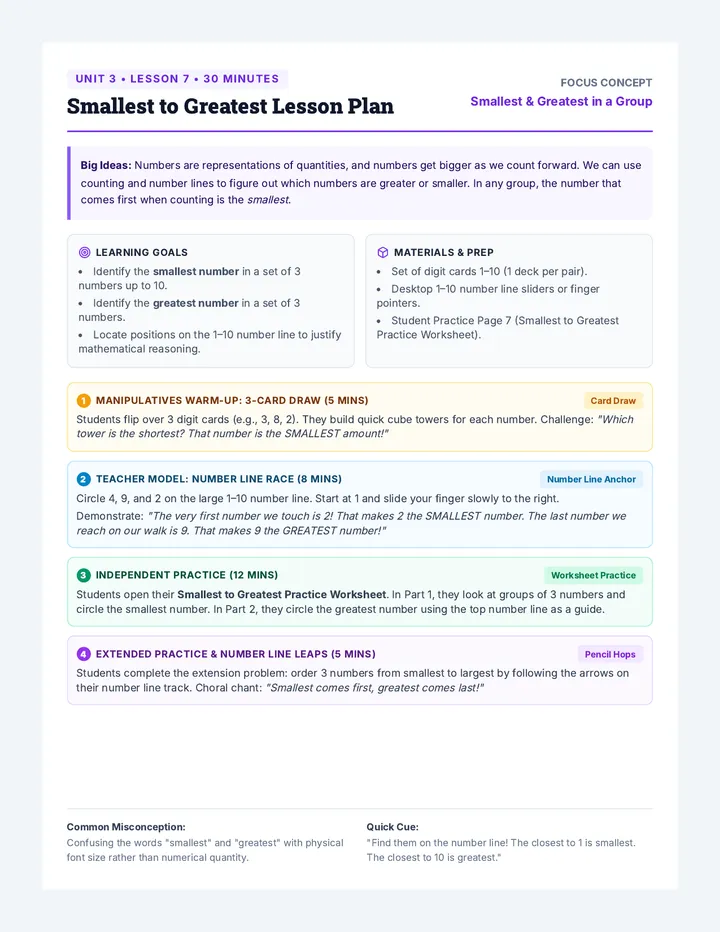
Smallest Greatest Lesson Plan Unit 3 • Lesson 7 • 30 Minutes
Smallest to Greatest Lesson Plan
Focus Concept Smallest & Greatest in a Group
Big Ideas: Numbers are representations of quantities, and numbers get bigger as we count forward. We can use counting and number lines to figure out which numbers are greater or smaller. In any group, the number that comes first when counting is the smallest .
Learning Goals
Identify the smallest number in a set of 3 numbers up to 10.
Identify the greatest number in a set of 3 numbers.
Locate positions on the 1–10 number line to justify mathematical reasoning.
Materials & Prep
Set of digit cards 1–10 (1 deck per pair).
Desktop 1–10 number line sliders or finger pointers.
Student Practice Page 7 (Smallest to Greatest Practice Worksheet).
1 Manipulatives Warm-Up: 3-Card Draw (5 Mins) Card Draw
Students flip over 3 digit cards (e.g., 3, 8, 2). They build quick cube towers for each number. Challenge: "Which tower is the shortest? That number is the SMALLEST amount!"
2 Teacher Model: Number Line Race (8 Mins) Number Line Anchor
Circle 4, 9, and 2 on the large 1–10 number line. Start at 1 and slide your finger slowly to the right.
Demonstrate: "The very first number we touch is 2! That makes 2 the SMALLEST number. The last number we reach on our walk is 9. That makes 9 the GREATEST number!"
3 Independent Practice (12 Mins) Worksheet Practice
Students open their Smallest to Greatest Practice Worksheet . In Part 1, they look at groups of 3 numbers and circle the smallest number. In Part 2, they circle the greatest number using the top number line as a guide.
4 Extended Practice & Number Line Leaps (5 Mins) Pencil Hops
Students complete the extension problem: order 3 numbers from smallest to largest by following the arrows on their number line track. Choral chant: "Smallest comes first, greatest comes last!"
Common Misconception: Confusing the words "smallest" and "greatest" with physical font size rather than numerical quantity.
Quick Cue: "Find them on the number line! The closest to 1 is smallest. The closest to 10 is greatest."
Smallest Greatest Practice Worksheet Name:
Number Line Reference (1–10)
1
2
3
4
5
6
7
8
9
10
Smallest to Greatest Practice
Use the number line above! Numbers get bigger as we count forward.
Lesson 7 Practice
Part 1 Look at each group of 3 numbers. Circle the SMALLEST number.
Group A
4 2 6
Circle the smallest
Group B
7 9 3
Circle the smallest
Group C
8 5 1
Circle the smallest
Part 2 Look at each group of 3 numbers. Put a BOX around the GREATEST number.
Group D
3 8 5
Box the greatest
Group E
6 2 10
Box the greatest
Group F
4 7 1
Box the greatest
Extended Practice Line Them Up!
Smallest to Largest
Put these three numbers in order from SMALLEST to LARGEST : 6 , 2 , 9
Smallest
Middle
Largest
Kindergarten Math • Unit 3: Smallest & Greatest Numbers Lesson 7 of 8
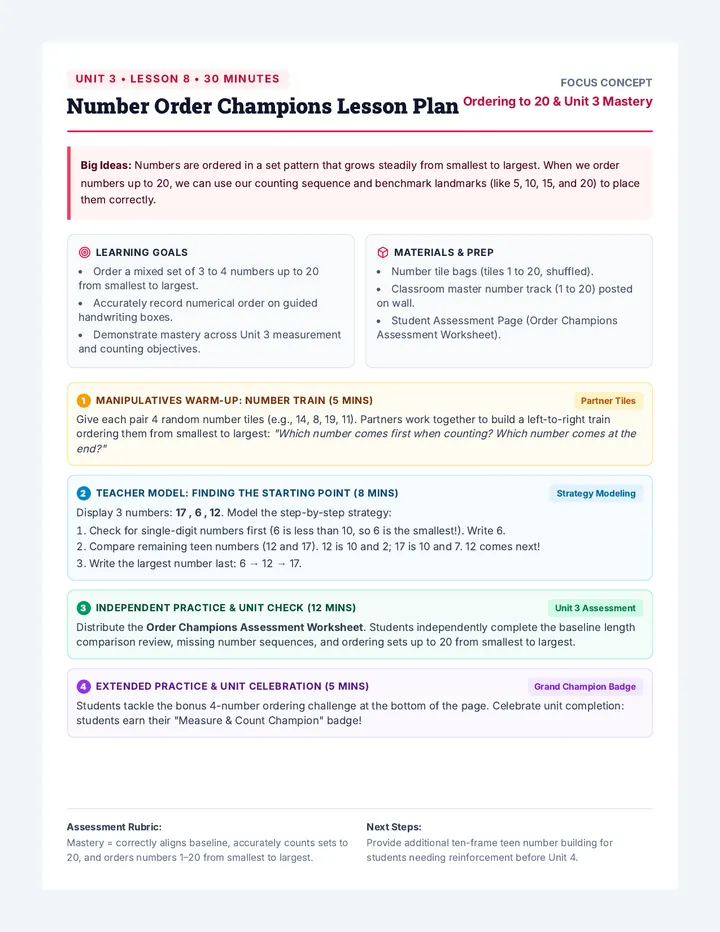
Order Champions Lesson Plan Unit 3 • Lesson 8 • 30 Minutes
Number Order Champions Lesson Plan
Focus Concept Ordering to 20 & Unit 3 Mastery
Big Ideas: Numbers are ordered in a set pattern that grows steadily from smallest to largest. When we order numbers up to 20, we can use our counting sequence and benchmark landmarks (like 5, 10, 15, and 20) to place them correctly.
Learning Goals
Order a mixed set of 3 to 4 numbers up to 20 from smallest to largest.
Accurately record numerical order on guided handwriting boxes.
Demonstrate mastery across Unit 3 measurement and counting objectives.
Materials & Prep
Number tile bags (tiles 1 to 20, shuffled).
Classroom master number track (1 to 20) posted on wall.
Student Assessment Page (Order Champions Assessment Worksheet).
1 Manipulatives Warm-Up: Number Train (5 Mins) Partner Tiles
Give each pair 4 random number tiles (e.g., 14, 8, 19, 11). Partners work together to build a left-to-right train ordering them from smallest to largest: "Which number comes first when counting? Which number comes at the end?"
2 Teacher Model: Finding the Starting Point (8 Mins) Strategy Modeling
Display 3 numbers: 17 , 6 , 12 . Model the step-by-step strategy:
Check for single-digit numbers first (6 is less than 10, so 6 is the smallest!). Write 6.
Compare remaining teen numbers (12 and 17). 12 is 10 and 2; 17 is 10 and 7. 12 comes next!
Write the largest number last: 6 → 12 → 17.
3 Independent Practice & Unit Check (12 Mins) Unit 3 Assessment
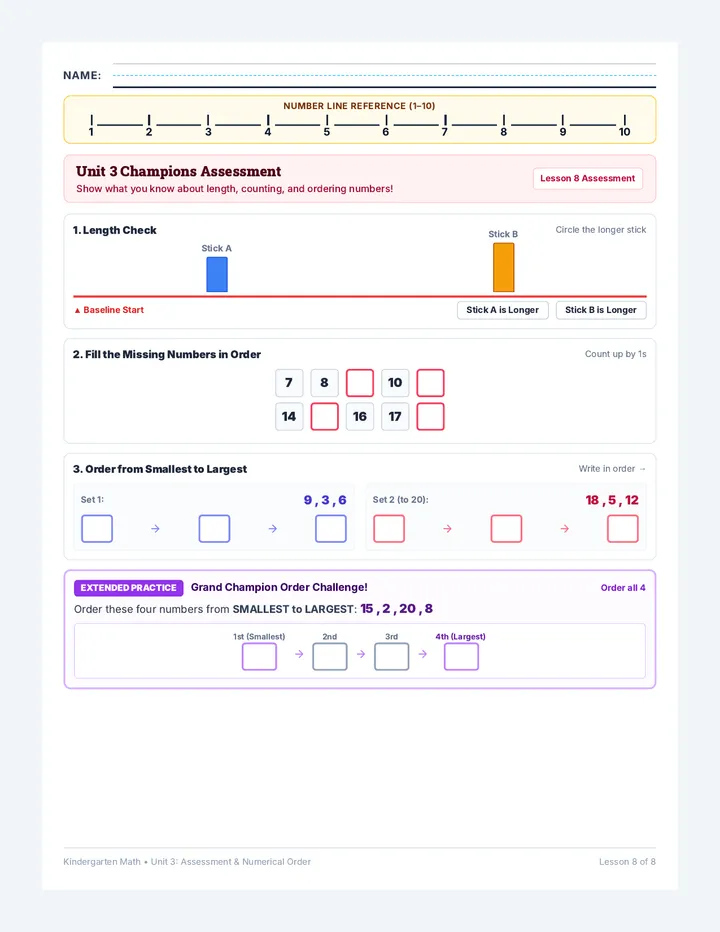
Distribute the Order Champions Assessment Worksheet . Students independently complete the baseline length comparison review, missing number sequences, and ordering sets up to 20 from smallest to largest.
4 Extended Practice & Unit Celebration (5 Mins) Grand Champion Badge
Students tackle the bonus 4-number ordering challenge at the bottom of the page. Celebrate unit completion: students earn their "Measure & Count Champion" badge!
Assessment Rubric: Mastery = correctly aligns baseline, accurately counts sets to 20, and orders numbers 1–20 from smallest to largest.
Next Steps: Provide additional ten-frame teen number building for students needing reinforcement before Unit 4.
Order Champions Assessment Worksheet Name:
Number Line Reference (1–10)
1
2
3
4
5
6
7
8
9
10
Unit 3 Champions Assessment
Show what you know about length, counting, and ordering numbers!
Lesson 8 Assessment
1. Length Check Circle the longer stick
Stick A
Stick B
▲ Baseline Start
Stick A is Longer Stick B is Longer
2. Fill the Missing Numbers in Order Count up by 1s
7 8
10
14
16 17
3. Order from Smallest to Largest Write in order →
Set 1: 9 , 3 , 6
Set 2 (to 20): 18 , 5 , 12
Extended Practice Grand Champion Order Challenge!
Order all 4
Order these four numbers from SMALLEST to LARGEST : 15 , 2 , 20 , 8
1st (Smallest)
2nd
3rd
4th (Largest)
Kindergarten Math • Unit 3: Assessment & Numerical Order Lesson 8 of 8