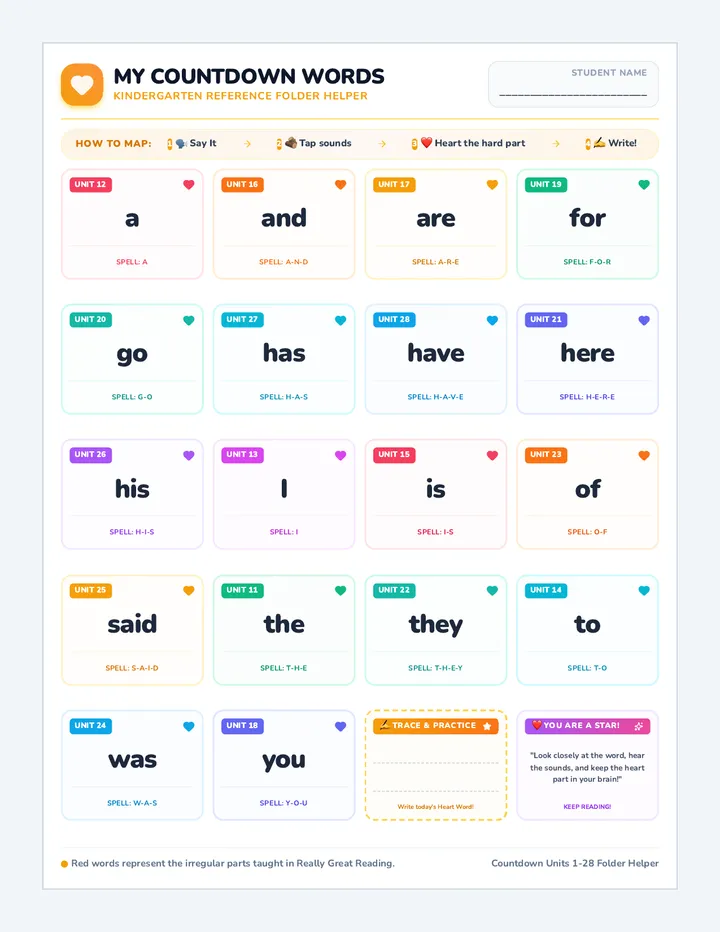
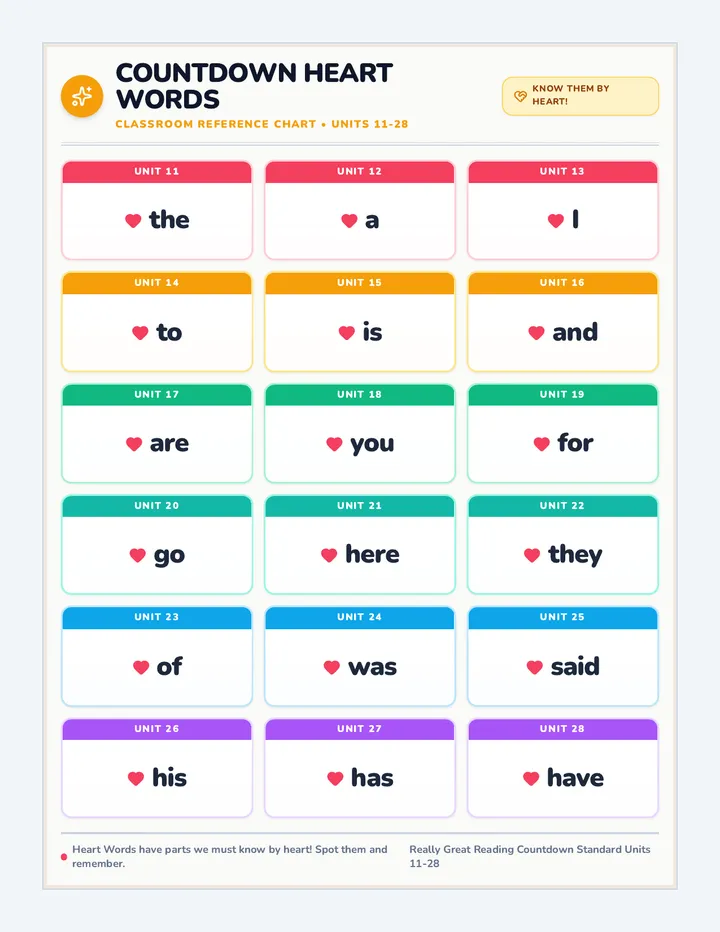
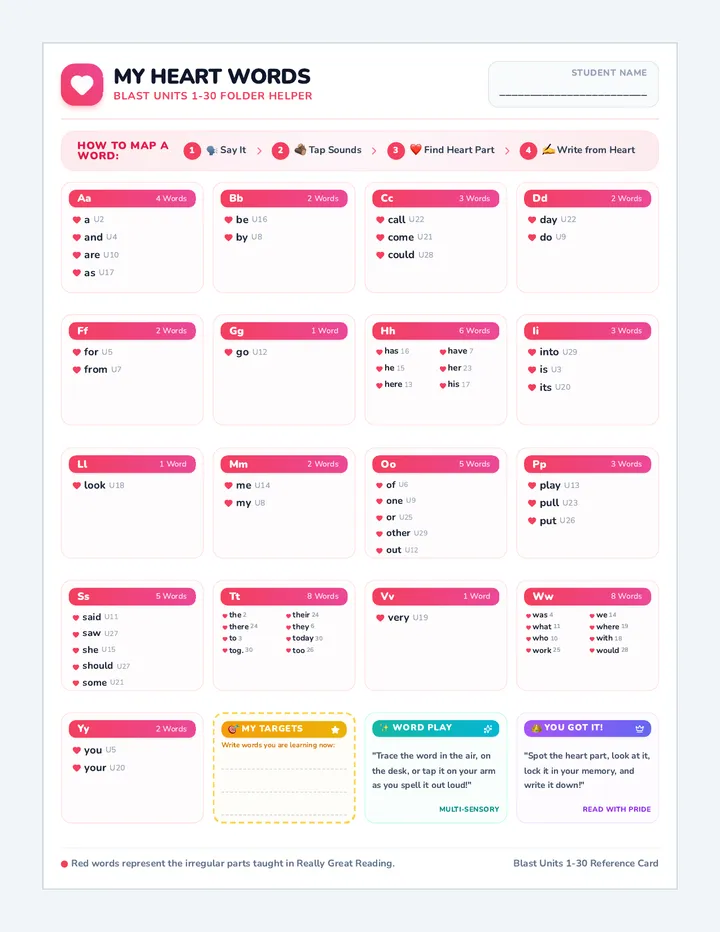
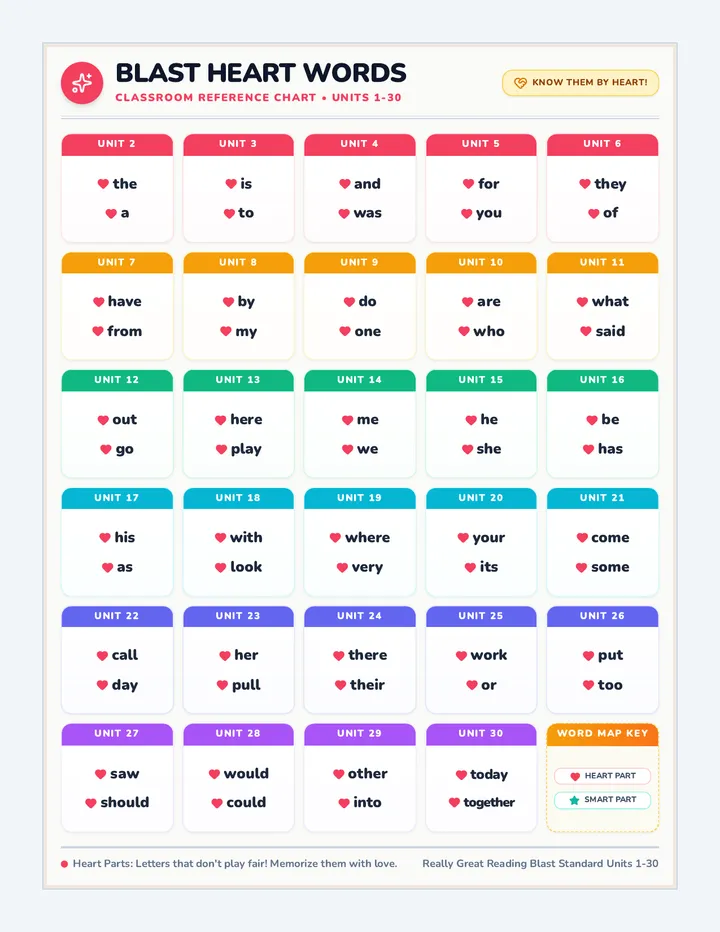
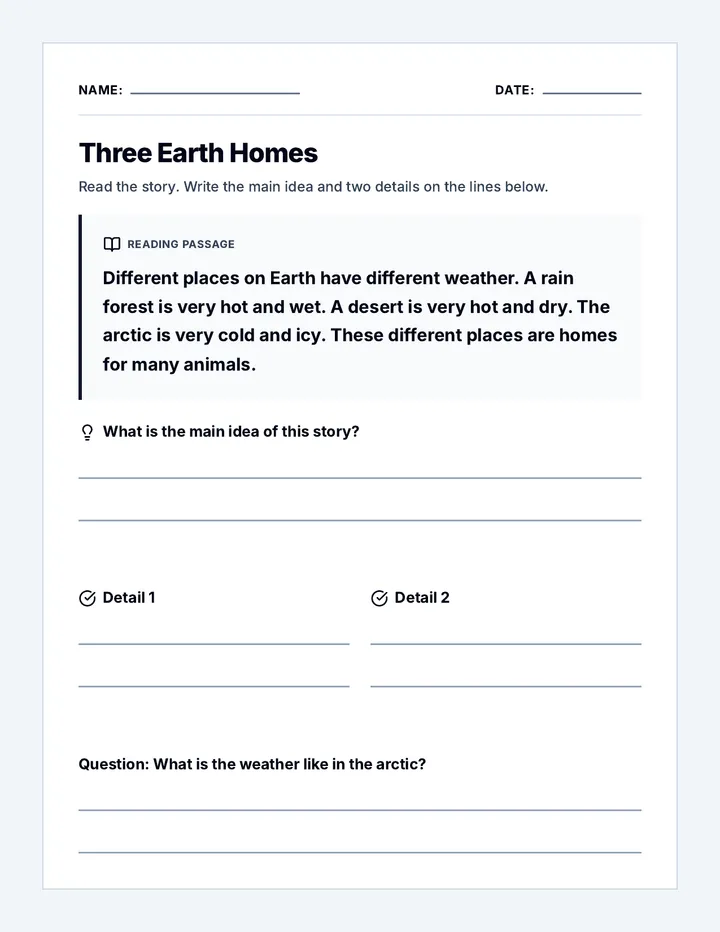
Introduces the short 'i' vowel sound (/ɪ/ as in "igloo"), building on previous blending skills with a focus on auditory discrimination and multi-sensory letter formation.
A 3rd-grade ELA lesson focused on reading a narrative passage and answering comprehension questions in the style of the NYS ELA exam. Students explore the theme of overcoming a challenge through the story of a girl facing her fear of the high dive.
A comprehensive intervention suite designed for 8th-grade students struggling with elopement and vandalism. It focuses on restorative justice, structural scheduling, and teacher-led support strategies.
Summative assessment on RI.3.1 using a comprehensive extreme weather passage.
A collaborative review and guided practice session preparing for the final assessment.
Students learn to generate their own questions and locate answers within a text about hurricanes.
Focused practice on answering explicit questions using a reading passage about tornadoes.
Introduction to RI.3.1 and building foundational skills for finding evidence in weather-related texts.
A week-long series of warm-up activities focusing on historical biographies and RI.3.1 standards to prepare students for end-of-grade testing.
Sensory support strategies and proprioceptive activities designed for students in grades 3-5. Bridges the gap between play-based movement and functional household participation with age-appropriate "strength challenges."
A comprehensive Grade 2 ESL lesson focused on the art of narration. Students develop academic language through sequencing words and transition phrases while practicing all four language domains (reading, writing, listening, and speaking) through a creative 'Story Lab' theme.
Sensory support strategies and proprioceptive activities specifically designed for students in grades K-3. Focuses on play-based heavy work, animal walks, and simple household participation.
A classroom management system focused on positive reinforcement through a token economy, featuring non-tangible rewards.
A comprehensive K-12 behavior management system that synthesizes best practices from MTSS, PBIS, and restorative justice frameworks. This lesson provides teachers with a clear decision-making flow and a detailed policy handbook for maintaining a positive school culture.
A cumulative review and formal assessment of dictionary navigation and entry analysis skills.
Focuses on the anatomy of a dictionary entry, specifically how to identify and choose between multiple definitions based on sentence context.
Introduction to the physical and digital structure of a dictionary, with a deep dive into using guide words for rapid word location.
A collection of worksheets designed to help students write structured biographical paragraphs about historical figures using mind maps and sentence starters. Each worksheet features a unique theme tailored to the figure's profession.
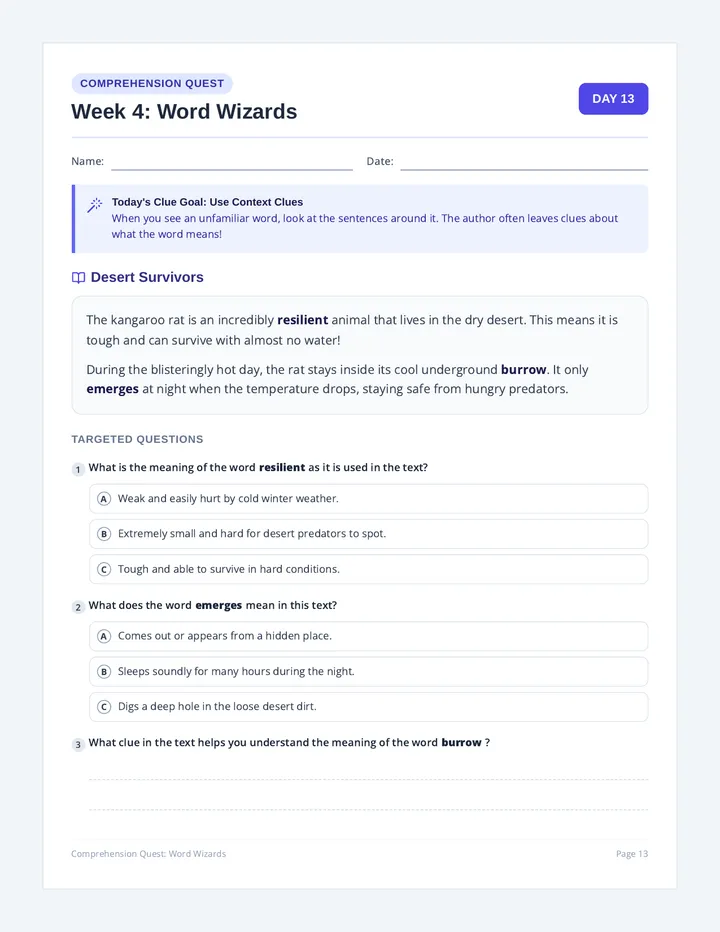
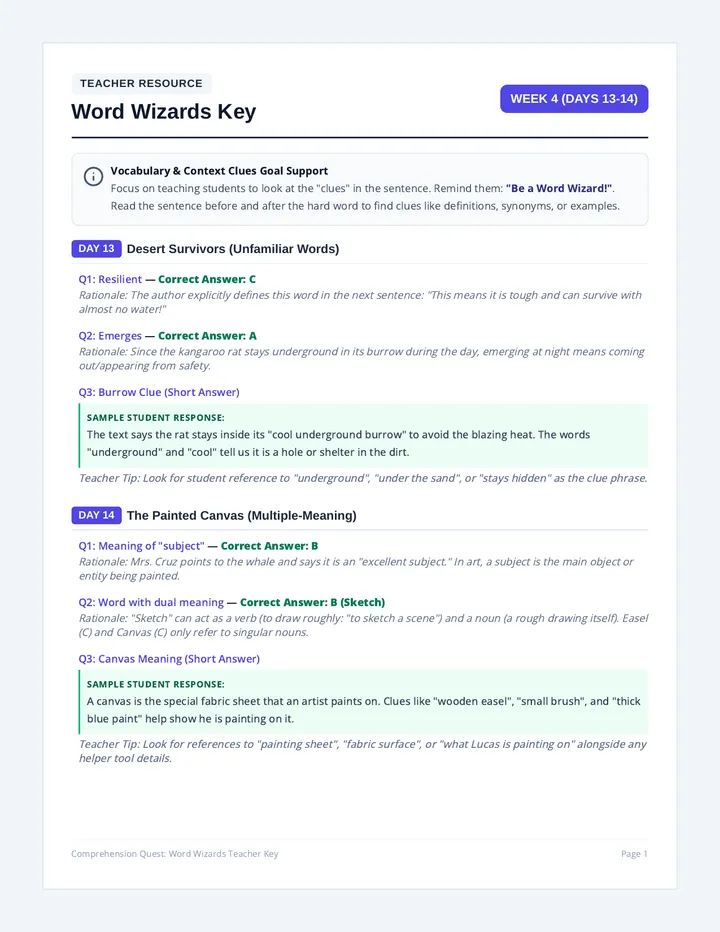
Students identify antonym clues to understand what a word is NOT, using contrasting pictures to solve the vocabulary puzzle.
Students use synonym clues to find words that mean the same thing as the unknown word, using pictures to match similar concepts.
Students explore example clues, where a sentence provides specific instances of a word to help reveal its meaning, paired with helpful visual supports.
Students learn to identify definition clues in sentences where the meaning of a tricky word is explained directly, using illustrations to confirm their findings.
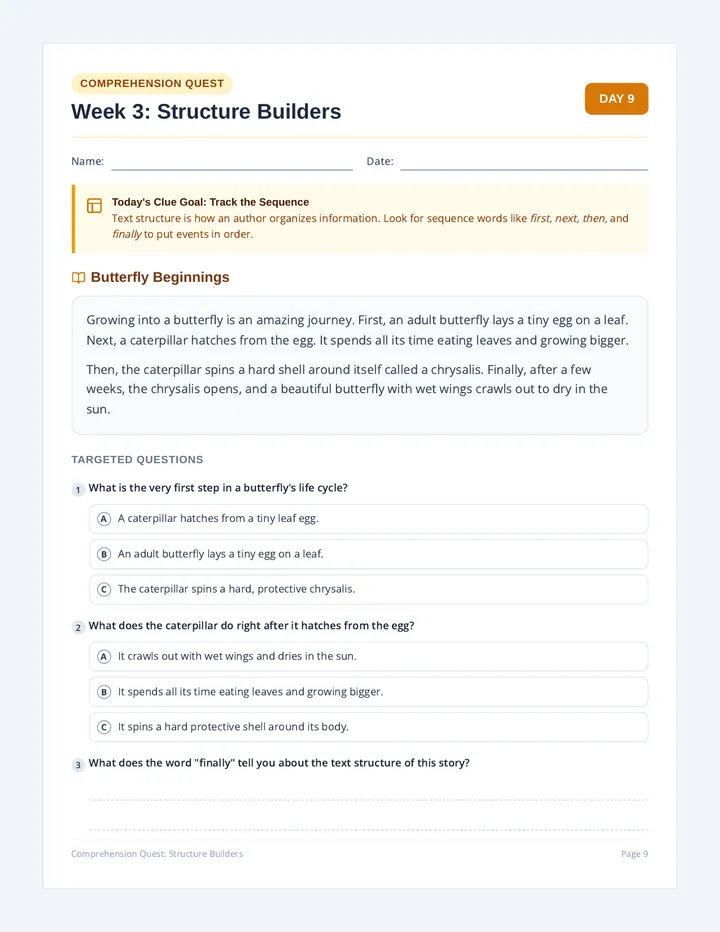
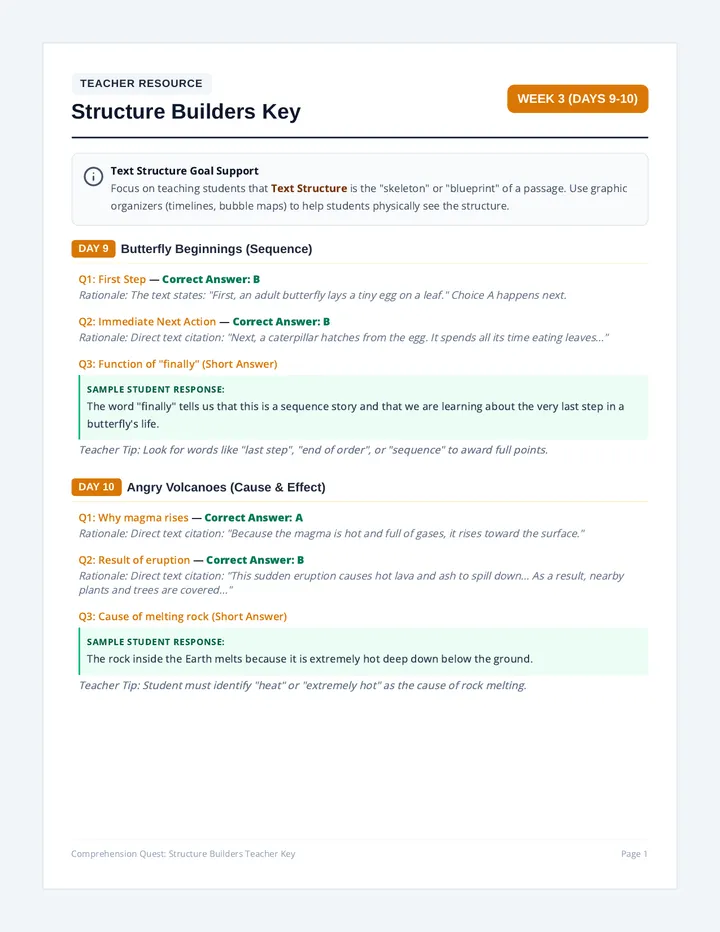
A lesson focused on narrative sequencing and logical flow through the lens of mystery and suspense stories. Students analyze transition words, cause and effect, and character development to reorder scrambled narratives.
Final assessment of RL.3.3 mastery through an EOG-formatted test and reflection.
Integrated review of traits, motivations, and plot contribution using complex EOG-style passages.
Focus on how character actions directly cause specific events in the story's sequence.
Focus on identifying character motivations and feelings and how they lead to specific actions.
Focus on identifying character traits using text evidence (what characters say, think, and do).
A specialized lesson designed for IEP students to master adding fractions with unlike denominators using visual scaffolds, multiplication charts, and color-coded steps. Focuses on simple denominators and visual area models to build conceptual understanding.
A mini-lesson for a 6th-grade resource room ELA class focusing on Auggie's character traits and his development throughout the first month of school in the novel 'Wonder'. This lesson uses a space-exploration theme and provides high levels of scaffolding.
A comprehensive set of resources for parents of junior high and high school students, focusing on proprioception, sensory seeking behaviors, and practical home-based strategies.
Students synthesize the entire novel's events, including the final chapter and afterword, to identify themes and analyze the resolution of the plot.
Students examine the setting's impact on the plot and synthesize details from Annemarie's encounter with the soldiers in the woods.
Students analyze character growth and the impact of point of view as Annemarie takes on a dangerous mission in chapters 13 and 14.
Focusing on chapters 11 and 12, students analyze plot elements and practice synthesizing information to summarize the escape to the boat.
Students evaluate plot details and suspense techniques used in chapters 9 and 10, focusing on the mysterious funeral of 'Great-Aunt Birte'.
Students investigate point of view and make deeper inferences about Uncle Henrik's role and the move to the coast in chapters 7 and 8.
Focusing on chapters 5 and 6, students track plot development and practice summarizing the high-tension events of the soldiers' midnight visit.
Students analyze character traits and make inferences about the changing atmosphere in Copenhagen as the Nazi occupation intensifies in chapters 3 and 4.
Students investigate Chapters 1-2, focusing on using 5th grade context clues (TEKS 5.3B) to decipher historical terminology and making logical predictions based on textual evidence (TEKS 5.6C) regarding the intensifying Nazi occupation.
A comprehensive set of articulation resources for kindergarteners focusing on /t/, /d/, /n/, /s/, and /z/ sounds in initial, medial, and final word positions through a playful safari theme.
A comprehensive parent training resource designed to support task initiation and sustained focus for students with autism using visual strategies and structured home routines.
The war ends and the Johansens look toward a future of rebuilding. Students evaluate the resolution of the novel and compare the fictional narrative to the historical facts presented in the Afterword.
The mission reaches its high-stakes climax as Annemarie faces the soldiers and delivers the package that determines the Rosens' survival. Students analyze the plot climax and the author's use of suspense and symbolic resolution.
Annemarie undertakes a dangerous solo journey through the woods to deliver a mysterious package, using her imagination to cope with intense fear. Students analyze character courage and the use of literary devices in suspenseful plotting.
Students synthesize the entire novel's events, including the final chapter and afterword, to identify themes and analyze the resolution of the plot. [5th Grade TEKS 5.7A, 5.8C]