Smart Estimators Student Worksheet
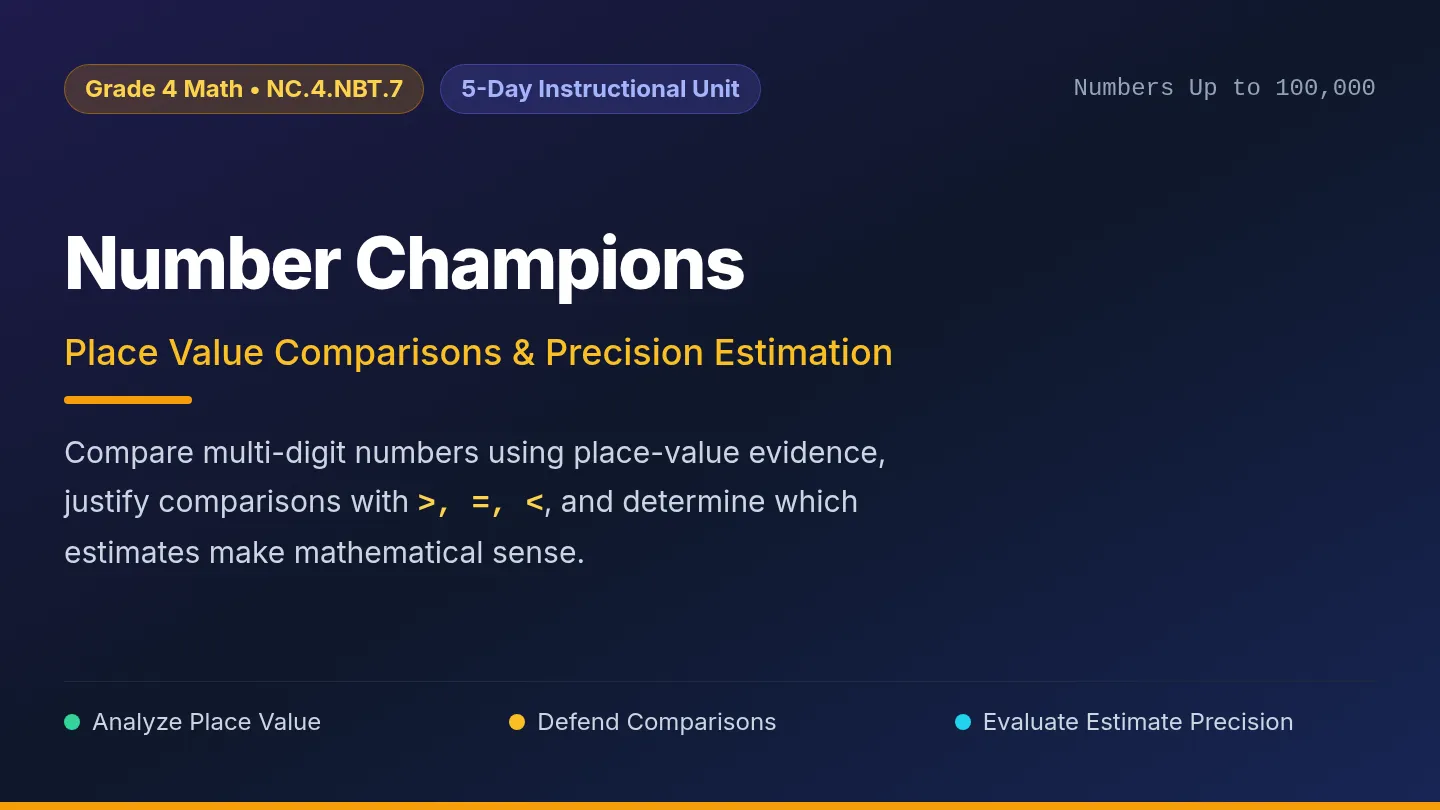
Grade 4 Math • Place Value & Estimation
Which Estimate is Better?
Name:
Date: Class:
Essential Question: How can estimation help determine whether an answer makes sense?
1 Warm-Up: Choose Your Precision
Round each number two different ways.
| Original Number | Rounded to Nearest Hundred | Rounded to Nearest Thousand |
|---|
| 4,786 | | |
| 3,258 | | |
| 9,143 | | |
A. Which estimate is closer to the exact number? Explain why.
B. When might rounding to the nearest thousand be more useful than nearest hundred?
C. Which estimate requires less precision?
2 Check for Understanding: 5,249 + 6,872
Part A: Nearest Hundred Estimate
5,249 →
6,872 →
Estimated Sum:
Part B: Nearest Thousand Estimate
5,249 →
6,872 →
Estimated Sum:
Part C: Which estimate is closer to the true sum? Explain your reasoning.
Part D: Without calculating the exact sum, predict whether the actual answer is closer to 12,000 or 13,000. Explain why.
3 Error Analysis (DOK 3): Spot the Misconception
Student Work
4,586 → 4,500
5,392 → 5,300
Estimate: 9,800
Did the student round correctly?
Which number(s) is incorrect?
Corrected Estimate:
Explain the student's mistake and how to fix it:
Smart Estimators • Student Worksheet Page 1 of 2
Independent Practice
Estimation Showdown & Application
Name:
4 Estimation Recording Organizer
Evaluate precision for each addition problem
Directions: For each problem: ① Round to nearest hundred & estimate, ② Round to nearest thousand & estimate, ③ Decide which estimate is better, and ④ Defend your reasoning.
| Problem | Nearest Hundred Estimate | Nearest Thousand Estimate | Better Estimate | Mathematical Reasoning (Why?) |
|---|
| 4,586 | | | | |
| + 5,392 | | | | |
| _ _ _ _ + _ _ _ _ | | | | |
= ________
|
_ _ _ _ + _ _ _ _
= ________
|
Hundred
Thousand
| |
| 6,241
+ 3,728 |
_ _ _ _ + _ _ _ _
= ________
|
_ _ _ _ + _ _ _ _
= ________
|
Hundred
Thousand
| |
| 8,479
+ 1,614 |
_ _ _ _ + _ _ _ _
= ________
|
_ _ _ _ + _ _ _ _
= ________
|
Hundred
Thousand
| |
| 3,368
+ 2,947 |
_ _ _ _ + _ _ _ _
= ________
|
_ _ _ _ + _ _ _ _
= ________
|
Hundred
Thousand
| |
| 7,903
+ 4,105 |
_ _ _ _ + _ _ _ _
= ________
|
_ _ _ _ + _ _ _ _
= ________
|
Hundred
Thousand
| |
5 Real-World Application Challenge (DOK 3)
The Carnival Ticket Count: A school sold 4,862 tickets on Friday and 5,274 tickets on Saturday for the annual fall carnival. The principal makes an announcement: “We probably sold about 20,000 tickets!”
Question 1: Is the principal's estimate reasonable? Why or why not?
Question 2: What would you estimate as the total tickets sold? Show your rounding and mental math.
Question 3: For ordering prizes, would you recommend rounding to the nearest hundred or thousand? Explain why.
Smart Estimators • Student Worksheet Page 2 of 2
Smart Estimators Teacher Guide
Teacher Instructional Facilitation Guide
Smart Estimators: Which Estimate is Better?
4.NBT.B.4 • 4.OA.A.3
Focus: Precision & Reasonableness
Essential Question: How can estimation help determine whether an answer makes sense?
“Estimation isn't guessing. It uses place value to make smart mathematical predictions. Good estimators think about how accurate they need to be before they choose what place value to round.”
Anchor Chart Framework: “Smart Estimators”
Step 1: Purpose
Decide how accurate the estimate needs to be for the situation.
Step 2: Place Value
Choose benchmark place value (nearest hundred vs. nearest thousand).
Step 3: Round
Round each addend accurately using place-value rules.
Step 4: Solve Mentally
Compute the sum mentally using basic facts and place value zeros.
Step 5: Compare
Compare the estimate against the exact calculation or known limits.
Step 6: Reasonable?
Verify if the answer makes sense in the problem context.
I I Do: Explicit Teacher Modeling (3,786 + 4,259)
Exact Sum = 8,045
Method 1: Nearest Hundred Higher Precision
3,786 → 3,800
4,259 → 4,300
Estimated Sum = 8,100
Difference from exact: +55
Method 2: Nearest Thousand Faster Mental Math
3,786 → 4,000
4,259 → 4,000
Estimated Sum = 8,000
Difference from exact: -45
Teacher Think-Aloud Script:
“Both estimates are reasonable. But which estimate is closer? 8,000 is 45 away, while 8,100 is 55 away! In this case, thousand-rounding happened to be 10 units closer because 3,786 rounded up by 214 and 4,259 rounded down by 259, nearly balancing out! But usually, hundreds keep more place-value information.”
DOK 3 Discussion Prompt: “Would I always round to the nearest hundred? When might rounding to the nearest thousand be better?” (Highlight: rapid decision-making, budget ballpark, stadium headcounts).
WE We Do: Guided Step-by-Step & Discourse (7,134 + 2,697)
Step 1: Nearest Hundred
7,100 + 2,700
= 9,800
Step 2: Nearest Thousand
7,000 + 3,000
= 10,000
Step 3: Exact Sum