Lenny.com
Explore
Create
ActivitiesNewMathEnglish Language ArtsScience & EngineeringSocial StudiesGlobal LanguagesHealth & Physical EducationSpecial EducationCounseling & Life SkillsArts & CreativityESL
Lenny.com
Lenny.com
Explore
Create
ActivitiesNewMathEnglish Language ArtsScience & EngineeringSocial StudiesGlobal LanguagesHealth & Physical EducationSpecial EducationCounseling & Life SkillsArts & CreativityESL
Lenny.com
Lenny.com

Solutions

Lenny for EducatorsLenny for SchoolsLenny for Districts

Product

ExploreSign inCreateSupportAbout

Resources

Getting startedMTSS Acceleration Program

© 2026 Lenny Learning Inc.

TermsPrivacyAccessibility
LinkedInInstagramX
Lenny
MathNumbers & CountingCounting ObjectsNumber NamesComparing NumbersNumber OperationsCounting SequenceNumbers 0-10Place Value Understanding and SystemAdd and Subtract Within 20Addition and Subtraction ConceptsAddition and Subtraction EquationsAddition and Subtraction ProblemsFoundations for MultiplicationMultiplication and Division PropertiesMultiply and Divide Within 100Multiplication and Division ProblemsFactors and MultiplesProperties of OperationsPatterns and RelationshipsGenerate and Analyze PatternsMulti-Digit ArithmeticPlace Value OperationsMulti-Digit and Decimal OperationsNumerical ExpressionsFour Operations and PatternsFour Operations Problem SolvingMeasurement & DataMeasurable AttributesMeasuring LengthsMeasure and Estimate Lengths in Standard UnitsRelate Addition and Subtraction to LengthClassifying and Counting ObjectsTime and MoneyArea Concepts and MeasurementPerimeter and Area MeasuresAngle Concepts and MeasurementTime, Volume, and MassMeasurement Unit ConversionsGeometryIdentifying ShapesShapes and AttributesShape Attributes and ReasoningShapes and CompositionClassifying 2D FiguresGeometric Figures and RelationshipsLines, Angles, and ShapesAngle, Area, and VolumeGeometric MeasurementVolume of 3D ShapesCoordinate Plane ApplicationsTransformations in the PlaneCongruence and SimilarityUnderstand congruence in terms of rigid motionsSimilarity and TransformationsProve Theorems Involving SimilarityPythagorean TheoremTrigonometry for General TrianglesMake Geometric ConstructionsProve Geometric TheoremsTheorems About CirclesFind Arc Lengths And Areas of Sectors of CirclesVolume FormulasRelationships Between Two-Dimensional and Three-Dimensional ObjectsProve Simple Geometric Theorems AlgebraicallyTranslate Between Geometric Description and Equation for Conic SectionApply Geometric Concepts in Modeling SituationsFractions & DecimalsFractions as NumbersBuilding FractionsFraction Equivalence and OrderingAdding and Subtracting FractionsMultiplying and Dividing FractionsDividing FractionsDecimal FractionsMulti-Digit Computation and FactorsAdd, Subtract, Multiply, and Divide Rational NumbersRational Number SystemIrrational Numbers and ApproximationsRatiosRatios and ProportionsProportional RelationshipsUnit RateAlgebraAlgebraic ExpressionsGenerate Equivalent ExpressionsQuantitative RelationshipsProportional Relationships and Linear EquationsEquations and InequalitiesEquation Solving and ReasoningLinear Equations and SystemsGraph Equations and InequalitiesSystems of EquationsReal-World Algebraic ProblemsQuantitative Reasoning with UnitsExpression StructureEquivalent Expression FormsRadicals and Integer ExponentsRational ExponentsRational and Irrational NumbersPolynomial OperationsPolynomial IdentitiesPolynomial Zeros and FactorsRational ExpressionsComplex Number OperationsComplex Numbers in PolynomialsComplex Numbers on PlaneStatistics & ProbabilityRepresent and Interpret DataData DistributionsStatistical VariabilityProbability ModelsCompound Event ProbabilitiesStatistical SamplingInterpret Categorical and Quantitative DataBivariate Data PatternsInterpret Linear ModelsComparing Two PopulationsRandom Processes in StatisticsIndependence and Conditional ProbabilityExpected ValuesProbability-Based Decision MakingStatistical Inference and ConclusionsFunctionsFunction Concepts and NotationDefine and Compare FunctionsInterpret Functions in ContextAnalyze Function RepresentationsModel Relationships with FunctionsIdentify Linear vs Exponential GrowthDistinguish Between Function TypesCompare Growth RatesInterpret Function ExpressionsBuild Functions from RelationshipsConstruct and Model FunctionsTransform and Combine FunctionsModel Comparison and SelectionSolve Exponential EquationsTrigonometryTrigonometric Ratios Involving Right TrianglesTrigonometric Functions and Unit CircleModel with Trigonometric FunctionsTrigonometric IdentitiesVectors & MatricesIntroduction to Vectors and MatricesVector QuantitiesVector OperationsMatrix OperationsCalculusLimits and ContinuityDerivative Concepts and NotationDerivative Rules and TechniquesApplications of DerivativesOptimization ProblemsRelated RatesCurve Sketching and AnalysisIntegration Concepts and NotationAntiderivatives and Indefinite IntegralsDefinite Integrals and AreaFundamental Theorem of CalculusIntegration TechniquesApplications of IntegrationDifferential EquationsSequences and SeriesParametric and Polar FunctionsVector-Valued Functions

Recipe Remix

A hands-on life skills and math lesson teaching students how to measure wet and dry kitchen ingredients accurately and double everyday recipes using fraction operations.

MSMatthew Sullivan

Recipe Remix

A hands-on life skills and math lesson teaching students how to measure wet and dry kitchen ingredients accurately and double everyday recipes using fraction operations.

MSMatthew Sullivan
¼ teaspoon
¼ tsp measuring spoon
¼ teaspoon¼ + ¼ = 2/4½ teaspoon½ tsp measuring spoon
½ teaspoon½ + ½ = 11 teaspoon1 tsp measuring spoon
1 ½ teaspoons1.5 × 2 = 3 tsp1 Tablespoon (Tbsp)1 Tbsp measuring spoon
1 Tablespoon1 × 2 = 2 Tbsp2 TablespoonsFill 1 Tbsp spoon twice (⅛ cup)
¼ cup¼ + ¼ = 2/4½ cup½ dry cup or ½ liquid line
⅓ cup⅓ + ⅓⅔ cupFill ⅓ cup twice
½ cup½ + ½ = 11 whole cup1 cup dry cup or 1 cup line
¾ cup¾ + ¾ = 6/41 ½ cupsOne 1-cup + one ½-cup

The Doubling Traps: What Does NOT Double?

Do NOT double oven temperature! 350°F stays 350°F. Doubling heat will burn the outside while inside stays raw.

Do NOT double baking time! Baking time may increase slightly (by 5-10 minutes if using a deeper pan), but never doubles.

Keep this reference card taped inside a kitchen cabinet door for easy meal preparation and independent living!

| | Whole Milk (Liquid) | 1 ¼ cups |

|

| | Vanilla Extract | ½ teaspoon |

|

|

3

Everyday Kitchen Independence

1. Your friend says: "We are doubling the recipe, so we should turn the oven from 350°F up to 700°F!" Why is your friend incorrect?

2. If you need ¾ cup of milk, but your ¾ cup measuring tool is in the dishwasher, what combination of smaller cups can you use?

Keep practicing measuring at home to prepare delicious meals with confidence and independence!

Extensions / Advanced: Challenge students to triple (3x) the pancake recipe, or calculate halving (0.5x) the batch for a single serving. Ask them to convert 4 Tbsp into liquid cup fractions (¼ cup).

Answer Key & Assessment Rubric

Master Solutions • Performance Standards

Teacher Resource • Page 2

Student Worksheet Answer Key

Part 1: Tool Match

  • 1. ¾ cup Whole Milk: Tool B (Liquid Measuring Cup)
  • 2. 1 ½ cups Rolled Oats: Tool A (Dry Nesting Cups)
  • 3. ½ tsp Cinnamon: Tool C (Measuring Spoons)
  • 4. ¼ cup Vegetable Oil: Tool B (Liquid Measuring Cup)

Part 2: Station 3 Proof

3 teaspoons exactly fill 1 Tablespoon. (3 tsp = 1 Tbsp).

Part 4: Independence Reflections

Q1 (Oven Temperature):

Oven heat does NOT double. 700°F will incinerate the crust while the batter stays raw. The chemistry of heat transfer requires the same baking temperature (350°F).

Q2 (¾ Cup Substitute):

Use one ½ cup + one ¼ cup (½ + ¼ = ¾), OR fill the ¼ cup measure three times (3 × ¼ = ¾).

Part 3: Grandma's Fluffy Pancakes Doubled Master Key

IngredientOriginal (1x)Math CalculationDoubled Amount (2x)
Flour1 ½ cups1 ½ + 1 ½ = 33 cups
Baking Powder1 teaspoon1 × 2 = 22 teaspoons
Sugar2 Tablespoons2 × 2 = 44 Tablespoons (or ¼ cup)
Milk1 ¼ cups1 ¼ + 1 ¼ = 2 &frac24;2 ½ cups
Vanilla Extract½ teaspoon½ + ½ = 11 teaspoon

Culinary Math Proficiency Rubric

Skill Category4 - Master Chef3 - Proficient Cook2/1 - Developing Cook
Tool SelectionFlawlessly categorizes dry vs. wet ingredients; selects appropriate spoon or cup size.Selects correct tool with 1 minor error; distinguishes wet from dry cups.Confuses liquid vs dry tools or mixes up tsp and Tbsp abbreviations.
Measuring PrecisionConsistently sweeps level with straight edge; reads liquids exactly at eye level on flat table.Levels dry cups adequately; checks liquids with minor tilt or angle.Heaps dry ingredients without leveling; holds liquid cup in mid-air.
Fraction ScalingCalculates all doubled quantities accurately; simplifies mixed fractions correctly.Doubles whole numbers and simple fractions (½ c); struggles with 1 ¼ c.Doubles denominator instead of numerator (e.g., ½ × 2 = ¼) or needs continuous 1-on-1 support.

Quick Verbal Exit Ticket: "If your cookie recipe needs 1 Tbsp of milk, how many teaspoons can you pour?"
Answer: 3 tsp

You might also like

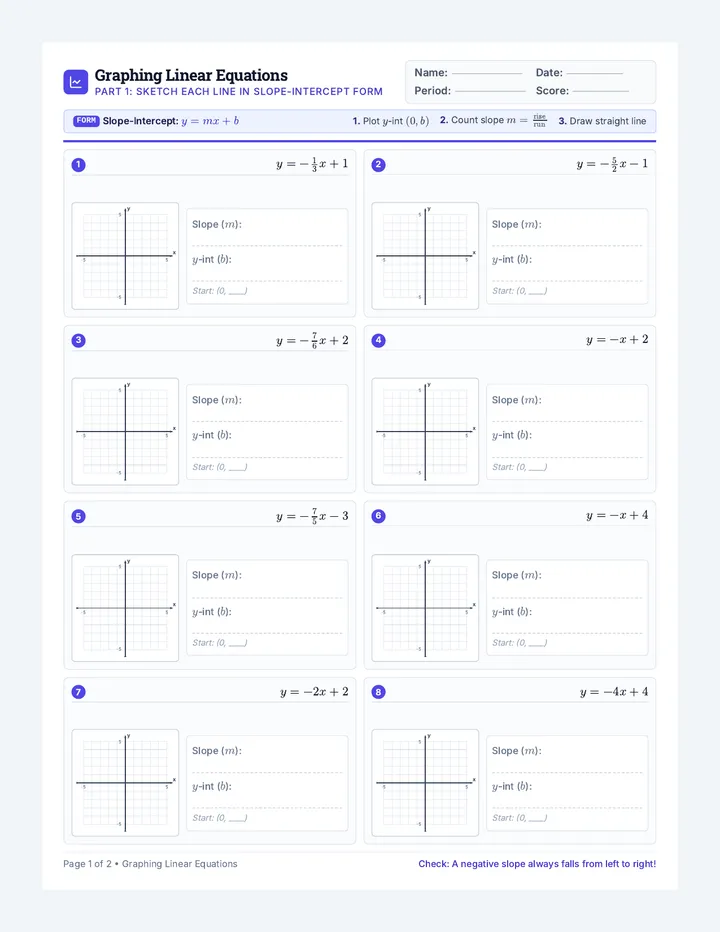
Linear Equations Practice Worksheet

Coordinate Geometry Mastery

A secondary mathematics curriculum sequence exploring linear functions and geometric transformations on the Cartesian coordinate plane, featuring print-ready guided practice and teacher keys.

FM

Fernando Mancini

4
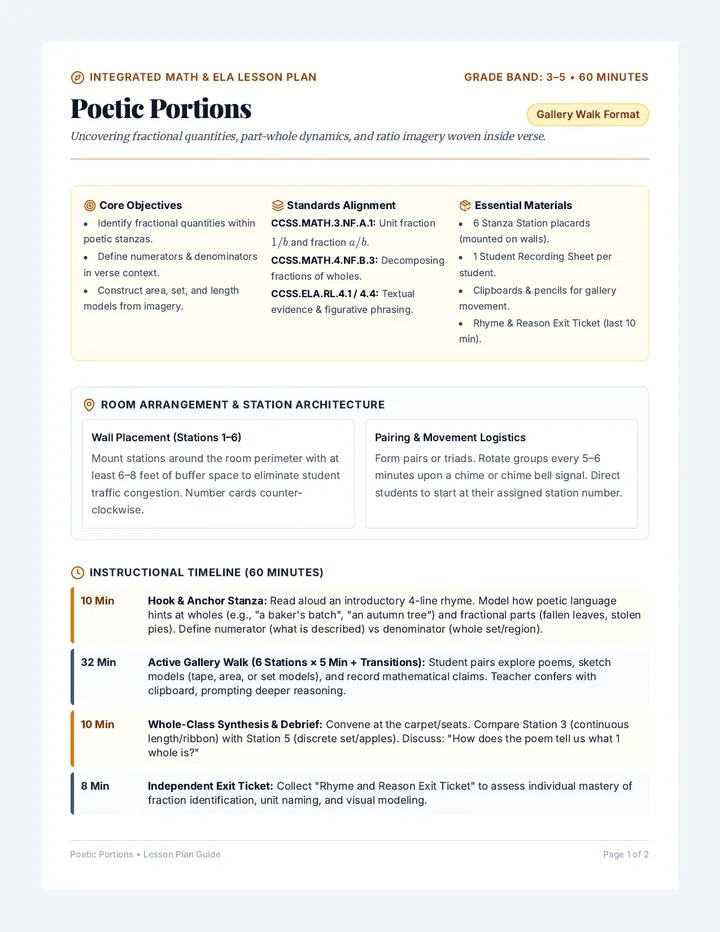
Poetic Portions Lesson Plan

Poetic Portions

A cross-curricular mathematics and language arts lesson where students participate in a gallery walk to analyze, interpret, and model fractional values embedded within poetic stanzas. Students decode fractional relationships of sets, lengths, and regions described in verse while building conceptual understanding.

NS

Naomi Seifert

5
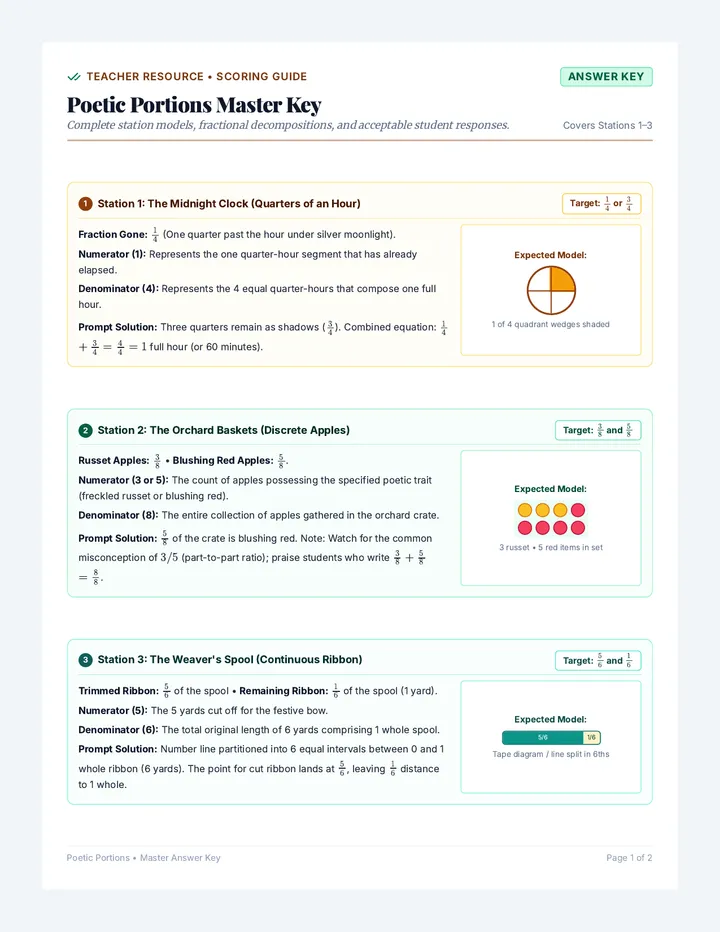
Poetic Portions Answer Key

Poetic Portions Answer Key

A 2-page teacher answer key and scoring guide providing full solutions, diagram exemplars, textual justifications, and exit ticket response criteria for the Poetic Portions lesson bundle.

NS

Naomi Seifert

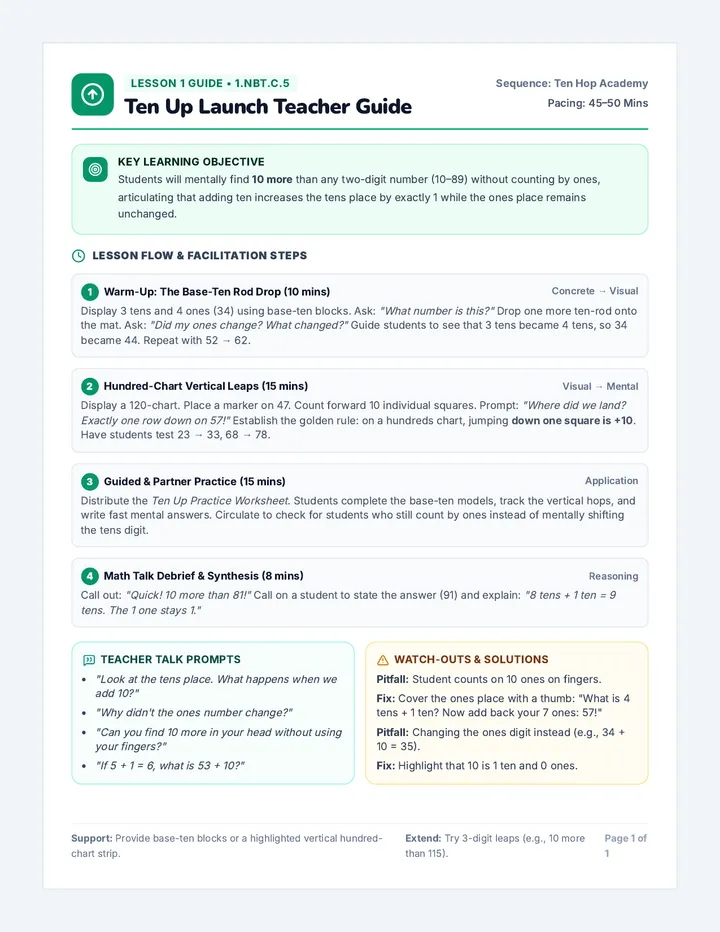
Ten Up Teacher Guide

Ten Hop Academy

A comprehensive 3-lesson primary math sequence designed to develop first graders' mental fluency with finding 10 more and 10 less than any two-digit number. Students transition from concrete base-ten models and hundreds-chart leap patterns to rapid mental calculations and clear verbal explanations.

K

kkipperman

9
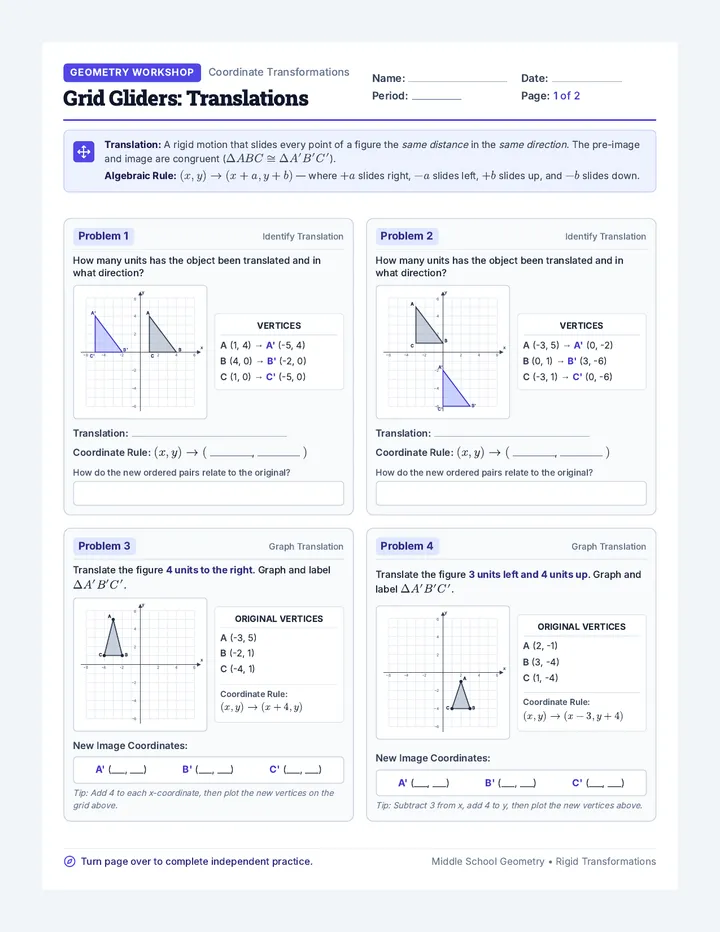
Grid Gliders Worksheet

Grid Gliders

A focused middle school geometry lesson on translations in the coordinate plane. Students discover rigid transformations, determine translation direction and distance, formulate coordinate rules, and graph translated figures.

FM

Fernando Mancini

2
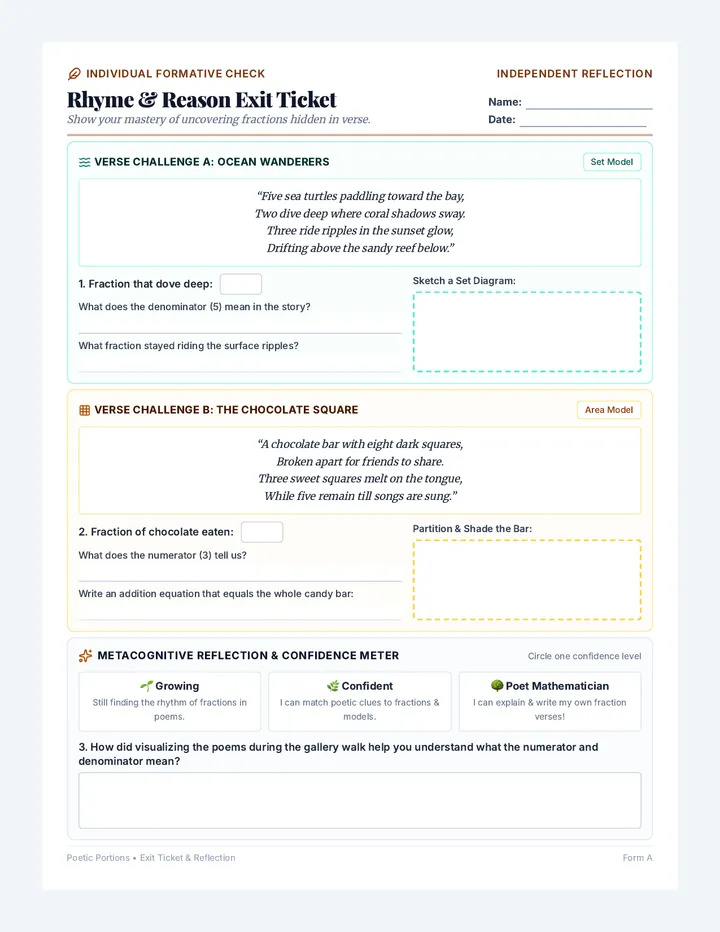
Rhyme and Reason Exit Ticket

Rhyme and Reason Exit Ticket

An individual formative assessment featuring two original verse-fraction challenges, visual modeling areas, and a metacognitive reflection on connecting literary imagery to fractional quantities.

NS

Naomi Seifert

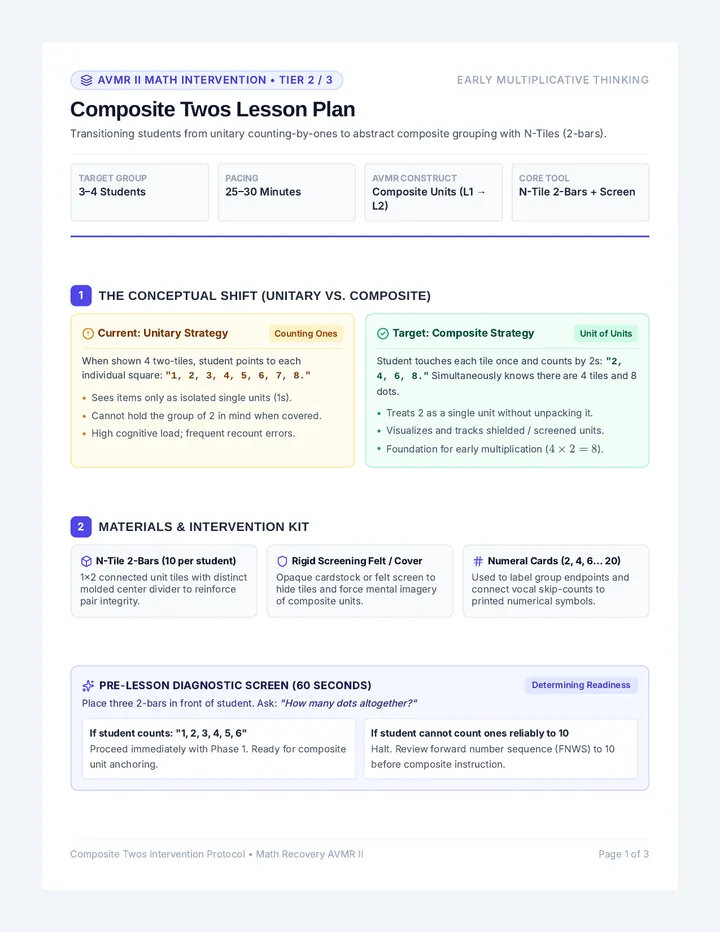
Composite Twos Lesson Plan

Math Intervention Suite

A comprehensive math intervention suite targeting foundational construct progressions from early multiplicative units to conceptual fraction schemes.

JW

Julie Whitehead

13
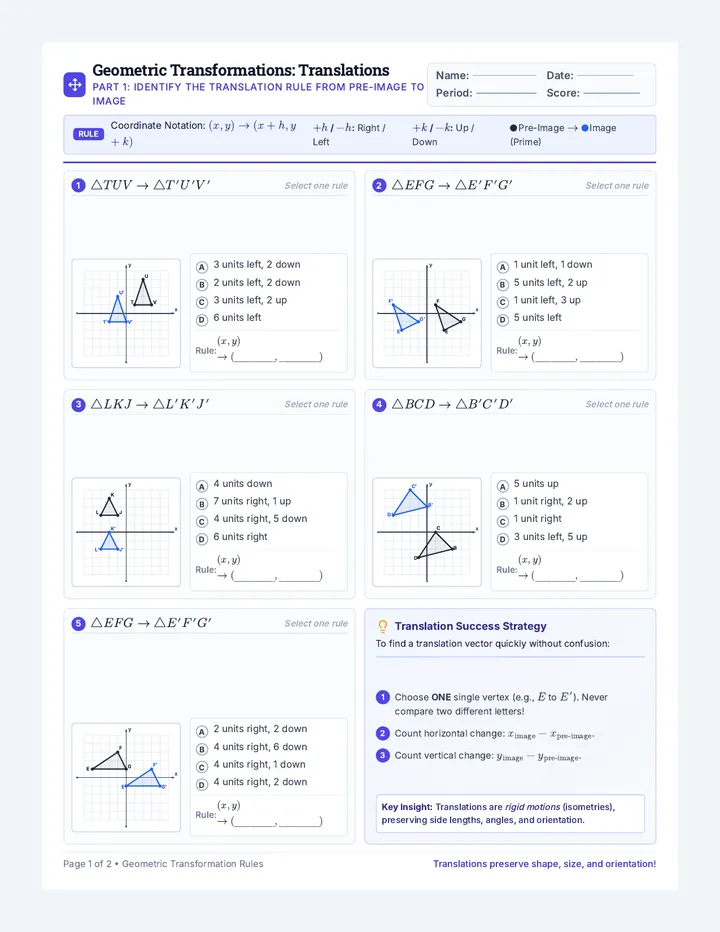
Translation Rules Worksheet

Geometric Translations

A targeted secondary geometry lesson on identifying, describing, and writing coordinate rules for translations on the Cartesian plane. Features vector coordinate diagrams and algebraic mapping notation.

FM

Fernando Mancini

2
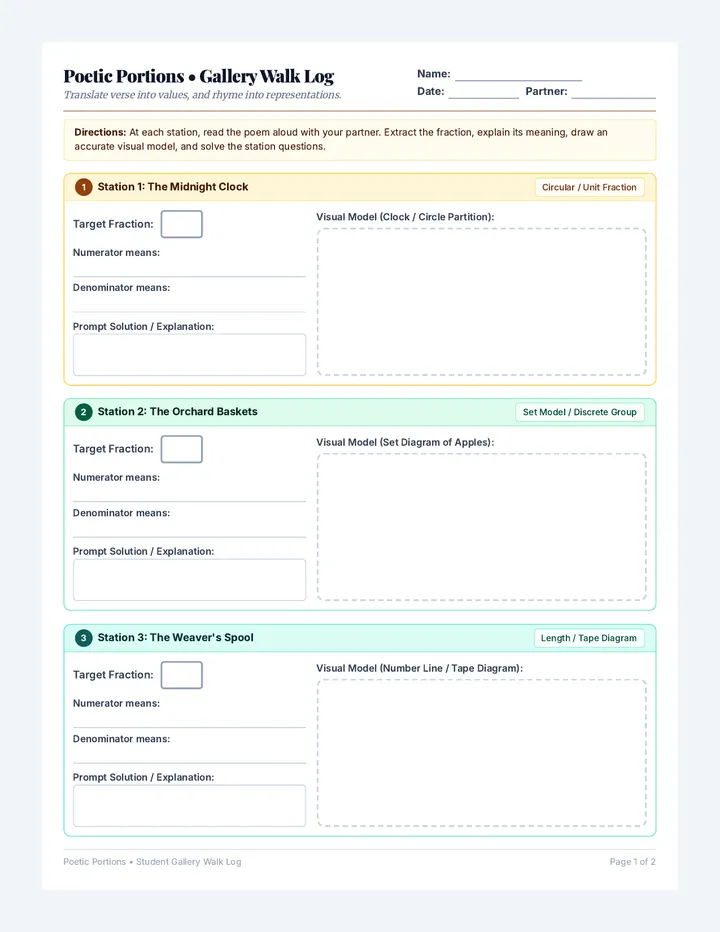
Poetic Portions Recording Sheet

Poetic Portions Recording Sheet

A structured 2-page student gallery walk recording sheet with designated spaces for identifying fractions, defining numerators and denominators in poetic context, sketching mathematical models, and justifying responses across all six stations.

NS

Naomi Seifert

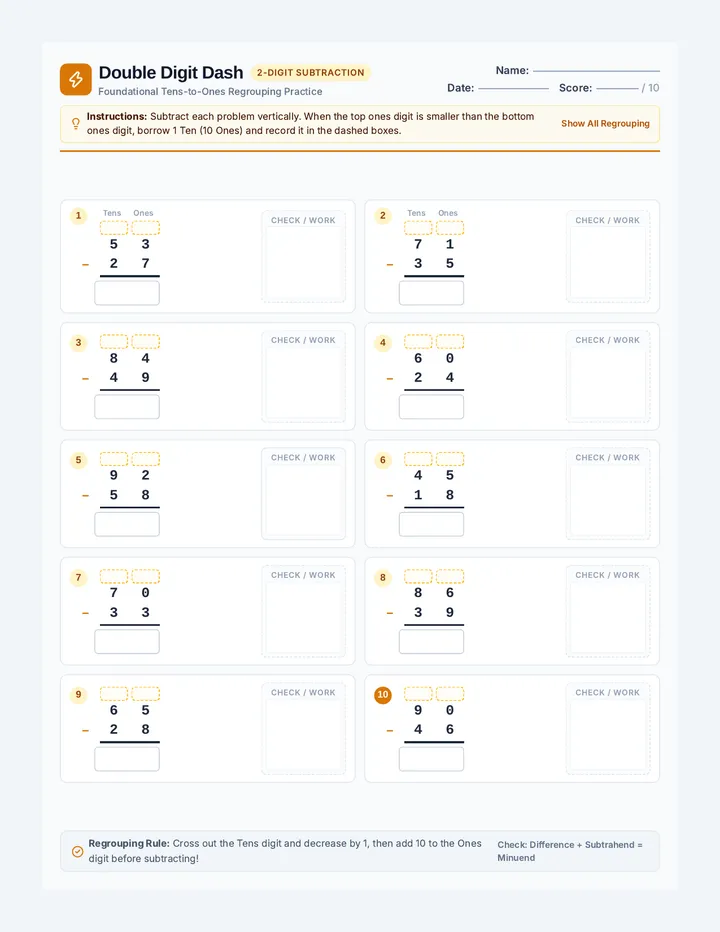
Double Digit Dash Worksheet

Elementary Skills Lab

A foundational elementary curriculum covering progressive multi-digit mathematics operations and early literacy grammar and phonics analysis.

JM

Jennifer Murphy

5
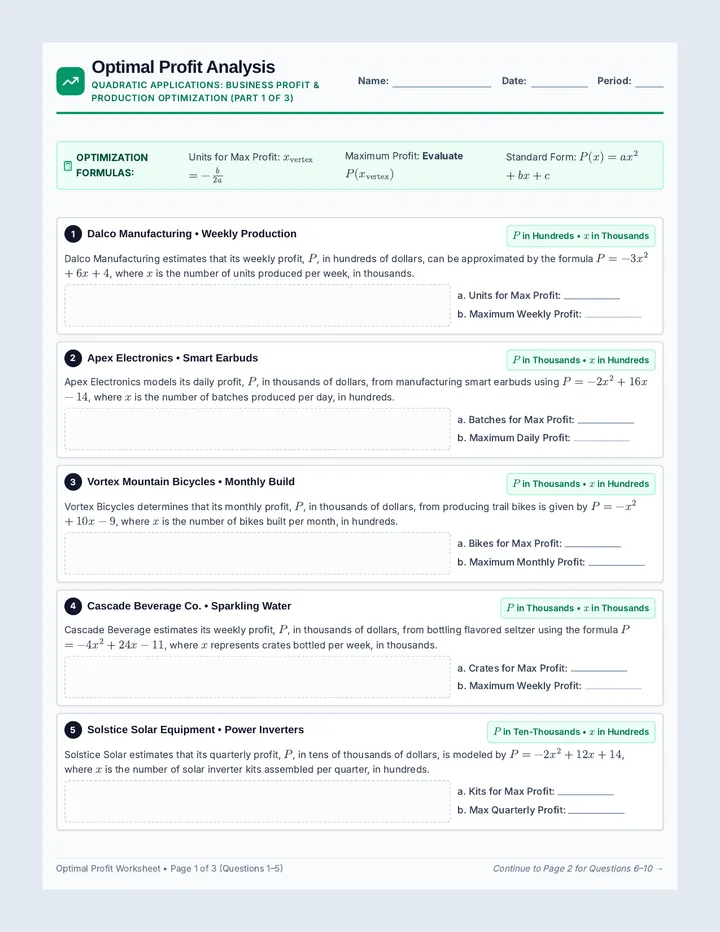
Optimal Profit Worksheet

Profit Optimization

An instructional lesson on quadratic business applications where students model revenue, cost, and profit to find vertex optima, maximum earnings, and strategic production levels.

CK

Cheydon Krysl

2
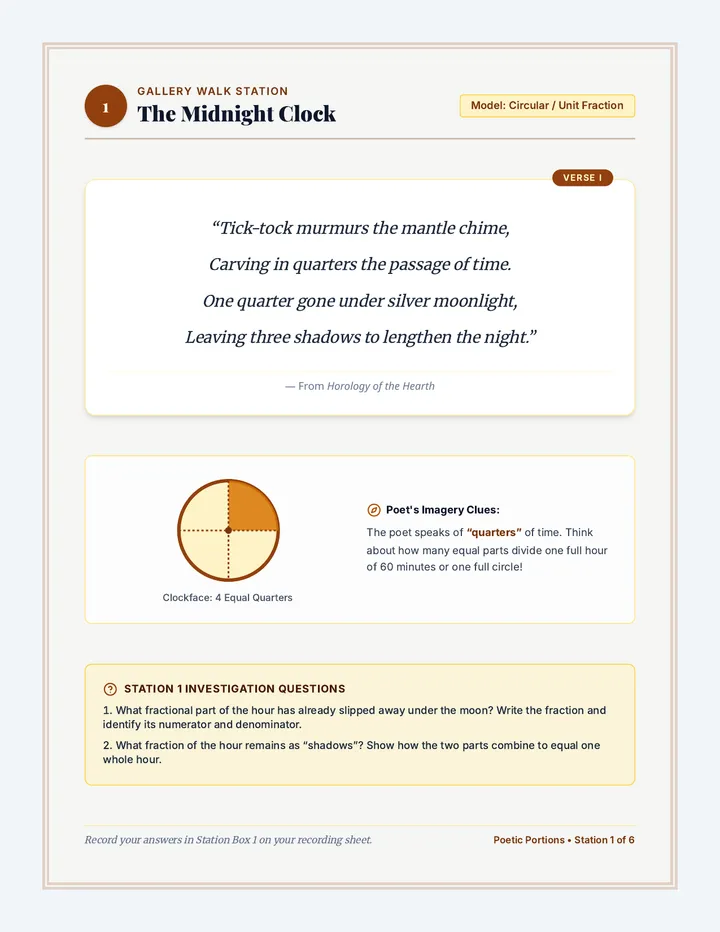
Stanza Stations Display Cards

Stanza Stations Display Cards

A set of six printable station placards for the poetry gallery walk. Each placard features an original short poem with embedded fractional imagery, conceptual diagram motifs, guiding challenge questions, and vocabulary clues.

NS

Naomi Seifert