Rational Blueprints Teacher Guide Grade 7 Mathematics • 60-Minute Lesson
Rational Blueprints: Teacher Guide
Standard: 7.EE.B.3
Multi-Step Rational Numbers & Estimation
Learning Target
Students will solve multi-step problems with positive and negative rational numbers in any form, convert strategically between forms, and use mental estimation to verify reasonableness.
Core Classroom Routine
1. Estimate First (mental math before touching a pencil/calculator) → 2. Compute (convert forms strategically) → 3. Check Reasonableness .
60-Minute Pacing Plan
Time
Phase
Teacher Moves & Student Actions
0–10 min
Warm-Up Hook
(Slides 1–3)
Present the Hourly Raise problem ($25/hr + 10% raise). Ask students to solve mentally without writing. Highlight how \(10\% = \frac{1}{10} = 0.1\) makes mental math effortless.
10–22 min
Mini-Lesson & Strategy Talk
(Slides 4–6)
Introduce the 3 Estimation Strategies (Benchmark Fractions, Compatible Numbers, Strategic Rounding). Model the Towel Bar problem and a Negative Rational problem, estimating before computing.
22–48 min
Extended Practice
(Worksheet + Slide 7)
26 min of structured practice. Students complete Part 1 (Warm-Up), Part 2 (Multi-Step Blueprints), and Part 3 (Error Analysis). Require students to fill in the Estimate box before computing exact values.
48–55 min
Estimation Debrief
(Slide 8)
Facilitate whole-class discussion comparing estimation strategies on selected problems. Spotlight Part 3 Error Analysis to show how estimation catches decimal/sign errors.
55–60 min
Exit Ticket
(Slide 9 + Handout)
Independent 2-question check. Collect to sort students for next-day small-group reteaching on form conversion or sign rules.
Estimation Toolkit (Key Concepts to Emphasize)
1. Benchmark Forms
Swap percents, decimals, and fractions for friendly equivalents: \(24.8\% \approx \frac{1}{4}\), \(0.33 \approx \frac{1}{3}\), \(10\% = \frac{1}{10}\).
2. Strategic Rounding
Round mixed numbers to whole or half units: \(27\frac{1}{2} - 9\frac{3}{4} \approx 28 - 10 = 18\), then \(18 \div 2 = 9\).
3. Compatible Numbers
Adjust numbers slightly so division or multiplication works cleanly: \(-48.6 \div 6.1 \approx -48 \div 6 = -8\).
Materials Needed: Lesson Slides, Practice Worksheet (1/student), Exit Ticket (1/student) Page 1 of 2
Facilitation, Discussion & Differentiation
Rational Blueprints
Discussion Prompts for Estimation Strategies (Min 10–22 & 48–55)
1. Choosing the Best Form:
"When you saw \(10\%\) of $25, or \(\frac{3}{4}\) combined with \(0.25\), which form did your brain switch to first? Why was that form faster than the others?"
2. Over- vs. Under-Estimating:
"In the Towel Bar problem, we rounded \(27\frac{1}{2}\) up to \(28\) and \(9\frac{3}{4}\) up to \(10\). Did those two roundings push our estimate higher or lower, or did they balance out?"
3. Reasonableness with Negatives:
"If a temperature drops \(3\frac{1}{4}^\circ\text{F}\) per hour for \(4.5\) hours starting at \(8.2^\circ\text{F}\), how do you know immediately whether the final answer must be positive or negative?"
4. Catching Calculator Errors:
"How close does an exact answer need to be to your estimate to feel confident? What if you got \(90\) inches instead of \(9\) inches—what mistake likely happened?"
Common Misconceptions & Quick Fixes
Misconception
Teacher Intervention
Computing first, then "faking" an estimate by rounding the final answer.Have students cover the exact-work box with their hand or do a 30-second "pencils down" estimate check with a partner first.
Sign errors in multi-step negatives (e.g., adding a drop instead of subtracting, or losing a negative when converting).Prompt students to sketch a quick vertical/horizontal number line next to their estimate to predict the sign of the result.
Converting repeating decimals inaccurately (e.g., rounding \(\frac{1}{3}\) to \(0.3\) too early in exact computation).Teach the rule: Use rounded decimals for estimation, but keep exact fractions when computing with thirds, sixths, or sevenths.
Differentiation Strategies
Support & Scaffolds
Provide a benchmark conversion card (\(\frac{1}{4}=0.25=25\%\), \(\frac{1}{2}=0.5=50\%\), \(\frac{3}{4}=0.75=75\%\), \(\frac{1}{10}=0.1=10\%\)).
Encourage bar models or number lines for two-step problems like the Towel Bar.
Allow calculators for exact computation only after the Estimate box is approved.
Extensions
Challenge students to find two different estimation strategies for Problem 4 and argue which gives a tighter bound.
Ask early finishers to write their own multi-step "Blueprint Problem" containing at least one negative fraction and one percent, plus an intentional error for a partner to catch.
Rational Blueprints • Grade 7 Math (7.EE.B.3) Page 2 of 2
Rational Blueprints Slides Grade 7 Mathematics • Lesson 7.EE.B.3
Rational Blueprints
Solving Multi-Step Problems with Fractions, Decimals & Percents — and Checking Every Answer with Estimation
60-Minute Workshop Rule #1: Estimate First!
Today's Mission
The Builder's 3-Step Routine
Step 1
Estimate First
Use mental math to predict a reasonable ballpark answer before writing steps.
Step 2
Convert & Solve
Switch strategically between fractions, decimals, and percents to compute accurately.
Step 3
Check Fit
Compare your exact result to your estimate. If they clash, hunt for the error!
Goal: Master positive and negative rational numbers in any form.
Warm-Up • Pencils Down Mental Math Only
The Paycheck Boost
Maya earns $25.00 per hour . She gets a 10% raise . What is her new hourly wage?
Form Switch Trick:
\(10\% = \frac{1}{10} = 0.1\)
Mental Check:
\(\frac{1}{10}\) of \(\$25 = \$2.50 \rightarrow \$27.50\)
Turn & Talk: Why is switching \(10\%\) to \(\frac{1}{10}\) faster than multiplying by \(0.10\)?
Mini-Lesson
3 Estimation Strategies
1. Benchmark Fractions & Percents
Swap messy numbers for friendly benchmarks: \(24.8\% \approx \frac{1}{4}\), \(0.49 \approx \frac{1}{2}\), \(33\% \approx \frac{1}{3}\).
2. Strategic Rounding (Whole or Half)
Round mixed numbers to the nearest whole or half: \(27\frac{1}{2} - 9\frac{3}{4} \approx 28 - 10 = 18\).
3. Compatible Numbers
Nudge numbers so they divide or multiply cleanly: \(-48.6 \div 6.1 \approx -48 \div 6 = -8\).
Tip: Pick the strategy that makes mental math easiest for the numbers in front of you.
Worked Example 1
Centering the Towel Bar
You want to center a towel bar that is \(9\frac{3}{4}\) inches long on a door that is \(27\frac{1}{2}\) inches wide. How far from each edge should you place the bar?
1. Estimate First
\(27\frac{1}{2} \approx 28\) and \(9\frac{3}{4} \approx 10\)
2. Exact Computation
\(27.5 - 9.75 = 17.75\text{ in.}\)
Worked Example 2
Tracking Negative Changes
A freezer starts at \(8.2^\circ\text{F}\) . Its temperature changes by \(-3\frac{1}{4}^\circ\text{F}\) per hour for \(4.5\) hours . What is the final temperature?
1. Estimate First
Start: \(8^\circ\text{F}\)
2. Exact Computation
\(-3\frac{1}{4} = -3.25\)
Extended Practice • 26 Minutes
Blueprint Workshop Protocol
Your Workflow
1. Complete Part 1 (Estimation Warm-Up) solo.2. On Part 2 , fill in the Estimate Box BEFORE computing exact math.3. Solve Part 3 to catch a classic calculator mistake.
Partner Check-Ins
Compare estimates after every 2 problems.
Ask: "Did you convert to fractions or decimals? Why?"
If your answers differ, check signs and estimates first!
Remember: A blank Estimate box means the problem isn't finished.
Whole-Class Debrief
Let's Talk Strategy
1. Which form (fraction, decimal, or percent) was fastest on Problem 2 and Problem 3? Why?
2. When you rounded two numbers in the same problem, did your estimate end up high, low, or balanced?
3. In Part 3 (Error Analysis), how did estimation immediately expose the mistake?
Be ready to share the exact mental math shortcut you used!
Final 5 Minutes
Exit Ticket
Show your Estimate , your Exact Computation , and a quick Reasonableness Check on your Exit Ticket.
Takeaway: Tools calculate fast, but your estimation skills keep the math honest.
Rational Blueprints Practice Worksheet Grade 7 Mathematics • Extended Practice
Rational Blueprints: Workshop Practice
Name: ____________________________
Date: ________________
Part 1: Estimation & Form-Switch Warm-Up
Estimate mentally — no exact math yet!
Write a quick mental estimate and name the strategy you used (Benchmark , Rounding , or Compatible Numbers ).
A. \(24.8\%\) of \(\$80.40\)
Estimate:
Strategy:
B. \(-63.4 \div 7.8\)
Estimate:
Strategy:
C. \(18\frac{7}{8} - 5\frac{1}{6} + 2.1\)
Estimate:
Strategy:
Part 2: Multi-Step Blueprints — For each problem, complete the Estimate box before solving. Convert fractions, decimals, and percents strategically.
1. A carpenter has a wooden board that is \(48.5\) inches long. She cuts off two equal shelves, each \(16\frac{3}{4}\) inches long, and wastes \(0.75\) inches in sawdust. How much board is left?
1. Estimate First
2. Exact Work (Convert & Solve)
3. Reasonableness Check
2. Jordan earns \(\$24.00\) per hour. He gets a \(15\%\) raise for working the weekend shift. How much does he earn for working \(6\frac{1}{2}\) hours on the weekend?
1. Estimate First
2. Exact Work (Convert & Solve)
3. Reasonableness Check
Rational Blueprints • Workshop Practice Page 1 of 3
Part 2: Multi-Step Blueprints (Continued)
Estimate → Compute → Check
3. A research drone starts at an elevation of \(-12.4\) meters (below sea level). It dives at a rate of \(-4\frac{1}{2}\) meters per minute for \(6\) minutes, then rises \(15.75\) meters. What is its final elevation?
1. Estimate First
2. Exact Work (Convert & Solve)
3. Reasonableness Check
4. A checking account has a balance of \(\$45.50\). Three automatic payments of \(\$22\frac{1}{4}\) each are deducted, and the bank charges a \(\$12.50\) overdraft fee. What is the new account balance?
1. Estimate First
2. Exact Work (Convert & Solve)
3. Reasonableness Check
5. A baker needs \(3\frac{1}{3}\) cups of flour for one batch of bread. She wants to make \(2.5\) batches, and she already has \(2\frac{1}{2}\) cups in a bowl. How many more cups of flour does she need?
1. Estimate First
2. Exact Work (Convert & Solve)
3. Reasonableness Check
Rational Blueprints • Workshop Practice Page 2 of 3
Part 2 (Challenge), Error Analysis & Reflection
Rational Blueprints
6. Over \(4\) days, a stock's value changed by \(-\$2.40\), \(+\$1\frac{3}{4}\), \(-\$3.15\), and \(+\$0.80\). What was the mean (average) daily change in the stock's value?
1. Estimate First
2. Exact Work (Convert & Solve)
3. Reasonableness Check
Part 3: Spot the Unreasonable Answer (Error Analysis)
Problem: A jacket originally costs \(\$60.00\). It is on sale for \(25\%\) off, and sales tax is \(8\%\) on the sale price. What is the final cost?Marcus's Calculator Work: \(60 \times 0.25 = 15\), then \(15 \times 1.08 = \$16.20\).
A. Use estimation to explain why \(\$16.20\) is unreasonable:
B. What mistake did Marcus make, and what is the exact cost?
Part 4: Estimation Strategy Reflection
1. On Problem 5, why was it smarter to keep \(\frac{1}{3}\) as a fraction instead of converting it to a decimal?
2. Which estimation strategy (Benchmarks, Rounding, or Compatible Numbers) helped you most today, and why?
Rational Blueprints • Workshop Practice Page 3 of 3
Rational Blueprints Exit Ticket Grade 7 Mathematics • 5-Minute Check
Rational Blueprints: Exit Ticket
Name: ____________________________
Date: ________________
Problem 1 • Multi-Step Solve & Check
A hiker starts at an elevation of \(120.5\) feet. She hikes down a trail at a rate of \(-18\frac{3}{4}\) feet per minute for \(8\) minutes, then climbs back up \(24.25\) feet. What is her final elevation?
1. Estimate First (show your mental rounding or compatible numbers):
2. Exact Work (convert forms strategically and show every step):
3. Reasonableness Check (compare your exact answer to your estimate):
Problem 2 • Estimation Strategy
A store offers a \(20\%\) discount on a \(\$49.85\) backpack. Which mental calculation gives the best estimate for the sale price?
A. Find \(\frac{1}{5}\) of \(\$50\), which is \(\$10\), and subtract from \(\$50\) to get about \(\$40\).
B. Find \(\frac{1}{2}\) of \(\$50\), which is \(\$25\), and subtract from \(\$50\) to get about \(\$25\).
C. Multiply \(\$50\) by \(20\) to get \(\$1,000\), then divide by \(10\) to get about \(\$100\).
D. Round \(\$49.85\) to \(\$40\) and subtract \(\$20\) to get about \(\$20\).
Rational Blueprints • Exit Ticket Page 1 of 1
Rational Blueprints Answer Key Teacher Resource • Solutions
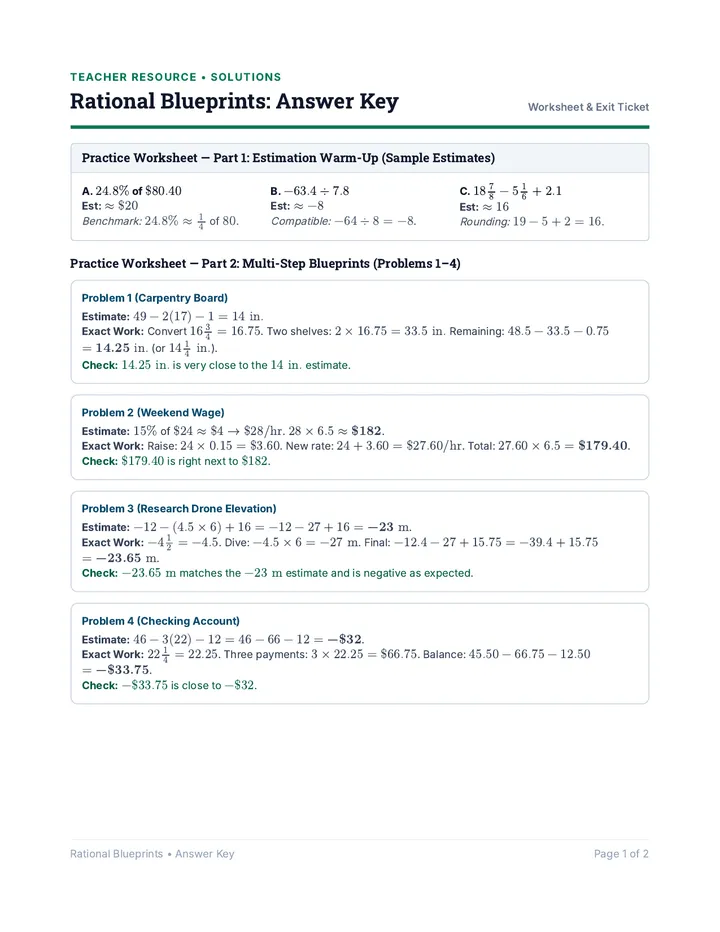
Rational Blueprints: Answer Key
Worksheet & Exit Ticket
Practice Worksheet — Part 1: Estimation Warm-Up (Sample Estimates)
A. \(24.8\%\) of \(\$80.40\)
Est: \(\approx \$20\)
Benchmark: \(24.8\% \approx \frac{1}{4}\) of \(80\).
B. \(-63.4 \div 7.8\)
Est: \(\approx -8\)
Compatible: \(-64 \div 8 = -8\).
C. \(18\frac{7}{8} - 5\frac{1}{6} + 2.1\)
Est: \(\approx 16\)
Rounding: \(19 - 5 + 2 = 16\).
Practice Worksheet — Part 2: Multi-Step Blueprints (Problems 1–4)
Problem 1 (Carpentry Board)
Estimate: \(49 - 2(17) - 1 = 14\text{ in.}\)
Exact Work: Convert \(16\frac{3}{4} = 16.75\). Two shelves: \(2 \times 16.75 = 33.5\text{ in.}\) Remaining: \(48.5 - 33.5 - 0.75 = \mathbf{14.25\text{ in.}}\) (or \(14\frac{1}{4}\text{ in.}\)).
Check: \(14.25\text{ in.}\) is very close to the \(14\text{ in.}\) estimate.
Problem 2 (Weekend Wage)
Estimate: \(15\%\) of \(\$24 \approx \$4 \rightarrow \$28/\text{hr}\). \(28 \times 6.5 \approx \mathbf{\$182}\).
Exact Work: Raise: \(24 \times 0.15 = \$3.60\). New rate: \(24 + 3.60 = \$27.60/\text{hr}\). Total: \(27.60 \times 6.5 = \mathbf{\$179.40}\).
Check: \(\$179.40\) is right next to \(\$182\).
Problem 3 (Research Drone Elevation)
Estimate: \(-12 - (4.5 \times 6) + 16 = -12 - 27 + 16 = \mathbf{-23\text{ m}}\).
Exact Work: \(-4\frac{1}{2} = -4.5\). Dive: \(-4.5 \times 6 = -27\text{ m}\). Final: \(-12.4 - 27 + 15.75 = -39.4 + 15.75 = \mathbf{-23.65\text{ m}}\).
Check: \(-23.65\text{ m}\) matches the \(-23\text{ m}\) estimate and is negative as expected.
Problem 4 (Checking Account)
Estimate: \(46 - 3(22) - 12 = 46 - 66 - 12 = \mathbf{-\$32}\).
Exact Work: \(22\frac{1}{4} = 22.25\). Three payments: \(3 \times 22.25 = \$66.75\). Balance: \(45.50 - 66.75 - 12.50 = \mathbf{-\$33.75}\).
Check: \(-\$33.75\) is close to \(-\$32\).
Rational Blueprints • Answer Key Page 1 of 2
Answer Key (Continued)
Problems 5–6, Error Analysis & Exit Ticket
Problem 5 (Bread Flour)
Estimate: \(3 \times 2.5 = 7.5\) (or \(8\)) cups needed; \(8 - 2.5 = \mathbf{5.5\text{ cups}}\).
Exact Work: Keep fractions! \(3\frac{1}{3} \times 2\frac{1}{2} = \frac{10}{3} \times \frac{5}{2} = \frac{25}{3} = 8\frac{1}{3}\text{ cups}\). Subtract: \(8\frac{1}{3} - 2\frac{1}{2} = 8\frac{2}{6} - 2\frac{3}{6} = \mathbf{5\frac{5}{6}\text{ cups}}\).
Problem 6 (Stock Mean Daily Change)
Estimate: \(-2 + 2 - 3 + 1 = -2\); \(-2 \div 4 = \mathbf{-\$0.50}\).
Exact Work: Convert \(1\frac{3}{4} = 1.75\). Sum: \(-2.40 + 1.75 - 3.15 + 0.80 = -3.00\). Mean: \(-3.00 \div 4 = \mathbf{-\$0.75}\) per day.
Part 3: Error Analysis (Jacket Sale)
A. Why unreasonable: \(25\%\) off \(\$60\) is \(\frac{1}{4}\) off (\(\$15\)), so the sale price is about \(\$45\). Adding \(8\%\) tax (\(\approx \$3.60\)) makes the final cost around \(\$48\)–\(\$49\), not \(\$16.20\).
B. Mistake & Exact Cost: Marcus calculated the discount amount (\(\$15\)) and forgot to subtract it from \(\$60\). Exact: \(60 - 15 = \$45\); \(45 \times 1.08 = \mathbf{\$48.60}\).
Part 4: Strategy Reflection (Sample Responses)
1. \(\frac{1}{3}\) is a repeating decimal (\(0.333\dots\)). Rounding it early causes rounding error, whereas multiplying fractions gives an exact answer.
2. Answers vary; students should explain how their chosen strategy simplified mental math.
Exit Ticket Solutions
Problem 1: Estimate: \(120 - (19 \times 8) + 24 = 120 - 152 + 24 = \mathbf{-8\text{ ft}}\) (or using \(-20\): \(120 - 160 + 25 = -15\text{ ft}\)).Exact Work: \(-18\frac{3}{4} = -18.75\). Descent: \(-18.75 \times 8 = -150\text{ ft}\). Final: \(120.5 - 150 + 24.25 = \mathbf{-5.25\text{ ft}}\) (or \(-5\frac{1}{4}\text{ ft}\)).Check: \(-5.25\text{ ft}\) is negative and close to the \(-8\text{ ft}\) estimate.
Problem 2: A (\(20\% = \frac{1}{5}\); \(\frac{1}{5}\) of \(\$50 = \$10\); \(\$50 - \$10 = \$40\)).
Rational Blueprints • Answer Key Page 2 of 2