Polygon and Proof Worksheet Geometry Practice Comprehensive Practice Set
Polygon and Proof Lab
Triangle Congruence Proofs, CPCTC & Special Quadrilateral Properties
Name:
Date:
Period:
Quick Reference: Congruence Shortcuts
HL Theorem: Hypotenuse and leg of right \(\triangle\) are \(\cong\) to another.
CPCTC: Corresponding Parts of Congruent Triangles are Congruent.
Segment Bisector: Divides a segment into two \(\cong\) halves (\(E\) is midpoint).
Part 1: Formal Two-Column Triangle Proofs
Problem 1 Right Triangle Congruence & CPCTC
Given the diagram below with right angles at \(I\) and \(Y\), \(\overline{IK} \cong \overline{YW}\), and \(\overline{JK} \cong \overline{XW}\):Prove: \(\angle K \cong \angle W\)
I K J Y W X
Statements
Reasons
1. \(\angle I\) & \(\angle Y\) right \(\angle\)s; \(\overline{IK} \cong \overline{YW}\); \(\overline{JK} \cong \overline{XW}\)
1. Given
2. \(\triangle IKJ\) and \(\triangle YWX\) are right triangles
2.
3. \(\triangle IKJ \cong \triangle YWX\)
3.
4. \(\angle K \cong \angle W\)
4.
Problem 2 Bisectors & Vertical Angles Proof
Given: \(\overline{AC}\) bisects \(\overline{BD}\) and \(\angle CBE \cong \angle EDA\).Prove: \(\triangle BEC \cong \triangle DEA\)
E A B C D
Statements
Reasons
1. \(\overline{AC}\) bisects \(\overline{BD}\); \(\angle CBE \cong \angle EDA\)
1. Given
2. \(\overline{BE} \cong \overline{DE}\)
2.
3. \(\angle BEC \cong \angle DEA\)
3.
4. \(\triangle BEC \cong \triangle DEA\)
4.
Polygon and Proof Lab • Student Practice Handout Page 1 of 4 • Turn over for Proofs Set 2
Part 1 Cont.
Shared Sides & CPCTC Proofs
Reflexive property, parallel line alternates, and midpoint theorems
Formal Deductive Reasoning
Problem 3 Parallel Lines & Shared Diagonal (SAS)
Given: \(\overline{AB} \parallel \overline{DC}\) and \(\overline{AB} \cong \overline{DC}\).Prove: \(\triangle ABD \cong \triangle CDB\) and \(\overline{AD} \cong \overline{CB}\).
A B C D
Statements
Reasons
1. \(\overline{AB} \parallel \overline{DC}\); \(\overline{AB} \cong \overline{DC}\)
1. Given
2. \(\angle ABD \cong \angle CDB\)
2.
3. \(\overline{BD} \cong \overline{BD}\)
3.
4. \(\triangle ABD \cong \triangle CDB\)
4.
5. \(\overline{AD} \cong \overline{CB}\)
5.
Problem 4 Rhombus Midpoint & SSS Proof
In rhombus \(ABCD\), diagonals meet at \(E\).Given: \(\overline{AB} \cong \overline{AD}\) and \(E\) is the midpoint of \(\overline{BD}\).Prove: \(\triangle ABE \cong \triangle ADE\) and \(\angle AEB \cong \angle AED\).
E A B C D
Statements
Reasons
1. \(\overline{AB} \cong \overline{AD}\); \(E\) is the midpoint of \(\overline{BD}\)
1. Given
2. \(\overline{BE} \cong \overline{DE}\)
2.
3. \(\overline{AE} \cong \overline{AE}\)
3.
4. \(\triangle ABE \cong \triangle ADE\)
4.
5. \(\angle AEB \cong \angle AED\)
5.
Polygon and Proof Lab • Student Practice Handout Page 2 of 4 • Turn over for Algebra Part 1
Part 2
Perimeters & Parallelograms
Linear perimeter equations and angle sum theorems
Show equations & evaluate all sides
Problem 5 Perimeter of a Quadrilateral
The perimeter of quadrilateral \(ABCD\) is 46 inches .length of the shortest side .
A B C D
Sum all 4 sides, solve for \(x\), and find shortest side:
\(x =\)
Shortest side is \(=\) in.
Problem 6 Parallelogram Perimeter & Side Dimensions
In parallelogram \(ABCD\), the total perimeter is 58 cm .
A B C D
Recall: Perimeter \(= 2(AB) + 2(BC)\):
\(x =\)
Side \(AB =\) cm
Side \(BC =\) cm
Problem 7 Parallelogram Consecutive & Opposite Angles
In parallelogram \(ABCD\), consecutive angles are given as:
A B C D
Hint: Consecutive angles are supplementary (\(m\angle A + m\angle B = 180^\circ\)):
\(x =\)
\(m\angle A =\) \(^\circ\)
\(m\angle B =\) \(^\circ\)
\(m\angle C =\) \(^\circ\)
Polygon and Proof Lab • Student Practice Handout Page 3 of 4 • Turn over for Rhombi & Rectangles
Part 3
Rhombus & Rectangle Problem Solving
Perpendicular diagonals, angle bisectors, and rectangle systems
Show equations & final evaluations
Problem 8 Rhombus Diagonals & Complementary Angles
In rhombus \(ABCD\), diagonals \(\overline{AC}\) and \(\overline{BD}\) intersect at point \(E\).(Hint: Diagonals are perpendicular!)
A D C B E
Set up equation for acute angles of right \(\triangle EBC\):
\(a =\)
\(m\angle EBC =\) \(^\circ\)
Problem 9 Rhombus Diagonal as Angle Bisector
In rhombus \(ABCD\), diagonal \(\overline{AC}\) bisects vertex \(\angle DAB\).
A D C B
Diagonal bisects vertex angle \(\implies m\angle DAC = m\angle BAC\):
\(x =\)
\(m\angle DAB =\) \(^\circ\)
\(m\angle ABC =\) \(^\circ\)
Problem 10 Rectangle Diagonals System of Equations
In rectangle \(ABCD\), diagonals \(\overline{AC}\) and \(\overline{BD}\) intersect at \(E\).
A D C B
Rectangle diagonals are \(\cong\) and bisect \(\implies AE = EC = DE\):
\(x =\)
\(y =\)
\(AC =\)
Polygon and Proof Lab • Student Practice Handout Page 4 of 4 • End of Practice Set
Polygon and Proof Answer Key Answer Key & Guide Complete Solutions
Polygon and Proof Lab: Solutions
Full Two-Column Proofs & Step-by-Step Parent Coaching Tips
Solutions Guide
10 Problems • 4 Pages
Coaching Tip: When reviewing proofs with your son, have him mark the diagram with pencil before writing. Ask: "What does the given tell us?" and "What hidden info (like vertical angles or shared sides) is in the picture?"
Part 1: Proofs Set A (Right Triangles & Bisectors)
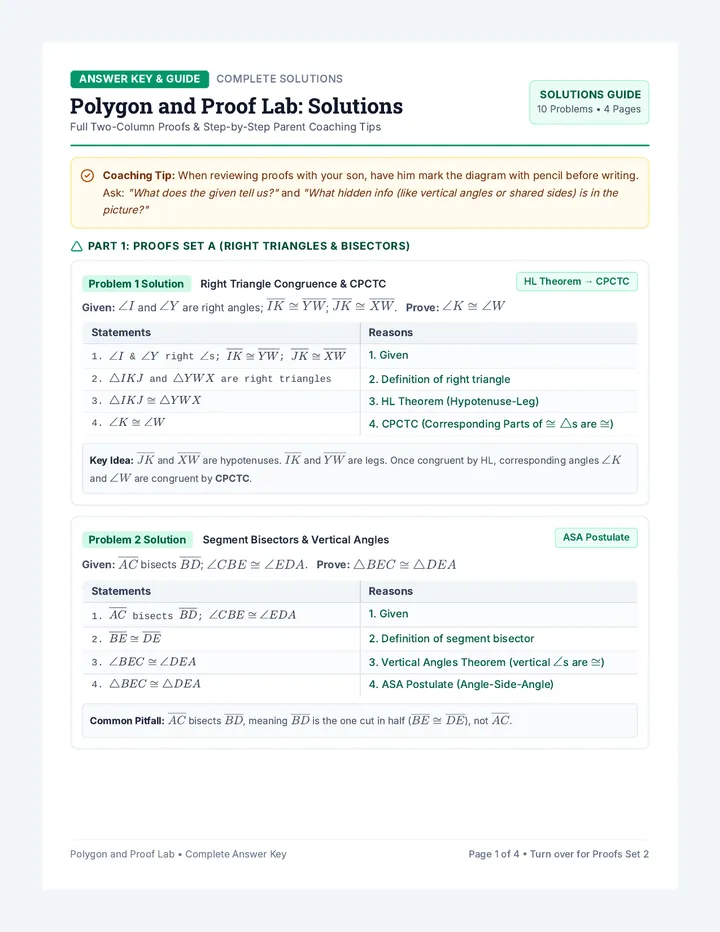
Problem 1 Solution Right Triangle Congruence & CPCTC
HL Theorem → CPCTC
Given: \(\angle I\) and \(\angle Y\) are right angles; \(\overline{IK} \cong \overline{YW}\); \(\overline{JK} \cong \overline{XW}\). Prove: \(\angle K \cong \angle W\)
Statements
Reasons
1. \(\angle I\) & \(\angle Y\) right \(\angle\)s; \(\overline{IK} \cong \overline{YW}\); \(\overline{JK} \cong \overline{XW}\)
1. Given
2. \(\triangle IKJ\) and \(\triangle YWX\) are right triangles
2. Definition of right triangle
3. \(\triangle IKJ \cong \triangle YWX\)
3. HL Theorem (Hypotenuse-Leg)
4. \(\angle K \cong \angle W\)
4. CPCTC (Corresponding Parts of \(\cong \triangle\)s are \(\cong\))
Key Idea: \(\overline{JK}\) and \(\overline{XW}\) are hypotenuses. \(\overline{IK}\) and \(\overline{YW}\) are legs. Once congruent by HL, corresponding angles \(\angle K\) and \(\angle W\) are congruent by CPCTC .
Problem 2 Solution Segment Bisectors & Vertical Angles
ASA Postulate
Given: \(\overline{AC}\) bisects \(\overline{BD}\); \(\angle CBE \cong \angle EDA\). Prove: \(\triangle BEC \cong \triangle DEA\)
Statements
Reasons
1. \(\overline{AC}\) bisects \(\overline{BD}\); \(\angle CBE \cong \angle EDA\)
1. Given
2. \(\overline{BE} \cong \overline{DE}\)
2. Definition of segment bisector
3. \(\angle BEC \cong \angle DEA\)
3. Vertical Angles Theorem (vertical \(\angle\)s are \(\cong\))
4. \(\triangle BEC \cong \triangle DEA\)
4. ASA Postulate (Angle-Side-Angle)
Common Pitfall: \(\overline{AC}\) bisects \(\overline{BD}\), meaning \(\overline{BD}\) is the one cut in half (\(\overline{BE} \cong \overline{DE}\)), not \(\overline{AC}\).
Polygon and Proof Lab • Complete Answer Key Page 1 of 4 • Turn over for Proofs Set 2
Part 1 Cont.
Proofs Set B: Shared Sides & CPCTC
Reflexive property and alternate interior angle applications
SAS & SSS Methods
Problem 3 Solution Parallel Lines & Shared Diagonal (SAS)
SAS → CPCTC
Given: \(\overline{AB} \parallel \overline{DC}\) and \(\overline{AB} \cong \overline{DC}\). Prove: \(\triangle ABD \cong \triangle CDB\) and \(\overline{AD} \cong \overline{CB}\)
Statements
Reasons
1. \(\overline{AB} \parallel \overline{DC}\); \(\overline{AB} \cong \overline{DC}\)
1. Given
2. \(\angle ABD \cong \angle CDB\)
2. Alternate Interior Angles Theorem (\(\parallel\) lines)
3. \(\overline{BD} \cong \overline{BD}\)
3. Reflexive Property of Congruence
4. \(\triangle ABD \cong \triangle CDB\)
4. SAS Postulate (Side-Angle-Side)
5. \(\overline{AD} \cong \overline{CB}\)
5. CPCTC
Coaching Note: Point out the "Z" shape formed by \(\overline{AB}\), transversal \(\overline{BD}\), and \(\overline{DC}\). The angles inside the corners of the Z are alternate interior angles.
Problem 4 Solution Rhombus Midpoint & SSS Proof
SSS → CPCTC
Given: \(\overline{AB} \cong \overline{AD}\); \(E\) is midpoint of \(\overline{BD}\). Prove: \(\triangle ABE \cong \triangle ADE\) and \(\angle AEB \cong \angle AED\)
Statements
Reasons
1. \(\overline{AB} \cong \overline{AD}\); \(E\) is midpoint of \(\overline{BD}\)
1. Given
2. \(\overline{BE} \cong \overline{DE}\)
2. Definition of midpoint
3. \(\overline{AE} \cong \overline{AE}\)
3. Reflexive Property of Congruence
4. \(\triangle ABE \cong \triangle ADE\)
4. SSS Postulate (Side-Side-Side)
5. \(\angle AEB \cong \angle AED\)
5. CPCTC
Geometric Insight: Since \(\angle AEB\) and \(\angle AED\) form a linear pair and are congruent, each must equal \(90^\circ\). This formally proves why diagonals of a rhombus are perpendicular!
Polygon and Proof Lab • Complete Answer Key Page 2 of 4 • Turn over for Algebra Part 1 Solutions
Part 2
Perimeter & Parallelogram Algebra
Solutions for Problems 5, 6, and 7
Linear Systems
Problem 5 Perimeter of Quadrilateral \(ABCD\)
\(x = 5\) • Shortest Side \(CD = 9\text{ in.}\)
Equation & Solving:
\((x+8) + (2x+1) + (3x-6) + (4x-7) = 46\)
\(10x - 4 = 46 \implies 10x = 50 \implies \mathbf{x = 5}\)
\(AB = 5+8 = 13\); \(BC = 2(5)+1 = 11\)
\(CD = 3(5)-6 = \mathbf{9}\text{ in. (Shortest)}\); \(DA = 13\)
Problem 6 Parallelogram Perimeter & Side Dimensions
\(x = 5\) • \(AB = 14\text{ cm}\) • \(BC = 15\text{ cm}\)
Given: Perimeter \(= 58\text{ cm}\), \(AB = 3x - 1\), \(BC = 2x + 5\). In a parallelogram, opposite sides are equal.
Perimeter Formula:
\(2(AB) + 2(BC) = 58\)
\(2(3x - 1) + 2(2x + 5) = 58\)
\(6x - 2 + 4x + 10 = 58\)
\(10x + 8 = 58 \implies 10x = 50 \implies \mathbf{x = 5}\)
Evaluate Side Lengths:
• \(AB = 3(5) - 1 = 15 - 1 = \mathbf{14\text{ cm}}\)
• \(BC = 2(5) + 5 = 10 + 5 = \mathbf{15\text{ cm}}\)
Check: \(2(14) + 2(15) = 28 + 30 = 58\text{ cm}\) ✓
Problem 7 Parallelogram Consecutive & Opposite Angles
\(x = 19\) • \(\angle A = 91^\circ\) • \(\angle B = 89^\circ\) • \(\angle C = 91^\circ\)
Given: \(m\angle A = 4x + 15\) and \(m\angle B = 6x - 25\). Consecutive angles are supplementary.
Supplementary Equation:
\(m\angle A + m\angle B = 180^\circ\)
\((4x + 15) + (6x - 25) = 180\)
\(10x - 10 = 180\)
\(10x = 190 \implies \mathbf{x = 19}\)
Evaluate Angle Measures:
• \(m\angle A = 4(19) + 15 = 76 + 15 = \mathbf{91^\circ}\)
• \(m\angle B = 6(19) - 25 = 114 - 25 = \mathbf{89^\circ}\)
• Opposite angle \(m\angle C = m\angle A = \mathbf{91^\circ}\)
Parent Coaching • Common Traps in Parallelograms
Perimeter vs. Single Side: Remind students that in a parallelogram, \(P = 2(\text{side}_1) + 2(\text{side}_2)\). Students often forget to double the sides when given only two adjacent lengths!
Opposite vs. Consecutive Angles: Opposite angles are equal (\(\angle A = \angle C\)), while consecutive angles add to \(180^\circ\) (\(\angle A + \angle B = 180^\circ\)).
Polygon and Proof Lab • Complete Answer Key Page 3 of 4 • Turn over for Rhombi & Rectangles Solutions
Part 3
Rhombus & Rectangle Algebra
Solutions for Problems 8, 9, and 10
Diagonals & Systems
Problem 8 Rhombus Complementary Angles
\(a = 7\) • \(m\angle EBC = 51^\circ\)
Diagonals are perpendicular (\(\overline{AC} \perp \overline{BD}\)), so \(\triangle EBC\) is right with acute angles summing to \(90^\circ\).
Solve for \(a\):
\((5a + 4) + (8a - 5) = 90\)
\(13a - 1 = 90 \implies 13a = 91 \implies \mathbf{a = 7}\)
Evaluate \(m\angle EBC\):
\(m\angle EBC = 8(7) - 5 = 56 - 5 = \mathbf{51^\circ}\)
Check: \(5(7)+4 = 39^\circ\); \(39^\circ + 51^\circ = 90^\circ\) ✓
Problem 9 Rhombus Angle Bisector & Adjacent Angles
\(x = 11\) • \(m\angle DAB = 74^\circ\) • \(m\angle ABC = 106^\circ\)
In a rhombus, diagonals bisect opposite vertex angles: \(m\angle DAC = m\angle BAC\).
Bisector Equation:
\(3x + 4 = 5x - 18\)
\(4 + 18 = 5x - 3x\)
\(22 = 2x \implies \mathbf{x = 11}\)
Full Angles:
• \(m\angle DAC = 3(11)+4 = 37^\circ\)
• \(m\angle DAB = 37^\circ + 37^\circ = \mathbf{74^\circ}\)
• \(m\angle ABC = 180^\circ - 74^\circ = \mathbf{106^\circ}\)
Problem 10 Rectangle Diagonals System
\(x = 7\) • \(y = 1\) • \(AC = 44\)
In a rectangle, diagonals are congruent and bisect each other \(\implies AE = EC = DE\).
Equation 1: \(AE = EC\)
\(3x + y = 2x + y + 7\)
Subtract \(y \implies 3x = 2x + 7\)
\(\mathbf{x = 7}\)
Equation 2: \(AE = DE\)
\(3(7) + y = 2y + 3(7) - 1\)
\(y = 2y - 1 \implies \mathbf{y = 1}\)
\(AE = 22 \implies AC = 22 + 22 = \mathbf{44}\)
Parent Coaching • Rhombus & Rectangle Traps
Rhombus Angle Trap: Students often mistakenly set \(\angle ECB = \angle EBC\). Remind them that diagonals form a right angle at the center, so the two acute angles must sum to \(90^\circ\), not equal each other!
Rectangle Diagonal Power: In general parallelograms, \(AE = EC\) and \(BE = DE\), but \(AE \ne DE\). It is only because a rectangle has equal diagonals that all four half-diagonals are congruent!
Polygon and Proof Lab • Complete Answer Key Page 4 of 4 • End of Solutions
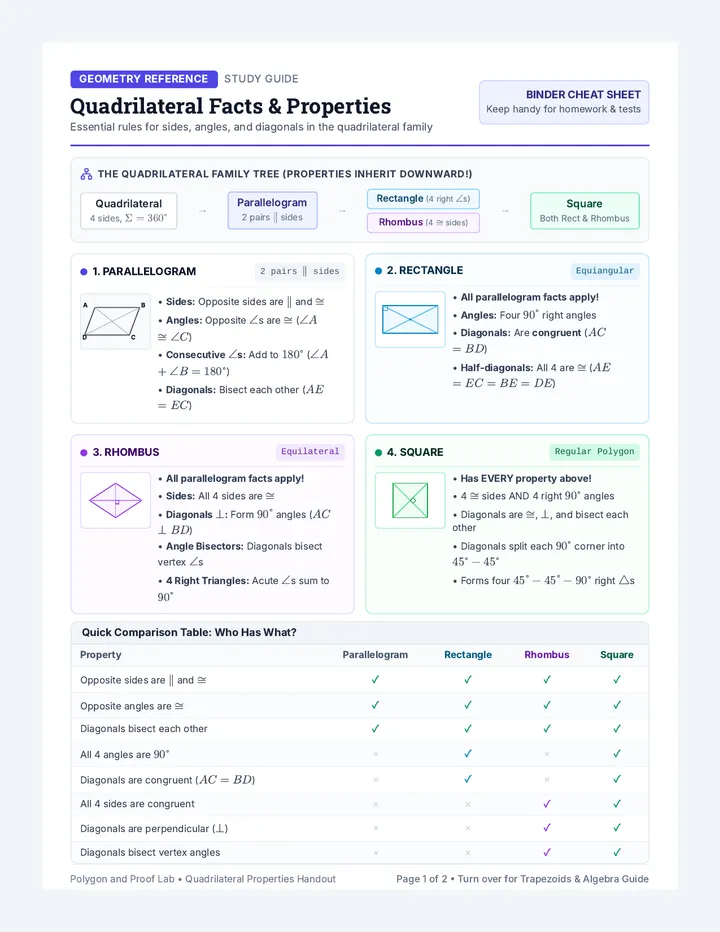
Quadrilateral Properties Handout Geometry Reference Study Guide
Quadrilateral Facts & Properties
Essential rules for sides, angles, and diagonals in the quadrilateral family
Binder Cheat Sheet
Keep handy for homework & tests
The Quadrilateral Family Tree (Properties Inherit Downward!)
Quadrilateral
→
Parallelogram
→
Rectangle (4 right \(\angle\)s)
Rhombus (4 \(\cong\) sides)
→
Square
1. Parallelogram
2 pairs \(\parallel\) sides
A B C D
• Sides: Opposite sides are \(\parallel\) and \(\cong\)
• Angles: Opposite \(\angle\)s are \(\cong\) (\(\angle A \cong \angle C\))
• Consecutive \(\angle\)s: Add to \(180^\circ\) (\(\angle A + \angle B = 180^\circ\))
• Diagonals: Bisect each other (\(AE = EC\))
2. Rectangle
Equiangular
• All parallelogram facts apply!
• Angles: Four \(90^\circ\) right angles
• Diagonals: Are congruent (\(AC = BD\))
• Half-diagonals: All 4 are \(\cong\) (\(AE = EC = BE = DE\))
3. Rhombus
Equilateral
• All parallelogram facts apply!
• Sides: All 4 sides are \(\cong\)
• Diagonals \(\perp\): Form \(90^\circ\) angles (\(AC \perp BD\))
• Angle Bisectors: Diagonals bisect vertex \(\angle\)s
• 4 Right Triangles: Acute \(\angle\)s sum to \(90^\circ\)
4. Square
Regular Polygon
• Has EVERY property above!
• 4 \(\cong\) sides AND 4 right \(90^\circ\) angles
• Diagonals are \(\cong\), \(\perp\), and bisect each other
• Diagonals split each \(90^\circ\) corner into \(45^\circ - 45^\circ\)
• Forms four \(45^\circ-45^\circ-90^\circ\) right \(\triangle\)s
Quick Comparison Table: Who Has What?
Property
Parallelogram
Rectangle
Rhombus
Square
Opposite sides are \(\parallel\) and \(\cong\)
✓
✓
✓
✓
Opposite angles are \(\cong\)
✓
✓
✓
✓
Diagonals bisect each other
✓
✓
✓
✓
All 4 angles are \(90^\circ\)
×
✓
×
✓
Diagonals are congruent (\(AC = BD\))
×
✓
×
✓
All 4 sides are congruent
×
×
✓
✓
Diagonals are perpendicular (\(\perp\))
×
×
✓
✓
Diagonals bisect vertex angles
×
×
✓
✓
Polygon and Proof Lab • Quadrilateral Properties Handout Page 1 of 2 • Turn over for Trapezoids & Algebra Guide
Part B
Trapezoids, Kites & Algebraic Playbook
How to Set Up Equations
Trapezoid 1 Pair \(\parallel\)
Base 1 Base 2
• Exactly 1 pair of parallel bases
• Consecutive angles along legs sum to \(180^\circ\)
• \(\text{Midsegment} = \frac{\text{Base}_1 + \text{Base}_2}{2}\)
Isosceles Trap. Symmetric
• Non-parallel legs are congruent
• Base angles are congruent
• Diagonals are congruent (\(AC = BD\))
• Opposite angles sum to \(180^\circ\)
Kite Perpendicular
• 2 pairs of consecutive \(\cong\) sides
• Diagonals are perpendicular (\(\perp\))
• Exactly 1 pair of opposite \(\angle\)s is \(\cong\)
• Main diagonal bisects other diagonal
Algebraic Playbook: When to Set Equal vs. When to Add
1. Set Equal: \(\text{Expr}_1 = \text{Expr}_2\) Congruent
• Opposite sides of parallelogram (\(AB = CD\))
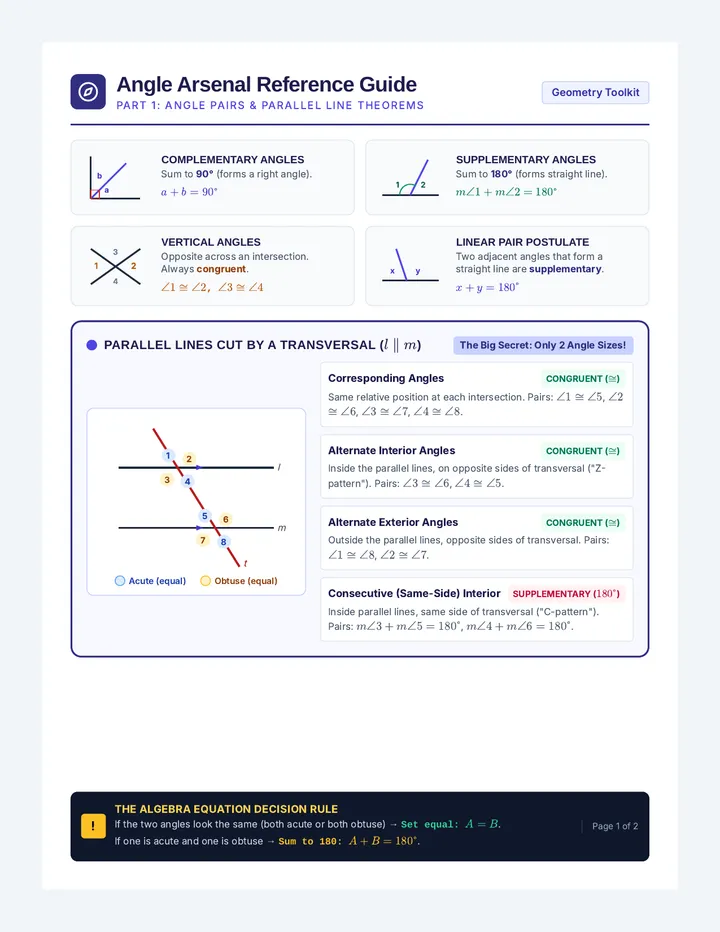
2. Add to \(180^\circ\): \(\angle_1 + \angle_2 = 180^\circ\) Supplementary
• Any two consecutive (neighboring) angles in a parallelogram, rhombus, or trapezoid leg.
3. Add to \(90^\circ\): \(\angle_1 + \angle_2 = 90^\circ\) Complementary
• In a rhombus or kite , diagonals meet at \(90^\circ\).
4. Perimeter: \(\Sigma \text{Sides} = \text{Perimeter}\) Sum All 4
• Add all 4 side expressions: \((x+8) + (2x+1) + \dots = 46\)Always plug \(x\) back in to find the shortest/longest side!
Worked Model Examples (Common Test Questions)
Model A: Rhombus Diagonal Angles
In rhombus \(ABCD\), \(m\angle ECB = 5a + 4\) and \(m\angle EBC = 8a - 5\). Find \(m\angle EBC\).
Diagonals \(\perp \implies\) complementary acute \(\angle\)s:
\((5a + 4) + (8a - 5) = 90^\circ\)
\(13a - 1 = 90 \implies 13a = 91 \implies \mathbf{a = 7}\)
\(m\angle EBC = 8(7) - 5 = 56 - 5 = \mathbf{51^\circ}\)
Model B: Rectangle Diagonals System
In rectangle \(ABCD\), \(AE = 3x + y\), \(EC = 2x + y + 7\), \(DE = 2y + 3x - 1\). Find \(x\) and \(y\).
Rect. diagonals \(\cong\) and bisect \(\implies AE = EC = DE\):
\(3x + y = 2x + y + 7 \implies \mathbf{x = 7}\)
\(3x + y = 2y + 3x - 1 \implies y = 2y - 1 \implies \mathbf{y = 1}\)
Length \(AE = 3(7)+1 = \mathbf{22}\) • \(AC = \mathbf{44}\)
Golden Geometry Rule: Never assume a property from the drawing alone! Always read the prompt to verify whether it specifies a parallelogram , rectangle , rhombus , or trapezoid before setting up your equation.
Polygon and Proof Lab • Quadrilateral Properties Handout Page 2 of 2 • End of Reference Guide