Algebra Steps Scaffolded Worksheet Algebra 1 • Linear Equations Mastery Page 1 of 9
Step-by-Step Equation Workshop
Part 1: Two-Step Equations with Integers (Problems 1–3)
Name:
Date:
Period:
Core Strategy: Use inverse operations in reverse order: undo addition/subtraction first, then undo multiplication/division.
Keep Balanced
Problem 1 \(3x + 7 = 25\)
Positive Coefficients
Step 1: Undo Addition / Subtraction
Step 2: Undo Multiplication / Division
Solution
x = _____ Check: [ ]
Problem 2 \(5x - 12 = -32\)
Negative Constant
Step 1: Undo Addition / Subtraction
Step 2: Undo Multiplication / Division
Solution
x = _____ Check: [ ]
Problem 3 \(-4y + 9 = -15\)
Negative Coefficient
Step 1: Undo Addition / Subtraction
Step 2: Undo Multiplication / Division
Solution
y = _____ Check: [ ]
Algebra 1 • Linear Equations Mastery Page 2 of 9
Two-Step Equations with Integers
Problems 4–7: Showing inverse operations with expanded workspace
Name:
Problem 4 \(-2m - 11 = 17\)
All Signs Managed
Step 1: Undo Addition / Subtraction
Step 2: Undo Multiplication / Division
Solution
m = _____ Check: [ ]
Problem 5 \(\frac{a}{3} - 8 = -2\)
Fractional Division
Step 1: Undo Addition / Subtraction
Step 2: Undo Multiplication / Division
Solution
a = _____ Check: [ ]
Problem 6 \(7p + 19 = 5\)
Positive Coefficient
Step 1: Undo Addition / Subtraction
Step 2: Undo Multiplication / Division
Solution
p = _____ Check: [ ]
Problem 7 \(-6k + 14 = -22\)
Opposite Sign Steps
Step 1: Undo Addition / Subtraction
Step 2: Undo Multiplication / Division
Solution
k = _____ Check: [ ]
Algebra 1 • Linear Equations Mastery Page 3 of 9
Two-Step Equations with Integers
Problems 8–10: Concluding two-step equations & self-check
Name:
Problem 8 \(8 - 3w = 29\)
Leading Constant
Step 1: Undo Addition / Subtraction
Step 2: Undo Multiplication / Division
Solution
w = _____ Check: [ ]
Problem 9 \(\frac{n}{-4} + 6 = 11\)
Negative Divisor
Step 1: Undo Addition / Subtraction
Step 2: Undo Multiplication / Division
Solution
n = _____ Check: [ ]
Problem 10 \(-9x - 13 = 50\)
Negative Coefficient
Step 1: Undo Addition / Subtraction
Step 2: Undo Multiplication / Division
Solution
x = _____ Check: [ ]
Part 1 Self-Assessment: Rate your confidence with two-step equations:
[ 1 ] Need Practice [ 2 ] Getting There [ 3 ] Mastered!
Algebra 1 • Linear Equations Mastery Page 4 of 9
Step-by-Step Equation Workshop
Part 2: Distributing Positive & Negative Numbers (Problems 11–13)
Name:
Distributive Rule: Multiply outside factor into all terms: \(a(b + c) = ab + ac\). Remember: \((-)(-) = (+)\)!
Watch Signs
Problem 11 \(4(x + 6) = 36\)
Positive Factor
Step 1: Distribute Across Terms
Step 2: Solve Resulting Equation
Solution
x = _____ Check: [ ]
Problem 12 \(3(2y - 5) = -27\)
Subtraction in Parentheses
Step 1: Distribute Across Terms
Step 2: Solve Resulting Equation
Solution
y = _____ Check: [ ]
Problem 13 \(-5(m + 4) = 35\)
Negative Factor
Step 1: Distribute Across Terms
Step 2: Solve Resulting Equation
Solution
m = _____ Check: [ ]
Algebra 1 • Linear Equations Mastery Page 5 of 9
Distributive Property with Integers
Problems 14–17: Multiplying positive and negative factors
Name:
Problem 14 \(-2(3a - 7) = 32\)
Negative Factor × Subtraction
Step 1: Distribute Across Terms
Step 2: Solve Resulting Equation
Solution
a = _____ Check: [ ]
Problem 15 \(-(p - 9) = 14\)
Distributing -1
Step 1: Distribute Across Terms
Step 2: Solve Resulting Equation
Solution
p = _____ Check: [ ]
Problem 16 \(-4(2k + 3) = -44\)
Negative Factor
Step 1: Distribute Across Terms
Step 2: Solve Resulting Equation
Solution
k = _____ Check: [ ]
Problem 17 \(6(1 - 2w) = -42\)
Variable in Second Position
Step 1: Distribute Across Terms
Step 2: Solve Resulting Equation
Solution
w = _____ Check: [ ]
Algebra 1 • Linear Equations Mastery Page 6 of 9
Distributive Property with Integers
Problems 18–20: Negative distribution & sign management
Name:
Problem 18 \(-3(-4x + 2) = -54\)
Negative × Negative
Step 1: Distribute Across Terms
Step 2: Solve Resulting Equation
Solution
x = _____ Check: [ ]
Problem 19 \(5(3 - n) = 40\)
Positive Factor × Subtraction
Step 1: Distribute Across Terms
Step 2: Solve Resulting Equation
Solution
n = _____ Check: [ ]
Problem 20 \(-8(x - 4) = -24\)
Negative × Subtraction
Step 1: Distribute Across Terms
Step 2: Solve Resulting Equation
Solution
x = _____ Check: [ ]
Part 2 Sign Watch: Did you remember that multiplying two negative numbers gives a positive?
[ ] Always Checked [ ] Sometimes Missed
Algebra 1 • Linear Equations Mastery Page 7 of 9
Step-by-Step Equation Workshop
Part 3: Variables on Both Sides with Integers (Problems 21–23)
Name:
Balancing Strategy: Collect variable terms on one side (smaller to larger), then collect all constants on the other side.
Collect Like Terms
Problem 21 \(5x + 8 = 2x + 23\)
Positive Coefficients
Step 1: Collect Variables on One Side
Step 2: Collect Constants & Isolate
Solution
x = _____ Check: [ ]
Problem 22 \(7y - 15 = 3y + 9\)
Mixed Signs
Step 1: Collect Variables on One Side
Step 2: Collect Constants & Isolate
Solution
y = _____ Check: [ ]
Problem 23 \(2m + 14 = -4m - 16\)
Negative Variable Term
Step 1: Collect Variables on One Side
Step 2: Collect Constants & Isolate
Solution
m = _____ Check: [ ]
Algebra 1 • Linear Equations Mastery Page 8 of 9
Variables on Both Sides with Integers
Problems 24–27: Balancing equations with variable terms
Name:
Problem 24 \(-3a - 7 = 5a + 25\)
Leading Negative Term
Step 1: Collect Variables on One Side
Step 2: Collect Constants & Isolate
Solution
a = _____ Check: [ ]
Problem 25 \(8k + 3 = 11k - 18\)
Larger Term on Right
Step 1: Collect Variables on One Side
Step 2: Collect Constants & Isolate
Solution
k = _____ Check: [ ]
Problem 26 \(4 - 2w = 3w + 29\)
Leading Constant
Step 1: Collect Variables on One Side
Step 2: Collect Constants & Isolate
Solution
w = _____ Check: [ ]
Problem 27 \(-6p + 11 = -2p - 21\)
Negative Terms on Both Sides
Step 1: Collect Variables on One Side
Step 2: Collect Constants & Isolate
Solution
p = _____ Check: [ ]
Algebra 1 • Linear Equations Mastery Page 9 of 9
Variables on Both Sides with Integers
Problems 28–30: Mastery challenge equations & unit summary
Name:
Problem 28 \(9x - 14 = 4x - 44\)
Both Subtractions
Step 1: Collect Variables on One Side
Step 2: Collect Constants & Isolate
Solution
x = _____ Check: [ ]
Problem 29 \(-5n + 18 = 2n - 17\)
Opposite Sign Variables
Step 1: Collect Variables on One Side
Step 2: Collect Constants & Isolate
Solution
n = _____ Check: [ ]
Problem 30 \(10 - 4y = -7y + 31\)
Mastery Challenge
Step 1: Collect Variables on One Side
Step 2: Collect Constants & Isolate
Solution
y = _____ Check: [ ]
Unit Completion Check: All 30 equations completed with intermediate steps shown and verified.
Final Score: ______ / 30
Algebra Steps Answer Key Teacher Resource • Answer Key & Scoring Guide Part 1 Key (1–10)
Two-Step Equations Answer Key
Problems 1–10: Detailed inverse operation steps and verified solutions
Page 1 of 3
#1 \(3x + 7 = 25\) x = 6
Step 1: \(3x = 25 - 7 \implies 3x = 18\)
Step 2: \(x = \frac{18}{3} \implies x = 6\)
Check: \(3(6) + 7 = 18 + 7 = 25 \checkmark\)
#2 \(5x - 12 = -32\) x = -4
Step 1: \(5x = -32 + 12 \implies 5x = -20\)
Step 2: \(x = \frac{-20}{5} \implies x = -4\)
Check: \(5(-4) - 12 = -20 - 12 = -32 \checkmark\)
#3 \(-4y + 9 = -15\) y = 6
Step 1: \(-4y = -15 - 9 \implies -4y = -24\)
Step 2: \(y = \frac{-24}{-4} \implies y = 6\)
Check: \(-4(6) + 9 = -24 + 9 = -15 \checkmark\)
#4 \(-2m - 11 = 17\) m = -14
Step 1: \(-2m = 17 + 11 \implies -2m = 28\)
Step 2: \(m = \frac{28}{-2} \implies m = -14\)
Check: \(-2(-14) - 11 = 28 - 11 = 17 \checkmark\)
#5 \(\frac{a}{3} - 8 = -2\) a = 18
Step 1: \(\frac{a}{3} = -2 + 8 \implies \frac{a}{3} = 6\)
Step 2: \(a = 6 \cdot 3 \implies a = 18\)
Check: \(\frac{18}{3} - 8 = 6 - 8 = -2 \checkmark\)
#6 \(7p + 19 = 5\) p = -2
Step 1: \(7p = 5 - 19 \implies 7p = -14\)
Step 2: \(p = \frac{-14}{7} \implies p = -2\)
Check: \(7(-2) + 19 = -14 + 19 = 5 \checkmark\)
#7 \(-6k + 14 = -22\) k = 6
Step 1: \(-6k = -22 - 14 \implies -6k = -36\)
Step 2: \(k = \frac{-36}{-6} \implies k = 6\)
Check: \(-6(6) + 14 = -36 + 14 = -22 \checkmark\)
#8 \(8 - 3w = 29\) w = -7
Step 1: \(-3w = 29 - 8 \implies -3w = 21\)
Step 2: \(w = \frac{21}{-3} \implies w = -7\)
Check: \(8 - 3(-7) = 8 + 21 = 29 \checkmark\)
#9 \(\frac{n}{-4} + 6 = 11\) n = -20
Step 1: \(\frac{n}{-4} = 11 - 6 \implies \frac{n}{-4} = 5\)
Step 2: \(n = 5 \cdot (-4) \implies n = -20\)
Check: \(\frac{-20}{-4} + 6 = 5 + 6 = 11 \checkmark\)
#10 \(-9x - 13 = 50\) x = -7
Step 1: \(-9x = 50 + 13 \implies -9x = 63\)
Step 2: \(x = \frac{63}{-9} \implies x = -7\)
Check: \(-9(-7) - 13 = 63 - 13 = 50 \checkmark\)
Grading Rubric per problem: 1 pt for Step 1 inverse operation, 1 pt for Step 2 isolating variable, 1 pt for correct final sign and value (3 pts total). Total: 30 Points
Teacher Resource • Answer Key & Scoring Guide Part 2 Key (11–20)
Distributive Property Answer Key
Problems 11–20: Distributing positive and negative numbers with full solutions
Page 2 of 3
#11 \(4(x + 6) = 36\) x = 3
Step 1: \(4x + 24 = 36\)
Step 2: \(4x = 12 \implies x = 3\)
Check: \(4(3 + 6) = 4(9) = 36 \checkmark\)
#12 \(3(2y - 5) = -27\) y = -2
Step 1: \(6y - 15 = -27\)
Step 2: \(6y = -12 \implies y = -2\)
Check: \(3(2(-2) - 5) = 3(-9) = -27 \checkmark\)
#13 \(-5(m + 4) = 35\) m = -11
Step 1: \(-5m - 20 = 35\)
Step 2: \(-5m = 55 \implies m = -11\)
Check: \(-5(-11 + 4) = -5(-7) = 35 \checkmark\)
#14 \(-2(3a - 7) = 32\) a = -3
Step 1: \(-6a + 14 = 32\)
Step 2: \(-6a = 18 \implies a = -3\)
Check: \(-2(3(-3) - 7) = -2(-16) = 32 \checkmark\)
#15 \(-(p - 9) = 14\) p = -5
Step 1: \(-p + 9 = 14\)
Step 2: \(-p = 5 \implies p = -5\)
Check: \(-(-5 - 9) = -(-14) = 14 \checkmark\)
#16 \(-4(2k + 3) = -44\) k = 4
Step 1: \(-8k - 12 = -44\)
Step 2: \(-8k = -32 \implies k = 4\)
Check: \(-4(2(4) + 3) = -4(11) = -44 \checkmark\)
#17 \(6(1 - 2w) = -42\) w = 4
Step 1: \(6 - 12w = -42\)
Step 2: \(-12w = -48 \implies w = 4\)
Check: \(6(1 - 2(4)) = 6(-7) = -42 \checkmark\)
#18 \(-3(-4x + 2) = -54\) x = -4
Step 1: \(12x - 6 = -54\)
Step 2: \(12x = -48 \implies x = -4\)
Check: \(-3(-4(-4) + 2) = -3(18) = -54 \checkmark\)
#19 \(5(3 - n) = 40\) n = -5
Step 1: \(15 - 5n = 40\)
Step 2: \(-5n = 25 \implies n = -5\)
Check: \(5(3 - (-5)) = 5(8) = 40 \checkmark\)
#20 \(-8(x - 4) = -24\) x = 7
Step 1: \(-8x + 32 = -24\)
Step 2: \(-8x = -56 \implies x = 7\)
Check: \(-8(7 - 4) = -8(3) = -24 \checkmark\)
Key Pitfall to Check: Distributing negative numbers into negative terms (\(-a(-b) = +ab\)). Emphasize sign precision. Total: 30 Points
Teacher Resource • Answer Key & Scoring Guide Part 3 Key (21–30)
Variables on Both Sides Answer Key
Problems 21–30: Collecting variable and constant terms with verified solutions
Page 3 of 3
#21 \(5x + 8 = 2x + 23\) x = 5
Step 1: \(3x + 8 = 23\)
Step 2: \(3x = 15 \implies x = 5\)
Check: \(5(5) + 8 = 33\); \(2(5) + 23 = 33 \checkmark\)
#22 \(7y - 15 = 3y + 9\) y = 6
Step 1: \(4y - 15 = 9\)
Step 2: \(4y = 24 \implies y = 6\)
Check: \(7(6) - 15 = 27\); \(3(6) + 9 = 27 \checkmark\)
#23 \(2m + 14 = -4m - 16\) m = -5
Step 1: \(6m + 14 = -16\)
Step 2: \(6m = -30 \implies m = -5\)
Check: \(2(-5) + 14 = 4\); \(-4(-5) - 16 = 4 \checkmark\)
#24 \(-3a - 7 = 5a + 25\) a = -4
Step 1: \(-8a - 7 = 25\)
Step 2: \(-8a = 32 \implies a = -4\)
Check: \(-3(-4) - 7 = 5\); \(5(-4) + 25 = 5 \checkmark\)
#25 \(8k + 3 = 11k - 18\) k = 7
Step 1: \(-3k + 3 = -18\)
Step 2: \(-3k = -21 \implies k = 7\)
Check: \(8(7) + 3 = 59\); \(11(7) - 18 = 59 \checkmark\)
#26 \(4 - 2w = 3w + 29\) w = -5
Step 1: \(4 - 5w = 29\)
Step 2: \(-5w = 25 \implies w = -5\)
Check: \(4 - 2(-5) = 14\); \(3(-5) + 29 = 14 \checkmark\)
#27 \(-6p + 11 = -2p - 21\) p = 8
Step 1: \(-4p + 11 = -21\)
Step 2: \(-4p = -32 \implies p = 8\)
Check: \(-6(8) + 11 = -37\); \(-2(8) - 21 = -37 \checkmark\)
#28 \(9x - 14 = 4x - 44\) x = -6
Step 1: \(5x - 14 = -44\)
Step 2: \(5x = -30 \implies x = -6\)
Check: \(9(-6) - 14 = -68\); \(4(-6) - 44 = -68 \checkmark\)
#29 \(-5n + 18 = 2n - 17\) n = 5
Step 1: \(-7n + 18 = -17\)
Step 2: \(-7n = -35 \implies n = 5\)
Check: \(-5(5) + 18 = -7\); \(2(5) - 17 = -7 \checkmark\)
#30 \(10 - 4y = -7y + 31\) y = 7
Step 1: \(10 + 3y = 31\)
Step 2: \(3y = 21 \implies y = 7\)
Check: \(10 - 4(7) = -18\); \(-7(7) + 31 = -18 \checkmark\)
Cumulative Unit Score: 30 Problems × 3 Points = 90 Total Points (or scale to 100 with 10 pts for showing all steps). Total: 30 Points
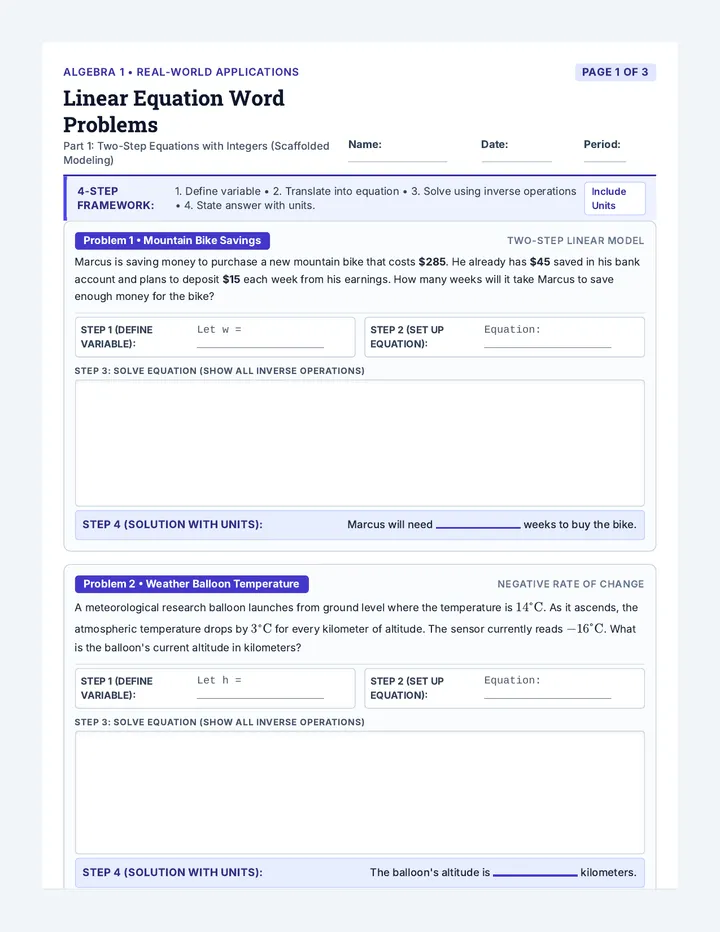
Algebra Word Problems Worksheet Algebra 1 • Real-World Applications Page 1 of 3
Linear Equation Word Problems
Part 1: Two-Step Equations with Integers (Scaffolded Modeling)
Name:
Date:
Period:
4-Step Framework: 1. Define variable • 2. Translate into equation • 3. Solve using inverse operations • 4. State answer with units.
Include Units
Problem 1 • Mountain Bike Savings Two-Step Linear Model
Marcus is saving money to purchase a new mountain bike that costs $285 . He already has $45 saved in his bank account and plans to deposit $15 each week from his earnings. How many weeks will it take Marcus to save enough money for the bike?
Step 1 (Define Variable): Let w = ____________________
Step 2 (Set Up Equation): Equation: ____________________
Step 3: Solve Equation (Show All Inverse Operations)
Step 4 (Solution with Units): Marcus will need weeks to buy the bike.
Problem 2 • Weather Balloon Temperature Negative Rate of Change
A meteorological research balloon launches from ground level where the temperature is \(14^\circ\text{C}\) . As it ascends, the atmospheric temperature drops by \(3^\circ\text{C}\) for every kilometer of altitude. The sensor currently reads \(-16^\circ\text{C}\) . What is the balloon's current altitude in kilometers?
Step 1 (Define Variable): Let h = ____________________
Step 2 (Set Up Equation): Equation: ____________________
Step 3: Solve Equation (Show All Inverse Operations)
Step 4 (Solution with Units): The balloon's altitude is kilometers.
Algebra 1 • Real-World Applications Page 2 of 3
Linear Equation Word Problems
Part 2: Distributive Property with Positive & Negative Numbers
Name:
Group Multiplier Strategy: When multiple identical groups are purchased or altered, set up equations in the form \(a(x + b) = c\).
Distribute First
Problem 3 • Theater Group Costumes Group Multiplier Model
A community youth theater orders 4 identical costume packages for its lead actors. Each package contains one custom stage jacket and an accessory kit that costs $12 . If the total bill before tax came to $260 , what was the individual price of each custom stage jacket?
Step 1 (Define Variable): Let j = ____________________
Step 2 (Set Up Equation): Equation: ____________________
Step 3: Solve Equation (Show Distribution & Inverse Steps)
Step 4 (Solution with Units): Each custom stage jacket costs $.
Problem 4 • Submersible Ocean Probes Negative Integer Depth Model
An oceanographic vessel deploys 3 identical research probes . Each probe begins at an unknown baseline depth \(d\) and descends an additional \(15\text{ meters}\) deeper (\(-15\text{ m}\)). If the combined sum of their new depths is \(-105\text{ meters}\) , what was the initial baseline depth of each probe?
Step 1 (Define Variable): Let d = ____________________
Step 2 (Set Up Equation): Equation: ____________________
Step 3: Solve Equation (Show Distribution & Inverse Steps)
Step 4 (Solution with Units): The initial baseline depth was meters.
Algebra 1 • Real-World Applications Page 3 of 3
Linear Equation Word Problems
Part 3: Variables on Both Sides with Integers (Break-Even Models)
Name:
Equal Rates Comparison: Set Expression A equal to Expression B to find the break-even value where both quantities match.
Balance Sides
Problem 5 • Gym Membership Comparison Break-Even Cost Model
Peak Fitness charges a $30 one-time enrollment fee plus $25 per month. Iron Works Gym charges a $70 enrollment fee plus $15 per month. After how many months will the total cost paid at both gyms be exactly the same?
Step 1 (Define Variable): Let m = ____________________
Step 2 (Set Up Equation): Peak = Iron: _______________
Step 3: Solve Equation (Collect Variables & Isolate)
Step 4 (Solution with Units): Both gyms cost the same after months ($130 total).
Problem 6 • Draining and Filling Water Tanks Opposite Rates Model
Tank A starts with 180 gallons of water and is draining at a rate of 8 gallons per minute . Tank B starts with 60 gallons and is filling at a rate of 4 gallons per minute . After how many minutes will both tanks contain the exact same amount of water?
Step 1 (Define Variable): Let t = ____________________
Step 2 (Set Up Equation): Tank A = Tank B: ___________
Step 3: Solve Equation (Collect Variables & Isolate)
Step 4 (Solution with Units): Both tanks have equal water after minutes (100 gal).
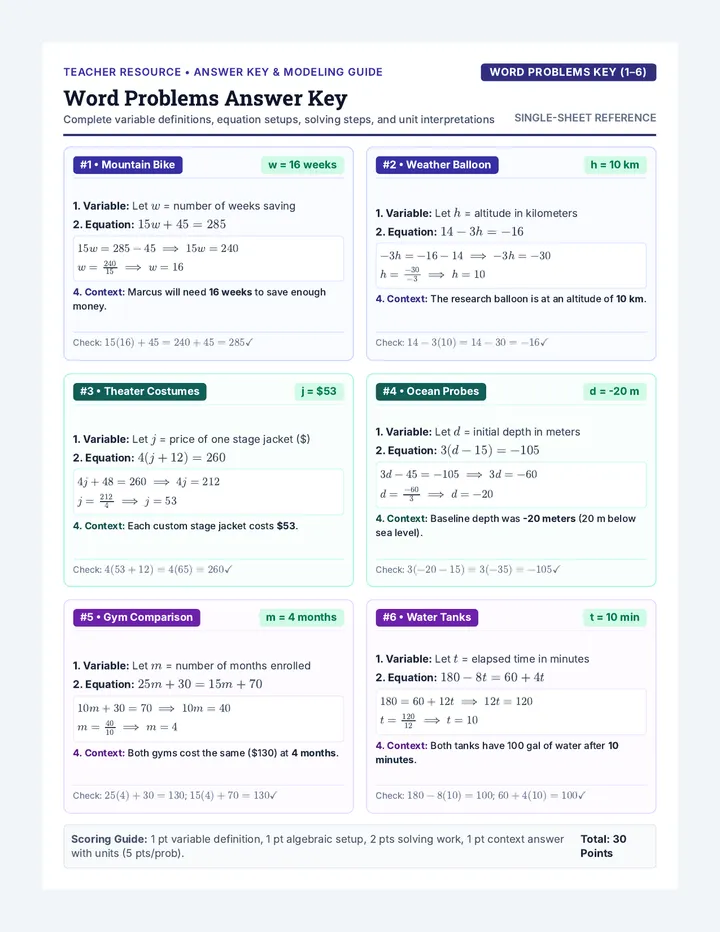
Algebra Word Problems Answer Key Teacher Resource • Answer Key & Modeling Guide Word Problems Key (1–6)
Word Problems Answer Key
Complete variable definitions, equation setups, solving steps, and unit interpretations
Single-Sheet Reference
#1 • Mountain Bike w = 16 weeks
1. Variable: Let \(w\) = number of weeks saving
2. Equation: \(15w + 45 = 285\)
\(15w = 285 - 45 \implies 15w = 240\)
4. Context: Marcus will need 16 weeks to save enough money.
Check: \(15(16) + 45 = 240 + 45 = 285 \checkmark\)
#2 • Weather Balloon h = 10 km
1. Variable: Let \(h\) = altitude in kilometers
2. Equation: \(14 - 3h = -16\)
\(-3h = -16 - 14 \implies -3h = -30\)
4. Context: The research balloon is at an altitude of 10 km .
Check: \(14 - 3(10) = 14 - 30 = -16 \checkmark\)
#3 • Theater Costumes j = $53
1. Variable: Let \(j\) = price of one stage jacket ($)
2. Equation: \(4(j + 12) = 260\)
\(4j + 48 = 260 \implies 4j = 212\)
4. Context: Each custom stage jacket costs $53 .
Check: \(4(53 + 12) = 4(65) = 260 \checkmark\)
#4 • Ocean Probes d = -20 m
1. Variable: Let \(d\) = initial depth in meters
2. Equation: \(3(d - 15) = -105\)
\(3d - 45 = -105 \implies 3d = -60\)
4. Context: Baseline depth was -20 meters (20 m below sea level).
Check: \(3(-20 - 15) = 3(-35) = -105 \checkmark\)
#5 • Gym Comparison m = 4 months
1. Variable: Let \(m\) = number of months enrolled
2. Equation: \(25m + 30 = 15m + 70\)
\(10m + 30 = 70 \implies 10m = 40\)
4. Context: Both gyms cost the same ($130) at 4 months .
Check: \(25(4) + 30 = 130\); \(15(4) + 70 = 130 \checkmark\)
#6 • Water Tanks t = 10 min
1. Variable: Let \(t\) = elapsed time in minutes
2. Equation: \(180 - 8t = 60 + 4t\)
\(180 = 60 + 12t \implies 12t = 120\)
4. Context: Both tanks have 100 gal of water after 10 minutes .
Check: \(180 - 8(10) = 100\); \(60 + 4(10) = 100 \checkmark\)
Scoring Guide: 1 pt variable definition, 1 pt algebraic setup, 2 pts solving work, 1 pt context answer with units (5 pts/prob). Total: 30 Points