Percent Simplifier Worksheet
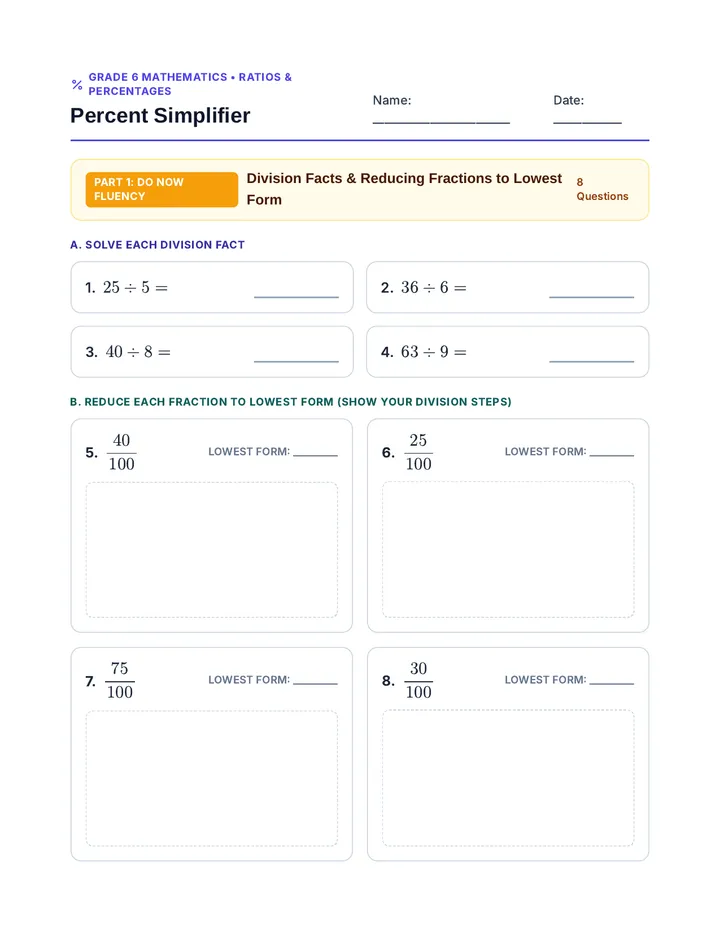
Grade 6 Mathematics • Ratios & Percentages
Percent Simplifier
Name: ________________________
Date: ____________
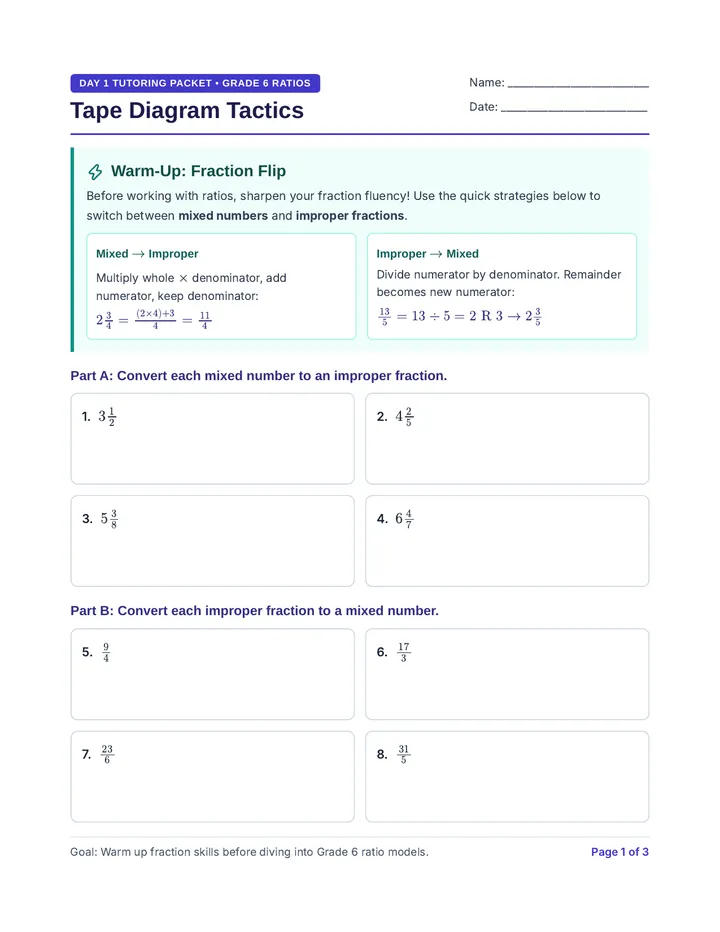
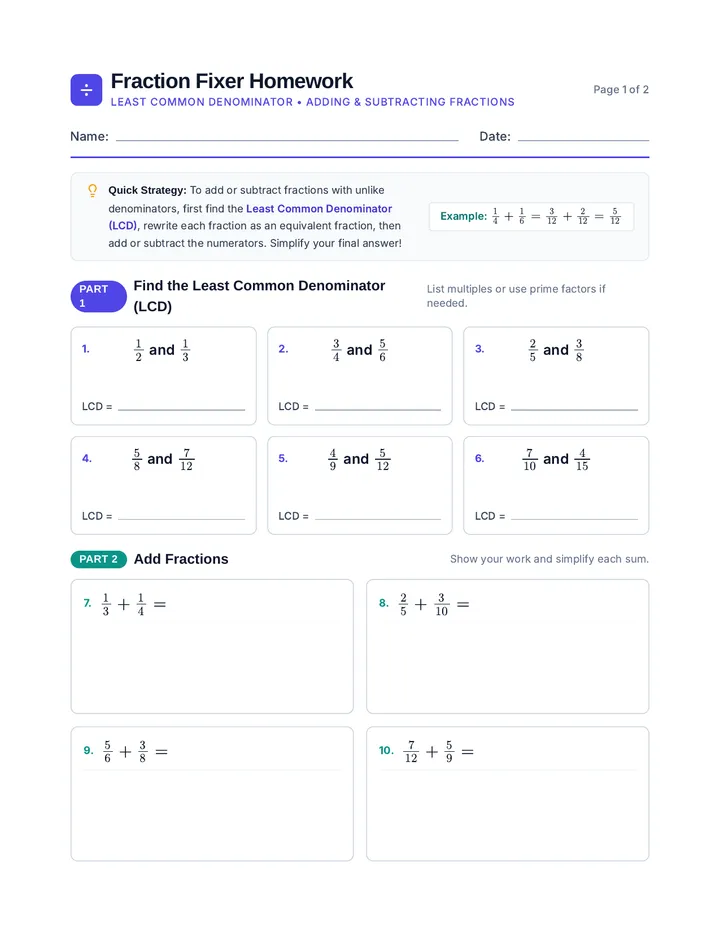
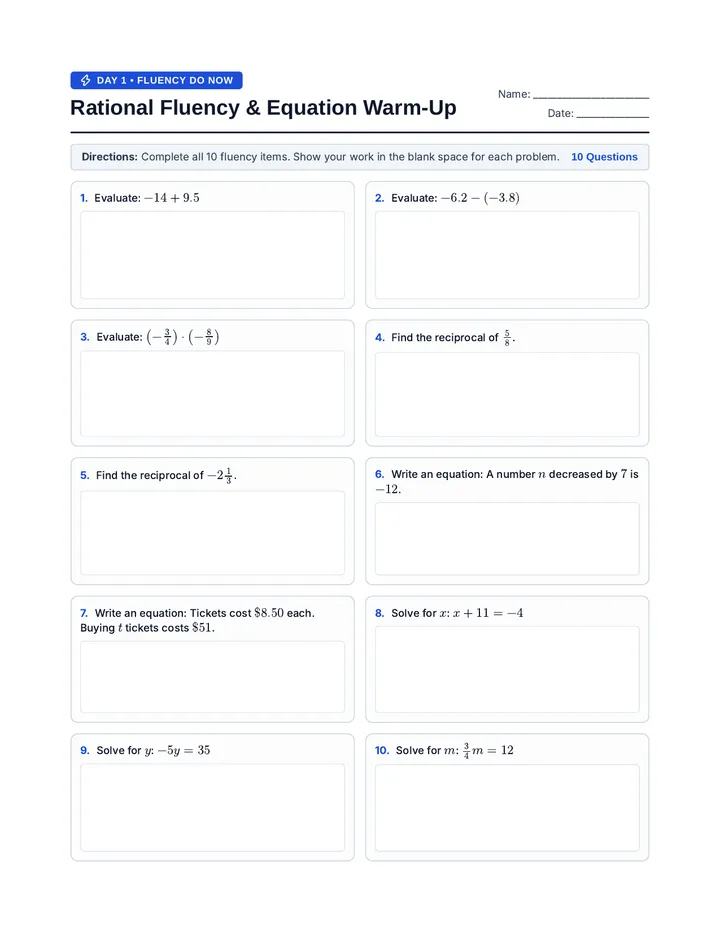
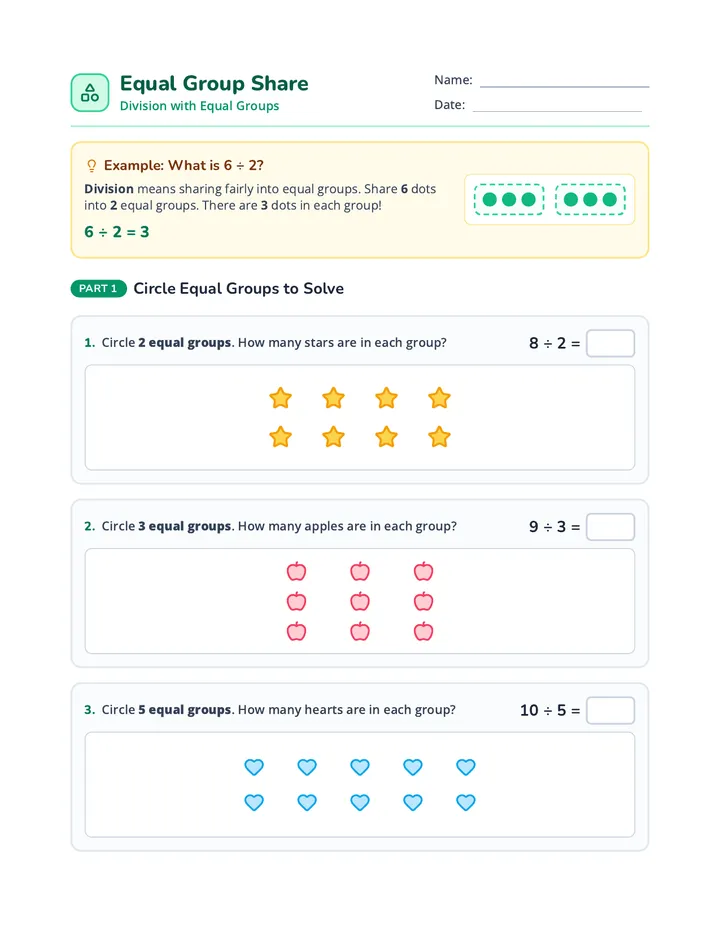
Part 1: Do Now Fluency
Division Facts & Reducing Fractions to Lowest Form
8 Questions
A. Solve each division fact
1. \(25 \div 5 =\)
2. \(36 \div 6 =\)
3. \(40 \div 8 =\)
4. \(63 \div 9 =\)
B. Reduce each fraction to lowest form (show your division steps)
5. \(\dfrac{40}{100}\) Lowest Form: _________
6. \(\dfrac{25}{100}\) Lowest Form: _________
7. \(\dfrac{75}{100}\) Lowest Form: _________
8. \(\dfrac{30}{100}\) Lowest Form: _________
Percent Simplifier Part 2: Guided Practice • Question 1 of 2
Part 2: Guided Practice
Percent of a Number
Question 1
Guided Practice • Question 1 Evaluate: 25% of 32
Calculate 25% of 32:
a. 4 b. 8 c. 12 d. 16
Final Choice:
Percent Simplifier Part 2: Guided Practice • Question 2 of 2
Part 2: Guided Practice
Finding the Whole
Question 2
Guided Practice • Question 2 Evaluate: 18 is 30% of ?
18 is 30% of what number?
a. 5.4 b. 48 c. 54 d. 60
Final Choice:
Percent Simplifier Part 3: Independent Practice
Part 3: Independent Practice
Solo Mastery
2 Questions
Independent Practice • Question 1 Evaluate: 40% of 45
Calculate 40% of 45:
a. 12 b. 18 c. 20 d. 24
Final Choice:
Independent Practice • Question 2 Evaluate: 15 is 25% of ?
15 is 25% of what number?
a. 3.75 b. 45 c. 60 d. 75
Final Choice:
Percent Simplifier Part 4: Exit Ticket
Part 4: Exit Ticket
Final Formative Check
2 Questions
Exit Ticket • Question 1 Evaluate: 20% of 65
Calculate 20% of 65:
a. 10 b. 13 c. 15 d. 26
Final Choice:
Exit Ticket • Question 2 Evaluate: 21 is 30% of ?
21 is 30% of what number?
a. 6.3 b. 63 c. 70 d. 90
Final Choice:
Self-Check: Can you find percents of a number and missing wholes?
Need Help Almost Got It!
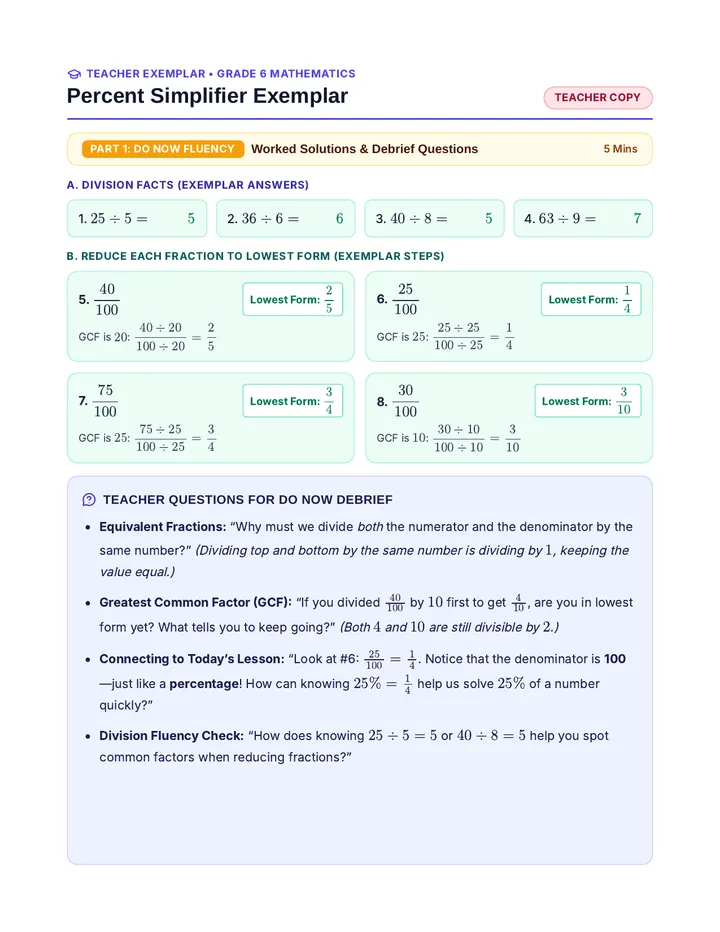
Percent Simplifier Teacher Exemplar
Teacher Exemplar • Grade 6 Mathematics
Percent Simplifier Exemplar
Teacher Copy
Part 1: Do Now Fluency
Worked Solutions & Debrief Questions
5 Mins
A. Division Facts (Exemplar Answers)
1. \(25 \div 5 =\) \(5\)
2. \(36 \div 6 =\) \(6\)
3. \(40 \div 8 =\) \(5\)
4. \(63 \div 9 =\) \(7\)
B. Reduce Each Fraction to Lowest Form (Exemplar Steps)
5. \(\dfrac{40}{100}\) Lowest Form: \(\dfrac{2}{5}\)
GCF is \(20\): \(\dfrac{40 \div 20}{100 \div 20} = \dfrac{2}{5}\)
6. \(\dfrac{25}{100}\) Lowest Form: \(\dfrac{1}{4}\)
GCF is \(25\): \(\dfrac{25 \div 25}{100 \div 25} = \dfrac{1}{4}\)
7. \(\dfrac{75}{100}\) Lowest Form: \(\dfrac{3}{4}\)
GCF is \(25\): \(\dfrac{75 \div 25}{100 \div 25} = \dfrac{3}{4}\)
8. \(\dfrac{30}{100}\) Lowest Form: \(\dfrac{3}{10}\)
GCF is \(10\): \(\dfrac{30 \div 10}{100 \div 10} = \dfrac{3}{10}\)
Teacher Questions for Do Now Debrief
- Equivalent Fractions: “Why must we divide both the numerator and the denominator by the same number?” (Dividing top and bottom by the same number is dividing by \(1\), keeping the value equal.)
- Greatest Common Factor (GCF): “If you divided \(\frac{40}{100}\) by \(10\) first to get \(\frac{4}{10}\), are you in lowest form yet? What tells you to keep going?” (Both \(4\) and \(10\) are still divisible by \(2\).)
- Connecting to Today’s Lesson: “Look at #6: \(\frac{25}{100} = \frac{1}{4}\). Notice that the denominator is 100—just like a percentage! How can knowing \(25\% = \frac{1}{4}\) help us solve \(25\%\) of a number quickly?”
- Division Fluency Check: “How does knowing \(25 \div 5 = 5\) or \(40 \div 8 = 5\) help you spot common factors when reducing fractions?”
Percent Simplifier Exemplar Part 2: Guided Practice • Question 1 of 2
Guided Practice • Q1
Percent of a Number
Evaluate: 25% of 32
Calculate 25% of 32:
a. 4 b. 8 c. 12 d. 16
Key Words Breakdown (Annotate Together)
“25%” (Percentage & 100): Means \(25\) out of \(\mathbf{100} \rightarrow \dfrac{25}{100}\).
“of” (Multiply / Whole): Points directly to the whole (total).
“32” (Whole / Total): Follows “of”, so \(\mathbf{32}\) is the total.
Unknown (Part): We are solving for the part of \(32\).
Exemplar Student Work: \(\dfrac{\text{part}}{\text{total}} = \dfrac{p\%}{100}\)
Final Choice: b
Step 1 (Set up \(\dfrac{\text{part}}{\text{total}} = \dfrac{p\%}{100}\)): \(\dfrac{\text{part}}{32} = \dfrac{25}{100}\)
Step 2 (Simplify \(\dfrac{25}{100}\) from Do Now #6): \(\dfrac{\text{part}}{32} = \dfrac{1}{4}\)
Step 3 (Scale to find the Part): Since \(4 \times 8 = 32\), multiply numerator by \(8\): \(\dfrac{1 \times 8}{4 \times 8} = \dfrac{\mathbf{8}}{32} \;\Rightarrow\; \text{part} = \mathbf{8}\).
Teacher Questions (Key Words & Proportion Setup)
- “Circle the word ‘of’. Is \(32\) the part or the whole (total)? Where does it go in \(\frac{\text{part}}{\text{total}}\)?”
- “What number always goes under the percentage \(25\)?” (100!)
- “From our Do Now, what is \(\frac{25}{100}\) in lowest form? How does \(\frac{1}{4}\) help us scale up to a total of \(32\)?”
- “Should our answer (the part) be larger or smaller than the whole (\(32\))? Why?”
Percent Simplifier Exemplar Part 2: Guided Practice • Question 2 of 2
Guided Practice • Q2
Finding the Whole (Double Number Line + Proportion)
Evaluate: 18 is 30% of ?
18 is 30% of what number?
a. 5.4 b. 48 c. 54 d. 60
Key Words Breakdown
“18 is”: Part \(= 18\)
“30%”: Percent \(= 30\) out of 100
“of what number?”: Whole \(= ?\)
Step 1: Double Number Line → Step 2: Solve Using \(\dfrac{\text{part}}{\text{total}} = \dfrac{p\%}{100}\)
Final Choice: d
Amount
0 6 12 18 ••• 60
Percent
0% 10% 20% 30% ••• 100%
DNL: \(30\% \div 3 = 10\% \;\Rightarrow\; 18 \div 3 = 6\) \(10\% \times 10 = 100\% \;\Rightarrow\; 6 \times 10 = \mathbf{60}\)
Proportion Setup: \(\dfrac{\text{part}}{\text{total}} = \dfrac{p\%}{100} \;\Rightarrow\; \dfrac{18}{\text{total}} = \dfrac{30}{100} = \dfrac{3}{10}\). Since \(3 \times 6 = 18\), multiply denominator by \(6\): \(\dfrac{3 \times 6}{10 \times 6} = \dfrac{18}{\mathbf{60}} \;\Rightarrow\; \text{total} = \mathbf{60}\).
Teacher Questions (Double Number Line & Proportion Setup)
- “Look at ‘18 is 30% of what number?’ Is \(18\) the part or the whole? Why?”
- “On our Double Number Line, how do we jump from \(30\% = 18\) down to \(10\% = 6\), and then up to \(\mathbf{100\%} = \mathbf{60}\)?”
- “Now let’s write it as \(\frac{\text{part}}{\text{total}} = \frac{p\%}{100}\): Where does \(18\) go? Where does \(30\) go? Where does \(\mathbf{100}\) go?”
- “How does reducing \(\frac{30}{100}\) to \(\frac{3}{10}\) (Do Now #8) make solving \(\frac{18}{\text{total}} = \frac{3}{10}\) super fast?”
Percent Simplifier Exemplar Part 3: Independent Practice • Monitoring Laps
Part 3: Independent Practice
Monitoring Laps, Stamp & Mini-Stamps
7 Mins
Lap 1: Key Words & Setup (Mins 1–2) Mini-Stamp #1
Look For: Students underline “of”, label part vs. whole, and set up \(\dfrac{\text{part}}{\text{total}} = \dfrac{p\%}{100}\).
Mini-Stamp Prompt: “Point to ‘of’. Is the total given (Q1), or are we solving for the total (Q2)? Put each number into \(\frac{\text{part}}{\text{total}} = \frac{p\%}{100}\).”
Lap 2: Strategy & Calculation (Mins 3–5) Mini-Stamp #2
Look For: Q1 reduced \(\frac{40}{100} = \frac{2}{5}\) and scaled to \(45\); Q2 used Double Number Line or \(\frac{15}{\text{total}} = \frac{25}{100} = \frac{1}{4}\).
Mini-Stamp Prompt: “Reduce \(\frac{40}{100}\) to lowest form first. On Q2, how do you scale \(\frac{1}{4}\) so the part is \(15\)?”
Lap 3: Mastery Stamp (Mins 6–7) Criteria for Stamp
Stamp When: Both questions show labeled part / total / 100, valid \(\frac{\text{part}}{\text{total}} = \frac{p\%}{100}\) (or Double Number Line) work, and correct Final Choices (Q1: b, Q2: c).
Exemplar Student Solutions
Q1. Calculate 40% of 45: Final Choice: b. 18
Proportion Setup: \(\dfrac{\text{part}}{45} = \dfrac{40}{100} = \dfrac{2}{5}\). Scale (\(\times 9\)): \(\dfrac{2 \times 9}{5 \times 9} = \dfrac{\mathbf{18}}{45} \;\Rightarrow\; \text{part} = \mathbf{18}\).
Q2. 15 is 25% of what number? Final Choice: c. 60
Proportion Setup: \(\dfrac{15}{\text{total}} = \dfrac{25}{100} = \dfrac{1}{4}\). Scale (\(\times 15\)): \(\dfrac{1 \times 15}{4 \times 15} = \dfrac{15}{\mathbf{60}} \;\Rightarrow\; \text{total} = \mathbf{60}\).
Percent Simplifier Exemplar Part 4: Exit Ticket • Quick-Sort
Part 4: Exit Ticket
Exemplar Solutions & Reteach Plan
4 Mins
Exit Ticket • Question 1 Final Choice: b. 13
Calculate 20% of 65:
Key Words: “of 65” \(\rightarrow \text{total} = 65\), \(p\% = 20\%\).
Proportion Setup: \(\dfrac{\text{part}}{65} = \dfrac{20}{100} = \dfrac{1}{5} \;\xrightarrow{\times 13}\; \dfrac{\mathbf{13}}{65} \;\Rightarrow\; \text{part} = \mathbf{13}\).
Exit Ticket • Question 2 Final Choice: c. 70
21 is 30% of what number?
Key Words: \(\text{part} = 21\), \(p\% = 30\%\), \(\text{total} = ?\) (“of what number”)
DNL & Proportion: \(30\% = 21 \Rightarrow 10\% = 7 \Rightarrow 100\% = 70\) | \(\dfrac{21}{\text{total}} = \dfrac{30}{100} = \dfrac{3}{10} \;\xrightarrow{\times 7}\; \dfrac{21}{\mathbf{70}}\).
Teacher Quick-Sort & Next Steps
Got It! (2/2 Correct): Ready for multi-step percent word problems and error analysis (spotting mistakes like \(20 \times 80\)).
Almost (1/2 Correct): Most common error is multiplying \(0.30 \times 21 = 6.3\) (choice a) on Q2. Reteach using the Double Number Line + \(\frac{\text{part}}{\text{total}} = \frac{p\%}{100}\).
Need Help (0/2 Correct): Pull small group to practice circling “of”, identifying part vs. total, and setting up \(\frac{\text{part}}{\text{total}} = \frac{p\%}{100}\).