Parallelogram Area Practice Sheet 6th Grade Geometry
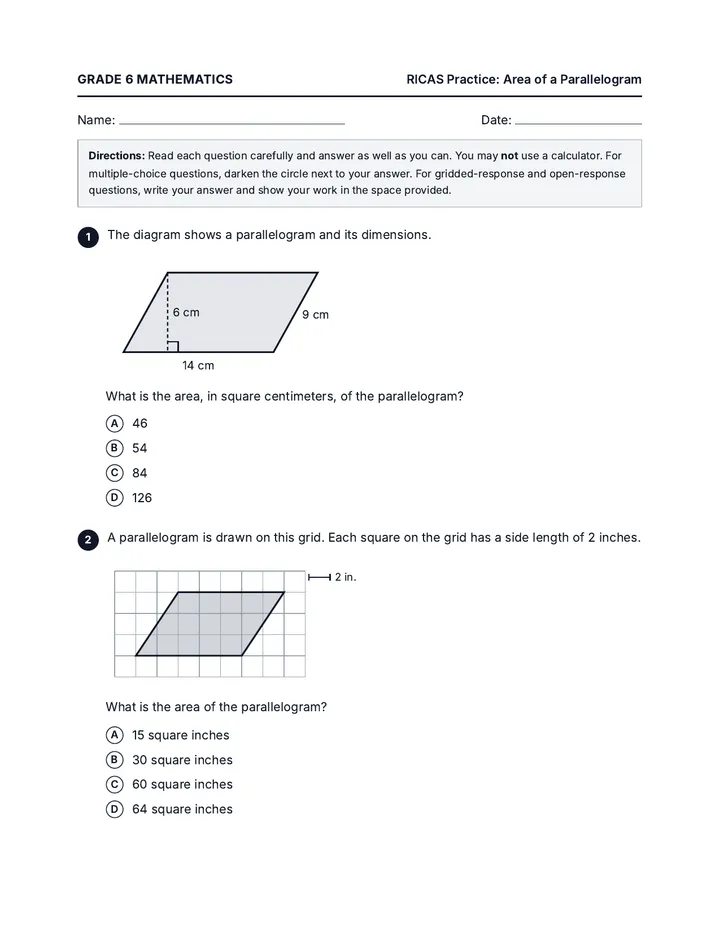
Parallelogram Area Practice
Name:
Date:
Directions: Find the area of each parallelogram. Include square units in your answer and watch out for extra side lengths!
Formula \(A = b \times h\)
1 Not drawn to scale
12 cm 5 cm 7 cm
2 Not drawn to scale
9 in 6 in 8 in
3 Not drawn to scale
10.5 m 4 m 6 m
4 Not drawn to scale
8 ft 7 ft 11 ft
5 Not drawn to scale
15 mm 8 mm 9 mm
6 Not drawn to scale
6 cm 11 cm 13 cm
7 Not drawn to scale
7.5 in 4 in 5.2 in
8 Not drawn to scale
14 m 9 m 10 m
9 Not drawn to scale
11 ft 7 ft 10 ft
10 Not drawn to scale
12.5 cm 6.2 cm 8.4 cm
Parallelogram Area Answer Key Teacher Resource • 6th Grade Geometry
Parallelogram Area Answer Key
Formula \(A = b \times h\)
#
Base (\(b\))
Height (\(h\))
Extra Side
Calculation
Area
1
12 cm
5 cm
7 cm
\(12 \times 5\)
\(60\text{ cm}^2\)
2
9 in
6 in
8 in
\(9 \times 6\)
\(54\text{ in}^2\)
3
10.5 m
4 m
6 m
\(10.5 \times 4\)
\(42\text{ m}^2\)
4
8 ft
7 ft
11 ft
\(8 \times 7\)
\(56\text{ ft}^2\)
5
15 mm
8 mm
9 mm
\(15 \times 8\)
\(120\text{ mm}^2\)
6
6 cm
11 cm
13 cm
\(6 \times 11\)
\(66\text{ cm}^2\)
7
7.5 in
4 in
5.2 in
\(7.5 \times 4\)
\(30\text{ in}^2\)
8
14 m
9 m
10 m
\(14 \times 9\)
\(126\text{ m}^2\)
9
11 ft
7 ft
10 ft
\(11 \times 7\)
\(77\text{ ft}^2\)
10
12.5 cm
6.2 cm
8.4 cm
\(12.5 \times 6.2\)
\(77.5\text{ cm}^2\)
Common Misconceptions to Watch For
Using the slanted side: Students often multiply the base by the extra side length instead of the perpendicular height.
Rotated bases (#4 and #8): Remind students that the base is whichever side forms a right angle (\(90^\circ\)) with the height—not always the bottom edge.
Outside heights (#2 and #9): Heights drawn outside the figure on an extended base line still measure the perpendicular distance between parallel bases.
Missing Dimension Practice Sheet 6th Grade Geometry
Missing Dimension Practice
Name:
Date:
Directions: Use the given area to find the missing base (\(b\)) or height (\(h\)) of each parallelogram. Watch out for extra side lengths!
Formula \(A = b \times h\)
1 Area = \(48\text{ cm}^2\)
8 cm h = ? 7 cm
2 Area = \(63\text{ in}^2\)
b = ? 7 in 10 in
3 Area = \(45\text{ m}^2\)
10 m h = ? 6 m
4 Area = \(72\text{ ft}^2\)
b = ? 8 ft 11 ft
5 Area = \(108\text{ mm}^2\)
12 mm h = ? 10 mm
6 Area = \(56\text{ cm}^2\)
b = ? 7 cm 9 cm
7 Area = \(30\text{ in}^2\)
7.5 in h = ? 5 in
8 Area = \(110\text{ m}^2\)
b = ? 10 m 13 m
9 Area = \(84\text{ ft}^2\)
12 ft h = ? 9 ft
10 Area = \(78\text{ cm}^2\)
b = ? 6 cm 8 cm
Missing Dimension Answer Key Teacher Resource • 6th Grade Geometry
Missing Dimension Answer Key
Formulas \(h = A \div b \;\;|\;\; b = A \div h\)
#
Given Area
Given Dimension
Extra Side
Calculation
Missing Answer
1
\(48\text{ cm}^2\)
\(b = 8\text{ cm}\)
7 cm
\(48 \div 8\)
\(h = 6\text{ cm}\)
2
\(63\text{ in}^2\)
\(h = 7\text{ in}\)
10 in
\(63 \div 7\)
\(b = 9\text{ in}\)
3
\(45\text{ m}^2\)
\(b = 10\text{ m}\)
6 m
\(45 \div 10\)
\(h = 4.5\text{ m}\)
4
\(72\text{ ft}^2\)
\(h = 8\text{ ft}\)
11 ft
\(72 \div 8\)
\(b = 9\text{ ft}\)
5
\(108\text{ mm}^2\)
\(b = 12\text{ mm}\)
10 mm
\(108 \div 12\)
\(h = 9\text{ mm}\)
6
\(56\text{ cm}^2\)
\(h = 7\text{ cm}\)
9 cm
\(56 \div 7\)
\(b = 8\text{ cm}\)
7
\(30\text{ in}^2\)
\(b = 7.5\text{ in}\)
5 in
\(30 \div 7.5\)
\(h = 4\text{ in}\)
8
\(110\text{ m}^2\)
\(h = 10\text{ m}\)
13 m
\(110 \div 10\)
\(b = 11\text{ m}\)
9
\(84\text{ ft}^2\)
\(b = 12\text{ ft}\)
9 ft
\(84 \div 12\)
\(h = 7\text{ ft}\)
10
\(78\text{ cm}^2\)
\(h = 6\text{ cm}\)
8 cm
\(78 \div 6\)
\(b = 13\text{ cm}\)
Common Misconceptions to Watch For
Dividing by the slanted side: Students may divide the area by the distractor side length instead of the given base or perpendicular height.
Multiplying instead of dividing: Remind students to substitute into \(A = b \times h\) and use division to isolate the missing dimension.
Units: Missing base and height answers should use linear units (e.g., cm, in, m, ft, mm), not square units.
Parallelogram Word Problems Sheet 6th Grade Geometry
Parallelogram Word Problems
Name:
Date:
Directions: Read each problem carefully. Use the formula to find the area, missing base, or missing height. Show your work and include units!
Formula \(A = b \times h\)
1
Maya is planting a parallelogram-shaped flower bed in her backyard. The base of the flower bed is 14 feet , the slanted side is 9 feet , and the perpendicular height is 6 feet . How many square feet of soil does she need to cover the flower bed?
Answer:
2
A school spirit banner is cut in the shape of a parallelogram with an area of 135 square inches . If the base of the banner is 15 inches and the slanted edge is 11 inches , what is the perpendicular height of the banner?
Answer:
3
An architect designs a skylight shaped like a parallelogram that has an area of 42 square meters . The perpendicular height between the top and bottom frames is 5 meters . What is the length of the base of the skylight?
Answer:
4
A kitchen backsplash uses parallelogram-shaped ceramic tiles. Each tile has a base of 12.5 centimeters , a slanted side of 8 centimeters , and a perpendicular height of 6 centimeters . What is the area of one tile?
Answer:
5
An angled parking space is painted as a parallelogram with an area of 162 square feet . If the base of the parking space along the curb is 9 feet , what is the perpendicular height of the parking space?
Answer:
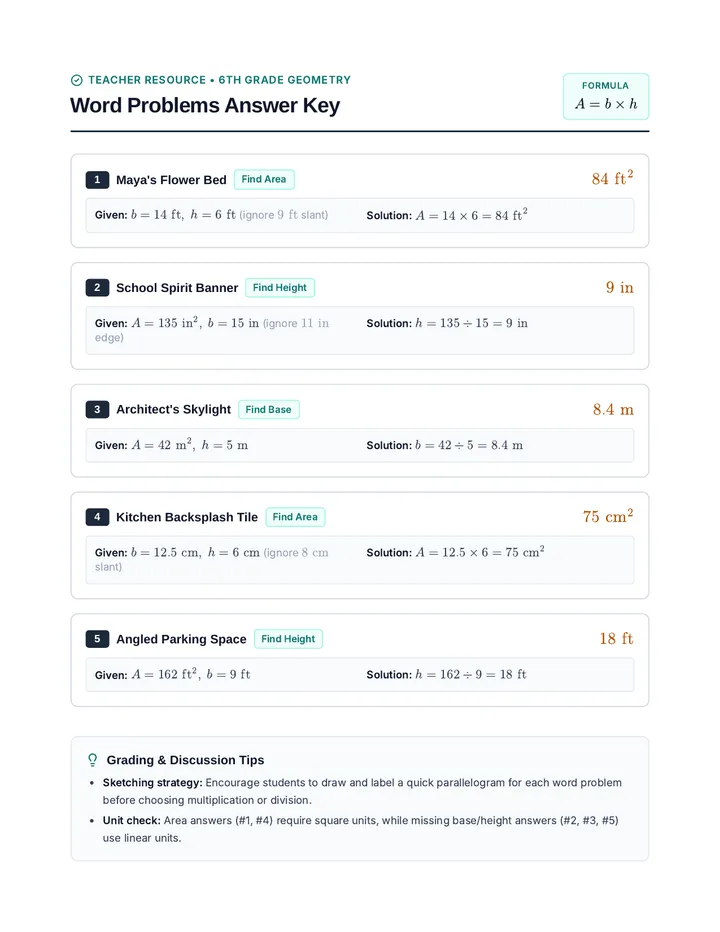
Word Problems Answer Key Teacher Resource • 6th Grade Geometry
Word Problems Answer Key
Formula \(A = b \times h\)
1 Maya's Flower Bed Find Area
\(84\text{ ft}^2\)
Given: \(b = 14\text{ ft},\; h = 6\text{ ft}\) (ignore \(9\text{ ft}\) slant)
Solution: \(A = 14 \times 6 = 84\text{ ft}^2\)
2 School Spirit Banner Find Height
\(9\text{ in}\)
Given: \(A = 135\text{ in}^2,\; b = 15\text{ in}\) (ignore \(11\text{ in}\) edge)
Solution: \(h = 135 \div 15 = 9\text{ in}\)
3 Architect's Skylight Find Base
\(8.4\text{ m}\)
Given: \(A = 42\text{ m}^2,\; h = 5\text{ m}\)
Solution: \(b = 42 \div 5 = 8.4\text{ m}\)
4 Kitchen Backsplash Tile Find Area
\(75\text{ cm}^2\)
Given: \(b = 12.5\text{ cm},\; h = 6\text{ cm}\) (ignore \(8\text{ cm}\) slant)
Solution: \(A = 12.5 \times 6 = 75\text{ cm}^2\)
5 Angled Parking Space Find Height
\(18\text{ ft}\)
Given: \(A = 162\text{ ft}^2,\; b = 9\text{ ft}\)
Solution: \(h = 162 \div 9 = 18\text{ ft}\)
Grading & Discussion Tips
Sketching strategy: Encourage students to draw and label a quick parallelogram for each word problem before choosing multiplication or division.
Unit check: Area answers (#1, #4) require square units, while missing base/height answers (#2, #3, #5) use linear units.
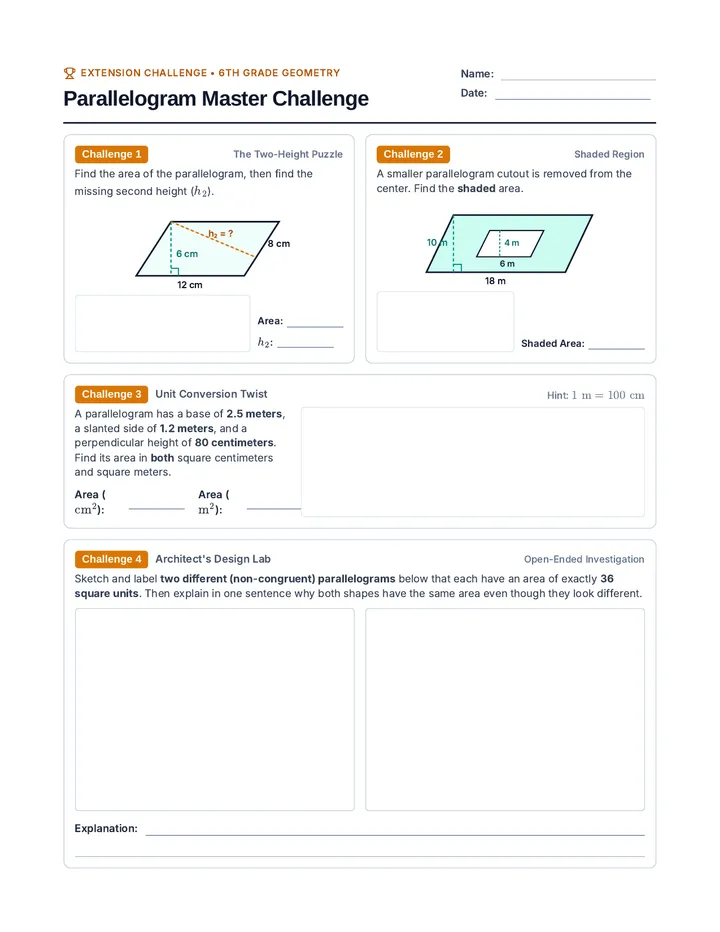
Parallelogram Master Challenge Activity Extension Challenge • 6th Grade Geometry
Parallelogram Master Challenge
Name:
Date:
Challenge 1 The Two-Height Puzzle
Find the area of the parallelogram, then find the missing second height (\(h_2\)).
12 cm 6 cm 8 cm h₂ = ?
Area:
\(h_2\):
Challenge 2 Shaded Region
A smaller parallelogram cutout is removed from the center. Find the shaded area.
18 m 10 m 6 m 4 m
Shaded Area:
Challenge 3 Unit Conversion Twist
Hint: \(1\text{ m} = 100\text{ cm}\)
A parallelogram has a base of 2.5 meters , a slanted side of 1.2 meters , and a perpendicular height of 80 centimeters . Find its area in both square centimeters and square meters.
Area (\(\text{cm}^2\)):
Area (\(\text{m}^2\)):
Challenge 4 Architect's Design Lab
Open-Ended Investigation
Sketch and label two different (non-congruent) parallelograms below that each have an area of exactly 36 square units . Then explain in one sentence why both shapes have the same area even though they look different.
Explanation:
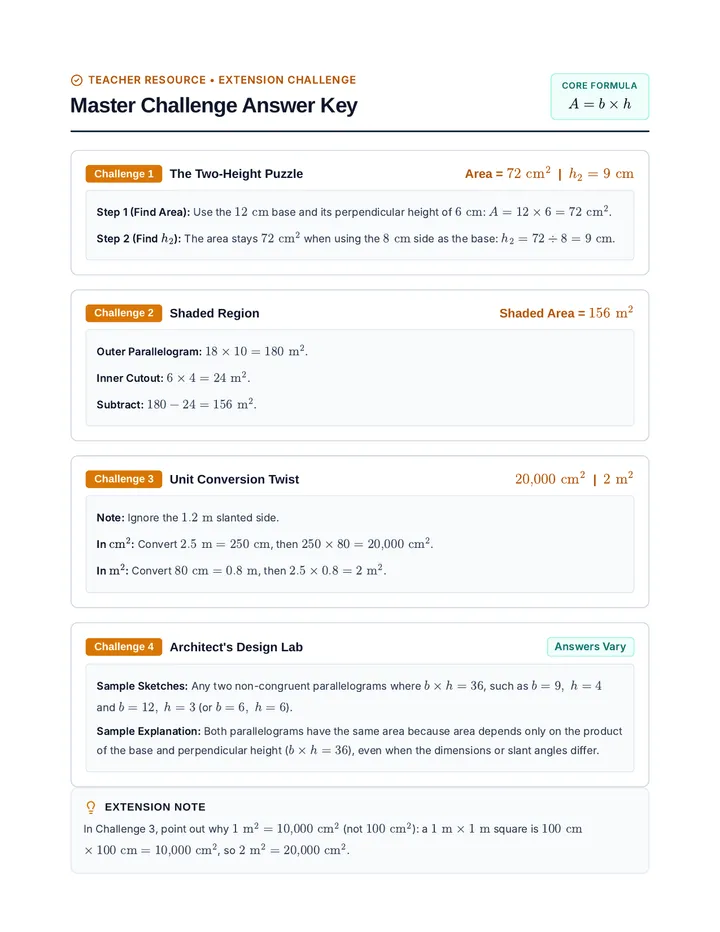
Master Challenge Answer Key Teacher Resource • Extension Challenge
Master Challenge Answer Key
Core Formula \(A = b \times h\)
Challenge 1 The Two-Height Puzzle
Area = \(72\text{ cm}^2\) | \(h_2 = 9\text{ cm}\)
Step 1 (Find Area): Use the \(12\text{ cm}\) base and its perpendicular height of \(6\text{ cm}\): \(A = 12 \times 6 = 72\text{ cm}^2\).
Step 2 (Find \(h_2\)): The area stays \(72\text{ cm}^2\) when using the \(8\text{ cm}\) side as the base: \(h_2 = 72 \div 8 = 9\text{ cm}\).
Challenge 2 Shaded Region
Shaded Area = \(156\text{ m}^2\)
Outer Parallelogram: \(18 \times 10 = 180\text{ m}^2\).
Inner Cutout: \(6 \times 4 = 24\text{ m}^2\).
Subtract: \(180 - 24 = 156\text{ m}^2\).
Challenge 3 Unit Conversion Twist
\(20{,}000\text{ cm}^2\) | \(2\text{ m}^2\)
Note: Ignore the \(1.2\text{ m}\) slanted side.
In \(\text{cm}^2\): Convert \(2.5\text{ m} = 250\text{ cm}\), then \(250 \times 80 = 20{,}000\text{ cm}^2\).
In \(\text{m}^2\): Convert \(80\text{ cm} = 0.8\text{ m}\), then \(2.5 \times 0.8 = 2\text{ m}^2\).
Challenge 4 Architect's Design Lab
Answers Vary
Sample Sketches: Any two non-congruent parallelograms where \(b \times h = 36\), such as \(b = 9,\; h = 4\) and \(b = 12,\; h = 3\) (or \(b = 6,\; h = 6\)).
Sample Explanation: Both parallelograms have the same area because area depends only on the product of the base and perpendicular height (\(b \times h = 36\)), even when the dimensions or slant angles differ.
Extension Note
In Challenge 3, point out why \(1\text{ m}^2 = 10{,}000\text{ cm}^2\) (not \(100\text{ cm}^2\)): a \(1\text{ m} \times 1\text{ m}\) square is \(100\text{ cm} \times 100\text{ cm} = 10{,}000\text{ cm}^2\), so \(2\text{ m}^2 = 20{,}000\text{ cm}^2\).