Number Bond Builders Slides Lesson 1 Within 10
Parts & Wholes Builders
How do two Parts snap together to build a Whole?
P
P
=
W
Meet the Parts & the Whole
Every number bond has 1 Whole and 2 Parts.
W
The Whole
The total amount. All the cubes together!
7 cubes total
P
The Parts
The smaller pieces that snap together to make the whole.
and
4 cubes and 3 cubes
The Golden Builder Rule
YES! Add Parts
Snap Part + Part together to build the Whole.
4 + 3 = 7
Part + Part = Whole
NO! Never Do This
You NEVER add a Whole and a Part!
7 + 4 = 11
7 is already the Whole! We don't have 11 cubes.
Let's Build Together!
Find the Whole when we have two Parts: 5 and 3.
Whole ?
Part 5
Part 3
Builder Check:
1. Do we have both Parts? Yes! (5 and 3)
2. Snap the parts together: 5 + 3 = 8
The Whole is 8!
Spot the Mistake
Did Leo Break the Builder Rule?
W 9
P 6
P ?
Leo wrote:
9 + 6 = 15
Talk to a partner: Why is 15 NOT the missing part?
Hint: 9 is the Whole! Can a Part be bigger than the Whole?
Number Bond Practice Worksheet Lesson 1 Practice
Number Bond Builders
Name: ________________________
Date: ______________
Builder Rule: Snap Part + Part to make the Whole. Never add a Whole and a Part!
Part 1: Circle the WHOLE in each group of 3 numbers.
Remember: The Whole is the biggest total number!
495
826
3710
Part 2: Add the two Parts to build the Whole.
4
3
4. Equation:
4 + 3 = ____
6
2
5. Equation:
6 + 2 = ____
5
5
6. Equation:
5 + 5 = ____
2
7
7. Equation:
2 + 7 = ____
Lesson 1 Practice (Page 2) Name: ________________________
Part 3: Find the missing Part.
You already have the Whole! Subtract the known Part from the Whole.
8
5
8. Subtract:
8 - 5 = ____
10
3
9. Subtract:
10 - 3 = ____
7
2
10. Subtract:
7 - 2 = ____
9
4
11. Subtract:
9 - 4 = ____
12. Fix the Builder Mistake!
6
4
Maya tried to find the missing part by writing 6 + 4 = 10.
What did Maya do wrong? Write the correct equation and answer:
Parts Wholes Exit Ticket Lesson 1 Exit Ticket
Parts & Wholes Check
Name: ________________________
Date: ______________
1. Find the missing Part.
Fill in the empty circle and write the equation you used.
W 9
P 5
P
My equation:
2. Circle YES or NO.
The Whole is 8 and one Part is 2. Sam says the other part is 10 because 8 + 2 = 10.
Is Sam right?
YES
NO
Show or tell why:
Parts Wholes Teacher Guide Intervention Teacher Guide
Lesson 1: Parts & Wholes
20–25 Minutes
Small Group (2–5 Students)
Learning Goal
Students will distinguish between a Whole (total) and Parts in a number bond within 10, and explain why you never add a whole and a part.
Materials Needed
10 linking cubes per student
Number Bond Builders Slides
Number Bond Practice Worksheet
Parts Wholes Exit Ticket
Pacing & Explicit Intervention Script
1. Concrete Warm-Up (5 min) — Slides 1–2
Have students snap 4 cubes and 3 cubes together. "The 7-cube stick is our Whole . When we break it apart, 4 and 3 are our Parts ."
2. The Golden Builder Rule (5 min) — Slides 3–5
Hold up the 7-stick (Whole) and a 4-stick (Part). "Can I add 7 + 4 to find the missing part? NO! 7 is already the whole. We never add a whole and a part!"
3. Guided & Independent Practice (8 min) — Worksheet
Complete Part 1 together, checking that students circle the largest number as the Whole. Have students use cubes to verify Part 3.
4. Daily Exit Ticket (3–5 min)
Administer the 2-question exit ticket independently. Look for whether students subtract 9 - 5 (not 9 + 5) on Q1 and reject 8 + 2 = 10 on Q2.
Answer Key
Worksheet (Page 1 & 2)
Part 1: 1) 9 | 2) 8 | 3) 10
Part 2: 4) 7 (4+3=7) | 5) 8 (6+2=8) | 6) 10 (5+5=10) | 7) 9 (2+7=9)
Part 3: 8) 3 (8-5=3) | 9) 7 (10-3=7) | 10) 5 (7-2=5) | 11) 5 (9-4=5)
12: Maya added the Whole (6) and a Part (4). Correct: 6 - 4 = 2.
Exit Ticket
Q1: Missing part is 4 . Equation: 9 - 5 = 4 (or 5 + 4 = 9).
Q2: NO . 8 is the Whole, so you cannot add 8 + 2. The other part is 6 (8 - 2 = 6).
Fact Family Houses Slides Lesson 2 Within 10
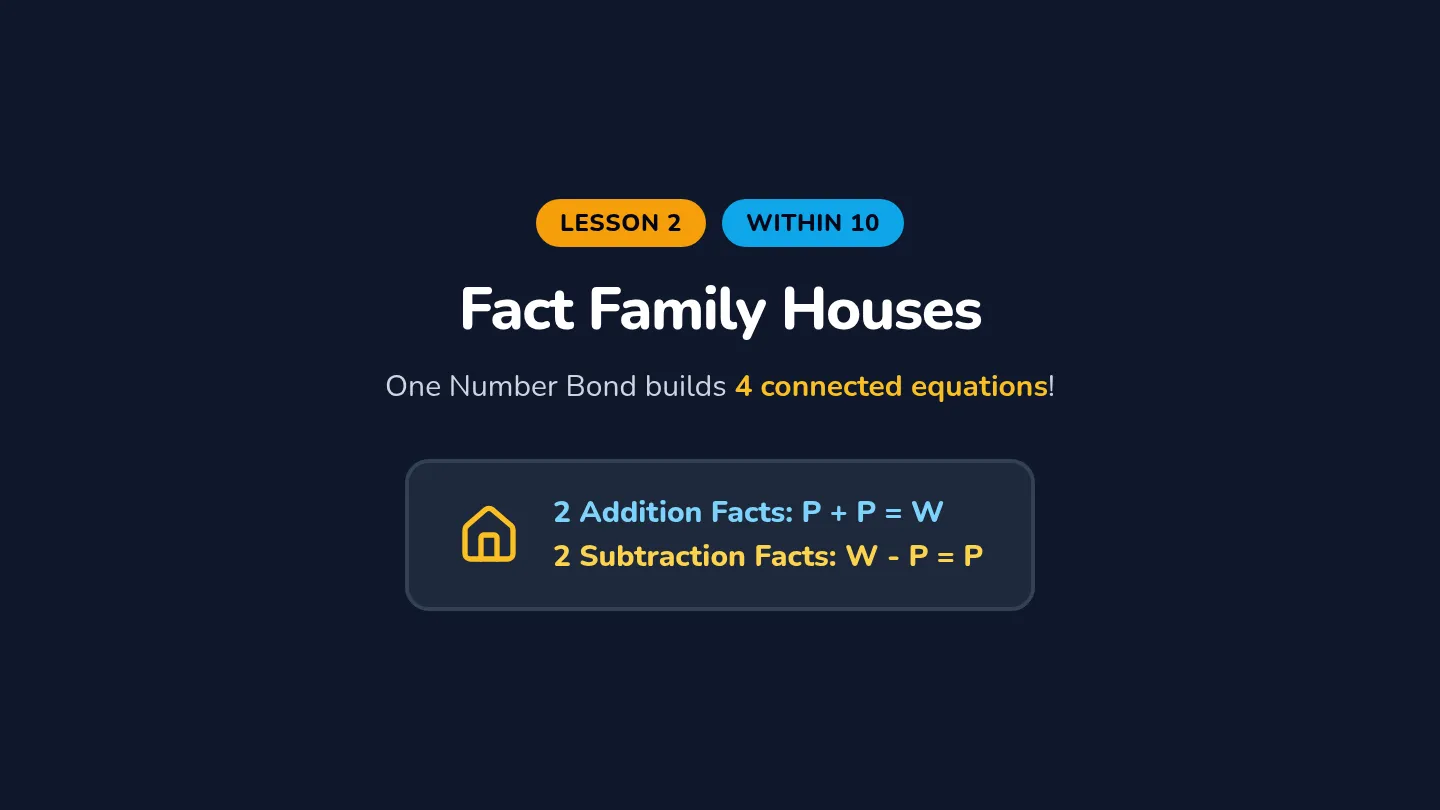
Fact Family Houses
One Number Bond builds 4 connected equations!
2 Addition Facts: P + P = W
2 Subtraction Facts: W - P = P
Where Does the Whole Live?
The Whole has a special seat in every equation!
Addition (+)
Two Parts snap together. The Whole goes at the END !
3 + 5 = 8
5 + 3 = 8
Subtraction (-)
Start with the Whole! Take away one Part.
8 - 3 = 5
8 - 5 = 3
Build This Fact Family House
Our numbers are 9 (Whole), 2 (Part), and 7 (Part).
Whole 9
Part 2
Part 7
2 + 7 = 9
7 + 2 = 9
9 - 2 = 7
9 - 7 = 2
Check Every Fact!
Only use the 3 numbers in the roof: 9, 2, and 7.
Never write 9 + 2 = 11! That adds a Whole and a Part.
Whole + Part Trap
Which Equation Belongs in the House?
Roof numbers: 10 (Whole), 6 (Part), 4 (Part)
Choice A
10 + 6 = 16
Choice B
6 - 10 = 4
Choice C
10 - 6 = 4
Turn & Talk: Why are A and B traps? Why is C right?
Fact Family Practice Worksheet Lesson 2 Practice
Fact Family Houses
Name: ________________________
Date: ______________
Addition: Part + Part = Whole | Subtraction: Whole - Part = Part
1. Fact Family House
WHOLE7
PART4
PART3
____ + ____ = ____
____ + ____ = ____
____ - ____ = ____
____ - ____ = ____
2. Fact Family House
WHOLE10
PART8
PART2
____ + ____ = ____
____ + ____ = ____
____ - ____ = ____
____ - ____ = ____
3. Find the Whole, then build!
WHOLE
PART5
PART4
____ + ____ = ____
____ + ____ = ____
____ - ____ = ____
____ - ____ = ____
4. Find the Part, then build!
WHOLE8
PART5
PART
____ + ____ = ____
____ + ____ = ____
____ - ____ = ____
____ - ____ = ____
Lesson 2 Practice (Page 2) Name: ________________________
Part 2: Cross out (X) the equation that does NOT belong in the family.
Watch out for equations that add a Whole and a Part!
5. Family: Whole = 9, Part = 6, Part = 3
6 + 3 = 9
9 + 6 = 15
9 - 3 = 6
6. Family: Whole = 7, Part = 5, Part = 2
7 + 2 = 9
7 - 5 = 2
2 + 5 = 7
7. Family: Whole = 10, Part = 7, Part = 3
10 - 7 = 3
3 + 7 = 10
10 + 3 = 13
8. Builder Thinking
In a subtraction equation like 9 - 4 = 5, why does the Whole (9) always go first?
Fact Families Exit Ticket Lesson 2 Exit Ticket
Fact Family Check
Name: ________________________
Date: ______________
1. Write all 4 equations for this Number Bond.
Remember where the Whole goes in addition and subtraction!
W 8
P 6
P 2
____ + ____ = ____
____ + ____ = ____
____ - ____ = ____
____ - ____ = ____
2. Circle the equation that is a TRAP (does NOT belong).
Numbers: Whole = 9, Part = 4, Part = 5
9 - 5 = 4
9 + 4 = 13
4 + 5 = 9
Why is it a trap?
Fact Families Teacher Guide Intervention Teacher Guide
Lesson 2: Fact Family Houses
20–25 Minutes
Small Group (2–5 Students)
Learning Goal
Students will write 4 related equations (2 addition, 2 subtraction) from a number bond within 10, placing the Whole in the correct position.
Materials Needed
Fact Family Houses Slides
Fact Family Practice Worksheet
Fact Families Exit Ticket
2-color counters or cubes (optional)
Pacing & Explicit Intervention Script
1. Review & Seat of the Whole (5 min) — Slides 1–2
"In addition, we snap two parts together, so the Whole sits at the END. In subtraction, we start with everything we have, so the Whole sits at the START!"
2. Build & Spot the Trap (6 min) — Slides 3–4
Model the 9-2-7 house. On Slide 4, ask why 10 + 6 = 16 is a trap: "10 is already the Whole! We never add a Whole and a Part."
3. Guided & Independent Practice (8 min) — Worksheet
Watch Houses 3 and 4 closely—students must find the missing Whole (9) or missing Part (3) before writing the 4 equations.
4. Daily Exit Ticket (3–5 min)
Check Q1 for all 4 valid equations (no 8 + 6 = 14 or 6 - 8 = 2) and Q2 for identifying 9 + 4 = 13 as the trap.
Answer Key
Worksheet (Page 1 & 2)
1: 4+3=7, 3+4=7, 7-4=3, 7-3=4
2: 8+2=10, 2+8=10, 10-8=2, 10-2=8
3 (W=9): 5+4=9, 4+5=9, 9-5=4, 9-4=5
4 (P=3): 5+3=8, 3+5=8, 8-5=3, 8-3=5
5–7 Traps: 5) 9+6=15 | 6) 7+2=9 | 7) 10+3=13
8: You start with the Whole because you take a part away from the total.
Exit Ticket
Q1: 6+2=8, 2+6=8, 8-6=2, 8-2=6
Q2: 9 + 4 = 13 is the trap because 9 is the Whole and 4 is a Part—you cannot add a Whole and a Part.
Mystery Number Slides Lesson 3 Within 10
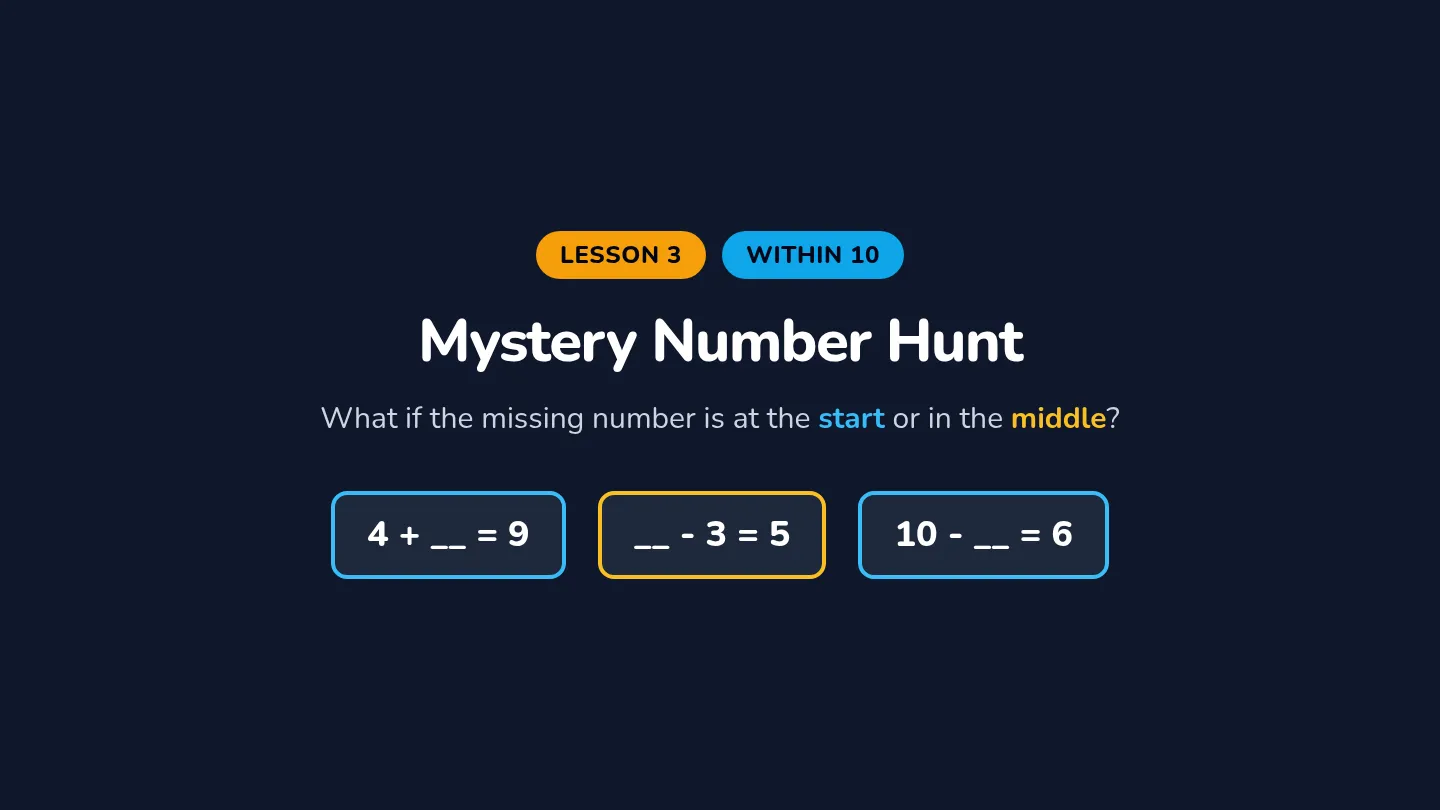
Mystery Number Hunt
What if the missing number is at the start or in the middle?
4 + __ = 9
__ - 3 = 5
10 - __ = 6
The 2-Step Detective Plan
Never guess! Always ask: "Am I missing a Part or the Whole?"
Step 1: Label P and W
In + , the Whole is at the END .- , the Whole is at the START .
P + P = W | W - P = P
Step 2: Solve the Bond
• Missing Whole? Add Part + Part .Whole - Part .
NEVER add a Whole and a Part!
Case 1: Missing Part
Solve: 4 + __ = 9
W 9
P 4
P ?
Watch out! Even though you see a + sign...
Do NOT do 4 + 9 = 13! (9 is the Whole!)
We are missing a Part, so subtract:
9 - 4 = 5 → 4 + 5 = 9
Case 2: Missing Whole
Solve: __ - 3 = 5
W ?
P 3
P 5
In subtraction, the Whole goes at the START!
We have both Parts (3 and 5), and we are missing the Whole.
Snap the Parts together:
3 + 5 = 8 → 8 - 3 = 5
Mystery Number Practice Worksheet Lesson 3 Practice
Mystery Number Hunt
Name: ________________________
Date: ______________
Step 1: Put numbers in the Number Bond (W and P). Step 2: Missing W? Add P+P. | Missing P? Subtract W-P.
Part 1: Fill in the Number Bond to find each Mystery Number.
1. Missing Part
3 + ____ = 8
2. Missing Part
____ + 4 = 10
3. Missing Part
9 - ____ = 5
4. Missing Whole
____ - 2 = 6
5. Missing Whole
6 + 3 = ____
6. Missing Whole
____ - 4 = 3
Lesson 3 Practice (Page 2) Name: ________________________
Part 2: Solve the Mystery Equations!
Circle whether you are missing a Part (P) or the Whole (W) , then solve.
7. 5 + ____ = 9 Missing: P / W
8. ____ - 5 = 5 Missing: P / W
9. 8 - ____ = 2 Missing: P / W
10. ____ + 6 = 8 Missing: P / W
11. 10 - 7 = ____ Missing: P / W
12. ____ - 1 = 7 Missing: P / W
13. Builder Story Mystery
Ben had some blocks. He gave 3 blocks to Mia. Now Ben has 6 blocks left. How many blocks did Ben start with?
Equation with Mystery Box:
Number Bond & Answer:
Mystery Numbers Exit Ticket Lesson 3 Exit Ticket
Mystery Number Check
Name: ________________________
Date: ______________
1. Find the Mystery Number:
4 + ____ = 9
Fill in the Number Bond to prove your answer:
W
P
P
How did you solve it?
2. Find the Mystery Number:
____ - 3 = 5
Fill in the Number Bond to prove your answer:
W
P
P
How did you solve it?
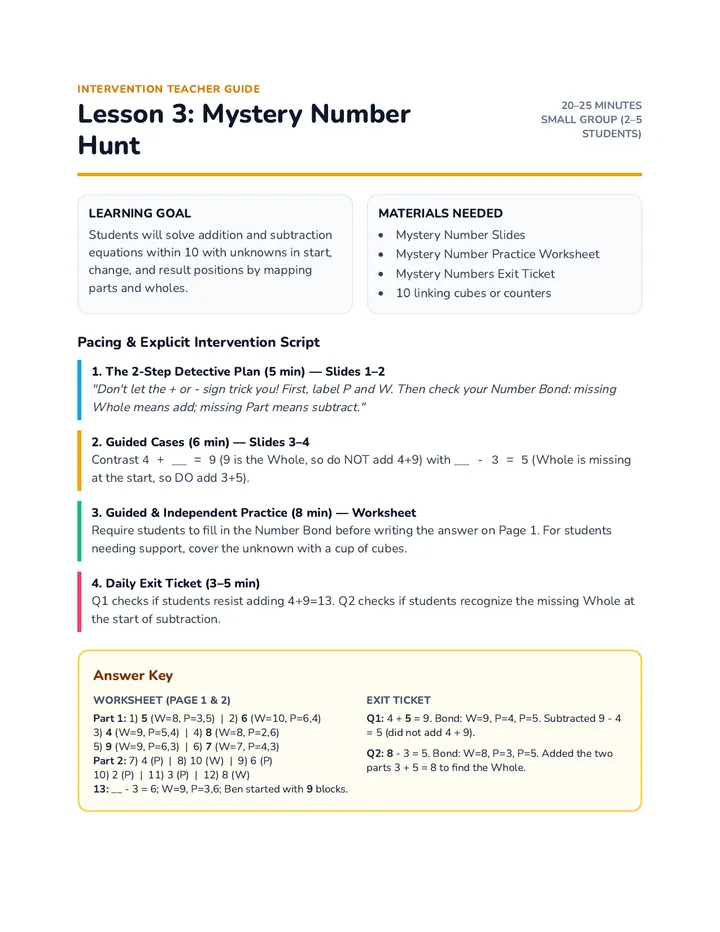
Mystery Numbers Teacher Guide Intervention Teacher Guide
Lesson 3: Mystery Number Hunt
20–25 Minutes
Small Group (2–5 Students)
Learning Goal
Students will solve addition and subtraction equations within 10 with unknowns in start, change, and result positions by mapping parts and wholes.
Materials Needed
Mystery Number Slides
Mystery Number Practice Worksheet
Mystery Numbers Exit Ticket
10 linking cubes or counters
Pacing & Explicit Intervention Script
1. The 2-Step Detective Plan (5 min) — Slides 1–2
"Don't let the + or - sign trick you! First, label P and W. Then check your Number Bond: missing Whole means add; missing Part means subtract."
2. Guided Cases (6 min) — Slides 3–4
Contrast 4 + __ = 9 (9 is the Whole, so do NOT add 4+9) with __ - 3 = 5 (Whole is missing at the start, so DO add 3+5).
3. Guided & Independent Practice (8 min) — Worksheet
Require students to fill in the Number Bond before writing the answer on Page 1. For students needing support, cover the unknown with a cup of cubes.
4. Daily Exit Ticket (3–5 min)
Q1 checks if students resist adding 4+9=13. Q2 checks if students recognize the missing Whole at the start of subtraction.
Answer Key
Worksheet (Page 1 & 2)
Part 1: 1) 5 (W=8, P=3,5) | 2) 6 (W=10, P=6,4)
4 (W=9, P=5,4) | 4) 8 (W=8, P=2,6)
9 (W=9, P=6,3) | 6) 7 (W=7, P=4,3)
Part 2: 7) 4 (P) | 8) 10 (W) | 9) 6 (P)
2 (P) | 11) 3 (P) | 12) 8 (W)
13: __ - 3 = 6; W=9, P=3,6; Ben started with 9 blocks.
Exit Ticket
Q1: 4 + 5 = 9. Bond: W=9, P=4, P=5. Subtracted 9 - 4 = 5 (did not add 4 + 9).
Q2: 8 - 3 = 5. Bond: W=8, P=3, P=5. Added the two parts 3 + 5 = 8 to find the Whole.
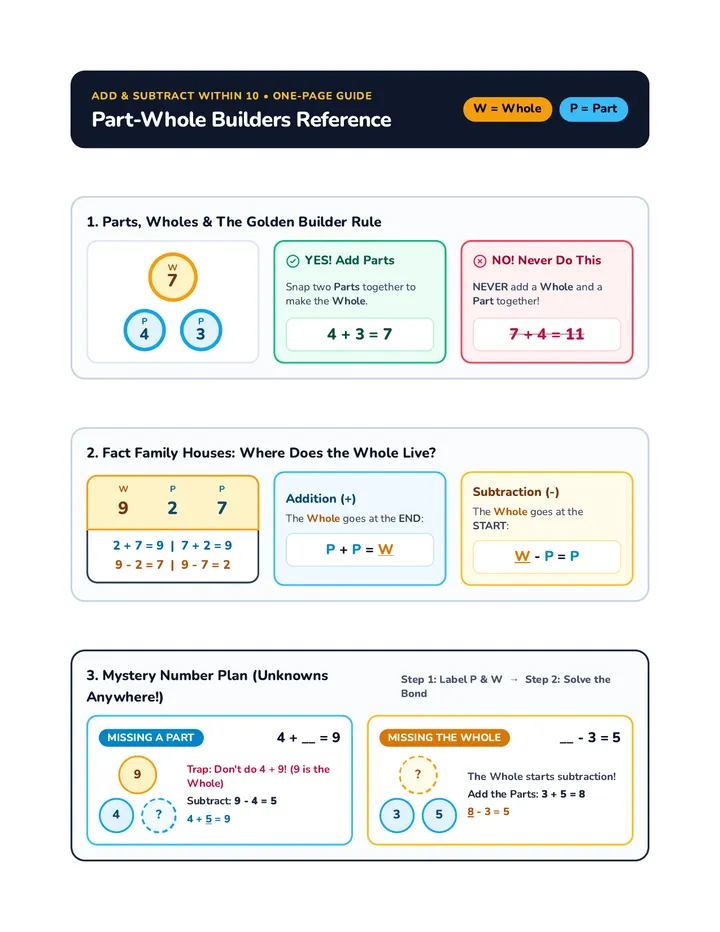
Part Whole Reference Sheet Add & Subtract Within 10 • One-Page Guide
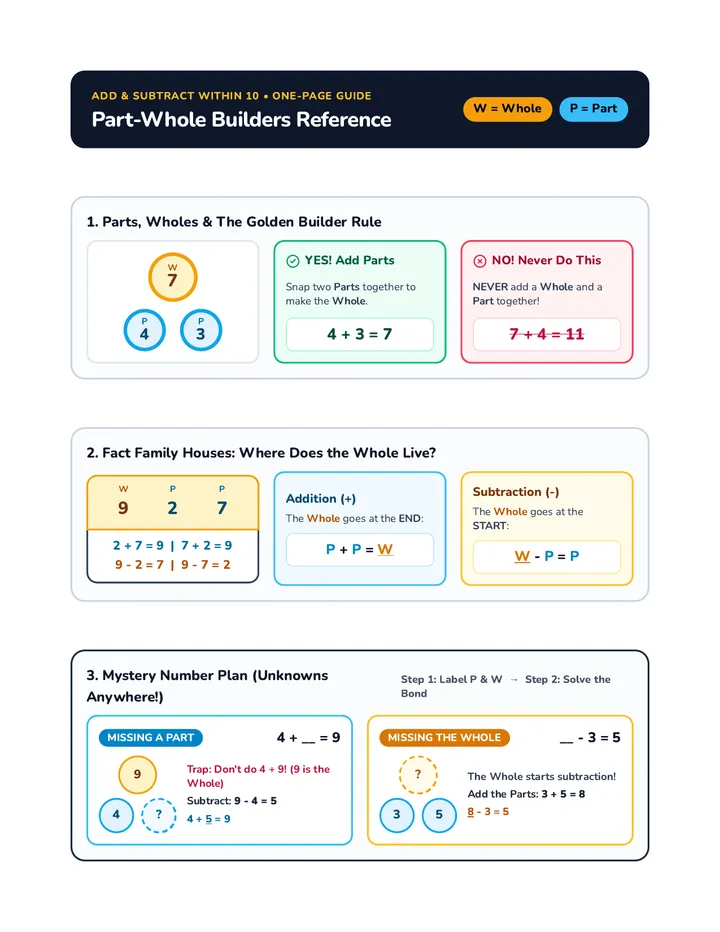
Part-Whole Builders Reference
W = Whole P = Part
1. Parts, Wholes & The Golden Builder Rule
W 7
P 4
P 3
YES! Add Parts
Snap two Parts together to make the Whole .
4 + 3 = 7
NO! Never Do This
NEVER add a Whole and a Part together!
7 + 4 = 11
2. Fact Family Houses: Where Does the Whole Live?
W9
P2
P7
2 + 7 = 9 | 7 + 2 = 9
9 - 2 = 7 | 9 - 7 = 2
Addition (+)
The Whole goes at the END :
P + P = W
Subtraction (-)
The Whole goes at the START :
W - P = P
3. Mystery Number Plan (Unknowns Anywhere!)
Step 1: Label P & W → Step 2: Solve the Bond
Missing a Part 4 + __ = 9
9
4
?
Trap: Don't do 4 + 9! (9 is the Whole)
Subtract: 9 - 4 = 5
4 + 5 = 9
Missing the Whole __ - 3 = 5
?
3
5
The Whole starts subtraction!
Add the Parts: 3 + 5 = 8
8 - 3 = 5
Part Whole Complete Packet Add & Subtract Within 10 • One-Page Guide
Part-Whole Builders Reference
W = Whole P = Part
1. Parts, Wholes & The Golden Builder Rule
W 7
P 4
P 3
YES! Add Parts
Snap two Parts together to make the Whole .
4 + 3 = 7
NO! Never Do This
NEVER add a Whole and a Part together!
7 + 4 = 11
2. Fact Family Houses: Where Does the Whole Live?
W9
P2
P7
2 + 7 = 9 | 7 + 2 = 9
9 - 2 = 7 | 9 - 7 = 2
Addition (+)
The Whole goes at the END :
P + P = W
Subtraction (-)
The Whole goes at the START :
W - P = P
3. Mystery Number Plan (Unknowns Anywhere!)
Step 1: Label P & W → Step 2: Solve the Bond
Missing a Part 4 + __ = 9
9
4
?
Trap: Don't do 4 + 9! (9 is the Whole)
Subtract: 9 - 4 = 5
4 + 5 = 9
Missing the Whole __ - 3 = 5
?
3
5
The Whole starts subtraction!
Add the Parts: 3 + 5 = 8
8 - 3 = 5
Lesson 1 Practice
Number Bond Builders
Name: ________________________
Date: ______________
Builder Rule: Snap Part + Part to make the Whole. Never add a Whole and a Part!
Part 1: Circle the WHOLE in each group of 3 numbers.
Remember: The Whole is the biggest total number!
495
826
3710
Part 2: Add the two Parts to build the Whole.
4
3
4. Equation:
4 + 3 = ____
6
2
5. Equation:
6 + 2 = ____
5
5
6. Equation:
5 + 5 = ____
2
7
7. Equation:
2 + 7 = ____
Lesson 1 Practice (Page 2) Name: ________________________
Part 3: Find the missing Part.
You already have the Whole! Subtract the known Part from the Whole.
8
5
8. Subtract:
8 - 5 = ____
10
3
9. Subtract:
10 - 3 = ____
7
2
10. Subtract:
7 - 2 = ____
9
4
11. Subtract:
9 - 4 = ____
12. Fix the Builder Mistake!
6
4
Maya tried to find the missing part by writing 6 + 4 = 10.
What did Maya do wrong? Write the correct equation and answer:
Lesson 1 Exit Ticket
Parts & Wholes Check
Name: ________________________
Date: ______________
1. Find the missing Part.
Fill in the empty circle and write the equation you used.
W 9
P 5
P
My equation:
2. Circle YES or NO.
The Whole is 8 and one Part is 2. Sam says the other part is 10 because 8 + 2 = 10.
Is Sam right?
YES
NO
Show or tell why:
Lesson 2 Practice
Fact Family Houses
Name: ________________________
Date: ______________
Addition: Part + Part = Whole | Subtraction: Whole - Part = Part
1. Fact Family House
WHOLE7
PART4
PART3
____ + ____ = ____
____ + ____ = ____
____ - ____ = ____
____ - ____ = ____
2. Fact Family House
WHOLE10
PART8
PART2
____ + ____ = ____
____ + ____ = ____
____ - ____ = ____
____ - ____ = ____
3. Find the Whole, then build!
WHOLE
PART5
PART4
____ + ____ = ____
____ + ____ = ____
____ - ____ = ____
____ - ____ = ____
4. Find the Part, then build!
WHOLE8
PART5
PART
____ + ____ = ____
____ + ____ = ____
____ - ____ = ____
____ - ____ = ____
Lesson 2 Practice (Page 2) Name: ________________________
Part 2: Cross out (X) the equation that does NOT belong in the family.
Watch out for equations that add a Whole and a Part!
5. Family: Whole = 9, Part = 6, Part = 3
6 + 3 = 9
9 + 6 = 15
9 - 3 = 6
6. Family: Whole = 7, Part = 5, Part = 2
7 + 2 = 9
7 - 5 = 2
2 + 5 = 7
7. Family: Whole = 10, Part = 7, Part = 3
10 - 7 = 3
3 + 7 = 10
10 + 3 = 13
8. Builder Thinking
In a subtraction equation like 9 - 4 = 5, why does the Whole (9) always go first?
Lesson 2 Exit Ticket
Fact Family Check
Name: ________________________
Date: ______________
1. Write all 4 equations for this Number Bond.
Remember where the Whole goes in addition and subtraction!
W 8
P 6
P 2
____ + ____ = ____
____ + ____ = ____
____ - ____ = ____
____ - ____ = ____
2. Circle the equation that is a TRAP (does NOT belong).
Numbers: Whole = 9, Part = 4, Part = 5
9 - 5 = 4
9 + 4 = 13
4 + 5 = 9
Why is it a trap?
Lesson 3 Practice
Mystery Number Hunt
Name: ________________________
Date: ______________
Step 1: Put numbers in the Number Bond (W and P). Step 2: Missing W? Add P+P. | Missing P? Subtract W-P.
Part 1: Fill in the Number Bond to find each Mystery Number.
1. Missing Part
3 + ____ = 8
2. Missing Part
____ + 4 = 10
3. Missing Part
9 - ____ = 5
4. Missing Whole
____ - 2 = 6
5. Missing Whole
6 + 3 = ____
6. Missing Whole
____ - 4 = 3
Lesson 3 Practice (Page 2) Name: ________________________
Part 2: Solve the Mystery Equations!
Circle whether you are missing a Part (P) or the Whole (W) , then solve.
7. 5 + ____ = 9Missing: P / W
8. ____ - 5 = 5Missing: P / W
9. 8 - ____ = 2Missing: P / W
10. ____ + 6 = 8Missing: P / W
11. 10 - 7 = ____Missing: P / W
12. ____ - 1 = 7Missing: P / W
13. Builder Story Mystery
Ben had some blocks. He gave 3 blocks to Mia. Now Ben has 6 blocks left. How many blocks did Ben start with?
Equation with Mystery Box:
Number Bond & Answer:
Lesson 3 Exit Ticket
Mystery Number Check
Name: ________________________
Date: ______________
1. Find the Mystery Number:
4 + ____ = 9
Fill in the Number Bond to prove your answer:
W
P
P
How did you solve it?
2. Find the Mystery Number:
____ - 3 = 5
Fill in the Number Bond to prove your answer:
W
P
P
How did you solve it?
Intervention Teacher Guide
Lesson 1: Parts & Wholes
20–25 Minutes
Small Group (2–5 Students)
Learning Goal
Students will distinguish between a Whole (total) and Parts in a number bond within 10, and explain why you never add a whole and a part.
Materials Needed
10 linking cubes per student
Part-Whole Reference Sheet
Lesson 1 Worksheet & Exit Ticket
Pacing & Explicit Intervention Script
1. Concrete Warm-Up (5 min)
Have students snap 4 cubes and 3 cubes together. "The 7-cube stick is our Whole . When we break it apart, 4 and 3 are our Parts ."
2. The Golden Builder Rule (5 min)
Hold up the 7-stick (Whole) and a 4-stick (Part). "Can I add 7 + 4 to find the missing part? NO! 7 is already the whole. We never add a whole and a part!"
3. Guided & Independent Practice (8 min)
Complete Part 1 together, checking that students circle the largest number as the Whole. Have students use cubes to verify Part 3.
4. Daily Exit Ticket (3–5 min)
Administer the 2-question exit ticket independently. Look for whether students subtract 9 - 5 (not 9 + 5) on Q1 and reject 8 + 2 = 10 on Q2.
Answer Key
Worksheet (Pages 2–3)
Part 1: 1) 9 | 2) 8 | 3) 10
Part 2: 4) 7 (4+3=7) | 5) 8 (6+2=8) | 6) 10 (5+5=10) | 7) 9 (2+7=9)
Part 3: 8) 3 | 9) 7 | 10) 5 | 11) 5
12: Maya added the Whole (6) and a Part (4). Correct: 6 - 4 = 2.
Exit Ticket (Page 4)
Q1: Missing part is 4 . Equation: 9 - 5 = 4 .
Q2: NO . 8 is the Whole, so you cannot add 8 + 2. The other part is 6 (8 - 2 = 6).
Intervention Teacher Guide
Lesson 2: Fact Family Houses
20–25 Minutes
Small Group (2–5 Students)
Learning Goal
Students will write 4 related equations (2 addition, 2 subtraction) from a number bond within 10, placing the Whole in the correct position.
Materials Needed
Part-Whole Reference Sheet
Lesson 2 Worksheet & Exit Ticket
2-color counters or cubes (optional)
Pacing & Explicit Intervention Script
1. Review & Seat of the Whole (5 min)
"In addition, we snap two parts together, so the Whole sits at the END. In subtraction, we start with everything we have, so the Whole sits at the START!"
2. Build & Spot the Trap (6 min)
Model the 9-2-7 house. Ask why 10 + 6 = 16 is a trap: "10 is already the Whole! We never add a Whole and a Part."
3. Guided & Independent Practice (8 min)
Watch Houses 3 and 4 closely—students must find the missing Whole (9) or missing Part (3) before writing the 4 equations.
4. Daily Exit Ticket (3–5 min)
Check Q1 for all 4 valid equations (no 8 + 6 = 14 or 6 - 8 = 2) and Q2 for identifying 9 + 4 = 13 as the trap.
Answer Key
Worksheet (Pages 5–6)
1: 4+3=7, 3+4=7, 7-4=3, 7-3=4
2: 8+2=10, 2+8=10, 10-8=2, 10-2=8
3 (W=9): 5+4=9, 4+5=9, 9-5=4, 9-4=5
4 (P=3): 5+3=8, 3+5=8, 8-5=3, 8-3=5
5–7 Traps: 5) 9+6=15 | 6) 7+2=9 | 7) 10+3=13
8: You start with the Whole because you take a part away from the total.
Exit Ticket (Page 7)
Q1: 6+2=8, 2+6=8, 8-6=2, 8-2=6
Q2: 9 + 4 = 13 is the trap because 9 is the Whole and 4 is a Part—you cannot add a Whole and a Part.
Intervention Teacher Guide
Lesson 3: Mystery Number Hunt
20–25 Minutes
Small Group (2–5 Students)
Learning Goal
Students will solve addition and subtraction equations within 10 with unknowns in start, change, and result positions by mapping parts and wholes.
Materials Needed
Part-Whole Reference Sheet
Lesson 3 Worksheet & Exit Ticket
10 linking cubes or counters
Pacing & Explicit Intervention Script
1. The 2-Step Detective Plan (5 min)
"Don't let the + or - sign trick you! First, label P and W. Then check your Number Bond: missing Whole means add; missing Part means subtract."
2. Guided Cases (6 min)
Contrast 4 + __ = 9 (9 is the Whole, so do NOT add 4+9) with __ - 3 = 5 (Whole is missing at the start, so DO add 3+5).
3. Guided & Independent Practice (8 min)
Require students to fill in the Number Bond before writing the answer on Page 8. For students needing support, cover the unknown with a cup of cubes.
4. Daily Exit Ticket (3–5 min)
Q1 checks if students resist adding 4+9=13. Q2 checks if students recognize the missing Whole at the start of subtraction.
Answer Key
Worksheet (Pages 8–9)
Part 1: 1) 5 (W=8) | 2) 6 (W=10) | 3) 4 (W=9) | 4) 8 (W=8) | 5) 9 (W=9) | 6) 7 (W=7)
Part 2: 7) 4 (P) | 8) 10 (W) | 9) 6 (P) | 10) 2 (P) | 11) 3 (P) | 12) 8 (W)
13: __ - 3 = 6; W=9, P=3,6; Ben started with 9 blocks.
Exit Ticket (Page 10)
Q1: 4 + 5 = 9. Bond: W=9, P=4, P=5. Subtracted 9 - 4 = 5 (did not add 4 + 9).
Q2: 8 - 3 = 5. Bond: W=8, P=3, P=5. Added the two parts 3 + 5 = 8 to find the Whole.