Box It Up Handout Box It Up! Domain & Range
Visual Guide & Practice Handout
Name: ___________________________
Date: ____________________________
How to Find Domain & Range by Boxing Up the Graph
Step 1: Box It
Draw the smallest rectangular box that encloses the graph, touching its farthest edges.
Step 2: Domain (x)
Read the left → right width on the x-axis : \(x_{\text{left}} \le x \le x_{\text{right}}\).
Step 3: Range (y)
Read the bottom → top height on the y-axis : \(y_{\text{bottom}} \le y \le y_{\text{top}}\).
Visual Guide Example: Enclose the Entire Figure
Read the numbers along the x & y axes
Domain (Left → Right on x-axis)
The box touches the leftmost whisker at \(x = -13\) and the rightmost ear at \(x = 13\).
Range (Bottom → Top on y-axis)
The box touches the bottom of the chin at \(y = -12\) and the top ear at \(y = 10.5\).
Applying It to Functions & Relations
Check open & closed endpoints, study the worked example, then try the two guided problems.
Page 2
Watch the Endpoints: Open vs. Closed Circles!
Closed Circle (Included)
The boundary point is part of the graph. Use \(\le\) or \(\ge\) and brackets \([ \, ]\).
Open Circle (Not Included)
The boundary point is NOT part of the graph. Use \(<\) or \(>\) and parentheses \(( \, )\).
Worked Example: Box the Function
Inequality & Interval Notation
x y -3 4 3 -2
Domain (Left to Right on x-axis)
Box starts at closed dot \(x = -3\) and ends at open dot \(x = 4\).
Inequality: \(-3 \le x < 4\) | Interval: \([-3, 4)\)
Range (Bottom to Top on y-axis)
Lowest valley is \(y = -2\) and highest peak is \(y = 3\) (both solid points).
Inequality: \(-2 \le y \le 3\) | Interval: \([-2, 3]\)
Tip: Always box the highest peak and lowest valley—not just the endpoints!
Guided Practice: Try These Together
Box the graph first, then read the axes
1. Dipping Curve Watch the Valley!
x y -4 -2 2 4 4 2 -2 -4
Domain:
Range:
2. Tie-Breaker V-Graph Tie at y = 3!
x y -4 -2 2 4 4 2 -2 -4
Domain:
Range:
Your Turn: Box It Up!
Draw the smallest rectangular box around each graph. 2) Write the Domain and Range in inequality or interval notation.
Page 3
3. Straight Segment Box & Read
x y -4 -2 2 4 4 2 -2 -4
Domain:
Range:
4. Parabolic Arch Watch the Peak!
x y -4 -2 2 4 4 2 -2 -4
Domain:
Range:
5. Open & Closed Mix Check the Dots!
x y -4 -2 2 4 4 2 -2 -4
Domain:
Range:
6. Sideways Curve Relation
x y -4 -2 2 4 4 2 -2 -4
Domain:
Range:
Quick Check: Why must the box touch the highest, lowest, leftmost, and rightmost points—not just the endpoints?
Next Level: Never--Ending Functions (How to Handle Arrows!)
Still draw the smallest box —then add right-angle corner arrows where arrows hit the box and replace those numbers with \(\infty\).
Page 4
A. Ends at Closed Circles Read Numbers
Domain: \(-7 \le x \le 7.75\) | \([-7, 7.75]\)
Range: \(-7.25 \le y \le 8\) | \([-7.25, 8]\)
B. Continues with Arrows Corner Arrows → ∞
Domain: \(-\infty < x < \infty\) | \((-\infty, \infty)\)
Range: \(-\infty < y < \infty\) | \((-\infty, \infty)\)
1. Box It First: Draw the smallest box around the visible curve just like in A .
2. Add Corner Arrows: Where an arrow hits the box (B ), draw a right angle with two directional arrows.
3. Swap for \(\infty\): Replace the axis numbers on those arrow sides with \(-\infty\) or \(\infty\)!
7. Upward Parabola Draw Box + Corner Arrows
x y -2 2 2 -3
Domain:
Range:
8. One-Sided Ray Closed Start, Corner Arrow End
x y -2 2 2 -2
Domain:
Range:
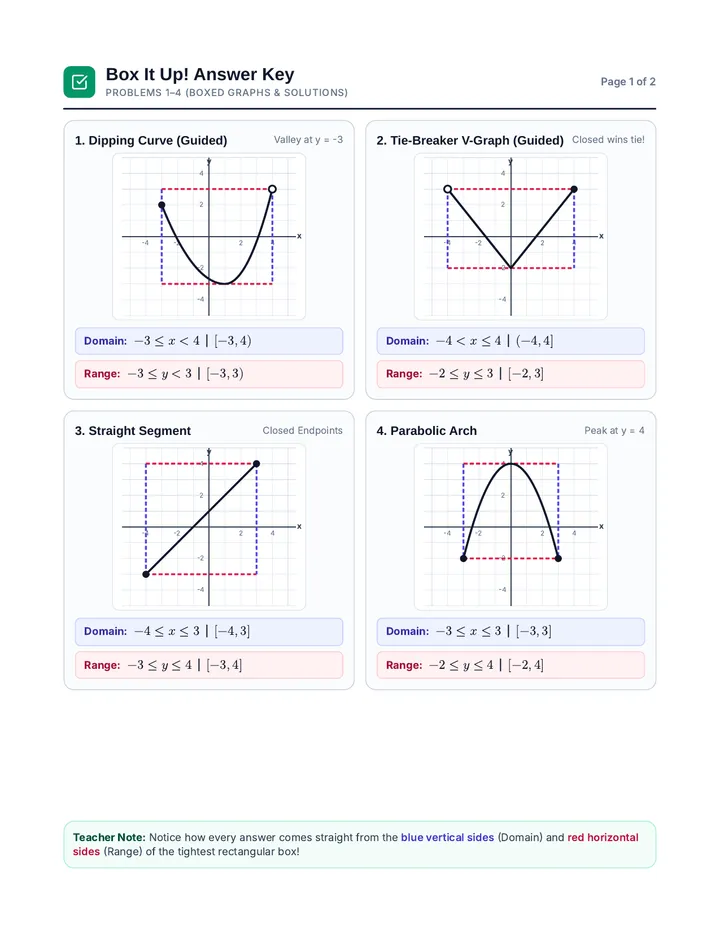
Box It Up Answer Key Box It Up! Answer Key
Problems 1–4 (Boxed Graphs & Solutions)
Page 1 of 2
1. Dipping Curve (Guided) Valley at y = -3
x y -4 -2 2 4 4 2 -2 -4
Domain: \(-3 \le x < 4\) | \([-3, 4)\)
Range: \(-3 \le y < 3\) | \([-3, 3)\)
2. Tie-Breaker V-Graph (Guided) Closed wins tie!
x y -4 -2 2 4 4 2 -2 -4
Domain: \(-4 < x \le 4\) | \((-4, 4]\)
Range: \(-2 \le y \le 3\) | \([-2, 3]\)
3. Straight Segment Closed Endpoints
x y -4 -2 2 4 4 2 -2 -4
Domain: \(-4 \le x \le 3\) | \([-4, 3]\)
Range: \(-3 \le y \le 4\) | \([-3, 4]\)
4. Parabolic Arch Peak at y = 4
x y -4 -2 2 4 4 2 -2 -4
Domain: \(-3 \le x \le 3\) | \([-3, 3]\)
Range: \(-2 \le y \le 4\) | \([-2, 4]\)
Teacher Note: Notice how every answer comes straight from the blue vertical sides (Domain) and red horizontal sides (Range) of the tightest rectangular box!
Box It Up! Answer Key
Problems 5–8 (Including Relations & Corner-Arrow Infinity Examples)
Page 2 of 2
5. Open & Closed Mix Valley at y = -3
x y -4 -2 2 4 4 2 -2 -4
Domain: \(-4 < x \le 4\) | \((-4, 4]\)
Range: \(-3 \le y \le 3\) | \([-3, 3]\)
6. Sideways Curve (Relation) Tie at x = 3!
x y -4 -2 2 4 4 2 -2 -4
Domain: \(-3 \le x \le 3\) | \([-3, 3]\)
Range: \(-4 < y \le 4\) | \((-4, 4]\)
7. Upward Parabola Corner Arrows → ∞
x y -2 2 2 -3 -∞ +∞ +∞ +∞
Domain: \(-\infty < x < \infty\) | \((-\infty, \infty)\)
Range: \(y \ge -3\) | \([-3, \infty)\)
8. One-Sided Ray Half-Open Box
x y -2 2 2 -2 +∞ +∞
Domain: \(x \ge -2\) | \([-2, \infty)\)
Range: \(y \ge -2\) | \([-2, \infty)\)
Quick Check Sample Answer:
A curve can reach higher, lower, farther left, or farther right in the middle (at a peak, valley, or bend) than at its endpoints. Boxing the entire graph ensures no \(x\)- or \(y\)-values are left out.
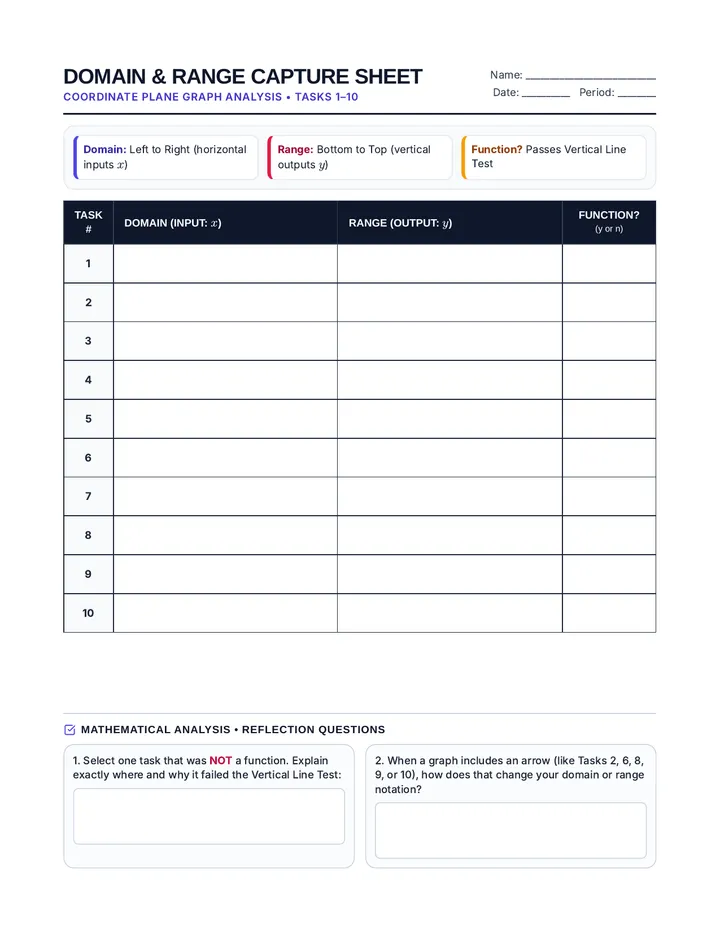
Task Card Practice Handout DOMAIN & RANGE CAPTURE SHEET
Coordinate Plane Graph Analysis • Tasks 1–10
Name: ___________________________
Date: __________ Period: ________
Domain: Left to Right (horizontal inputs \(x\))
Range: Bottom to Top (vertical outputs \(y\))
Function? Passes Vertical Line Test
TASK #
DOMAIN (INPUT: \(x\))
RANGE (OUTPUT: \(y\))
FUNCTION? (y or n)
1
2
3
4
5
6
7
8
9
10
Mathematical Analysis • Reflection Questions
1. Select one task that was NOT a function. Explain exactly where and why it failed the Vertical Line Test:
2. When a graph includes an arrow (like Tasks 2, 6, 8, 9, or 10), how does that change your domain or range notation?
Domain & Range Task Cards (1–4)
Box up each graph directly on the card, then record Domain, Range, and Function status on your Capture Sheet.
Page 2
Task 1: Piecewise Segment 1
Task Prompts: Find the leftmost and rightmost \(x\)-values for Domain. Find the lowest and highest \(y\)-values for Range.
Task 2: Ray with Arrow 2
Pay Attention: Notice the arrow pointing up and to the left! Use corner arrows and \(\infty\). Does it pass the Vertical Line Test?
Task 3: Star Shape 3
Outer Boundaries: Look at the outermost tips of the star horizontally and vertically. Is this closed shape a function?
Task 4: Vertical Oval 4
Tangent Bounds: Find the left/right vertical edges and top/bottom horizontal edges. Can one \(x\)-input have more than one \(y\)-output?
Record your answers for Tasks 1–4 on your Capture Sheet (Page 1).
Domain & Range Task Cards (5–8)
Box up each graph directly on the card, then record Domain, Range, and Function status on your Capture Sheet.
Page 3
Task 5: Sideways Curve 5
Different Endpoints: One endpoint reaches \(x = -4\) while the other stops at \(x = -1\). What is the true minimum \(x\)?
Task 6: Vertex & Ray 6
Vertex & Ray: Minimum point at \((-1, 0)\); continues upward to the right infinitely. Add corner arrows where the ray hits the box!
Task 7: Vertical Segment 7
Vertical Segment: Look closely at \(x = -1\) connecting \(y = -2\) to \(y = 3\). How does this affect function status?
Task 8: Parabolic Minimum 8
Parabolic Minimum: Vertex at \((1, 0)\), ends at \(x = 2\) on the right, and continues upward-left without bound.
Record your answers for Tasks 5–8 on your Capture Sheet (Page 1).
Domain & Range Task Cards (9–10)
Box up each graph directly on the card, add right-angle corner arrows, and finish your Capture Sheet.
Page 4
Task 9: Downward Parabola 9
Both Directions: Both arrows point downward and outward infinitely. What does this mean for the domain \(x\)? Where is the maximum \(y\)?
Task 10: Asymmetric V-Ray 10
Asymmetry Alert: The left side stops at a solid dot at \((-4, -6)\), while the right side continues downward forever with an arrow.
Remember the Box It Up! Strategy on Every Task Card
1. Draw the Tightest Box Enclose the visible graph from its farthest left, right, bottom, and top edges.
2. Add Corner Arrows Wherever a graph arrow hits your box, draw a small right angle with two directional arrows and swap numbers for \(-\infty\) or \(\infty\).
3. Vertical Line Test Check if any vertical line crosses the graph more than once—if it does, mark n on your Capture Sheet!
Don't forget to complete the two Reflection Questions at the bottom of your Capture Sheet!
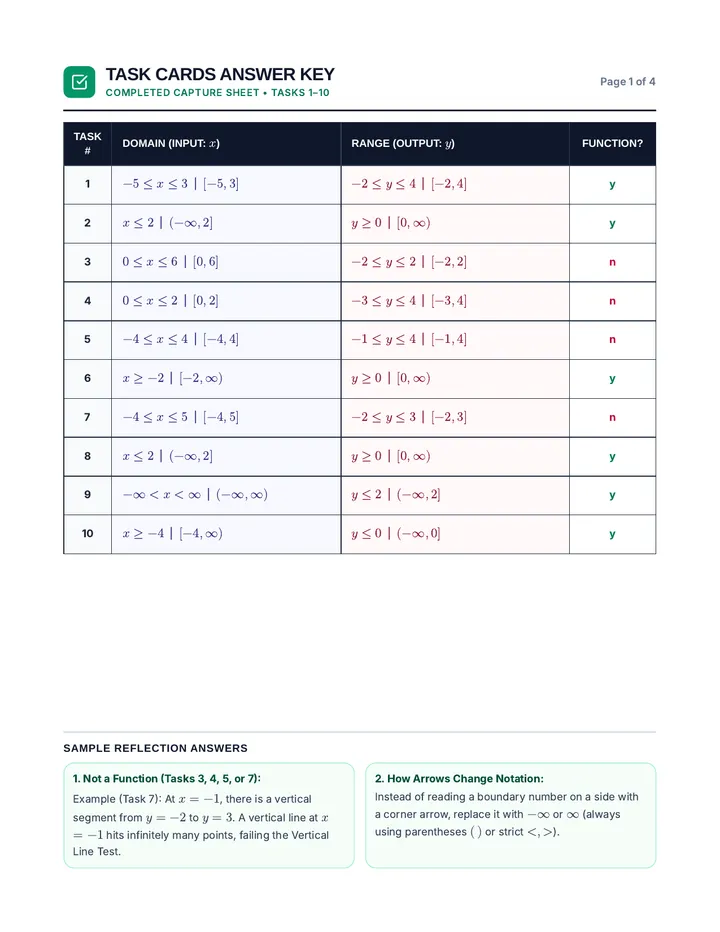
Task Card Answer Key TASK CARDS ANSWER KEY
Completed Capture Sheet • Tasks 1–10
Page 1 of 4
TASK #
DOMAIN (INPUT: \(x\))
RANGE (OUTPUT: \(y\))
FUNCTION?
1
\(-5 \le x \le 3\)
\([-5, 3]\)
\(-2 \le y \le 4\)
2
\(x \le 2\)
\((-\infty, 2]\)
\(y \ge 0\)
3
\(0 \le x \le 6\)
\([0, 6]\)
\(-2 \le y \le 2\)
4
\(0 \le x \le 2\)
\([0, 2]\)
\(-3 \le y \le 4\)
5
\(-4 \le x \le 4\)
\([-4, 4]\)
\(-1 \le y \le 4\)
6
\(x \ge -2\)
\([-2, \infty)\)
\(y \ge 0\)
7
\(-4 \le x \le 5\)
\([-4, 5]\)
\(-2 \le y \le 3\)
8
\(x \le 2\)
\((-\infty, 2]\)
\(y \ge 0\)
9
\(-\infty < x < \infty\)
\((-\infty, \infty)\)
\(y \le 2\)
10
\(x \ge -4\)
\([-4, \infty)\)
\(y \le 0\)
Sample Reflection Answers
1. Not a Function (Tasks 3, 4, 5, or 7):
Example (Task 7): At \(x = -1\), there is a vertical segment from \(y = -2\) to \(y = 3\). A vertical line at \(x = -1\) hits infinitely many points, failing the Vertical Line Test.
2. How Arrows Change Notation:
Instead of reading a boundary number on a side with a corner arrow, replace it with \(-\infty\) or \(\infty\) (always using parentheses \(( \, )\) or strict \(<, >\)).
Boxed Solutions: Task Cards 1–4
Color-coded rectangular boxes show the exact Domain (indigo) and Range (rose) boundaries.
Page 2 of 4
1. Piecewise Segment Function: Yes
Domain: \(-5 \le x \le 3\) | \([-5, 3]\)
Range: \(-2 \le y \le 4\) | \([-2, 4]\)
2. Ray with Arrow Function: Yes
Domain: \(x \le 2\) | \((-\infty, 2]\)
Range: \(y \ge 0\) | \([0, \infty)\)
3. Star Shape Function: No
Domain: \(0 \le x \le 6\) | \([0, 6]\)
Range: \(-2 \le y \le 2\) | \([-2, 2]\)
4. Vertical Oval Function: No
Domain: \(0 \le x \le 2\) | \([0, 2]\)
Range: \(-3 \le y \le 4\) | \([-3, 4]\)
Boxed Solutions: Task Cards 5–8
Color-coded rectangular boxes show the exact Domain (indigo) and Range (rose) boundaries.
Page 3 of 4
5. Sideways Curve Function: No
Domain: \(-4 \le x \le 4\) | \([-4, 4]\)
Range: \(-1 \le y \le 4\) | \([-1, 4]\)
6. Vertex & Ray Function: Yes
Domain: \(x \ge -2\) | \([-2, \infty)\)
Range: \(y \ge 0\) | \([0, \infty)\)
7. Vertical Segment Function: No
Domain: \(-4 \le x \le 5\) | \([-4, 5]\)
Range: \(-2 \le y \le 3\) | \([-2, 3]\)
8. Parabolic Minimum Function: Yes
Domain: \(x \le 2\) | \((-\infty, 2]\)
Range: \(y \ge 0\) | \([0, \infty)\)
Boxed Solutions: Task Cards 9–10
Color-coded rectangular boxes with right-angle corner arrows show where graphs continue to infinity.
Page 4 of 4
9. Downward Parabola Function: Yes
Domain: \(-\infty < x < \infty\) | \((-\infty, \infty)\)
Range: \(y \le 2\) | \((-\infty, 2]\)
10. Asymmetric V-Ray Function: Yes
Domain: \(x \ge -4\) | \([-4, \infty)\)
Range: \(y \le 0\) | \((-\infty, 0]\)
Key Takeaway for Students: Even when a graph has arrows (Tasks 2, 6, 8, 9, and 10), drawing the smallest box around the visible portion first—and then adding right-angle corner arrows—makes it immediately clear which sides stop at a number and which sides stretch to \(-\infty\) or \(\infty\).