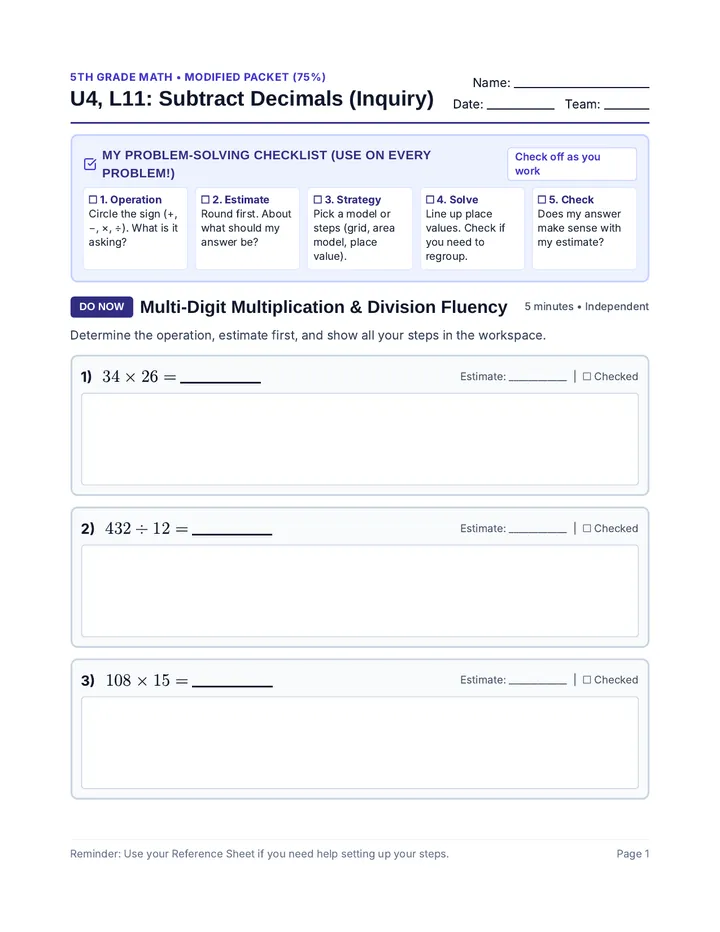
Fraction Division 75% Packet 6th Grade Math • Lesson 11 (75% Modified)
Dividing Fractions by Fractions
Name: ________________________
Date: __________ Team: ________
IEP Fluency Check:
☐ Line up place values / decimals ☐ Multiplication: Zero placeholder ☐ Division: D-M-S-B-R (1 digit at a time)
Do Now (2 Questions)
Read carefully • Choose your operation • Show all work
1. (5.NBT.7)
To visit his grandmother, Luis takes a train 6.35 miles, a bus 5.4 miles, and then walks 2 miles. How many miles is Luis's journey in total?
A. 11.75
B. 13.75
C. 6.91
D. 11.77
2. (5.NF.6)
Several days a week Melissa goes walking at a large city park. There are two loops at the park. The lake loop is \(1\frac{3}{5}\) miles. On Monday, Melissa walked \(2\frac{1}{3}\) laps of the lake loop. How many miles did Melissa walk on Monday?
Excellence: Fraction Fluency (6 Questions)
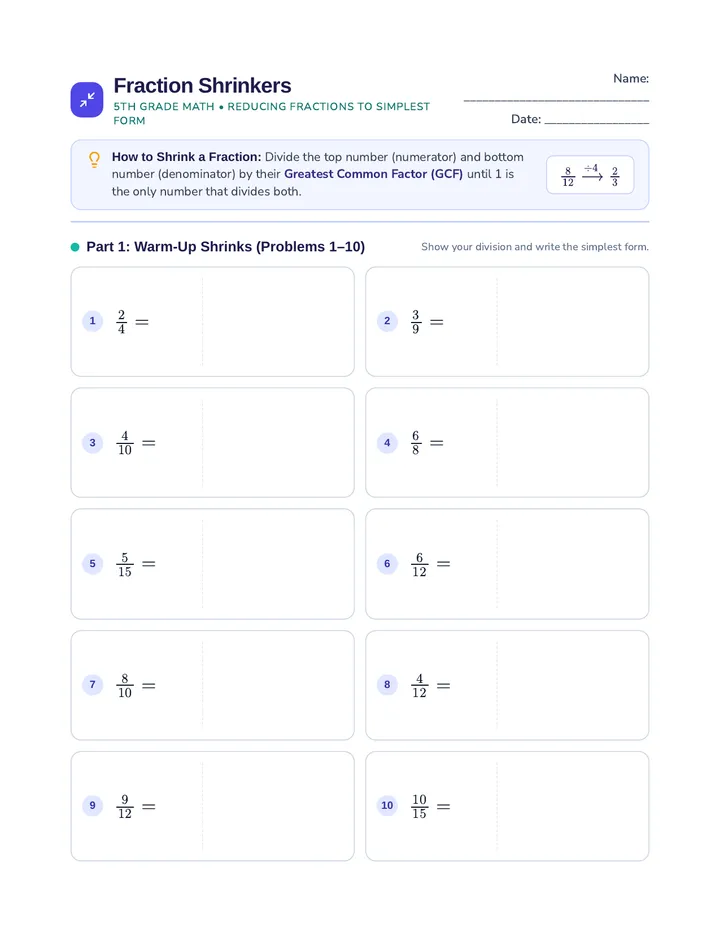
Check: Divide numerator by denominator or find GCF
Simplify the improper fractions to mixed numbers:
a) \(\frac{24}{5}\)
b) \(\frac{54}{3}\)
c) \(\frac{46}{6}\)
Simplify the fractions below to their simplest forms:
d) \(\frac{4}{8}\)
e) \(\frac{45}{60}\)
f) \(\frac{12}{30}\)
Activate Prior Knowledge (APK)
Write the expression • Solve using a model • Include units
Ms. Michels has \(\frac{1}{2}\) of a granola bar left for breakfast. She wants to finish it in 3 bites. How much granola bar will be in each bite? Remember to include units.
Expression:
Model & Answer:
Ms. Nager has 3 ounces of coffee left in her Thermos. Each sip she takes is \(\frac{1}{2}\) an ounce. How many sips will it take for her to finish her coffee? Remember to include units.
Expression:
Model & Answer:
Guided Practice: The Algorithm
5 Questions • Use your Reference Sheet if needed
When dividing fractions , the strategy we use is called: ____________________________.
1) Keep the ___________ fraction the ___________.
2) Switch the division sign to a _______________ sign.
3) Flip the ___________ fraction to get the _____________.
4) ___________________ and simplify.
Try It! Show every step of the algorithm:
\(4 \div \frac{1}{3}\)
\(2 \div \frac{2}{5}\)
\(\frac{1}{4} \div 6\)
\(\frac{6}{7} \div \frac{2}{7}\)
\(\frac{8}{9} \div \frac{2}{12}\)
APK: Dividing with Mixed Numbers (3 Questions)
Reminder: Convert mixed numbers to improper fractions first
\(1\frac{4}{5} \div \frac{3}{5}\)
\(2\frac{1}{6} \div \frac{1}{6}\)
\(6 \div 1\frac{1}{5}\)
Priority Practice (4 Questions)
Rewrite improper quotients as mixed numbers • CHECK each problem
Algorithm Checklist: ☐ Whole # over 1 ☐ Keep-Switch-Flip ☐ Multiply across ☐ Simplify / Mixed # ☐ Check with multiplication
\(\frac{2}{3} \div \frac{1}{4}\)
\(\frac{2}{3} \div 4\)
\(4 \div \frac{2}{3}\)
Natasha has \(\frac{3}{4}\) of a pound of ground beef. Each burger requires \(\frac{2}{5}\) of a pound. How many complete burgers can she make? How much ground beef will be leftover? Remember to include units.
M.O.L.E. Check
☐ M: Mark up
☐ O: Organize
☐ L: Label
☐ E: Explain/Units
Extra Practice (2 Questions)
Show all steps • Include units on word problems
\(\frac{2}{3} \div \frac{3}{4}\)
Brandon has 5 half-pound chocolate bars. It takes \(1\frac{1}{2}\) pounds of chocolate, broken into chunks, to make a batch of cookies. How many full batches can Brandon make with the chocolate he has on hand? How much chocolate will be leftover? Remember to include units.
Exit Ticket — Lesson 11 (4 Questions)
Independent Check • Use M.O.L.E. & Algorithm
\(\frac{2}{5} \div \frac{3}{4}\)
\(\frac{2}{3} \div 5\)
\(7 \div \frac{6}{7}\)
3 students share \(\frac{2}{3}\) lb. of raisins. How many pounds of raisins will each student get? Remember to include units.
Answer: ____________________ pounds of raisins
6th Grade Math • L011 Homework (75% Modified)
Dividing Fractions by Fractions
Name: ________________________
Homework Self-Check: ☐ Keep first fraction ☐ Switch \(\div\) to \(\times\) ☐ Flip second fraction ☐ Simplify final answer
\(\frac{1}{6} \div \frac{8}{11}\)
\(\frac{11}{2} \div \frac{1}{2}\)
\(\frac{1}{3} \div \frac{13}{9}\)
\(\frac{4}{3} \div \frac{11}{12}\)
\(\frac{13}{4} \div \frac{1}{2}\)
6th Grade Math • L011 Homework Part 2 (75% Modified)
Mixed Review & Fluency Practice
9 Questions
Multiplication Check (5.NBT.B.5):
☐ Stack by place value ☐ Drop 0 placeholder for tens ☐ Add partial products
Long Division Check (5.NBT.B.6):
☐ D-M-S-B-R cycle ☐ Remainder < Divisor ☐ Bring down 1 digit at a time
\(810000 \div 900\)
\(1842 \div 6\)
\(33000 \times 20\)
\(\frac{4}{5}\) of \(80\)
\(\frac{2}{3}\) of \(\frac{3}{5}\)
\(4\frac{3}{10} + \frac{25}{20}\)
\(6\frac{3}{8} - 2\frac{3}{4}\)
\(1\frac{1}{4} \times 3\frac{3}{4}\)
Find the GCF: 21 and 56
Fraction Division 50% Packet 6th Grade Math • Lesson 11 (50% Modified)
Dividing Fractions by Fractions
Name: ________________________
Date: __________ Team: ________
IEP Fluency Check:
☐ Line up place values / decimals ☐ Multiplication: Zero placeholder ☐ Division: D-M-S-B-R (1 digit at a time)
Do Now (1 Question)
Read carefully • Choose your operation • Show all work
1. (5.NBT.7)
To visit his grandmother, Luis takes a train 6.35 miles, a bus 5.4 miles, and then walks 2 miles. How many miles is Luis's journey in total?
A. 11.75
B. 13.75
C. 6.91
D. 11.77
Excellence: Fraction Fluency (4 Questions)
Check: Divide numerator by denominator or find GCF
Simplify the improper fractions to mixed numbers:
a) \(\frac{24}{5}\)
b) \(\frac{46}{6}\)
Simplify the fractions below to their simplest forms:
c) \(\frac{4}{8}\)
d) \(\frac{45}{60}\)
Activate Prior Knowledge (APK — 1 Question)
Write the expression • Solve using a model • Include units
Ms. Michels has \(\frac{1}{2}\) of a granola bar left for breakfast. She wants to finish it in 3 bites. How much granola bar will be in each bite? Remember to include units.
Expression:
Model & Answer:
Guided Practice: The Algorithm (3 Questions)
Use your Reference Sheet if needed
When dividing fractions , the strategy we use is called: ____________________________.
1) Keep the ___________ fraction the ___________.
2) Switch the division sign to a _______________ sign.
3) Flip the ___________ fraction to get the _____________.
4) ___________________ and simplify.
Try It! Show every step of the algorithm:
\(4 \div \frac{1}{3}\)
\(\frac{1}{4} \div 6\)
\(\frac{8}{9} \div \frac{2}{12}\)
APK: Dividing with Mixed Numbers (2 Questions)
Reminder: Convert mixed numbers to improper fractions first
\(1\frac{4}{5} \div \frac{3}{5}\)
\(6 \div 1\frac{1}{5}\)
Priority Practice (4 Questions)
Rewrite improper quotients as mixed numbers • CHECK each problem
Algorithm Checklist: ☐ Whole # over 1 ☐ Keep-Switch-Flip ☐ Multiply across ☐ Simplify / Mixed # ☐ Check with multiplication
\(\frac{2}{3} \div \frac{1}{4}\)
\(\frac{2}{3} \div 4\)
\(4 \div \frac{2}{3}\)
Natasha has \(\frac{3}{4}\) of a pound of ground beef. Each burger requires \(\frac{2}{5}\) of a pound. How many complete burgers can she make? How much ground beef will be leftover? Remember to include units.
M.O.L.E. Check
☐ M: Mark up
☐ O: Organize
☐ L: Label
☐ E: Explain/Units
6th Grade Math • L011 Exit Ticket (50% Modified)
Dividing Fractions by Fractions
Name: ________________________
Exit Ticket Check: ☐ Keep-Switch-Flip ☐ Simplify / Mixed Number ☐ M.O.L.E. on word problem ☐ Include units
\(\frac{2}{5} \div \frac{3}{4}\)
\(7 \div \frac{6}{7}\)
3 students share \(\frac{2}{3}\) lb. of raisins. How many pounds of raisins will each student get? Remember to include units.
Answer: ____________________ pounds of raisins
6th Grade Math • L011 Homework (50% Modified)
Fraction Division & Fluency Review
Name: ________________________
Multiplication Check (5.NBT.B.5):
☐ Stack by place value ☐ Drop 0 placeholder ☐ Add partial products
Long Division Check (5.NBT.B.6):
☐ D-M-S-B-R cycle ☐ Remainder < Divisor ☐ Bring down 1 digit
Part 1: Dividing Fractions (Keep-Switch-Flip)
\(\frac{1}{6} \div \frac{8}{11}\)
\(\frac{11}{2} \div \frac{1}{2}\)
\(\frac{4}{3} \div \frac{11}{12}\)
Part 2: Mixed Review & 5th Grade Fluency
\(810000 \div 900\)
\(1842 \div 6\)
\(33000 \times 20\)
\(\frac{4}{5}\) of \(80\)
\(6\frac{3}{8} - 2\frac{3}{4}\)
Find the GCF: 21 and 56
Fraction & Fluency Reference Sheet Desktop Strategy Reference Sheet • Side 1
Dividing Fractions & Word Problems
6.NS.A.1 • Lesson 11
1. Dividing Fractions Algorithm: Keep – Switch – Flip
Never flip the FIRST fraction!
1 PREPARE: Write whole numbers over \(1\) (e.g., \(4 = \frac{4}{1}\)). Convert mixed numbers to improper fractions.
2 KEEP: Keep the first fraction (dividend) exactly the same.
3 SWITCH: Switch the division sign (\(\div\)) to a multiplication sign (\(\times\)).
4 FLIP: Flip the second fraction (divisor) to its reciprocal .
5 SOLVE & SIMPLIFY: Multiply straight across (\(\frac{\text{top} \times \text{top}}{\text{bottom} \times \text{bottom}}\)), then simplify.
Example
\(\frac{2}{3} \div \frac{1}{4}\)
Keep Switch Flip
\(\frac{2}{3} \times \frac{4}{1} = \frac{8}{3}\)
Simplify: \(2\frac{2}{3}\)
2. Mixed \(\leftrightarrow\) Improper
Mixed \(\rightarrow\) Improper (Before Dividing):
1. Multiply denominator \(\times\) whole number.
2. Add the numerator.
3. Keep the same denominator.
\(1\frac{4}{5} = \frac{(5 \times 1) + 4}{5} = \frac{9}{5}\)
Improper \(\rightarrow\) Mixed (Final Answer):
Divide numerator \(\div\) denominator. The remainder becomes the new numerator!
\(\frac{24}{5} = 24 \div 5 = 4\text{ R}4 = 4\frac{4}{5}\)
3. Simplifying & Checking
Simplest Form: Divide top and bottom by the Greatest Common Factor (GCF).
\(\frac{12}{30} \div \frac{6}{6} = \frac{2}{5}\)
Check with Multiplication:
Your quotient \(\times\) divisor should equal your starting dividend!
If \(4 \div \frac{1}{3} = 12\), check: \(12 \times \frac{1}{3} = \frac{12}{3} = 4\) ✓
4. M.O.L.E. Word Problem Checklist
You decide the operation!
M — Mark Up
Circle numbers and units. Underline the question being asked.
O — Organize
Ask: Am I combining, finding a part of, or splitting into equal groups? Write your expression.
L — Label
Show all calculation steps clearly. Label what each number represents.
E — Explain/Units
Re-read the question. Does your answer make sense? Include units!
Desktop Strategy Reference Sheet • Side 2
Multi-Digit Multiplication & Long Division
5.NBT.B.5 & 5.NBT.B.6
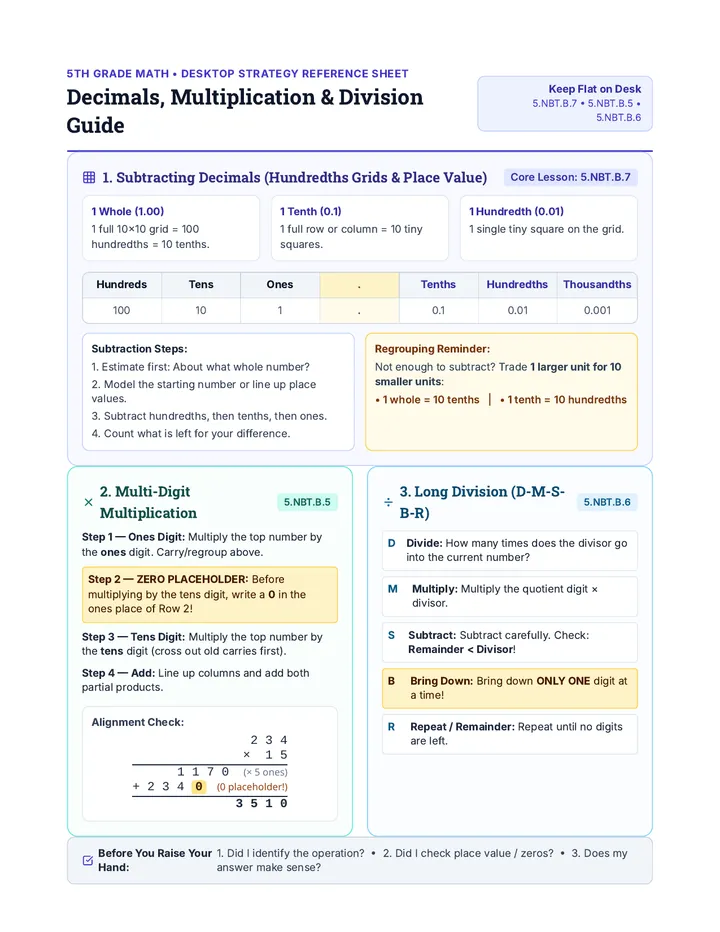
1. Multi-Digit Multiplication (Standard Algorithm)
Watch out for the ZERO placeholder!
1 STACK: Line up digits by place value (ones under ones, tens under tens).
2 ONES DIGIT: Multiply the top number by the ones digit. Regroup (carry) above the next column.
3 ZERO PLACEHOLDER: Before multiplying by the tens digit, write a 0 in the ones place of Row 2!
4 TENS DIGIT: Cross out old carried numbers, then multiply the top number by the tens digit.
5 ADD: Add your partial products together.
Example: \(342 \times 24\)
342
× 24
1,368 (×4)
+ 6,840 (×20)
8,208
2. Long Division Cycle: D – M – S – B – R
Bring down ONE digit at a time!
D — Divide: How many times does the divisor go into the current number?
M — Multiply: Multiply your quotient digit by the divisor.
S — Subtract: Subtract to find what is left over. Check: Is it smaller than the divisor?
B — Bring Down: Bring down ONLY ONE digit from the dividend!
R — Repeat / Remainder: Repeat D-M-S-B until no digits are left. Write any leftover as a remainder or fraction.
Example: \(384 \div 12\)
Step 1: \(38 \div 12 = \mathbf{3}\) (D)
\(3 \times 12 = 36\) (M)
\(38 - 36 = 2\) (S: \(2 < 12\) ✓)
Step 2: Bring down 4 \(\rightarrow 24\) (B)
Step 3: \(24 \div 12 = \mathbf{2}\) (R)
Quotient = 32
3. Quick Checks: Adding Decimals & Powers of 10
Adding/Subtracting Decimals (5.NBT.7):
Always line up the decimal points ! Add placeholder zeros to whole numbers (e.g., \(2 = 2.00\)).
Multiplying/Dividing by Zeros:
In \(810,000 \div 900\), cancel matching pairs of zeros first: \(8,100 \div 9 = 900\).
Lesson 11 TMD Data Tracker Push-In & Co-Teaching Internalization Plan
Skills TMD & Data Collection Tool
Teacher: ___________________ Date/Pd: ____________
Push-In Target: Guided Support (8 Students)
Lesson Title: Gr6 L11: Dividing Fractions by Fractions (Algorithm)
Std: 6.NS.A.1 • 5.NBT.B.5 • 5.NBT.B.6
Integration: Dividing Fractions by Fractions (Keep-Switch-Flip Algorithm & M.O.L.E. Protocol) & 5th Grade Multi-Digit Fluency Maintenance (Multi-Digit Multiplication & Long Division IEP Goals).
Objective: SWBAT divide fractions by fractions, whole numbers, and mixed numbers using the Keep-Switch-Flip algorithm, and execute multi-digit multiplication and long division algorithms without zero-placeholder or bring-down errors.
1. YESTERDAY'S EXIT TICKET DATA & GAP REFLECTION Mastery: ○ Low (<50%) ● Med (51–75%) ○ High (>75%)
Primary Academic Gap: When transitioning from visual models to the algorithm, students flipped the dividend (first fraction) instead of the divisor , or forgot to write whole numbers over \(1\) before finding the reciprocal. In maintenance fluency, targeted IEP students dropped the zero placeholder when multiplying by tens and brought down multiple digits simultaneously in long division (e.g., \(1842 \div 6\)).
Strategic Adjustments Today: Deploy 75% and 50% reduced workload packets preserving full cognitive demand (students choose operations and solve independently); provide 2-sided Desktop Strategy Reference Sheets; embed self-monitoring checklists for Keep-Switch-Flip, M.O.L.E., zero placeholders, and D-M-S-B-R cycles.
2. CO-TEACHER COLLABORATION & ROLE DIVISION (DAILY SYNC)
DAILY SKILLS FOCUS
Applying Keep-Switch-Flip accurately; converting whole/mixed numbers before flipping; maintaining standard algorithm alignment & placeholder zeros.
CO-TEACHING ROLES
Gen Ed: Whole-class launch, pacing, and board modeling.SPED: Facilitates 8-student guided table, delivers BID prompts, logs real-time AM data.
PREDICTED GAPS & SCAFFOLDS
Gap: Flips first fraction or skips D-M-S-B-R zero in quotient.Prompt: "Check step 2 on your Reference Sheet: Which fraction do we flip?"
3. HEART OF THE LESSON (HOTL): FACILITATION & CFUs • GUIDED TABLE Core Strategy
Keys to Success (Anchor on Easel):
Prepare: Write wholes over \(1\); convert mixed numbers to improper.Keep: Keep the first fraction (dividend) the same.Switch: Switch \(\div\) to \(\times\).Flip: Flip the second fraction (divisor) to its reciprocal.Fluency Anchor: Zero placeholder in mult; D-M-S-B-R in division.
Stamp & Key Rule:
“Dividing by a fraction is the same as multiplying by its reciprocal! Prepare first, then Keep–Switch–Flip, multiply across, and simplify.”
CFU Question:
“In \(\frac{2}{3} \div 4\), why must we write \(4\) as \(\frac{4}{1}\) before we flip? What happens if we forget?”
4. MOMENT OF PRODUCTIVE STRUGGLE #1 (MPS 1)
Priority Practice #1 (\(\frac{2}{3} \div \frac{1}{4}\)), #2 (\(\frac{2}{3} \div 4\)) & Mult. Fluency
Anticipated Error / Misconception
BID / Teacher Prompt (Scaffold Question)
1. Flips the First Fraction (Dividend): In \(\frac{2}{3} \div \frac{1}{4}\), writes \(\frac{3}{2} \times \frac{1}{4} = \frac{3}{8}\).“Check your Reference Sheet! What does the K stand for? Which fraction stays untouched?”
2. Whole Number Reciprocal Error: In \(\frac{2}{3} \div 4\), writes \(\frac{2}{3} \times 4 = \frac{8}{3}\) without flipping \(4\) to \(\frac{1}{4}\).“How do we write a whole number as a fraction? Write \(4\) over \(1\) first—now what is its reciprocal?”
3. Drops Multiplication Zero Placeholder: In multi-digit multiplication, multiplies by tens without writing \(0\) in the ones place of row 2.“Check your Multiplication Checklist! Before multiplying by the tens digit, what MUST go in the ones place?”
Plan Mini-RTD for Most Likely Error (Easel Script):
“Pencils down in 3-2-1! Look at \(\frac{2}{3} \div 4\). Four is a whole number, so we prepare it as \(\frac{4}{1}\). Now Keep \(\frac{2}{3}\), Switch \(\div\) to \(\times\), Flip \(\frac{4}{1}\) to \(\frac{1}{4}\). Multiply across: \(\frac{2}{12}\), which simplifies to \(\frac{1}{6}\)!”
Script a Stamp (MPS 1 Key Takeaway):
“Always write whole numbers over \(1\) before you Keep-Switch-Flip! And in multi-digit multiplication, always drop your \(0\) placeholder before multiplying by tens!”
Name Your AM Laps 1–6 (Specific Look-Fors) • Live Push-In Scans
Lap 1:
Lap 2:
Lap 3:
Lap 4:
Lap 5:
Lap 6:
REAL-TIME PUSH-IN STUDENT DATA TRACKER (6 LAPS • 8 STUDENTS) Mark: ✓ Mastered | ✗ Error | • BID Prompted
Student Name / IEP Target
L1
L2
L3
L4
L5
L6
Error Code / Observation
BID Delivered
1. ____________ [IEP: _____]
☐
☐
☐
☐
☐
☐
2. ____________ [IEP: _____]
☐
☐
☐
☐
☐
☐
3. ____________ [IEP: _____]
☐
☐
☐
☐
☐
☐
4. ____________ [IEP: _____]
☐
☐
☐
☐
☐
☐
5. ____________ [IEP: _____]
☐
☐
☐
☐
☐
☐
6. ____________ [IEP: _____]
☐
☐
☐
☐
☐
☐
7. ____________ [IEP: _____]
☐
☐
☐
☐
☐
☐
8. ____________ [IEP: _____]
☐
☐
☐
☐
☐
☐
5. MOMENT OF PRODUCTIVE STRUGGLE #2 (MPS 2)
Priority Practice #4 (Natasha's Beef) & Long Division (\(1842 \div 6\))
Anticipated Error / Misconception
BID / Teacher Prompt (Scaffold Question)
1. Reverses Dividend & Divisor in Word Problem: Writes \(\frac{2}{5} \div \frac{3}{4}\) instead of \(\frac{3}{4} \div \frac{2}{5}\).“Check M.O.L.E. Step O! What total amount are we starting with and splitting up? Put that total FIRST.”
2. Long Division Bring-Down / Zero Error: In \(1842 \div 6\), skips \(0\) in the quotient (\(37\) instead of \(307\)) or brings down \(4\) and \(2\) together.“Follow D-M-S-B-R! You brought down ONE digit (\(4\)). Does \(6\) go into \(4\)? Write \(0\) on top before bringing down the \(2\)!”
3. Omits or Mislabels Leftover Units: Solves \(\frac{3}{4} \div \frac{2}{5} = 1\frac{7}{8}\), but cannot state complete burgers vs. pounds leftover.“Re-read the question! \(1\frac{7}{8}\) is how many burgers. If she makes \(1\) complete burger using \(\frac{2}{5}\) lb, how much beef is left?”
Plan Mini-RTD for Most Likely Error (Easel Script):
“Freeze table! In \(1842 \div 6\), \(6\) goes into \(18\) three times. Bring down ONLY the \(4\). Since \(6\) goes into \(4\) zero times, we MUST write \(0\) in the tens place before bringing down the \(2\) to make \(42\)!”
Script a Stamp (MPS 2 Key Takeaway):
“In long division, execute one cycle of D-M-S-B-R per digit—never bring down two digits at once! In word problems, put the total you are splitting FIRST and label your units.”
Name Your AM Laps 1–6 (Specific Look-Fors) • Live Push-In Scans
Lap 1:
Lap 2:
Lap 3:
Lap 4:
Lap 5:
Lap 6:
REAL-TIME PUSH-IN STUDENT DATA TRACKER (6 LAPS • 8 STUDENTS) Mark: ✓ Mastered | ✗ Error | • BID Prompted
Student Name / IEP Target
L1
L2
L3
L4
L5
L6
Error Code / Observation
BID Delivered
1. ____________ [IEP: _____]
☐
☐
☐
☐
☐
☐
2. ____________ [IEP: _____]
☐
☐
☐
☐
☐
☐
3. ____________ [IEP: _____]
☐
☐
☐
☐
☐
☐
4. ____________ [IEP: _____]
☐
☐
☐
☐
☐
☐
5. ____________ [IEP: _____]
☐
☐
☐
☐
☐
☐
6. ____________ [IEP: _____]
☐
☐
☐
☐
☐
☐
7. ____________ [IEP: _____]
☐
☐
☐
☐
☐
☐
8. ____________ [IEP: _____]
☐
☐
☐
☐
☐
☐
Post-Lesson Synthesis
6. Exit Ticket & Assessment Tracker (8 Students)
Mandatory Non-Negotiable
ET LAP 1 (ALGORITHM SETUP)
Did student write whole numbers over \(1\), keep the dividend, switch \(\div\) to \(\times\), and flip the divisor?
ET LAP 2 (SIMPLIFY & UNITS)
Did student convert improper quotients to mixed numbers, simplify, and include units on the raisin problem?
CONCEPTUAL STAMP
“In \(\frac{2}{3} \div 3\), we share \(\frac{2}{3}\) lb among \(3\) students: \(\frac{2}{3} \times \frac{1}{3} = \frac{2}{9}\) lb per student.”
PUSH-IN STUDENT ASSESSMENT DATA COLLECTION TOOL (8 STUDENTS) Mastery: Low (<50%) / Med (51–75%) / High (>75%)
Student Name / IEP Target
Score / %
Level
Primary Misconception / Gap
Tomorrow's Push-In Action
1. ____________ [IEP: _____]
___ / ___
L / M / H
2. ____________ [IEP: _____]
___ / ___
L / M / H
3. ____________ [IEP: _____]
___ / ___
L / M / H
4. ____________ [IEP: _____]
___ / ___
L / M / H
5. ____________ [IEP: _____]
___ / ___
L / M / H
6. ____________ [IEP: _____]
___ / ___
L / M / H
7. ____________ [IEP: _____]
___ / ___
L / M / H
8. ____________ [IEP: _____]
___ / ___
L / M / H
Next-Day Push-In Priority & Strategy
Priority Standard / Gap to Target:
Solidifying Keep-Switch-Flip with whole numbers and mixed numbers (6.NS.A.1); reinforcing multi-digit multiplication zero-placeholder (5.NBT.B.5) and long division D-M-S-B-R single-digit bring-down alignment (5.NBT.B.6).
Planned Grouping / Push-In Delivery:
Tier II (Kidney Table): 5-minute Do Now reteach using Keep-Switch-Flip cards and M.O.L.E. word problem sorting.Tier III (Co-Taught Station): Guided practice with Reference Sheet, place-value grids, and D-M-S-B-R checklists.