Operations Power Review Worksheet
Math • Grade 3 • Unit 4 Review
Name: Date:
1. What number goes in the blank to make the following equation true?
6 × _____ = 48
A. 6
B. 7
C. 8
D. 9
3.OA.C.7
2. Balloons come in 6 colors. Devon bought 7 balloons of each color. After he gave some balloons to his sister, Devon had 18 balloons left. How many balloons did Devon give his sister?
Write the correct answer in the box.
balloons
3.OA.D.8
3. Mrs. Polly needs to split her 36 students into 4 teams for a game. How many students will be on each team?
Write your answer in the box below.
3.OA.A.3
4. This figure is tiled with square units.
4 in. 6 in.
3 in.
Write the total area, in square inches, of the figure.
square in.
3.MD.C.7c
5. Multiply.
8 × 7 =
A. 15
B. 48
C. 56
D. 64
3.OA.C.7
Math • Grade 3 • Unit 4 Review
Name: Page 2
6. Leo picks 24 flowers from his garden. He wants to give the same number of flowers to each of his 4 friends. Which picture shows how many flowers Leo gives to each friend?
A.
B.
C.
D.
3.OA.A.2
9. Stacy is on a skateboarding team. The team has a total of 7 members. Each member on her team has 2 skateboards. Each skateboard has 4 wheels. Which equation can be used to find the total number of skateboard wheels, W, the team has?
A. W = 7 + 2 × 4
B. W = 7 ÷ 2 × 4
C. W = 7 + 2 + 4
D. W = 7 × 2 × 4
3.OA.D.8
- 4 = 20 ÷
Which number makes this equation true?
A. 4
B. 5
C. 16
D. 24
3.OA.A.4
8. Mrs. Turner uses 4 eggs to make 1 cake. How many eggs does she need to make 8 cakes?
A. 4 eggs
B. 12 eggs
C. 28 eggs
D. 32 eggs
3.OA.A.3
10. An equation is shown.
3 × = 21
What number is missing from the equation?
A. 6
B. 7
C. 18
D. 24
3.OA.A.4
Math • Grade 3 • Unit 4 Review
Name: Page 3
11. Look at the expression below.
(7 × 4) × 2
Which of the following is equivalent to the expression?
A. (2 + 4) × 7
B. 7 + 4 + 2
C. 7 × (4 × 2)
D. (7 + 4) × 2
3.OA.B.5
12. Look at the equation shown.
35 ÷ = 7
Which equation could help find the unknown value?
A. 7 × = 35, and the unknown value is 7
B. + 7 = 35, and the unknown value is 28.
C. 35 + 7 = , and the unknown value is 42.
D. 7 × = 35, and the unknown value is 5
3.OA.B.6
13. Carol sharpened 42 colored pencils and needs to place them equally into 6 bins. How many colored pencils will she place into each bin?
A. 6 pencils
B. 7 pencils
C. 8 pencils
D. 9 pencils
3.OA.A.2
14. Part of a multiplication table is shown.
What numbers complete the pattern in the table? Write your answers in the table.
3.OA.D.9
Operations Power Review Answer Key
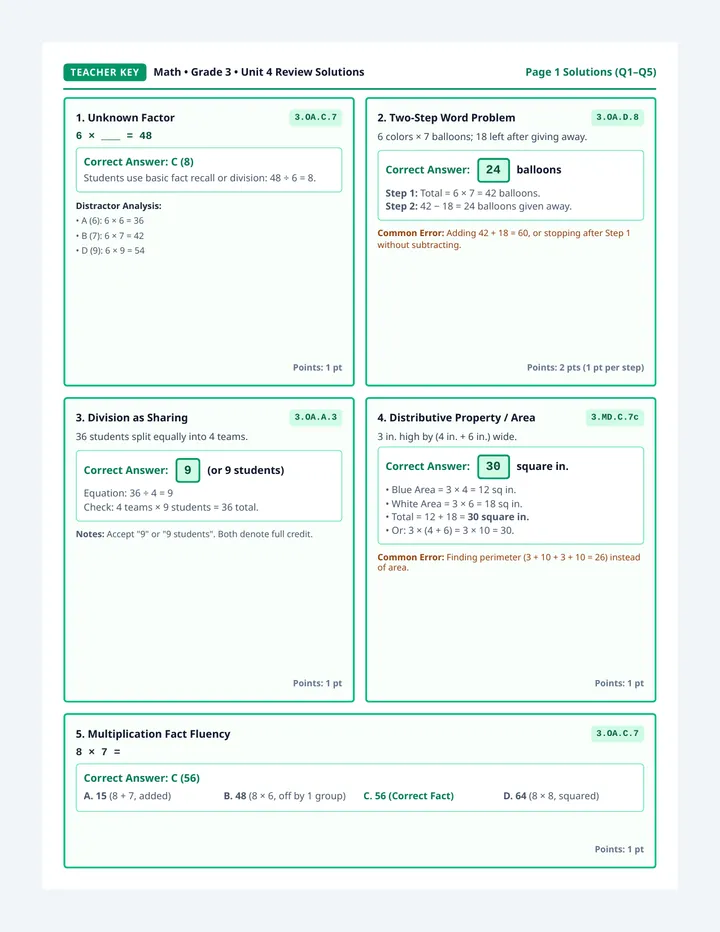
Teacher Key Math • Grade 3 • Unit 4 Review Solutions
Page 1 Solutions (Q1–Q5)
1. Unknown Factor 3.OA.C.7
6 × ___ = 48
Correct Answer: C (8)
Students use basic fact recall or division: 48 ÷ 6 = 8.
Distractor Analysis:
• A (6): 6 × 6 = 36
• B (7): 6 × 7 = 42
• D (9): 6 × 9 = 54
Points: 1 pt
2. Two-Step Word Problem 3.OA.D.8
6 colors × 7 balloons; 18 left after giving away.
Correct Answer: 24 balloons
Step 1: Total = 6 × 7 = 42 balloons.
Step 2: 42 − 18 = 24 balloons given away.
Common Error: Adding 42 + 18 = 60, or stopping after Step 1 without subtracting.
Points: 2 pts (1 pt per step)
3. Division as Sharing 3.OA.A.3
36 students split equally into 4 teams.
Correct Answer: 9 (or 9 students)
Equation: 36 ÷ 4 = 9
Check: 4 teams × 9 students = 36 total.
Notes: Accept "9" or "9 students". Both denote full credit.
Points: 1 pt
4. Distributive Property / Area 3.MD.C.7c
3 in. high by (4 in. + 6 in.) wide.
Correct Answer: 30 square in.
• Blue Area = 3 × 4 = 12 sq in.
• White Area = 3 × 6 = 18 sq in.
• Total = 12 + 18 = 30 square in.
• Or: 3 × (4 + 6) = 3 × 10 = 30.
Common Error: Finding perimeter (3 + 10 + 3 + 10 = 26) instead of area.
Points: 1 pt
5. Multiplication Fact Fluency 3.OA.C.7
8 × 7 =
Correct Answer: C (56)
A. 15 (8 + 7, added)
B. 48 (8 × 6, off by 1 group)
C. 56 (Correct Fact)
D. 64 (8 × 8, squared)
Points: 1 pt
Teacher Key Math • Grade 3 • Unit 4 Review Solutions
Page 2 Solutions (Q6–Q10)
6. Equal Groups Visual Model 3.OA.A.2
24 flowers partitioned equally among 4 friends.
Correct Answer: A
Why: 24 ÷ 4 = 6 flowers per friend. Option A illustrates exactly 4 groups (one for each friend), with 6 flowers in each group.
Distractor Rationale:
• B: 4 groups of 4 = 16 total flowers (incorrect count).
• C: 3 groups of 6 = 18 flowers (only 3 friends).
• D: 6 groups of 4 = 24 flowers (represents 24 ÷ 6 = 4, showing 6 friends instead of 4).
Points: 1 pt
9. Multi-Step Representation 3.OA.D.8
7 members × 2 skateboards each × 4 wheels each.
Correct Answer: D
W = 7 × 2 × 4
Finding total items across nested groups requires repeated multiplication: 7 members × 2 boards = 14 boards; 14 boards × 4 wheels = 56 wheels.
Points: 1 pt
7. Unknown Divisor 3.OA.A.4
4 = 20 ÷ [ ]
Correct Answer: B (5)
Related fact: 4 × 5 = 20, therefore 20 ÷ 5 = 4.
Distractor C (16) reflects subtraction error (20 − 4). Distractor D (24) reflects addition (20 + 4).
Points: 1 pt
8. Equal Groups Word Problem 3.OA.A.3
4 eggs per cake × 8 cakes.
Correct Answer: D (32 eggs)
Equation: 8 × 4 = 32 eggs.
Distractor B (12) is 4 + 8 (addition trap). Distractor C (28) is 4 × 7.
Points: 1 pt
10. Missing Factor 3.OA.A.4
3 × [ ] = 21
Correct Answer: B (7)
21 ÷ 3 = 7. Missing factor is 7.
Distractor C (18) is 21 − 3. Distractor D (24) is 21 + 3.
Points: 1 pt
Teacher Key Math • Grade 3 • Unit 4 Review Solutions
Page 3 Solutions (Q11–Q14)
11. Associative Property 3.OA.B.5
(7 × 4) × 2
Correct Answer: C
7 × (4 × 2)
The Associative Property states that grouping factors differently does not change the product: (a × b) × c = a × (b × c). Both equal 56.
Options A, B, and D erroneously insert addition operations.
Points: 1 pt
12. Division as Unknown Factor 3.OA.B.6
35 ÷ [ ] = 7
Correct Answer: D
7 × [ ] = 35, and the unknown value is 5
Understanding division as an unknown-factor problem: 35 ÷ ? = 7 is solved by finding ? in 7 × ? = 35. Since 7 × 5 = 35, the unknown is 5.
Option A incorrectly gives the value as 7. Options B and C use addition.
Points: 1 pt
13. Division Word Problem 3.OA.A.2
42 colored pencils placed equally into 6 bins.
Correct Answer: B (7 pencils)
Equation: 42 ÷ 6 = 7 pencils per bin.
Check: 6 × 7 = 42.
• A (6): 6 × 6 = 36
• C (8): 6 × 8 = 48
• D (9): 6 × 9 = 54
Points: 1 pt
14. Multiplication Table Pattern 3.OA.D.9
Identifying arithmetic patterns in a multiplication grid.
Correct Answers in Table:
Top Blank = 35
Bottom Blank = 40
Two Solution Methods:
• Row Patterns: Row 2 counts by 7s (28, 35, 42, 49). Row 3 counts by 8s (32, 40, 48, 56).
• Column Pattern: Column 2 counts by 5s (30, 35, 40, 45).
Points: 2 pts (1 pt each blank)
Scoring Guide & Unit Standards Summary Total Points Possible: 16 pts
3.OA.A (Represent & Solve)
Q3, Q6, Q7, Q8, Q10, Q13 (6 pts)
3.OA.B (Properties)
Q11, Q12 (2 pts)
3.OA.C & D (Fluency & Multi-Step)
Q1, Q2, Q5, Q9, Q14 (7 pts)
3.MD.C (Area Partitioning)
Q4 (1 pt)