Number Rumble Teacher Guide Instructional Guide
NUMBER RUMBLE
TARGET GRADES: 7 - 9
SUBJECT: The Real Number System
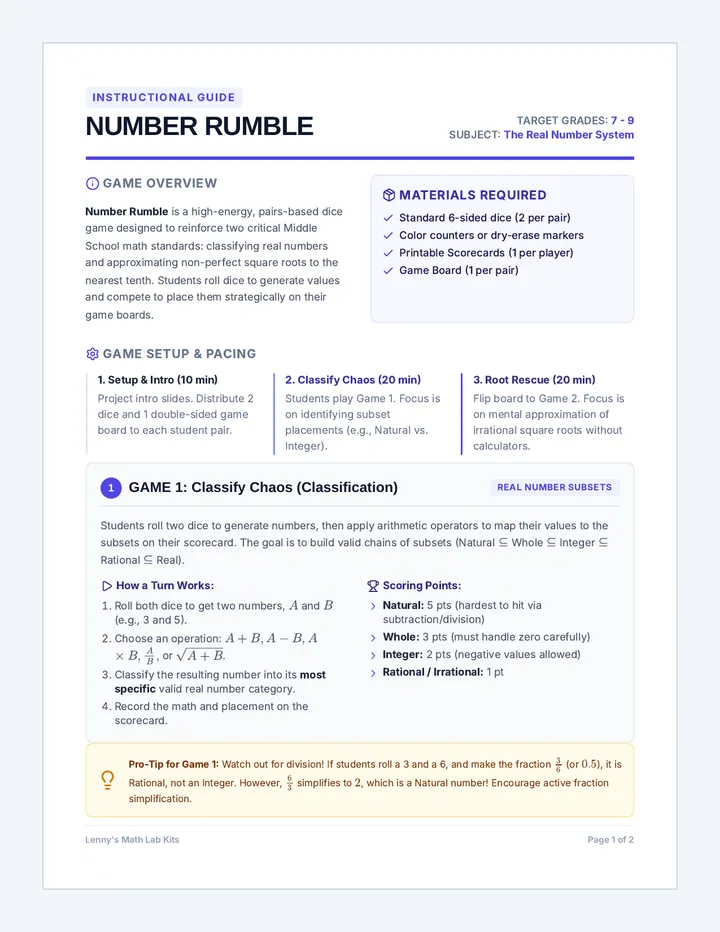
Game Overview
Number Rumble is a high-energy, pairs-based dice game designed to reinforce two critical Middle School math standards: classifying real numbers and approximating non-perfect square roots to the nearest tenth. Students roll dice to generate values and compete to place them strategically on their game boards.
Materials Required
Standard 6-sided dice (2 per pair)
Color counters or dry-erase markers
Printable Scorecards (1 per player)
Game Board (1 per pair)
Game Setup & Pacing
1. Setup & Intro (10 min)
Project intro slides. Distribute 2 dice and 1 double-sided game board to each student pair.
2. Classify Chaos (20 min)
Students play Game 1. Focus is on identifying subset placements (e.g., Natural vs. Integer).
3. Root Rescue (20 min)
Flip board to Game 2. Focus is on mental approximation of irrational square roots without calculators.
1 GAME 1: Classify Chaos (Classification)
Real Number Subsets
Students roll two dice to generate numbers, then apply arithmetic operators to map their values to the subsets on their scorecard. The goal is to build valid chains of subsets (Natural ⊆ Whole ⊆ Integer ⊆ Rational ⊆ Real).
How a Turn Works:
Roll both dice to get two numbers, \( A \) and \( B \) (e.g., 3 and 5).
Choose an operation: \( A+B, A-B, A \times B, \frac{A}{B}, \) or \( \sqrt{A+B} \).
Classify the resulting number into its most specific valid real number category.
Record the math and placement on the scorecard.
Scoring Points:
Natural: 5 pts (hardest to hit via subtraction/division)Whole: 3 pts (must handle zero carefully)Integer: 2 pts (negative values allowed)Rational / Irrational: 1 pt
Pro-Tip for Game 1: Watch out for division! If students roll a 3 and a 6, and make the fraction \(\frac{3}{6}\) (or \(0.5\)), it is Rational, not an Integer. However, \(\frac{6}{3}\) simplifies to \(2\), which is a Natural number! Encourage active fraction simplification.
Lenny's Math Lab Kits Page 1 of 2
NUMBER RUMBLE: INSTRUCTION & KEYS
Teacher Reference
2 GAME 2: Root Rescue (Root Approximation)
Irrational Estimation
Students create two-digit integers from rolled dice, place them inside square roots to generate irrational numbers, and approximate them mentally to the nearest tenth. Students race to place markers on the interval track on the board.
How a Turn Works:
Roll both dice. Create a 2-digit number (e.g., rolling a 2 and a 5 can make 25 or 52).
Take the square root of that number (e.g., \(\sqrt{25}\) or \(\sqrt{52}\)).
If perfect, evaluate it (\(\sqrt{25} = 5\)). If non-perfect, estimate to the nearest tenth (e.g., \(\sqrt{52} \approx 7.2\)).
Record the boundary integers and estimated tenth value. Place a counter on the board section matching that number's range.
Estimation Strategy Guide:
To estimate \(\sqrt{52}\):
Common Misconceptions
Halving Roots: Students might divide by 2 (e.g., saying \(\sqrt{52} = 26\)). Use visual area squares to combat this.Over-generalizing Rational: Thinking all roots are irrational. Remind them that \(\sqrt{16} = 4\), which is natural!
Differentiation Ideas
Support: Provide a printed sheet of perfect squares 1-144. Let them use a physical number line.Challenge: Allow students to construct 3-digit radicands by rolling 3 dice, or enforce a strict timer on estimation turns.
Quick Reference & Key (Possible 2-Digit Combos)
Dice Rolled Radicands Approximate Square Roots (Nearest Tenth) Classification of \(\sqrt{\text{Radicand}}\) 1 and 6 16 or 61 \(\sqrt{16} = 4.0\) \(\sqrt{61} \approx 7.8\) 2 and 5 25 or 52 \(\sqrt{25} = 5.0\) \(\sqrt{52} \approx 7.2\) 3 and 6 36 or 63 \(\sqrt{36} = 6.0\) \(\sqrt{63} \approx 7.9\) 4 and 5 45 or 54 \(\sqrt{45} \approx 6.7\) \(\sqrt{54} \approx 7.3\)
To run this lesson seamlessly, project the Number Rumble Slides during gameplay. Ready to Rumble
Lenny's Math Lab Kits Page 2 of 2
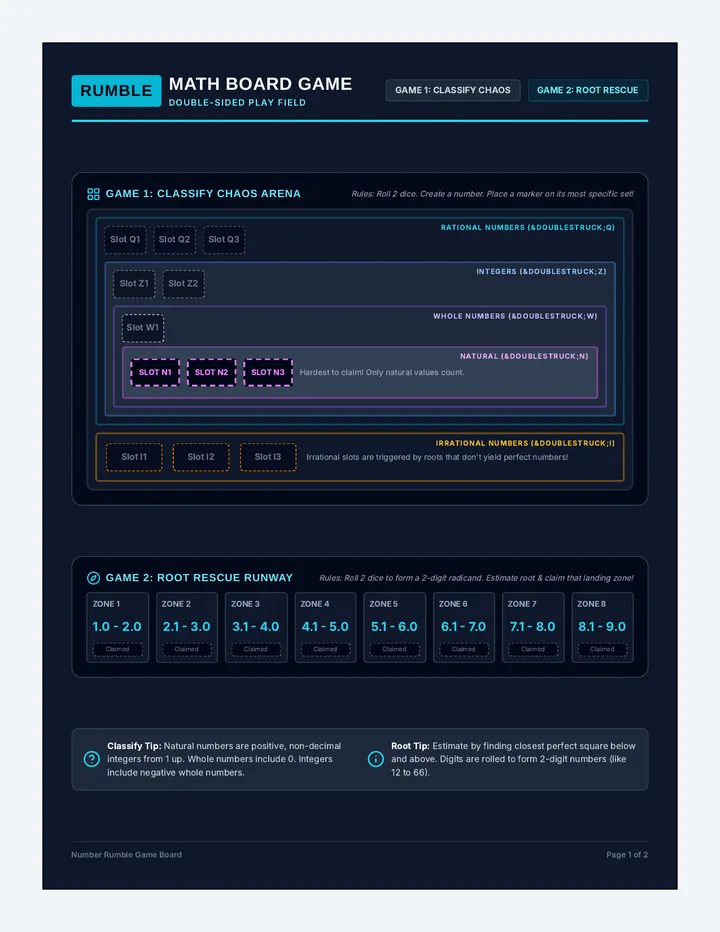
Number Rumble Game Board RUMBLE
MATH BOARD GAME
Double-Sided Play Field
GAME 1: CLASSIFY CHAOS GAME 2: ROOT RESCUE
Game 1: Classify Chaos Arena
Rules: Roll 2 dice. Create a number. Place a marker on its most specific set!
Rational Numbers (&DoubleStruck;Q)
Slot Q1
Slot Q2
Slot Q3
Integers (&DoubleStruck;Z)
Slot Z1
Slot Z2
Whole Numbers (&DoubleStruck;W)
Slot W1
Natural (&DoubleStruck;N)
Slot N1
Slot N2
Slot N3
Hardest to claim! Only natural values count.
Irrational Numbers (&DoubleStruck;I)
Slot I1
Slot I2
Slot I3
Irrational slots are triggered by roots that don't yield perfect numbers!
Game 2: Root Rescue Runway
Rules: Roll 2 dice to form a 2-digit radicand. Estimate root & claim that landing zone!
Zone 1
1.0 - 2.0
Claimed
Zone 2
2.1 - 3.0
Claimed
Zone 3
3.1 - 4.0
Claimed
Zone 4
4.1 - 5.0
Claimed
Zone 5
5.1 - 6.0
Claimed
Zone 6
6.1 - 7.0
Claimed
Zone 7
7.1 - 8.0
Claimed
Zone 8
8.1 - 9.0
Claimed
Classify Tip: Natural numbers are positive, non-decimal integers from 1 up. Whole numbers include 0. Integers include negative whole numbers.
Root Tip: Estimate by finding closest perfect square below and above. Digits are rolled to form 2-digit numbers (like 12 to 66).
Number Rumble Game Board Page 1 of 2
Player Record Sheet
NUMBER RUMBLE SCORECARD
Player Name
Partner Name
Date
Class Period
GAME 1 Log: Classify Chaos
Target: Highest total score
Round Dice A & B Math Equation & Result Most Specific Classification Checked Points 1 e.g. 5 - 2 = 3 Natural (5pt) Whole (3pt) Integer (2pt) Rational (1pt)
Number Rumble Slides Real Number System Battle
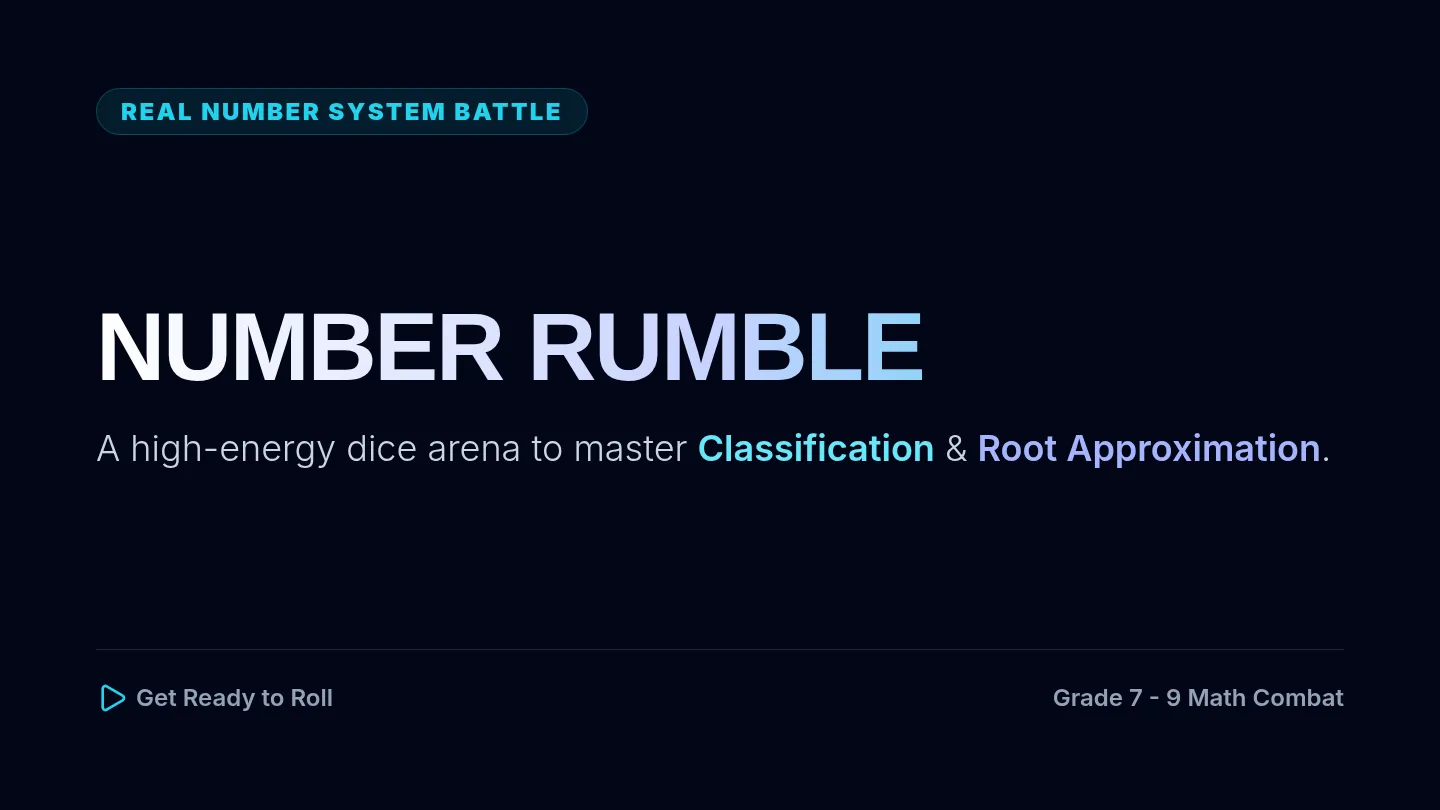
NUMBER RUMBLE
A high-energy dice arena to master Classification & Root Approximation.
Get Ready to Roll Grade 7 - 9 Math Combat
THE CLASSIFICATION RECAP
Natural & Whole (&DoubleStruck;N & &DoubleStruck;W)
Natural numbers start at 1, 2, 3...Zero (0) . No negatives!
Integers (&DoubleStruck;Z)
All whole numbers and their negatives:
Rational (&DoubleStruck;Q)
Fractions, terminating decimals (0.5), or repeating decimals (0.333...).
Irrational (&DoubleStruck;I)
Decimals that never end and never repeat!
Every Real Number sits in exactly one of these primary zones. Choose your placement wisely!
1 GAME 1: CLASSIFY CHAOS
1
ROLL & BUILD
Roll 2 dice. Use operations: \(A+B\), \(A-B\), \(A \times B\), \(\frac{A}{B}\), or \(\sqrt{A+B}\) to make a number.
2
CLASSIFY
Identify the most specific set. For example: \(6 / 2 = 3\) (Natural!), \(2 / 5 = 0.4\) (Rational!).
3
CLAIM & SCORE
Check the subset box on your scorecard and place a marker on the board. Most specific set gets max points!
Pro-Strategy: Target Natural (5 pts) and Whole (3 pts) early! Subtraction and division can make negative or fractional values easily.
ROOT ESTIMATION WORKOUT
Worked Example: Estimate \(\sqrt{52}\) without a calculator
Step 1: Boundaries
Identify the perfect squares directly below and above 52:49 and 64 .
Step 2: Integers
Evaluate:7 < \(\sqrt{52}\) < 8 .
Step 3: Approximate
52 is very close to 49 (only 3 units away).7.2 !
Test with your partners: What is the boundary integer and estimation for \(\sqrt{21}\)?
2 GAME 2: ROOT RESCUE
1. Create Radicand
Roll 2 dice to build a 2-digit number. E.g., rolling a 4 and a 1 allows you to make \(\sqrt{14}\) or \(\sqrt{41}\).
2. Run the Estimation
Find the perfect square boundaries. Estimate to the nearest tenth. Write it on your scorecard.